The Story So Far
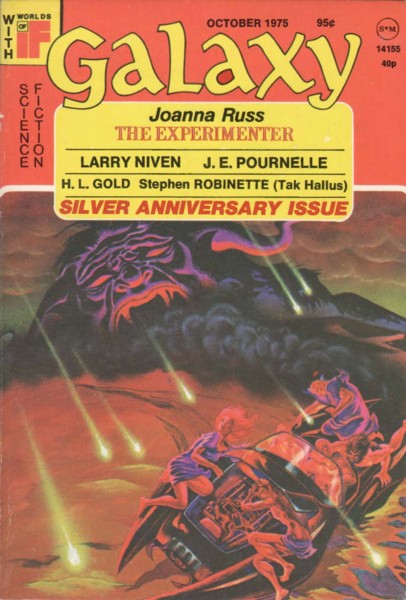
Allen Carpentier has died, which turns out to be only the beginning of his suffering. He’s in Hell now, or Infernoland as he calls it, at first stuck in a little bottle like he were a genie before being released by a fat balding guy named Benito. Benito what? You’ll see. Now, Benito has been in Hell for a long time, and seems to know a way to get out. To where? Who’s to say. He’s to act as the Virgil to Allen’s Dante, and after all, Infernoland does seem to be modeled after Dante Alighieri’s vision of Hell. Funnily enough, the only way to get out of Hell and possibly into Heaven (or at least purgatory) is to go down, through each circle, each being stranger and more torturous than the last. For a while Allen has a hard time believe he’s in the real Hell and not some simulacrum; after all, he’s an SF writer and a rational man, not one given to superstition. But if Infernoland is a prank, or some sado-masochistic theme park, it’s extremely elaborate. “The Builders” have put a lot of work into it. Of course, it’d probably be easier just to take the whole setting as supernatural than to try some mental gymnastics, but that’s where some of the humor comes in—this being kind of a dark comedy. People have gone to Hell for all kind of reasons, not all of them seemingly reasonable. Niven and Pournelle get a lot of mileage out of depicting kinds of people they don’t like (mostly, but not always, people with left-wing bents) suffering in Hell, although the suffering itself is not always so bad either. There are a few times where they get more specific about whom they’ve thrown into Hell, although not too specific if the person was still alive in 1975. There’s a pretty memorable scene where Kurt Vonnegut (not named, but it’s very clearly meant to be him) is locked up in a big tomb, much to Allen’s annoyance.
Of course, it isn’t just Allen and Benito stuck together on this voyage, since their party does grow some, if also only temporarily. In an episode where the gang builds a glider, they get the help of Corbett, who was a pilot in life, and later they also recruit Billy the Kid—or at least a guy who claims to be Billy the Kid. Eventually they lose Corbett when he loses his nerve and decides to trudge his way back up to one of the higher circles. The thing is that nobody can die in Hell, on account of already being dead, and even though you may suffer incredibly gruesome torment that would have killed a normal person, you’ll not only live but heal in record time. So, this must be the real deal, then. Not helping is that aside from people populating Hell there are also black-skinned demons, a beast with an impossibly long tail named Midos, and a fishman named Geryon. Allen can barely bring himself to trust Benito as well, since the man knows a bit too much and acts more than a little off, like Allen is supposed to know who he is—or, more specificially, like Benito is some infamous figure from history.
Enhancing Image
We’re in the last stretch of Inferno, and it’s actually the shortest, which makes me think there’s more in the book version than what made it into the serial. I’m starting to think that yeah, there had to be some stuff cut out, because this feels stripped down within an inch of its life. Overall it feels more like the skeleton of a novel than the full picture, but I do have to say I like the bones on this thing enough. Then again, I’m not sure how much you can add to it and I’m even less sure why Niven and Pournelle felt compelled to return to it a few decades later. Something genre writers, both old and young, should learn is that more often than not, you should leave a good story well enough alone. Quit while you’re ahead.
It doesn’t take much time at all for Billy the Kid to quite literally get carried out of the novel, which in a world where nobody can die if I guess one way to do it. Just yoink a character out and put them in a location that’s virtually unreachable, it’s kinda like killing them off but not exactly. The party disintegrates rather quickly thereafter, since some World War II guys are all too happy (by that I mean outraged) to tell Allen he’s been traveling with Benito Mussolini this whole time. Yes, that Benito Mussolini. It really isn’t a shocker at all if you’ve been reading along and have not been living under a rock since the time of the pharaohs. I do genuinely have to wonder if the authors intended this to be a big reveal or if it’s meant to be like a joke, because I found it straining on my suspension of disbelief that Allen never figured it out for himself when it should’ve taken him maybe a few minutes. Also it sure is convenient that every historical figure we’d met up to this point where not know who Mussolini is, although that doesn’t go to explain why nobody who lived in a post-WWII world pointed out (or at least more strongly than merely hinted) that Benito looks and sounds familiar. It’s a contrived twist while also being laid on pretty thick, although maybe it was not so thick for readers in 1975. The reveal now feels demeaningly obvious, but given what Americans were allowed to learn in high schools in the days before the internet it’s possible that Mussolini was a semi-obscure figure for those not much interested in politics.
Well, anyway, Allen does what any reasonable person who’s confronted with the so-called father fascism: he chucks him into a goddamn fiery pit. Benito doesn’t even resist Allen turning on him, as if he expected and maybe even wanted this to happen. Of course, nobody can die here, which includes Benito, and you bet we’ll be seeing him again before the end. I do think the decision to make Benito Mussolini a pretty flawed but ultimately heroic character is certainly a choice. The former dictator, who was an avowed atheist in life, seems to have caught a second wind of Catholicism in Hell, and it seems to be an earnest religious awakening. The idea is that if Hell is meant to be punishment, then someone can choose to either better themself admist the horror or wallow in their sins until the end of time, and Benito has chosen the former. Niven and Pournelle are clearly trying to make an example of Benito, as to the potential of Hell’s cleansing flames, although they don’t go so far as to, say, rehabilitate Hitler or Stalin, who are mentioned but (for better or worse) never seen in-story. If Inferno were published as a new novel today it would probably cause a minor stir on social media and in SF fandom, what with how it handles real-life people; but in 1975, if it stirred any controversy then I’ve yet to find evidence of such a thing happening. I have to admit I like the audaciousness of such a move, even if it’s wrongheaded (and it probably is).
Eventually Allen and Benito do reunite, and despite having a good reason to wanna have a go at Allen’s neck, Benito’s pretty understanding about the whole thing. If for much of the novel we were stuck with Benito in the throws of religious mania, then this last stretch sees him having sunk into a depression. Speaking of religious mania, I mentioned that Kurt Vonnegut is one of the few then-living people featured in Hell. For those who think what the authors did with Vonnegut was really petty, just be aware that L. Ron Hubbard gets treated so much worse that it’s almost incomparable. As we reach the final circle of Hell and are about to meet Lucifer himself, Hubbard (again, not named, but context clues make it obvious) makes a cameo as a strange and disfigured monster which shambles around. For some reason Niven and Pournelle have a real bone to pick with people who create “false” religions, or who found religions chiefly for the purpose of making money off of gullible would-be followers.
The ending of Inferno is a bit of an anticlimax, although this seems to be by design, after the increasingly horrific bodily harm Allen has gone through. The iced-over lake, the final area, is relatively easy to traverse, and Lucifer, in the brief time he appears, seems like a chill guy. He only has a couple lines, but he does hit Allen with an epiphany about the purpose of Hell. There’s been a running debate among Christians for centuries as to the purpose of Hell, whether punishment in Hell is eternal or temporary, and so on. The authors here reach a compromise of sorts: Hell is eternal if you choose to stay there. Most of the people stuck in Hell are there either because they refuse to admit to their sins or because they see their punishment as appropriate. There have been at least a handful of people who’ve been escorted out of Hell thanks to Benito, so God knows how many others must have voyaged out over the eons. Benito has chosen to stay in Hell up to now because, well, he’s Benito Mussolini. (I think it needs be mentioned that Niven and Pournelle, while arguing that of course fascism is bad, also downplay just how instrumental a role Mussolini played in the world political climate unto the present day.) Allen convinces Benito that his time in Hell is finally up and that he can go on without him, for ironically, given that his goal this whole time has been to escape Hell, Allen chooses ultimately to stay. The ending is really abrupt, to the point where I’m convinced there’s more to it in the book version, but there’s a passing of the torch between Allen and Benito, the former taking the latter’s place.
A Step Farther Out
I remember years ago trying to read The Mote in God’s Eye, which is supposed to be the best of the Niven-Pournelle collaborations, and even after a couple false starts I couldn’t through it much. Mind you this was years ago, I’ve changed quite a bit as a reader, but I remember it being a rather stuffy and conservative (in a bad way) novel. I did not have such an issue with Inferno, although even in its book form it’s still less than half the length of The Mote in God’s Eye. Cut out the language and the most violent of the gore and you have something that could’ve appeared in Unknown a few decades earlier, since Inferno is essentially a fantasy novel, but with an evident SFnal bent to it that gives one the impression that its authors (or at least one of them, since Niven has occasionally written fantasy) are more accustomed to writing science fiction. It’s a detour for both its authors that more or less works, assuming you’re not too bothered by the humor and the fact that Inferno almost reads like fanfiction.
See you next time.



 Science Fiction & Fantasy Remembrance