(Cover by Virgil Finlay. Famous Fantastic Mysteries, December 1947.)
I was thinking of taking a break from this blog for this month, but maybe I’ll save the vacation for September. Funnily enough it was easier to come up with a review forecast, with stuff I’m interested in checking out, than it was to announce a month-long break. This is what happens when you’re a compulsive reader.
Anyway, we’re back to our usually programming, although we have a serial novel in a whopping four installments (although Space Viking is not as long as the installment number would have you think), as well as a reprinted SF-horror yarn by one of the most famous British authors of all time. Of course, with the exception of Arthur Conan Doyle, these are all authors I’ve covered before. I figured that if I’m gonna keep myself busy, even going against my own expectations, I may as well keep things “safe” for the time being. At least with Bruce Sterling this is earned, considering I was set to write about another short story of his many moons ago, only to not get around to it. Consider this a second attempt.
I’m keeping this post short and sweet. Not much to report on my end, aside from recently acquiring a second cat. (Cats are easy to adopt, like they just kinda let you pick them up, get them their shots, sign a paper, badda-bing badda-boom.) I also have maybe one too many books on my plate at the moment (incidentally none of them are genre fiction), so I hope to whittle that down, make things more manageable.
As for the stories, we have one from the 1910s, one from the 1960s, one from the 1970s, and two from the 1980s.
For the serial:
Space Viking by H. Beam Piper. Serialized in Analog Science Fiction, November 1962 to February 1963. Piper was born in 1904, but didn’t start writing SF until he was in his forties, making his debut in 1947. The next decade or so was productive enough for him, including the non-SF mystery novel Murder in the Gun Room. Said novel, while not SF, does pay tribute to fandom in the years following World War II. Space Viking was one of several novels Piper had written in quick succession in the last few years of his life, along with The Cosmic Computer, Little Fuzzy (and its sequel), and Lord Kalvin of Otherwhen. Sadly, after a failed marriage and with the belief that his writing career was floundering, Piper took his own life in 1964.
For the novellas:
“The Color of Neanderthal Eyes” by James Tiptree, Jr. From the May 1988 issue of The Magazine of Fantasy and Science Fiction. Tiptree is one of the most acclaimed authors of her generation, although despite being typically considered part of the New Wave she was actually a decade or two older than most of her peers. Her life story is a dramatic one, worthy of a Hollywood biopic, and the circumstances of her death remain controversial to this day.
“The Araqnid Window” by Charles L. Harness. From the December 1974 issue of Amazing Stories. Harness’s career as a writer spanned six decades, although it came in fits and starts. He stepped away from writing in the ’50s to focus on his job and raising his family, only returning after a decade. “The Araqnid Window” itself is one of only two Harness stories published in the ’70s. His job as a patent attorney goes to explain his low output.
For the short stories:
“Sunken Gardens” by Bruce Sterling. From the June 1984 issue of Omni. Sterling was born in Brownsville, Texas, but later became an Austin denizen. Unusually he made his fiction debut with a novel, Involution Ocean, published when he was very young. His first ambitious project, though, was the Shaper/Mechanist universe, comprising the novel Schismatrix and some short stories.
“The Horror of the Heights” by Arthur Conan Doyle. From the December 1947 issue of Famous Fantastic Mysteries. First published in 1913. While Doyle did not invent the detective story (he rightly credits Edgar Allan Poe with that), he did codify the genre and became quite rich and famous off of it it. Doyle also wrote in other genres, though, including horror and science fiction.
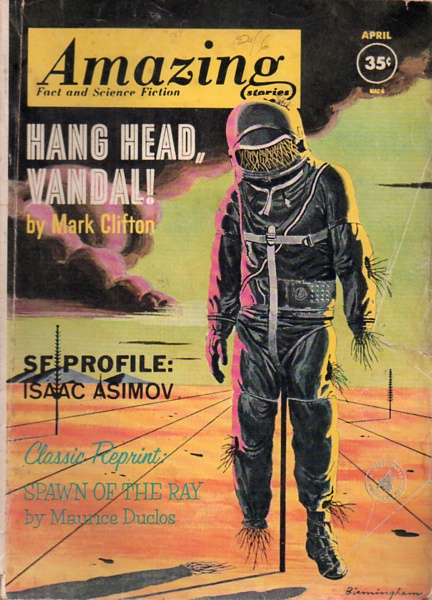
(Cover by Lloyd Birmingham. Amazing Stories, April 1962.)
It’s been some months since I did my last marathon of short stories from Amazing Stories, and in the magazine’s own timeline it’s been a couple decades. Not that nothing good was being printed in the ’40s and ’50s, but I only have three months to do this thing and this is a magazine with a really long and messy history.
Last time we saw pretty much the end of T. O’Conor Sloane’s tenure, by which point Amazing Stories wasn’t doing so well, either in sales or the quality of the fiction. There was then a change in publishers and Sloane stepped down, the old man (he was born in 1851) dying in 1940. The next editor was the much younger and more eccentric Raymond A. Palmer, who would do stuff with the magazine that was for both good and ill. Palmer was only 27, and came to the editorship from the perspective of a fan, at a time when the first Worldcon hadn’t even happened yet. Palmer ran Amazing Stories for the next decade and obviously bought some good fiction, but his biggest contribution was the long-running series of hoax stories written by Richard S. Shaver. The so-called Shaver mystery amassed a cult following, but it did little to improve the magazine’s sales overall, and indeed damaged its reputation at a time when it was already treated as thoroughly second-rate. Something had to be done.
When Palmer left to persue other ventures in the field (notably he edited Other Worlds, which printed some pretty good material on a modest budget), Howard Browne, who hitherto worked as managing editor, took over. Up to this point Amazing Stories had languished as a pulp-format magazine, and as the new decade arrived it became clear that the digest format was the way of the future for genre magazines that wanted to be more respectible. So, Browne had it changed to digest, and for a brief time in the early ’50s Amazing Stories was looking good for a second-rate magazine. Notably Browne bought the first story by Walter M. Miller, and we also saw stories from the likes of Theodore Sturgeon, Robert Bloch, Charles Beaumont, and even Robert Heinlein. This rise in quality coincided with the debut of a new sister magazine, Fantastic, which Browne also edited. It could be because Browne was reported to dislike SF as a genre, or maybe it’s because fantasy is in some ways less restrictive than SF, but from the beginning it seemed like Fantastic was the favored sibling.
Both magazines had their peaks and valleys, though, especially as money ran tight and Brown eventually stepped down to go back to focus on crime fiction. In the latter half of the ’50s both magazines had resorted to reprints and relying on a deceptively small group of workhorse authors who often got published under pseudonyms. It was not unusual to find, say, two or even three stories by Robert Silverberg under a variety of names in a single issue. Shit was getting ridiculous. Paul W. Fairman acted as caretaker editor for a couple years, but clearly a fresh and ingenious face was needed if the two magazines were to survive.
Cele Goldsmith was only 25 when she took over Amazing Stories, but she had already acted as managing editor under Fairman and so had a good idea as to what the job would entail. Even so, the arrangement ended up being a bit unorthodox, and both magazines went through some big changes. The custom for editors was to write an editorial (as you do) for each issue, but Goldsmith didn’t write editorials; instead that duty went to Norman M. Lobsenz, who also wrote the story blurbs. ISFDB lists only a few times during her six-year tenure where Goldsmith wrote an editorial. This is the reason why we have little insight into what her opinions on anything were, and when she wrote a brief essay that appeared in the March 1983 issue of Amazing Stories, reminiscing about her editorship, she had long since moved on from the field. But she did not forget her roots. To use Goldsmith’s own words from that very essay:
I’m often asked if I miss science fiction. Of course I do. And what I miss most is the contact with the many writers who became my friends. I confess to feeling a bit smug in the private knowledge that much of their success occurred because I was, at one time, their only reader and their most important audience.
Said writers who either submitted early stories or straight up made their debuts in Goldsmith’s magazines included Roger Zelazny, Ben Bova, Piers Anthony, Thomas M. Disch, David R. Bunch, Phyllis Gotlieb, and of course, Ursula K. Le Guin, who would become perhaps the most universally acclaimed American genre author of the 20th century. Fritz Leiber, who had taken a few years off from writing, returned with a vengeance at the tail end of the ’50s, and the magazines he appeared in most were easily Goldsmith’s, especially Fantastic. J. G. Ballard was well-established in the British magazines, but Goldsmith offered him his first consistent market in the US. In the awkward years between the ’50s boom-and-bust and the New Wave of the late ’60s, Goldsmith paved the way for authors who would fully bloom in the latter period. During the six years of Goldsmith’s editorship, Amazing Stories got nominated for the Hugo for Best Professional Magazine five times, with 1960 marking the first time it was ever nominated. Fantastic also got nominated multiple times.
Now, as for what I’ll be covering this month, I’ll acknowledge the elephant in the room: it’s all dudes. With the major exception of Le Guin, there was surprisingly not a noticeable uptick in lady authors appearing Amazing, despite a lady editor being in charge. This is by no means indicative of some bias on Goldsmith’s part or unique to her, as much of the ’60s saw an unfortunate drought in women writing for the genre magazines, even when compared the previous decade. Still, I wanted to cover as much ground as I could while also picking stories that look interesting. We’re starting with an early Harlan Ellison story from the December 1958 issue, the first issue credited to Goldsmith as editor, and ending with a Zelazny story from the June 1965 issue, Goldsmith’s last. Ziff-Davis, Amazing‘s long-time publisher, gave up it and Fantastic after the June 1965, and Goldsmith went with Ziff-Davis in the divorce. Both magazines became cheap reprint papers for a few years after, but they eventually recovered.
With all that said, it’s time to get to the fiction.
For the short stories:
“Are You Listening?” by Harlan Ellison. From the December 1958 issue. You know him, you love him (or maybe not), but it can’t be denied that Harlan Ellison continues to be a north star by which SF writers guide themselves, even nearly a decade after his death. Eventually he would become famous and an award-winner, but in 1958 Ellison was just another struggling young writer.
“First Love” by Lloyd Biggle, Jr. From the September 1959 issue. One of those authors to have fought in WWII, Biggle began writing SF about a decade after the war ended. He studied musicology and even got a PhD out of it, but it’s his SF and involvement in fandom (he founded the Science Fiction Oral History Association) that would occupy much of his time until his death in 2002.
“Getting Regular” by David R. Bunch. From the August 1960 issue. Like Harlan Ellison, Bunch anticipated the New Wave by about a decade, making his genre debut in 1957. Bunch specialized in the short-short story, each tending to clock in at only half a dozen pages. His penchant for both quirkiness and brevity goes to explain why he’s the only author to appear twice in Dangerous Visions.
“A Dusk of Idols” by James Blish. From the March 1961 issue. Blish was one of the first notable critics of genre SF, at least in the US, and his reviews of fiction specifically as printed in the magazines make his critical work a distant precursor to this very site. He was also pretty good when it came to writing fiction, especially in the ’50s, which saw him win a Hugo for A Case of Conscience.
“Thirteen to Centaurus” by J. G. Ballard. From the April 1962 issue. By the early ’60s Ballard was already well-established in the UK, but Goldsmith was an early champion of his work in the US, with him appearing regularly in both Amazing Stories and Fantastic during Goldsmith’s tenure. Ballard is most famous (or infamous) for his novels, including Crash and Empire of the Sun.
“Down to Earth” by Harry Harrison. From the November 1963 issue. Harrison started out as an illustrator, but he made his debut as a writer in 1951 and kept at it for decades. He also later became a prolific anthology editor. Given that much of Harrison’s fiction is known for being lightweight, it might come as jarring that his most famous novel is the bleak Make Room! Make Room!
“A Game of Unchance” by Philip K. Dick. From the July 1964 issue. To this day Dick is one of my favorite authors, even when taking his faults into account. Dick emerged at one of the best (sometimes funny, other times scary) short-story writers of the ’50s, inside or outside of the field. But ya know, novels make more money. As such we didn’t see as much short fiction from Dick in the ’60s.
“The Furies” by Roger Zelazny. From the June 1965 issue. I had to pick at least one major discovery Goldsmith had made, and it was a hard choice since, truth be told, the material in Fantastic during this time was stronger overall than what Amazing Stories offered. Zelazny appeared more often in Fantastic, which makes sense, but that doesn’t mean he wasn’t a good fit for Amazing Stories.
(Cover by Allen Anderson. Planet Stories, January 1951.)
A change is coming to this site, and unfortunately it’s not for the better. I was supposed to review Leigh Brackett’s The Big Jump last month, but while I had finished reading the novel on time, I could not bring myself to write anything all that substantive about it. It’s fine, basically. It’s a short novel that is sort of spacefaring but decidedly unlike the swashbuckling planetary romances Brackett had made her bread and butter. Novels, for the most part, were also not really her strong suit, which makes her 1955 novel The Long Tomorrow all the more an outlier. I wanted to write about Brackett still, though, so this month we’ll be downsizing and looking at a short story of hers from earlier in her career, “The Halfling,” which got a Retro Hugo nomination. It’s also not a planetary romance, though; instead Poul Anderson, who for a time early in his career wrote some Brackett-esque science-fantasy, will take up that mantel. Incidentally I was supposed to write about an Anderson novella sometime last year, but never got around to it, so I’ll be making up for lost time.
The increasing habit I’ve made of missing out on pieces I had set out to cover has made me think this site could use some downsizing of its own. Thankfully not much will change except, sad to say, I will no longer be covering “complete” novels, i.e., stories 40,000 words or longer that are printed whole in magazine issues. This was a niche department to begin with, which I would only make use of a few times each year, but it seems with my life circumstances in mind that such a department is no longer viable. Of course, I’ll still be covering novels in serial form (indeed we have one such novel for this month), but the Complete Novels section you see at the top of the page of now dead. Those reviews will be kept up, because why not, but I will no longer be updating that department for the foreseeable future. Instead I will simply not post anything on the 31st of the month going forward, which gives me a bit of extra time to relax as well as the previous post more time to marinate at the top of the page. Really I think this is the best move for everyone, and I also think the price for no longer reviewing such stories is a rather small one.
July will see all short stories from Amazing Stories, but for this month it’s pretty much just more of the same. Nothing unusual here. Aside from Brackett and Anderson, authors I’d meant to cover earlier but couldn’t, we have the serial version of Gordon R. Dickson’s first major novel, as well as a novella from Katherine MacLean and an out-of-left-field SF-horror yarn from the now-obscure Raymond F. Jones. I had temporarily forgotten about my thing of reviewing as least one piece from Amazing Stories this month and almost replaced Jones with a Bruce Sterling Omni story. But Sterling is gonna have to way a bit, probably a few months.
We’re leaning vintage this month, with one story from the 1940s, three from the 1950s, and one from the 1960s.
For the serial:
Dorsai! by Gordon R. Dickson. Serialized in Astounding Science Fiction, May to July 1959. Born and raised up to a point in Canada, but moving with his family to the US when he was 13, Dickson can now strike one as oddly mild-mannered and sympathetic for being a major forerunner of what we now call military SF. The Childe Cycle, which contains the Dorsai stories, would encompass his life’s work, although he never lived to give it a proper ending. Dorsai! was not the first story in the cycle, but apparently the second, as well as the first novel. The magazine version was nominated for a Hugo.
For the novellas:
“The Diploids” by Katherine MacLean. From the April 1953 issue of Thrilling Wonder Stories. MacLean was one of the last major discoveries John W. Campbell had made, and indeed she would appear regularly in Astounding/Analog over the course of many years. Despite living an exceedingly long time (she died in 2019), she mostly stopped writing after the 1970s. She trained in psychology and had apparently taken in interest in Dianetics at one point.
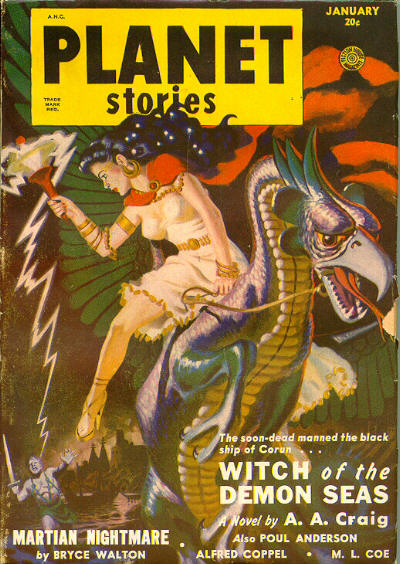
“Witch of the Demon Seas” by Poul Anderson. From the January 1951 issue of Planet Stories. Anderson was another Astounding/Analog regular, although he also appeared basically everywhere else. Born American but raised by Danish immigrants, there’s a strong sense of the “Nordic twilight” in Anderson’s writing, especially but not exclusively his later work. Early in his career he followed in the footsteps of Leigh Brackett and wrote some planetary romances.
For the short stories:
“The Halfling” by Leigh Brackett. From the February 1943 issue of Astonishing Stories. Retro Hugo nominee for Best Novelette. Instead of reviewing a novel I guess we’ll settle for something more small-scale. Brackett had made her debut in 1940, in Astounding, but she quickly turned to other magazines despite the lesser pay. She would eventually find much success as a screenwriter.
“Stay Off the Moon!” by Raymond F. Jones. From the December 1962 issue of Amazing Stories. Born and raised in Utah, Jones seems to have been the first Mormon SF writer of note, so in that sense he was ahead of his time. He was active through much of the ’40s and ’50s. Fans of Mystery Science Theater 3000 may recognize him for having written This Island Earth (the novel, not the movie).
We are now knee-deep in spring, which means last month I narrowly survived a fit of allergies. (I’m not really exaggerating, I got hit with what the doctor called postnasal drip, and for some days it was difficult to even breathe, let alone sleep at night.) In terms of weather this might be my least favorite time of year, because of said allergies. In better news, it’s also time for applying for memberships at the yearly Worldcon, if you’re interested. This one is happening in LA, which is unfortunate because it’s the other side of the country for me and I don’t have any connections who live close enough to where the action’s happening. I have a few friends in California, but as you know, California is a big state. (That’s not even getting into people from outside the US who want to attend in person. It’s rough.) I did end up getting a WSFS membership, I think for the third year in a row. I mainly do this for all the free stuff you get, a very good I would say given it’s only $50. You get ebooks of novels and short fiction, and you even get files for the movies up for Best Dramatic Presentation.
As for what we’ll be reading this month, for the first time in a long while we have a complete novel, which I have to get around to this time. (Unlike last time.) We also have a novel in serialized form, by someone whom I’m sure will not raise any eyebrows. Incidentally, two of the stories here are related to World War II, although one was written on the eve of the war in Europe while the other is an early example of a “Hitler wins” alternate history. Such a scenario is pretty tired today, but it was not so when C. M. Kornbluth came up with it back in the ’50s. Another funny connection is that both Kornbluth and L. Ron Hubbard served in WWII, the former in the army and the latter in the navy. Hubbard’s time in the navy was respectable, and I’m sure nothing untoward or embarrassing happened when he was at sea. Unfortunately for Kornbluth, his time in the army caused a weakness in his heart that would later see him die quite young.
Anyway…
We have one story from the 1940s, two from the 1950s, one from the 1980s, one from the 2000s, and one from the 2020s.
For the serial:
Final Blackout by L. Ron Hubbard. Serialized in Astounding Science Fiction, April to June 1940. Where do we even start with Hubbard? One of the most controversial figures in not just SF but also modern religion and pseudo-science. Hubbard had Dianetics published in 1950, and in 1952 he founded the Church of Scientology, one of the most successful (if only because of the disproportionate number of rich people in its ranks) cults in recorded history. Before all that, he was a fairly respected genre writer, with the late ’30s and early ’40s marking his peak for both quality and quantity. Final Blackout is probably the most well-received of Hubbard’s SF novels, after the much more famous but also more controversial Battlefield Earth.
For the novellas:
“The Giants of the Violet Sea” by Eugenia Triantafyllou. From the September-October 2021 issue of Uncanny Magazine. Born and raised in Greece, and indeed currently living there, Triantafyllou writes her fiction in English. Her personal website says she has “a flair for dark things.” She made her debut in 2017, and so far has only written short fiction. This here novella is the longest work of Triantafyllou’s to have been published up to that point.
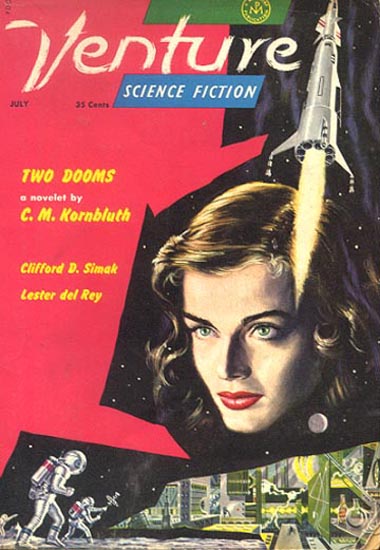
“Two Dooms” by C. M. Kornbluth. From the July 1958 issue of Venture Science Fiction. Kornbluth is maybe one of my favorite SF writers to have really flourished during the ’50s magazine boom-and-bust, although he had made his debut long before that. He was a prodigy whose earliest work was published when he was a literal teenager. Unfortunately he also died very young, at just 34, from a weak heart, robbing the field of one of its most incisive writers.
For the short stories:
“The Persecutor’s Tale” by John M. Ford. From the November 1982 issue of Amazing Stories. Speaking of very good writers gone too soon, Ford also made his debut when only in his teens, but he picked up on the trade pretty quickly. A writer’s writer, the best way to read a Ford novel is the read it twice. Sadly he died in 2006, at just 49, having not quite completed his final novel.
“Always” by Karen Joy Fowler. From the April-May 2007 issue of Asimov’s Science Fiction. Nebula winner for Best Short Story. Believe it or not, there’s an L. Ron Hubbard connection here. Fowler is maybe the most high-profile author to have made her debut in the annual (and Scientology-backed) Writers of the Future anthology series, although Fowler herself is not a Scientologist.
For the complete novel:
The Big Jump by Leigh Brackett. From the February 1953 issue of Space Stories. While Brackett’s first few stories were published in Astounding, she soon moved to other magazines that were more open to her brand of space adventure SF. By the end of World War II she’d come to be associated most with Planet Stories, in a mutually beneficial relationship. Indeed, after Edgar Rice Burroughs, Brackett can be considered the leading writer of planetary romance. She married fellow writer Edmond Hamilton in 1946, but they almost never collaborated. Nowadays she’s best known as a successful screenwriter, and for her grounded SF novel The Long Tomorrow, which is quite different from what she most often wrote. The Big Jump is a short novel, apparently published in magazine form unabridged, and later as one half of an Ace Double along with Philip K. Dick’s Solar Lottery.
March was a bit of a marathon here at SFF Remembrance, but truth be told I had more fun writing about that very old and dusty science fiction than in the past few months. I had been suffering from fatigue, along with some real-life stuff that was getting to me and making it hard to sleep at night. Now I feel somewhat rejuvinated. I feel good enough about reviewing stuff here again, in fact, that I’m bringing back the two-short-stories two-novellas deal, although I’m still keeping it to one serial for the month. The serial in question is a three-parter, being the first appearance of one of the most important SF novels ever written—and yet one that has been totally lost to the sands of time. You might find references to The Skylark of Space if you’re a Star Wars fan, as a point of trivia, since it was this novel that in part invented the space opera subgenre. Edmond Hamilton was writing space opera at shorter lengths around the same time Smith made his debut, but there was nothing on the scale of Smith’s novel before it. Smith “revised” it for its eventual book publication, removing co-author Le Hawkins Garby’s contributions, but we’ll be reading it as it appeared in Amazing Stories. This was a long time coming for me.
For the dates of stories, we’re looking at one from the 1920s, two from the 1950s, one from the 1960s, and one from the 1990s. Both of the stories from the ’50s are from the first half of that decade, which was an incredibly productive period for magazine SF.
For the serial:
The Skylark of Space by E. E. Smith and Lee Hawkins Garby. Serialized in Amazing Stories, August to October 1928. When Smith studied chemistry at the University of Iowa, he didn’t think he would later become one of the pioneering authors of space opera. He didn’t even think he would write fiction, until he talked science fiction with Lee Hawkins Garby and her husband, who were friends from college. This was in 1915, before “science fiction” had even been coined as a label. The Skylark of Space took some years to gestate, but when it appeared in 1928 it made Smith a sensation among the then-niche SF readership. Garby’s contributions were later removed when the novel appeared belatedly in book form.
For the novellas:
“Half-Past Eternity” by John D. MacDonald. From the July 1950 issue of Super Science Stories. Fans of classic crime fiction will be familiar with MacDonald, at least by reputation. His Travis McGee series is one of the most prolific and widely read detective series ever. In 1972 he was given the Grand Master Award by the Mystery Writers of America. He also wrote a good deal of SF from the late ’40s through the early ’50s, along with nearly every other genre.
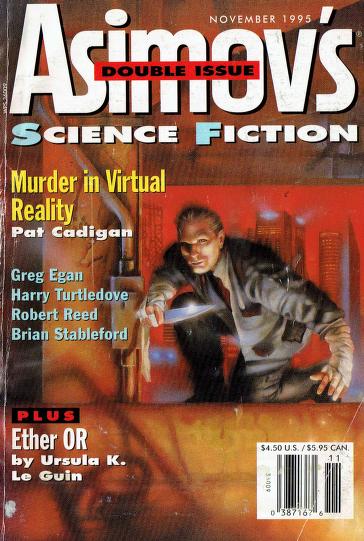
“Death in the Promised Land” by Pat Cadigan. From the November 1995 issue of Asimov’s Science Fiction. It was first published in the March 1995 issue of Omni, but that magazine had gone purely online by that point and the Asimov’s printing marked its first physical appearance. Cadigan is arguably the queen of cyberpunk, going back to the ’80s. She’s not as famous as William Gibson or Bruce Sterling, but she really should be more read than she is.
For the short stories:
“Dumb Martian” by John Wyndham. From the July 1952 issue of Galaxy Science Fiction. It’s surprising to think that Wyndham had made his SF debut in the early ’30s. His career peak came later than it does with most authors, since he was deep in his forties when The Day of the Triffids was published. The ’50s were a great time to be John Wyndham, between his novels and short stories.
“Timberline” by Brian W. Aldiss. From the September 1961 issue of The Magazine of Fantasy and Science Fiction. This is the fourth installment in Aldiss’s Hothouse series, which was then published as a novel. The series of stories, rather than the novel version, won Aldiss a Hugo, which was certainly a confusing move. It’s been almost a year since I reviewed the last Hothouse story, so here we go.
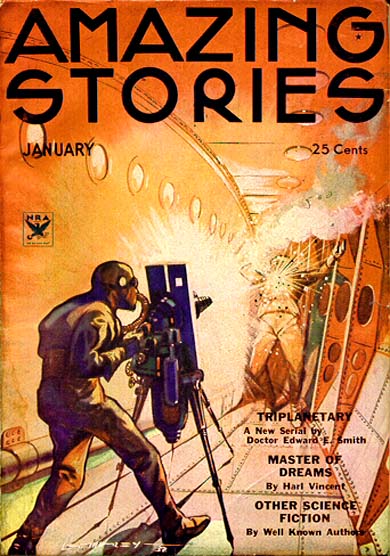
(Cover by Leo Morey. Amazing Stories, Jaanuary 1934.)
In March 1926, there was a new fiction magazine on newsstands. This in itself was an unexceptional event; after all, there were already quite a few fiction magazines on the market, “the usual fiction magazine, the love story and the sex-appeal type of magazine, the adventure type, and so on.” But this was Amazing Stories, a magazine whose mission statement was to publish a genre of fiction which prior to this didn’t even have a name: science fiction. Sorry, “scientifiction.” The publisher was Experimental Publishing Company, which had already run SF-adjacent magazines, namely Science and Invention and Radio News, and the editor was Hugo Gernsback. Gernsback was born and raised in Luxemburg, but moved to the US as a young man, where he made a name for himself as an inventor, as well as taking major part in the aforementioned magazines. He was also a lousy fiction writer, and even worse when it came to having business sense. What he lacked in those areas, though, he certainly at least tried to compensate with a restless imagination. He was a pioneer in the truest sense, with both the good and bad that come with being on the razor’s edge of innovation. Gernsback ran SF before, but he wanted a whole magazine dedicated to “scientific fiction,” and as he explains in the inaugural editorial: “By ‘scientifiction’ I mean the Jules Verne, H. G. Wells, and Edgar Allan Poe type of story—a charming romance intermingled with scientific fact and prophetic vision.” The standard for science fiction had been set.
There was science fiction prior to Amazing Stories, of course, and a lot of it. Gernsback himself considered the first real master of SF to be Edgar Allan Poe, who despite being known for his horror also wrote quite a few SF stories—the two not being mutually exclusive. (Nowadays people, including those like Brian Aldiss who very much know their stuff, tend to say SF really started with Mary Shelley’s Frankenstein.) Other practitioners of proto-SF include Jack London, William Hope Hodgson, Nathaniel Hawthorne, Ambrose Bierce, and others. Indeed, it’s this wealth of SF published prior to 1926 that would make up the bulk of the material in Amazing Stories for the first few years of its existence. Gernsback especially resorted to reprints of stories and novels by H. G. Wells, who was still alive and well at this point. The business relationship between Gernsback and Wells eventually soured, and unfortunately this was a common occurrence with authors hoping to be published in Amazing Stories. The big problem was that Gernsback seemed to have the money-handling abilities of a gerbil or guinea pig, neglecting to pay his writers for absurdly long periods, even having to be threatened legally to pay up. The money problem got so bad that it’s suspected by some historians that Gernsback declared bankruptcy because he found it preferrable to paying up on his debts. There was an infamous case where H. P. Lovecraft only appeared in Amazing Stories once, with “The Colour Out of Space” (one of his best), on account of Gernsback’s reluctance to pay him, with Lovecraft calling him “Hugo the rat.”
Despite the financial strain, and with Gernsback losing his own magazine only three years after launching it, Amazing Stories somehow persevered. Things looked even rougher when T. O’Conor Sloane, who was managing editor under Gernsback, got kicked upstairs to become editor. Sloane was already in his seventies when he took over, so he was goddamn unspeakably old from the outset. He eventually died in 1940, at the impressive age of 88. If Amazing Stories was shaky in quality under Gernsback, with the original fiction often failing to stand toe-to-toe with the reprints, then the Sloane era made it thoroughly play second-fiddle to newfangled SF magazines, including Astounding Stories and Gernsback’s own Wonder Stories. Within just five years or so the first SF magazine got relegated to publishing second-rate fiction with second-rate paychecks for its writers. E. E. Smith, who had first made his mark in Amazing Stories, eventually jumped ship in favor of Astounding. You also like authors like Jack Williamson, who stayed loyal to Gernsback despite everything. That Amazing Stories made it to the end of the ’30s, and survived well beyond that, is really incredible. It subsisted largely on an audience comprised of young readers and scientist/inventor types. These are very different demographics in some ways, mind you. It continued, under Sloane, as the magazine where science and adventure would (ideally, if not so much in practice) be perfectly balanced.
It wasn’t all bad. In scouting for this month’s selection of short stories to review, I thought the pickings would be slim, but there was still a decent amount of fiction printed in the first ten years or so of this magazine’s life that at least looked intriguing. For instance, how many women would you say wrote for Amazing Stories in those early years? More than you’d think. Gernsback had his shortcomings, but he didn’t seem to have a misogynistic streak worth mentioning, and on occasion he published stories that would be considered positively feminist for the time. So, we have nine stories, the biggest batch of fiction I’ve had to tackle in a bit, all from the 1920s and ’30s. I’m sure some of it will not be very good, and it’s worth mentioning that when reading SF of such vintage it’s important to put yourself in a certain mindset. Still, I think I chose well.
For the short stories:
“The Thing from—’Outside’” by George Allan England. From the April 1926 issue. First published in 1923. Makes sense that we’re starting with a reprint, given the heavy usage of them in early issues. Also, it originally appeared in the Gernsback-edited magazine Science and Invention. England was a prolific pulp adventure writer, real-life adventurer, and failed socialist politician.
“The Fate of the Poseidonia” by Clare Winger Harris. From the June 1927 issue. Harris was, as far as we can tell, the first woman to write for the genre magazines under her own name. She made her debut in Weird Tales in 1926, but more than half of her work went to Amazing Stories. I had meant to review her debut story some months ago, but I struggled to write anything constructive about it.
“The Metal Man” by Jack Williamson. From the December 1928 issue. Williamson might have the single longest career in genre fiction, although Michael Moorcock is getting close. He made his debut in 1928, with this very story, and only stopped with his death in 2006. He always remained pulpy in style to an extent, but he managed to stay relevant for an impressive span of time.
“The Undersea Tube” by L. Taylor Hansen. From the November 1929 issue. Lucile Taylor Hansen was a trained anthropologist whose writing was mostly nonfiction books and articles. She concealed her first name and gender when writing SF early on, likely to separate this side gig (she didn’t write much SF) from her life in academia. She contributed some science articles to Amazing much later.
“The Gostak and the Doshes” by Miles J. Breuer. From the March 1930 issue. Breuer was the son of Czech immigrants, and even wrote for Czech-American publications in Czech rather than English. He was a trained medical doctor, and he spent most of his adult life in Nebraska, working alongside his dad at first. As you can guess, he didn’t write that much SF, on account of his day job.
“Omega” by Amelia Reynolds Long. From the July 1932 issue. Long seemed to have lived her whole life in Pennsylvania, although she would’ve lived on the other end of the state from me. She cut her teeth on writing SF, seemingly using the field as a training ground, but she later moved to detective fiction and poetry. She worked at the William Penn Memorial Museum for 15 years.
“The Lost Language” by David H. Keller. From the January 1934 issue. Of the pre-Campbell SF writers, Keller might be one of the most respected. Like Breuer, he was a trained physician, complete with an MD, and like Breuer he served in the Medical Corps in World War I. He was one of the first American doctors to deal with PTSD in soldiers, which apparently influenced his fiction.
“The Human Pets of Mars” by Leslie F. Stone. From the October 1936 issue. Stone was another pioneer in the field, in that like Harris she published under her real name, although many assumed it was a pseudonym. Her work is shockingly feminist and anti-capitalist for the time. She stopped writing by 1940, having become disillusioned with both the field and the world at large.
“Shifting Seas” by Stanley G. Weinbaum. From the April 1937 issue. For about a year and a half, Weinbaum was arguably the hottest new writer in SF. His untimely death from cancer in December 1935, about 18 months after his debut, means we’ll never know how he might’ve matured as a writer. Ironically he never appeared in Amazing during his life, opting instead for its competitors.
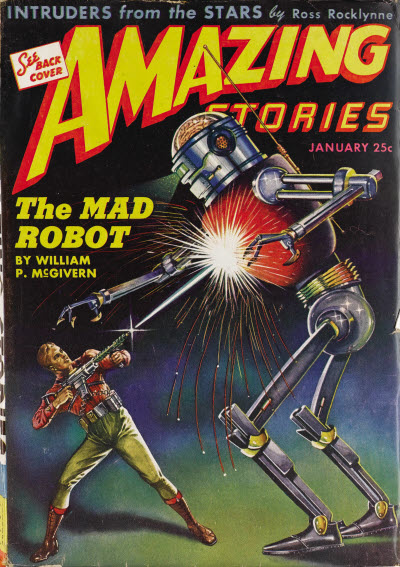
(Cover by Robert Fuqua. Amazing Stories, January 1944.)
What a year, huh? And we just started.
Since a lot of us are snowed in, or at least dealing with some pesky snow and ice (and ICE) in the midst of our everyday activities, we may as well pass the time by cozying up with some good reading. Or maybe not so good. Truth be told, I’m not so sure about the quality of what I’ll be tackling this month, with maybe one exception, the short story. Why yes, it’s been a while (a couple years) since I reviewed and quite enjoyed Philip José Farmer’s story “Mother,” which you may remember as being strange and pretty risqué for early 1950s SF. Farmer did write a sequel, “Daughter,” which from what I’ve heard is just as good if not better. As for choosing the obligatory item from Amazing Stories, to celebrate that magazine’s centennial, I decided to pick something from the rather neglected and maligned ’40s period. At the same time, Ross Rocklynne is not just some hack writer, so we’ll see. It had also been, for my money, too long since I’d scavenged the pages of If, namely for a serialized novel or novella, of which many were published in that magazine. For February it’s all sci-fi and all retro.
Now, there is an announcement I’d been wanting to make here, and maybe should have with last month’s review forecast, but now is as good a time. I recently launched a sister blog on Substack, Sketches from a Reader’s Album, which is not focused on genre fiction at all (although genre fiction will inevitably figure into it on occasion), but is like SFF Remembrance a review blog with the occasional editorial. At least that’s the idea. There I’ll be writing about literary fiction, nonfiction, and poetry, namely books that have won the National Book Award. (The National Book Award is sort of like to the Pulitzer Prize what the Nebula is to the Hugo, if you care for that sort of thing.) With both sites you can expect only so many posts a month, but they’ll be lengthy and hopefully entertaining.
As far as time frames go, we have one story from the 1940s, one from the 1950s, and one from the 1960s. Because I’ll be covering stories published in Amazing Stories in the 1920s and ’30s, we unfortunately will not be getting to more recent stuff until April at the earliest.
For the serial:
Earthblood by Keith Laumer and Rosel George Brown. Serialized in If, April to July 1966. Such a collaboration sounds out of the blue, and honestly I’m not even sure how or why Laumer and Brown came together to work on a novel. But it’s not totally unexpected. Laumer and Brown made their debuts at almost the exact same time, at the tail end of the ’50s, and both were prolific during the pre-New Wave years. They were also very close in age. Sadly Brown died at just 41 years old in 1967, one year after Earthblood was published, while Laumer suffered a stroke in 1971 which left him unable to write for a time. I know little about Earthblood aside from it being an adventure novel, of the sort that was common in If in the ’60s.
For the novella:
“Intruders from the Stars” by Ross Rocklynne. From the January 1944 issue of Amazing Stories. Retro Hugo finalist for Best Novella. Rocklynne is one of those unexpected survivors from the pre-Campbell years, having made his debut in 1935 when he was just 22, and continuing up to the early ’50s before going on hiatus. (Like too many SF writers of his generation he became interested in Dianetics.) He eventually made a comeback in the late ’60s, and even appeared in Again, Dangerous Visions. Despite the Retro Hugo nomination, “Intruders from the Stars” has almost never been reprinted.
For the short story:
“Daughter” by Philip José Farmer. From the Winter 1954 issue of Thrilling Wonder Stories. The SF market in the early ’50s was such that you could get your story published even if it was more daring than average, provided you accepted selling to one of the second-rate magazines. By 1954, Farmer had already become notorious for his novella “The Lovers,” about a sexually explicit (for the time) romance between an Earthman and an alien woman who is more bug-like than she appears. Early Farmer is pulpy in style, but he can be rather big and provocative with his ideas.
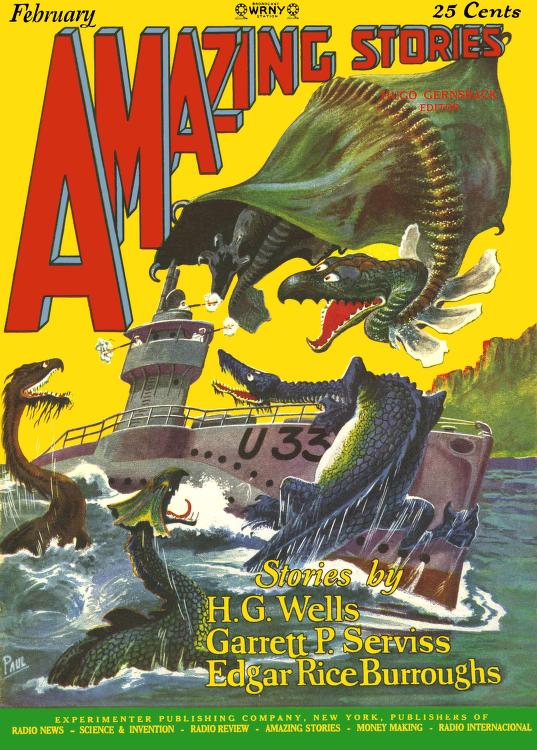
(Cover by Frank R. Paul. Amazing Stories, February 1927.)
Since it’s now the new year for everyone, it’s only natural that we have some new things to look forward to or new things to do. I have a few New Year’s resolutions myself: some movies on my watchlist, quite a few video games I hope to get around to playing. I have hundreds of games in my backlog and even more books to be read in my personal library. I have multiple hobbies, which is something I would recommend to everyone. Unfortunately another thing on my to-do list for 2026 is to either get a second job or to try my hand at writing professionally, which would take time away from this hobbies, including this here blog.
Truth be told, I’ve been winding down productivity here for a minute, so this shouldn’t come as a surprise. I’m seemingly incapable of uploading posts “on time” (but of course who’s keeping time except for myself), and I’ve been missing one or even two reviews every month for the past several months. I wouldn’t be too worried, for the few of you who read this, since I’m not gonna be shutting down this site—just lowering my productivity. Granted, for the first couple years I ran this site I was writing at a feverish pace; in hindsight I’ve not really sure how I did that while also having a day job. In 2023 and 2024 I wrote over 200,000 words a year, according to the stats, which is a lot for one person. There was less wordage for 2025, and now for 2026 you can expect fewer posts as well. But this is like being on a flight and going from 20,000 feet to 10,000 feet.
Now, as you may know, Amazing Stories turns 100 this year. It was revived (again) not too long ago as basically a fanzine, but I would like to celebrate Amazing Stories as a professional magazine, which still means going through material that spans seven decades or so. It’s a lot, not helped by the fact that it has a pretty messy history as far as changes in editorship and publisher go. Except for maybe the beginning of its life it always played second fiddle to competing magazines, but it survived (sometimes even thrived) for an impressive stretch of time, given the circumstances. So, every month (except for March, July, and October, where you can expect short-story marathons) I’ll be covering a serial, novella, or short story from the pages of Amazing Stories. This should be interesting.
With the exception of the aforementioned months we’ll be doing only one serial, one novella, and one short story every month from now on, plus at least one editorial. Anyway, we have one story from the 1900s, one from the 1930s, and one from the 1950s.
For the serial:
The First Men in the Moon by H. G. Wells. Serialized in Amazing Stories, December 1926 to February 1927. First published in 1901. Feel like it would be criminal to pay tribute to Amazing Stories without bringing up Wells at least once, possibly even twice, since he was heavily associated with the magazine in its first few years. Wells himself is arguably the most important SF writer to have ever lived, with his influence being felt to this day practically everywhere you look. Any given SFnal premise likely has its roots in something Wells did over a century ago. This is even more impressive when you consider that Wells at the height of his powers lasted only half a dozen years or so. The First Men in the Moon is one of the last of his classic novels.
For the novella:
“The Gulf Between” by Tom Godwin. From the October 1953 issue of Astounding Science Fiction. Godwin became somewhat famous in SF circles for exactly one story, “The Cold Equations,” which he wrote pretty much in collaboration in John W. Campbell. It might surprise some people that Godwin had in fact written other stuff, and I admit I’m part of the problem because I don’t think I’ve read any Godwin aside from “The Cold Equations.” But I’m gonna fix that. “The Gulf Between” was Godwin’s first story, and it’s notable, if for no other reason than that the cover it inspired would later be reworked as the iconic cover for a certain Queen album.
For the short story:
“The Cairn on the Headland” by Robert E. Howard. From the January 1933 issue of Strange Tales. Over the course of about a dozen years, Howard wrote nonstop for every outlet that would accept his work, and he was not just a fantasy writer, also writing horror, Westerns, sports stories, and non-supernatural adventure pulp. He wrote everything except for SF, which he didn’t seem to have an interest in. Conan the Cimmerian occupied much of Howard’s later years, to the point where he began to resent his creation, but this didn’t stop him from doing standalone yarns like this one.
(Cover by Frank Kelly Freas. Satellite, December 1956.)
Merry Christmas, happy birthday to me, and all that.
People who keep up with my posts may have noticed that I missed a couple things last month, including what was to be the start of the second serialized novel, Kuttner and Moore’s Fury. Let’s say I’ve been slow about it. Generally I’ve been slower about keeping up with this blog than I was a year ago, and there could be a few reasons for this, but the point is that I’ve come to understand I’m not as on top of my own blog as I once was. I’ve slowed down with the “required” reading, and I’ve been slower about writing, although (not to toot my own horn) I still write here more than some other fan writers I know. Maybe nowadays the load I give myself is just a bit too much, especially since I’ve also been wanting to get into writing professionally, for that bit of extra money, only I’ve not been able to find the time and/or motivation for it. So, I’ll lighten the load a bit. From now on I’ll only be covering one serial a month, regardless of length. Of course, if the serial is four parts or longer this won’t make a difference, but a lot of serials are three-parters, which should give me an extra day to myself. Other than that, it’s gonna be business as usual.
What do we have on our table? All science fiction, which isn’t very diverse, but when these stories were published is certainly more diverse. One story from the 1940s, one from the ’50s, one from the ’60s, one from the ’70s, one from the 2000s, and one from the 2020s.
For the serial:
Fury by Henry Kuttner and C. L. Moore. Serialized in Astounding Science Fiction, May to July 1947. Kuttner and Moore wrote so much, both together and each solo, that they resorted to a few pseudonyms, one of them being Lawrence O’Donnell. Fury takes place in the same universe as the earlier Kuttner-Moore story “Clash by Night.” Despite Fury historically being credited to Kuttner alone, Moore claimed years later to having been a minor collaborator.
For the novellas:
“Welcome to Olympus, Mr. Hearst” by Kage Baker. From the October-November 2003 issue of Asimov’s Science Fiction. Baker had spent much of her adult life working in insurance and with theatre as her primary hobby, before pivoting to writing SF in her forties. No doubt she would still be writing SF today, had she not died all too soon in 2010. Still, for about a dozen years she wrote furiously, with her big series following a team of time-traveling secret agents.
“The Dragon Masters” by Jack Vance. From the August 1962 issue of Galaxy Science Fiction. Winner of the Hugo for Best Short Fiction. This is a reread, although I only have a vague memory of having read it in the first place, and that was without Jack Gaughan’s accompanying artwork. Despite what the title might make you think, “The Dragon Masters” is pure planetary SF, albeit with fantasy-esque coloring that Vance had become known for at this point.
For the short stories:
“An Important Failure” by Rebecca Campbell. From the August 2020 issue of Clarkesworld. Winner of the Theodore Sturgeon Memorial Award. Born and raised in Canada but now living in the UK, Campbell has written only one novel so far, which in fact was her first SF writing of any sort. Good news is she’s been somewhat prolific in writing short stories and novellas over the past decade.
“The Earth Dwellers” by Nancy Kress. From the December 1976 issue of Galaxy Science Fiction. This is the third time now that I’ve come to Kress, and why not? Her career now spands nearly half a century, and her stories, if not always entertaining, often provide some food for thought. I know nothing about “The Earth Dwellers,” except it marked Kress’s very first appearance in the field.
For the complete novel:
A Glass of Darkness by Philip K. Dick. From the December 1956 issue of Satellite Science Fiction. This book sounds unfamiliar, even for seasoned Dick fans, although it may ring a bell under its book title: The Cosmic Puppets. Dick had burst onto the scene in the early ’50s as one of the most promising short-story writers at the time, in a generation that included such bright newcomers as Robert Sheckley, Algis Budrys, and Katherine MacLean. It only stood to reason, then, that while writing short stories nonstop was all well and good, writing a novel was the logical next step. A Glass of Darkness wasn’t the first novel Dick wrote, but it was the first to be published.
A short and sweet review forecast for this month, partly because I’m running behind on my writing a bit and so am pressed for time, but also because I don’t have a particular theme in mind here. Of course, if you thought I was gonna take a break from reviewing spooky fiction altogether after last month, you’d be mistaken, as both of the short stories due for November are horror pieces. We’re still deep in autumn, after all, and honestly my thirst for spooky shit has not been quenched.
Another thing I just randomly decided to throw in there is that both of the serials are novels written in collaboration, by authors who gained a good deal of acclaim and presumably money from working together. In one case there’s decades-long besties Larry Niven and the late Jerry Pournelle, who shared similar politics and also writing philosophies. There’s also the husband-wife duo of Henry Kuttner and C. L. Moore, perennial favorites on this site, who wrote most of their novels together, although for decades Fury has been erroneously credited to just Kuttner.
We’ve got one story from the 1850s (the oldest I will have reviewed thus far), two from the 1940s, two from the 1970s, and one from the 2000s.
For the serials:
Inferno by Larry Niven and Jerry Pournelle. Serialized in Galaxy Science Fiction, August to October 1975. Niven had quickly established himself as one of the major hard SF writers by the end of the ’60s, but Pournelle had a longer road to success, first being active as a fan and then not writing his first stories and articles professionally till he was deep in his thirties. In the ’70s and ’80s Niven and Pournelle wrote several successful novels in collaboration.
Fury by Henry Kuttner and C. L. Moore. Serialized in Astounding Science Fiction, May to July 1947. Kuttner and Moore wrote so much, both together and each solo, that they resorted to a few pseudonyms, one of them being Lawrence O’Donnell. Fury takes place in the same universe as the earlier Kuttner-Moore story “Clash by Night.” Despite Fury historically being credited to Kuttner alone, Moore claimed years later to having been a minor collaborator.
For the novellas:
“Against the Fall of Night” by Arthur C. Clarke. From the November 1948 issue of Startling Stories. Clarke is one of the most famous SF writers ever, to the point that by the ’60s he had become, along with Isaac Asimov and Robert Heinlein, a media personality. He collaborated with Stanley Kubrick on the script for 2001: A Space Odyssey whilst writing the novel version parallel to it.
“The Region Between” by Harlan Ellison. From the March 1970 issue of Galaxy Science Fiction. Ellison is similarly a pretty famous (if more controversial) figure, being just as notorious for his real-life antics and combative nature as for his writing. This novella, one of Ellison’s longest stories, works as a standalone but was commissioned as part of a series which features the same main character.
For the short stories:
“The Old Nurse’s Story” by Elizabeth Gaskell. From the October 1927 issue of Weird Tales. First published in 1852. Now here’s a name you probably didn’t see coming. For someone who gained notoriety as one of the finest novelists of the mid-Victorian period, as well as being Charlotte Brontë’s first major biographer, Gaskell also wrote a fair amount of supernatural fiction.
“I Live with You” by Carol Emshwiller. From the March 2005 issue of The Magazine of Fantasy and Science Fiction. By this point Carol had outlived her late husband, Ed Emshwiller, by over a decade, but she had long since made a name for herself. The last Emshwiller story I wrote about was from the late ’50s, but nearly half a century later we still find her seemingly in her prime.