We are now knee-deep in spring, which means last month I narrowly survived a fit of allergies. (I’m not really exaggerating, I got hit with what the doctor called postnasal drip, and for some days it was difficult to even breathe, let alone sleep at night.) In terms of weather this might be my least favorite time of year, because of said allergies. In better news, it’s also time for applying for memberships at the yearly Worldcon, if you’re interested. This one is happening in LA, which is unfortunate because it’s the other side of the country for me and I don’t have any connections who live close enough to where the action’s happening. I have a few friends in California, but as you know, California is a big state. (That’s not even getting into people from outside the US who want to attend in person. It’s rough.) I did end up getting a WSFS membership, I think for the third year in a row. I mainly do this for all the free stuff you get, a very good I would say given it’s only $50. You get ebooks of novels and short fiction, and you even get files for the movies up for Best Dramatic Presentation.
As for what we’ll be reading this month, for the first time in a long while we have a complete novel, which I have to get around to this time. (Unlike last time.) We also have a novel in serialized form, by someone whom I’m sure will not raise any eyebrows. Incidentally, two of the stories here are related to World War II, although one was written on the eve of the war in Europe while the other is an early example of a “Hitler wins” alternate history. Such a scenario is pretty tired today, but it was not so when C. M. Kornbluth came up with it back in the ’50s. Another funny connection is that both Kornbluth and L. Ron Hubbard served in WWII, the former in the army and the latter in the navy. Hubbard’s time in the navy was respectable, and I’m sure nothing untoward or embarrassing happened when he was at sea. Unfortunately for Kornbluth, his time in the army caused a weakness in his heart that would later see him die quite young.
Anyway…
We have one story from the 1940s, two from the 1950s, one from the 1980s, one from the 2000s, and one from the 2020s.
For the serial:
- Final Blackout by L. Ron Hubbard. Serialized in Astounding Science Fiction, April to June 1940. Where do we even start with Hubbard? One of the most controversial figures in not just SF but also modern religion and pseudo-science. Hubbard had Dianetics published in 1950, and in 1952 he founded the Church of Scientology, one of the most successful (if only because of the disproportionate number of rich people in its ranks) cults in recorded history. Before all that, he was a fairly respected genre writer, with the late ’30s and early ’40s marking his peak for both quality and quantity. Final Blackout is probably the most well-received of Hubbard’s SF novels, after the much more famous but also more controversial Battlefield Earth.
For the novellas:
- “The Giants of the Violet Sea” by Eugenia Triantafyllou. From the September-October 2021 issue of Uncanny Magazine. Born and raised in Greece, and indeed currently living there, Triantafyllou writes her fiction in English. Her personal website says she has “a flair for dark things.” She made her debut in 2017, and so far has only written short fiction. This here novella is the longest work of Triantafyllou’s to have been published up to that point.
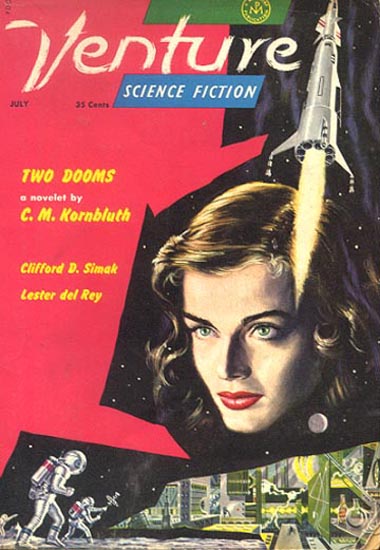
- “Two Dooms” by C. M. Kornbluth. From the July 1958 issue of Venture Science Fiction. Kornbluth is maybe one of my favorite SF writers to have really flourished during the ’50s magazine boom-and-bust, although he had made his debut long before that. He was a prodigy whose earliest work was published when he was a literal teenager. Unfortunately he also died very young, at just 34, from a weak heart, robbing the field of one of its most incisive writers.
For the short stories:
- “The Persecutor’s Tale” by John M. Ford. From the November 1982 issue of Amazing Stories. Speaking of very good writers gone too soon, Ford also made his debut when only in his teens, but he picked up on the trade pretty quickly. A writer’s writer, the best way to read a Ford novel is the read it twice. Sadly he died in 2006, at just 49, having not quite completed his final novel.
- “Always” by Karen Joy Fowler. From the April-May 2007 issue of Asimov’s Science Fiction. Nebula winner for Best Short Story. Believe it or not, there’s an L. Ron Hubbard connection here. Fowler is maybe the most high-profile author to have made her debut in the annual (and Scientology-backed) Writers of the Future anthology series, although Fowler herself is not a Scientologist.
For the complete novel:
- The Big Jump by Leigh Brackett. From the February 1953 issue of Space Stories. While Brackett’s first few stories were published in Astounding, she soon moved to other magazines that were more open to her brand of space adventure SF. By the end of World War II she’d come to be associated most with Planet Stories, in a mutually beneficial relationship. Indeed, after Edgar Rice Burroughs, Brackett can be considered the leading writer of planetary romance. She married fellow writer Edmond Hamilton in 1946, but they almost never collaborated. Nowadays she’s best known as a successful screenwriter, and for her grounded SF novel The Long Tomorrow, which is quite different from what she most often wrote. The Big Jump is a short novel, apparently published in magazine form unabridged, and later as one half of an Ace Double along with Philip K. Dick’s Solar Lottery.
Well, let’s get to it.

