We are now knee-deep in spring, which means last month I narrowly survived a fit of allergies. (I’m not really exaggerating, I got hit with what the doctor called postnasal drip, and for some days it was difficult to even breathe, let alone sleep at night.) In terms of weather this might be my least favorite time of year, because of said allergies. In better news, it’s also time for applying for memberships at the yearly Worldcon, if you’re interested. This one is happening in LA, which is unfortunate because it’s the other side of the country for me and I don’t have any connections who live close enough to where the action’s happening. I have a few friends in California, but as you know, California is a big state. (That’s not even getting into people from outside the US who want to attend in person. It’s rough.) I did end up getting a WSFS membership, I think for the third year in a row. I mainly do this for all the free stuff you get, a very good I would say given it’s only $50. You get ebooks of novels and short fiction, and you even get files for the movies up for Best Dramatic Presentation.
As for what we’ll be reading this month, for the first time in a long while we have a complete novel, which I have to get around to this time. (Unlike last time.) We also have a novel in serialized form, by someone whom I’m sure will not raise any eyebrows. Incidentally, two of the stories here are related to World War II, although one was written on the eve of the war in Europe while the other is an early example of a “Hitler wins” alternate history. Such a scenario is pretty tired today, but it was not so when C. M. Kornbluth came up with it back in the ’50s. Another funny connection is that both Kornbluth and L. Ron Hubbard served in WWII, the former in the army and the latter in the navy. Hubbard’s time in the navy was respectable, and I’m sure nothing untoward or embarrassing happened when he was at sea. Unfortunately for Kornbluth, his time in the army caused a weakness in his heart that would later see him die quite young.
Anyway…
We have one story from the 1940s, two from the 1950s, one from the 1980s, one from the 2000s, and one from the 2020s.
For the serial:
Final Blackout by L. Ron Hubbard. Serialized in Astounding Science Fiction, April to June 1940. Where do we even start with Hubbard? One of the most controversial figures in not just SF but also modern religion and pseudo-science. Hubbard had Dianetics published in 1950, and in 1952 he founded the Church of Scientology, one of the most successful (if only because of the disproportionate number of rich people in its ranks) cults in recorded history. Before all that, he was a fairly respected genre writer, with the late ’30s and early ’40s marking his peak for both quality and quantity. Final Blackout is probably the most well-received of Hubbard’s SF novels, after the much more famous but also more controversial Battlefield Earth.
For the novellas:
“The Giants of the Violet Sea” by Eugenia Triantafyllou. From the September-October 2021 issue of Uncanny Magazine. Born and raised in Greece, and indeed currently living there, Triantafyllou writes her fiction in English. Her personal website says she has “a flair for dark things.” She made her debut in 2017, and so far has only written short fiction. This here novella is the longest work of Triantafyllou’s to have been published up to that point.
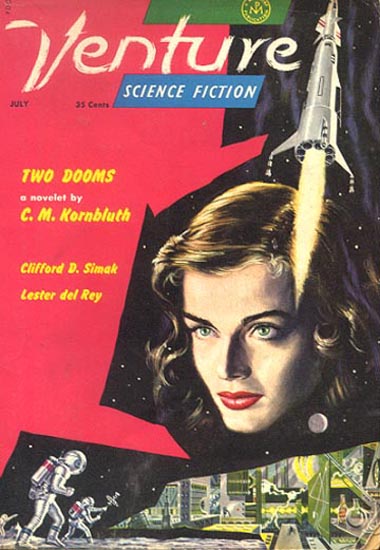
“Two Dooms” by C. M. Kornbluth. From the July 1958 issue of Venture Science Fiction. Kornbluth is maybe one of my favorite SF writers to have really flourished during the ’50s magazine boom-and-bust, although he had made his debut long before that. He was a prodigy whose earliest work was published when he was a literal teenager. Unfortunately he also died very young, at just 34, from a weak heart, robbing the field of one of its most incisive writers.
For the short stories:
“The Persecutor’s Tale” by John M. Ford. From the November 1982 issue of Amazing Stories. Speaking of very good writers gone too soon, Ford also made his debut when only in his teens, but he picked up on the trade pretty quickly. A writer’s writer, the best way to read a Ford novel is the read it twice. Sadly he died in 2006, at just 49, having not quite completed his final novel.
“Always” by Karen Joy Fowler. From the April-May 2007 issue of Asimov’s Science Fiction. Nebula winner for Best Short Story. Believe it or not, there’s an L. Ron Hubbard connection here. Fowler is maybe the most high-profile author to have made her debut in the annual (and Scientology-backed) Writers of the Future anthology series, although Fowler herself is not a Scientologist.
For the complete novel:
The Big Jump by Leigh Brackett. From the February 1953 issue of Space Stories. While Brackett’s first few stories were published in Astounding, she soon moved to other magazines that were more open to her brand of space adventure SF. By the end of World War II she’d come to be associated most with Planet Stories, in a mutually beneficial relationship. Indeed, after Edgar Rice Burroughs, Brackett can be considered the leading writer of planetary romance. She married fellow writer Edmond Hamilton in 1946, but they almost never collaborated. Nowadays she’s best known as a successful screenwriter, and for her grounded SF novel The Long Tomorrow, which is quite different from what she most often wrote. The Big Jump is a short novel, apparently published in magazine form unabridged, and later as one half of an Ace Double along with Philip K. Dick’s Solar Lottery.
(Cover by Chester Martin. Planet Stories, Summer 1946.)
Who Goes There?
Leigh Brackett debuted in 1940, with her first couple stories being printed in Astounding, but quickly she found other magazines more enticing despite the smaller paycheck. She stopped submitting to John W. Campbell for the same reason her future husband Edmond Hamilton did: creative differences. Campbell wanted science fiction of a new, more technical, more cerebral sort, while Bracket and Hamilton were devotees of a school of adventure fiction that predates Campbellian SF. Brackett, by her own admission, was also pretty indifferent to keeping up with real-world scientific discoveries. It might be considered strange, then, that nowadays Brackett is most known for her post-nuclear novel The Long Tomorrow and her work as a screenwriter. She also wrote a fair amount of detective fiction, which does show its influence in her SF somewhat. She wrote the first draft of the screenplay for The Empire Strikes Back in the last months of her life, which saw her return to her planetary romance roots.
Ray Bradbury is one of the most famous writers in all American literature, especially for his novel Fahrenheit 451 and his fix-up “novel” The Martian Chronicles. Bradbury didn’t think of himself as an SF writer and it’s probably best, if anything, to understand much of his fiction with a horror lends; indeed his first collection, Dark Carnival, was horror-focused. In the ’50s Bradbury would gain mainstream recognition, but in the ’40s he was a fledgling short story writer and fan, with Brackett and Henry Kuttner (who were only five years older than Bradbury) acting as mentors. “Lorelei of the Red Mist” is a Brackett story at heart, but for better or worse Brackett was unable to finish it before trying her luck at screenwriting, leaving Bradbury to write the second half of the novella by himself. For what it’s worth I think Bradbury did a good job paying respect to Brackett’s style, although even without the latter’s word on who did what it’s not hard to figure out where the Bradbury part of the story begins.
Placing Coordinates
First published in the Summer 1946 issue of Planet Stories, which is on the Archive. It’s been reprinted a fair number of times, including in Three Times Infinity (ed. Leo Margulies), The Best of Planet Stories #1 (ed. Leigh Brackett), The Great SF Stories Volume 8 (ed. Isaac Asimov and Martin H. Greenberg), Echoes of Valor II (ed. Karl Edward Wagner), and the Brackett collection Lorelei of the Red Mist: Planetary Romances. This is all for collecting’s sake since you can read the story for free on Project Gutenberg. Sadly there was never a sequel to that Planet Stories anthology.
Enhancing Image
Hugh Mongous Starke is a space robber who has made off with the biggest pile of money he’ll probably ever see in his life—only he’s on the run from authorities and it looks like he won’t live much longer. Indeed it doesn’t take long for a mishap with his ship to send his body packing, although his mind proves to be much more resilient. Left dying on Venus, Starke is confronted by a strange woman named Rann, who has the power to spare Starke and give him a new body if only he would hold up his end of a certain deal. Rann is a sorceress, the Lorelei of the title (I thought for a while it was the name of a character, but it’s referring to Rann and her role as a sort of temptress), who has powers beyond Starke’s understanding. Starke gets his new body, but he quickly finds he’s been thrown into a conflict he can scarcely fathom, among people who want him dead.
A while ago I reviewed Brackett’s “Enchantress of Venus,” one in a series starring the futuristic barbarian Eric John Stark (Starke and Stark are very different characters, I might add), and Brackett’s Venus in both stories very much takes after early 20th century depictions of the planet. Even in 1946 the Venus of this story must’ve seemed a little far-fetched. Think Zelazny’s “The Doors of His Face, the Lamps of His Mouth.” It’s not exactly hospitable, but it’s livable for humans who are tough enough; there’s local wildlife, and as expected this Venus is swampy, with the Red Sea (the red mist of the title) being home to a very dense gas as opposed to water. The gas is dense enough to buoy ships but breathable enough that a human could traverse the bottom for several hours without scuba gear. This is all stuff Starke will learn much later but which will be familiar to those of us who have read one or two of Brackett’s Venus stories before.
Starke’s mind has been transplanted to the body of Conan, a warrior who has been kept in chains (“Starke’s new body wore a collar, like a vicious dog.”) and tortured in the dark corridors of Crom Dhu, an island surrounded by the Red Sea and connected to the mainland only with a jetty. Crom Dhu is home to the Rovers, a group of humans (like Starke) who, unlike Our Anti-Hero™, have stuck to a borderline medieval way of living. There’s Romna, the local bard, and Faolan, the leader of the pack who has been rendered blind, both literally and with hatred for Conan. Then there’s Beudag, Faolan’s sister and, as it turns out, Conan’s lover—or rather former lover. Conan, despite being one of the Rovers, has been tortured because he betrayed his own people in a recent battle: he was set to marry Beudag but turned his back on her in favor of Rann. It’s unclear if Conan had planned this from the start or if Rann had put some kind of spell on him. He would’ve run off with the sorceress had he not been captured, and apparently Conan’s mind broke under the torture (possibly also combined with guilt), making his body an ideal vessel for Rann to slip Starke’s mind into it.
To get the obvious out of the way, this is in part a Conan homage. The fact that the Rover hideout is called Crom Dhu doesn’t help. Something clever Brackett does is that she makes the protagonist a typical space opera character (a lovable rogue in the mode of Han Solo, you could say) and puts him in the body of a sword-and-sorcery hero. Eric John Stark takes after Conan (not to mention Tarzan) while Hugh Starke is basically a civilized man (albeit a remorseless criminal), only he’s been thrown into a scenario that would not be unusual for Robert E. Howard to conceive. We also don’t get to know much about the Conan of Brackett’s story, since his consciousness is MIA (although not as absent as was first thought, as we’ll discover later) and he can’t get a word in edgewise. The other characters tell us what sort of man Conan was like and it’s up to Starke to fill in the blanks; he’ll have to do his homework pretty quick, after all, or else he might get killed by one of the Rovers who are out for vengeance. Faolan suspects Starke might be an agent for Rann—a rational concern, considering Rann does want Starke to destroy the Rovers from the inside.
To complicate things further, Beudag clearly misses her former lover, and seeing him returned to a somewhat normal state (or rather seeing his body again inhabited by a working mind) immediately draws her to Starke. Starke is similarly taken with Beudag, who is a warrior lady who could probably crush his head with her thighs. Romance is not exactly Brackett’s strong suit (I remember criticizing the romantic aspect of her Eric John Stark stories that I’ve read), but the off-the-cuff romance in “Lorelei of the Red Mist” feels more justified since Starke is in the body of a man who was in love with Beudag, and he eventually finds that his memories are actually becoming intertwined with Conan’s, on top of Rann’s power over him. This story apparently drew some controversy among the Planet Stories readership for its overt (for 1946 pulp fiction) sexuality, and true enough Brackett and Bradbury are eager to describe human nudity (both male and female) in as much detail as was possible under the circumstances. It’s also unambiguous that both Beudag and Rann find Conan (or rather his body) very attractive. This is not just titilation. There’s some irony in the fact that Starke has a strong mind but originally had a weak body, while Conan has a strong body (even under torture) but a relatively weak mind.
But wait, there’s more! There’s a threeway conflict going on. There’s the humans, the sea-people who dwell in the Red Sea (they’re humanoid but they have gills and thin webbing between their fingers and such), and Rann’s people, who are descended from the sea-people and are apparently racist toward their own ancestors. All three sides hate each other, but right now shit is not looking good for the humans, as Crom Dhu has been under siege and there’s no way of getting off the island. The island is fortified such that Rann’s people will have a hard time getting in, but Faolan’s people can’t get out, and if Faolan dies then the humans will have no choice but to surrender. All Starke would have to do is kill Faolan and Rann will get what she wants and Starke will get his million credits. Rann is held up in the city of Falga, and there was a battle there recently that left the humans retreating and Conan becoming a traitor. There’s a whole backstory that’s partly given to us through exposition but which remains partly up to the reader’s imagination, the result being that Brackett (and I say her specifically since she wrote the first half and thus did most of the legwork with world-building) makes the world of the story feel bigger than it is.
There Be Spoilers Here
Starke, under the influence of Rann, nearly kills Faolan, Romna, and Beudag before being “rescued” by Rann’s people. The deal was that if Starke did what he was supposed to then he would get a million credits, but obviously Rann has no intent of actually following through on this, resulting in Starke narrowly surviving the double-cross and retreating into the Red Sea. It’s at this point that the story takes an unusual turn, and this is because Bradbury is now in control. Brackett said she didn’t know where the story was heading when she passed the torch to Bradbury, and admittedly you can still predict the rest in broad strokes. The details are what matter, though. The story doesn’t descend into horror exactly but it does get noticeably spookier, and the language becomes a bit more poetic as well. (I don’t see Brackett using “ebon” as frequently as Bradbury does here.) Bradbury does his best to mesh with Brackett’s style, but still there’s a switching of gears that you’d probably notice even if you didn’t know the nature of this collaboration. The SFnal part of the story was already tenuous, but by the time Bradbury takes over it has all but evaporated. I do like the idea, however, that within the bast universe of this distant future, with his spaceships and laser beams, that there are pockets of civilization that lag centuries behind that future. The Rovers, for example, have no issue with slavery, nor do they seem to have any weaponry that’s on par with even 20th century American standards. Jack Vance would basically make a whole career on such far-future medievalism.
At the bottom of the Red Sea, Starke comes across a pack of hounds, and a shepherd, one of the sea-people who apparently has the power to bring the dead back to life—not to their full selves, but as zombies. This is something that was not alluded to at all previously. The sea-people wanna use an army of the undead to take both Crom Dhu and Falga, which naturally doesn’t please Starke. Using a nigh invincible army would be nice, but Beudag has been taken hostage by Rann and Starke does feel that he ought to redeem himself in the eyes of the Rovers. It could also be that his personality has meshed with that of Conan’s to the point where he’s seeing himself in Conan’s shoes. “That part of him that was Conan cried out. Conan was so much of him and he so much of Conan it was impossible for a cleavage.” He manages to convince the shepherd to at least have the sea-people strike Falga first, to buy the Rovers time and maybe convince the sea-people that they have a common enemy! Which works! Although the ensuing battle at Falga—really a massacre more than a real battle—is depicted as horribly grotesque. “It was very simple and very unpleasant.” Still, he convinces the sea-people to spare Crom Dhu the same fate. The climax of “Lorelei of the Red Mist” has Starke do the typical heroic things, like rescuing Beudag, saving Crom Dhu, and killing Rann, but it’s also about him coming to terms with the fact that he is no longer entirely Hugh Starke, but “Hugh-Starke-Called-Conan,” host to that second personality and vicariously offering Conan the chance to redeem himself. Starke eventually finds his old body and gives it a proper burial, saying goodbye to his old self literally but metaphorically also saying goodbye to his former life as a rogue. He will work to become an honorable warrior now, with Beudag (who is in love with both Starke and Conan) at his side.
A Step Farther Out
This is a very interesting story, even if it is structurally wonky. It doesn’t help also that I was very tired (from work and a sprained ankle denying me much-wanted sleep) when I was reading it. It does seem a bit long in the tooth, not helped by the obvious divide between the Brackett and Bradbury material. At the same time this is exactly the sort of story that would never see print in Astounding, because it’s a little too fun-loving, a little too horror-inflected, a little too unscientific, and a little too erotically charged. Despite taking place on the same version of Venus as the aforementioned “Enchantress of Venus” this feels less like Edgar Rice Burroughs and more like Robert E. Howard, which of course is not a bad thing! (Makes me wonder what might’ve happened had Howard lived to see the sword-and-planet boom of the ’40s and early ’50s.) If you’re interested in old-school planetary romance, something which predates Dune and which is a lot less sophisticated but also less heady than Herbert’s take, this is a good start.
(Cover by Edward Valigursky. Amazing Stories, May 1959.)
It’s February, and 29 days instead of the usual 28—not like that makes a difference for my review schedule. It’s the time of one of my least favorite holidays: Valentine’s Day. I just ignored it last year, but this time I figured I may as well have some fun with the timing of it. Originally I was gonna tackle all collaborative stories this month, as a gimmick. After all, it takes two to tango, and authors working together can sometimes bring out the best in each other. Indeed for the collaborations I decided to go for different types of collaborative relationship: mentor and apprentice (Brackett and Bradbury), siblings (the Strugatsky brothers), an emerging master and his idol (Ellison and van Vogt), young lovers (Tuttle and Martin), and an actual married couple (Kuttner and Moore). It’s a fun idea!
Unfortunately I did say “originally” because tragedy struck the field last month: we lost some our most talented writers. Within the span of a week Terry Bisson, Howard Waldrop, and Tom Purdom died. I was gonna wait until April to do this, but I realized that with the way things have been going we might lose a few more major talents in the interim. This may sound cynical, but I wanted to strike while the iron was hot. It also lets me not have to comb too hard for collaborative stories.
For the novellas:
“Lorelei of the Red Mist” by Leigh Brackett and Ray Bradbury. From the Summer 1946 issue of Planet Stories. The logical heir apparent to Edgar Rice Burroughs, Brackett’s influence on the planetary romance can’t be overlooked. I need not tell you about Bradbury. Despite being only five years his senior and debuting around the same time, Brackett acted as a mentor figure to Bradbury. It’s probably not a coincidence both were Planet Stories regulars in the late ’40s.
“The Storms of Windhaven” by Lisa Tuttle and George R. R. Martin. From the May 1975 issue of Analog Science Fiction. This is a reread, but you know how I feel about rereads. Tuttle is known for her horror, but she has also dabbled in SF, and I can guess how she contributed to the Windhaven stories. I don’t need to introduce Martin. They were lovers in the early ’70s, and were probably still together when they came up with the Windhaven setting.
For the short stories:
“The Human Operators” by Harlan Ellison and A. E. van Vogt. From the January 1971 issue of The Magazine of Fantasy and Science Fiction. The first of the two Ellison collaborations, although it was actually the last released, its magazine publication being pretty much simultaneous with Partners in Wonder. Ellison thought the world of van Vogt, even bullying the SFWA into making him a Grand Master.
“First Fire” by Terry Bisson. From the September 1998 issue of Science Fiction Age. Bion has the unique honor of being the first author whose work I reviewed on this site, that being his legendary story “Bears Discover Fire.” Bisson started out as a novelist but is probably now more remembered for his short fiction, with short but densely packed stories like “macs” and “They’re Made Out of Meat.”
“What You Need” by Henry Kuttner and C. L. Moore. From the October 1945 issue of Astounding Science Fiction. Retro Hugo nominee for Best Short Story. It’s hard to overstate how great Kuttner and Moore were together in the ’40s, and also how prolific. My quest to cover as many Twilight Zone stories as I can continues, as “What You Need” was turned into a classic TZ episode of the same name.
“Initiative” by Arkady and Boris Strugatsky. From the May 1959 issue of Amazing Stories. Translated by Harmon Rutley. The Strugatsky brothers were, aside from Yevgeny Zamyatin, the first Russian authors to leave an impression on American genre SF; mind you this was during the Cold War. Their novel Roadside Picnic is one of the most famous non-English SF novels, as well as the inspiration for Stalker.
“Do Ya, Do Ya, Wanna Dance?” by Howard Waldrop. From the August 1988 issue of Asimov’s Science Fiction. Unlike Bisson, Waldrop seemed to think himself much more keen on short fiction, with only one solo novel being published and at least one more supposed to have been written but never seeing print. He’s probably most known for his seminal alternate history story “The Ugly Chickens.”
“Reduction in Arms” by Tom Purdom. From the August 1967 issue of The Magazine of Fantasy and Science Fiction. Despite having debuted in the ’50s, Purdom was one of those writers who really came into his own in the ’60s, when the New Wave was in full bloom and the market for genre SF had become more permissive. Purdom remained active for over sixty years, and his absence is sorely felt.
Not much else to say. Next month, as I said not long ago, we’ll be covering all short stories, all from F&SF, and all from the ’50s. February is another roster of novellas and short stories, but with a twist.
(Cover by Allen Anderson. Planet Stories, Fall 1949.)
Who Goes There?
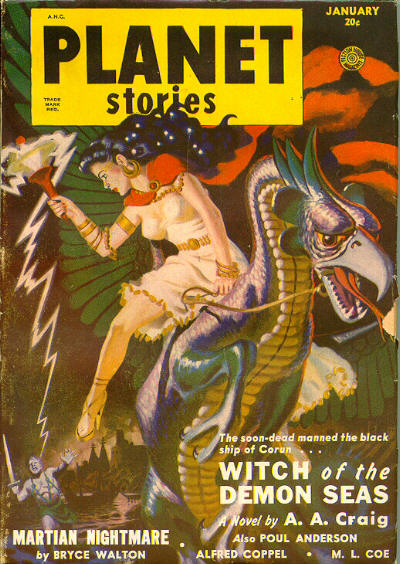
Planet Stories is a pretty interesting magazine whose contents I ought to give the deep-dive treatment one of these days, since a) it was one of the few SFF magazines in the ’40s to have a distinct personality of its own, and b) it encapsulates pulp science fiction at its most charming. It is a charming publication, with garish action-packed covers (perfecting the brass bra, I wanna add), probably the liveliest letters column in the field at the time, and, despite its juvenile exterior, being home to some excellent writers. Poul Anderson started his Dominic Flandry series here. Ray Bradbury contributed a few entries in what would later form The Martian Chronicles. Philip K. Dick’s first published story appeared here. But the author to define the magazine’s image was undoubtedly Leigh Brackett, whose planetary romances often made the cover, though she was generally keen on publishing in the adventure-leaning magazines like Startling Stories.
Brackett made her first couple sales to Campbell at Astounding Science Fiction, but she quickly looked elsewhere for her fiction, even if these magazines paid less. Nowadays Brackett is most known for the pretty good but uncharacteristic novel The Long Tomorrow, as well as her fairly successful career as a Hollywood screenwriter—for collaborating with Howard Hawks and, at the end of her life, writing the first draft of The Empire Strikes Back. Because Brackett got final screenwriting credit, she won a Hugo when the film won for Best Dramatic Presentation; she had been dead for three years when this happened. But for much of her time in our field, she acted as the heir apparent to Edgar Rice Burroughs, albeit being easily more downbeat and sophisticated than Burroughs. The star of today’s story, Eric John Stark, an Earthman raised on Mercury, owes a good deal to John Carter and Tarzan, with a strong hint of Conan the Barbarian.
Placing Coordinates
First published in the Fall 1949 issue of Planet Stories, which is on the Archive. More importantly, because “Enchantress of Venus” fell out of copyright and someone took note of this, it’s free and perfectly legal, being available on Project Gutenberg in a variety of formats, link here. For print we have more options still, this being one of Brackett’s more reprinted works of short fiction. The most relevant to me would have to be The Best of Leigh Brackett, part of the Ballantine slash Del Rey Best Of series—edited and with an introduction by her husband, Edmond Hamilton. Brackett did the same for Hamilton’s Best Of collection. Aww.
Enhancing Image
A bit of exposition before we get to the story proper, since the mechanics of Venus as depicted in the story are a little odd, especially for modern readers. In contrast with the red desert world of Mars, as in the preceding and proceeding Stark stories, the Venus in “Enchantress of Venus” is about as swampy as you can imagine—with gas so thick that it can actually buoy ships. Specifically the area where the action is set, so called the Red Sea, is what we might now call a dead sea in that it’s not filled with water; it is, however, filled to the brim with red gases. “It was not water. It was gaseous, dense enough to float the buoyant hulls of the metal ships, and it burned perpetually with its deep inner fires.” It is indeed possible to breathe at the bottom of the Red Sea, which will be important to keep in mind for later. I say all this now because I was quite confused at first myself.
Stark has come to Venus in search of a friend, but it doesn’t take long for him to acquire yet one more problem in the form of the captain of the ship he’s taken to Shuruun, the pirate-infested port town. The captain, Malthor, is perhaps one of these pirates in disguise, hoping to knock Stark unconscious or worse—a hint Stark picks up in time to fight back, scarring Malthor, before jumping ship. In Shuruun he again narrowly escapes getting his shit kicked in, partly because he’s musclebound enough to be played by a young Arnold Schwarzenegger and partly because, under strenuous circumstances, his upbringing by native Mercurians kicks in and he’s able to go beast mode. Something we find out quickly enough in this series is that Stark rather strongly takes after Tarzan, being half-man and half-beast, born to Earth people but raised in a savage culture. Stark is a barbarian in the sense that he is halfway between a civilized man and an animal.
While in Shuruun, Stark meets up with Larrabee, a fellow Earthman in exile, one who has been gone so long that people of Earth have since thought him dead. “He had never met Larrabee, but he remembered the pictures of him that had flashed across space on police bands.” The two get along as fellow expats, but Larrabee is about to leave the narrative for a long so it’ll be easy to forget about him. More of immediate importance is that we also run into Malthor’s daughter, Zareth, who going by descriptions of her also has to be of high school age. (I’m somewhat baffled by Brackett’s decision to have the third-person narrator linger on Zareth’s barely pubescent physique. I would expect such a decision from Marion Zimmer Bradley, but not Brackett.) Zareth admits upfront to being an agent of Malthor, who will beat her if she doesn’t do her job of luring Stark into a trap, but even so she refuses to go through with it, instead urging Stark to get out of Shuruun.
There are two female characters of importance here (I guess there’s a third, but she doesn’t do much), with Zareth as the first. Something I’ve noticed about Brackett’s writing is that it would be easy, if we were to apply whiteout to author bylines, to assume that the Stark stories were written by a pretty masculine if also gloomy man, given the role women play here. Not to say Brackett indulges in some internal misogyny, but it’s more how the women exist in relation to the male lead. Zareth is an innocent, almost angelic figure whose beauty (problematically described though it is) is to be taken in an ultimately platonic context; we can infer that while Stark respects Zareth, he is not enough of a pedophile too virtuous, despite his savagery, to see her as anything more than a good friend.
We’re told, however, of a series of islands in the Red Sea, about the “Lost Ones,” people who are spirited away and never to be seen again—about a castle where a band of slave-drivers called the Lhari lives. So naturally Stark goes there! What could possibly go wrong? It’s here that we’re finally introduced to our villains, the Lhari: a family of incestuous thieves and warlords who have taken people as slaves for the purpose of finding something at the bottom of the Red Sea. There are several members, but the big players are Varra, the titular enchantress (also a falconer); Egil, a mad warrior and Varra’s cousin, who also happens to be madly in lust with said cousin (wooo); Treon, a disabled man who is treated by his family as a moron but who is clearly not that, on top of being clairvoyant (ya know, the token good member of the family); and Arel, the matriarch of the family, a demented old woman who is basically a witch.
(Some femme fatales would put on an outward appearance of benevolence, but Varra is surprisingly upfront about being a bad bitch who only wants Stark for his muscles; he is apparently quite… breedable. I’m sorry, I don’t know how else to put that. In fairness to Varra, her choices are some other slave or to give Egil a pity fuck, which she’s not inclined to do. Needless to say Stark is not looking forward to being Varra’s sex slave. If I recall correctly the titular villainess of “Queen of the Martian Catacombs” also treats Stark as a sperm bank with arms and legs, which makes me wonder if there’s some femme-dom fetish-pandering at work here.)
In better news, in being held captive by the Lhari, Stark does finally meet Helvi, the friend he came to Venus looking for in the first place. Helvi has survived as a slave so far, but his brother, who “had broken tabu and looked for refuge in Shuruun,” was not so lucky. “A man cannot live too long under the sea,” Helvi says. They have to get out of here, but ideally before that they ought to figure out what the Lhari are excavating the bottom of the sea for and put a stop to them while they’re at it. You may notice we’re knee-deep in the novella and there’s been shockingly little action up to this point; we’ll get to that, but this is a story heavy on both atmosphere and dialogue, and the Lhari are quite chatty for being so inbred that their family tree looks more akin to a stump. (I’m sorry, I couldn’t resist.)
There Be Spoilers Here
Varra offers Stark to kill Egil and the other members of the family, barring Treon (whom Varra dumbly sees as no threat) and Arel (who’s pretty old and decrepit already), in exchange for Stark’s freedom and being able to raw-dog Varra every other night as co-ruler of Shuruun. This all sounds like a good deal, if not for the fact that Varra is clearly untrustworthy and is as likely to stick a knife in Stark’s back. Stark ultimately refuses, in a reasonable move which indicates he’s at least of average intelligence; some others of his ilk are more easily bamboozled. Unfortunately Stark has made multiple enemies at this point, with even Malthor rearing his head again so that Stark and him can have a rematch. Apparently Zareth, having been beaten (again) for not betraying Stark, has led Malthor to the bottom of the sea. No matter. Malthor goes down easily enough.
Egil, who had been eyeing Stark this whole time, nearly gets him with a crossbow, only for Zareth to do that ’90s action movie trope of jumping in front of the bolt to save Stark, sacrificing herself in the process. I was expecting some deus ex machina to kick in so that Zareth could be saved, but no, she dies the real death. In fairness, Egil’s death is worse, with Treon even looking on casually, “as though he had seen it all before and was not surprised.” Stark and Treon agree to have Zareth buried in her proper place, and the snowball of vengeance has now thoroughly been set in motion. The back end of “Enchantress of Venus” is a bit of bloodbath. A war between the slaves and slave-drivers breaks out with the slaves narrowly winning, “Nearly half the slaves were dead, and the rest wounded.” The Lhari are worse off. Treon kills Varra (a death so sudden that it’s actually easy to miss), but not before she mortally wounds him, while the rest die in battle. Treon, being the token good member of the family, is the only one to get a proper farewell from Stark; Our Hero™ seems just glad to be rid of Varra.
The Lhari have been wiped out, but more importantly the dark secret they’ve been trying to uncover (I won’t go into details, but I will say it reminded me of Indiana Jones and the Kingdom of the Crystal Skull) has been rendered such that nobody can make use of it anymore. It’s not hard to take an allegorical reading from all this, with the dark secret that ought not to be used by anyone standing in for (perhaps) the invention of the atomic bomb. There was a good deal of science fiction written about atomic power and the possibility of nuclear weapons in the year’s leading up to World War II, but following that war SF writers became deeply wary about the tangible reality of living in a world that could be torn asunder by said nuclear weapons—previously hypothetical but now known. “Enchantress of Venus,” like some of Brackett’s other later fiction, is filled with such wariness. Stark rescues Helvi and frees the slaves, but at a steep cost. Despite its action and generous doses of testosterone, this is not an adventure yarn that would make the reader feel like a jolly good badass vicariously.
A Step Farther Out
I was originally gonna tackle the first Eric John Stark story for this site, “Queen of the Martian Catacombs,” but I found that a) I was not yet accustomed enough to Brackett’s swashbuckling style to make total sense of it, and b) “Queen of the Martian Catacombs” was such a straightforward adventure narrative that I struggled to think of things to say about it. Not as much of an issue with “Enchantress of Venus,” in part because it’s so much slower than its predecessor, but it’s also a good deal bleaker. Given the episodic nature of the series it’s expected that Stark will end up pretty much where he started, but in this case it means a whole lot of death, including a few characters we’ve actually come to care about. When the action finally ramps up towards the end it comes almost as a relief, given the oppressive foggy atmosphere and wholly unlikable villains. Brackett’s science-fantasy outlook still reads as partly foreign to me (if you care about scientific plausibility then you will not survive), but look, I’m willing to forgive something if the tone is the right amount of melancholy.
(Cover by Allen Anderson. Planet Stories, Fall 1949.)
This will turn out to be a busy month for me. I’m gonna be a guest on one or two podcasts/streams with some people I very much respect, and I’ll also be flying out of my Jersey/Pennsylvania bubble to visit some friends I rarely ever get to hang out with in person. On the one hand this is all more eventful than what I usually deal with, but also I’ll have a bit less time to manage this site—which won’t stop me from putting in as much effort as I usually do. It’s draining sometimes, but that is how passion works.
My personal life is gonna be busy, but also my review lineup is FILLED for May: we’ve got two serials, two novellas, two short stories, and finally a complete novel—our first one in six months. I know, the gap between novel reviews looks to be wide, but mind you that there aren’t too many of these “complete” novels in the magazines.
One more thing: I mentioned in a past editorial that I think very highly of 1953 as a year when SFF flourished, in general and especially in magazine publishing, which was experiencing a bubble we would not see again until… now, basically. Strangely, I haven’t before covered ANYTHING from that year, so to compensate we’ve got two stories from 1953 in the lineup. 1953 was such a banger that I could probably get five years out of just reviewing everything that was published then.
Enough wasting time, though, let’s see what we have.
For the serials:
All Judgment Fled by James White. Serialized in Worlds of If, December 1967 to February 1968. White is an author I’ve not read a single word of (or at least I think) up to this point, and given his philosophy with storytelling this feels a little criminal to me. When planning this post I flip-flopped between All Judgment Fled, Second Ending, and The Dream Millennium for my first White, since all three sound appealing, and ultimately went with this because I’ve also been meaning to tackle something—anything—that was published in If.
Sos the Rope by Piers Anthony. Serialized in The Magazine of Fantasy and Science Fiction, July to September 1968. Yes, that Piers Anthony. He actually appeared regularly in the genre magazines early in his career, when he was a promising young writer and people did not yet know the horrors he was about to unleash on the world. My only prior Anthony experience was the short story “In the Barn,” and let me tell you… that’s the kind of thing that puts you off an author for years. But maybe Sos the Rope, his second novel, will be good!
For the novellas:
“The Rose” by Charles L. Harness. From the March 1953 issue of Authentic Science Fiction. Retro Hugo nominee for Best Novella. Harness is one of those recent discoveries of mine that I’ve been meaning to explore further—made easier because Harness was not that prolific a writer; when he wrote he was fairly productive, but then he would vanish for several years. Harness apparently struggled to find a publisher for “The Rose” in the US, having to jump across the Atlantic and submit it to a filthy British magazine.
“Enchantress of Venus” by Leigh Brackett. From the Fall 1949 issue of Planet Stories. Brackett is now most known for her part in the messy scripting process for The Empire Strikes Back, for her collaborations with director Howard Hawks, and for the rather unchararcteristic novel The Long Tomorrow. Much of Brackett’s fiction, however, is planetary romance a la Edgar Rice Burroughs, complete with swashbuckling antics. “Enchantress of Venus” is one of several stories starring Eric John Stark, the barbarian hero for the space age.
For the short stories:
“Second Variety” by Philip K. Dick. From the May 1953 issue of Space Science Fiction. Retro Hugo nominee for Best Novelette. Not that I try to hide my biases anyway, but Philip K. Dick is one of my top five favorite authors—and he ain’t #5 on that list. But before he broke new ground as a novelist, Dick was one of the most talented and prolific SFF writers of the ’50s, with about thirty of his short stories being published in 1953 alone. “Second Variety” is one of Dick’s most famous short stories, and yet somehow I’ve not read it before.
“Black God’s Shadow” by C. L. Moore. From the December 1934 issue of Weird Tales. It’s been two months since I reviewed Moore’s “The Black God’s Kiss,” which was a reread, and true enough there was a two-month gap in publication between “The Black God’s Kiss” and its direct sequel. Only a year into her career and Moore had skyrocketed to being one of Weird Tales‘s most popular authors, with the adventures of Northwest Smith and Jirel of Joiry getting started during this period. Moore is a favorite of mine, naturally.
For the complete novel:
Big Planet by Jack Vance. From the September 1952 issue of Startling Stories. Believe it or not, this is a reread—actually one of the first stories I remember reading via magazine scan. As is often the case with me, though, there are surely many things about this novel that I didn’t pick up on a first reading. Vance is not an author I’m strongly attached to, but he does fill a certain niche, being a planet builder par excellence and a crafter of gnarly planetary adventures when he feels like it. Big Planet represents planetary romance shifting away from the Burroughs-Brackett model (which is really science-fantasy), and injecting the subgenre with some semblance of scientific plausibility. But how does this novel hold up on a reread? Let’s find out.
We have a nice mix of science fiction and fantasy, all of it vintage. We’ll get back to some more recent publications next month… maybe. You have to understand that I only cover so much in a given month and that there’s so much history behind the genre magazines. The roster, you may notice, leans toward adventure this month, between the Brackett, Moore, Vance, and probably the Anthony pieces; it just sort of turned out that way. Maybe given that I’ll be traveling soon I thought it appropriate to focus more on tales of high adventure for my site. Regardless, it won’t be a boring lot.