(Cover by Virgil Finlay. Famous Fantastic Mysteries, December 1947.)
I was thinking of taking a break from this blog for this month, but maybe I’ll save the vacation for September. Funnily enough it was easier to come up with a review forecast, with stuff I’m interested in checking out, than it was to announce a month-long break. This is what happens when you’re a compulsive reader.
Anyway, we’re back to our usually programming, although we have a serial novel in a whopping four installments (although Space Viking is not as long as the installment number would have you think), as well as a reprinted SF-horror yarn by one of the most famous British authors of all time. Of course, with the exception of Arthur Conan Doyle, these are all authors I’ve covered before. I figured that if I’m gonna keep myself busy, even going against my own expectations, I may as well keep things “safe” for the time being. At least with Bruce Sterling this is earned, considering I was set to write about another short story of his many moons ago, only to not get around to it. Consider this a second attempt.
I’m keeping this post short and sweet. Not much to report on my end, aside from recently acquiring a second cat. (Cats are easy to adopt, like they just kinda let you pick them up, get them their shots, sign a paper, badda-bing badda-boom.) I also have maybe one too many books on my plate at the moment (incidentally none of them are genre fiction), so I hope to whittle that down, make things more manageable.
As for the stories, we have one from the 1910s, one from the 1960s, one from the 1970s, and two from the 1980s.
For the serial:
Space Viking by H. Beam Piper. Serialized in Analog Science Fiction, November 1962 to February 1963. Piper was born in 1904, but didn’t start writing SF until he was in his forties, making his debut in 1947. The next decade or so was productive enough for him, including the non-SF mystery novel Murder in the Gun Room. Said novel, while not SF, does pay tribute to fandom in the years following World War II. Space Viking was one of several novels Piper had written in quick succession in the last few years of his life, along with The Cosmic Computer, Little Fuzzy (and its sequel), and Lord Kalvin of Otherwhen. Sadly, after a failed marriage and with the belief that his writing career was floundering, Piper took his own life in 1964.
For the novellas:
“The Color of Neanderthal Eyes” by James Tiptree, Jr. From the May 1988 issue of The Magazine of Fantasy and Science Fiction. Tiptree is one of the most acclaimed authors of her generation, although despite being typically considered part of the New Wave she was actually a decade or two older than most of her peers. Her life story is a dramatic one, worthy of a Hollywood biopic, and the circumstances of her death remain controversial to this day.
“The Araqnid Window” by Charles L. Harness. From the December 1974 issue of Amazing Stories. Harness’s career as a writer spanned six decades, although it came in fits and starts. He stepped away from writing in the ’50s to focus on his job and raising his family, only returning after a decade. “The Araqnid Window” itself is one of only two Harness stories published in the ’70s. His job as a patent attorney goes to explain his low output.
For the short stories:
“Sunken Gardens” by Bruce Sterling. From the June 1984 issue of Omni. Sterling was born in Brownsville, Texas, but later became an Austin denizen. Unusually he made his fiction debut with a novel, Involution Ocean, published when he was very young. His first ambitious project, though, was the Shaper/Mechanist universe, comprising the novel Schismatrix and some short stories.
“The Horror of the Heights” by Arthur Conan Doyle. From the December 1947 issue of Famous Fantastic Mysteries. First published in 1913. While Doyle did not invent the detective story (he rightly credits Edgar Allan Poe with that), he did codify the genre and became quite rich and famous off of it it. Doyle also wrote in other genres, though, including horror and science fiction.
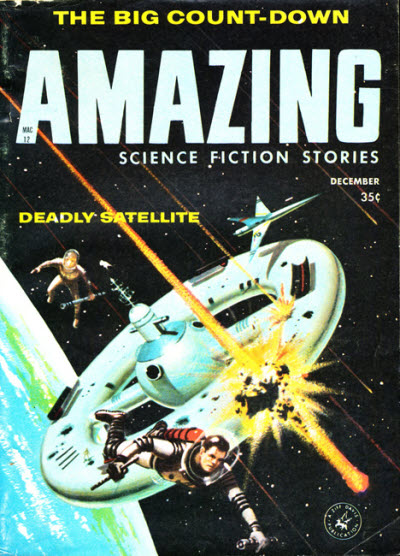
(Cover by Ed Valigursky. Amazing Stories, December 1958.)
Who Goes There?
Over the half-century and change that he was active, writing whatever the hell he wanted, Harlan Ellison made some friends, many admirers, and about as many enemies. In his lifetime he was one of the more controversial genre writers in the business, not least because of his toxic personality and at times really petty grievances. He was, for better or worse, about as dramatic as his fiction, which is saying something. Ellison was born in 1934 and started writing professionally when he was barely out of his times, just in time to see the magazine boom-and-bust of the ’50s, although it wasn’t until the ’60s that he really started catching people’s attentions. 1967 in particular can be considered an annus mirabilis for Ellison, as it saw the publications of his Hugo-winning story “I Have No Mouth and I Must Scream” and the landmark anthology Dangerous Visions, as well as the airing of the Star Trek episode “The City on the Edge of Forever,” which Ellison wrote the initial draft for (it’s a long story). Had Ellison tragically died in 1970, his legacy as an important figure would’ve remained secure, but he continued to write great fiction for several more decades.
In 1958 Ellison was another young writer looking to make some money by selling to as many outlets as he could. He wrote prolifically in the latter half of the ’50s, but little of this material would eventually make it into the big Ellison volumes like The Essential Ellison and Greatest Hits, with “Are You Listening?” being one of those forgotten early stories. Unfortunately there’s a reason for this. “Are You Listening?” isn’t terrible, but it’s rather forgettable, with the saving grace being that it shows an early attempt at handling a certain theme that would become a recurring one for Ellison, namely the issue of conformity in society.
Placing Coordinates
First published in the December 1958 issue of Amazing Stories. It was reprinted in the Ellison collections Ellison Wonderland and The Beast That Shouted Love at the Heart of the World.
Enhancing Image
Albert Winsocki has a problem: he seems to have phased out of existence. To be clear, Albert is alive and in the world, walking among the living, but the living don’t acknowledge him at all. Even Alma, his wife, simply started acting like he’s disappeared one day, despite the fact that he’s in the kitchen with her and trying to have a conversation. When people say they feel like they don’t exist anymore it’s just a figure of speech, but with Albert it’s quite literal. It isn’t even that Albert has become a ghost, with people and things phasing through him. Oh no, he can touch people, and even punch a guy in the nose, but he gets away with it because not only does the guy not notice getting punched, he doesn’t even feel the very real nosebleed. Suddenly it’s like no matter what Albert says or does matters. In a way this is all karmic. For the past couple decades of his life Albert’s been an unexceptional husband and an unexceptional worker, and now he’s paying for it. He’s worked at the same jewelry store for years, but his own boss doesn’t acknowledge him when he appears.
At least he’s honest. As Albert tell us:
I had been quiet all my life; I had married quietly and lived quietly and now, I had not even the one single pleasure of dying with a bang. Even that had been taken from me. I had just sort of snuffed out like a candle. How or why or when was no matter. I had been robbed of that one noise I had thought was mine, inevitable as taxes. But even that had been deprived me. I was a shadow… a ghost in a real world. And for the first time in my life, all the bottled-up frustrations I had never known were banked inside me, burst forth. I was shocked through and down with horror, but instead of crying, I did not cry.
In a metaphorical sense, if not literal, Albert’s malady is not unique to him. From the introductory blurb to the story itself it’s clear that this is about alienation and conformity in an urban post-war society. In the 1950s this was such a common theme, from Ralph Ellison’s Invisible Man to Invasion of the Body Snatchers, that it sort of became a cliche with ’50s American art, especially that which was made by educated men. Ellison was a child during World War II and just a bit too young to have been sent to Korea (although he did serve in the army later, during peacetime), but he came of age during an era when the US was emerging as one of two superpowers in the world. Yet a sense of ennui hung over Ellison and others of his generation like a cloud. Assuming “Are You Listening?” takes place in the late ’50s, Albert would actually be of the so-called Greatest Generation, but despite his age this is a story that comes off as having been written by a considerably younger person. There’s an overflowing of angst that typically belongs to the young, but also its roughness (Albert is not a very compelling narrator, which you could argue makes sense, but still) betrays the hand of someone who was doing apprentice work at this point.
Not a criticism of the story itself exactly, but I’m not sure why this was printed in Amazing Stories instead of Fantastic. I say this because while Ellison is known primarily for writing science fiction (although he rejected the label), he also wrote his fair share of fantasy and horror—indeed he sometimes wrote stories that can’t be easily categorized. “Are You Listening?” doesn’t have anything SFnal about it, as Albert problem just sort of happens to him one day and we never get a rationalization for it (I feel like I’m not spoiling anything by giving that away). The story is clearly meant to be a supernatural fable, albeit one where the “ghost” is technically still alive. This sounds more interesting on paper than in execution, sad to say; but on the bright side, at least it’s short. It also feels like a test run for “‘Repent, Harlequin!’ Said the Ticktockman,” with the overall message being that you should do whatever in your power to avoid being put in a metaphorical box. History loathes a conformist.
There Be Spoilers Here
Ehhhh…
A Step Farther Out
I’m not sure why this was printed in Amazing when it would’ve been a better fit for Fantastic. This was the first issue with Cele Goldsmith as editor, although she would’ve been sifting through stories Paul W. Fairman, the previous editor, had bought. This was also one of many stories Ellison would’ve been pumping out at the time, few of which would ever be reprinted more than once or twice. It’s possible there was too much material backlogged for Fantastic, which had more generous criteria for what could be published anyway. Then again, while it’s serviceable, I would not have bought “Are You Listening?” if I had a choice. I can’t recommend it unless you plan to dive into Ellison’s very early fiction.
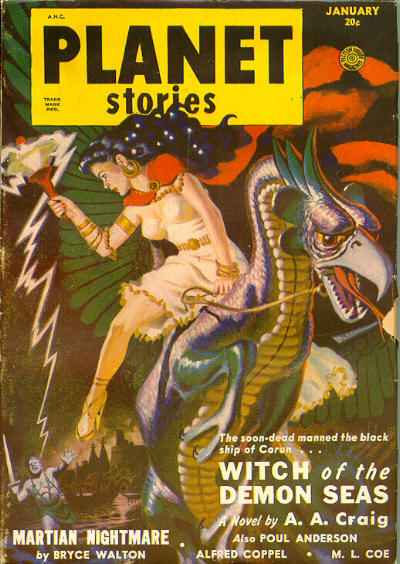
(Cover by Allen Anderson. Planet Stories, January 1951.)
Who Goes There?
During his lifetime, Poul Anderson was one of the most prolific and respected genre SF writers, winning seven Hugos for short fiction (a number I think only met by Harlan Ellison’s wins) and three Nebulas. He was a made a Worldcon Guest of Honor at a rather young age, although by that point he had already been active for little over a decade. Anderson was born in 1926 to Danish immigrants, and he and his family even lived in Denmark for a short time when he was very young—his Danish heritage being something that comes up rather often in his fiction. Vikings and generally people roaming the seas pop here and there, such as in the Hugo-winning story “The Longest Voyage,” and even in “Witch of the Demon Seas,” which is much earlier and less refined, there’s this sense that Anderson saw the sailor’s life as something to admire. The ship as a microcosm for human society would be used more famously in his novel Tau Zero, with the depths of space as a stand-in for the ocean. This is one of several recurring themes with Anderson, who over the course of half a century wrote too many novels and short stories to count across several series, not to mention all the standalone titles. He studied physics at the University of Minnesota, but took up writing full-time as soon as he graduated.
I was supposed to review a different Anderson novella, “A Tragedy of Errors,” months ago, but I never got around to it, and indeed I still haven’t read that story. I should, at some point. The thing with Anderson is that he wrote so much, the vast majority of which was published in the genre magazines, that he’s a good go-to author for when I’m feeling low on inspiration with review material. Anderson wrote so much, in fact, that a lot of his work has not been reprinted that frequently, if at all. In the case of today’s story its obscurity can be explained by its length, the fact that it was originally published under a pseudonym (there’s an Anderson story under his own name in this same issue, the more often reprinted “Tiger by the Tail”), and also it being on the weak side by Anderson standards.
Placing Coordinates
First published in the January 1951 issue of Planet Stories. It has since been reprinted in Swords Against Tomorrow (ed. Robert Hoskins) and the Anderson collection Swordsmen from the Stars. It has fallen out of copyright, so you can read it on Project Gutenberg.
Enhancing Image
There’s a procession going on in Achaera, showing off the captured pirate king Corun and his band of men. Corun of Conahur used to be a legitimate warrior, and a widely respected man, who turned pirate and roamed the seas. As the sorcerer Shorzon puts it, the man may be executed, but he deserves to be put “in a decent tomb.” Shorzon’s granddaughter, the young witch Chryseis, seems to agree with the old man, and even appears to be taken with Corun upon simply seeing him. The whole public affair is theatre, of course: Corun is to be locked away in a cell, apart from his men, and executed in due time. Of course, this is before Shorzon has anything to say on the matter, in which case the sorcerer has an offer to make with Corun. The idea is simple, that Corun is to accompany Shorzon and Chryseis with a small army to the Demon Sea, an infamous territory home to the Xanthi, an intelligent race of reptile-like humanoids who take to water like swans, and who are infamous for their capacity to overwhelm the forces of men. Corun was called upon not just because he’s supposed to be one of the finest warriors in the land, but because he’s one of the few people to have actually voyaged to the Demon Sea and lived to tell the tale.
So Corun has two options, either certain death at the hands of the law, or probable death at the hands of the Xanthi. The correct choice is obvious. “In any case—to live! To die, if he must, under the sky!” It also helps that he has immediately fallen for Chryseis’s beauty and elusive charm, which I’m sure will not come back to bite him.
Now you may be thinking, “Witches? Sorcery? I thought this was science fiction.” Well, it’s nominally science fiction. “Witch of the Demon Seas” is a planetary romance with a rather heavy emphasis on the fantasy half of the science-fantasy equation; there’s an SFnal twist late in the story, but for the most part the only thing that would identify it as SF is the fact that the action is set on a planet that is decidedly not Earth, and at the same time is not one of those secondary worlds a lot of fantasy works use. This is an alien planet, home to a wide breadth of alien life, including Chryseis’s pet “erinye,” a stranged winged beast. First and foremost it’s a maritime adventure set on the high seas, with the final destination being a black castle on an otherwise desolate island. In a way it’s all more reminiscent of The 7th Voyage of Sinbad than even Leigh Brackett’s planetary adventures, from which Anderson clearly took some inspiration. Brackett and Planet Stories had almost become synonymous with each other through the ’40s and ’50s, but while Brackett was prolific, she could not be there to provide a novella or novelette for every issue; hence there were other wirters, including Anderson very early in his career, who wrote what you might call Brackett Lite. Anderson is competent at providing such material for the magazine, but this is clearly not what he would ultimately excel at.
On the voyage, aboard the Briseia, we meet Captain Imazu, maybe the most sympathetic figure in the whole story, and certainly the one who seems most aware of what kind of story he’s in. He can see right through Shorzon’s scheme and knows intuitively that Chryseis figures into it somehow, but Corun is too horny star-struck to listen to reason. (By the way, you may notice that Corun has a similar name and even backstory to a certain Celtic warrior we all know.) The sequence when we’re on the Briseia, which includes a thrilling action scene when some of the Xanthi try boarding the ship by force, is also my favorite. What can I say, it takes advantage of my weakness for maritime stuff. (Also, as a final aside, I couldn’t help but notice Anderson using “larboard” to refer to “port,” as in the port side of the ship, using what was even in 1950 a very outdated nautical term. He obviously would’ve been aware that port had long since replaced larboard in the seaman’s lexicon, so I wonder why he did this.) There’s also the burgeoning romance between Corun and Chryseis, which is about as arbitrary as it is fast-moving (they’re implied to have sex after about maybe a few days of knowing each other), so I’m not too thrilled about that part. Mind you that we eventually get a plot-relevant explanation for why Corun falls head over heels for this girl he just met, but that doesn’t mean I like it.
There Be Spoilers Here
Sorcery is, psi powers?? No way.
A Step Farther Out
Was sort of dragging my heels to write about this one, although real-life circumstances also contributed to the delay. Anderson is a curious writer in that for how much he wrote over the decades, rarely does one catch an Anderson story that’s outright bad. Weak Anderson is still often better than what a lot of his contemporaries were doing, even those who arguably had higher highs in their output. “Witch of the Demon Seas” sees Anderson near the end of his apprentice phase, a period that undeniably came to end by the time he was writing the magazine version of Three Hearts and Three Lions and the serial version of Brain Wave a few years later. But aside from the fixation on piracy (a profession Anderson seemed to have some sympathy for even later in his career, see The Star Fox) and the nomadic anti-hero, this is a story one can skip when studying Anderson.
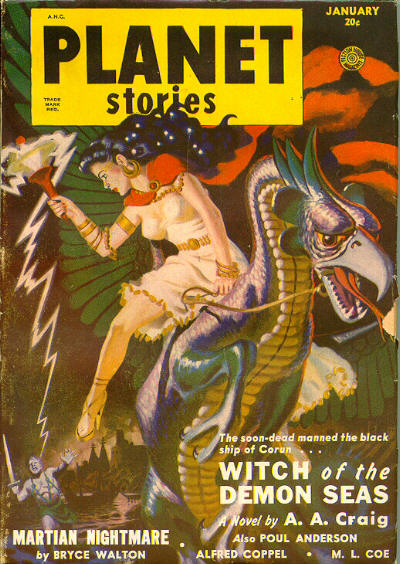
(Cover by Allen Anderson. Planet Stories, January 1951.)
A change is coming to this site, and unfortunately it’s not for the better. I was supposed to review Leigh Brackett’s The Big Jump last month, but while I had finished reading the novel on time, I could not bring myself to write anything all that substantive about it. It’s fine, basically. It’s a short novel that is sort of spacefaring but decidedly unlike the swashbuckling planetary romances Brackett had made her bread and butter. Novels, for the most part, were also not really her strong suit, which makes her 1955 novel The Long Tomorrow all the more an outlier. I wanted to write about Brackett still, though, so this month we’ll be downsizing and looking at a short story of hers from earlier in her career, “The Halfling,” which got a Retro Hugo nomination. It’s also not a planetary romance, though; instead Poul Anderson, who for a time early in his career wrote some Brackett-esque science-fantasy, will take up that mantel. Incidentally I was supposed to write about an Anderson novella sometime last year, but never got around to it, so I’ll be making up for lost time.
The increasing habit I’ve made of missing out on pieces I had set out to cover has made me think this site could use some downsizing of its own. Thankfully not much will change except, sad to say, I will no longer be covering “complete” novels, i.e., stories 40,000 words or longer that are printed whole in magazine issues. This was a niche department to begin with, which I would only make use of a few times each year, but it seems with my life circumstances in mind that such a department is no longer viable. Of course, I’ll still be covering novels in serial form (indeed we have one such novel for this month), but the Complete Novels section you see at the top of the page of now dead. Those reviews will be kept up, because why not, but I will no longer be updating that department for the foreseeable future. Instead I will simply not post anything on the 31st of the month going forward, which gives me a bit of extra time to relax as well as the previous post more time to marinate at the top of the page. Really I think this is the best move for everyone, and I also think the price for no longer reviewing such stories is a rather small one.
July will see all short stories from Amazing Stories, but for this month it’s pretty much just more of the same. Nothing unusual here. Aside from Brackett and Anderson, authors I’d meant to cover earlier but couldn’t, we have the serial version of Gordon R. Dickson’s first major novel, as well as a novella from Katherine MacLean and an out-of-left-field SF-horror yarn from the now-obscure Raymond F. Jones. I had temporarily forgotten about my thing of reviewing as least one piece from Amazing Stories this month and almost replaced Jones with a Bruce Sterling Omni story. But Sterling is gonna have to way a bit, probably a few months.
We’re leaning vintage this month, with one story from the 1940s, three from the 1950s, and one from the 1960s.
For the serial:
Dorsai! by Gordon R. Dickson. Serialized in Astounding Science Fiction, May to July 1959. Born and raised up to a point in Canada, but moving with his family to the US when he was 13, Dickson can now strike one as oddly mild-mannered and sympathetic for being a major forerunner of what we now call military SF. The Childe Cycle, which contains the Dorsai stories, would encompass his life’s work, although he never lived to give it a proper ending. Dorsai! was not the first story in the cycle, but apparently the second, as well as the first novel. The magazine version was nominated for a Hugo.
For the novellas:
“The Diploids” by Katherine MacLean. From the April 1953 issue of Thrilling Wonder Stories. MacLean was one of the last major discoveries John W. Campbell had made, and indeed she would appear regularly in Astounding/Analog over the course of many years. Despite living an exceedingly long time (she died in 2019), she mostly stopped writing after the 1970s. She trained in psychology and had apparently taken in interest in Dianetics at one point.
“Witch of the Demon Seas” by Poul Anderson. From the January 1951 issue of Planet Stories. Anderson was another Astounding/Analog regular, although he also appeared basically everywhere else. Born American but raised by Danish immigrants, there’s a strong sense of the “Nordic twilight” in Anderson’s writing, especially but not exclusively his later work. Early in his career he followed in the footsteps of Leigh Brackett and wrote some planetary romances.
For the short stories:
“The Halfling” by Leigh Brackett. From the February 1943 issue of Astonishing Stories. Retro Hugo nominee for Best Novelette. Instead of reviewing a novel I guess we’ll settle for something more small-scale. Brackett had made her debut in 1940, in Astounding, but she quickly turned to other magazines despite the lesser pay. She would eventually find much success as a screenwriter.
“Stay Off the Moon!” by Raymond F. Jones. From the December 1962 issue of Amazing Stories. Born and raised in Utah, Jones seems to have been the first Mormon SF writer of note, so in that sense he was ahead of his time. He was active through much of the ’40s and ’50s. Fans of Mystery Science Theater 3000 may recognize him for having written This Island Earth (the novel, not the movie).
Karen Joy Fowler was born in 1950, in Indiana, but her family then moved to California. She came to writing in her thirties, with a flurry of short stories in the latter half of the ’80s; looking at her bibliography, it looks like she wrote about half of her short stories over a five-year span. Fowler is almost certainly the most high-profile talent to have made her debut in the annual Scientology-backed Writers of the Future anthology series, although to my knowledge she is not a Scientologist. (Incidentally today’s story is centered around a cult.) Over the past few decades she’s found success writing both SFF and non-genre fiction, with her 2004 novel The Jane Austen Book Club becoming a mainstream bestseller and the audience for it probably being unaware that most of what Fowler’s written (at least at short lengths) has been science fiction and fantasy. Speaking of which, she hasn’t written too much short fiction since the early ’90s, but funnily enough what she began to lack in quantity she made up for in quality. “Always” won the Nebula for Best Short Story and got nominated for the Theodore Sturgeon Memorial Award, despite the lack of a Hugo nomination. It marked Fowler’s first appearance in Asimov’s in ten years, and is not science fiction at all but rather a drama with an unexplained fantasy element.
Placing Coordinates
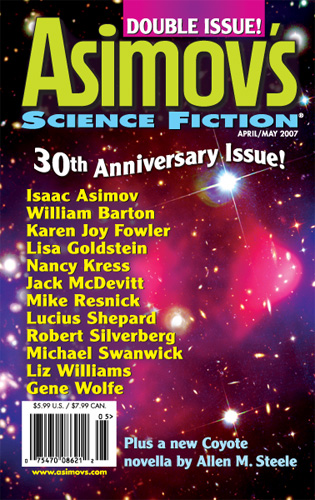
First published in the April-May 2007 issue of Asimov’s Science Fiction. It’s been reprinted in Science Fiction: The Best of the Year, 2008 Edition (ed. Rich Horton), Year’s Best SF 13 (ed. David G. Hartwell and Kathryn Cramer), and the Fowler collection What I Didn’t See and Other Stories.
Enhancing Image
Something that only occurred to me after the fact is that we never get the narrator’s name in this. The narrator, who at least started out as a 17-year-old girl, gets kicked out of her mom’s house and decides to hit the road with Wilt, her sort-of-friend-sort-of-boyfriend who’s nearly a decade older than her, and the two make their way to Always. This is in 1938. Always is a commune that was founded in the 1920s by one Brother Porter, who’s of indeterminate age of who is at least old enough to have a 14-year-old son. “I can’t tell you how old Brother Porter was, because he always said he wouldn’t give an irrelevant munber the power of being spoken out loud. He was a fine-looking man though. A man in his prime.” Right away we’re given the impression that Brother Porter is a suspicious man, who claims the ability to grant immortality (in the sense that people do not age) despite not having any apparent means of doing so, and more importantly the fact that he keeps the men and women (even the married couples) of the town in separate dorms and solicits sex from the latter group. Apparently the men are supposed to take some vow of celibacy. Homosexuality is not allowed. Drinking’s not allowed either, although less as a rule and more something that’s treated as a social taboo. So Always is a dry town. The townsfolk work jobs, but are supposed to give Brother Porter their paychecks, which begs the question of what the point of money here is. This is not a utopian socialist commune, but rather a society based in religion.
Indeed there’s very little that can be considered utopian about Always, even just from the first few pages of what is always a brief story. A society in which both hard drinking and free love are taboo, and yet one in which money is still a thing, is surely not a society that can be worth much of a damn. There’s also the fact that most of the people in town are much older than the narrator, ranging from middle-aged to elderly. A society predominantly comprised of people who are of retirement age or close to it surely can’t be much to write home about either. The husbands who live here are also strangely fine with getting cucked by the resident cult leader, and said cult leader (so we’re told by a few characters) also just so happens to be very good at sex. This all sounds implausible, but then you could look at just about any cult that’s taken off in the real world, whether it be Heaven’s Gate or the Church of Scientology, and wonder how any mature and rational person could buy into such a thing. Yet it has happened and continues to happen, despite our rationality telling us that this can’t be. “Always” is partly about cults and how a cult might sprout from the filthy mud of some person’s imagination, but it’s more focused on the alienation that seems to happen inevitably between cult followers and the rest of the world. In real life this alienation takes the form of a subtle change in personality, in a person’s outlook, but here Fowler treats it more literally. Consider, for one, the narrator’s anxiety about not aging:
At first. Brother Porter discouraged field trips, and then later we just found we had less and less in common with people who were going to die. When I complained about how old everyone else at Always was, Wilt pointed out that I was actually closer in age to some seventy-year-old who, like me, was going to live forever, than to some eighteen-year-old with only fifty or so years left. Wilt was as good with nmnbers as he was with cars and he was as right about that as everything else.
Once the townsfolk become convinced they will live forever they start perceiving time in a different and strange way, and the narrator is not immune to this. Of course, another question is why you would want to live forever if you’re already elderly and with one foot in the grave. Surely nobody would want to be old for the rest of eternity. There’s an old lady here, Winnifred Allington, who constantly complains about her arthritus, something that will never go away no matter how long she lives. Imagine having your joints ache and burn for a hundred years. This doesn’t sound like a very good deal to me. Wilt eventually agrees, because he leaves Always in 1941, when the US gets directly involved in WWII, and never returns. He seems to have the right idea. It would be ironic, at least, if Wilt were to get killed in the war, but instead he comes out of it just fine. The narrator, meanwhile, goes through a change, her mind not so much eroding as slowing down to the slowness of glacier—not that she becomes dumber, but rather she stops caring about normal human things. She stops getting attached to the animals at the zoo. She stops reading books and listening to music for fun. She even stops partaking in Always social life, since she stops seeing her fellow immortals as people and more as machines that are programmed to do and say the same things each day. There’s nearly a whole page of her just listing things the immortals repeat on a regular basis, probably without realizing how dull they themselves are.
I’ve seen reprints and other reviews called “Always” science fiction, but I’m not sure how it qualifies. It barely even counts as fantasy, never mind SF. The immortality trick Brother Porter pulls is never given an explanation—neither an SFnal nor supernatural one. The only maybe-supernatural thing that happens is that maybe the narrator doesn’t age over the course of several years; but the passage of time is vague enough, and we’re given so little as to the narrator’s own appearance, that we’re not sure if she’s still physically a teen girl by the end. Never mind that it’s off-putting that Brother Porter takes her on as a sexual partner despite being at least old enough to be her dad, and nobody in-story questions this. There is, in fact, very little that the characters come to question or wonder about. The only speculation that occurs is how the story observes the narrator’s changing mentality, in that Fowler speculates on how even the assumption of immortality might change someone’s attitude toward life over a period of years. Why act fast if you have more time than you could possibly know what to do with? Here’s a memorable passage detailing the narrator’s mindset, in a story that, to its credit, has its share of zingers:
I talked less and less. At first, my brain tried to make up the loss, dredging up random flashes from my past—advertising slogans, old songs, glimpses of shoes I’d worn, my mother’s jewelry, the taste of an ant I’d once eaten. A dream I’d had in which I was surrounded by food that was bigger than me, bread slices the size of mattresses, which seems like it should have been a good dream, but it wasn’t. Memories fast and scattershot. It pleased me to think my last experience of mortahty would be a toothpaste commercial. Clood-bye to all that.
Then I smoothed out and days would go by when it seemed I hardly thought at all. Tree time.
She becomes less like a human being, but unlike her fellow immortals she becomes more like a tree rather than a machine. She becomes more connected to nature. For all the strangeness of Always, the locale is very nice, as it’s located near the California coast and people are allowed to venture outside the town. So that’s something.
There Be Spoilers Here
Nothing lasts forever—not even the town where the people are supposed to live forever. It shouldn’t be surprising that the party must end, although how it ends is a bit funny. One of the more eccentric immortals, Frankie Frye, got the bright idea to test Brother Porter’s immortality by poisoning him. She didn’t do this out of malice, mind you, but as a genuine act of faith. “[Frankie] was so worked up and righteous, she made the rest of us feel we hadn’t ever had the same faith in Brother Porter she’d had or we would have poisoned him ourselves years ago.” Of course, it’s hard to feel bad for the man, since he was like a less pedophilic David Koresh. Being immortal, it turns out, does not mean you can’t be killed. The result is sort of a chain reaction, in which some more immortals get killed in horrible and inexplicable ways. The faith the collective had held had been broken. Ultimately the only person who decides to stay in Always is the narrator—a fact that she doesn’t seem to mind much. She has the trees and mountains for company, after all. (I guess this is supposed to be a bittersweet ending.)
A Step Farther Out
I wasn’t a fan, sorry. When it comes to fantasy fiction I’m fine with the lack of a “why” in the storytelling, but at some point the deliberate ambiguity the author invokes as to what is happening is supernatural or not that wearies me such that I stop wondering at all. Instead I start wondering about other things, these things having to do with the logic of the story, and that’s when it stops being fun. You can certainly poke holes in the fabric of “Always,” even with it being so concise, but the problem is that I should not feel compelled to poke holes in the story if I’m enjoying it enough. I feel as if Fowler had an idea, and something of a vignette to go with the idea, but it’s so lacking in “why” and “how” that it threatens to evaporate. I’m a little confused as to the Nebula win, as well as why multiple sources call it science fiction, because it seems as if we had read different stories. In fairness to Fowler, she’s quite good at dialogue and internal monologues, which I already knew from other short stories of hers I’ve read—just that in the case of “Always” I feel like this talent was in service of slight material.
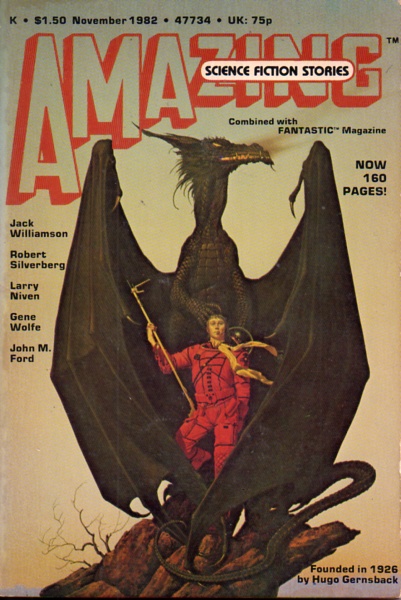
(Cover by Michael Whelan. Amazing Stories, November 1982.)
Who Goes There?
John Milo Ford (his friends called him Mike) was born in 1957 in Indiana, but later became a Minneapolis denizen. He was one of those rare literary prodigies, having made his first sale when he was only 18 and with his debut novel, Web of Angels, published when he was only 23. Unlike a lot of authors who specialize in one or two modes of writing, Ford was more of a jack of all trades, writing novels, short stories, poetry, speculative articles, and even designing tabletop games. It could be this versatility, combined with the fact that Ford’s work can at times be demanding by genre fiction standards, that might explain his perpetual obscurity. Not helping things was the years-long question of who owned his work, since apparently nobody had gotten in touch with the next of kin after Ford’s death, and so for over a decade his work was allowed to fall out of print. It was only since 2019 that Tor, Ford’s publisher, was able to contact the estate and gradually bring his books back into print. Sadly Ford died young, at just 49, after a long battle with chronic illness, including having to get a kidney transplant; this chronic illness also goes to explain why he wrote rather little in the last decade or so of his life. Even with Tor’s recent efforts, Ford will probably always remain an object of small but passionate interest.
In the late ’70s through the early ’80s, Ford appeared frequently in Asimov’s, while George H. Scithers was editor. The two had such a good partnership that when Scithers left and became editor of the cheaper and less prestigious Amazing Stories, Ford started appearing there as well. “The Persecutor’s Tale” is one of Ford’s longer short stories, which isn’t saying a whole lot, but as with his novels, it’s a little on the dense side. It’s also very rewarding. This is an allegorical fantasy yarn about justice in a quasi-medieval world where the God of Abraham seems to have gone out for lunch. As is typical with Ford at his best, it demands a second reading.
Placing Coordinates
First published in the November 1982 issue of Amazing Stories. It’s only been reprinted twice, in Another Round at the Spaceport Bar (ed. Darrell Schweitzer and George H. Scithers) and the Ford collection Heat of Fusion and Other Stories. Both are out of print.
Enhancing Image
In the days of the Empire, a group of travelers are forced to stop at a mountainside inn for the night, and not just any night but Midwinter’s Eve. The story is vague as to where or when we are, but certainly it can’t be Earth’s history as we know it. We have cars and electric lighting, but also centurions and a pair of mules dragging the run-down car to a stable. There’s also at least one profession that simply does not have a real-world equivalent, but we’ll get to that in a moment. The narrator claims to be a journalist, just another inoccuous observer who’s interested in other people’s stories. The other people in the group include a centurion, a Guardsman, an electrical engineer, a “chymist” (this suggests alchemy being a legit practice in the world of the story), and a justice and her two clerks. The justice, strangely, dons a blindfold, while her clerks help her move about and whisper things to her. It’s a literal take on the old saying that justice is blind. There is one last member of the group, though, a gaunt man who claims to be a persecutor. This bums out everyone else, including the innkeeper, who says the persecutor revealing his own profession as such is “unjust.” It’s not clear right away what a persecutor is, but we can tell from characters’ reactions that it’s not a well-liked job, even if it’s backed by the state. The innkeeper convinces the gaunt man that he owes them a story.
The gaunt man spends much of the story recounting the tale of a young man who, along with his lover, committed a horrid act that was however beyond the reach of the law, and “deeds were done in darkness, and things were thrown into deep water.” It’s just as vague as to what this horrid act could’ve been, or why the state police would be unable to reprimand the young man for it. Still, it was a job for the persecutor, who is not a cop or even secret police, but something else. Soon the persecutor is on the young man, hounding him, even in his bedroom in the dead of night. The young man realized that someone had betrayed him and that the persecutor would now follow him wherever he went, maybe hound him into suicide. “And sometimes, on his cot, in the deepest night, snakeskin would brush his cheek, and the persecutor’s bone mask would hover above him.” Whether the persecutor is actually there or not would be missing the point, since the effect is meant to be more psychological than physical. No matter where the young man goes, even if he changes his name and clothes, he still sometimes sees, even in broad daylight, the cloak and skull mask of the persecutor. Driven nearly mad, the young man at one point “maimed himself, in a bloody and dreadful manner,” which might be alluding to castration. It’s probably best that we don’t get the details.
So the tale ends. The young man is still out there, somewhere. Has he paid for his crime? The persecutor posits that maybe he hasn’t. Certainly the young man had paid with blood and flesh, but as the persecutor says, “Blood is nothing, flesh is nothing. Flesh and blood are wracked with iron, in the halls of physical justice. But iron cannot touch the spirit that sets itself above justice.. So, the persecutor is not a cop or the blindfolded justice at the inn, but instead the justice he seeks is spiritual. There’s a spiritual debt that the young man has not yet paid.
Reading back through passages of “The Persecutor’s Tale,” I do have to wonder if Ford was a Christian, as it very much has the ring of Christian allegory. More specifically I was thinking of the more allegorical stories of Gene Wolfe, whom Ford certainly would’ve read, and incidentally Wolfe also admired Ford’s fiction. Even more specifically I’ve been thinking of Wolfe’s “The Detective of Dreams,” which is ostensibly an eerie mystery yarn, but which ultimately reveals itself to be (and indeed can be best understood as) an extended metaphor for Wolfe’s idea of Catholic fear and forgiveness. There’s a long-running tradition among Christian authors, from Dostoevsky to Flannery O’Connor, with exploring the implications of justice in a world where not every crime will be punished and not every criminal will fall into the jaws of the law. There is, of course, “the law,” and then there is God’s law, as in the God of the Bible. Granted, it’s also possible Ford explored this subject matter less as a believer and more in the name of hunting intellectual big game. I’m not a Christian myself, or even religious at all, but I would not say such material would be off the table. This is the same guy who wrote The Dragon Waiting, which is set in a decidedly unchristian Europe where Julian the Apostate lived to overthrow Christianity as the dominant religion of Rome. (Also there are vampires, but read the book to find out more about that.) Similarly the world of “The Persecutor’s Tale” is one where something had changed, so that you have this intermingling of modern and archaic technology, bordering on steampunk.
Ford understood the assignment when writing this story, in that he knew what kind of story he wanted to write and how much he wanted to flesh out the details around the central allegory. None of the characters have names, and the time and place of the action are kept rather unspecified. The details of the world around the story don’t really matter. There’s some question over whether “The Persecutor’s Tale” counts as science fiction or fantasy; for myself I think of it as belonging to the latter genre. Sure, Amazing Stories was primarily an SF magazine, but after its sister magazine Fantastic folded in 1980 there was an opening for fantasy in its pages. It probably also helps that by 1983 TSR was publishing Amazing Stories. (That’s right, the Dungeons & Dragons company.) Ford doesn’t speculate on humanity’s future here so much as invent a somewhat outlandish altered Earth for the sake of providing a backdrop for an allegory about the need for justice. Historically, one thing that’s separated SF and fantasy is that the former tends toward the literal while the latter leans toward the metaphorical. The most popular works of fantasy fiction, going back to Shakespeare’s The Tempest and even the Book of Revelations (it is a work of allegorical fantasy, sorry), have been either understood as extended metaphors or as stories much given to metaphor and symbolism. “The Persecutor’s Tale” seems, at first, to be about the need for a vengeful Old Testament God, the God who allowed Job to be tortured and his family killed; but Ford has a neat little trick up his sleeve that throws this interpretation into question.
There Be Spoilers Here
There are a couple signs early on that the narrator is not who he appears to be, but the reader is unlikely to pick up on these signs, such as a tan line on the ring finger and the narrator’s tendency to stroke two of his fingers together in a specific gesture. It’s only after the gaunt man has finished his story and everyone’s gone to bed that the narrator reveals himself to be, in fact, the very persecutor the gaunt man was posing as. He takes a cloak and skull mask out of his bag and goes to stalk the gaunt man in the dead of night. It’s become apparent by night that the gaunt man and the young man in the tale are the same person, and that it’s actually no coincidence that the “journalist” and the gaunt man shared a car on their way to the city. The haunting of the young/gaunt man never ended—the good news being that it’s about to. With a “tiny silver pipe” in his throat to disguise his voice and a “heavy silver ring with its swirling fire opal” on his ring finger, the persecutor gets to work. What happens next is what really makes reading this story worth the effort, in that it’s both strange and very symbolic. At the same time there’s a bit of pathos with the ending. Even in this section I don’t feel like giving the whole game away. You should take twenty or so minutes out of your day and read it for yourself.
A Step Farther Out
Yeah, this is a good one, but then I also expected that. Nearly everything I’ve read by Ford has impressed me, or at least given me the impression that a second reading would be well worth the effort. It’s funny, because both Ford and Wolfe are known to be difficult by genre standards; but whereas Wolfe has long since found a passionate (if at times annoying and even fascist) following, there does not seem to be such a crowd among today’s readers for Ford. It could be because his novels are all either one-offs or media tie-ins (he actually wrote a couple Star Trek novels), because he died young, because for more than a decade his work was all out of print, or maybe the fact that while he certainly was active (very much so) in fandom, SFF fandom nowadays is so different than when Ford was alive that it all feels like a time capsule. At the same time there’s a reason why so many of his fellow writers admire his work, and similarly I’m championing him.
We are now knee-deep in spring, which means last month I narrowly survived a fit of allergies. (I’m not really exaggerating, I got hit with what the doctor called postnasal drip, and for some days it was difficult to even breathe, let alone sleep at night.) In terms of weather this might be my least favorite time of year, because of said allergies. In better news, it’s also time for applying for memberships at the yearly Worldcon, if you’re interested. This one is happening in LA, which is unfortunate because it’s the other side of the country for me and I don’t have any connections who live close enough to where the action’s happening. I have a few friends in California, but as you know, California is a big state. (That’s not even getting into people from outside the US who want to attend in person. It’s rough.) I did end up getting a WSFS membership, I think for the third year in a row. I mainly do this for all the free stuff you get, a very good I would say given it’s only $50. You get ebooks of novels and short fiction, and you even get files for the movies up for Best Dramatic Presentation.
As for what we’ll be reading this month, for the first time in a long while we have a complete novel, which I have to get around to this time. (Unlike last time.) We also have a novel in serialized form, by someone whom I’m sure will not raise any eyebrows. Incidentally, two of the stories here are related to World War II, although one was written on the eve of the war in Europe while the other is an early example of a “Hitler wins” alternate history. Such a scenario is pretty tired today, but it was not so when C. M. Kornbluth came up with it back in the ’50s. Another funny connection is that both Kornbluth and L. Ron Hubbard served in WWII, the former in the army and the latter in the navy. Hubbard’s time in the navy was respectable, and I’m sure nothing untoward or embarrassing happened when he was at sea. Unfortunately for Kornbluth, his time in the army caused a weakness in his heart that would later see him die quite young.
Anyway…
We have one story from the 1940s, two from the 1950s, one from the 1980s, one from the 2000s, and one from the 2020s.
For the serial:
Final Blackout by L. Ron Hubbard. Serialized in Astounding Science Fiction, April to June 1940. Where do we even start with Hubbard? One of the most controversial figures in not just SF but also modern religion and pseudo-science. Hubbard had Dianetics published in 1950, and in 1952 he founded the Church of Scientology, one of the most successful (if only because of the disproportionate number of rich people in its ranks) cults in recorded history. Before all that, he was a fairly respected genre writer, with the late ’30s and early ’40s marking his peak for both quality and quantity. Final Blackout is probably the most well-received of Hubbard’s SF novels, after the much more famous but also more controversial Battlefield Earth.
For the novellas:
“The Giants of the Violet Sea” by Eugenia Triantafyllou. From the September-October 2021 issue of Uncanny Magazine. Born and raised in Greece, and indeed currently living there, Triantafyllou writes her fiction in English. Her personal website says she has “a flair for dark things.” She made her debut in 2017, and so far has only written short fiction. This here novella is the longest work of Triantafyllou’s to have been published up to that point.
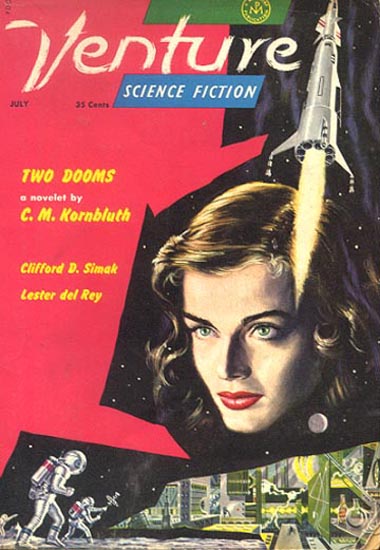
“Two Dooms” by C. M. Kornbluth. From the July 1958 issue of Venture Science Fiction. Kornbluth is maybe one of my favorite SF writers to have really flourished during the ’50s magazine boom-and-bust, although he had made his debut long before that. He was a prodigy whose earliest work was published when he was a literal teenager. Unfortunately he also died very young, at just 34, from a weak heart, robbing the field of one of its most incisive writers.
For the short stories:
“The Persecutor’s Tale” by John M. Ford. From the November 1982 issue of Amazing Stories. Speaking of very good writers gone too soon, Ford also made his debut when only in his teens, but he picked up on the trade pretty quickly. A writer’s writer, the best way to read a Ford novel is the read it twice. Sadly he died in 2006, at just 49, having not quite completed his final novel.
“Always” by Karen Joy Fowler. From the April-May 2007 issue of Asimov’s Science Fiction. Nebula winner for Best Short Story. Believe it or not, there’s an L. Ron Hubbard connection here. Fowler is maybe the most high-profile author to have made her debut in the annual (and Scientology-backed) Writers of the Future anthology series, although Fowler herself is not a Scientologist.
For the complete novel:
The Big Jump by Leigh Brackett. From the February 1953 issue of Space Stories. While Brackett’s first few stories were published in Astounding, she soon moved to other magazines that were more open to her brand of space adventure SF. By the end of World War II she’d come to be associated most with Planet Stories, in a mutually beneficial relationship. Indeed, after Edgar Rice Burroughs, Brackett can be considered the leading writer of planetary romance. She married fellow writer Edmond Hamilton in 1946, but they almost never collaborated. Nowadays she’s best known as a successful screenwriter, and for her grounded SF novel The Long Tomorrow, which is quite different from what she most often wrote. The Big Jump is a short novel, apparently published in magazine form unabridged, and later as one half of an Ace Double along with Philip K. Dick’s Solar Lottery.
Brian Aldiss was born in England in 1925, and he actually lived a very long time, dying literally one day after his 92nd birthday. He starting writing SF in the mid-’50s, being a generation younger than that first wave of British authors to write magazine SF like Arthur C. Clark and John Wyndham, and yet also a generation older than the New Wave crowd he would later fall in with. And whereas Clarke and Wyndham wanted popularity, preferably on both sides of the Antlantic, Aldiss had other ideas. Unfortunately by the late ’50s, when Aldiss’s work was appearing in the US, the magazine market was in the midst of a collapse; but the good news was that The Magazine of Fantasy and Science Fiction was thriving and also the perfect outlet for his fiction, said fiction being sort of dark and literary. The Hothouse stories, which were published in F&SF throughout 1961, were probably Aldiss’s most ambitious project up to that point. The series (but not the fix-up novel, which in the US was actually a bit shorter than the UK and magazine versions) won him a Hugo. It’s only been, what… ten months since I reviewed the previous entry in the series? Seems like only yesterday. We’re almost done here, since “Timberline” is the penultimate story. It’s also, unfortunately, the weakest entry in the series so far.
Placing Coordinates
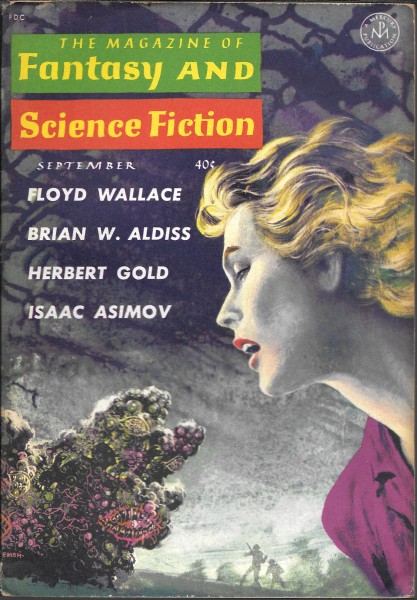
First published in the September 1961 issue of The Magazine of Fantasy and Science Fiction. It’s never been reprinted outside of Hothouse, which makes sense because if you were to hop into this story without having read what came before it, you would be lost.
Enhancing Image
Remember Poyly? Maybe not. She died near the end of “Undergrowth,” and rather unceremoniously, despite having been Gren’s love interest for a minute. Gren himself doesn’t seem too troubled or grief-stricken by this. In fact, I’m struggling to recall if “Timberline” mentions her at all. Of course, the team of humans already had a spare girl, in the form of Yattmur, who becomes Gren’s new girlfriend seemingly overnight. The two are accompanied by four tummy-belly men, who are short, hair, and cowardly by nature. Also dim-witted, not that Gren and Yattmur are all that intelligent. Arguably the only reason they’ve even made it this far is the help of the morel, a sentient and indeed highly intelligent fungus, on Gren’s head. The morel acts as like a second brain, although given the conflict it has with Gren the relationship they have is more like Eddie Brock and the symbiote. They will need all the help they can get, though, since humans are scarce, and for maybe the first time in history, plant life totally rules the world. There are also large carnivorous insects, but those don’t play much of a factor in “Timberline.” Instead, vegetable life has evolved to such a point as to replace practically all fauna on land.
It could be because Gren is the POV character (I hesitate to call him the “hero”), but the way Aldiss writes women in the Hothouse series really leaves something to be desired. Women are treated as disposable, and already we’ve seen multiple fridge-stuffings. This doesn’t even align with what would make sense in such a world: you’d think women would be treated as more valuable, in a world where mankind is endangered and has also become a prey animal, but no, their deaths are treated with as much (or rather with as little) gravity as when the men die. And that goes for the ones who don’t make it. As for Yattmur, she spends virtually all of “Timberline” sulking and complaining about Gren being mean to her, which is understandable on its own, but then she doesn’t do much of anything—not that Gren proves to be much better in that regard. Generally Aldiss’s view of humanity seems to be a dim one, which sometimes works, but sometimes it also results in some fatigued storytelling. It’s strange, and a bit funny, that the most active character in “Timberline” is a parasitic fungus.
The boat Our Heroes™ took at the end of the last story ends up crashing into an iceberg, but that’s okay, since all six survive and even make it onto an islet, in which there is enough food and shelter for the time being. Hell, there aren’t even any enemies here worth mentioning, so that for once Gren and Yattmur are able to have a good time. Maybe too good. The central conflict of this story is that the morel wants to keep moving, since it knows the team can’t stay here forever, while Gren is content to sit back and soak in the sun. This is all framed as serious, but it’s really not as serious as it sounds. The morel wants to progress the plot while Gren doesn’t. Both have valid arguments for their points of view, namely that yes, supplies will eventually run out on the islet, but also getting off the islet will be its own challenge, on account of the boat being wrecked. Meanwhile Gren becomes grumpier because of this, to the point where he becomes borderline abusive with Yattmur. The tummy-belly men are of no help whatsoever in all this; actually their so useless and whiny that it’s a wonder why Gren doesn’t just opt to murder them. Being both stupid and submissive, it’s not like the tummy-belly men would’ve resisted much on that front.
There is a somewhat humorous digression when Our Heroes™ uncover a (I’m not sure how else to put this) centuries-old robotic bird whose purpose seems to be to spew political slogans. That the bird is still in working order after all this time would strain one’s suspension of disbelief, if not for this being a world where Earth and its moon have become interlocked via a kind of plant-constructed elevator. And also there’s one half of the world where the sun always shines, while the other half lies in eternal darkness. Naturally Gren and the gang don’t even try to make sense of what the bird (which they name Beauty) is saying, since not only is there no such thing as “Monkey Labour” anymore, the physical land of India probably no longer exists. Politics, like human life in general, is transient. I said before that Aldiss strikes me as a pessimist, and the comic relief with Beauty is a case of that pessimism being used to inspire good writing. Beauty is an operational but now totally obsolete and worthless piece of machinery whose election-year ramblings are lost on the characters, who indeed would have nothing to gain from it even if they understood it.
There Be Spoilers Here
Their ticket off the islet turns out to be a species of bug-like vegetable called a “stalker,” a giant long-legged veggie that’s sort of like the tripods from H. G. Wells’s The War of the Worlds. It’s a nice image, but unfortunately this sequence of Gren and the others riding atop the stalkers goes on for half an eternity. Another good image that sadly gets drawn out is the moment they cross the “timberline,” i.e., the shadow-line separating the sunlit world from the land of night. Mind you that “Timberline” is about as long as “Hothouse,” so it’s a rather meaty novelette. For the first time in the series I feel like there’s some filler that could’ve been cut.
A Step Farther Out
Hopefully it will not take me another ten months to get to the final Hothouse story. Maybe eight. I do feel like returns on this series have been diminishing somewhat, but then maybe I wouldn’t feel that way if I was reading these stories in novel form. I have to assume the short passages of exposition at the beginning, which would strike the reader as obvious if they were to read these stories in quick succession, were removed for the novel. I remember James Blish got his panties in a twist over the world of Aldiss’s series being absurd, in that it’s really science-fantasy rather than properly SFnal, but the strange world of Hothouse is its selling point. Certainly the characters are not much to write home about, although the morel is a very fine creation. We’ll have to see how this all turns out.
(Cover by Philippe Halsman. The 28 June, 1952 issue of Collier’s, where Ray Bradbury’s “A Sound of Thunder” first appeared.)
When Robert Heinlein’s “The Green Hills of Earth” appeared in the 8 February, 1947 issue of The Saturday Evening Post, there was cause for celebration. Heinlein had just returned from a four-year hiatus, having spent much of that time helping with the war effort, and when he got back to writing it was as if he had never left. In the years immediately following the war, in which the US immerged as a superpower, there was a burgeoning suburban middle class, and therefore a burgeoning suburban middle-class readership. The Saturday Evening Post was, for much of its existence, a weekly tabloid-format magazine that had already been around for over a century; but by the immediate post-war years it had reached the absolute height of its popularity. By 1948 something like 10% of American adults were reading the Post, which was and still is a ridiculous circulation. The Post was a “slick” magazine, although it didn’t use slick paper; rather it was slick in the sense that it paid well for articles and stories, and the lucky author would enjoy a wide readership. It was a mainstream magazine that occasionally printed genre fiction. When several of Heinlein’s stories appeared in the Post in the late ’40s, corresponding with a book deal he had made with Scribner’s, he knew he had hit the big time.
Heinlein’s experience with gaining mainstream traction was not totally unique to him. There were some other writers of his generation, and even more of the following generation, who started out writing pulp fiction before moving to the slicks. Ray Bradbury, Elmore Leonard, John D. MacDonald, Raymond Chandler, Harlan Ellison, and even Stephen King had their first stories published in pulp magazines. King, in the introduction to his story collection Night Shift, thanks (among others) Robert W. Lowndes, who was editor of the cheap and now-forgotten magazines Magazine of Horror and Startling Mystery Stories. Lowndes had also bought King’s first two stories, when the latter was barely out of his teens. Evidently the apple hasn’t fallen too far from the tree.
Science fiction has infested practically every facet of modern life, so it can be hard to appreciate the fact that it used to be quite a niche interest. We’re constantly being flooded with bestselling novels that are SF, and a disproportionate number of the highest grossing movies ever are SF. For better or worse (it’s easily for the worse) we’re at the mercy of technocrats who grew up reading SF. But going back to the 1940s and ’50s, SF was mostly constrained to magazines with ultimately low circulations, not to mention all the B-movies. Even before that, SF was steeped in the pulp tradition, which is to say being published in pulp magazines. While science fiction as a codified genre became a thing in 1926, with the launch of Amazing Stories, the pulps went back to the tail end of the 19th century, and some fiction from these older pulp magazines even found their way as reprints in Hugo Gernsback’s newfangled “scientifiction” magazine. The pulps started proliferating in the 1900s thanks to a few big publishers, maybe the most famous of them among old SF fans being Street & Smith, who would later print Astounding Stories. By the time Amazing Stories launched, you already had popular pulp magazines that sometimes printed science fiction and fantasy, including Argosy, Adventure, and Blue Book. Most famously there was Weird Tales, which while focused on horror and fantasy also regularly printed SF.
The “pulp” label is easy enough to understand, although it’s not totally consistent. As a rule of thumb, a pulp magazine in the early 20th century had such-and-such dimensions, but more importantly it had to do with the quality of the paper, which was rough and brittle. Sometimes the edges were untrimmed. These magazines were cheaper to buy than their slick counterparts, but correspondingly they also paid less by the word. Also, in terms of class politics and age demographics, it must be said that while the likes of The Saturday Evening Post and Harper’s Weekly appealed to bourgeois readers, adults who while part of the workforce weren’t exactly getting their hands dirty, the pulps appealed more to working-class adults and adolescents. Granted that it’s unwise to generalize a whole era of popular fiction like this, the stories in these magazines tended to be heavy on action and plotting, and with at least a tinge of wish fulfillment. As I said, these stories did not pay well on a word-by-word basis, but if one could crack the code of what a magazine’s editor is looking for, and how to write a reliably solid adventure story, there was some money in it. The luckiest of these pulpsters was Edgar Rice Burroughs, who had taken on writing relatively late in life, already being deep in his thirties and with some odd jobs behind him. In 1912 alone Burroughs cracked the code with such gusto that he basically changed the face of American pulp fiction, with the one-two punch of A Princess of Mars and Tarzan of the Apes, both appearing in the pulp magazine The All-Story (which later merged with Argosy, it’s confusing). Burrough’s literary reputation is up for contention, but the cultural impact he continues to have is hard to deny.
Most of the authors who appeared in these pulps are now totally forgotten, and in fact got tossed into the dust bin of history decades ago. At the same time, some of the most important American writers of the 20th century got their start writing for the pulps, be they SFF magazines or other genres. Black Mask, founded in 1920, was a crime-oriented pulp magazine that would publish works by such future giants of crime fiction as Dashiell Hammett and Raymond Chandler. The best of these authors eventually moved on from the pulps in favor of better-paying markets, such as getting into novel-writing, but the strictness of magazine protocol encouraged discipline over raw imagination. In the introduction for his collection Trouble Is My Business, Chandler recounts his experiences with writing stories for Black Mask and other pulps in the ’30s as follows:
If the formula had been a little less rigid, more of the writing of that time might have survived. Some of us tried pretty hard to break out of the formula, but we usually got caught and sent back. To exceed the limits of a formula without destroying it is the dream of every magazine writer who is not a hopeless hack.
Chandler describes a push-and-pull effect with writing for the pulps that’s by no means unique to crime fiction—in fact it applies to every other genre of magazine fiction, including what appears in the slicks. Editors have their biases, no matter how benign they appear, and there were restrictions regarding censorship in those days that made it so that the language could never be too salty or the sex appeal all that explicit. (The sexiest a fiction magazine could get was Weird Tales, which you have to admit had some pretty erotically charged covers in the ’30s, but even that came with some legal trouble. Pick a random issue of Weird Tales from the year 1935 and juxtapose it with a random issue from 1939 or 1940: you’ll see the difference.) These restrictions encouraged writers to develop formulae that could get their work accepted with more ease, depending on the market. The work itself might not be masterful, but these markets did serve as training grounds for promising writers.
The years between the world wars saw the height of the pulps, but America’s involvement in World War II demanded everyone tighten their figurative belts, including a need for paper. The paper shortage during the war saw the deaths of several pulp magazines, maybe the most lamented of them being Unknown, Astounding‘s fantasy-oriented sister magazine. Astounding itself barely survived the paper shortage, being the only one of Street & Smith’s genre magazines to have made it. Even the ones that did survive, including Weird Tales and Amazing Stories, fell on hard times during and immediately after the war, with the former eventually closing its doors (not for the last time) in 1954. This is not to say good fiction wasn’t being published in these magazines, especially in the case of Weird Tales which continued strong more or less until the end, but these were struggling magazines with small (if also devoted) readerships. By the early ’50s the pulp format was on its way out, with former pulps switching over to digest. It didn’t help that there were newfangled magazines at this time, including Galaxy Science Fiction and The Magazine of Fantasy and Science Fiction, which were printed in digest format from the beginning. These magazines were not quite slick, as they were still aimed at the small world of genre readers; but they had decent quality paper, they paid well enough, and they (namely F&SF) even sometimes reprinted material from the slicks.
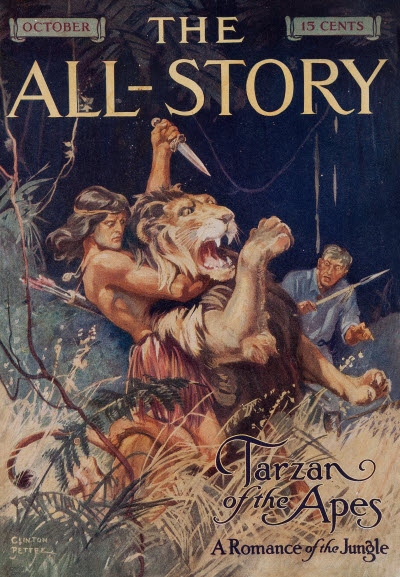
(Cover by Clinton Pettee. The All-Story, October 1928. This issue ran Tarzan of the Apes in its entirety.)
Of course, pulp writing, along with the format associated with it, is dead, and in fact has been dead since before my parents were even born. Analog Science Fiction, formerly Astounding, is now the only genre magazine still standing which had begun its life as a pulp magazine. What little remains of the pulp years has long since found its way into book form, as novels, story collections, anthologies, what have you. The 1950s saw the extinction of the pulp magazine, with the last of these to have stuck with the format, Science Fiction Quarterly, ending with its February 1958 issue. The digest format, a sort of happy medium between the unsophisticated pulps and the decidedly bourgeois slicks, continued. Now, while the pulps were gone, they were by no means forgotten. If you love Star Wars, Indiana Jones, Tarzan, or a good film noir, just know that these things have their roots in the pulps. Hell, H. P. Lovecraft had much of his fiction published in Weird Tales, and indeed that lurid magazine was often the only market that would take his work. Given that the rates were poor, the paper was brittle, and the readership either very young or not too thoroughly educated, pulp fiction left quite a legacy. And within a couple decades there would be a book counterpart to the digest magazines—that is to say, popular fiction in book form that’s sort of pulpy but also sort of slick. There soon came a mode of writing that would embody the best (and worst) qualities of both its parents, and in part is has to do with paperbacks outselling magazines.
The market for genre magazines has evolved radically over the decades, so that the most successful ones running today are online, subsisting on either Patreon subscriptions or simply donations. There’s no debate, however, that the book, and more specifically the paperback, enjoys a far wider readership than any magazine you can name in [the current year]. Go to any bookstore, be it a Barnes & Noble or that indie place you frequent just around the corner, and you will find rows upon rows of paperbacks and hardcovers; meanwhile there may be a couple stalls for magazines, if any, and only a fraction of those will be magazines focusing on fiction. Now, it’s not exactly cheap to buy a paperback novel, unless you have a publisher’s line of paperbacks, like Oxford World’s Classics or Barnes & Noble Classics, that focus on printing “classic literature” at very reasonable prices. But most paperbacks will cost you something. My paperback copy of R. F. Kuang’s Babel (to use an example of a recent novel that a lot of people have read and liked) ran me $20, which feels almost as if Kuang herself (or rather her publisher in this case, HarperCollins) had beaten me over the head with a stick and called me ugly. Kuang is independently wealthy, even if she weren’t a popular writer; surely she (or rather HarperCollins) didn’t need my $20. Still, she writes for a broad audience, as in she writes popular fiction, and evidently she’s doing something right.
You know who else writes popular fiction? George R. R. Martin. One of our most famous living writers, regardless of genre. I’ve covered a few of his short works on this very site, and will do so again eventually. Martin’s A Song of Ice and Fire series is very popular, both in how many people read these books as well as the demographic Martin writes (or wrote) with in mind. But was that always the case? Did you know that the Daenarys chapters of A Game of Thrones first appeared as a novella in an issue of Asimov’s Science Fiction, just a few months before A Game of Thrones found its way to bookstore shelves? If you were one of the relatively few people to have been subscribed to Asimov’s in 1996, you would’ve gotten a sneak peek at what has since become one of the most famous and controversial series in all of fantasy. Asimov’s is a digest magazine with, as I said, a healthy but ultimately modest readership. It’s not pulpy, but you also wouldn’t call it slick or popular. It’s sophisticated, but not that sophisticated. Martin himself has made no secret of being influenced by pulp fiction from the days of yore, namely SF published in Astounding before it became Analog. Indeed Martin’s biggest aspiration as a writer at the outset of his career was to get published in Analog, which he succeeded at. Nowadays people tend to overlook Martin’s pre-ASoIaF SFF, maybe because said fiction was not aimed at a general readership for the most part. I do suggest doing some digging and, for instance, reading the short fiction collected in Martin’s Dreamsongs.
Popular genre fiction takes the broad demographic and image of respectability from the slicks and combines that with the juvenile adventurousness of the pulps. The problem we’re now facing is that with the pulps long gone and the slick magazines not much more relevant, the options you have for reading some good SFF have narrowed. This is made worse by the phasing-out of the mass market paperback, which for a few decades served as like a book equivalent to a pulp magazine issue, in terms of paper quality, garishness, and affordability. The mass market paperback is smaller and cheaper than the trade paperback, but the latter has has finer and more flexible paper, not to mention an air of respectability. You can still find Martin’s old books as mass market paperbacks, but the same can’t be said for Kuang, or indeed other SFF authors of her age or even a generation older. Publishers used to get by on selling mass market paperbacks at $9 a pop, or magazine issues at the same price; but now they want your $20 for a trade paperback edition novel you might already have. Pulp and slick writing have merged, or maybe fallen together into a boiling pot, to create popular fiction, but this Frankenstein monster is itself a victim of capitalist greed. Clearly there’s a big audience for fancy trade paperbacks and even fancier hardcovers, but the problem (and I’m sort of paraphrasing Oscar Wilde here) is that audiences tend to be stupid.
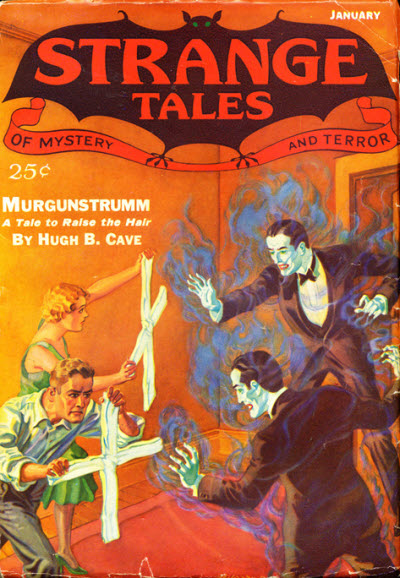
(Cover by H. W. Wesso. Strange Tales, January 1933.)
Who Goes There?
Robert E. Howard’s career lasted only about a dozen years, from 1924 until his death in 1936, but in that time he wrote several volumes’ worth of short fiction, poetry, and a few novels. He wrote for every pulp fiction of just about every sort (except, funnily enough, science fiction, whose market was burgeoning at the time), and for every magazine that would take him. He wrote Westerns, sports stories (he especially loved boxing), non-supernatural adventure fiction, horror, and of course, fantasy. Fantasy writing, prior to Howard, was pretty much invariably rooted in the British tradition, but Howard brought a distinctly American flavor which has been a subspecies of fantasy writing ever since. He is the father of sword-and-sorcery, although he wasn’t strictly the first practitioner, nor did he coin the term. But he created a few series characters who fell into fantasy of this sort, culminating in Conan the Cimmerian, the first great sword-and-sorcery hero. With Conan, his most popular creation, Howard’s legacy was secured; and a good thing too, considering Howard would take his own life at the age of just thirty. Most writers don’t even reach maturity in their craft by that age, and some don’t even start writing until later; so it’s impressive that Howard had said all that he more or less wanted to say by that time, although he had shown interest in shifting away from fantasy and focusing more on writing Westerns. Sadly, the world will never know.
Something I didn’t bring up in my recent editorial on Howard is how his Irish heritage informed his writing, there being no clearer an example of this than with Conan himself. Contrary to what Arnie has made us think, Conan, as written by Howard, is very much a Celtic warrior, rather than Germanic. Howard’s Irish background also plays a big role in today’s story, the standalone horror year “The Cairn on the Headland,” which takes place in none other than Dublin, Ireland. The setting, as well as its use of Irish and Nordic mythology, makes for some of Howard’s most overtly Irish writing. It’s also a fun time, so there’s that.
Placing Coordinates
First published in the January 1933 issue of Strange Tales. As was typical, it wasn’t ever reprinted in Howard’s lifetime, only first reappearing in the 1946 collection Skull-Face and Others. It has also appeared in The Macabre Reader (ed. Donald A. Wollheim), Rivals of Weird Tales (ed. Stefan R. Dziemianowicz, Martin H. Greenberg, and Robert Weinberg), and the Howard collections Wolfshead and The Horror Stories of Robert E. Howard.
Enhancing Image
This is a tad embarrassing, but although you get what the word means just from context in the story, I did feel the need to look up the definition of “cairn” at one point. It’s not a word you see used casually, at least in modern times, and neither is “headland.”
The story itself takes place sometime in the early 20th century, in what would’ve been the Irish Free State. James O’Brien (possibly a shoutout to Irish author Fitz-James O’Brien) is our protagonist and narrator, an Irish American who has come to the land of his ancestors, and unfortunately for him he didn’t come alone. Ortali is a gaping asshole, and is here because O’Brien can’t get rid of him. I’m not joking. In a series of events that maybe shouldn’t be taken at face value, O’Brien got into a feud with a professor, and went to his abode one night with the intent of just threatening the older man. However, the professor had drawn a knife, and in a freak accident fell on it, stabbed right through the heart. This sounds unlikely. Regardless of whether O’Brien is being an unreliable narrator in recounting this story, Ortali, being an assistant to the professor, had witnessed O’Brien just after the fact, and even if O’Brien didn’t commit murder it would be hard to prove otherwise in court. Ortali, being a totally reasonable man, decided to blackmail O’Brien, and the two have been conjoined at the hip ever since. As O’Brien says, “If hate could kill, [Ortali] would have dropped dead.” If only there was a way to be rid of him.
Calling O’Brien a hero would be terribly generous, not because he has thoughts of murdering Ortali for much of the story, but in fairness Ortali (at least from O’Brien’s perspective) is shown to be worse. Scheming, selfish, condescending, and maybe worst of all, disrespectful toward Irish history. He writes off O’Brien’s interest in Irish mythology as silly superstition, but you can guess who gets the last laugh there. O’Brien spends a good portion of the story’s opening stretch explaining the lore behind Grimmin’s Cairn, a monument on the outskirts of Dublin which serves as a sign of the fallen, in the last battle between the Celts and the Vikings. In 1014 CE, King Brian and his troops drove off the Vikings for the last time, making sure the Vikings didn’t take Ireland. Literally it was a battle between an indigenous people and an imperial force, but it was religiously a decisive blow, between “the White Christ” and Nordic paganism. Nowadays certain white supremacists and fascists cling to the Nordic pantheon symbolically, but Christianity was here to stay. The strange thing about the cairn, O’Brien claims, is that it surely was not made to commemorate the soldiers fallen in battle, being a single mound and, as he says, “too symmetrically built.” It was made for something (or someone) else.
Something I really dislike about the magazine version of “The Cairn on the Headland” is that the both the illustrations and introductory quotation give away all the major spoilers, so that frankly it’s hard to be surprised by the story’s climax. There’s a strange old woman by the name of Meve MacDonnal whom O’Brien meets, their meeting itself being a bit uncanny, because Meve’s accent is a strange one. If you’ve read this in Strange Tales you could already infer, however, that Meve is a ghost, having been dead some three centuries, a reveal that’s not made in-story until later. Still, the two bond over their shared heritage, with Meve even saying O’Brien was her maiden name. Meve also gives O’Brien a special cross, a relic he assumed to be kept away somewhere, in secret. Only one of it’s kind in the world. She says he’ll be needing it. What a nice lady, never mind the whole being-dead part. Of course it’s only later that O’Brien finds Meve’s grave and understands that either he’s nuttier than squirrel shit (a possibility) or he’s dealing with the supernatural.
Whilst ostensibly a spooky story, “The Cairn on the Headland” is less effective as horror than as a classic ghost story in an exotic locale. There’s an undercurrent of tragedy, given that despite it being his ancestral homeland, Howard never lived to visit Ireland. Lacking first-hand experience of the landscape, he resorted to the imagination, of which this story is very much a byproduct. Dublin here is not the Dublin of James Joyce, but a dreamland, where a plot epiphany quite literally comes to O’Brien in a dream, and which he decides to take at face value. Even in the real world we have this funny habit of reading our dreams as sometimes being premonitions, or warnings, so O’Brien’s behavior, while a bit contrived, is not that unusual. It also helps O’Brien is narrating, from his somewhat deranged point of view, so that it’s easier to buy into the weird shit.
There Be Spoilers Here
In this kind of story it’s customary to have a character who fucks around and finds out, which in this case is not O’Brien, but the even more unlikable Ortali. Thanks to a prophetic dream and some knowledge of Nordic mythology, O’Brien concludes that the cairn is not a monument to any Irish or Nordic soldier, but to Odin himself. The one-eyed. The Gray Man. Grimmin’s Cairn turns out to be a bastardization of Gray Man’s Cairn, after centuries of neglect, a fallen god stuck in a land where nobody believes in him. The Norse gods may be gone, but they’re by no means dead. The problem is that, as tend to be the case with the heads of pantheons, Odin is a major-league asshole—a lesson Ortali learns too late, after having torn the cairn asunder in the dead of night.
It’s maybe convenient for O’Brien, already a fugitive for one unlikely death, that the awakened and grumpy Odin smites Ortali with lightning. I mean what’re the odds of such a thing happening, right? Even more conveniently for O’Brien, the ghost lady had given him that cross, and for some reason, like a vampire, Odin is allergic to crosses. I know the reason, of course, it has to do with Norse religion having been overrun and finally replaced by Christianity. This is funny coming from Howard, who was not really a religious person at all, but I get it has more to do with Christianity’s (more specifically Catholicism’s) centuries-long shared history with Ireland than with a belief in “the White Christ.”
A Step Farther Out
Howard was not the most original of horror writers; like a lot of us he learned his craft by way of mimicry. “The Cairn on the Headland” is not a very original story, in that even if you didn’t have the ending spoiled for you in advance you can easily anticipate the outcome. It has a certain vibe about it, though, like a good-but-not-great M. R. James story. The atmosphere is the key to enjoying it.