Who Goes There?
John Milo Ford (his friends called him Mike) was born in 1957 in Indiana, but later became a Minneapolis denizen. He was one of those rare literary prodigies, having made his first sale when he was only 18 and with his debut novel, Web of Angels, published when he was only 23. Unlike a lot of authors who specialize in one or two modes of writing, Ford was more of a jack of all trades, writing novels, short stories, poetry, speculative articles, and even designing tabletop games. It could be this versatility, combined with the fact that Ford’s work can at times be demanding by genre fiction standards, that might explain his perpetual obscurity. Not helping things was the years-long question of who owned his work, since apparently nobody had gotten in touch with the next of kin after Ford’s death, and so for over a decade his work was allowed to fall out of print. It was only since 2019 that Tor, Ford’s publisher, was able to contact the estate and gradually bring his books back into print. Sadly Ford died young, at just 49, after a long battle with chronic illness, including having to get a kidney transplant; this chronic illness also goes to explain why he wrote rather little in the last decade or so of his life. Even with Tor’s recent efforts, Ford will probably always remain an object of small but passionate interest.
In the late ’70s through the early ’80s, Ford appeared frequently in Asimov’s, while George H. Scithers was editor. The two had such a good partnership that when Scithers left and became editor of the cheaper and less prestigious Amazing Stories, Ford started appearing there as well. “The Persecutor’s Tale” is one of Ford’s longer short stories, which isn’t saying a whole lot, but as with his novels, it’s a little on the dense side. It’s also very rewarding. This is an allegorical fantasy yarn about justice in a quasi-medieval world where the God of Abraham seems to have gone out for lunch. As is typical with Ford at his best, it demands a second reading.
Placing Coordinates
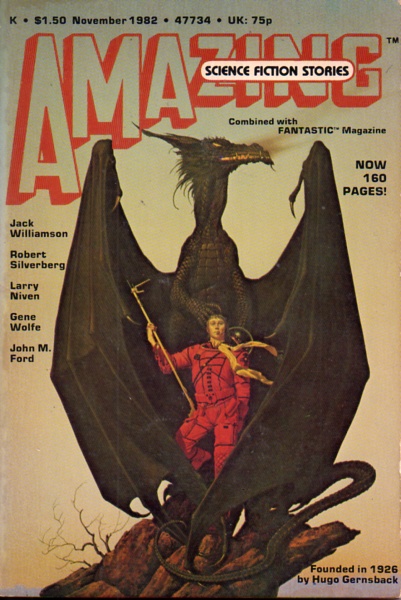
First published in the November 1982 issue of Amazing Stories. It’s only been reprinted twice, in Another Round at the Spaceport Bar (ed. Darrell Schweitzer and George H. Scithers) and the Ford collection Heat of Fusion and Other Stories. Both are out of print.
Enhancing Image
In the days of the Empire, a group of travelers are forced to stop at a mountainside inn for the night, and not just any night but Midwinter’s Eve. The story is vague as to where or when we are, but certainly it can’t be Earth’s history as we know it. We have cars and electric lighting, but also centurions and a pair of mules dragging the run-down car to a stable. There’s also at least one profession that simply does not have a real-world equivalent, but we’ll get to that in a moment. The narrator claims to be a journalist, just another inoccuous observer who’s interested in other people’s stories. The other people in the group include a centurion, a Guardsman, an electrical engineer, a “chymist” (this suggests alchemy being a legit practice in the world of the story), and a justice and her two clerks. The justice, strangely, dons a blindfold, while her clerks help her move about and whisper things to her. It’s a literal take on the old saying that justice is blind. There is one last member of the group, though, a gaunt man who claims to be a persecutor. This bums out everyone else, including the innkeeper, who says the persecutor revealing his own profession as such is “unjust.” It’s not clear right away what a persecutor is, but we can tell from characters’ reactions that it’s not a well-liked job, even if it’s backed by the state. The innkeeper convinces the gaunt man that he owes them a story.
The gaunt man spends much of the story recounting the tale of a young man who, along with his lover, committed a horrid act that was however beyond the reach of the law, and “deeds were done in darkness, and things were thrown into deep water.” It’s just as vague as to what this horrid act could’ve been, or why the state police would be unable to reprimand the young man for it. Still, it was a job for the persecutor, who is not a cop or even secret police, but something else. Soon the persecutor is on the young man, hounding him, even in his bedroom in the dead of night. The young man realized that someone had betrayed him and that the persecutor would now follow him wherever he went, maybe hound him into suicide. “And sometimes, on his cot, in the deepest night, snakeskin would brush his cheek, and the persecutor’s bone mask would hover above him.” Whether the persecutor is actually there or not would be missing the point, since the effect is meant to be more psychological than physical. No matter where the young man goes, even if he changes his name and clothes, he still sometimes sees, even in broad daylight, the cloak and skull mask of the persecutor. Driven nearly mad, the young man at one point “maimed himself, in a bloody and dreadful manner,” which might be alluding to castration. It’s probably best that we don’t get the details.
So the tale ends. The young man is still out there, somewhere. Has he paid for his crime? The persecutor posits that maybe he hasn’t. Certainly the young man had paid with blood and flesh, but as the persecutor says, “Blood is nothing, flesh is nothing. Flesh and blood are wracked with iron, in the halls of physical justice. But iron cannot touch the spirit that sets itself above justice.. So, the persecutor is not a cop or the blindfolded justice at the inn, but instead the justice he seeks is spiritual. There’s a spiritual debt that the young man has not yet paid.
Reading back through passages of “The Persecutor’s Tale,” I do have to wonder if Ford was a Christian, as it very much has the ring of Christian allegory. More specifically I was thinking of the more allegorical stories of Gene Wolfe, whom Ford certainly would’ve read, and incidentally Wolfe also admired Ford’s fiction. Even more specifically I’ve been thinking of Wolfe’s “The Detective of Dreams,” which is ostensibly an eerie mystery yarn, but which ultimately reveals itself to be (and indeed can be best understood as) an extended metaphor for Wolfe’s idea of Catholic fear and forgiveness. There’s a long-running tradition among Christian authors, from Dostoevsky to Flannery O’Connor, with exploring the implications of justice in a world where not every crime will be punished and not every criminal will fall into the jaws of the law. There is, of course, “the law,” and then there is God’s law, as in the God of the Bible. Granted, it’s also possible Ford explored this subject matter less as a believer and more in the name of hunting intellectual big game. I’m not a Christian myself, or even religious at all, but I would not say such material would be off the table. This is the same guy who wrote The Dragon Waiting, which is set in a decidedly unchristian Europe where Julian the Apostate lived to overthrow Christianity as the dominant religion of Rome. (Also there are vampires, but read the book to find out more about that.) Similarly the world of “The Persecutor’s Tale” is one where something had changed, so that you have this intermingling of modern and archaic technology, bordering on steampunk.
Ford understood the assignment when writing this story, in that he knew what kind of story he wanted to write and how much he wanted to flesh out the details around the central allegory. None of the characters have names, and the time and place of the action are kept rather unspecified. The details of the world around the story don’t really matter. There’s some question over whether “The Persecutor’s Tale” counts as science fiction or fantasy; for myself I think of it as belonging to the latter genre. Sure, Amazing Stories was primarily an SF magazine, but after its sister magazine Fantastic folded in 1980 there was an opening for fantasy in its pages. It probably also helps that by 1983 TSR was publishing Amazing Stories. (That’s right, the Dungeons & Dragons company.) Ford doesn’t speculate on humanity’s future here so much as invent a somewhat outlandish altered Earth for the sake of providing a backdrop for an allegory about the need for justice. Historically, one thing that’s separated SF and fantasy is that the former tends toward the literal while the latter leans toward the metaphorical. The most popular works of fantasy fiction, going back to Shakespeare’s The Tempest and even the Book of Revelations (it is a work of allegorical fantasy, sorry), have been either understood as extended metaphors or as stories much given to metaphor and symbolism. “The Persecutor’s Tale” seems, at first, to be about the need for a vengeful Old Testament God, the God who allowed Job to be tortured and his family killed; but Ford has a neat little trick up his sleeve that throws this interpretation into question.
There Be Spoilers Here
There are a couple signs early on that the narrator is not who he appears to be, but the reader is unlikely to pick up on these signs, such as a tan line on the ring finger and the narrator’s tendency to stroke two of his fingers together in a specific gesture. It’s only after the gaunt man has finished his story and everyone’s gone to bed that the narrator reveals himself to be, in fact, the very persecutor the gaunt man was posing as. He takes a cloak and skull mask out of his bag and goes to stalk the gaunt man in the dead of night. It’s become apparent by night that the gaunt man and the young man in the tale are the same person, and that it’s actually no coincidence that the “journalist” and the gaunt man shared a car on their way to the city. The haunting of the young/gaunt man never ended—the good news being that it’s about to. With a “tiny silver pipe” in his throat to disguise his voice and a “heavy silver ring with its swirling fire opal” on his ring finger, the persecutor gets to work. What happens next is what really makes reading this story worth the effort, in that it’s both strange and very symbolic. At the same time there’s a bit of pathos with the ending. Even in this section I don’t feel like giving the whole game away. You should take twenty or so minutes out of your day and read it for yourself.
A Step Farther Out
Yeah, this is a good one, but then I also expected that. Nearly everything I’ve read by Ford has impressed me, or at least given me the impression that a second reading would be well worth the effort. It’s funny, because both Ford and Wolfe are known to be difficult by genre standards; but whereas Wolfe has long since found a passionate (if at times annoying and even fascist) following, there does not seem to be such a crowd among today’s readers for Ford. It could be because his novels are all either one-offs or media tie-ins (he actually wrote a couple Star Trek novels), because he died young, because for more than a decade his work was all out of print, or maybe the fact that while he certainly was active (very much so) in fandom, SFF fandom nowadays is so different than when Ford was alive that it all feels like a time capsule. At the same time there’s a reason why so many of his fellow writers admire his work, and similarly I’m championing him.
See you next time.
 Science Fiction & Fantasy Remembrance