There’s something about October that brings a change in me. It could be that autumn has now unambiguously started, as opposed to just going by the autumnal equinox. The weather is now colder and dryer. My hands and nose are getting dry, the latter occasionally resulting in a nosebleed. I now feel like I can put on a hoodie and jog around the city. The trees will start being stripped of their leaves. Overall it’s a time of changes, mostly for the better. October is also the month of Halloween, which is far and away my favorite holiday, to the point where it might the only one I really get festive about. Now is the time for watching horror movies, from the classices to some grade-A schlock. Time to catch up on some horror reads I’ve accumulated on my shelf. Time for pumpkin spice lattes, if you’re into that. In other words, this is for me what Christmastime is for some people—mind you that I tend to get depressed around Christmas.
For this month we’re back to reviews at regular intervals, all short stories, all featuring thrills, chills, and assorted horrors. For the first time in a while I’m actually excited with what I’m gonna be writing about. Hopefully you’ll be joining me in reading at least a few of these.
We have one story from the 1940s, three from the ’50s, three from the ’80s, one from the ’90s, and one from the 2020s.
For the short stories:
“The Hungry House” by Robert Bloch. From the April 1951 issue of Imagination. Bloch was correspondents with H. P. Lovecraft when the former was still in high school, and this friendship had an apparent influence on Bloch’s early fiction. While he’s most famous for writing Psycho, which is non-supernatural horror, most of Bloch’s work involves ghouls, cosmic horrors, and whatnot.
“Rabbit Test” by Samantha Mills. From the November-December 2022 issue of Uncanny Magazine. Winner of the Hugo, Nebula, and Theodore Sturgeon Memorial Award, being only the third story ever to win all three. Mills debuted in 2016, with her debut novel published in 2024. “Rabbit Test” was the last of a streak of short stories, as Mills stopped writing short fiction for three years.
“Punishment Without Crime” by Ray Bradbury. From the March 1950 issue of Other Worlds Science Fiction. Being one of the most famous American authors ever, it can be easy to forget that Bradbury started writing for the genre magazines, not all of them being of the first rate. He also wrote so much horror early in his career that only a fraction of it appeared in The October Country.
“Lost Memory” by Peter Phillips. From the May 1952 issue of Galaxy Science Fiction. I had ever heard of Peter Phillips before, which might be because he was only active for a short time, from about 1948 to 1958. He stopped writing SF for reasons I’m not sure of. He was also British, at a time when there weren’t too many active in the field, even appearing in the inaugural issue of New Worlds.
“Yellowjacket Summer” by Robert McCammon. From the October 1986 issue of Twilight Zone Magazine. McCammon made his debut in 1978, but it took him a bit to come to the forefront of contemporary horror fiction. His massive post-apocalyptic novel Swan Song tied for the inaugural Stoker for Best Novel. Disillusionment with the industry made him step away from writing for a decade.
“Bloodchild” by Octavia E. Butler. From the June 1984 issue of Asimov’s Science Fiction. Winner of the Hugo and Nebula for Best Novelette. This is a reread for me, but I’ve been meaning to return to it for a close read for a minute. Butler wrote only maybe a dozen short stories, but they’ve received a disproportinate amount of praise, with her winning Hugos for short fiction twice consecutively.
“Reckoning” by Kathe Koja. From the July 1990 issue of The Magazine of Fantasy and Science Fiction. Koja debuted in the late ’80s with a pretty strong string of short stories before her debut novel, The Cipher, hit stores in 1991. She was a formiddable horror talent in the ’90s, but in the 2000s onward took to writing novels aimed at young readers, and she hasn’t written much generally lately.
“Day of Judgment” by Edmond Hamilton. From the September 1946 issue of Weird Tales. While he’s most known as a pioneer of space opera, as well as his Captain Future series, Hamilton appeared frequently in Weird Tales from the beginning of his career, sometimes with SF but also sometimes with fantasy and horror. He was an old-school pulp writer in that he wrote for basically any market.
“The Pear-Shaped Man” by George R. R. Martin. From the October 1987 issue of Omni. Winner of the Stoker for Best Long Fiction. Martin is a case where a series (A Song of Ice and Fire) of his is so famous that it overshadows the rest of his work, which mind you is considerable. Martin’s gone on record as thinking of himself as instincively a horror writer, a fact which is on display here.
We have pretty much an all-star cast of authors here, so I hope this will help my recent writing slump. Of course, the most important thing is that we have fun with this. Happy Halloween.
(Cover by C. Barker Petrie, Jr. Weird Tales, August 1926.)
Who Goes There?
A couple years ago I was supposed to review A. Merritt’s novel The Dwellers in the Mirage, although I couldn’t get far into it before admitting defeat. It could be because I was reading it as it appeared in Fantastic Novels, a magazine with a type size intended for ants and other insects, but I was struggling with it. At the time I knew I would have to give Merritt another shot at some point, not least because of his reputation in the field—or, more accurately, his lack of a reputation nowadays. Abraham Merritt only wrote eight novels and small number of short stories, which for someone who wrote pulp fiction is borderline miniscule, but in fact he had such a well-paying day job that he felt not the need to write much fiction. He worked as assistant editor and later editor of The American Weekly, a Sunday newspaper whose top positions paid a pretty good deal. (Making it as a journalist a century ago meant a lot more than it does now, in the sense that you could afford a house without taking on a second job.) Merritt basically quit writing fiction after 1934 to focus on his lucrative career, resulting in a writing career that lasted not quite twenty years. As with close contemporary Edgar Rice Burroughs, Merritt didn’t start writing fiction until he was in his thirties; but once he picked it up, he found a good deal of success with it as well. Merritt cultivated such a devoted following that he’s one of a very small group of people to have a genre magazine named after him, the short-lived A. Merritt’s Fantasy Magazine.
Yet Merritt’s reputation dwindled in the years following his death in 1943, with naysayers popping up rather early on. In one of his books of criticism, I forget which piece exactly, James Blish calls Merritt a lousy writer. While such an assessment is more often true than not when it comes to once-beloved genre writers from so long ago (E. E. Smith was indeed a pretty bad writer, and his immense influence on the field is thus hard to account for), this judgment of Merritt seems harsh to me. It’s telling that Merritt was one of the first people to be inducted posthumously into the Science Fiction and Fantasy Hall of Fame, then was “awarded” the Cordwainer Smith Rediscovery Award in 2009. His stuff only seems to be kept in print by small independent presses, and I’m actually unsure if even all his novels are in print. He also wrote few short stories, with “The Woman of the Wood” being his only original appearance in Weird Tales. Merritt’s work was frequently reprinted in the genre magazines of the time, but he was originally published in the general pulps, namely Argosy.
Placing Coordinates
First published in the August 1926 issue of Weird Tales, and later reprinted in the January 1934 issue. It’s also been reprinted in the first issue of Avon Fantasy Reader, A Treasury of Modern Fantasy (ed. Terry Carr and Martin H. Greenberg), The Fantasy Hall of Fame (ed. Robert Silverberg and Martin H. Greenberg), and the Merritt collection The Fox Woman and Other Stories. It’s in the public domain now, which means you can read it however, although it’s not been transcribed for Project Gutenberg in the US as of yet. Very little of Merritt’s public-domain work is there.
Enhancing Image
McKay, an American World War I veteran, has come to the mountains of France in need of some fresh air. A pilot in the war, McKay had apparently joined the French forces and later the Americans, once they entered the war; but while he served honorably, the experience left him shell-shocked. “The war had sapped him, nerve and brain and soul. Through all the years that had passed since then the wound had kept open.” This is, of course, Merritt telling us upfront that we ought to take McKay’s testimony of the strange events to follow with a grain of salt. Indeed, McKay not entirely having his mental screws in place is key to the story working, or else it would sound even more ridiculous than it already does. McKay is quite different from his creator, being a war veteran while Merritt was not, but both men are what we might call eccentrics, and both also have green thumbs. McKay would be perfectly happy as a gardener, such that he seems to get along better with plants than people, and like Bob Ross he has a tendency to bestow human personality on the birch and pine trees of the Vosages. He’s staying at a lodge, owned by an unnamed inn-keeper and his wife, on the edge of a lake, with only one other human habitation at that forested lake—that being the house of Polleau and his two sons.
Polleau and his sons are the descendants of serfs who lived off the land generations ago, but they’ve been feuding with their surroundings such that several members of their family have befallen to bizarre tree-related accidents. Now they are the last of their kind. Given that McKay repeatedly equate the trees with royalty and medieval figures, it’s easy to picture the last of the serfs going up against a legion of nobility (or so Merritt/McKay thinks) from centuries past, in a France which has not had a monarch for many years at this point. When one of the sons tries cutting down a birch (the birch trees are given feminine qualities), McKay witnesses something very strange indeed: the trees seem to fight back. The birch, wounded, lies on a neighboring fir “as though it were a wounded maid stretched on breast, in arms, of knightly lover.” Something I’ll say in Merritt’s favor is that while he’s fond of using certain words over and over, he has a knack for evocative imagery that’s a step above most other people submitting to Weird Tales at the time. The cast is small, and it become apparent pretty soon where Merritt is gonna take the plot, but the setting is well-realized, and there’s an intense earthiness to it that reads like a pulpier and perhaps less scary Algernon Blackwood. I have no doubt that Merritt would’ve read his fair share of Blackwood, considering he was big into reading on the occult and both authors have a shared fondness for rural spaces. “The Woman of the Wood” was by no means the first “Nature fights back” story, probably not even the first to be published in Weird Tales that year, but it’s redeemed by Merritt’s knack for setting and tone.
One of the sons lose an eye in the ordeal, which was a bit more violent than I was expecting, but also it’s unsurprising that a) this conflict between man and tree is a bit more literal than would be deemed realistic, and b) McKay sympathizes a lot more with the trees. Later he is tormented, or maybe just haunted, by a small army of birches come to life as ghostly women, which is how I imagine we got the cover for this magazine issue. The trees tempt McKay to “slay” (they keep using that word specifically for a while, which makes the proceedings just a bit hard to take seriously) the Polleau family for them. Since the closest we have to a human woman in the story is the inn-keeper’s wife, who doesn’t say much, the estrogen quota will have to be met in the form of sly and vaguely slutty tree spirits. The spirits of the forest are not exactly evil, nor are they really good, but simply wanting to retaliate against a small but passionate force of deforestation. It does not seem to occur to anyone, even Polleau himelf, that the old man and his sons should probably make plans to move out of the mountains; but then, considering what we see of them, it wouldn’t be surprising that their pride would make moving out of the question. As is typical of weird fiction, and also pulp writing generally at the time, there’s an appeal more to emotions than the brain. That Merritt can delay the reader in thinking about the logical issues of the setting is to the story’s benefit, not really a negative. That McKay himself is shown to be in a fragile mental state to begin with also makes his extreme actions in the climax easier to understand.
There Be Spoilers Here
The really crazy part, which might be the one thing I wasn’t expecting in terms of the story itself (putting style and pacing aside), is that McKay gets away with murder. Yeah, he shivs one of the sons in the goddamn neck, in a kind of tree-induced rage, actually rips out the guy’s throat with the knife (it should be sliced instead of ripped if it’s with a blade, but putting that aside…), and it’s pretty graphic. It’s about as graphic as you could get away with in a dark fantasy magazine with a lot of naked women on its covers in the 1920s. And what’s more, the trees kill Polleau and the other son off-screen, giving McKay enough leeway to get off scott free. The trees don’t even take vengeance on him when he turns down their offer to join them (I assume by giving up his human body to become a tree spirit, I’m not sure), they just seem a little crestfallen about it. But yeah, aside from being shaken from killing a guy and making contact with a bunch of ghosts, McKay gets out of this in one piece. Didn’t expect that.
A Step Farther Out
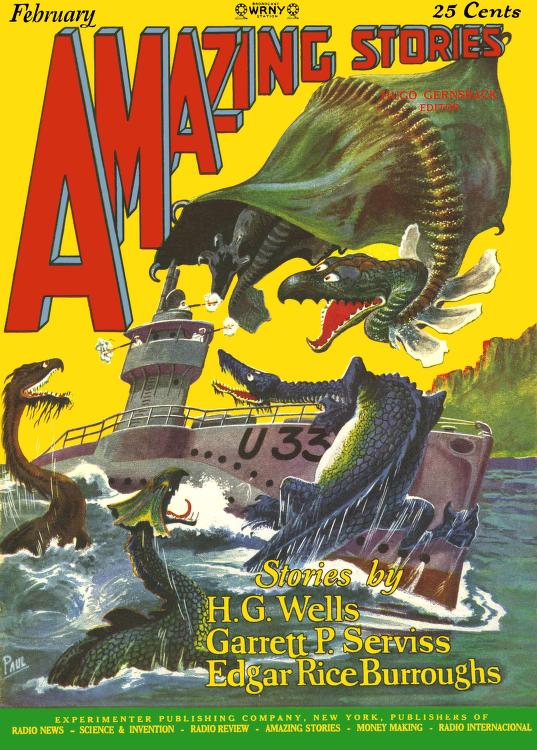
Merritt’s known more for his novels (not that he’s known much at all these days), but I’m more of a short story fan myself. Why he didn’t contribute more to Weird Tales, I’m not sure. Maybe the pay rate wasn’t enough. At least with Amazing Stories in the late ’20s, Merritt’s lack of original appearances (although he did give the green light on a few reprints) can be explained by Hugo Gernsback being reluctant to pay anybody much of anything. By the time more rivals to Weird Tales, and indeed more genre alternatives to the general pulps, came about, Merritt stopped writing, and then he died about a decade later. It’s a bit of a shame, because it turns out he wasn’t half bad at writing short fiction. “The Woman of the Wood” is a decent bit of rural weird horror that’s aged better than most from the same period, namely due to Merritt’s style plus the lack of racism.
Joan D. Vinge was one of the more acclaimed SF writers in the latter half of the ’70s through the ’80s, which makes her retreat from public notice all the more conspicuous. She debuted in 1974 and was one of the post-New Wave crowd, alongside the likes of George R. R. Martin and John Varley. As you can guess, she was also married to Vernor Vinge for much of the ’70s, although they split in 1979, which didn’t stop Joan from ditching Vinge’s last name for her byline going forward. She won a Hugo for the borderline metafictional story “Eyes of Amber,” and she won another Hugo for her second novel, The Snow Queen. After the ’80s her output went down massively, to the point where she disappeared for nearly all of the 2000s. One reason for this is that she suffered a car accident in 2002 that left her unable to write for some years, although that doesn’t explain her relative inactivity in the ’90s as well. She has also, weirdly enough, written about as many novelizations as original novels at this point, including novelizations of (I’m not kidding) Return of the Jedi, Willow, Return to Oz, Cowboys & Aliens, and the ’90s Lost in Space movie. She had written virtually no short fiction since 1990, which makes “The Storm King” one of her later stories, published the same year as The Snow Queen. Unlike most of Vinge’s work, “The Storm King” is fantasy, although it retains Vinge’s propensity for incorporating fairy tale elements.
Placing Coordinates
First published in the April 1980 issue of Asimov’s Science Fiction. It’s been reprinted in Isaac Asimov’s Wonders of the World (ed. Shawna McCarthy and Kathleen Moloney), A Dragon-Lover’s Treasury of the Fantastic (ed. Margaret Weis), and the Vinge collection Phoenix in the Ashes.
Enhancing Image
This will be a short and sweet review, because despite being nearly thirty magazine pages I don’t have much to say about “The Storm King.” I think it’s interesting to point out first that this really is a high fantasy story published in Asimov’s, early in the magazine’s history when such a thing was rare. Granted, Roger Zelazny’s “Unicorn Variation” was published there a year later and was just as much a fantasy story, and even won a Hugo for it. The market for short fantasy fiction, barring a brief period in the 1930s and more so the last decade or so, has never been that good. 1980 saw the death of Fantastic, so that F&SF was the only magazine in town that published a good deal of short fantasy. But Asimov’s, even in its first years, occasionally printed fantasy, and the results tended to be rewarding. I liked “The Storm King” enough, although I didn’t love it.
Lassan-din has a problem—actually he has two problems, but we’ll get to the second one in a minute. He is the heir apparent to the throne in Kwansai, but he’s a prince in exile and he’s willing to do anything to take back what is “rightfully” his, even to go against his homeland’s predominent religion by consulting an old witch. The witch in question and her servant girl, the latter calling herself Nothing, are pagans who work with the elements of Nature. There’s also a dragon who lords over this area called the Storm King, who like your typical Tolkien-esque dragon is an intelligent being who communicates with humans telepathically. Lassan-din wants to tame the Storm King and use its power to retake the throne, but as the witch says, “You don’t fight fire with fire. You fight fire with water.” The witch gives the prince a hint as to how to deal with the dragon and sends Nothing with him, but as she also says, as a kind of warning, “power always has a price.” Nothing will repeat this phrase verbatim much later, which of course means that we’re meant to take it as the story’s thesis. And indeed it is. It becomes clear quite early on that Vinge’s story is a fable about how power corrupts, to the point where it feels a little condescending and wearying; that the plot trajectory goes pretty much exactly the way I expected, going off of the thesis Vinge gives us, also means there’s not much surprising in store for us. Since “The Storm King” doesn’t have any real twists or turns, that forces us to turn to other things in looking for the story’s merits.
In all fairness. while this kind of high fantasy is commonplace now, such that I have precious little interest in modern fantasy writing, it would’ve been more novel in 1980, right after the sword-and-sorcery revival and right before we started getting the super-chunky multi-book sagas that have since dominated the genre. “The Storm King,” for better or worse, would’ve fit right in with short fantasy being published nowadays. There is, of course, also a sexual element, with Nothing being implied to be a prostitute as well as a witch’s apprentice; and while her relationship with Lassan-din never turns romantic exactly, it does get rather steamy. The problem on Lassan-din’s end is that he had suffered some unspecified abuse from his uncle, which has left him impotent, although Vinge is unclear as to what exactly is wrong with him. I thought at first that Lassan-din genitals must’ve gotten damaged, but this turns out not to be the case. There’s an obvious symbolic connection between Lassan-din’s impotence and his having fallen from the throne. Well, the damage can’t be that bad, for Lassan-din and Nothing have sex, and there’s a little something extra thrown into the deal that the former is not made aware of. (You can guess what it is.) The two proceed on their quest, which sees Our Anti-Hero™ finally meet the Storm King himself, and another deal is made. Lassan-din inherits the Storm King’s scales and his control of lightning, but obviously there wouldn’t be much of a story if things ended here.
There Be Spoilers Here
Lassan-din retakes the throne, but he doesn’t become respected so much as feared among his people, not to mention the dragon is still free to terrorize the populace. Lassan-din’s reign becomes so maligned that he too becomes known as the Storm King, by which point he realizes he might’ve made a mistake. He’s unable to reverse the deal he had made with the dragon, being unable to rid himself of those scales; even if the dragon wanted to, he could not undo what has been done. He comes to the conclusion that if he can’t save himself then he can at least save everybody else, so he decides to banish the Storm King from the land. We get what is more or less a happy ending. Hell, there’s even a baby in the mix, with Nothing (now named Fallatha) having a daughter by him. This all reeks a bit of wish fulfillment, at least from a modern perspective. This is a story about how power corrupts, and yet the one whose character is poisoned by power still has enough of a conscience to do the right thing at the end of the day, never mind retaining some of his humanity. Lassan-din is an anti-hero who would be a villain in some other stories, depending on the perspective one writes from, and while this is a nice arc for a character to have, it doesn’t feel real at all. Unfortunately, in real life, someone in Lassan-din’s position is unlikely to have any redeeming qualities of note, nor are they likely to suffer at all from the pain and oppression they bring on other people. “The Storm King” is fantasy due to its setting, but it’s also fantasy because it depicts someone with immense power actually facing consequences for their actions.
A Step Farther Out
Sorry for the delay. Depression and a bit of writer’s block. I was honestly stumped for a bit as to what my thoughts on this story even were, maybe because I tried thinking back on something I had perhaps missed, only to think I really had gotten everything on my initial reading and that I didn’t need to put much thought into it. Maybe not the first Joan D. Vinge story I should’ve written about her first, since in a way it’s an outlier among her short fiction, but it’s also one of her short stories that I’d not read yet that I really wanted to check out. I was mildly disappointed, if only because I expected there to be more to it, but Vinge is not a bad writer. Hell, at this point she was a better writer than her ex-husband. It’s just that “The Storm King” doesn’t show Vinge at her best.
(Cover artist not credited. Subterranean, Summer 2010.)
Who Goes There?
Rachel Swirsky has been around for nearly the past twenty years, as a writer but also as an important figure in modern SF fandom. She was the founding editor of PodCastle back in 2008. She has also been open about issues of disability, cultural Judaism, and feminism, which are some of many topics permeating 21st century SFF that were not as prominent (except for feminism) half a century ago. The irony is that her social media presence seems to be oddly miniscule for a modern SFF writer. She won two Nebulas early in her career, for the 2013 prose poem “If You Were a Dinosaur, My Love,” and earlier for the 2010 fantasy novella “The Lady Who Plucked Red Flowers Beneath the Queen’s Window.” Maybe not the win, but for my money the nomination was certainly warranted. When it comes to choosing what fiction to review I sometimes fear that I might not have enough to say about the work to warrant its own post (a fear that has come to fruition a few times before), but thankfully this is a meaty novella that almost begs to be given the analysis treatment.
Placing Coordinates
First published in the Summer 2010 issue of Subterranean Online, which nowadays you can only access via the Wayback Machine. It’s been reprinted in The Best Science Fiction and Fantasy of the Year Volume Five (ed. Jonathan Stran), The Year’s Best Science Fiction & Fantasy: 2011 Edition (ed. Rich Horton), Heiresses of Russ 2011: The Year’s Best Lesbian Speculative Fiction (ed. Steve Berman and JoSelle Vanderhooft), and the Swirsky collection How the World Became Quiet: Myths of the Past, Present, and Future.
Enhancing Image
In the Land of Flowered Hills, Naeva is a sorceress and also Queen Rayneh’s favorite—as both a sorceress and a lover. This is not cause for scandal at all; on the contrary, lesbianism is treated as compulsory in this land. The Land of Flowered Hills, from Naeva’s view, is virtually paradise, being a matriarchal society where women rule and men are treated as an underclass, even being called “worms” regularly. Childbirth is so frowned upon that women who get stuck with the thankless job of having kids are also treated rather with disdain, being called “broods.” There’s a stringent hierarchy based on gender, and to a lesser extent on class, this being a kind of Social Darwinist nightmare in which the strong abuse the weak without hesitation or regret. This all sounds dystopian, and also ridiculous, like how a misogynist would imagine a matriarchal society in a work of satire, so as to take the piss out of feminism’s more unsavory notions, namely political lesbianism. For women, heterosexuality is universally frowned on, to the point where women who have children willingly with men are labeled perverts. I’m not sure how such a society is supposed to survive in the long run; but then again, given what happens in this story, it doesn’t.
Naeve, for all her loyalty to the crown, gets caught in the crossfire between Rayneh and her daughter Tryce, the latter wanting to take the throne as she believes her mother is unfit to defend the land against an oncoming army of barbarians. The barbarians are, of course, male, which is perhaps the biggest slight for these women, on top of the fact that they breed naturally and have been building their numbers with frightening speed. To make a long story short, Naeve is convinced to turn her back on Rayneh, but this costs her dearly, in that she is hit with a magic arrow and is thus put in a state where she is both alive and dead. She is rendered effectively immortal, but this is on the condition that someone is able to summon her from her coma, and also to provide a vessel for her soul to inhabit, on account of her original body being very much dead. People’s souls in the world of the story can be swapped to other bodies, with the caveat that the owner of that body will die when the new soul departs. That’s the original method transferring souls, anyway. So while the feud with Rayneh and Tryce takes up the first section of the novella, Naeve’s life-death state lasts from years to decades to centuries, so that before long she starts jumping (or rather she is summoned by different people periodically) ahead long after Tryce has died and the Land of Flowered Hills has fallen. Naeve becomes one of a small group of people, called “Insomniacs,” who are stuck in a perpetual state of magic-induced hibernation and revival.
The basic challenge of this novella (whose full title I don’t feel like repeating) is that Naeve herself is rather a horrible person, and the story is told exclusively through her perspective. I’m always kind of intrigued by the thought experiment of knowingly telling a story through the eyes and voice of someone who is thoroughly unlikable; it’s really a tightrope act, which for the most part I think Swirsky pulls off here. This is a story about bigotry and future shock, and I think Swirsky does something ambitious here in that she tries to put us in the mindset of someone who is an active bigot. Naeve’s fierce misandry ends up causing problems for herself and virtually everyone she meets, yet throughout the story she doesn’t change so much as come to the conclusion that she hasn’t changed. Normally in a narrative that’s at least novella-length, such as this, we expect the protagonist to go through some kind of change, to have a revelation or some epiphany, so that something about their character has altered by the end. They had learned a valuable lesson, or have suffered a certain trauma that makes them reevaluate how they understand the world. Yet despite being highly knowledgeable about magic and being considered one of the wisest members of her society, Naeve refuses to change her opinion on the status of men throughout the story, even when she befriends a man named Pasha briefly (and I do mean briefly, he’s barely in it before being killed off), a friendship that she writes off as being an exception that proves the rule. By the time Naeve gets resurrected for the last time, at the hands of a nerdy but cute scholar named Misa, she has not really aged or even changed as a person at all while literal centuries have passed by her.
Swirsky plays with fantasy conventions quite a bit here, mostly to good effect, although I have to admit I don’t really care for the whimsical-poetic prose style she goes for. After having read and reviewed a decent amount of fantasy over the years I can say that when it comes to English-language literature there are basically only two schools of fantasy writing: British and American. These are not mutually exclusive, and indeed someone who is British or American will not necessarily write in their respective nation’s school of writing; this is especially true with American writers, who to this day have a bad habit of copping notes from the British. In the British school the key forerunners are J. R. R. Tolkien, C. S. Lewis, William Morris, and Lord Dunsany. In the US you have Robert E. Howard, H. P. Lovecraft, Edgar Rice Burroughs, and Fritz Leiber. One of these clearly has more of a stranglehold on modern fantasy writing, even among Americans, than the other. The Land of Flowered Hills itself even has a vaguely Lord Dunsany-esque ring to its name. With all due respect to Swirsky, because her issue is by no means unique to her (if anything it’s far too common), trying to capture Dunsany’s exquisiteness of style is a bit of a fool’s errand; too often it comes off as cutesy and cloying.
There Be Spoilers Here
Naeve is summoned in the body of a straw dummy, which makes things awkward when she and Misa inevitably have a sexual/romantic relationship. Misa lives in and for academia, and being a scholar she is naturally taken by Naeve’s antiquity and knowledge regarding magic, although she’s disgusted by Naeve’s misandry. There’s that joke where you have a seemingly liberal white woman and her disgustingly racist boyfriend whose bigotry she just kind of, ignores? Enables? I think we’re supposed to sympathize with Misa here, but it’s hard to sympathize with someone who, perhaps against their better judgment, falls for someone as unlikable and toxic as Naeve. Generally, and this could be because we’re stuck in Naeve’s shoes the whole time, Swirsky seems to think that we out to at least take pity on Our Anti-Heroine™ for her inability to become a decent person adapt with the changing times. One might take pity on Naeve the same way one might take pity on an older family member whose brain has clearly been fried from watching Fox News nonstop and utterly failing to question the basic evils of our society, but personally I don’t feel sorry for these people. I simply can’t. Why? Because bigotry kills. Bigotry is as much a tool used in the violence and tyranny that terrorizes marginalized groups, except because it’s invisible and immaterial it’s something that people are willing to give a pass. But this mindset is put to the test when the academy and its environs are threatened by a plague, which is apparently magic-induced, and (surprise, surprise) Naeve just so happens to be the only one who knows a way to cure it. But, aha, she refuses to give this cure to the male members, condemning about half the populace to a painful death.
This is abhorrent. I mean there’s really no excuse made for why Naeve should have the right to condemn hundreds and even thousands because of her stupid and childish prejudices, but Misa and her colleagues fail to question Naeve’s stupidity seriously before basically mind-raping her for the cure. The results are disastrous. Everyone around Naeve is horrifically injured and even having gotten the cure, they come to the conclusion that she’s too dangerous to keep awake. The whole back half of the story is quite interesting, as much for what isn’t said (or maybe what Swirky did not intend) as what is. The idea is that you have a conservative who is quite literally ancient, thrust into a small society of liberals, the result being that neither side is willing to budge, nor is anybody willing to articulate their own position without coming off as an asshole. I see this as a critique of the kind of liberalism that takes hold in academia, in that these scholars take pride in the idea of multiculturalism, but are unwilling to challenge positions that are tangibly harmful for society, especially for those who are in some kind of second-class position. For reasons that are never given, Misa and her colleagues are totally incapable of explaining to Naeve just why it is that egalitarianism is important for a society to survive, which might be the point. Unfortunately the climax gets the wind knocked out of its sails by virtue of the ending, or rather the lack of an ending. Naeve is put into hibernation, before being awakened by some god-like entity. We’re told that we have reached the end of this universe, and that Naeve and her fellow Insomniacs will be carried over to the new universe—only as what is not made clear.
What the fuck is this? Nothing is resolved, Naeve’s character hasn’t changed much at all, and now I’m wondering, since she will apparently lose her consciousness in this new universe, how she is even telling this story to us. It’s a fallacy of first-person narration that even seasoned professionals are prone to making, but still it’s annoying. Why and especially how is Naeve telling us this story? Who is she talking to? We never get an answer to these questions, and they’re questions that didn’t need to be asked in the first place, only I couldn’t help but wonder about them.
A Step Farther Out
Its pacing is a bit lopsided, its ending comes off like a wet fart, and I did not fall in love with the style like I’ve seen some other reviewers do; but with that said, this is a fascinating and even harrowing read. It has a few obvious flaws, which seem to come from someone still being early in her writing career (Swirsky would’ve only been 26 or 27 when she wrote it), but it’s impressive enough on its face that I understand the awards attention. Hell, I appreciate that people actually paid attention to a novella that was published in a magazine and not as a chapbook, in the year 2010. This was before Tor Books (by that I really mean Macmillan) started monopolizing on chapbooks, so that virtually every SFF novella that hopes to find a decent readership nowadays will have to come to us in the form of a flimsy and overpriced chapbook. For $15 you can buy a slim hardcover that you can read through in a couple hours, compared to $10 for a magazine issue that has at least twice as much fiction between its covers! Sorry, I’m a little bitter. Point is I do recommend Swirky’s story.
(Cover by H. R. Van Dongen. Astounding, November 1955.)
So I had read Anne McCaffrey’s “The Weather on Welladays,” and I didn’t like it. I’ve read Dragonflight and The Ship Who Sang, plus one other novel and a few short stories now, and I’m still not really sure what McCaffrey’s appeal is (I say this as someone who jumps to defend A. E. van Vogt’s early work). “The Weather on Welladay” isn’t bad, but it’s seriously hampered by being a novelette where the perspective shifts several times so that we have a few protagonists, when ideally we should have only one. I also just don’t think McCaffrey is that good a writer when compared with some of her peers, who were (and still are) not as popular. It’s nice that McCaffrey was the first woman to win both a Hugo and Nebula for fiction, but I wish those honors had gone to better writers. That’s the gist of how I felt about it, in case you’re wondering where my review post for it is.
The funny thing is that I had too good a time during the couple of days I normally would’ve spent on reading and writing for this site, which is ironic. I struggle to write here either when my personal life is at a peak or when it’s deep in a valley. I have to admit to you, the five of you who actually read these posts, that I sometimes resent writing—well, really anything, but especially for SFF Remembrance. Sometimes I just don’t feel like writing anything, but the problem is that if you stop writing then it can be a real challenge to start again. Writing (if you’re “a writer”) is like brushing your teeth, in that ideally it should be a daily activity. But I also don’t like writing that much; yet at the same time I can barely do anything else that would be considered “productive.” I work a service job. I pay my bills and my rent and my taxes like a “good American,” but I feel like I don’t create anything. I have this urge, or maybe this sense of obligation, to create something that is of any value, but I can’t do it. I hate myself and this country I am forced to live in. The environment is hostile, for creativity but also just for human decency. It’s like that Godspeed You! Black Emperor song: “We are trapped in the belly of this horrible machine, and the machine is bleeding to death.” I hate being here, and yet I’m not sure where I could be that’s better. I hate that this is a culture that worships money and productivity. We must have infinite growth, even if the destination is oblivion.
Putting aside that I’m forced to live in this body, and in this third-rate backwater country called America, things are going well for me! Maybe that’s the problem: on a personal I’m doing well, for the most part, but I get the sense that this contentedness will not last, because the world around me is dying. My surroundings are transient. There will surely come a point where the workers of the world will have their revenge and the last politician is strangled with the entrails of the last capitalist; but I’m convinced that I will not live to see any of this happen. Not even the beginning of it. I will have made my way for the exit before this play called The Downfall of Capitalism will have even gotten to its prelude. The curtains will not have risen and we will not see the stage, let alone the actors. There is a future on the way, but something tells me I won’t take part in it.
…
This is getting to be a bit much.
What’s the holdup? After all, it’s a packed month, as far as my review schedule goes, and I’ve really been meaning to get to some of these works for a hot minute. I’m also taking advantage of the loophole I had made for myself and so I have a serial from Galaxy, on top of a novella. We’ve got one story from the 1920s, one from the 1940s, one from the 1950s, one from the 1960s, one from the 1970s, one from the 1980s, and one from the 2010s. This might be my most diverse roster yet, in terms of when the works were published. Well, let’s get to it.
For the serials:
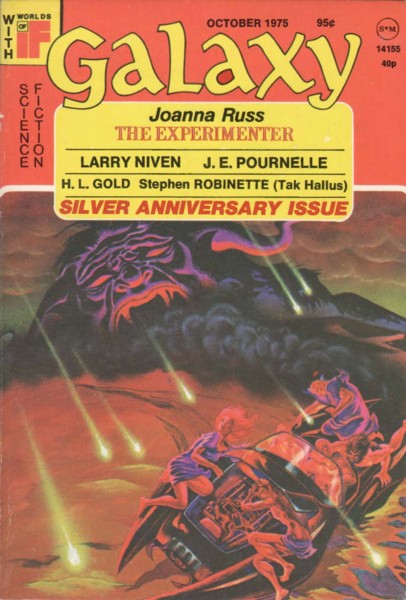
A Time of Changes by Robert Silverberg. Serialized in Galaxy Science Fiction, March to May-June 1971. Nebula winner for Best Novel. When Galaxy changed editors in 1969, readers at the time as well as historians are prone to say the change was a downgrade. One major plus, however, of Ejler Jakobsson taking over was that we got several Silverberg novels in the magazine as serials in rather quick succession. Despite the acclaim he was earning, A Time of Changes was the only Silverberg novel from this period to win a major award.
Under Pressure by Frank Herbert. Serialized in Astounding Science Fiction, November 1955 to January 1956. Also titled The Dragon in the Sea, this was Herbert’s first novel, after he had been in the field for a few years already with now-forgotten short fiction. Herbert’s legacy pretty much solely rests on his Dune series, to the point where it might surprise the reader to find any Herbert that isn’t Dune-related in the wild. I’ve heard from a friend or two that this is actually supposed to be one of Herbert’s best, but we’ll see about that.
For the novellas:
“The Lady Who Plucked Red Flowers Beneath the Queen’s Window” by Rachel Swirsky. From the Summer 2010 issue of Subterranean Online. Nebula winner for Best Novella. More controversially Swirsky also won a Nebula for her story “If You Were a Dinosaur, My Love.” She was also the founding editor of PodCastle, which is crazy to me because she was like, 26? She’s written a good deal of short fiction and poetry over the years, plus one novel so far.
“A Tragedy of Errors” by Poul Anderson. From the February 1968 issue of Galaxy Science Fiction. It’s been a minute since we last covered Anderson, made more conspicuous because he wrote a truly staggering amount of fiction. Of Anderson’s several series the most ambitious might be his Technic History, a centuries-spanning saga tracing the rise and fall of a galactic empire. “A Tragedy of Errors” takes place toward the end of this future history’s timeline.
For the short stories:
“The Storm King” by Joan D. Vinge. From the April 1980 issue of Asimov’s Science Fiction. Not quite as well-known as her late ex-husband, Vernor, partly on account of the fact that she hasn’t written much over the past four decades, but Joan D. Vinge was one of the most promising new writers of the post-New Wave era. She’s more known for her SF, but “The Storm King” is fantasy.
“The Woman of the Wood” by A. Merritt. From the August 1926 issue of Weird Tales. In the ’20s and ’30s Merritt was one of the most popular pulp writers, even getting a magazine named after him. I was set to review one of Merritt’s novels a couple years ago, but I could not get far into it. Well, now it’s time to correct things a bit. Curiously Merritt didn’t write much short fiction.
For the complete novel:
The Sorcerer’s Ship by Hannes Bok. From the December 1942 issue of Unknown. Bok was known far more for his artwork than his fiction, which is understandable given that he was one of the most gifted and recognizable SFF artists of the ’40s and ’50s. You kinda know a certain magazine or book cover is a Bok work just from looking at it. That Bok died relatively young and in poverty, after having all but retired from illustrating, is tragic. Of course, we might not even know about Bok in the first place if not for Ray Bradbury acting as cheerleader for his early material. Bok was really one of the few mavericks of SFF from that era, being a semi-closeted gay man with some niche hobbies, who was also a perfectionist when it came to his art. The Sorcerer’s Ship was Bok’s debut novel and was published complete in Unknown, but would not see book publication until after his death.
Brian Aldiss is what the SF Encyclopedia calls a leading “man of letters” in the field, which is to say he’s adept at both fiction and nonfiction, being one of the field’s great jack-of-all-trades writers. He won a Hugo for the stories comprising Hothouse (strangely as a series of short stories and not for the novel version), but he also won a Hugo for the hefty nonfiction book Trillion Year Spree (co-authored with David Wingrove), which is an opinionated overview of genre SF history, and which is itself a revamped version of the earlier Billion Year Spree. Aldiss had a combative personality and whereas authors nowadays, being their own PR staff, are incentivized to play nice with fellow authors in public, Aldiss made no secret of how he felt about his peers. He debuted a whole decade before the New Wave kicked off, but fit right in with that movement, being probably more influenced by William S. Burroughs than Edgar Rice Burroughs. In other words, despite being born in 1925 and debuting in the ’50s, Aldiss’s fiction can come off as pretty literary—sometimes a little too literary. I’ve been trudging through the Hothouse stories for the past several months, and now it’s time to tackle the third and longest story so far. Mind you that I don’t have a great deal to say about “Undergrowth,” so bear with me.
Placing Coordinates
First published in the July 1961 issue of The Magazine of Fantasy and Science Fiction. It has never been reprinted on its own, which makes sense since it’s the third entry in a series.
Enhancing Image
I actually didn’t know it had already been what, seven months since I reviewed “Nomansland”? It’s been way longer than I had assumed. Granted, these stories are similar enough to each other that to write about them in quick succession would’ve been a chore for me. The Hothouse series can be considered a picaresque of sorts, in which a young person (Gren) goes off on a series of adventures in the name of self-discovery. It becomes apparent by the end of “Nomansland” that Gren is to be our main character throughout the series, and that conversely anyone not named Gren can expect to have a short life and a brutal death. The beginning of “Undergrowth” briefly recaps what happened in the previous story, although I have to assume this opening passage is removed for the novel version since it would certainly strike the reader as redundant. These stories make up a serial in all but name, albeit published a couple months apart at somewhat irregular intervals. It would be necessary to remind the reader of what the fuck is happening, especially since the world Aldiss establishes is so multifaceted, so this recap bit was the best he could’ve done. Gren and his companion Poyly are exiled from their small group of humans and, just when it seems all hope is lost, they come across the morels, a race of sentient fungi that communicate telepathically with the host in a symbiotic relationship. Gren and Poyly get some free hats and head off, out of what is clearly an homage to Eden, with their talking fungus buddies on their heads.
Each story in Hothouse leans into a different subgenre, or so it seems. Generally I would call it science-fantasy, in that while it’s ostensibly SF it so brazenly goes against known laws of physics and biology that it’s clear Aldiss did not intend the world of Hothouse to be an extrapolation of our world, or indeed our universe. In “Hothouse” we’re introduced to mankind in a world where mankind has been relegated to the bottom of the food chain, wherein bugs and carnivorous vegetation have long since taken the top spot. The result is a kind of pseudo-documentary, or rather pseudo-nonfiction, being about as much a sociological study as it is adventure fiction. “Nomansland” downplays the sociological aspect and zooms in to focus on Gren, a teen boy among a group of people who are even younger and dumber than he is; and, more strangely, “Nomansland” has a gothic horror angle, complete with a dark castle built by termites (sorry, termights). Now that we’ve met the morels, one of whom becomes Gren’s headmate so that he always has someone to talk to, the series switches gears yet again. This time it becomes more like a “lost race” adventure of the sort that was popular in the late 19th and early 20th centuries. We’re introduced to the herders, a tribe of humans who live in a congealed lava pit and fear what they call the Black Mouth. One of these herders, Yattmur, serves as Gren and Poyly’s guide to the tribe’s ways and later as a companion. We’re given insight into Gren’s thought processes, but not so with Poyly and Yattmur, the result being that we’re stuck in the male protagonist’s shoes whilst only the female characters’ actions are known to us. I would have very little to tell you about Poyly as a person; she spends much of her time being a load despite having a morel like Gren, which should have granted her more intelligence.
The first revelation to come in this story is that the morels and mankind have a shared history that goes back centuries, indeed back to when mankind was a young fledgling species. This seems to be an alternate reality in which mankind’s evolutionary history is inextricably connected with morels, the latter being like beacons of intelligence but without bodies of their own to command. The central conflict of Hothouse can be considered to be one between thought and action, or rather the tug-of-war between humanity’s capacity for unique thought and our place as animals. In “Hothouse” the humans we read about are little more than animals you’d find in a zoo, having rituals and ways of communicating, but without anything that you would call civilization and without that Shakespearean capacity for interiority. These people do not have thoughts by default; it’s only with the morels that they’re able to recapture what was once a common human ability, which is the ability to think. Or rather Gren’s ability to think. Conversely the other humans they meet, namely the herders and later the Fishers (the latter being a tribe of cowardly people who have tails, these tails in fact being connected with a parasitic tree), who act much in the way Gren’s tribe had acted before Gren got his funny fungus on his head. This is a story about discovering intelligence in a world that is overwhelmingly based in instinct, as in being opposed to intelligence. That Aldiss is interested in a boy gaining this intelligence but is not so interested in the women (well, they’re young girls) Gren meets is a blotch on what is otherwise clearly the work of someone who knows what he’s doing.
There Be Spoilers Here
Once Gren’s freed the Fishers of their parasites, he becomes their new leader, and by extension he also leads Poyly and Yattmur. The back end of “Undergrowth” takes the form of a seafaring adventure, in which at one point Poyly accidentally gets thrown overboard and drowns. It’s a scene that’s striking for its brevity and its sheer violence, as Aldiss kills Poyly off about as sadistically as any other character thus far, but we also get the most memorable line from this story, coming from Gren’s morel: “Half of me is dead.” It’s the one moment in “Undergrowth” where loss as humans experience it is experienced, and Gren isn’t even the one who most profoundly expresses this sense of loss. But that’s okay, since it’s implied that Yattmur will replace Poyly as Gren’s girlfriend, given enough time. On the one hand I appreciate that Aldiss is willing to kill anybody for the right effect, and in keeping with the savagery of the world he has created, but also fridging Poyly like this is a bit concerning in the context of a narrative that treats women as accessories.
A Step Farther Out
Hopefully it won’t take me as long to tackle the next story in the series, although I can’t guarantee anything. It took me a whole week to hunker down and write anything more substantive than a paragraph for this site, and it took some locking-in to do so. I’ve recently come to feel resentful of what I so, this being supposedly a hobby. Ya know, something to take the edge off, for when I’m not working. But Aldiss is not someone you read casually; he’s more intellectual than most of his peers and he wants you to know this. The Hothouse stories were evidently big hits with American readers, but while they do focus more on adventure, with a good deal of violence thrown in, Aldiss is not half-assing it.
Not much to say this month, except of course it is the start of Pride Month. For me Pride Month is every month of the year, so I don’t put that much significance in it; maybe I would if I went out more, attended some events in my city, which I should probably do. I’m only now realizing, as I’m finishing up this forecast post, that I could’ve also given more space to authors I know to be queer, but oh well. I focus more on old-timey SF (What even counts as “old-timey” at this point, like pre-2000?), and unfortunately there aren’t many confirmed-queer authors from before maybe the ’70s. You’ve got Frank M. Robinson, who was gay. Ditto for Samuel R. Delany. I’ve heard from a respectable source that Theodore Sturgeon was bisexual, but I’ve yet to dig into this and find actual evidence of it. Marion Zimmer Bradley was queer, but she was also a heinous sex criminal so I’m not sure about counting that. Joanna Russ was a lesbian, although I forget when she came out. You can see what my problem is there.
More so I thought about using this month to inject a bit more variety into my reviewing plate, so that it’s not all science fiction. Obviously I have to finish the Zelazny serial, which I’m liking quite a bit so far, but I also got the itch to tackle some sword-and-sorcery fantasy that isn’t Fritz Leiber or Robert E. Howard. Fuck it, John Jakes’s Brak the Barbarian. We’re also finally returning to Brian Aldiss’s Hothouse “series” with the third entry, this “series” being very much science-fantasy rather than straight SF. We’ve got a ’50s Cold War story from Philip K. Dick, who I love, and who in the ’50s seemed preoccupied with the possibility of nuclear annihilation. Relatable. Last but not least I’ve got a cyberpunk novella from Pat Cadigan, who on reflection I think is one of my favorite short fiction writers from the ’80s and ’90s. Then there’s Sonya Dorman, who I know I’ve read a few stories from in passing but I’ve not actively sought her out until now.
Going by decade, we’ve got one story from the 1950s, two from the 1960s, two from the 1970s, and one from the 1990s.
For the serials:
Doorways in the Sand by Roger Zelazny. Serialized in Analog Science Fiction, June to August 1975. Zelazny is one of the most influential SFF writers of all time, his mark being apparent on the likes of George R. R. Martin and (God help us) Neil Gaiman; and yet despite a couple generations of writers (especially those of fantasy) owing a debt to Zelazny, much of his work remains obscure or simply out of print, including this standalone novel.
Witch of the Four Winds by John Jakes. Serialized in Fantastic, November to December 1963. Jakes later found mainstream success writing historical fiction, but his early career was defined by SF and especially fantasy. During the sword-and-sorcery revival of the ’60s Jakes came in with his own sword-swinging hero, Brak the Barbarian. This serial got published in book form under the much worse title of Brak the Barbarian Versus the Sorceress.
For the novellas:
“Fool to Believe” by Pat Cadigan. From the February 1990 issue of Asimov’s Science Fiction. When it comes to naming the architects of cyberpunk the first to come up are William Gibson and Bruce Sterling, but Cadigan was also instrumental in shaping the movement. She had actually made her debut in the late ’70s, but as she did not write her first novel for several years she initially made her name as one of the best short fiction writers in the field.
“Undergrowth” by Brian W. Aldiss. From the July 1961 issue of The Magazine of Fantasy and Science Fiction. Aldiss started as a brave new talent in the UK before quickly (much faster than most of his peers, it must be said) making a name for himself in the US. “Undergrowth” is the third Hothouse story, out of five, all of which would then form the “novel” Hothouse. Aldiss won a Hugo for these stories collectively, as opposed to the novel version.
For the short stories:
“Breakfast at Twilight” by Philip K. Dick. From the July 1954 issue of Amazing Stories. In the ’50s, before he turned more to writing novels, Dick was one of the most prolific and awesome short story writers in the field. Not everything he churned out was a hit, but he had a respectably high batting average. Of course it’s very hard for me to be objective with Dick since he’s one of my favorites.
“Journey” by Sonya Dorman. From the November-December 1972 issue of Galaxy Science Fiction. Dorman was a poet as well as a short story writer who only wrote SF sporadically, and mostly for original anthologies, even appearing in Dangerous Visions. Most of her short fiction has been reprinted rarely or not at all, with “Journey” never appearing in book form as of yet.
(Cover by Graves Gladney. Unknown, November 1939.)
Who Goes There?
Crime fiction was and still is a genre kept in its own ghetto, like SF and fantasy, but as with those other genres it sometimes has broken into the literary mainstream. One of the big success stories of classic crime fiction is Raymond Chandler, who aside from writing some poetry had not tried his hand at writing professionally at all until he was in his forties. (This is a lesson in how if you’re such-and-such an age and wondering if it’s too late to try your hand at writing, don’t worry.) He was born in Chicago but came to be deeply affiliated with LA, which is no surprise given that that nearly all his novels take place in LA and its surroundings. He also spent some of his formative years in England, getting an education there, hence his US-UK dual citizenship. In fact Chandler’s knowledge of England plays into today’s story, which is not a detective story (although there is a detective in it), nor is it set in the US at all, but instead Victorian-era London. “The Bronze Door” is the only Chandler story to be published first in an SFF magazine, and it saw print the same year as The Big Sleep, his debut novel. Chandler had turned fifty by this point. He ended up writing only seven novels plus a rather modest supply of short fiction (he mostly stopped with the latter by around 1940), but it was enough.
Placing Coordinates
First published in the November 1939 issue of Unknown. It has the rare of actually appearing in a genre magazine twice, being reprinted in the October 1953 issue of The Magazine of Fantasy and Science Fiction. You can also find it in the Chandler volume Collected Stories.
Enhancing Image
James Sutton-Cornish is fat and middle-aged, and also given to day drinking, which angers his wife to the point where she can’t take it anymore. Mr. and Mrs. Sutton-Cornish have been living in the estate of the former’s ancestors, which really is the only thing that belongs to him; everything else belongs to the wife, including Teddy, their dog. “The rest was hers. Even the clothes he wore, the money in his bank account. But the house was still his—at least in name.” With their divorce underway, James heads out and goes into a bit of a stupor, and catches a cab—that being a horse-and-buggy, not a car. This strikes him as odd, but not that odd. “The Bronze Door” is presumably set in what was then the present day (the 1930s), and at one point James refers to “the war,” probably meaning World War I. But the cab seems to go back in time, at least to the Edwardian era, so that as James makes his way to Soho he also travels to an older, darker, grimier London. He doesn’t like this very much. He ends up at an auction house, and this is where he comes across the door of the title, which is a pretty weird contraption. It’s a metal door that can be placed anywhere and which opens one way, to—somewhere. Possibly nowhere. The theory we get from James is that the bronze door comes from the Golden Age of Islam, in which a sultan or whoever would use it as a method of hiding inconvenient concubines. (It’s Chandler, so of course sex comes up, but it’s also Unknown so it’s very tame.) James takes the door back home with him. Hilarity ensues.
Not that James was a good person to begin with (actually he and Mrs. Sutton-Cornish were arguably made for each other in that they’re both kinda evil), but “The Bronze Door” sees Our Anti-Hero™ slip into outright villainy by the simple abuse of a magical power. We see what the door does by some criminal who’s on the run going through it and simply vanishing into thin air, and it doesn’t take long for James to get a few ideas as to how the door might be applied to his benefit. Like getting rid of a bitchy ex-wife. There’s a tinge of misogyny here, as well as a homophobic remark that Chandler throws out there out of nowhere. At his home, James has portraits of now-gone family members, with the one sticking out being a general who was apparently an evil piece of shit, and also “fruity-looking” in the attire he wore for his portrait. Of course we’re supposed to infer that this general was depraved and debauched in some way, although in ways that Chandler is not really able to describe; for better or worse the general’s crimes are left up to the imagination. Given that Chandler’s writing can be pretty hardboiled and graphic for the time, I have to wonder if “The Bronze Door” was written as this tame or if it got put through the washer by John W. Campbell and his secretary. In the introduction for the F&SF reprint, the editors say that Chandler had actually written a lot of fantasy fiction over the years, but without the intent of seeing it published. The implication is that there’s this treasure trove of such fiction written by Chandler, but given that Chandler died in 1959 and that literally none of this alleged fiction has turned up, I have to wonder if they were misled, or if perhaps Chandler’s estate had his unpublished work locked away indefinitely. Needless to say this is not as hardboiled as Chandler’s usual stuff, and also given that he turned mostly to writing novels after this point it’s easy to see how he only had one other fantasy story published.
I mentioned earlier that while it’s not really a detective story, “The Bronze Door” does have a detective, in the form of Detective-sergeant Lloyd, who starts out as being on the trail of the criminal James has sent through the door, and who later sniffs around once one too many people in the area go missing without a trace. Lloyd is probably the closest we get in Chandler’s work to his take on Sherlock Holmes, although Lloyd is less a Sherlock parody and more your typical image of a late 19th or early 20th century British detective. (I should also probably mention again that the time period for “The Bronze Door” is rather vague, since it’s implied to take place in what was then the modern day, but there are also hints of a pre-WWI Britain. Chandler doesn’t explain it really, and this might be my biggest quibble with the story.) Generally Chandler could’ve done to explain more of the setting, or rather given us a more vivid picture, but what he does give us is splendid in the moment. Nobody does the simile quite like Chandler. There are descriptions of things here that I’d never even thought of before, let alone seen in writing. Philip Marlowe, the jaded protagonist of all of Chandler’s novels, has a way with words that tells us he’s more cultured than he appears, being a chronically drunk private detective, and Chandler does what he can to translate this prose-poetry to a very different setting with a very different kind of protagonist. If this were a more typical Chandler story then Lloyd would be the viewpoint character, since he’s the closest we get to a hero in this ordeal, but instead for the most part we’re stuck in the shoes of the no-good upper-class bum that is James.
There Be Spoilers Here
After James has gitten rid of the wife, and also her dog, one gets the sense that the walls are closing in on him. He’s “won” in the short term, but now he’s lonelier than ever, firing the few people working at his estate and spending the rest of the story as a cranky loner, sinking deeper into what is clearly insanity. There’s a hint of the gothic about “The Bronze Door,” with both the architecture of James’s estate and the implication that he’s falling prey to a strain of insanity that runs in his family. It’s somewhere between “The Fall of the House of Usher” and “The Rats in the Walls,” although it’s not quite a horror story. Naturally murder (in effect if not the exact result) will out, and eventually Lloyd tracks down James. The two have a bit of a fight, although it doesn’t last long, which makes since given we’re told Lloyd is a lot more physically fit than the decrepit James. The ending as a whole is not surprising, but a neat touch is that Lloyd gets some PTSD from James disappearing into the bronze door, it being a supernatural event that he can never bring himself to explain. It’s something that would freak out anyone outside of The X-Files, even someone as experienced as Lloyd. But hey, he gets a promotion and becomes an inspector by the end, so it’s not all bad. The fact that we never see what becomes of people who go through the bronze door makes it just a bit creepier. I should mention that Chandler, aside from being a raging alcoholic, seemed to have episodes of depression, most severely after his wife died, wherein he actually attempted suicide, so his fiction would be pessimistic.
A Step Farther Out
As you can see, “The Bronze Door” is a little detour in Chandler’s oeuvre, being a fantastic mystery, but not a mystery of the sort that Chandler was used to writing. Then there’s the setting, of which we never see the like again before or after with Chandler. It’s predictable, but also a solid story that’s elevated by Chandler being frankly a better prose stylist than most of the people contributing to Unknown. When you read Chandler you read for the flavor of the words more so than the plot. Not sure how Campbell managed to procure a story from someone who apparently had no experience with fantasy, but it’s a charming and somewhat eerie diversion that sees a master outside of his realm of expertise.
At the beginning of the year I said that I would be covering one short story or novella from Galaxy each month—but I said nothing about serials. The truth is that Galaxy was, alongside Astounding/Analog, the most consistent market for serialized novels and novellas at the time, so it would feel wrong to never acknowledge that part of the magazine’s history. As such we’re getting a novella and a serial from Galaxy this month; that they’re both from authors I admire probably helps.
Last month I covered a horror story by the crime/mystery author Dorothy Salisbury Davis, which gave me the idea of finding more SFF by people who normally write crime/mystery, which while also a genre that has a history in pulp magazines, is “realistic” fiction rather than SFF. One curiosity that struck me ever since I saw it years ago was the fantasy story “The Bronze Door” by Raymond Chandler, which marked one of only two times he appeared in an SFF magazine. Someone who wrote a good deal more SFF than Chandler would be John D. MacDonald, who wrote prolifically for the genre magazines in the late ’40s and early ’50s before shifting to crime fiction and making a killing on that. So for this month’s complete novel we’ve got the early MacDonald novel Wine of the Dreamers. Rounding out the novel-length stuff is a relatively obscure standalone SF novel by Roger Zelazny, who nowadays is more known for his fantasy.
For the women we have two people who are a few generations apart and coming from different continents, but who still, each in her own way, have come to write science fiction. Kate Wilhelm is actually a bit hard to find in magazines after the late ’60s, once she found her voice as a writer, but the September 2001 issue of F&SF was a special issue dedicated to Wilhelm, complete with a new novella. As for the Greek writer Eugenia Triantafyllou, I picked just about the newest story I reasonably could’ve (an unofficial rule of mine is that a story must be at least a year old for me to consider it for review), with “Loneliness Universe” being a finalist in this year’s Hugos. I’m voting in the Hugos, by the way.
That makes one story from the 1930s, two from the 1950s, two from the 1970s, one from the 2000s, and one from the 2020s.
For the serial:
The Dream Millennium by James White. Serialized in Galaxy Science Fiction, October to December 1973. I’ve been meaning to read more James White, and thankfully several of his novels first appeared as serials. White first appeared in the UK, in New Worlds, before eventually finding some success in the US as well. Along with Bob Shaw he was one of the few Irish SF writers to appear regularly on both sides of the Atlantic back in those days.
Doorways in the Sand by Roger Zelazny. Serialized in Analog Science Fiction, June to August 1975. Zelazny is one of the most influential SFF writers of all time, his mark being apparent on the likes of George R. R. Martin and (God help us) Neil Gaiman; and yet despite a couple generations of writers (especially those of fantasy) owing a debt to Zelazny, much of his work remains obscure or simply out of print, including this standalone novel.
For the novellas:
“Yesterday’s Tomorrows” by Kate Wilhelm. From the September 2001 issue of The Magazine of Fantasy and Science Fiction. It’s easy to forget this, but Wilhelm started in the ’50s, only that she flew under the radar for about a decade. Like a caterpillar turning into a butterfly, though, Wilhelm seemed to metamorphize almost overnight into one of the most acclaimed SF authors from the late ’60s until her death in 2018. She was married to Damon Knight.
“The Other Man” by Theodore Sturgeon. From the September 1956 issue of Galaxy Science Fiction. Sturgeon is one of my favorite authors, especially of short fiction. Sturgeon had started to write professionally with “mainstream” fiction, although this went nowhere and he quickly pivoted to SFF, much to our benefit. His productivity was peaks and valleys so that he was writing either a lot or nothing at all. He was most consistently productive in the ’50s.
For the short stories:
“Loneliness Universe” by Eugenia Triantafyllou. From the May-June 2024 issue of Uncanny Magazine. Hugo and Nebula nominee for Best Novelette. Triantafyllou was born and raised in Greece, and continues to live abroad, but writes her fiction in English. She made her debut back in 2017, and has yet to write her first novel, although maybe she just much prefers writing short fiction.
“The Bronze Door” by Raymond Chandler. From the November 1939 issue of Unknown. Possibly the most acclaimed crime writer of the 20th century, seriously only rivaled by Agatha Christie, Chandler’s known for his series of novels starring Philip Marlowe. Chandler famously didn’t start writing crime fiction until he was in his forties, and didn’t write his first novel until he was pushing fifty.
For the complete novel:
Wine of the Dreamers by John D. MacDonald. From the May 1950 issue of Startling Stories. Fans of crime fiction would know MacDonald for his prolific (21 novels over a span of as many years) Travis McGee series, as well as the standalone novel Cape Fear (first titled The Executioners, but then retitled after the 1962 film adaptation), but he also wrote a good deal of science fiction in the late ’40s and early ’50s. It’s not unusual for authors to cut their teeth on working with one genre before moving to greener pastures, so that much like how Elmore Leonard started with Westerns before moving to crime fiction, the same happened with MacDonald. Wine of the Dreamers was either MacDonald’s first or second novel, it’s hard to say.
(Cover by J. Allen St. John. Weird Tales, October 1936.)
The Story So Far
Valeria of the Red Brotherhood is a warrior-pirate who was aboard ship not too long ago, but jumped in order to escape an unwanted marriage proposal. She then joined an army of mercenaries, but left that as well, after killing one of the officers. She’s now a fugitive, but she’s not alone, for Conan was in the same army and also deserted, with the intent of following Valeria’s trail. Conan doesn’t wanna kill Valeria, indeed having killed the brother of the officer she had killed off-screen, but rather is curious about her—in more ways than one. Aside from being warriors, one thing Conan and Valeria have in common is that they’re very bad at taking orders. They’re having a “fun” time bickering when a dragon in the forest they’re hiding out in kills their horses, and looks to have them for lunch next. Using a spear and some poison fruit, Conan’s able to incapacitate (although probably not kill) the dragon, and the two make a run for it on foot. On the plains by the forest there’s a domed city, called Xuchotl, which once had an indigenous population but which is not thinly populated by two clans, who years ago had moved in and slaughtered the original residents. Yes, that is technically genocide. We’re told that the indigenous people of the city were no better than those who killed them, and in some ways might’ve been worse. Now it’s a war between the last members of the Tecuhltli and Xotalancas, clans named after their founders. No children have been born in these clans in quite a few years, and it seems each is a mini-civilization on its last legs.
With the help of a Tecuhltli named Techotl, Our Heroes™ get introduced to the Tecuhltli higher-ups, namely their “king” Olmec and his partner Tascela (in the previous installment I said they were married, but their relationship is actually more ambiguous than that), the latter appearing youthful and yet, it turns out, being centuries old. Olmec sort of hires Conan and Valeria in the hopes that they’ll help vanquish the remaining Xotalancas. (The red nails of the title refer to red nails that are stuck into a column in Olmec’s chamber, each representing a vanquished enemy.) This arrangement goes sideways, though, when later that day one of Tascela’s servants tries to put Valeria into a deep sleep with the help of a black lotus. Valeria doesn’t appreciate this very much, so she tortures the servant until she confesses what Tascela’s plan is, although she escapes into the catacombs, never to be seen again but likely to be killed off-screen by something. It’s at this point that Valeria hears swords clashing at the gates, which probably means the Xotalancas have chosen now to make their final assault.
Enhancing Image
A battle goes down, with the Tecuhltli being victorious, of course. They’ve killed the last of the Xotalancas, which ordinarily would mean everyone gets to live happily ever after, but as you know, Tascela has other plans. Olmec also has plans of his own, and ultimately the two rulers fight for a bit over who gets a piece of Valeria’s ass. Olmec wants to rape Valeria while Tascela somehow has even worse plans in mind. Of course, while Olmec is a burley bearded guy who can break someone’s spine in half, Tascela is a sorceress who many years ago had put a spell on Olmec so that he would be unable to lay much more than a finger on her. Is this the only Howard-written Conan story with both a heroine and a villainess? Unfortunately, by this point Valeria has become little more than the obligatory damsel who needs rescuing, although while she’s physically helpless she does have quite the mouth on her. We hear about some “profanities” coming from her and it’s easy to imagine her dropping several F bombs if not for censorship. I sort of get the criticism of Valeria not being enough of a badass heroine, but at the same time I do think she works as a kind of foil to Conan. I think it’s also worth mentioning that it’s easy to believe Howard had based Valeria on Novalyne Price, his girlfriend at the time, namely through her assertive attitude and penchant for cursing, as was apparently Novalyne’s habit when she wasn’t on the job. Clearly by the last couple years of his life Howard was moving in a direction that, while not exactly feminist, was more sympathetic to women as people. Remember that this is a guy who really could not imagine living in a world without his mother in it.
As if to compensate for the slow middle section of the novella, the back end of Red Nails is nonstop violence and conspicuously erotic imagery (I don’t mean that last part in a bad way). Howard said in at least one letter that he thought of Red Nails as his sexiest Conan story, and between the two BDSM-coded torture scenes it’s easy to believe him. Yes, a second BDSM-coded torture scene has hit the towers! This time it’s Valeria who’s on the slab, with the dark-skinned Tascela towering over her, in an image that provided the cover for the first installment. (I should probably have mentioned by now that Tascela is coded as being equivalent to ancient Egyptian royalty, going by how Howard describes her clothing and especially with how she’s illustrated in the version of Red Nails printed in The Best of Robert E. Howard Volume II.) Conan kills Olmec and comes in for the rescue, but it looks like Our Heroes™ are outnumbered when the thing from the catacombs emerges as a deus ex machina, in the form of Tolkemec, who had been banished there many years prior. Conan kills Tolkemec while Valeria takes the chance to stab Tascela in the back, who despite being able to replenish her youth and make people follow her every order is apparently made of tissue paper if someone manages to catch her off-guard. “I had to do that much, for my own self-respect!” says Valeria, as almost a meta statement on how given her damsel status for much of the story she had to take down someone. Why not her evil counterpart, then? It makes enough sense. It also acts as a bit of a twist on its own, if also as an anticlimax, since Tascela shows herself to not be much of a fight after all, at least physically.
As I was reading Mark Finn’s Blood & Thunder: The Life and Art of Robert E. Howard (a good one-volume biography, if also unfortunately sloppy in the proofreading department), and Finn makes a point that I’m sure is not new but which I thought useful for my own read of Red Nails: he considers Red Nails to be a thematic counterpart to Howard’s earlier Beyond the Black River, which might still be my favorite Conan story. Granted that Beyond the Black River benefits from a tighter narrative focus and the damsel being a man instead of a beautiful woman for Conan to make out with, the two novellas do each show one side of the same coin, with Beyond the Black River showing barbarism creeping up on civilization while Red Nails shows what Howard saw as the inherent evil of civilization. A more conventionally racist (mind you that Howard did have racist tendencies) narrative would’ve painted the original inhabitants of Xuchotl as backward “savages,” but from what we’re told about them they were actually quite an advanced and “civilized” people—at least on paper. But they were also decadent, and their collective villainy made way for the settlers that came in and slaughtered them. Now that the clans have been wiped out as well, Conan sees the city being truly bereft of human life now as no great loss. “It’s well the breed exterminated itself,” he says, which could be referring to the original inhabitants, the clans (who after had spawned from one people), or both. For both Conan and Howard, civilization is only temporary, and at some point will meet its end. This is the view of a philosophical pessimist, which one could argue is the most essential foundation for dark fantasy.
A Step Farther Out
I have to admit that when I finished Red Nails I felt a bittersweetness, because it was the last Conan story Howard wrote; even had he lived longer it’s unlikely he would’ve written more Conan, as he made it clear in letters at the time that he was getting tired of the character, and moreover he was getting tired of writing fantasy in general. That one can think this while only pushing thirty is something many of us would now think of as absurd, but Howard really meant it. About a year after he finished Red Nails he got in his car, took out a revolver, put it to the side of his head, and pulled the trigger. It’s ironic that he had basically intended this as the final Conan story, since it ends on a relatively upbeat note (I mean hey, all the bad people are dead) and implies more adventures between Conan and Valeria—only we never got to see those. Eventually I’ll cover more Howard, specifically work of his that isn’t Conan, assuming I don’t follow my leader.