Who Goes There?
Brian Aldiss was born in England in 1925, and he actually lived a very long time, dying literally one day after his 92nd birthday. He starting writing SF in the mid-’50s, being a generation younger than that first wave of British authors to write magazine SF like Arthur C. Clark and John Wyndham, and yet also a generation older than the New Wave crowd he would later fall in with. And whereas Clarke and Wyndham wanted popularity, preferably on both sides of the Antlantic, Aldiss had other ideas. Unfortunately by the late ’50s, when Aldiss’s work was appearing in the US, the magazine market was in the midst of a collapse; but the good news was that The Magazine of Fantasy and Science Fiction was thriving and also the perfect outlet for his fiction, said fiction being sort of dark and literary. The Hothouse stories, which were published in F&SF throughout 1961, were probably Aldiss’s most ambitious project up to that point. The series (but not the fix-up novel, which in the US was actually a bit shorter than the UK and magazine versions) won him a Hugo. It’s only been, what… ten months since I reviewed the previous entry in the series? Seems like only yesterday. We’re almost done here, since “Timberline” is the penultimate story. It’s also, unfortunately, the weakest entry in the series so far.
Placing Coordinates
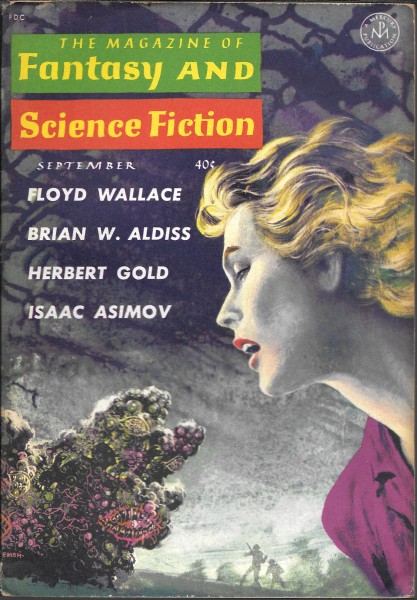
First published in the September 1961 issue of The Magazine of Fantasy and Science Fiction. It’s never been reprinted outside of Hothouse, which makes sense because if you were to hop into this story without having read what came before it, you would be lost.
Enhancing Image
Remember Poyly? Maybe not. She died near the end of “Undergrowth,” and rather unceremoniously, despite having been Gren’s love interest for a minute. Gren himself doesn’t seem too troubled or grief-stricken by this. In fact, I’m struggling to recall if “Timberline” mentions her at all. Of course, the team of humans already had a spare girl, in the form of Yattmur, who becomes Gren’s new girlfriend seemingly overnight. The two are accompanied by four tummy-belly men, who are short, hair, and cowardly by nature. Also dim-witted, not that Gren and Yattmur are all that intelligent. Arguably the only reason they’ve even made it this far is the help of the morel, a sentient and indeed highly intelligent fungus, on Gren’s head. The morel acts as like a second brain, although given the conflict it has with Gren the relationship they have is more like Eddie Brock and the symbiote. They will need all the help they can get, though, since humans are scarce, and for maybe the first time in history, plant life totally rules the world. There are also large carnivorous insects, but those don’t play much of a factor in “Timberline.” Instead, vegetable life has evolved to such a point as to replace practically all fauna on land.
It could be because Gren is the POV character (I hesitate to call him the “hero”), but the way Aldiss writes women in the Hothouse series really leaves something to be desired. Women are treated as disposable, and already we’ve seen multiple fridge-stuffings. This doesn’t even align with what would make sense in such a world: you’d think women would be treated as more valuable, in a world where mankind is endangered and has also become a prey animal, but no, their deaths are treated with as much (or rather with as little) gravity as when the men die. And that goes for the ones who don’t make it. As for Yattmur, she spends virtually all of “Timberline” sulking and complaining about Gren being mean to her, which is understandable on its own, but then she doesn’t do much of anything—not that Gren proves to be much better in that regard. Generally Aldiss’s view of humanity seems to be a dim one, which sometimes works, but sometimes it also results in some fatigued storytelling. It’s strange, and a bit funny, that the most active character in “Timberline” is a parasitic fungus.
The boat Our Heroes™ took at the end of the last story ends up crashing into an iceberg, but that’s okay, since all six survive and even make it onto an islet, in which there is enough food and shelter for the time being. Hell, there aren’t even any enemies here worth mentioning, so that for once Gren and Yattmur are able to have a good time. Maybe too good. The central conflict of this story is that the morel wants to keep moving, since it knows the team can’t stay here forever, while Gren is content to sit back and soak in the sun. This is all framed as serious, but it’s really not as serious as it sounds. The morel wants to progress the plot while Gren doesn’t. Both have valid arguments for their points of view, namely that yes, supplies will eventually run out on the islet, but also getting off the islet will be its own challenge, on account of the boat being wrecked. Meanwhile Gren becomes grumpier because of this, to the point where he becomes borderline abusive with Yattmur. The tummy-belly men are of no help whatsoever in all this; actually their so useless and whiny that it’s a wonder why Gren doesn’t just opt to murder them. Being both stupid and submissive, it’s not like the tummy-belly men would’ve resisted much on that front.
There is a somewhat humorous digression when Our Heroes™ uncover a (I’m not sure how else to put this) centuries-old robotic bird whose purpose seems to be to spew political slogans. That the bird is still in working order after all this time would strain one’s suspension of disbelief, if not for this being a world where Earth and its moon have become interlocked via a kind of plant-constructed elevator. And also there’s one half of the world where the sun always shines, while the other half lies in eternal darkness. Naturally Gren and the gang don’t even try to make sense of what the bird (which they name Beauty) is saying, since not only is there no such thing as “Monkey Labour” anymore, the physical land of India probably no longer exists. Politics, like human life in general, is transient. I said before that Aldiss strikes me as a pessimist, and the comic relief with Beauty is a case of that pessimism being used to inspire good writing. Beauty is an operational but now totally obsolete and worthless piece of machinery whose election-year ramblings are lost on the characters, who indeed would have nothing to gain from it even if they understood it.
There Be Spoilers Here
Their ticket off the islet turns out to be a species of bug-like vegetable called a “stalker,” a giant long-legged veggie that’s sort of like the tripods from H. G. Wells’s The War of the Worlds. It’s a nice image, but unfortunately this sequence of Gren and the others riding atop the stalkers goes on for half an eternity. Another good image that sadly gets drawn out is the moment they cross the “timberline,” i.e., the shadow-line separating the sunlit world from the land of night. Mind you that “Timberline” is about as long as “Hothouse,” so it’s a rather meaty novelette. For the first time in the series I feel like there’s some filler that could’ve been cut.
A Step Farther Out
Hopefully it will not take me another ten months to get to the final Hothouse story. Maybe eight. I do feel like returns on this series have been diminishing somewhat, but then maybe I wouldn’t feel that way if I was reading these stories in novel form. I have to assume the short passages of exposition at the beginning, which would strike the reader as obvious if they were to read these stories in quick succession, were removed for the novel. I remember James Blish got his panties in a twist over the world of Aldiss’s series being absurd, in that it’s really science-fantasy rather than properly SFnal, but the strange world of Hothouse is its selling point. Certainly the characters are not much to write home about, although the morel is a very fine creation. We’ll have to see how this all turns out.
See you next time.
 Science Fiction & Fantasy Remembrance