March was a bit of a marathon here at SFF Remembrance, but truth be told I had more fun writing about that very old and dusty science fiction than in the past few months. I had been suffering from fatigue, along with some real-life stuff that was getting to me and making it hard to sleep at night. Now I feel somewhat rejuvinated. I feel good enough about reviewing stuff here again, in fact, that I’m bringing back the two-short-stories two-novellas deal, although I’m still keeping it to one serial for the month. The serial in question is a three-parter, being the first appearance of one of the most important SF novels ever written—and yet one that has been totally lost to the sands of time. You might find references to The Skylark of Space if you’re a Star Wars fan, as a point of trivia, since it was this novel that in part invented the space opera subgenre. Edmond Hamilton was writing space opera at shorter lengths around the same time Smith made his debut, but there was nothing on the scale of Smith’s novel before it. Smith “revised” it for its eventual book publication, removing co-author Le Hawkins Garby’s contributions, but we’ll be reading it as it appeared in Amazing Stories. This was a long time coming for me.
For the dates of stories, we’re looking at one from the 1920s, two from the 1950s, one from the 1960s, and one from the 1990s. Both of the stories from the ’50s are from the first half of that decade, which was an incredibly productive period for magazine SF.
For the serial:
The Skylark of Space by E. E. Smith and Lee Hawkins Garby. Serialized in Amazing Stories, August to October 1928. When Smith studied chemistry at the University of Iowa, he didn’t think he would later become one of the pioneering authors of space opera. He didn’t even think he would write fiction, until he talked science fiction with Lee Hawkins Garby and her husband, who were friends from college. This was in 1915, before “science fiction” had even been coined as a label. The Skylark of Space took some years to gestate, but when it appeared in 1928 it made Smith a sensation among the then-niche SF readership. Garby’s contributions were later removed when the novel appeared belatedly in book form.
For the novellas:
“Half-Past Eternity” by John D. MacDonald. From the July 1950 issue of Super Science Stories. Fans of classic crime fiction will be familiar with MacDonald, at least by reputation. His Travis McGee series is one of the most prolific and widely read detective series ever. In 1972 he was given the Grand Master Award by the Mystery Writers of America. He also wrote a good deal of SF from the late ’40s through the early ’50s, along with nearly every other genre.
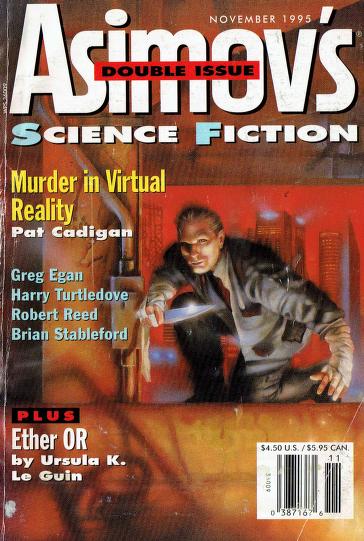
“Death in the Promised Land” by Pat Cadigan. From the November 1995 issue of Asimov’s Science Fiction. It was first published in the March 1995 issue of Omni, but that magazine had gone purely online by that point and the Asimov’s printing marked its first physical appearance. Cadigan is arguably the queen of cyberpunk, going back to the ’80s. She’s not as famous as William Gibson or Bruce Sterling, but she really should be more read than she is.
For the short stories:
“Dumb Martian” by John Wyndham. From the July 1952 issue of Galaxy Science Fiction. It’s surprising to think that Wyndham had made his SF debut in the early ’30s. His career peak came later than it does with most authors, since he was deep in his forties when The Day of the Triffids was published. The ’50s were a great time to be John Wyndham, between his novels and short stories.
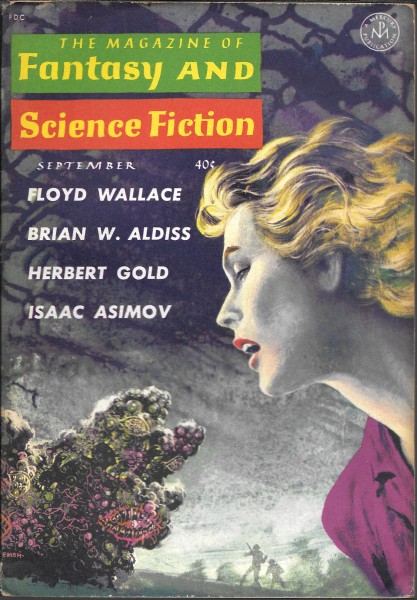
“Timberline” by Brian W. Aldiss. From the September 1961 issue of The Magazine of Fantasy and Science Fiction. This is the fourth installment in Aldiss’s Hothouse series, which was then published as a novel. The series of stories, rather than the novel version, won Aldiss a Hugo, which was certainly a confusing move. It’s been almost a year since I reviewed the last Hothouse story, so here we go.
Brian Aldiss is what the SF Encyclopedia calls a leading “man of letters” in the field, which is to say he’s adept at both fiction and nonfiction, being one of the field’s great jack-of-all-trades writers. He won a Hugo for the stories comprising Hothouse (strangely as a series of short stories and not for the novel version), but he also won a Hugo for the hefty nonfiction book Trillion Year Spree (co-authored with David Wingrove), which is an opinionated overview of genre SF history, and which is itself a revamped version of the earlier Billion Year Spree. Aldiss had a combative personality and whereas authors nowadays, being their own PR staff, are incentivized to play nice with fellow authors in public, Aldiss made no secret of how he felt about his peers. He debuted a whole decade before the New Wave kicked off, but fit right in with that movement, being probably more influenced by William S. Burroughs than Edgar Rice Burroughs. In other words, despite being born in 1925 and debuting in the ’50s, Aldiss’s fiction can come off as pretty literary—sometimes a little too literary. I’ve been trudging through the Hothouse stories for the past several months, and now it’s time to tackle the third and longest story so far. Mind you that I don’t have a great deal to say about “Undergrowth,” so bear with me.
Placing Coordinates
First published in the July 1961 issue of The Magazine of Fantasy and Science Fiction. It has never been reprinted on its own, which makes sense since it’s the third entry in a series.
Enhancing Image
I actually didn’t know it had already been what, seven months since I reviewed “Nomansland”? It’s been way longer than I had assumed. Granted, these stories are similar enough to each other that to write about them in quick succession would’ve been a chore for me. The Hothouse series can be considered a picaresque of sorts, in which a young person (Gren) goes off on a series of adventures in the name of self-discovery. It becomes apparent by the end of “Nomansland” that Gren is to be our main character throughout the series, and that conversely anyone not named Gren can expect to have a short life and a brutal death. The beginning of “Undergrowth” briefly recaps what happened in the previous story, although I have to assume this opening passage is removed for the novel version since it would certainly strike the reader as redundant. These stories make up a serial in all but name, albeit published a couple months apart at somewhat irregular intervals. It would be necessary to remind the reader of what the fuck is happening, especially since the world Aldiss establishes is so multifaceted, so this recap bit was the best he could’ve done. Gren and his companion Poyly are exiled from their small group of humans and, just when it seems all hope is lost, they come across the morels, a race of sentient fungi that communicate telepathically with the host in a symbiotic relationship. Gren and Poyly get some free hats and head off, out of what is clearly an homage to Eden, with their talking fungus buddies on their heads.
Each story in Hothouse leans into a different subgenre, or so it seems. Generally I would call it science-fantasy, in that while it’s ostensibly SF it so brazenly goes against known laws of physics and biology that it’s clear Aldiss did not intend the world of Hothouse to be an extrapolation of our world, or indeed our universe. In “Hothouse” we’re introduced to mankind in a world where mankind has been relegated to the bottom of the food chain, wherein bugs and carnivorous vegetation have long since taken the top spot. The result is a kind of pseudo-documentary, or rather pseudo-nonfiction, being about as much a sociological study as it is adventure fiction. “Nomansland” downplays the sociological aspect and zooms in to focus on Gren, a teen boy among a group of people who are even younger and dumber than he is; and, more strangely, “Nomansland” has a gothic horror angle, complete with a dark castle built by termites (sorry, termights). Now that we’ve met the morels, one of whom becomes Gren’s headmate so that he always has someone to talk to, the series switches gears yet again. This time it becomes more like a “lost race” adventure of the sort that was popular in the late 19th and early 20th centuries. We’re introduced to the herders, a tribe of humans who live in a congealed lava pit and fear what they call the Black Mouth. One of these herders, Yattmur, serves as Gren and Poyly’s guide to the tribe’s ways and later as a companion. We’re given insight into Gren’s thought processes, but not so with Poyly and Yattmur, the result being that we’re stuck in the male protagonist’s shoes whilst only the female characters’ actions are known to us. I would have very little to tell you about Poyly as a person; she spends much of her time being a load despite having a morel like Gren, which should have granted her more intelligence.
The first revelation to come in this story is that the morels and mankind have a shared history that goes back centuries, indeed back to when mankind was a young fledgling species. This seems to be an alternate reality in which mankind’s evolutionary history is inextricably connected with morels, the latter being like beacons of intelligence but without bodies of their own to command. The central conflict of Hothouse can be considered to be one between thought and action, or rather the tug-of-war between humanity’s capacity for unique thought and our place as animals. In “Hothouse” the humans we read about are little more than animals you’d find in a zoo, having rituals and ways of communicating, but without anything that you would call civilization and without that Shakespearean capacity for interiority. These people do not have thoughts by default; it’s only with the morels that they’re able to recapture what was once a common human ability, which is the ability to think. Or rather Gren’s ability to think. Conversely the other humans they meet, namely the herders and later the Fishers (the latter being a tribe of cowardly people who have tails, these tails in fact being connected with a parasitic tree), who act much in the way Gren’s tribe had acted before Gren got his funny fungus on his head. This is a story about discovering intelligence in a world that is overwhelmingly based in instinct, as in being opposed to intelligence. That Aldiss is interested in a boy gaining this intelligence but is not so interested in the women (well, they’re young girls) Gren meets is a blotch on what is otherwise clearly the work of someone who knows what he’s doing.
There Be Spoilers Here
Once Gren’s freed the Fishers of their parasites, he becomes their new leader, and by extension he also leads Poyly and Yattmur. The back end of “Undergrowth” takes the form of a seafaring adventure, in which at one point Poyly accidentally gets thrown overboard and drowns. It’s a scene that’s striking for its brevity and its sheer violence, as Aldiss kills Poyly off about as sadistically as any other character thus far, but we also get the most memorable line from this story, coming from Gren’s morel: “Half of me is dead.” It’s the one moment in “Undergrowth” where loss as humans experience it is experienced, and Gren isn’t even the one who most profoundly expresses this sense of loss. But that’s okay, since it’s implied that Yattmur will replace Poyly as Gren’s girlfriend, given enough time. On the one hand I appreciate that Aldiss is willing to kill anybody for the right effect, and in keeping with the savagery of the world he has created, but also fridging Poyly like this is a bit concerning in the context of a narrative that treats women as accessories.
A Step Farther Out
Hopefully it won’t take me as long to tackle the next story in the series, although I can’t guarantee anything. It took me a whole week to hunker down and write anything more substantive than a paragraph for this site, and it took some locking-in to do so. I’ve recently come to feel resentful of what I so, this being supposedly a hobby. Ya know, something to take the edge off, for when I’m not working. But Aldiss is not someone you read casually; he’s more intellectual than most of his peers and he wants you to know this. The Hothouse stories were evidently big hits with American readers, but while they do focus more on adventure, with a good deal of violence thrown in, Aldiss is not half-assing it.
Not much to say this month, except of course it is the start of Pride Month. For me Pride Month is every month of the year, so I don’t put that much significance in it; maybe I would if I went out more, attended some events in my city, which I should probably do. I’m only now realizing, as I’m finishing up this forecast post, that I could’ve also given more space to authors I know to be queer, but oh well. I focus more on old-timey SF (What even counts as “old-timey” at this point, like pre-2000?), and unfortunately there aren’t many confirmed-queer authors from before maybe the ’70s. You’ve got Frank M. Robinson, who was gay. Ditto for Samuel R. Delany. I’ve heard from a respectable source that Theodore Sturgeon was bisexual, but I’ve yet to dig into this and find actual evidence of it. Marion Zimmer Bradley was queer, but she was also a heinous sex criminal so I’m not sure about counting that. Joanna Russ was a lesbian, although I forget when she came out. You can see what my problem is there.
More so I thought about using this month to inject a bit more variety into my reviewing plate, so that it’s not all science fiction. Obviously I have to finish the Zelazny serial, which I’m liking quite a bit so far, but I also got the itch to tackle some sword-and-sorcery fantasy that isn’t Fritz Leiber or Robert E. Howard. Fuck it, John Jakes’s Brak the Barbarian. We’re also finally returning to Brian Aldiss’s Hothouse “series” with the third entry, this “series” being very much science-fantasy rather than straight SF. We’ve got a ’50s Cold War story from Philip K. Dick, who I love, and who in the ’50s seemed preoccupied with the possibility of nuclear annihilation. Relatable. Last but not least I’ve got a cyberpunk novella from Pat Cadigan, who on reflection I think is one of my favorite short fiction writers from the ’80s and ’90s. Then there’s Sonya Dorman, who I know I’ve read a few stories from in passing but I’ve not actively sought her out until now.
Going by decade, we’ve got one story from the 1950s, two from the 1960s, two from the 1970s, and one from the 1990s.
For the serials:
Doorways in the Sand by Roger Zelazny. Serialized in Analog Science Fiction, June to August 1975. Zelazny is one of the most influential SFF writers of all time, his mark being apparent on the likes of George R. R. Martin and (God help us) Neil Gaiman; and yet despite a couple generations of writers (especially those of fantasy) owing a debt to Zelazny, much of his work remains obscure or simply out of print, including this standalone novel.
Witch of the Four Winds by John Jakes. Serialized in Fantastic, November to December 1963. Jakes later found mainstream success writing historical fiction, but his early career was defined by SF and especially fantasy. During the sword-and-sorcery revival of the ’60s Jakes came in with his own sword-swinging hero, Brak the Barbarian. This serial got published in book form under the much worse title of Brak the Barbarian Versus the Sorceress.
For the novellas:
“Fool to Believe” by Pat Cadigan. From the February 1990 issue of Asimov’s Science Fiction. When it comes to naming the architects of cyberpunk the first to come up are William Gibson and Bruce Sterling, but Cadigan was also instrumental in shaping the movement. She had actually made her debut in the late ’70s, but as she did not write her first novel for several years she initially made her name as one of the best short fiction writers in the field.
“Undergrowth” by Brian W. Aldiss. From the July 1961 issue of The Magazine of Fantasy and Science Fiction. Aldiss started as a brave new talent in the UK before quickly (much faster than most of his peers, it must be said) making a name for himself in the US. “Undergrowth” is the third Hothouse story, out of five, all of which would then form the “novel” Hothouse. Aldiss won a Hugo for these stories collectively, as opposed to the novel version.
For the short stories:
“Breakfast at Twilight” by Philip K. Dick. From the July 1954 issue of Amazing Stories. In the ’50s, before he turned more to writing novels, Dick was one of the most prolific and awesome short story writers in the field. Not everything he churned out was a hit, but he had a respectably high batting average. Of course it’s very hard for me to be objective with Dick since he’s one of my favorites.
“Journey” by Sonya Dorman. From the November-December 1972 issue of Galaxy Science Fiction. Dorman was a poet as well as a short story writer who only wrote SF sporadically, and mostly for original anthologies, even appearing in Dangerous Visions. Most of her short fiction has been reprinted rarely or not at all, with “Journey” never appearing in book form as of yet.
Brian Aldiss started out in the pages of New Worlds and Science Fantasy, those two foremost genre magazines in the UK in the ’50s, but by the end of that decade he had gained a foothold in the US, particularly finding an American home in F&SF. Given his fast-and-loose approach to genre, this makes sense. Aldiss was one of those authors who anticipated the New Wave, to the point of becoming one of its big players. (Mind you that most of the important authors involved with the New Wave, that quintessential ’60s SF movement, had debuted a decade earlier.) He had already gotten a Hugo nomination for Best New Writer (it was a Hugo at the time, don’t ask) when he wrote the stories that would comprise the fix-up novel Hothouse, one of these stories appearing every other month or so in F&SF, the resulting series winning the Hugo for Best Short Fiction—the only time in the history of the Hugos this has happened, and admittedly with good reason. I reviewed “Hothouse” a few months back with the intention of continuing the series, and so here we are with “Nomansland,” a direct sequel.
Placing Coordinates
First published in the April 1961 issue of The Magazine of Fantasy and Science Fiction. It has never been reprinted on its own, although of course you can find it as part of Hothouse.
Enhancing Image
You may recall the adults from the first story went to the moon via a network of traverser webs, grew wings, and have since ventured back to Earth to bring the children of their kind with them to the moon. Lily-yo and the others go unmentioned in “Nomansland,” as instead we’re left to focus on the young folks they had left behind, including Gren, who has emerged as the true protagonist—a position he will apparently hold for the rest of the “series.” Toy is the new matriarch of the little tribe, with the only two males of breeding age being Gren and Veggy. (The two males are probably only barely in their early teens, as the humans of this far future consider “coming of age” to be when you’re physically matured enough to be able to reproduce.) There’s obviously a rivalry going on between the males, not least because Gren is older and wiser while Veggy spends pretty much the whole story being a little dumbass. (I said, in my review of “Hothouse,” that the human characters might have personalities, but I didn’t say they would be likable personalities.) Anyway, Aldiss is still much more interested in the world of the story rather than the people in it, the few humans left feelings small both physically (they’re shorter than modern-day humans, and also have green skin) and in terms of their importance to the narrative. I get the impression that had there been no humans at all that Aldiss would find some way to make the Hothouse stories about something else.
The only one sympathetic to Gren’s plight is Poyly, who will eventually figure rather importantly into the plot (and presumably the next story in the series), but not for now. What’s important is that with “Nomansland” we’re given a couple new creatures to play with, and also a new location in the form of nomansland itself, basically the coastline of this world, the area where the single impossibly massive banyan that serves as the foundation for the world’s vegetation meets its match, the sea. It’s a case of the unstoppable force meeting the immovable object, and it’s also that line where the fight for survival is at its fiercest. Aldiss could’ve written a mean script for a nature documentary if he was interested, if the Hothouse stories are any indication. There’s a cold detachment in how he describes the actions of the humans and their surroundings, but this is also mixed with a poetic sensibility that probably meant F&SF was the only appropriate outlet for this kind of story in the early ’60s. There’s a juxtaposition between Aldiss’s refusal to give the humans a Shakespearean inner life and his loving odes to the strange yet natural world he has created. It’s science-fantasy in the sense that while the basis of this world is implausible (there is, after all, a half of the world where it’s always day and the other night), Aldiss tries to give science-fictional explanations within those parameters. My favorite example of this is “Nomansland” has to be the “sand octopus,” a large tentacled beast which lurks near the coast and catches whatever on the beach it can grab, since crabs have long since gone extinct. Seemingly everything in this world is big—except for the humans.
Since “Nomansland” is a sequel to “Hothouse,” and since both stories were clearly planned as part of a series, there’s not too much I can say about one that doesn’t also apply to the other. If “Hothouse” establishes the cutthroat nature of the world then “Nomansland” expands the boundaries a bit, quite literally as Gren is spirited away by a suckerbird (which is not an actual bird) and narrowly survives, only to land at nomansland, and here the story takes on an unexpected gothic flavor. You see, real-world termites were famous for being ingenious and productive architects; so it only makes sense that the termights, their vastly larger descendants, would produce architecture of an appropriate scale—in this case a bug-made castle that Gren takes refuge in, even meeting a cat (or the descendant of cats) along the way, showing that humans are not the last vertebrate life on the planet—although this may not be true for much longer. Up this point the narrative has been geared towards action and observation, with basically no character insight allowed, which is probably intentional given what’s about to happen. If the characters seem unintelligent it’s because they simply haven’t been granted it—ingenuity, maybe, but not introspection.
There Be Spoilers Here
Gren reunites with the rest of the tribe, which turns out to not be so happy a reunion as Toy and Veggy think Gren is unfit to be the alpha male, and a close encounter with a sand octopus results in the young member of the tribe getting killed in a rather violent fashion. (There’s a girl named Fay and another named May; I think the latter gets killed. I’m not sure why Aldiss gave two characters such similar names. Maybe a way to signal their status as redshirts?) There’s a vote among the tribe and Gren is driven to exile, presumably to meet a gruesome death, and soon. But as luck would have it he comes into contact with morel, a sentient fungus that, when attached to one’s head, can not only communicate with the host telepathically but has access to something like an ancestral memory in the host’s brain. The result is that, all of a sudden, Gren is granted a level of intelligence (here conflated with knowledge) he did not have access to before, and he even convinced Poyly to share the “gift” with him. The ending of “Nomansland” is pretty unsubtly an homage to Adam and Eve getting kicked out of Eden, although here it’s framed as ultimately for the best. Gren and Poyly give up their “souls” (their wooden dolls, you may recall) and leave nomansland together in search of a brighter future. Well, not if Aldiss has anything to say about it. We’ll see in “Undergrowth,” the next story, soon enough.
A Step Farther Out
Give me a few more months and we’ll see a continuation of this series—I mean the reviews, not the stories. I have to admit as I acclimate myself more with the world of Hothouse, I start to “get” what Aldiss is doing more. The ambition of this project is perhaps better appreciates as a series of related stories than as a novel.
I wish I could say the past month has been better for me, but it has not. A big thing is happening in my life, in that today is actually the move-in date for my first apartment. Wow, imagine, at 28, my first apartment. Been taking care of the practical side of things, with assistance: furniture, stuff for the kitchen and bathroom, and of course signing up with utilities. This has been a long time coming, and truth be told I’ve become immensely tired of living with my parents. And yet I’m not happy. Moving into my own place might prove only marginally better than my previous living situation. I don’t make enough to pay for rent so I’ll be bleeding my savings for the following months. The only reason my application even got accepted is my credit score is good. I’ll be living by myself in this one-bedroom apartment. It’ll be very lonely here, as none of my partners live close enough to move in with me, and anyway, with one exception we don’t know each other that well yet. Surely the lack of my parents breathing down my neck will do me some good, but this will be a solitary existence.
Honestly I’ve been tired all the time as of late. My work schedule as of right now is erratic and I find myself going to sleep at six in the morning and waking up after noon. As you may know I have anxiety and depression, and while the former has not been as bad lately, the latter has been worse, or rather more persistent. I’m tired of everything. I’m tired of my job. I’m tired of my imperfect body, and the fact that I can barely sleep. I’m tired of being tired. The US election is in less than a week and honestly I’m sick of this fucking immoral country, and its authorities who have been spending the past couple centuries murdering socialists, queer people, ethnic minority groups, etc. We’re only a quarter into the 21st century but already I feel like almost everything that could go wrong has already gone wrong. And will get worse. I’m normally a pessimist, so take all this with a grain of salt, but I don’t see conditions improving much.
So, go backward or forward, but don’t stay here. I hate it here. I do this blog for fun, and according to stats have written 186,000 words (or about equivalent to Great Expectations in word count) this year alone; but I also do it as a coping mechanism. I don’t do it for readers, or money, because not enough people read this blog or even know about it, despite my spreading word on a few social media platforms. Maybe when I hit 200 subscribers I’ll start a Patreon. Just know I’ve been going at this for two years now because it gives me some degree of emotional security. If not for all these words I would surely have given up a minute ago.
Now, what do we have for reviewing? We have two stories from the ’40s, three from the ’60s, one from the ’80s, one from the ’90s, and one from the 2010s.
For the novellas:
“Attitude” by Hal Clement. From the September 1943 issue of Astounding Science Fiction. Retro Hugo nominee for Best Novella. Feels like it’s been a while since we last talked about Clement, who was one of the first hard SF authors as we now think of the term. Not only was Clement a pioneer, he had a pretty long life and career, remaining active into the beginning of the 21st century. His prose is workmanlike and his human characters tend to be little more than abstractions, but his lectures-as-stories can be enthralling.
“Last Summer at Mars Hill” by Elizabeth Hand. From the August 1994 issue of The Magazine of Fantasy and Science Fiction. Nebula and World Fantasy Award winner for Best Novella. Over the past four decades Hand has taken a kind of jack-of-all-trades approach to writing, tackling SF, fantasy, and horror seemingly with equal relish, with even the occasional movie novelization to her credit. (She wrote the novelization of the infamous 2003 Catwoman movie.) “Last Summer at Mars Hill” is one of her most decorated stories.
For the short stories:
“Beyond the Threshold” by August Derleth. From the September 1941 issue of Weird Tales. Derleth was correspondents with H. P. Lovecraft and could be argued as the person most responsible for preserving Lovecraft’s legacy, as he co-founded Arkham House with Donald Wandrei in 1939 firstly to reprint his mentor’s fiction. He also wrote quite a bit of fiction in his own right.
“The Scar” by Ramsey Campbell. From the Summer 1969 issue of Startling Suspense Stories. One of August Derleth’s biggest discoveries as editor was Ramsey Campbell, whose work Derleth had discovered when he was but a teenager. Campbell’s first collection was published when he was only 18, so that he got his start in weird fiction very early. He would later become a prolific horror novelist.
“Nomansland” by Brian W. Aldiss. From the April 1961 issue of The Magazine of Fantasy and Science Fiction. Aldiss debuted in the 1950s and would remain active pretty much until his death, which was not too long ago. He would win a Short Fiction Hugo for Hothouse, which is sort of a novel but also a collection of linked stories. We already covered the first story, and now we’re on the second.
“Flowers of Edo” by Bruce Sterling. From the May 1987 issue of Asimov’s Science Fiction. Sterling debuted in 1977 when he was barely out of his teens, but he would become one of the defining SF writers of the ’80s. While typically labeled as cyberpunk, Sterling has a surprising versatility, with even early novels like Schismatrix and Islands in the Net being very different from each other.
“Soft Clocks” by Yoshio Aramaki. From the January-February 1989 issue of Interzone. First published in 1968. Translated by Kazuko Behrens and Lewis Shiner. Seeing as how the Sterling story takes from Japanese culture, I thought it only right (and perhaps a neat gimmick) to follow up with a story from a Japanese writer. Yoshio Aramaki has been active since the ’60s as an author and critic.
“Checkerboard Planet” by Eleanor Arnason. From the December 2016 issue of Clarkesworld. Judging from her rate of output you might think Arnason a more recent author, but in fact she was born in 1942 and made her debut back in 1973. She’s been an activist for left-liberal causes since the ’60s but did not start writing full-time until 2009, hence her recent uptick in productivity.
Brian W. Aldiss debuted in the mid-’50s, and within just a few years he emerged as one of the most eye-catching talents in genre SF, on both sides of the Atlantic. Being a British writer he naturally started with the UK magazines, but once he found a home in F&SF stateside it was clear he was a talent not to be fucked with. He would have one of the longest and most acclaimed (at least among fellow writers) careers of any genre SF writer, having started in the ’50s but seamlessly becoming a crucial figure in the New Wave a decade later. He wrote one of the first notable histories of the field, Billion Year Spree, then later massively revised it and co-wrote with David Wingrove to make Trillion Year Spree, the latter winning him (and Wingrove) a Hugo. Of course Aldiss had already won a Hugo, this one for fiction, under circumstances so unusual as to not be repeated. See, people usually count Hothouse as a novel, although it’s really a fix-up of related stories; and the “novel,” as a series of linked stories, won Aldiss the 1962 Hugo for Short Fiction. It remains the only example of a short fiction Hugo going to a group of stories. Admittedly had Hothouse (initially titled The Long Afternoon of Earth in the US) been counted as a novel then Aldiss would’ve stood no chance against the titan that was Heinlein’s Stranger in a Strange Land. I’ve read “Hothouse” before, although I’m rereading it and reviewing it now because I remember basically nothing from that first encounter. I’ve not read the other stories yet, but rest assured I’ll be covering them on this site in due time.
Placing Coordinates
First published in the February 1961 issue of The Magazine and Science Fiction. Obviously you can find “Hothouse” in its novel form, but as a standalone story it’s also been reprinted in Mutants: Eleven Stories of Science Fiction (ed. Robert Silverberg), The Great Science Fiction Series (ed. Martin H. Greenberg, Joseph Olander, and Frederik Pohl), The Great SF Stories #23 (ed. Isaac Asimov and Martin H. Greenberg), and a Silverberg anthology that’s gone by two titles, Robert Silverberg’s Worlds of Wonder and Science Fiction: 101. That last one comes with commentary on each story which at the very least may prove interesting to you, if not helpful as a would-be short fiction writer.
Enhancing Image
The epigraph of this story is a couplet from the Andrew Marvell poem titled “To His Coy Mistress,” a borderline erotic love poem in which, seemingly, the narrator’s beloved is conflated with a tree—maybe not just a tree but the tree. All the trees of the world. It’s a proto-environmentalist poem that you’ve very likely seen quoted elsewhere if you’re a seasoned SF reader, since Ursula K. Le Guin quotes the same couplet for her short story “Vaster Than Empires and More Slow.” If I had a nickel for every time this poem has been quoted in 20th century science fiction I would have at least two nickels—which may not sound like a lot, but it’s weird that it happened at least twice! Of course in the case of the Aldiss story the tree of Marvell’s poem is indeed a single tree that has grown so as to become a vast forest by itself. “On this great continent where the humans lived, only one banyan tree grew now. It had become first King of the forest, then it had become the forest itself. It had conquered the deserts and the mountains and the swamps.” The single banyan tree has conquered the “day” half of the world, serving as the base for what has now become mostly varieties of plant life, from fungi to strange bulking plants called “traversers” that can easily be confused for enormous spiders. Earth and the moon have become locked in place in relation to each other, such that one half of the world is literally always day while the other is always without light, and the traversers have even somehow built a network of webs that acts as a path between Earth and the moon. The only non-plant life on land is a few species of insect, which nonetheless have grown truly massive, along with a small pocket of mankind.
You may notice that this premise sounds a bit outlandish even by Looney Tunes standards. The idea of Earth and its moon becoming locked in place, with there even being life on the latter, is patently scientifically implausible, which I suspect is why in Robert P. Mills’s introductory blurb for “Hothouse” he calls it “science fantasy.” It would be a fatal error to read Aldiss’s story as straight SF, as apparently James Blish did; but as I’ll get to in a moment, it’s not totally unfair to blame Blish for his dissatisfaction with “Hothouse”—not for the implausibility of the premise itself, but because Aldiss goes out of his way to try to make it sound plausible. The third-person narration often reads like a script for a nature documentary, albeit a bit more flowery (aha) than the usual. We meet a tribe of humans, comprised of adults and children (in the world of the story you basically stop being considered a child once you’re physically old enough to breed, (which has its own implications…), and it only takes a couple pages for one of the children to get swallowed up by a massive plant akin to a Venus fly trap. “It is the way,” as the elders say. Life both is and is not cheap here; given the smallness of the tribe every life counts, but also there are more children than adults because not all the children are expected to make it to adulthood. Not so much safety in numbers as an insurance policy. There are more children than adults, but there are also more women than men. The adult women make the important decisions while the men are basically walking sperm banks; this could be construed as feminist if not for the fact that the humans are both deeply tied to tradition and have basically no rights to speak of. After all, civilization as we know it does not exist. It’s a tyrannical little tribe, functioning as it does for the “good” of the race, which after all could easily go extinct.
Humans are so likely to be lost entirely to the vegetation or insects that rather than try to bury what can be retrieved the tribe does a burial rite for a fallen member’s “soul,” a doll “roughly carved of wood” that then stood in for the once-living person. After having done this for the child who’d been killed at the beginning of the story, the elders and the children of the tribe decide to part ways—the elders being old enough to “go up” and the children now being old enough to look after themselves. The life expectancy in this future world must be insanely short—like in the days of hunter-gatherer groups. It makes sense, now that the few humans left have become prey far more often than predator, and Aldiss is a mean-enough bastard that he’s not above killing off children or well-meaning characters. Even in this first story characters can die suddenly, so it’s best to not get too attached to anyone. Nevertheless, we do have characters with names, and possibly even personalities—although we don’t have much to go on there. We have a bit of an ensemble for this first story, but the closest we get to a protagonist would be Lily-yo, the matriarch of the tribe and the one who decides that maybe it would be for the best if she and a few fellow elders took a one-way ticket to the moon, along the traversers’ web, a journey which may or may not kill them. Only two males are left out of the children, Gren and Veggy, and as we can infer these humans really need their walking sperm banks. (I’ve read that Gren becomes an important character as the series goes on, but in this first story he’s little more than an accessory, and easy to forget about.) So of the adults going up we have Lily-yo, Haris, Flor, Jury, Daphe, and Hy. I may be forgetting someone, so sorry about that.
We have carnivorous plants, but we also have giant insects with the tigerflies, treebees, plantants, and termights. (Can you guess what the termights are supposed to be.) The insects feed off each other, the humans, and even the traversers. I know this is supposed to be unfathomably far in the future, but I have to wonder what could’ve happened to produce such a fucked up ecosystem as this; not only are basic physics out the window, but so is Darwinian evolution seemingly. And yet, a good chunk of the story’s word count is Aldiss explaining the dynamics of this ecosystem, as if it were not based on an already-implausible premise. Taken purely as science fiction it’s nonsensical, but it also fights against being taken as fantasy—at least fantasy as the genre was understood in 1961. The telling of the story is as if we’re being given a glimpse into the lives of future humans who actually bear little relation to us, and who have become almost like the animals you’d see in a nature documentary. When Lily-yo and company have gotten to the moon they find themselves mutates via solar radiation, and also find that Daphe and Hy did not survive the journey. It is the way. We’re given no insight into the thinking of these characters, such that they become purely kinetic beings, all living and dying on action, and so we’re not that emotionally invested when a few do inevitably kick the bucket. But there’s another side to this, in that Aldiss’s treatment of his characters is so heartless that it reinforces the cutthroat nature of this story’s world. It’s kill or be killed. When the surviving adults reach the moon they find they’ve become mutated, which would normally be a negative—only here it means they might’ve found an advantage over their nenemies. And maybe an ally.
There Be Spoilers Here
The traversers had constructed a passage to the moon, and brought life with them. “More thoroughly than another dominant species had once managed to do, the traversers colonised the moon.” I find it funny to think “Hothouse” takes place in the same universe as the real-world moon landing, although that wouldn’t happen for another eight years, not to mention the physics don’t line up at all. How would humanity have gotten to the moon with this story’s physics? With a really big slingshot? Anyway, the adults of the tribe find traversers, along with other plant life (yes, breathable air), on the moon, but they also find the flymen. It’s not obvious at first, but the flymen are in fact mutated humans, with angel-like wings that make them suited to the moon’s lighter gravity. Growing wings is one mutation made possible by solar radiation; there are mutations that are less useful. There are non-winged humans among the flymen called Captives who nonetheless serve an important function in this moon society, called “the True World.” But there’s still a problem: replenishing the human race. Age has something to do with it, but the likelier culprit for the lack of children on the moon is that the radiation tended to render the incoming humans impotent, “the rays that made their wings grow made their seed die,” so that the only practical solution is to retrieve more humans from Earth. The leader of the flymen, Band Appa Bondi, is one such human who had been spirited away to the moon as a child. Don’t get attached to him.
Also don’t get attached to Jury; she gets killed offscreen. It is the way. The climax of “Hothouse” sees Band Appa Bondi and the remainder of Lily-yo’s gang heading back to Earth to retrieve the children, only to be met with an army of tigerfly larvae—all of whom happen to be hungry, Band Appa Bondi gets killed unceremoniously in the battle and Our Heroes™ don’t even pay it a second thought. It’s hard to overstate how both outlandish and hardboiled this story is; it’s an odd but compelling combination. “Hothouse” very much ends on a sequel hook—not really a cliffhanger but as a sign of things to come. I remember Silverberg, in his Science Fiction: 101 anthology, had to evaluate “Hothouse” quite differently from the other stories included since it’s the only one that wasn’t written as a standalone; like sure, you could read it as a standalone, if you’re a little freak, but what’s the point in that. What’s the point of developing a fictional world as vividly (if outlandishly) as Aldiss does here and relegating that to a one-off story? What is this, Jack Vance? Aldiss is a good deal more cerebral than Vance. I like Aldiss, but I get the impression he knew he was the smartest person in the room nine times out of ten, and I’m subconsciously envious of this as a certified dumbass. I sometimes get the impression Aldiss may be too smart for me. As such “Hothouse” may be the quintessential Aldiss story in that it leaves me evenly split between ambivalent and intrigued—both because I’m keenly aware he’s doing something unique, and he knows it too.
It is the way.
A Step Farther Out
I appreciate “Hothouse” a lot more on a reread, although I’m not sure I can say it’s “my thing.” It’s already a longish novelette, but it’s dense. It’s easy to see how a hardcore SF reader would be frustrated by it, but it’s also easy to see how in 1961 readers would’ve been impressed with it; it’s not quite New Wave, not least because it lacks any kind of psychological insight into its human characters, but it’s very much a stepping stone to the New Wave era. I also feel that despite sometimes being printed on its own that this is palpably the first entry in a series, as the ending shows, such that I feel like I won’t be honest with myself if I don’t cover “Nomansland” in a few months. Indeed “Nomansland” was already in the can when “Hothouse” was published, since Mills mentions having bought it in the introduction. This is not my favorite Aldiss, but it’s very much worth following.
As I’ve said elsewhere, we’re gonna be covering the ’60s in this year-long tribute to The Magazine of Fantasy and Science Fiction this month. Picking stories to review for July proved a challenge, but in a good way. Over its 75-year history F&SF has gone through several editors, which is normal, but the ’60s were almost certainly the most tumultuous time in the magazine’s history, for a few reasons. At the beginning of the decade Robert P. Mills was editor, and for the few years he edited F&SF Mills was very capable, arguably even on par with Anthony Boucher; but Mills was an agent and publisher first, and editing wasn’t something he wanted to do as a career. So the torch was passed to Avram Davidson, which sounds like an odd choice with hindsight, but it probably made perfect sense at the time. Davidson was a well-respected writer out of the “new” generation; he was more literary than most of his contemporaries, but he was also… quirkier. For practical reasons more than anything Davidson’s editorship could not last, and so the torch was passed once again, this time to Joseph W. Ferman, with his son Edward assisting him. Joseph lasted about a year before passing the torch to Ed; and this time, by the beginning of 1966, the torch would stay in place, as Ed Ferman would remain editor for the next 25 years. By the last ’60s F&SF had found a new and comfortable niche.
The rapid changing of editors also coincided with a rapid changing of material and reader expectations at this time. The ’60s were the decade of a lot of things: the Vietnam War escalating, racial and socio-economic strife reaching a breaking point, the assassinating of left-leaning public figures, the coming of the hippies. More innocuously it saw the birth of the New Wave, which was spearheaded in the UK by Michael Moorcock and a small army of forward-thinking British writers (although, if it makes you feel better, quite a few important contributors to the New Wave were American), reinventing New Worlds to make it a boundary-pushing powerhouse of a magazine. The US scene was a bit slow to catch up. John W. Campbell and Frederik Pohl lamented the New Wave, but the rascally movement would eventually find a sympathizing magazine in the US with F&SF. Understandably the fiction published in F&SF during this time was a good deal more eclectic than what happened in the ’50s, so it also makes sense the lineup of authors for this month would be a bit eccentric. We have a few of the usual suspects, but we also have… Lin Carter? And Russell Kirk…? We have a New Waver with Brian Aldiss, although the story chosen is decidedly anticipatory of the New Wave rather than part of it. For the most part we have science fiction here, with some horror thrown in; this was not a great time for fantasy in F&SF. Still, I think it’s at least an interesting roster.
Let’s see what’s on our plate.
For the short stories:
“The Oldest Soldier” by Fritz Leiber. From the May 1960 issue. He’s baaaaack. Honestly it’s been too long—in fact it’s been exactly a year since we last covered Leiber. Of course in the interim I’ve not refrained from writing about him on a different outlet or two, and can you blame me? This time we have an entry in his Change War series, being one of the first examples of a time war in SF.
“Hothouse” by Brian W. Aldiss. From the February 1961 issue. Aldiss has a career that goes shockingly far back for someone who died fairly recently, having debuted in the ’50s and almost overnight becoming a force to be reckoned with. Hothouse is usually considered a novel, but as a series of linked stories it won Aldiss a Hugo. This first entry in the “series” is a much-needed reread for me.
“Subcommittee” by Zenna Henderson. From the July 1962 issue. There were quite a few female authors active in the early days of F&SF (more so than other SFF magazines), and one of the most prolific contributors was Henderson. Her fiction often involves families and the experiences of children, and she’s most known for her stories of “The People.” This story, however, is totally standalone.
“The Voyage of the ‘Deborah Pratt’” by Miriam Allen deFord. From the April 1963 issue. DeFord has one of the most curious careers of any old-timey SF writer, and in 1963 she was almost certainly the oldest living contributor to F&SF, being in her seventies. Prior to taking up genre writing she wrote for socialist and feminist publications, as well as conducting research for Charles Fort.
“Cynosure” by Kit Reed. From the June 1964 issue. Starting in the ’50s and remaining active until her death in 2017 (she lived to be 85), Reed’s work is often quirky, humorous, satirical, but also at times brutal. Her science was never hard, and her disposition makes one think of Shirley Jackson. Both are vicious when it comes to domestic portraits. In other words, Reed was perfect for F&SF.
“Uncollected Works” by Lin Carter. From the March 1965 issue. Acclaimed, if also controversial, as an editor, and pretty notorious as a writer, Carter is probably most responsible for reviving interest in pre-Tolkien fantasy in the ’60s and ’70s. He’d been active as a fan since the ’40s, but “Uncollected Works” was his first solo professional story, and it garnered him a Nebula nomination.
“Balgrummo’s Hell” by Russell Kirk. From the July 1967 issue. Kirk, at least when he was alive, was known more as a conservative political philosopher, and indeed Christianity is integral to both his fiction and non-fiction. But he was also a surprisingly accomplished writer of supernatural horror, and despite being very much an outsider he did sometimes appear in the pages of F&SF.
“They Are Not Robbed” by Richard McKenna. From the January 1968 issue. McKenna gained mainstream recognition with his one novel, The Sand Pebbles, but it seems he used science fiction as a training ground, such that he appeared semi-regularly in the magazines—both before and after his death. McKenna died in 1964, but he apparently had a small trove of stories waiting to be published.
“The Movie People” by Robert Bloch. From the October 1969 issue. Bloch is most known for writing Psycho, but his career started much earlier and much more embedded in the Lovecraftian tradition—indeed he and Lovecraft were correspondents when Bloch was a teenager. On top of writing bestsellers Bloch wrote for film and TV, even penning a few (horror-themed) Star Trek episodes.