Who Goes There?
Joyce Carol Oates was born in 1938, in upstate New York, and lived her early years among farmers and the land, in contrast with fellow New York authors born within just a few years of her like Thomas Pynchon and Don DeLillo. This rural background partly informs today’s story, but more on that in a bit. For a long time I thought her debut novel was A Garden of Earthly Delights, but actually it was With Shuddering Fall a few years earlier. Oates started writing when she was very young, writing quite a few short stories when she was in high school and with With Shuddering Fall published when she was 26. Soon she became one of the most acclaimed fiction writers of her generation, winning the National Book Award for her 1969 novel them and garnering multiple Pulitzer Prize nominations over the years. She has kept on writing (and, more recently, tweeting) at almost a breakneck pace for the past sixty years, and it looks like she’ll only stop once she shuffled off this mortal coil; if anything her productivity has only gone up with age, as she’s published at least one novel every year since 2000.
Despite her reputation and literary credentials, a good portion of Oates’s fiction is horror, even resulting in her winning several Stokers across a few categories. Her 1995 short novel Zombie is not about the walking dead, like how you would assume, but about a Dahmer-like serial killer. Much of Oates’s horror fiction is of the non-SFF variety, with her fascination with murderers and shady figures by the side of the road going at least as far back as her 1966 story “Where Are You Going, Where Have You Been?” Today’s story, “Family,” can be considered an example of weird science fiction, in that it puts us in the near future, in a rural community that’s surviving in the wake of some unspecified calamity, and with more disasters to come. It’s not quite post-apocalyptic, but rather like George Romero’s Dawn of the Dead it sees human society in the midst of collapse.
Placing Coordinates
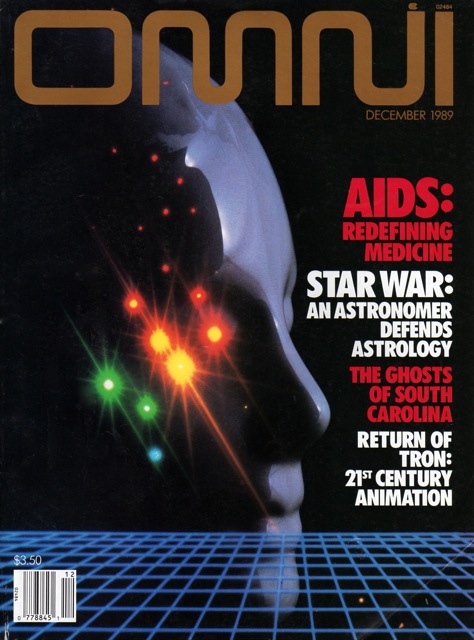
First published in the December 1989 issue of Omni. It’s been reprinted in The Year’s Best Fantasy and Horror: Third Annual Collection (ed. Ellen Datlow and Terri Windling), Masters of Darkness III (ed. Desnis Etchison), American Fantastic Tales: Terror and the Uncanny from the 1940s to Now (ed. Peter Straub), The Weird: A Compendium of Strange and Dark Stories (ed. Ann and Jeff VanderMeer), and the Oates collection Extenuating Circumstances: Stories of Crime and Suspense.
Enhancing Image
In a way, “Family” can be read as a fable, helped by the nameless narrator and the vagueness of the setting, both where (it’s simply called “the Valley”) and when (“neither summer nor winter, spring nor fall”). The narrator, like Ishmael, has little to no bearing on the action of the plot, so for the most part I’ll stop mentioning them from here on out. They live in a family with a few brothers and sisters, and two parents, simply called Mother and Father. The family is relatively well-off since Father had sold most of the acres of land he had inherited, at a time when such land still had value. Unfortunately, the parents’ marriage deteriorates and Father moves out, never to be seen or (strangely) even really thought about again. By this point the family had fallen on hard times, with some of the livestock being killed by rabid dogs and Father having to let go of most of the servants. Obviously there would have to be a new man of the house, so to speak. It takes Mother no time at all to take in a new man, as well as his children from his previous marriage. New Father’s physical description is, let’s say a bit disconcerting, with “an unusually large head the cranium particularly developed, and small shrewd quick-darting eyes beneath brows of bone.” Then there’s New Father’s mouth, which gets described thusly:
The man’s jaws were strangely elongated, the lower jaw at least an inch longer than the upper, so that a wet malevolent ridge of teeth was revealed; as so often happened in those days, a single thought passed like lightning among us children, from one to the other to the other, each of us smiling guiltily as it struck us: Crocodile!
When starting “Family,” you might be duped into thinking it’s taking place in the present day and without anything SFnal at the outset, but soon it becomes apparent the family are living at some point in the future, where the country (presumably the US) has fallen into conditions similar to the Great Depression, only now martial law has also been declared. There was also some unspecified disaster in the past that’s resulted in mutations, which is what’s clearly happened with New Father and at least one other character, whom we’ll get to in a moment. There’s talk of water being contaminated and people living in compounds rather than on the land, with the family eventually being confined to one of these compounds. “All schools, public and private, had been shut down indefinitely.” For only being maybe 7,500 words in length, “Family” is dense with allusions, details, and worldbuilding of a sort that’s unusually subtle for SF; but then Oates might’ve written it primarily as pastoral horror, which is how people seem to take it, given where it’s been reprinted. Even so, it is undoubtedly near-future SF that reads as uncannily believably and thoughtful, with conditions worsening for the family over time as it looks like the government is becoming increasingly desperate. We’re never told exactly why things have gotten so rotten, which is probably for the better; it’s not like, after decades of post-nuclear SF, we need to know the specifics here.
The real conflict comes into play when Cory, an older sister, gives birth without anyone knowing who the father is, with even Cory not knowing how this all happened. Realistically it’s all but guaranteed that Cory had been raped while she was unconscious, and that the most likely culprit is New Father, given the baby’s strange characteristics. Of course, Mother interrogates every man and boy in the compound, including relatives, about whether they spawned the “bastard child,” and if New Father really was the one responsible then we never find out. We’re not even sure what the baby’s sex is. Oates (or rather the narrator) describes the baby as less like a small human being and more like a strange animal, if also a “defenseless living thing,” and it is indeed quite strange, with a “small pursed mouth set like a manta ray’s in its shallow face.” The baby feeds on Cory so fiercely that her breasts ooze blood and pus and it’s only thanks to the family getting a new cow that the baby can be fed safely. Now, it could be because I have an aversion to human babies, but the baby in “Family” is basically everything I would thereotically hate about raising a child, including the outlandish off-chance that said child would be a mutant would shark teeth and a fish-like mouth. You can’t blame Mother all that much when she tries prying the baby from Cory’s hands with the probable intention of killing it. Unfortunately for everyone, Mother does not.
There Be Spoilers Here
Cory dies one night, her body found the next morning with her chest all but eaten through. The narrator and others thought it must’ve been hungry rats that had gotten in, somehow missing the baby in the same room but going for Cory while she lay in her bed. Of course, we know better. Looking back through this story, the foreshadowing of the baby’s insatiable appetite is not all that subtle, although one is not prone to think of it in the moment. At the same time, the baby isn’t evil, for “evil” would require some knowledge of the moral spectrum, of which the baby (or indeed any baby) simply can’t have. No, rather the truth is that the baby was born with a weird mutation, for which it obviously had no say in, and it can’t help but be a cannibal; heck, it would latch onto anything it could get its lips on. After Cory’s death, and eventually after Mother’s (her death, on the other hand, being unknown, or at least the narrator is unable to recall how it happened), there’s a New Mother in the house and it becomes apparent that something must be done about Cory’s baby. By this point, said baby weighs a massive thirty pounds, yet is still unable to talk or walk.
Everyone silently is aware the danger the baby presents (even Lona, another sister who took Cory’s baby in, has to watch her ankles around it), yet there’s also the implicit responsibility the family has to protect one of its own. It’s a curious dillemma, since the baby is murderous, not to mention mutated to such an extent that it barely even resembles a human child, and yet it can’t be reasonably held accountable for its actions. New Mother makes the cold if understandable decision to take a few of the kids and enter Lona’s place in the dead of night, lure out the baby with treats, and put it in a barrel full of hungry rats. This is an oddly roundabout way of doing things, but then maybe none of those involved want the baby’s blood on their hands. It’s a disturbing sequence, not least because the baby’s death is necessary; in a better world it would surely be possible to put the poor thing in special care where it can be raised and maybe even eventually learn to not munch on its fellow man. It’s too bad that the world of “Family” is decidedly unfit for the likes of such mutations—indeed it’s becoming increasingly hard to live for even “normal” human beings. And then, what is “normal”? The ending, which is ostensibly happy but which has an underlying cynicism similar to the ending of Faulkner’s As I Lay Dying, implies that normalcy is not objective but rather a matter of circumstance.
A Step Farther Out
From what I can tell, “Family” is an outlier among Oates’s horror fiction, which might explain why it’s only appeared once and in an obscure collection. Most of Oates’s horror is non-supernatural, or at least the supernatural element is only implied, but “Family” is unusual in that it shows Oates dabbling in speculative fiction. It’s a shame she’s not done it more often, given how much she’s written, because she’s surprisingly adept at the whole thing. “Family” is effective as both science fiction and horror, although I’ve only seen people acknowledge its virtues as pertaining to the latter genre. Sure, there are a few scenes and short passages where I could almost feel my skin crawl, but there’s more to it than that. Right here is a somewhat hidden gem one ought not to miss.
See you next time.