Rule #213: Reassure crew with the phrase, “No Biggie.”
Rule #214: Aliens are real and they like to kill.
It’s hard to know where to start with this one, in part because the show’s very existence is so unexpected. This is despite the fact that an Among Us animated series, based on the video game of the same name, had been announced way back in 2023, and in fact had been finished for nearly two years before being dropped unceremoniously on Paramount+ just earlier this month. In a way the delay is fitting: the game came out in 2018, but didn’t see a serious boost in traffic until 2020. (I wonder what happened that year.) It’s fair to say the folks at Innersloth, a small-time developer, didn’t expect their little multiplayer-focused game to become a cultural phenomenon, with celebrities and even at least one US congressperson streaming their sessions, not to mention at least one notable film appearance. (Remember Glass Onion, that first sequel to Knives Out? I thought it was pretty good.) The game became obscenely popular, so maybe some kind of movie or TV adaptation was almost an inevitability. Even so, it sounds at first like a bad joke, because how much can you do with a game without any discernable plot or characters, and whose reputation in the years since its catapulting to fame has become decidedly a mixed bag? I think I’ve seen more Among Us memes than actual footage of the game in recent years, and I myself haven’t played it in a hot minute. Being color-blind and having only so many friends who would be down to play this particular game with me is an easy recipe for such a situation. It is what it is.
The premise of the game is simple and thus easy to learn but hard to master. You’re on a spaceship as some thing that’s like a cross between a bean and a trash can, as a part of a crew. Most of the crew are who they claim to be, but there’s at least one among you who is an alien in disguise. Your objectives differ depending on whether you’re a genuine crewmate or an impostor. The only way to get rid of an impostor is to call for a vote, and there is of course a chance of ejecting an innocent crewmate into the vacuum of space. There are bells and whistles we could get into, but that’s the gist of it. Every session naturally involves trust, cooperation, and most of all, paranoia. Everyone aboard looks the damn same except for color and attire, being, as Orange in the show puts it, “equally mediocre formless non-sexual beings who are very, very ugly.” There’s a bit of “lore,” but there’s no plot or concrete cast of characters—only what the players are able to invent for each session. (There’s the apparently story-driven Among Us: On Guard, but that game’s not out yet.) The game has a kind of old-school simplicity that would make it accessible to people across multiple age groups, which goes some way to explain its mainstream success. This simplicity also makes Among Us arguably ideal for fandom input, including art, music, fanfiction, and even fan-made animation. Oh, and the memes.
And then there’s the animated series, created by Owen Dennis and backed by a small army of writers, including at least one veteran (Alex Horab) from Infinity Train, Dennis’s previous show. Speaking of people who also worked on Infinity Train, Ashley Johnson, who played the lead in that show, has returned as Purple, the closest the Among Us show has to a protagonist. Aside from Johnson we have a surprisingly solid cast of veteran actors and comedians along for the ride, including Debra Wilson, Elijah Wood, Phil LaMarr, Wayne Knight, Yvette Nicole Brown, “special guest star” Patton Oswalt, and others I’ll be sure to mention. While I said Purple is effectively the series protagonist, this is very much an ensemble effort, although due to Among Us being a murder mystery and with a growing body count as the show progresses, some characters inevitably get less time to shine than others. Who lives and who dies, and in what order? That would be telling. Now, it would be very hard to discuss this show and sing some praises for it without giving away any plot turns, so I’ll only be talking explicitly about what happens in the first three episodes. I think that’s a good compromise. Hell, you can watch the first episode for free on YouTube right this second, which I obviously recommend—BUT ONLY AFTER HAVING READ THE REST OF MY REVIEW, PLEASE.
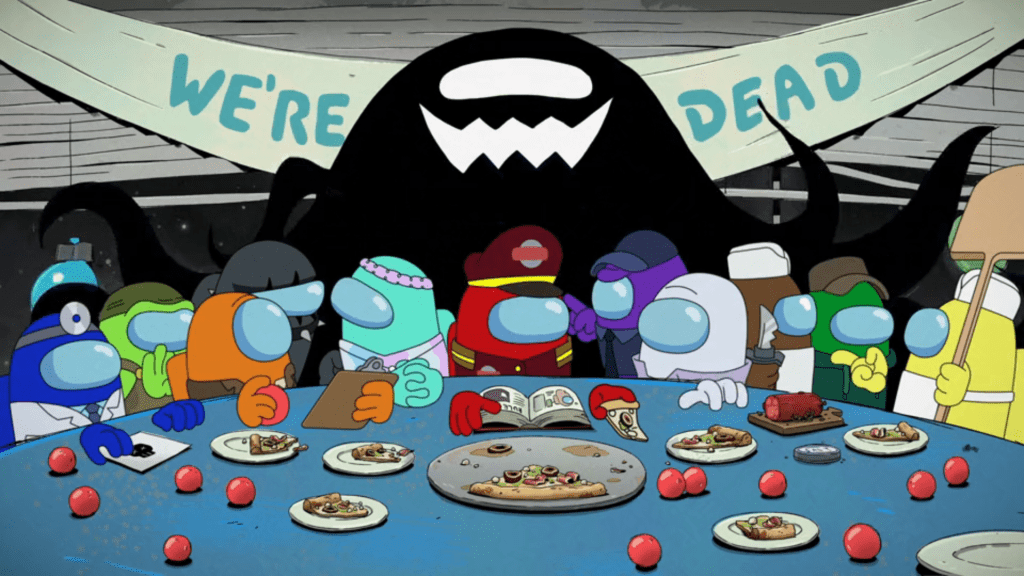
As for the plot, we have two newcomers, Green (Wood) and White (Oswalt), aboard the Skeld, on route to deliver a shipment of Ore Plus to the planet Industria. MIRA, the corporation that owns the Skeld, makes bank by mining Ore Plus from asteroids and selling this spiffy new substance as as a precious and efficient fuel source. It’s a long trip, with a rather colorful (and dysfunctional) crew, so that there’s drama even before the first body hits the floor. We have Red (Randall Park), the captain of the ship and a certified company bootlicker who seems to have gotten his job by kissing the right asses. There’s the aforementioned Purple as security officer, although as they’re quick to point out, MIRA gave the Skeld very little to work with in terms of preventing crewmates from dying horribly. (The cameras around the ship do not record, and also they shoot in black-and-white, which is a big problem when crewmates are identified mostly by their body colors.) There’s Blue (Dan Stevens), the ship’s doctor, who is adored (and sexualized) by literally everyone. There’s Lime (Knight), the terminally paranoid engineer, who claims to also be “an ordained minister.” We have Yellow (Wilson) and Brown (LaMarr), the ship’s cooks, a couple of besties and blue-collar socialists. We have Black (Liv Hewson) and Cyan (Kimiko Glenn), a geologist and a gemologist respectively. Finally there’s Orange (Brown, as in Yvette Nicole Brown, not Brown the character), an HR person from MIRA who’s supposed to give Green and White a tour of the ship. It takes one episode for everything to go wrong.
An accident involving an asteroid (by that I mean an accident Red caused by giving White control of the ship for a few minutes, on account of White being here because they won some contest [and on account of Red being very bad at their job]) throws everything into jeopardy. But don’t worry, with some teamwork and a whole crateful of rubber balls, the day is saved! Until later, when White comes into the cafeteria with a serious illness known as having their head sliced cleanly from the rest of their body. (Farewell, Patton Oswalt.) It’s a bloody mess, and more importantly, there’s presumably a killer on the loose. Red is not convinced of this at first, or at least they act like they’re not convinced of a killer being on the loose. Sure thing, buddy. We know, of course, that someone among the crew is an impostor—possibly even (wait for it) an alien impostor.
The game is afoot, as it were. The problem is that there’s no Sherlock Holmes figure on the case, or even a Sam Spade. Purple works in security, but they’re stuck with crummy equipment and only got the job in the first place because Red, who used to be friends with Purple (why they had a falling out would be going a little too into spoiler territory), vouched for them. Red themself can barely be trusted with commanding a ship, let alone solving a murder on said ship. A great deal of the conflict, then, comes from interpersonal drama rather than direct threats from the alien, although the alien shows itself to be both cunning and vicious. Despite being rated TV-PG on Paramount+, there’s a lot of gore to be found in Among Us, to the degree that it honestly makes the video game (which has its own share of blood and bone) look tame by comparison. Surely it would be unthinkable to rate this show as something ostensibly for kids if the bean creatures being gutted and decapitated were humans instead. There’s also some mild swearing, and there’s a scene that happens in the fifth episode that I would struggle to describe, even if I wasn’t giving away a major spoiler with it. The point is that while the animation is clean and cutesy (courtesy of Titmouse), and the tone mostly comedic, this is still a genuine murder mystery with high stakes. The Among Us show is like a stew with Alien, The Thing, Knives Out, and Looney Tunes cartoons as some but not all of the ingredients.
A major positive that comes from telling a mystery story, which is to say a tale of detection and deduction, is that it’s possible to make the viewer feel as if they’re collaborating with the author by deducing from facts alongside the characters, such that one can correctly figure out the killer before the characters draw the same conclusions. Granted that the viewer has a bird’s-eye view of the story, and thus is able to make connections that none of the characters would be able to make individually, much of the fun in going through a detective story is the sense of interactivity, even if it’s ersatz-interactivity like in the case of a movie or novel. In Among Us the video game, the player really does get to play detective—unless the player is the one who’s supposed to evade detection, obviously. The problem that looms over every instance of a video game getting adapted to a non-interactive medium, namely the loss of that interactivity, is softened a good deal in the case of Among Us, since the show invites the viewer to look for clues, and like every good detective story the clues are hiding in plain sight, only waiting for an especially discerning viewer to gather them. Said clues become more apparent on rewatching, but the subtleness which with Dennis and company do their foreshadowing gives the show a good deal of rewatch value anyway. There are also red herrings, false leads, sabotaged equipment, cases of the alien taunting the crew, crewmates pointing fingers at each other. Ya know, the good stuff. It’s also pretty funny.
I said that the tone is mostly comedic, which is to say that some of these characters are meant to be taken more as caricatures rather than as people with unique interior lives. White is the most obvious caricature of the lot, being a clueless and unrepentent capitalist (“What’s a capitalist?” asks Green at one point, to which White responds happily, “ME!”), so of course he’s the first to get the ax. There are members of the cast who are given more room for interiority, though, and there’s even a moment or two of pathos that comes from a character who otherwise seems to be there just to fill out the roster—yet these moments do not totally come out of nowhere. At the same time the show takes a rapid-fire approach to humor that’s not gonna win everyone over, in the sense that it takes a quality-over-quantity philosophy with its jokes. This is understandable, given that each episode only runs about 13 minutes on average and Among Us has to function as both a comedy and a murder mystery. The quality of the average joke is pretty good, though, and while I didn’t find myself laughing constantly (although there are certain bits I keep going back to), even the worst jokes are inoffensive. It helps, too, that while there are a few references sprinkled in there, including one to Henry Stickmin of all things, many of the jokes come from how quippy and at times absurd the dialogue can get, along with line delivery. Even with a cast like this you’d think at least some of the actors would phone it in, but this is not the case. My favorite here might be Wayne Knight as Lime, who has so much goddamn fun with his role.
Finally, and this is something I’ve alluded to before, but this show is pretty woke. There’s a strong anti-capitalist sentiment among both the characters and the larger themes of the story, given that MIRA is indirectly responsible for every bad thing that happens, whether it be the lack of decent security equipment, putting someone as unqualified as Red in the captain’s chair, or making Green do grunt work as an unpaid intern and sending them into what turns out to be a bloodbath. There aren’t any escape pods or even a proper airlock system—just a trash disposal unit. Yellow is absolutely right when they say Green is being exploited for their labor, being both non-union and only compensated with “experience” on their resume. Also, you may have noticed that I keep using “they” and “them” to refer to all the characters, and this is accurate: every character aboard the Skeld is non-binary, or maybe genderless, with everyone using they/them. (Incidentally Liv Hewson, Black’s VA, really is non-binary, so that’s nice.) Everyone also seems to be bisexual without much of a preference when it comes to gendered appearances, with a running gag being that everyone finds Blue attractive. Then there’s the Scene™ I mentioned before but could not (and indeed cannot) describe, but believe me when I say it’s something.
What we have with Among Us the show is sort of a miracle. It’s easily one of the best video game adaptations in the business, and unlike, say, The Last of Us (season 1, anyway, I’ve heard mixed things about season 2), which captures the story and characters of the source material well but not really how it feels to play The Last of Us, if I’m making any sense to you. With Among Us, on the other hand, it does feel like a particularly intense session of the game, albeit with a team of professional writers and voice-actors instead of your friends. We probably won’t get a second season, nor does the show call for one; there are possible scenarios for a follow-up, sure, but the story told in the show is so tightly wound and self-contained that it seems as if Dennis and company worked on it with the mindset that they would never get to do another show quite like it again. It’s short as is, which is maybe my one lingering gripe, in that all told it runs just over two hours, so that at times it does come off as the tream trying to cram a lot into a small space. But what we did get serves as a new gold standard for translating the excitement and interactivity that comes with gaming into another medium.
And remember, FUCK PARAMOUNT.

