Who Goes There?
Katherine MacLean was born in 1925, in New Jersey, and she took to writing SF rather young, in the late ’40s while working as a lab technician. MacLean arriving at the scene corresponded with those of quite a few other authors of her generation, as the magazine market was about to form a bubble the likes of which would not be seen again until decades later. When the bubble burst in the mid-’50s, MacLean’s output declined, to the point where she didn’t write that much after the ’50s, and after the ’70s had virtually retired from writing. The result is that despite living a very long life, only dying in 2019, MacLean now feels like an artifact of an almost ancient era of SF, of which she was one of the better practitioners. Despite typically being regarded as “hard SF,” the stories I’ve read from MacLean lean much harder into the soft sciences, and at times just pseudo-science (namely having to do with ESP, which she seemed to believe genuinely in); but clearly it’s her attitude and not the material itself that gives her the label. She could be considered a successor to A. E. van Vogt, working to fill a niche van Vogt had left when he stopped writing SF in the early ’50s. She can be considered, alongside van Vogt and Charles L. Harness, to be part of a school of SF writers who play fast and loose with scientific plausibility, and yet who treat this looseness with much seriousness.
Placing Coordinates
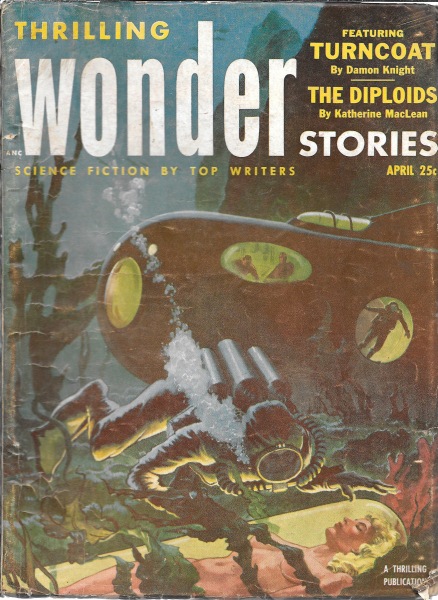
First published in the April 1953 issue of Thrilling Wonder Stories. It’s only ever been reprinted in the MacLean collection The Diploids.
Enhancing Image
The last time I wrote about MacLean was with two of her best and most reprinted stories, “Pictures Don’t Lie” and “The Snowball Effect.” These show MacLean in top form, and incidentally they were also published in Galaxy, despite Astounding (I think) having printed more of MacLean’s work. “The Diploids” definitely leans more toward the Astounding type of narrative, for reasons I can’t get into without spoiling, although it appeared in the less prestigious but in some ways more permissive Thrilling Wonder Stories. Unfortunately “The Diploids” is lesser MacLean, which doubly sucks because it’s longer than both of the aforementioned stories combined. Forty magazine pages doesn’t sound like a whole lot, but between the formatting of this specific magazine (a lot of wordage per page) and there being so much expository dialogue, it was a bit of a slog.
Paul “Mart” (short for Martian) Breden is a 28-year-old patent attorney who has a problem—actually two problems. The first is that Devon, a mad scientist and scorned would-be patent inventor, has taken it upon himself to get at Paul by any means, include a stray shot with a handgun in broad daylight. For better or worse Devon is unstable, a paranoid, and also a raging moron, one who is convinced Paul is an alien. We know from the outset that something is different about Paul, on account of him having six fingers on each hand, but to make things freakier, he also had a third eye hidden in the back of his head. (He wears his hair long so nobody would see it, which begs the question of what would happen if Paul suffered from male pattern baldness.) Aside from the fingers Paul has adnormalities about his body that he’s able to hide in public, but his close encounter with Devon results in him coming out to Nadine, his sort-of girlfriend. (Their relationship is kinda messy, not helped by Nadine being offscreen for most of the story.) Upon revealing the third eye, the first time he’s ever done this as an adult, Paul starts to wonder if maybe he really is an alien like Devon said. I feel like I’m not spoiling much by saying that this turns out to not be the case. Paul is indeed a human, born and raised on Earth and to human parents; but his parents whom he’s known his whole life had adopted him while his biological parents are unknown, so his lineage remains a mystery.
There are some bewildering character moments and interactions that make me wonder if maybe MacLean should’ve done another rewrite, including but not limited to Paul just casually shrugging off taking a bullet graze to the neck and Nadine being seemingly unable to make up her mind if she wants to start a family with Paul or not; more conspicuously, the third-person narrator tells us that Paul is slow to anger, yet multiple times in-story we see this informed bit of characterization being contradicted. In practice Paul is shown to have a short fuse, although in his defense he’s about as quick to stop being angry as he is to start. Devon is ostensibly a villain, but he’s played almost as a joke and it becomes easy to forget about him once Paul starts on the quest to find more of his own people, who are called diploids and who he thinks are “mutants” like himself. (This ends up not being quite right, but more on that in a minute.) Safe to say the pacing of this novella is strange and rather lopsided. It takes about a third of the way in for the intrigue to start building in earnest, and there is a whole cast of characters we don’t meet until the second half. There’s also some use of coincidence in order to get the plot moving: Paul just so happens to see an ad, which we’re later told only gets put up once a year, that leads him down the rabbit hole to not only tracing his lineage but finding other folks like himself. This is unusually sloppy storytelling for MacLean.
There Be Spoilers Here
In fairness to MacLean, she does put a little twist on a story which at first looks to be just a variation on van Vogt’s Slan. No doubt MacLean was thinking of Slan, which at this point was one of the most popular novels in the field. Indeed there used to be many fans of van Vogt, but they’re all dead now. Anyway, Paul is not a mutant in the strict sense that his abnormalities occurred by genetic accident; rather they were put there, intentionally, with the “accident” instead being that Paul was not supposed to have made it beyond the fetal stage. There’s a somewhat convoluted backstory involving a laboratory that experimented on human embryos much like how cosmetics companies experiment on animals, only for some of these embryos to be illegally sold off to the highest bidder and allowed entry into human society. Paul is one of the “E-2” line, in that on top of his weird but useful physical quirks he has also been gifted with high intelligence. (MacLean, as I suppose was common among folks at the time, treats IQ with a totally straight face. Anyone who has an IQ of above 140 is presumed to be a genius.) The big revelation, of course, is that rather than being a freak, Paul has won the genetic lottery, which the story treats as very good news for his and Nadine’s hopes of having children. The “diploids” are indeed a very small but special sub-race of supermen (and women).
A Step Farther Out
Well, that was a bit of a dud. It’s something you have to expect when reading SF of this vintage, though, even when it’s from someone of above-average skill like MacLean. I’m not sure if MacLean buys into the genetics mumbo jumbo she puts out in “The Diploids,” considering we know she bought enough into the notion of psi powers that she had apparently taken an interest in Dianetics in the ’50s. (The number of SF authors to have bought at least somewhat into L. Ron Hubbard’s pseudo-science at this time is depressingly high.) “The Diploids” is unusual for MacLean in a few ways, being it’s one of her longer stories, that it doesn’t have to do so much with sociology nor is it all that socially conscious, and also the debt she paid to van Vogt as an influence is at its most overt here. Like I said, though, there’s also a sloppiness with pacing and characterization that tells me MacLean had submitted it to a higher-paying magazine, namely Astounding, only for it to get rejected. But that’s just a theory.
See you next time.

