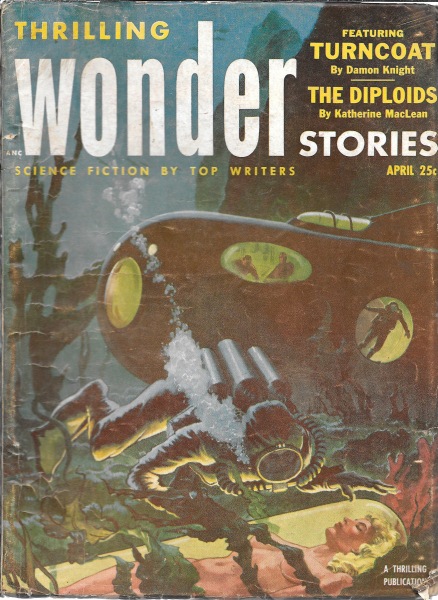
(Cover by Jack Coggins. Thrilling Wonder Stories, April 1953.)
Who Goes There?
Katherine MacLean was born in 1925, in New Jersey, and she took to writing SF rather young, in the late ’40s while working as a lab technician. MacLean arriving at the scene corresponded with those of quite a few other authors of her generation, as the magazine market was about to form a bubble the likes of which would not be seen again until decades later. When the bubble burst in the mid-’50s, MacLean’s output declined, to the point where she didn’t write that much after the ’50s, and after the ’70s had virtually retired from writing. The result is that despite living a very long life, only dying in 2019, MacLean now feels like an artifact of an almost ancient era of SF, of which she was one of the better practitioners. Despite typically being regarded as “hard SF,” the stories I’ve read from MacLean lean much harder into the soft sciences, and at times just pseudo-science (namely having to do with ESP, which she seemed to believe genuinely in); but clearly it’s her attitude and not the material itself that gives her the label. She could be considered a successor to A. E. van Vogt, working to fill a niche van Vogt had left when he stopped writing SF in the early ’50s. She can be considered, alongside van Vogt and Charles L. Harness, to be part of a school of SF writers who play fast and loose with scientific plausibility, and yet who treat this looseness with much seriousness.
Placing Coordinates
First published in the April 1953 issue of Thrilling Wonder Stories. It’s only ever been reprinted in the MacLean collection The Diploids.
Enhancing Image
The last time I wrote about MacLean was with two of her best and most reprinted stories, “Pictures Don’t Lie” and “The Snowball Effect.” These show MacLean in top form, and incidentally they were also published in Galaxy, despite Astounding (I think) having printed more of MacLean’s work. “The Diploids” definitely leans more toward the Astounding type of narrative, for reasons I can’t get into without spoiling, although it appeared in the less prestigious but in some ways more permissive Thrilling Wonder Stories. Unfortunately “The Diploids” is lesser MacLean, which doubly sucks because it’s longer than both of the aforementioned stories combined. Forty magazine pages doesn’t sound like a whole lot, but between the formatting of this specific magazine (a lot of wordage per page) and there being so much expository dialogue, it was a bit of a slog.
Paul “Mart” (short for Martian) Breden is a 28-year-old patent attorney who has a problem—actually two problems. The first is that Devon, a mad scientist and scorned would-be patent inventor, has taken it upon himself to get at Paul by any means, include a stray shot with a handgun in broad daylight. For better or worse Devon is unstable, a paranoid, and also a raging moron, one who is convinced Paul is an alien. We know from the outset that something is different about Paul, on account of him having six fingers on each hand, but to make things freakier, he also had a third eye hidden in the back of his head. (He wears his hair long so nobody would see it, which begs the question of what would happen if Paul suffered from male pattern baldness.) Aside from the fingers Paul has adnormalities about his body that he’s able to hide in public, but his close encounter with Devon results in him coming out to Nadine, his sort-of girlfriend. (Their relationship is kinda messy, not helped by Nadine being offscreen for most of the story.) Upon revealing the third eye, the first time he’s ever done this as an adult, Paul starts to wonder if maybe he really is an alien like Devon said. I feel like I’m not spoiling much by saying that this turns out to not be the case. Paul is indeed a human, born and raised on Earth and to human parents; but his parents whom he’s known his whole life had adopted him while his biological parents are unknown, so his lineage remains a mystery.
There are some bewildering character moments and interactions that make me wonder if maybe MacLean should’ve done another rewrite, including but not limited to Paul just casually shrugging off taking a bullet graze to the neck and Nadine being seemingly unable to make up her mind if she wants to start a family with Paul or not; more conspicuously, the third-person narrator tells us that Paul is slow to anger, yet multiple times in-story we see this informed bit of characterization being contradicted. In practice Paul is shown to have a short fuse, although in his defense he’s about as quick to stop being angry as he is to start. Devon is ostensibly a villain, but he’s played almost as a joke and it becomes easy to forget about him once Paul starts on the quest to find more of his own people, who are called diploids and who he thinks are “mutants” like himself. (This ends up not being quite right, but more on that in a minute.) Safe to say the pacing of this novella is strange and rather lopsided. It takes about a third of the way in for the intrigue to start building in earnest, and there is a whole cast of characters we don’t meet until the second half. There’s also some use of coincidence in order to get the plot moving: Paul just so happens to see an ad, which we’re later told only gets put up once a year, that leads him down the rabbit hole to not only tracing his lineage but finding other folks like himself. This is unusually sloppy storytelling for MacLean.
There Be Spoilers Here
In fairness to MacLean, she does put a little twist on a story which at first looks to be just a variation on van Vogt’s Slan. No doubt MacLean was thinking of Slan, which at this point was one of the most popular novels in the field. Indeed there used to be many fans of van Vogt, but they’re all dead now. Anyway, Paul is not a mutant in the strict sense that his abnormalities occurred by genetic accident; rather they were put there, intentionally, with the “accident” instead being that Paul was not supposed to have made it beyond the fetal stage. There’s a somewhat convoluted backstory involving a laboratory that experimented on human embryos much like how cosmetics companies experiment on animals, only for some of these embryos to be illegally sold off to the highest bidder and allowed entry into human society. Paul is one of the “E-2” line, in that on top of his weird but useful physical quirks he has also been gifted with high intelligence. (MacLean, as I suppose was common among folks at the time, treats IQ with a totally straight face. Anyone who has an IQ of above 140 is presumed to be a genius.) The big revelation, of course, is that rather than being a freak, Paul has won the genetic lottery, which the story treats as very good news for his and Nadine’s hopes of having children. The “diploids” are indeed a very small but special sub-race of supermen (and women).
A Step Farther Out
Well, that was a bit of a dud. It’s something you have to expect when reading SF of this vintage, though, even when it’s from someone of above-average skill like MacLean. I’m not sure if MacLean buys into the genetics mumbo jumbo she puts out in “The Diploids,” considering we know she bought enough into the notion of psi powers that she had apparently taken an interest in Dianetics in the ’50s. (The number of SF authors to have bought at least somewhat into L. Ron Hubbard’s pseudo-science at this time is depressingly high.) “The Diploids” is unusual for MacLean in a few ways, being it’s one of her longer stories, that it doesn’t have to do so much with sociology nor is it all that socially conscious, and also the debt she paid to van Vogt as an influence is at its most overt here. Like I said, though, there’s also a sloppiness with pacing and characterization that tells me MacLean had submitted it to a higher-paying magazine, namely Astounding, only for it to get rejected. But that’s just a theory.
(Cover by Jack Coggins. Thrilling Wonder Stories, April 1953.)
Who Goes There?
I don’t know what to make of Philip José Farmer, but in my defense his peculiar place in SF history is partly what has secured his legacy. It’d be easy to say Farmer is a New Wave author, but he’s a whole generation older than the New Wavers and indeed his roots are distinctly pre-New Wave, despite getting started late as a writer. Farmer was already in his thirties when his debut story “The Lovers” was published in the August 1952 issue of Startling Stories, and apparently readers went nuts over it. There was nothing in terms of content (although not style) that quite matched “The Lovers,” as it was rejected by both Astounding and Galaxy for its graphic (for the time) depiction of romance between a human man and an alien woman who appears human enough. Samuel Mines, editor of Startling Stories and Thrilling Wonder Stories, knew he had found a special talent, and Farmer’s first few stories (mostly in Mines’s magazines) led him to winning the Hugo (although nowadays it would be the Astounding Award) for Best New Author. In hindsight this can read as a bit odd, considering Philip K. Dick and Robert Sheckley debuted the same year as Farmer, but the old saying that sex sells was and continues to be true.
The author spotlight for today’s story, “Mother,” labels it as Farmer’s second story, although this would not have been true unless it was the second story Farmer had sold—which is quite possible. Mines singles out “Mother” as being even more transgressive than “The Lovers,” and despite the latter being more famous I think Mines is right; not only does it go into more devious territory than “The Lovers,” it’s also the better story! This is a well-structured and more engrossing tale of first contact, and I’m about to explain why it works in conjunction with Farmer’s Oedipal hijinks.
Placing Coordinates
First published in the April 1953 issue of Thrilling Wonder Stories. I had first heard about “Mother” through its inclusion in the collection Strange Relations, not to be confused with the omnibus of the same title that also includes The Lovers (the novel version) and Flesh. I’ve read The Lovers and Flesh but not any of the stories in Strange Relations, which seem thematically related. Because “Mother” is a very good story it has been reprinted quite a few times elsewhere, most notably in the Farmer tribute collections The Best of Philip José Farmer and The Philip José Farmer Centennial Collection. If you like chunky anthologies there’s also The Science Fiction Century (ed. David G. Hartwell).
Enhancing Image
Paula Fetts and her son Eddie start out as the only survivors of a crash, and things only get worse from there. Paula is a scientist while Eddie, who must be at least in his twenties despite early descriptions of him (more on this later), is a famous opera singer. As with any mother-son relationship where the former pampers the latter, the son is a little maladjusted. Had Eddie lived in pre-Freudian times he could’ve lived the rest of his life as a shameless mama’s boy, but this is modernity and Farmer knows that such juicy material should not be passed up. Eddie is a bit of a hot mess, but Paula, wanting to stay close to her boy, pulls some strings so that her son can accompany her on this latest expedition to a charted but uncolonized planet, on the basis that Eddie’s expertise in opera could be used to study the form on human colonies. “That the yacht was not visiting any colonized globes seemed to have been missed by the bureaus concerned.” There are sprinkles of humor throughout the story and they’re surprisingly effective. For example, the sheer morbidity of Eddie not liking to clean up the gibbed remains of the crew (quite literally bones and tissue from the impact) because he doesn’t like the sight of blood.
Eddie is, at least symbolically, a child in a man’s body.
The expedition ends before it can even start, with Paula and Eddie being left stranded on the alien planet and with only some portable tech and rations to keep them going. While we’re still at this very early part in the story, before we get to the aliens themselves, I wanna talk about Paula and how interesting she is in terms of her function in the narrative. It was rare for a woman to be the protagonist of an SF story at the time, especially in the adventure mode as with “Mother,” and true enough Paula ends up not filling the protagonist role; she’s undoubtedly smart and competent, but we’re only gonna be in her shoes for a minute before the narrative’s perspective changes profoundly and Paula is, quite intentionally, pushed off-stage. It’s also this opening section that the story is at its most conventional before it goes off the rails (in a good way), with Our Heroes™ using radio to try to find some beacon on the planet; but it’s not too long before they unwittingly get themselves ensnared by the story’s real star.
Eddie and Paula get separated, with the POV now suddenly changing to Eddie’s, with the man-child being trapped in what resembles a huge egg turned on its side, the interior of which feels “soft and yielding—something fleshlike and womanly—almost breastlike in texture and smoothness and warmth, and its hint of gentle curving.” Farmer does not beat around the bush much here. (Also, take a shot every time Farmer uses the word “flesh” and its variants.) At first unsure of his surroundings, Eddie comes to find that he’s inside a very large and very motherly alien, itself unable to move but having tentacles so as to have a good reach both inside and outside. These aliens, which resemble boulders on the outside, hence Our Heroes™ not being aware of their nature at first, are in fact highly intelligent and communicative creatures, with the Mother (with a capital M) Eddie’s inside of even being able to talk to him via Eddie’s radio tech. The Mothers talk in a certain frequency, like they’re FM radio sets, which will prove to bode both good and ill for the humans.
The Mothers are the things on which the story hinges, so let’s talk about them. Often writers struggle (or simply don’t try at all) to create aliens that are not just humanoids with blue skin and funny ears, even though, in terms of probability, we’re far more likely to encounter alien life that’s akin to either starfish or an amoeba. Farmer seemed aware of this from the beginning, as the tragedy of “The Lovers” relies on the alien woman appearing to be more humanoid than she really is; but “Mother” goes a step farther by speculating on how a human might mate with an alien that, while sentient, does not look or behave like a human at all. The Mothers are a single-sex race in that all of the Mothers are female; there are no males of the species—not even disposable things that exist as sperm banks. How do the Mothers reproduce, then? Well, these aliens catch males of other species, only they’re not thought of as males, but as “mobiles.” A mobile, to a Mother, is a male, who will spend time in the egg chamber before getting devoured and released into the environment where the cycle will begin anew. “Mobiles were male. Eddie had been mobile. He was, therefore, a male.” This would intrigue if I found it in a story published in the current year, but for something published seventy years ago it’s kind of astonishing.
Okay, so Eddie and Paula will at some point get eaten by their Mothers, but think also about how I said that the Mothers aren’t exactly discerning about what is male and female. Paula is being kept in a fellow Mother and is apparently acting as that Mother’s mate, but while this can be construed as lesbianism on the Mother’s part, the Mother does not register Paula as being female. It’s almost like gender lines are blurry or something. That Farmer was messing around with this in 1953 should earn him a medal (it did get him a Hugo), but that he did so while showing that in only a matter of months he had matured as a storyteller gets him my respect. “Mother” is a novelette, nearly twenty magazine pages, but it feels shorter somehow, even though there’s little action once Eddie gets trapped inside the Mother. The degree to which Farmer explores the alien mindset of the Mothers while also injecting this with humor is admirable.
There Be Spoilers Here
Eddie has spent enough time in the Mother by now that he’s almost become accustomed to it; he has even given his Mother a name, Polyphema, as a sort of mythology gag. Eddie and Polyphema are able to understand each other somewhat, but there were still the problems of a) contacting Paula, and b) escaping. The first gets solved when Eddie’s able to negotiate with Polyphema and talk with Paula from across the aisle, so to speak. While the humans will eventually be eaten as Nature demands, being “semantic” mobiles (in that they’re able to talk with their Mothers) gives their respective Mothers significant prestige among their peers. (Again, while the Mothers are unable to move, they can communicate across considerable distances, and are thus quite talkative, even catty at times.) Paula has a plan to get out of her own Mother (she has no qualms about killing an intelligent alien being that is simply acting according to its nature) soon enough, but Eddie still has to figure a way to get away from Polyphema.
Unfortunately for everyone a bit of miscommunication comes in to deprive of us a happy (i.e., boring) ending. Without thinking Eddie tells Polyphema that Paula, the mobile in the neighboring Mother, is his mother. The mobile is herself female, which strikes Polyphema as a paradox. “Her world was split into two: mobile and her kind, the immoble. Mobile meant food and mating. Mobile meant—male. The Mothers were—female.” When Paula does come Eddie’s way, Polyphema takes her and devours her almost instantly, in which has to be the story’s most shocking moment—even if I anticipated something like this happening. What shocked me even more was the very dark joke to follow Paula’s death, which actually had me cackling a bit. I’m not gonna say it here because it would feel ruined without the proper buildup, but when you see you might feel compelled to do a double take. Farmer can be a real comedian when he feels like it.
Having lost his real mother, and without any chance of escape, let alone finding civilization again, something strange happens to Eddie: he starts to regress, not just mentally but even physically. The longer Eddie stays with the Sluggos (i.e., the pups, who will one day become Mothers themselves) in Polyphema’s sack the more alien he becomes.
He was, in a sense, their father. Indeed, as they grew to hog-size, it was hard for their female parent to distinguish him from her young. As he seldom walked any more, and was often to be found on hands and knees in their midst, she could not scan him too well. Moreover, something in the heavywet air or in the diet had caused every hair on his body to drop off. He grew very fat. Generally speaking, he was one with the pale, soft, round, and bald offspring. A family likeness.
At the beginning of the story a nearby clock goes backwards in time when the ship crashes—doesn’t stop, but goes back. Farmer brings back this little nugget of symbolism at the end when Eddie, having seemingly met the end of his tether, goes back in time in nearly every way possible—back, even, to being like an infant in his mother’s womb. I knew in advance that “Mother” would end with the human protagonist inside an alien womb, in a Freudian returning-to-the-womb bit, but having actually read it now, the context makes the ending much more effective; it even becomes eerie, although given the alternatives the ending could be worse for Eddie. While having lost his real mother, Eddie is able to leave behind the psychic trauma of human adulthood and will probably now spend the rest of his days in the care of an alien surrogate—one who also happens to be the mother of his children. And they say old SF is unsophisticated.
A Step Farther Out
“Mother” feels like a breath of fresh air especially after the last Farmer story I had read, which was “Don’t Wash the Carats,” a New Wave-era story from one of those goddamn Orbit volumes that I found nigh unreadable hippie garbage. I’m not against hippie-dippy literature and I’m not even against Farmer when he does it necessarily, being one of the few people in the world who likes “Riders of the Purple Wage,” but I just like my literature to read like it was deliberately constructed. Not only is “Mother” deliberately constructed but it shows that Farmer was on to some weird shit at a time when most genre authors were playing by the old rules. Its style is pulpy, yes, but it’s clearly written in the adventure mode so as to more effectively subvert expectations we have about old-school first contact narratives. Tts subject matter also points toward a grand liberalization of the field that had neither a name nor a shape yet… but it was on its way.
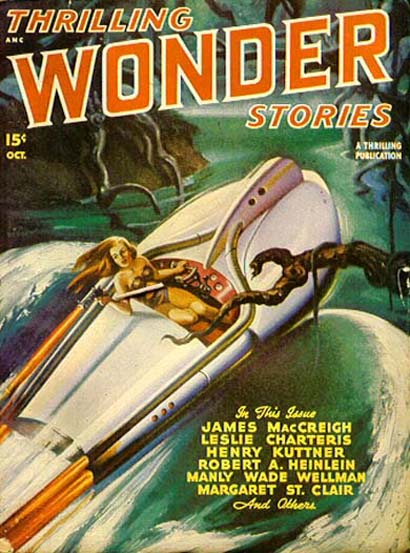
(Cover by Earle Bergey. Thrilling Wonder, October 1947.)
Who Goes There?
Henry Kuttner is probably one of the more tragically undervalued writers from the so-called Golden Age of SF. He and his wife C. L. Moore were “co-winners” of the Cordwainer Smith Rediscovery Award. The SF Encyclopedia calls him “a journeyman of genius.” He started in 1936 as a denizen of Weird Tales, as one of the younger members in the Lovecraft Circle, though his early horror seems to take more after Robert E. Howard than Lovecraft, and by the early 1940s he had matured into one of the funniest and most reliable writers contributing regularly to Astounding Science Fiction and Unknown. Kuttner’s years-long collaboration with Moore was so seamless and fruitful that a) people can only make educated guesses as to who wrote what, and b) Moore’s own immense talent would have the doubly tragic effect of undermining Kuttner’s own talent in historical accounts. Kuttner dying prematurely in 1958 (only a month apart from another comedian of the field, C. M. Kornbluth), before he could’ve possibly returned to writing (he was busy getting his Master’s degree) may have also contributed to modern recollections of him being rather foggy.
The reality is that Kuttner’s razor-sharp wit and pessimistic sense of humor, plus a social awareness uncommon in his peers at the time, made him a major precursor to certain SF writerss in the generation following him, including Robert Sheckley, William Tenn, and yes, a mature C. M. Kornbluth. He even had a massive influence on Ray Bradbury, even though the two writers have little in common in terms of worldview. Kuttner, who submitted to every publication under the sun, serves as an unintentional landmark in that his death coincided with a profound shrinking of the SFF magazine market towards the end of the ’50s. He continues to be missed.
Placing Coordinates
First published in the October 1947 issue of Thrilling Wonder Stories, which is on the Archive. “Exit the Professsor” is listed on ISFDB as a collaboration with Moore, but frankly I find this hard to believe; it was initially published under Kuttner’s name alone, was collected in Kuttner-specific collections (including Ballantine’s The Best of Henry Kuttner), but more importantly, it reads like a Kuttner story from start to finish. Anyway, if you want reprints then go for the aforementioned Ballantine volume (I wanna start collecting those at some point, they’re very collectable) and the most essential volume of them all, Two-Handed Engine: The Selected Stories of Henry Kuttner and C. L. Moore. Has been anthologized weirdly little.
Enhancing Image
I hope you like eccentric families, because we’ve got one for the ages here. The Hogbens are what you might imagine to be a stereotypical Appalachian (my girlfriend, a Kentucky native, informs me it’s pronounced App-uh-lach-an) family, the Hogbens, who are very redneck-y… only there’s something weird about all of them. We’ve got Saunk, our narrator, the eldest child of the family; Little Sam, the baby of the group, who has two heads and is supposed to be to telepathic; Paw, the dad, who, either because he chooses to or because he doesn’t know how to turn back, is always invisible; Maw, the mom, who… I actually don’t remember what’s weird about her; Uncle Les, who’s able to FLY on command; and Grandpaw, who speaks pseudo-Shakespearean and who is old enough to have known Roger Bacon—making him at least 700 years old. So yeah, they’re mutants.
The story kicks into gear because the Hogbens have a strange contraption, a “shotgun-gadget” that actually kills a few member of a rival family, though by the Hogbens’ own admission they don’t know how the dingus works. The family has been making a ruckess with this contraption and with people alleging strange things coming from that area, so it’s only a matter of time before a scientist gets involved: Galbraith, the titular professor. As Galbraith explains, “Our foundation is studying eugenics, and we’ve got some reports about you. They sound unbelievable.” When someone says they’re studying eugenics it’s usually a red flag; but Galbraith is here because the Hogbens are suspected (rightly) of being natural mutants, having sustained their genes for centuries now and having kept low-key by living in a rural area.
Given what I said before about Grandpaw it shouldn’t be surprising that the Hogbens’ legacy can be traced back very easily to the UK—hell, not just the UK but the British isles of the Middle Ages. One nitpick I do have is that while it makes sense to hide in a part of the world with few people if one is trying to hide one’s mustations, I’m not sure if rural Kentucky is the best choice. Anyway, Galbraith is curious and also devious enough that once he’s gotten hold of the Hogbens he all but holds them hostage, forcing one of them to either travel to New York with him to be studied or to have a science team come to their place. The Hogbens’ secret must be kept and Saunk is not above committing a little (more) murder, but Grandpaw says that there will be no more killing from this household—not that killing Galbraith would probably help the family in the long run.
What do, then?
Before I get to spoilers (there’s really not a lot to cover), I wanna talk about one thing that may prove a roadblock for some people reading this story, which is how Saunk is a redneck and that he’s the one narrating, which means the story’s action is conveyed with a pho-net-ick ack-sent, like an off-brand rendition of one of Faulkner’s more backwoods-y characters. It’s very readable, mind you; you get used to the accent quickly enough. There is, of course, the question of whether a diehard Californian like Kuttner will render a rural dialogue a) accurately, and b) with sensitivity: the answer to both is probably no. I would take more issue with this if “Exit the Professor” was a more serious story, but it’s not; it is quite mindfully a pure comedy that, had the science-fictional element been changed to fantasy, would’ve fit right at home in Unknown. Indeed it’s the story’s harking back to Kuttner’s comedic fantasies in Unknown that gives me a soft spot for it.
One last thing: there are a lot of great lines here. Saunk is a funny narrator, less because he’s trying to be funny and more because he happens to say funny things at times. When Galbraith sees the shotgun-gadget he pesters Saunk with questions, and, having little idea as to how the thing works, Saunk is very curt about it. “It puts holes in things,” he says at one point. What a lad. The brevity is what makes it funny.
There Be Spoilers Here
So they can’t kill Galbraith, lest they upset Grandpaw, and Saunk can’t go to New York for risk of exposing the family; so what now. Saunk is a bright boy, though, and he comes up with a scheme involving the shotgun-gadget. See, the shotgun-gadget doesn’t just put holes in things. Saunk uses the professor’s curiosity against him by having him mess with the dingus, aiming at a weather-cock “to be safe,” which actually results in a whole lot of toothaches in the village. “I guess half the people in town had gold fillings in their teeth.” There’s a town hall meeting, with people threatening to lynch the professor for his meddling with the shotgun-gadget, but of course, instead of helping the professor out of his problem, the hogbens decide to make it WORSE. This all reads like an epic prank gone wrong.
The dingus removes people’s gold fillings—and also false teeth. And glass eyes. And the chairs in the town hall. And people’s clothes. Kuttner seems of the belief that naked people in public are funny; a wise man he is. So you’ve got a bunch of naked hillbillies chasing after the professor wanting to tar and feather his ass, which leaves him only one option: the Hogbens. The solution the Hogbens have in mind is… a bit odd; don’t think we’re given a scientific explanation for it. Somehow they shrink the professor down to a very small size and keep him stuck in a bottle. “Sometimes we take out the bottle we keep him in and study him.” I can’t tell if this is supposed to be a ship-in-a-bottle scenario (which would be pretty cool, you have to admit) or if they just keep the professor in there and treat him like a doll. I like the climax but I’ll admit I’m not as big on the ending itself, which is abrupt.
Your mileage may vary depending on how much you enjoy snappy jokess in your SF and how much you can tolerate stereotypes for the sake of humor, but for what it’s worth I’d say the Hogbens come out pretty well.
A Step Farther Out
I specifically picked “Exit the Professor” as something that looks lightweight and entertaining before I continue to suffer through Sos the Rope, and that’s what I got! At the same time this shows Kuttner on his own (contrary to what ISFDB tells you) and on his best behavior, channeling some of the whacky humor he’d proven a master of in the early ’40s, with a somewhat plausible science-fictional premise to boot. Unless you’re Appalachian and are easily offended then the hijinks of the story should not offend. This is short and quite chuckle-worthy, to the point where I could just quote several little echanges that caught me off guard—though that wouldn’t help anyone. Of the Kuttner stories I’ve reviewed thus far this one is my favorite. It’s like comfort food: it’s not challenging but it makes you feel good.
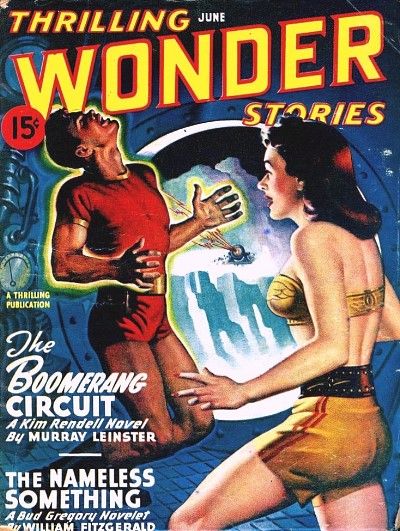
(Cover by Earle Bergey. Thrilling Wonder Stories, June 1947.)
Who Goes There?
Last month I reviewed C. L. Moore’s “The Black God’s Kiss” (review here), which was a reread and a reminder that sometimes rereads are important. As I delve deeper into the works of Moore and her first husband, Henry Kuttner, the more I think that there ought to be a major resurgance in interest with regards to these two. In the ’40s Kuttner and Moore were the writing duo in science fiction, being so seamless in their collaborations that they struggled to tell who wrote what—a layer of ambiguity that has plagued genre historians ever since. With some stories it’s safe enough to say who did what, but sometimes it comes down to “educated” guesses: a rule of thumb is that if a story post-1940 is credited to Moore alone then it probably is just her, but Kuttner sadly does not receive the same treatment for stuff published under his byline without Moore. The two as a pair contributed frequently to Astounding Science Fiction, but each would also submit to other outlets solo, and Kuttner especially appeared without Moore’s next to his quite often in Startling Stories and Thrilling Wonder Stories. It might be that because Kuttner did not have as high a reputation as Moore that he was more inclined to appear in second-rate magazines.
It’s true that Kuttner was a less refined writer than his wife; his technique was more steeped in the tradition of pulp craftsmanship, being more adept at producing “raw” story over memorable lines of prose. As such, Kuttner is harder to judge on a line-by-line basis, but rather should be judged by the total effect his work has, which at its best certainly rivals Moore’s. Kuttner was also one of the great humorists of classic SFF, being one of John W. Campbell’s court jesters in the peak days of Astounding and Unknown, but the downside is that his knack for comedy can cast a veil over his talent for social commentary and, yes, a bit of philosophy. Today’s story, “The Big Night,” is relatively serious for Kuttner (though it’s still knee-deep in pulp prose), which might be why he had it initially published under the pseudonym Hudson Hastings.
Placing Coordinates
First published in the June 1947 issue of Thrilling Wonder Stories, which is on the Archive. The good news is that if you want a more readable digital copy you’re in luck, because for some reason this story fell out of copyright and it’s available, perfectly legally, on Project Gutenberg. As for paper reprints you only have a few options, but the ones I recommend are pretty good. First, and as will usually be a source for Kuttner/Moore reviews, there’s Two-Handed Engine, a massive tome that collects “essential” stories from Kuttner and Moore, both solo and in collaboration, and you can get a used copy for a reasonable price. There’s also the Ballantine paperback volume The Best of Henry Kuttner, which admittedly relies too much on stories that were most likely written in collaboration with Moore (Moore does not get the same treatment for her Ballantine Best Of volume). Suprisingly “The Big Night” has not been anthologized anywhere, not even for like a stray collection of pulp-era space opera stories. Oh well.
Enhancing Image
Normally when we’re introducing to spaceships, especially in pulp-era SF, there’s an attempt on the author’s part to capture a sense of wonder with the ship’s bulk and speed, but Kuttner doesn’t do that; instead we’re introduced to La Cucaracha (yes, that’s its name) with language that would be considered unflattering, her “fat body” scarred with a molten streak across her middle and with spot-welds standing in for liver spots. La Cucaracha is an old ship and she’s on her last leg, and to make matters worse her skipper, Sam Danvers, is drunk again. Danvers mostly plays second fiddle to the story’s real protagonist, Logger Hilton, the first mate.
(An aside before we continue is that I wouldn’t go into this expecting female representation at all, as there’s not a single named female character and La Cucaracha‘s crew is all-male.)
Hilton is called to talk with Danvers, or rather to talk him out of his stupor, as Danvers is indeed quite drunk and, like his ship, is very old. “He was a big man, or rather he had been once, but now the flesh had shrunk and he was beginning to stoop a little.” We aren’t told ages, but judging from some comparisons I’d say Hilton is in his forties while Danvers is in his seventies, so you know we’re not dealing with spring chickens. When we meet Danvers he’s “making a speech to an imaginary Interplanetary Trade Commission.” The ITC, as I’ll call it from now on, had recently done a routine inspection of the ship and found she’s “unsafe,” which isn’t surprising given she’s riddled with scars and she may break apart any moment. On the one hand Danvers is fundamentally a sympathetic character, and from his perspective the ITC (i.e., government regulation) is the villain, but both Danvers and Hilton know that La Cucaracha is not long for this world.
You see, La Cucaracha is a hyper-ship, which is to stay a ship that can cross hyperspace and easily venture into what’s called the Big Night—the space beyond our solar system. To get around the speed-of-light barrier in space travel authors will opt for some kind of shortcut, and jumping into hyperspace—a dimension totally removed from ours—is this story’s shortcut of choice. Interstellar travel was, up till recently, done with hyper-ships, but something has been threatening to make these great ships obsolete: long-distance teleportation. More useful for transporting cargo than people, but still teleportation presents a cheap and relatively safe alternative to hyper-ships. The implication, which Kutter might agree with, is that the introduction of “matter-transmitting” will be a net positive for interstellar relations and commerce (important because, as we’ll see, there are a few intelligent alien species to contend with), but still hyper-ships being outmoded will put thousands of men out of work.
So about those aliens. We’re introduced to several characters on the ship, not all of whome are human. There’s Hilton and Danvers; there’s Wiggins, the second mate; there’s Saxon, a fresh “recruit” who is not exactly there of his own volition; but most intriguingly for me there’s Ts’ss, a Selenite, Kuttner’s most original creation here. The Selenites are a tentacled raxce akin to octopi, and in disposition they’re rather stoic, a very old and wise race, even bearing a resemblance to Vulcans. Ts’ss is the Spock equivalent, which… look, I’ve held off on this long enough: I can’t help but make comparisons to Star Trek with this one, they’re too obvious. Even hyperspace reminds me of a ship warping, although the blinking-in-and-out-of-existence part is more stark here; you can’t see SHIT in hyperspace, you have to calculate where you’ll end up. “You had to work blind here, with instruments. And if you got on the wrong level, it was just too bad—for you!” Anyway, in a story where characters each have a single defining trait (we can’t afford more than one), Ts’ss is the closest we get to someone multi-layered, though ultimately he is still merely a support player.
At a little over 10,000 words this is a novelette, but “The Big Night” has perhaps one too many characters/subplots. There’s a subplot with the ship meeting up with a trader on a distant planet, which naturally doesn’t work out because the trading post there is set to have teleporters installed; there’s a subplot with Saxon, the new recruit, which doesn’t do much aside from provide a sort of deus ex machina for the climax; there’s a weird little detour involving another alien race that I’ll get into deeper in the spoilers section that could’ve been cut. Generally this story suffers from being overstuffed considering the simplicity (albeit effective simplicity) of its tone and thesis. Kuttner also does the thing where alien races are boiled down to traits that basically all members of that race share, but for a short story this is more forgivable than if it was a whole novel.
Kuttner was always the pessimist, but that sense of doom was usually counterbalanced by a healthy dose of humor; not so with “The Big Night.” While I just shat on this story for its pacing, I’m impressed that something from the late ’40s can be this fatalistic about the future of space travel. By most metrics the crew of La Cucaracha would probably be tried in court for smuggling and kidnapping; a fraction of the crew, including Saxon, the new guy, were shanghaied, a fact that Hilton and Danvers find bitter but ultimately a necessary evil to keep the ship going. There just aren’t enough people signing up for hyper-ships these days, and even Hilton plans to put his engineering degree to good use once this last trip is finished. The end of an age coming and nobody can stop it.
There Be Spoilers Here
The second alien race we come across are the Canopians, who are considered to be morons as far as sentient races go, albeit with one attribute that makes them indespensible space-farers: they have a real knack for navigation. While at the trading outpost Hilton gets roofied by Danvers, in a way, Hilton is well aware, not dissimilar from how the ship shanghais people, but this time it’s to get Hilton back on the ship without him putting up a fight—over the fact that Danvers recruited a Canopian. Hilton just wants to go home and be done with this whole business, but Danvers isn’t done yet. The Canopian’s skill with navigating and Saxon’s background as a teleporter engineer (a little fact that Hilton is hesitant to tell Danvers) rescue La Cucaracha from almost certain destruction during its return trip. The back end of “The Big Night” is a little too convoluted for me, and if I didn’t run it through Google Docs (Is there a more efficient way to get a word count for something?) I would’ve assumed it was a longer novelette.
By the end we’ve reached the point where the ship has some more time bought for itself, but how long is the question. Now doubt some of the crew will jump ship on the next step; there may even be threats of mutiny, which anyway is always a concern with ships. It’s here that we get my favorite bit of dialogue, which naturally comes from Ts’ss, and it really sums up Kuttner’s point in a way that borders on poetic:
“The reason I keep shipping on La Cucaracha is because I can be busy and efficient aboard, and planets aren’t for Selenites any more. We’ve lost our own world. It died long ago. But I still remember the old traditions of our Empire. If a tradition ever becomes great, it’s because of the men who dedicate themselves to it. That’s why anything ever became great. And it’s why hyper-ships came to mean something, Mr. Hilton. There were men who lived and breathed hyper-ships. Men who worshipped hyper-ships, as a man worships a god. Gods fall, but a few men will still worship at the old altars. They can’t change. If they were capable of changing, they wouldn’t have been the type of men to make their gods great.”
Ts’ss supposes that yes, teleportation is replacing the hyper-ships, but then eventually something else will come along and replace teleportation. No doubt the riders of horse carriages felt a similar sense of doom when the automobile started becoming commercially viable, or when silent movie actors had to face spoken dialogue. Some do not make the transition, and that’s a perfectly natural byproduct of change, if unfortunate. Danvers would rather die than give up his ship, and given his age that’s likely to happen whether anyone would want that or not. Some people will never give up the old ways. Kuttner doesn’t seem to be rooting for tradition here (he hardly strikes me as a conservative), but he may be saying that there’s virtue in stubbornness, if that stubbornness serves something great.
A Step Farther Out
I said at the beginning that Kuttner’s writing ought to be taken in totality, and that very much applies to “The Big Night,” a story that could’ve been a thousand words shorter but which remains, at its core, a bittersweet passing the torch in the distant future. Usually in SF we see spaceships and teleportation working in tandem, and realistically, if the two were to ever happen, they probably would not conflict so much—but still Kuttner considers, more than some other authors, the possible repurcussions of teleportation. I’m reminded specifically of the early section of Star Trek II: The Wrath of Khan, and also Star Trek VI: The Undiscovered Country, where there’s a palpable sense of an era coming to an end, and also Kirk and Danvers not being that dissimilar: both love their ships too much to pack it in just yet. Most of Kuttner’s work that I’ve read up till now has been set on Earth and in the near future or even the “present” day, but “The Big Night” makes me wonder what other space-faring SF he wrote…
(Cover artist uncredited. Thrilling Wonder Stories, April 1950.)
Who Goes There?
James Blish is one of the defining practitioners of ’50s SF, although his legacy is sort of a mixed bag and he has not retained nearly the level of popularity of, say, Isaac Asimov or Ray Bradbury. Like Asimov, Blish spent his formative years as part of the Futurians, a left-leaning New York-based fan group (although Blish’s politics were much murkier). Thus, Blish hung out with the likes of Frederik Pohl, Judith Merril, Donald Wollheim, and C. M. Kornbluth. The Futurians would have an incalculably large impact on the history of the field, and like Kornbluth and others, Blish got his professional start in the early ’40s writing for Astonishing Stories and Super Science Stories. Also like Kornbluth, Blish would go on hiatus during America’s involvement in World War II, and would not return until the tail end of the ’40s, by this point having metamorphized into his “mature” phase.
1950 was an especially important year for Blish, as he started his epic Cities in Flight series with the novelette “Okie,” in the April 1950 issue of Astounding Science Fiction. That same month (although technically it would’ve been a month prior) we got “There Shall Be No Darkness,” one of the most notable SF-horror efforts of its era. The story was considered major enough (or at least fit enough for adaptation, and I would agree on that) to be made into a film, titled The Beast Must Die. But whereas as the source material is more concerned with rationalizing lycanthropy in scientific terms (it is, as I’ll explain, totally SF and not fantasy), the film looks to be more of a straight murder mystery. The Beast Must Die remains the only film adaptation of Blish’s work, which is a big shame because something like “A Work of Art” or “Surface Tension” could work great as a short film—maybe in the next season of Love, Death & Robots?
Little bit of trivia: Blish’s A Case of Conscience is so far (assuming they bring back the Retro Hugos) the only story to have won the Hugo twice, as the novel version won the Best Novel Hugo in 1959 while the novella version (which from what I’ve heard is the first third of the novel) won the Retro Hugo for Best Novella. This is also if we’re not counting Asimov’s Foundation trilogy, which won both a special series Hugo and a couple Retro Hugos.
Placing Coordinates
First appeared in the April 1950 issue of Thrilling Wonder Stories, which is on the Archive. Was later reprinted in the January 1969 issue of Magazine of Horror, also on the Archive. Unless you have a real phobia of two-columned writing (in which case you should not be reading old-fashioned SFF magazines like yours truly), it’s pretty easy to find online. Ah, but those book reprints! Because “There Shall Be No Darkness” is a somewhat famous story we have some options here. Firstly there’s A Treasury of Modern Fantasy by Terry Carr and Martin H. Greenberg; as I said in my review of C. L. Moore’s “Daemon,” this and Masters of Fantasy are the same anthology. There’s also The Fantasy Hall of Fame, edited by Robert Silverberg, which seems to have a pretty loose conception of “fantasy” but whose contents are nonetheless of exceptional quality.
For single-author collections we have some good ones. If you’re a collector then I would suggest The Best of James Blish, as part of the Ballantine/Del Rey Best Of series from the ’70s and ’80s; these babies are old but gold, and their covers all range from good to excellent, making them fine collectors’ items. More recent, and even being in print, is Works of Art, which strives to be a more comprehensive collection of Blish’s short fiction. It’s a fancy hardcover from NESFA Press and it’s reasonably affordable (if you consider $30 to be reasonable). This is definitely one of that more reprinted stories I’ve reviewed thus far.
Enhancing Image
We start at a house party, the people therein being functionally the entire cast; there are something like eight or nine people at the party, but only six of them are plot-crucial, so I’ll focus on those. We’ve got Paul Foote, Jan Jarmoskowski, Doris Gilmore, Chris Lundgren, and Tom and Caroline Newcliffe, the host and hostess respectively. Tom and Caroline are filthy rich, and it’s not a coincidence that all the guests have to do with the arts and sciences—Painter being a painter, Jan and Doris being pianists (Doris actually being a former student of Jan’s, though they’re only seven years apart in age), and Chris being a psychiatrist as well as the story’s resident Mr. Exposition. Paul is the protagonist by virtue of the fact that he’s the POV character for most of it (I say most, put a pin in that one), since he’s not much of a hero; he’s more or less an ordinary guy who thinks, right from the beginning, that there’s something suspicious going on at the party.
There was another person in the room but Foote could not tell who it was. When he turned his unfocused eyes to count, his mind went back on him and he never managed to reach a total. But somehow there was the impression of another presence that had not been of the party before.
Jarmoskowski was not the presence. He had been there before. But he had something to do with it. There was an eighth presence now and it had something to do with Jarmoskowski.
What was it?
What is off about Jan, exactly? For one, his index and middle fingers are the same length, which admittedly is a little weird. Paul also notes that throughout dinner, Jan keeps stratching the palms of his hands (which also look unusually hairy), and, perhaps most telling, his canines are more pronounced than one would expect. If you’re in a werewolf story and you’re aware that you’re in a werewolf story, these all sound like very obvious signs that the person is a werewolf, but Paul is working off a hunch here—a hunch he acts on when he thinks the time is right. Unfortunately for Paul, he does something you’re very much not supposed to do in a horror story: confront the person who is probably (i.e., almost certainly) the killer by himself. I’m not sure what compelled Paul to do all this in the first place, as it’s not implied that he believed in werewolves before all this, though we soon find out that a certain other character knows a lot more than he lets on.
When Paul interrogates Jan, silver knife in hand (it has to be silver), we get what is very much not a twist but which feels like it could be one in another writer’s hands, which is Jan’s transformation. From what I’ve heard, The Beast Must Die tries really hard to save the werewolf reveal until the third act, but in “There Shall Be No Darkness,” there is no such stalling; we get a confirmation of Jan’s lycanthropy less than a third into the story, and frankly, it was telegraphed pretty strongly in advance. If you’re looking for a straight murder mystery, you’ll be let down, but Blish is clearly going for something else here. This is not, contrary to my initial expectations, a rehash of John W. Campbell’s “Who Goes There?” The reveal of Jan as the werewolf is not what the story is about; rather, the reveal of the werewolf serves as only the beginning of what makes this story so interesting: its science-fictional rationalization for lycanthropy.
Normally we would waist a lot of time with Paul trying to convince the other guests that there’s a werewolf on the property, but not so! Doris happened to catch a glimpse of Jan in his wolf form, mistaking him at first for one of the mansion’s dogs, though Jan is a big black wolf with red eyes. It’s a cool design, and it’s no surprise that Virgil Finlay would use it as inspiration for his badass interior art—ya know, the thing that convinced me to pick up this story in the first place. Finlay sure can get it.
Now, about how lycanthropy works in this story, because while it is inventive, and Blish’s attempt is an ambitious one, he can’t make it work 100%. Firstly, lycanthropy is treated basically like a physical illness with psychological ramifications, like a combination of tuberculosis and epilepsy. Like with TB back in ye olden times, someone with lycanthropy is rendered an outcast, even if the people casting them out can’t quite articulate what’s wrong with them. There is a truckload of technobabble Blish employs to make it sound like it makes sense, but basically a lycanthrope is able to manipulate organic matter to such an extent that they’re able to morph into animals whose skeletal structures are similar enough—at will! Hence, a lycanthrope can change into a wolf. This even extends to their clothes, assuming the clothes are made of organic material like cotton or what have you.
A lot of questions are raised with regards to how lycanthropy works here, and while Blish doesn’t answer all these questions, the mechanics behind lycanthropy are surprisingly not the most far-fetched thing in this story. But we’ll get to that in the spoilers section. Point being, werewolves are a bit different in “There Shall Be No Darkness,” but there are consistencies that will strike horror veterans as familiar; for one, Paul was right to confront Jan with a silver weapon, as lycanthropes are in fact weak to silver. They’re also weak to wolfsbane (called wolfbane in-story) and related plants, which was actually what made Jan scratch himself and act irritable—he was having an allergic reaction to the plants around the mansion.
We get all this information from Chris Lundgren, who, on top of being an apparently highly respected psychiatrist, is also experienced in dealing with lycanthropes. It’s not surprising, then, that he’s the first to believe Paul’s claim that Jan is a werewolf; what is surprising is that despite having known Jan for some time, Chris remained unaware of his lycanthropy while Paul, the average dude, had his suspicions. Regardless, without Chris the story would be standard horror as opposed to horror-tinged sicnec eifction, which is certainly unique; rarely is a story’s genre dependant on a single character. None of these characters is written with too much depth, and like I said, Chris is Mr. Exposition, but it says something of Blish’s vision and storytelling prowess that things remain very much engaging.
The question then becomes one of how to deal with Jan. Silver would work great, but the only silver Our Heroes™ have that could be used for weaponry is knives and candlesticks. They try melting some of the silver to make homegrown bullets, since the Newcliffes are hunters and have some guns to go around, but these prove to be woefully inaccurate, never mind possibly dangerous to the shooter. Ambushing Jan would be incredibly unlikely, due to his agility, so a hand-to-paw fight would probably not end well. Not helping matters is a snow storm which eventually turns into a blizzard, essentially trapping everyone on the property while Jan is on the prowl. “Why doesn’t he just go off somewhere and never be seen again?” Well, the explanation is a weird one: basically, Jan specifically has Doris in mind for his next victim, or at the very least is drawn to her, since during the first stretch of the story he imagined a pentagram on her hand which marked her. The obsession with the pentagram apparently last seven days, which is why Jan doesn’t escape right away.
Blish is very fond of putting science and religion in the boxing ring and seeing who wins, and while it certainly doesn’t go as in-depth as A Case of Conscience, there’s a bit of science-versus-religion with “There Shall Be No Darkness.” It’s all but said that Jan is a Christian, and a particularly superstitious one at that. According to Chris the vision of the pentagram is a hallucination lycanthropes have might compell them to unleash beastly violence (hence my earlier comparison to epilepsy, what with afflicted people having visions because of their seizures), but Jan probably believes the pentagram carries real metaphysical weight. Indeed, the larger effort to understand a mythical creature like the werewolf in scientific terms seems to be Blish trying to reconcile science with supernatural forces.
There Be Spoilers Here
What to do about the silver bullet problem? You’ll never guess. I said before that the Newcliffes are a rich couple, but what happens strains suspension of disbelief so hard that it actually put ths werewolf technobabble in perspective. Tom Newcliffe orders a shipment of guns and silver bullets to be FLOWN IN OVERNIGHT, DURING A SNOW STORM. This would be hard enough to take if the story was set in modern times and Tom had an Amazon Prime account, never mind the cartoon shit that we get here. Perhaps more than anything else, this passage tells me that Blish could’ve had a masterpiece on his hands if he had so much as gone through one more rewrite; alas, this was the ’50s (or more accurately the late ’40s) and people writing for the pulps were not inclined to revise too much.
I wanna take this moment to talk about where and when “There Shall Be No Darkness” was published, because I think it explains the story’s unique but unrefined nature. Thrilling Wonder Stories was, along with its sister magazine Startling Stories, a second-rate SFF magazine in an era when Astounding was king; there was no question that Campbell’s magazine paid the most and had the most prestigious image. Which is not to say there weren’t alternatives! Albeit not many, especially for a horror tale like Blish’s. Weird Tales was still going, and you could argue “There Shall Be No Darkness” is what could’ve been called a “weird-scientific” tale, but it’s totally possible that Weird Tales paid an even lower rate at this point than Thrilling Wonder Stories. I wouldn’t know off the top of my head. It almost certainly would not have appealed to Campbell, whose tastes were starting to narrow, and who very soon would unleash a cataclysm upon the field: Dianetics.
Maybe it was for the best that Blish’s story ended up where it did.
A lot happens in “There Shall Be No Darkness,” much of it best experienced without having the whole thing spelled out, so I won’t delve too much here. It’s a long and complex story; ISFDB erroneously cites it as a novella, when really it comes out to about thirty book pages, but that mistake says something about its density. I’ll zero in on the climax, which I think actually leans closer to tragedy than horror. Following the deaths of a couple characters, and with Jan nowhere to be seen, Paul contemplates what might happen if Jan were to escape off the property and spread the disease of lycanthropy far and wide (lycanthropy being an infectious disease, not unlike our modern conception of zombies). We arrive at perhaps the most Blish-esque passage, which seems to forecast one of Blish’s chief concerns during his mature phase: mankind’s metaphysical place in the universe.
Maybe God is on the side of the werewolves.
The blasphemy of an exhausted mind. Yet he could not put it from him. Suppose Jarmoskowski should conquer his compulsion and lie out of sight until the seven days were over. Then he could disappear. It was a big country. It would not be necessary for him to kill all his victims—just those he actually needed for food. But he could nip a good many. Every other one, say.
And from wherever he lived the circle of lycanthropy would grow and widen and engulf—
Maybe God had decided that proper humans had made a mess of running the world, had decided to give the nosferatu, the undead, a chance at it. Perhaps the human race was on the threshold of that darkness into which he had looked throughout last night.
But Jan comes back—to Doris. Perhaps he hasn’t killed her yet because he loves her, and she’s had a crush on him for years; if not for the current circumstances, they might be perfect for each other. Like something out of the book of Genesis, Jan tempts Doris by making her an offer, and a pretty simple one: he bites her, “infects” her with his disease, and they run off together, two lycanthropes who will have nothing except each other. Despite what Paul suspects, lycanthropy is a genetic dead end; it can only be spread via infection, and lycanthropes, no matter where they go, will be treated as pariahs. Could two lycanthropes also breed in order to continue this pseudo-species? Probably. Blish isn’t very clear on that, but then, oddly less so than the earlier Jack Williamson novella “Darker Than You Think,” “There Shall Be No Darkness” is not really concerned with sex. Regardless, lycanthropy sounds like a fine recipe for succumbing to madness, then death.
Paul, who we’re told has a habit of eavesdropping, uses his habit for good this time when he stops by Doris’s room and catches the two talking, and… well, you can get what happens next. Not that Jan seems to mind dying too much; for him it would either be that or living an impossible dream with Doris. Think living day after day as a werewolf would be cool? Think again! Of course, it seems like in werwolf media a person’s life expectancy whittles down to a fraction of what it would normally be if they become a werewolf; if authorities or werwolf hunters don’t get them then their own inevitable self-loathing will. Damn near every werewolf narrative I can think of is ultimately a tragic one, in the sense that we get a grim end that comes about because of a combination of circumstances and the main character’s flaws. In the context of the story, lycanthropy may as well be a terminal illness, and Jan no longer wants to be treated—he just wants it to end.
A Step Farther Out
I would highly recommend “There Shall Be No Darkness,” even though I think it’s obviously flawed in parts. A problem I’ve often encountered with Blish (except for “A Work of Art,” which I think is a masterpiece) is that his prose does not quite match up with the breadth of his ideas. You could make that criticism with a lot of old-timey SFF authors, especially guys like Philip K. Dick and A. E. van Vogt whose raw prose does not do justice to what they’re writing about, but Blish was heavily inspired by the modernists of all people! He was a big fan of James Joyce! He thought Joyce’s “The Dead” was the best short story ever written. Clearly he wanted to be like Joyce, or at least a D. H. Lawrence, but like most SFF writers (especially from that period), Blish was not a poet; he did not have a delicate ear for the English language. I say all this because “There Shall Be No Darkness” is a very good story that feels like it could’ve been a truly great story, and in that it feels both deeply satisfying and disappointing at the same time.
Well, that’s spooky month for you. Despite the fact that I’ve covered three vampire stories this month, I have to admit I’m more fond of werewolves; it’s just a shame that there don’t seem to be as many werewolf stories as vampire stories. I can think of several reprint anthologies wholly dedicated to vampire stories, but werewolves don’t get that much love. If you’re looking for some vintage but inventive werewolf action, then today’s story will almost certainly do the trick. I’m quite fond of it.



 Science Fiction & Fantasy Remembrance