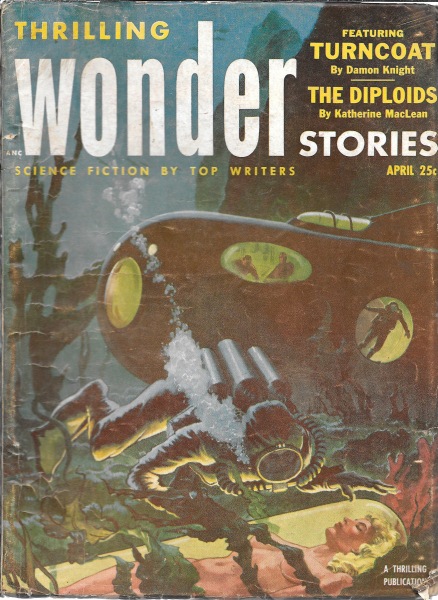
(Cover by Jack Coggins. Thrilling Wonder Stories, April 1953.)
Who Goes There?
Katherine MacLean was born in 1925, in New Jersey, and she took to writing SF rather young, in the late ’40s while working as a lab technician. MacLean arriving at the scene corresponded with those of quite a few other authors of her generation, as the magazine market was about to form a bubble the likes of which would not be seen again until decades later. When the bubble burst in the mid-’50s, MacLean’s output declined, to the point where she didn’t write that much after the ’50s, and after the ’70s had virtually retired from writing. The result is that despite living a very long life, only dying in 2019, MacLean now feels like an artifact of an almost ancient era of SF, of which she was one of the better practitioners. Despite typically being regarded as “hard SF,” the stories I’ve read from MacLean lean much harder into the soft sciences, and at times just pseudo-science (namely having to do with ESP, which she seemed to believe genuinely in); but clearly it’s her attitude and not the material itself that gives her the label. She could be considered a successor to A. E. van Vogt, working to fill a niche van Vogt had left when he stopped writing SF in the early ’50s. She can be considered, alongside van Vogt and Charles L. Harness, to be part of a school of SF writers who play fast and loose with scientific plausibility, and yet who treat this looseness with much seriousness.
Placing Coordinates
First published in the April 1953 issue of Thrilling Wonder Stories. It’s only ever been reprinted in the MacLean collection The Diploids.
Enhancing Image
The last time I wrote about MacLean was with two of her best and most reprinted stories, “Pictures Don’t Lie” and “The Snowball Effect.” These show MacLean in top form, and incidentally they were also published in Galaxy, despite Astounding (I think) having printed more of MacLean’s work. “The Diploids” definitely leans more toward the Astounding type of narrative, for reasons I can’t get into without spoiling, although it appeared in the less prestigious but in some ways more permissive Thrilling Wonder Stories. Unfortunately “The Diploids” is lesser MacLean, which doubly sucks because it’s longer than both of the aforementioned stories combined. Forty magazine pages doesn’t sound like a whole lot, but between the formatting of this specific magazine (a lot of wordage per page) and there being so much expository dialogue, it was a bit of a slog.
Paul “Mart” (short for Martian) Breden is a 28-year-old patent attorney who has a problem—actually two problems. The first is that Devon, a mad scientist and scorned would-be patent inventor, has taken it upon himself to get at Paul by any means, include a stray shot with a handgun in broad daylight. For better or worse Devon is unstable, a paranoid, and also a raging moron, one who is convinced Paul is an alien. We know from the outset that something is different about Paul, on account of him having six fingers on each hand, but to make things freakier, he also had a third eye hidden in the back of his head. (He wears his hair long so nobody would see it, which begs the question of what would happen if Paul suffered from male pattern baldness.) Aside from the fingers Paul has adnormalities about his body that he’s able to hide in public, but his close encounter with Devon results in him coming out to Nadine, his sort-of girlfriend. (Their relationship is kinda messy, not helped by Nadine being offscreen for most of the story.) Upon revealing the third eye, the first time he’s ever done this as an adult, Paul starts to wonder if maybe he really is an alien like Devon said. I feel like I’m not spoiling much by saying that this turns out to not be the case. Paul is indeed a human, born and raised on Earth and to human parents; but his parents whom he’s known his whole life had adopted him while his biological parents are unknown, so his lineage remains a mystery.
There are some bewildering character moments and interactions that make me wonder if maybe MacLean should’ve done another rewrite, including but not limited to Paul just casually shrugging off taking a bullet graze to the neck and Nadine being seemingly unable to make up her mind if she wants to start a family with Paul or not; more conspicuously, the third-person narrator tells us that Paul is slow to anger, yet multiple times in-story we see this informed bit of characterization being contradicted. In practice Paul is shown to have a short fuse, although in his defense he’s about as quick to stop being angry as he is to start. Devon is ostensibly a villain, but he’s played almost as a joke and it becomes easy to forget about him once Paul starts on the quest to find more of his own people, who are called diploids and who he thinks are “mutants” like himself. (This ends up not being quite right, but more on that in a minute.) Safe to say the pacing of this novella is strange and rather lopsided. It takes about a third of the way in for the intrigue to start building in earnest, and there is a whole cast of characters we don’t meet until the second half. There’s also some use of coincidence in order to get the plot moving: Paul just so happens to see an ad, which we’re later told only gets put up once a year, that leads him down the rabbit hole to not only tracing his lineage but finding other folks like himself. This is unusually sloppy storytelling for MacLean.
There Be Spoilers Here
In fairness to MacLean, she does put a little twist on a story which at first looks to be just a variation on van Vogt’s Slan. No doubt MacLean was thinking of Slan, which at this point was one of the most popular novels in the field. Indeed there used to be many fans of van Vogt, but they’re all dead now. Anyway, Paul is not a mutant in the strict sense that his abnormalities occurred by genetic accident; rather they were put there, intentionally, with the “accident” instead being that Paul was not supposed to have made it beyond the fetal stage. There’s a somewhat convoluted backstory involving a laboratory that experimented on human embryos much like how cosmetics companies experiment on animals, only for some of these embryos to be illegally sold off to the highest bidder and allowed entry into human society. Paul is one of the “E-2” line, in that on top of his weird but useful physical quirks he has also been gifted with high intelligence. (MacLean, as I suppose was common among folks at the time, treats IQ with a totally straight face. Anyone who has an IQ of above 140 is presumed to be a genius.) The big revelation, of course, is that rather than being a freak, Paul has won the genetic lottery, which the story treats as very good news for his and Nadine’s hopes of having children. The “diploids” are indeed a very small but special sub-race of supermen (and women).
A Step Farther Out
Well, that was a bit of a dud. It’s something you have to expect when reading SF of this vintage, though, even when it’s from someone of above-average skill like MacLean. I’m not sure if MacLean buys into the genetics mumbo jumbo she puts out in “The Diploids,” considering we know she bought enough into the notion of psi powers that she had apparently taken an interest in Dianetics in the ’50s. (The number of SF authors to have bought at least somewhat into L. Ron Hubbard’s pseudo-science at this time is depressingly high.) “The Diploids” is unusual for MacLean in a few ways, being it’s one of her longer stories, that it doesn’t have to do so much with sociology nor is it all that socially conscious, and also the debt she paid to van Vogt as an influence is at its most overt here. Like I said, though, there’s also a sloppiness with pacing and characterization that tells me MacLean had submitted it to a higher-paying magazine, namely Astounding, only for it to get rejected. But that’s just a theory.
The ’50s saw a profound influx of new talent in magazine SF, which coincided with the magazine market itself experiencing a bubble. While C. M. Kornbluth was one of the best and most vicious of these talents to ride the bubble, and was indeed not much older than newcomers like Philip K. Dick and Robert Sheckley, he had in fact made his debut at the tail end of the ’30s. Kornbluth was born in 1923, and started writing fiction of professional quality when he was all of 15 years old, making him one of the few real prodigies in literature. He was a member of the Futurians, a New York-based left-leaning (but more on how that relates to Kornbluth later) group of fans, some of whom would go on to revolutionize the field at large. Its membership was pretty stacked, including but not limited to Frederik Pohl, Judith Merril, Donald Wollheim, James Blish, Isaac Asimov, and Damon Knight. Pohl especially was close friends with Kornbluth, and even as editor of a couple low-paying magazines got much of the latter’s earliest work printed. Maybe the best of these early stories, 1941’s “The Words of Guru,” is not science fiction at all but instead horror of a particularly nasty stripe, and despite Kornbluth being all of 17 when he wrote it it’s a story that still holds up pretty damn well to this day.
About half of Kornbluth’s short stories were published between 1939 and 1942. He got drafted into the war, and even saw action at the Battle of the Bulge as part of a heavy machine gun crew. This experience in the war seemed to have exacerbated a weak heart, which eventually led to his early death in 1958. It’s tempting to think of what might’ve happened had Kornbluth lived to a proper age, not least because on the day of his death he was due to interview for the editorship of The Magazine of Fantasy and Science Fiction. Robert P. Mills was managing editor of F&SF and editor of its sister magazine, Venture Science Fiction, and was due to meet with Kornbluth. But this meeting never happened. Instead Mills replaced Anthony Boucher as editor of F&SF, in what ended up being a few of the magazine’s strongest years. Mills was a very capable editor, but still, one has to wonder what F&SF under Kornbluth would’ve been like. According to Pohl, Kornbluth sent “Two Dooms” to F&SF, as “The Doomsman,” but for reasons never given it was published in Venture instead. It may have been the last story Kornbluth himself had sent out for purchase.
Placing Coordinates
First published in the July 1958 issue of Venture Science Fiction. It was reprinted sometime later that year in the Kornbluth collection A Mile Beyond the Moon, although there’s at least one edition that doesn’t have this story. There’s also The Best of C. M. Kornbluth and His Share of Glory: The Complete Short Science Fiction of C. M. Kornbluth. As for anthology appearances we have Great Short Novels of Science Fiction (ed. Robert Silverberg), Hitler Victorious: Eleven Stories of the German Victory in World War II (ed. Gregory Benford and Martin H. Greenberg), and The World Treasury of Science Fiction (ed. David G. Hartwell).
Enhancing Image
There have been so many “Hitler wins” alternate history stories over the decades that frankly there are too many. The earliest example a lot of people think of would be Philip K. Dick’s The Man in the High Castle, but “Two Dooms” predates that novel by a few years, and may have possibly been a point of influence for Dick. Incidentally both stories involve some sort of mysticism, although both the means and ends are different. “Two Dooms” starts in our world but soon shifts over in time, not just into an alternate timeline but also about 150 years into the future. Edward Royland is a 23-year-old scientist, fresh out of college, working at Los Alamos. The year is 1944, and so far “the Bomb” is on its way to being tested but has yet to find a use in the war. Royland suspects that the atomic bomb might never be used at all, and he doesn’t know if this is good or bad. Really he’s come to hate his job, working under Oppenheimer, having heat rashes under his arms and sweating in what is quite literally a desert. After work one day he drives over to the hut of a friend of his, Nahataspe, a Hopi Indian who has something that might expand Royland’s mind—or maybe crack it like an egg. Royland takes some magic mushrooms which Nahataspe calls “the God Food,” wondering if he’s in for a mean trip. Well, he does go on a trip, of a sort, but it’s far beyond anything expected.
After an intense blackout Reynolds wakes up to find the hut empty. Both Nahataspe and his possessions are gone. This is bad enough, but what Raynolds finds once he leaves the hut is worse:
He went to the village well and found it choktxl with dust. It was while he stared into the dry hole that he first became afraid. Suddenly it all was real; he was no more an onlooker but a frightened and very thirsty man. He ransacked the dozen houses of the settlement and found nothing to his purpose—a child’s skeleton here, a couple of cartridge cases there.
The settlement had at some point been emptied of human life—by force, it seems. This is the first creepy moment in a story that’s full of such moments, although it must be said that not all of these may have been intentional. The immediate problem for Royland is that all of a sudden he finds he’s become terribly thirsty, and with the village well run dry he sets out on the road (barefoot, since the jeep he took has also disappeared) like a man already half-dead. First he hitches a ride with Martfield, a “Paymaster Seventh” who gives him some water, and who takes Royland back to civilization. Unfortunately for Martfield he’s reprimanded for “harboring a fugitive” (the assumption is that Royland had escaped from a German or Japanese labor camp) and expected to report himself, with the implication that he’s to be executed. Yet the German military men who take Royland in for examination find his story too outlandish and his very existence too open of a question. They interrogate him (at gunpoint, naturally), and Royland explains his job and WWII—the problem being that WWII, as these Germans understand it, did not happen. There was instead “the War of Triumph,” which lasted a decade longer than WWII did, and with Japan continuing to fight long after the Third Reich had fallen, giving the remnants of the Nazi regime time to take back control and beat the Allies.
That’s the short of it, anyway.
There’s a lot to unpack in what ends up being a protracted expositional scene, so let’s get to it. Not only had the War of Triumph ended, but it’s been over for over a century at this point. The Germans and Japanese have since taken control of the US, sharing ground not along broad regional lines but instead working quite literally side by side. This is very similar to how things work in The Man in the High Castle, although not quite. Let’s talk about Adolf Hitler. In Dick’s novel, Hitler remained in power for a time before the Reich higher-ups decided to lock him up in a mental institution, his brain having been eroded by late-stage syphilis. In “Two Dooms” Hitler never even became head of the Reich, but instead an “early Party agitator” who plotted to assassinate “the Leader,” who turns out to have been Joseph Goebbels. Instead of blowing his shit smooth off in his bunker, Hitler was executed during the War. There’s some irony here. Kornbluth makes some implausible predictions in creating his alternate timeline (it’s hard to believe the Japanese would’ve kept fighting for a whole decade after 1945), but the one big prediction he makes that rings true is the notion that Nazi Germany would’ve existed even without Hitler—indeed, Germany did not need Hitler per se in order to turn fascist, just a Hitler-esque figure. Maybe not even that. The ingredients for a fascist Germany were all there, in the years following WWI. Strictly speaking, “Two Dooms” is not an example of a “Hitler wins” story, but it at least follows the rules close enough.
Now, in order to engage with any story with such a premise we have do some suspension of disbelief, just right off the bat. Stories in which the Axis powers invade and then occupy the US are implausible for a few reasons, not the least of them being that neither Germany nor Japan considered such an operation to be practical. It’s improbable, if not outright impossible, that either of the remaining Axis powers would’ve orchestrated bombing campaigns against the US mainland, let alone set boots on the ground. Some savvy writers have found some alternative to this when writing such alternate history. Memorably in Philip Roth’s The Plot Against America the US threatens to turn fascist from within, thanks to Nazi sympathizers under the leadership of Charles Lindbergh, although this “plot” gets deferred (disappointingly, it must be said) at the last minute. In Robert Harris’s Fatherland, the victorious Reich looks to have friendly diplomatic relations with a susceptible America. These are both more believable than what Kornbluth and Dick had envisioned, but then it’s worth noting that those two did not have access to information about the war effort that would’ve still been classified. As to be expected of such an early example of the subgenre, “Two Dooms” is a victim of dated history, and unfortunately Kornbluth didn’t even live long enough to have read Dick’s novel. This in itself would be fine, but “Two Dooms” shows its age in other ways, and those ways happen to be a lot harder to stomach.
Royland escapes from some Nazi doctor asshole and makes way for the countryside once again. Too bad this is New Mexico. He meets a drunken Chinese man (he somehow guesses correctly that the man is Chinese just from looking at him, and also he does not say “Chinese man”) named Li Po. (Apparently this is supposed to be a reference to the ancient poet Li Bai, but sources must’ve transliterated it as Li Po at the time.) Li Po is a drunkard as well as in the midst of killing himself by drowning, to reclaim his honor, but Royland saves him and they become friends. The village Li Po belongs to is more ethnically diverse than you’d expect: “[The villagers] were a mixed lot of Chinese, Hindus, Dravidians and, to Royland’s surprise, low-caste and outcaste Japanese; he had not known there were such things.” Worryingly, however, white people are not allowed here, but Li Po manages to get Royland in on the basis of a great big lie. Over the next month or so, Royland goes native, in a sense, working the land as a farmer until his skin darkens and it becomes possible to mistake him for, say, a Latino. He has the right hair and physique for it. He comes to adjust to rough ways of the village, being on the brink of but not quite starving as he works. He even comes to acquire a fiancée, a submissive Indian (as in from India) woman. There is, sad to say, a joke or two about curry.
Speaking of which, there is some abhorrent racism in “Two Dooms,” at least some of which can be pinned on Royland’s own prejudices, but at some point you have to wonder how much Kornbluth agrees with his Orientalist and not-all-that-bright protagonist. Royland is shown to be a bit of a proto-otaku in his irrational admiration for Japanese culture, a country that would eventually be on the receiving end of the very weapon Royland has a part in developing. But Li Po and the other villagers, including (indeed especially) the young woman Royland is set to marry, are caricatures. The samurai (yes, complete with a sword) who comes to the village one night and cuts off Li Po’s head is another caricature. As he leaves the village for the last time Royland goes on a dazed rant about how these people need to stop having children “irresponsibly,” pointing towards the long-standing racist view that China and India are host to hordes of unwashed masses who can’t be trusted to take care of themselves. Royland’s racist tendencies are never seriously challenged in-story, and Kornbluth doesn’t comment on them. The only time these prejudices are challenges, in which Royland stops and has a thought, is when he remembers Bloom, a European Jewish refugee (the name might be a shoutout to Leo Bloom of Joyce’s Ulysses) who came to America. Bloom talks with a funny accent, but he’s at least given a bit more dignity than the non-white characters in the story.
There Be Spoilers Here
Before we get to the end, let’s talk about Kornbluth’s politics. I said before that the Furutians were a left-leaning fan group, ranging from liberals to card-carrying CPUSA members. Well, that was before the end of WWII anyway; needless to say people were quick to distance themselves from party politics once it became clear that the Cold War was underway. Kornbluth was one of the younger Futurians, and while he was friendly with some who were decidedly quite on the left end of things (namely Frederik Pohl and Judith Merril), his own politics are rather hard to gauge. The problem, or rather a limitation of Kornbluth’s writing, is that he seemed incapable of taking his own work all that seriously, at least when working on his own. There’s a jokiness with a lot of Kornbluth’s short fiction, even with the absence of proper jokes, and even when things take a turn for the morbid. Kornbluth can be thought as a somewhat more socially conscious (and more geared towards writing SF) counterpart to Robert Bloch. Both were part of the same generation, both were prodigies, both were culturally but not religiously Jewish, both were urbanites (Kornbluth from New York and Bloch from Chicago), both had a very dark sense of humor, and both were shrewder than their fiction often makes one assume. They were also, for better or worse, seemingly incapable of taking their own work all that seriously. There’s a deep-running disdain for the human condition that results in either writer sometimes coming off as reactionary.
Unsurprisingly Royland is able to find some of “the God Food” that got him into this alternate timeline in the first place and so, by simply repeating the process, is able to wake back up in our time. What’s curious is that there’s no firm reason to believe what Royland experienced was actually an alternate timeline and not just a psychoactive drug trip gone sideways. The implication, which Kornbluth may or may not want us to take at face value, is that Royland dipped into a timeline in which the US never dropped the atomic bombs on Japan, thereby resulting in a protacted war and the Third Reich eventually returning. This, of course, can’t be allowed to happen. The conclusion Royland reaches, which Kornbluth may or may not agree with, is a bit of an odd one, even for 1958, and on account of how Kornbluth wrote about nuclear weapons in other stories of his. Hell, not too long ago I wrote about a collaboration he did with Pohl, “Nightmare with Zeppelins,” which takes an unambiguously anti-nuclear stance. But was that more Pohl or Kornbluth’s idea? Pohl’s politics are much easier to gauge, not least because Pohl was pretty candid when writing about his evolving worldview and we have a lot more autobiographical material from him. It’s just one of those things you have to wonder about.
A Step Farther Out
I’m not sure how to feel about this one. At the very least “Two Dooms” is worth looking into as a pioneering example of a certain type of alternate history narrative, but much like other works of art that run on the cutting edge it has some issues. There have also, needless to say, been variations on this idea since then have been done better and with more depth, although I can’t imagine there are too many “Hitler wins” stories that are worth a damn to begin with. It’s such a tired idea now. But that was not the case when Kornbluth wrote it. I do suggest reading shorter stories from Kornbluth first, if you’re new to him.
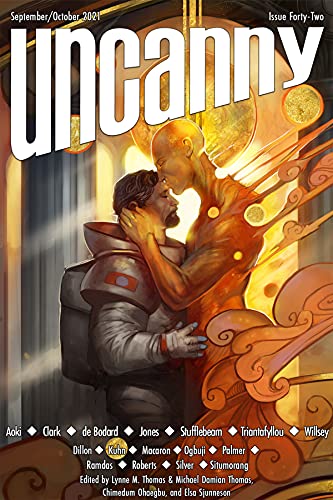
Eugenia Triantafyllou made her debut in 2017, and within a few years was writing some evocative and award-winning short fiction. She has yet to write a novel, or maybe she doesn’t have one in mind—not that she’s obligated. (More importantly, we’re still waiting on a collection of her short fiction.) The online magazine boom of the 2010s made it easier for authors from outside the Anglosphere to at least have their work translated into English and published in the US; and while Triantafyllou was born and raised in Greece, she writes her fiction in English. Her debut also nearly coincided with the launch of Uncanny Magazine, where she’s been a regular contributor ever since. This is actually not my first time reading Triantafyllou, since I did also read (although I don’t remember it vividly) her Hugo-nominated story “Loneliness Universe.” Unfortunately “The Giants of the Violet Sea” left me feeling rather cold, which is weird because on paper this is the sort of thing that should appeal to me: it has dolphins (of a sort), themes exploring colonialism and environmentalism, and even a murder-mystery plot. But I will try to explain myself.
Placing Coordinates
First published in the September-October 2021 issue of Uncanny Magazine. It has yet to be reprinted anywhere.
Enhancing Image
Themis is the prodigal daughter, having returned to the remote seaside village of Tafros, the place of her childhood, after some years. It’s too bad that the circumstances for her return could not have been better. Her brother Melas has died, or rather been killed. Poison ink, courtesy of a venedolphin. This is unusual, because not only was Melas a venedolphin tamer who worked with the big animals (the titular giants) regularly, but these animals are simply not known to do such a thing. Themis knows this. “This isn’t the first time they have killed people. But not tamers like Melas. Never tamers. Some poachers in the past, and rightfully so. A couple of stupid kids a long time ago, who did not have the gift my brother had.” The venedolphins are known for their ink sacks, which are harvested when the animal reaches a certain age by a tamer, without killing it. Poachers, on the other hand, don’t care so much for the animal’s wellbeing. Melas had apparently gotten himself caught in a net and poisoned, and he died a slow and very painful death. It doesn’t take long, upon a doctor examining Melas’s body, for us to figure that it was not a venedolphin, but (drum roll) foul play. Somebody had injected Melas with the poisonous ink while he was stuck in the net. But why would someone do such a thing? This will be the biggest question driving the rest of the (very long at 27,000 words) story.
A few things are going on here. Themis, despite not being a detective, wants to avenge her brother, and at the same time she has mommy issues, on account of not staying in Tafros and taking up her mother’s profession of tattooing the dead. There’s also this fellow Clem, a humanoid alien (the fact that he’s not human matters in terms of how Themis and others interact with him, but not that much) from “the Central Colony” who’s been working with Melas on this planet. To complicate things further there’s also Pirros, a fellow villager who is functionally Themis and Melas’s adopted brother, since their family has found him when he was an orphaned child. There are at least three people who have a personal connection to Melas’s death, which means (so detective-story logic dictates) at least one of them has a motive for killing him. In a classic detective story the killer and the victim tend to have a shared history, a trope that applies here as well. Themis immediately suspects Clem is up to something fishy, on account of her own xenophobia and because of Clem’s business with the colony. While she ends up being right about Clem having an ulterior motive for being here, she’s not right in the way she was thinking. Clem doesn’t really help his own case, since he’s awkward around humans and even has to wear a pressure suit while on this planet, he and his people not being adapted for it.
This is all well and good, but I struggled to stay invested in “The Giants of the Violet Sea” for two major reasons. The first is that this is about as long as Hemingway’s The Old Man and the Sea, yet it reads as longer. The pacing is all out of sorts, with some scenes being almost constipated in length, and the final stretch being so protracted that there came a point where I almost forgot we were supposed to be looking for the son of a bitch who killed Melas. I should thereotically be able to read through a story of this length in one, maybe two sittings, but I simply could not. The bigger issue has to do with grammar and typos, which are not issues I tend to bring up when reviewing literature. Maybe it’s because I’m not a professional editor or some academic, but I don’t get too fussed over ungrammatical sentences, and actually I think it’s fine to be a little ungrammatical if you as the writer are aiming for a certain effect. With that said, I can’t imagine why (and I don’t recall this being an issue in “Loneliness Universe”) Triantafyllou would so frequently resort to sentence fragments and obvious run-on sentences in this story. I also don’t understand why she uses the semi-colon maybe a handful of times throughout the whole thing, refraining from using it even in cases where it’s easily a more sensible option than a comma or a period. There’s a truly incessant number of sentence fragments and comma splices, so that sentences suddenly stop and start, or sentences where the whole is awkwardly stitched together with a comma, or maybe the lack of a comma where there should be on.
I’m gonna give a couple examples, so you can see what I mean. The first is from a scene in which Themis sees a young boy from the village swimming too close to some venedolphins.
Here it goes:
I try to summon my mother’s voice. Or what my mother might have sounded like if she ever needed to raise her voice to make me feel like dirt. The child doesn’t seem to care, instead he dives back into the mucky darkness and before I realize it, I am waist deep in the water, paddling my way through flotsam. The guttural noise of the venedolphins rises up. Like an underwater storm. I can’t find the kid anywhere.
Not that I’m a professional, or that I know the game of writing better than Triantafyllou, but if I were to do some minimal rewriting, that paragraph would come out like the following:
I try to summon my mother’s voice, or what my mother might have sounded like if she ever needed to raise her voice to make me feel like dirt. The child doesn’t seem to care; instead he dives back into the mucky darkness. Before I realize it, I am waist deep in the water, paddling my way through flotsam. The guttural noise of the venedolphins rises up, like an underwater storm. But I can’t find the kid anywhere.
It’s at least 90% the same, but I’ve merged some sentence fragments together to create whole sentences, fixed a comma splice, fixed a run-on sentence with a period and thus created two sentences, and finally I tweaked that last line so that it sounds slightly more dramatic. The result is a passage that (I should think) is easier on the eyes.
Here’s a shorter and more mild example. This is from a later scene, in a subplot where Themis and Clem visit the Alimniots, a group of human colonists with a culture similar to that of Themis’s people. The big difference is that the Alimniots have an omnivorous diet, and they’re not opposed to killing venedolphins for their meat.
Here:
They are less rigid than us. No wonder they eat the beasts. It’s a very thin line though, between this and poaching, maybe they have already crossed it. Or perhaps it was never there but we didn’t know.
The passage can just as easily look like this:
They are less ridig than us. No wonder they eat the beasts. It’s a very thin line, though, between this and poaching; maybe they have already crossed it, or perhaps it was never there but we didn’t know.
You now have a comma where there should probably be one, as well as the comma splice being fixed by turning the comma into a semi-colon, thus making a less awkward connecting bridge between the two halves of this sentence. You seen what I mean, right?
Then there are the typos and inconsistencies, of which there are a few. I’m used to seeing typos in magazine stories, especially old ones, but there is a degree of sloppiness here that begs the question of how much the editors were handling Triantafyllou’s story. Something that especially irked me was whether Mother/Father should be capitalized in a certain context, as Themis refers to her mother and (deceased) father as Mother and Father respectively—but not always. “Mother” and “Father” are titles and thus capitalized, like when you say President Harry Truman or whatever. Ah, but except for when it’s the mother, or the president. But Triantafyllou or the editors do not take this into account. Also, while it’s perfectly natural for there to be a typo or three in a manuscript, like a misspelled word, these should be scrubbed out before publication. Nobody’s perfect, of course, but there are several instances in Triantafyllou’s story where there’s, say, a missing quotation mark, and in at least one case there’s a word that’s clearly misspelled. What sucks is that I have no other version of this story to compare it with, as it has yet to find a home in book form. Surely part of the reason for the lack of reprints is the length, which is awkward for an anthology, and also there’s no collection of Triantafyllou’s work as of yet.
It seems like we don’t think about how a magazine editor might play with the text of a story they’ve bought, or about the collaborative nature between the editor and the author. The job is not just to buy and reject stories that have made it past the slush pile, but to work with the author. Some of the most famous/beloved SF stories in the “canon” only turned out the way they did because of some judicious and even inspirational editing. Sure, he was an asshole with some very bad opinions, but John W. Campbell really set the gold standard by writing detailed rejection letters to his writers. What I’m saying is that (and it pains me to say this) it feels like Triantafyllou’s editors failed her here. “The Giants of the Violet Sea” needed an editor’s helping hand, and for some reason it didn’t get one. You can trim the length quite feasibly, but also there are frequent lapses of inelegant sentence structure that read as almost unprofessional. Hell, I even spotted a few cases of tense slippage, since this was written in first-person present tense (not a mode I’m a fan of, but to each their own) and occasionally Themis slips into the past tense to describe a current action.
There Be Spoilers Here
We learn early on that the venedolphins didn’t kill Melas, and it turns out the poachers (who I don’t think we ever even encounter within the story) didn’t kill him either. It was Pirros. Well, he was one of about two viable suspects. I do like how this is revealed, though, with Themis seeing Pirros torture an immature venedolphin in extracting its ink sack. She deduses that while Melas was not as perfect person, he was too experienced a tamer to let someone get the upper hand on him—unless it was someone he knew and trusted. Pirros himself being a poacher is kind of an obvious twist, not helped by his vibes being kinda off throughout the story, but I feel like I should give credit where it’s due.
A Step Farther Out
I feel like an asshole for not liking this one, and also for going on a rant about editing. Clearly the professionals who make up SFWA disagreed with me, though, because “The Giants of the Violet Sea” got a Nebula nomination. On the one hand, it’s nice (and all too rare) for a novella published in a magazine to get awards attention in our current era. Not only are chapbooks in vogue, but Tor have taken it upon themselves to take a truly obscene slice of the market, to the point where they have virtually a monopoly on SFF chapbooks and by extension on stories of novella length. I wish I could recommend this one, but I honestly can’t, as it’s far too unpolished, to such an extent that it may well have gone through zero editing between the manuscript arriving in the (virtual) mail and the story being published in Uncanny Magazine. It’s a real shame.
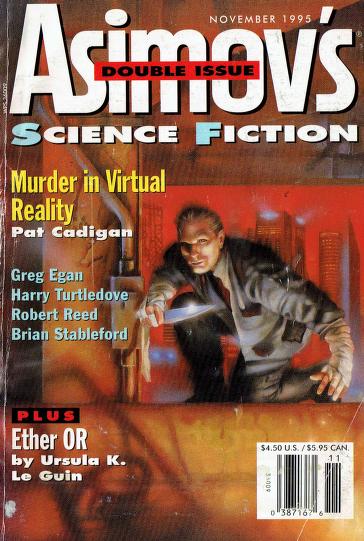
Pat Cadigan could be considered the queen of cyberpunk, as while she wasn’t the first woman to write it (that honor arguably goes to Joan D. Vinge, whose novella “Fireship” was indeed one of the first real examples of cyberpunk), she would become one of the major architects of the movement in the ’80s, alongside William Gibson and Bruce Sterling. Throughout that decade she made a name for herself with her short fiction, whereas Gibson and Sterling focused more on novels, which may go to explain their wider appeal with readers. (And also, you might say, the fact that they were men.) Her debut novel, Mindplayers, was well-received but didn’t become a bestseller. Another thing I’ve noticed with Cadigan is that, at least earlier in her career, she seemed fond of cannibalizing her short fiction for her novels. For example, her novella “Fool to Believe” was later turned into Fools. Today’s story, “Death in the Promised Land,” would itself later form part of the novel Tea from an Empty Cup, which might be why the novella version has only been reprinted a few times. Like “Fool to Believe,” this is at its core a detective story, in the fashion of Raymond Chandler and his ilk (incidentally Chandler also liked to cannibalize his short stories for the sake of his novels), so I was predisposed to enjoy it at least somewhat. And I did!
Placing Coordinates
First published online in the March 1995 issue of Omni Online, which I don’t think you can even access with the Wayback Machine. The first physical appearance of “Death in the Promised Land” was the November 1995 issue of Asimov’s Science Fiction. It was reprinted in The Year’s Best Science Fiction: Thirteenth Annual Collection (ed. Gardner Dozois) and The Mammoth Book of Extreme Science Fiction (ed. Mike Ashley).
Enhancing Image
Artificial Reality is, for a lot of people, even better than the real thing—to the point where what happens in AR can feel totally real, both the good and the bad. Dore Konstantin’s most recent case puts this whole idea to the test, as a teen boy has been murdered, both in AR and, seemingly at the same time, in real life. The kid’s had his throat slashed, a death made stranger because his “persona” in AR suffered the same fate. The persona’s name is Shantih Love while the kid’s name is Tomoyuki Iguchi, although that can’t be his “real” name since the kid is not Japanese. I don’t think we ever find out his “real” name, not that it matters too much. It’s an unusual case: you have a kid with two fake names, one of which is copyrighted and which the killer seemed to have hijacked—a mask to be worn in AR. This is the eighth such case of someone being murdered while in AR in as many months, and yet the law has not been able to connect these killings to each other. Konstantin really has her work cut out for her, despite having been a detective for a dozen years at this point. She also basically has no experience using AR herself, which I have to admit is a point that does strain my suspension of disbelief a bit. How is it possible for her to have so much experience while a) still being squeamish about blood, and b) still being a “virgin” who doesn’t know the rules of AR? But I’m getting slightly sidetracked.
We don’t get to know a great deal about life outside of AR, but what we do learn implies the real world has really gone to shit, which tracks for cyberpunk. Konstantin herself barely seems to be getting by on her salary, having until recently shared a little hole in the ground with her partner, now called her ex. Actually we’re gonna be reminded, incessantly, that Konstantin is going through a recent breakup, to the point where she’ll be mentioning her ex on almost every single page of this novella. Having gone through a serious breakup a couple months ago myself, I can confirm that at least this part of her character is quite believable. She also does some classic detective work, like watching surveillance footage of Shantih Love’s final moments in AR and interviewing a few people who work at the building that holds this AR cubicle—people who, for the most part, would rather not talk to her much. Something they don’t tell you that’s a quintessential part of the detective experience (at least in fiction, but probably also in real life) is being sort of a public nuisance. The coroner and the cops on the scene are also not a great deal of help, not that there’s too much that can be said for the kid. He apparently has his throat slashed with some kind of knife, and also, much more strangely, he’s apparently married. He got killed just ten minutes into what was supposed to be a 260-minute session (Konstantin remarks that just being in AR for that long, over four years, would be unhealthy on its own) and nobody knows who did it.
“Death in the Promised Land” is a product of its time when it comes to how it deals with the possibilities of VR (inexplicably called AR here), and in a way it feels outdated even for 1995. Characters have this preoccupation with Japanese culture, to the point where “turning Japanese” is a phenomenon (see again the kid taking on a Japanese name), which would raise an eyebrow but not be unexpected had this story been published a decade earlier. Japan being treated as an economic and cultural power on par with the US is a pretty old cyberpunk trope, indeed being part of the package almost from the movement’s inception; but by this point, in 1995, the bubble had burst and Japan was no longer on top of the world. Why Cadigan decided to use this trope and take it at face value several years after its possibility in the real world came to look remote, I’m not sure. Granted, Japanese pop culture has left an irremovable mark on America well up to [the current year], since anime and manga are big cash cows here, but you don’t see white people cruising around dressed in kimonos in public. But then again, writing speculative fiction means speculating on the future, and speculating on such a thing means nine times out of ten you’ll be wrong. Still, the story’s attitude toward race and cultural appropriation is a bit strange. This is not helped by there, at least to my recollection, not being a single Japanese character past maybe a mention as part of the backstory. This issue seems to have been rectified for the novel version.
The novella can be basically split into two parts, those being the setup, which takes place in the real world, and the payoff, which takes place in AR, in a simulated world called post-apocalyptic New York City. Sorry, “Noo Yawk Sitty.” Her only hint to finding the killer lies in someone named Bodi Sativa (Get it? Like Bodhisattva?), or rather that’s the persona’s name. Bodi Sativa has a reputation in post-apocalyptic Noo Yawk Sitty as a kind of religious figure, which should be obvious given her name. Religion comes up, rather unsubtly, before we’ve even started reading the novella—just look at that title. But while Cadigan makes allusions to Buddhist and Abrahamic practices, it’s not something you’re rewarded for much if you choose to linger on it. Rather, the allusions are a means to an end, the end having to do with the blurry line between reality and simulation. Even for 1995 it’s not a new theme for cyberpunk, and even Cadigan had explored this theme more strikingly in the past. To be fair, though, in a vacuum it’s effective enough. Konstantin throws herself into the world of AR, specifically Noo Yaw Sitty, a shared hub world for people who wear headsets and so-called hotsuits (often simply called ‘suits), these ‘suits allowing them to better immerse themselves in the virtual world. There’s the line between your real body and your virtual body, and then there’s the line between your real-life persona and your virtual persona. We would now call these personae avatars, and like in modern video games these personae are things you can buy and own—unless you happen to get hijacked in AR, or if you died.
There Be Spoilers Here
The way Cadigan goes about solving the mystery at the heart of this story is a little anticlimactic, maybe by design. Combining the detective narrative with SF has presented an age-old problem and with many authors over the decades coming up with solutions to said problem. How do you write a compelling mystery in, for instance, a world where surveillance is practically omnipresent and the detective has a theoretically infinite number of tools at their disposal? What would be the mindset of the consummate criminal in such a world? In the case of “Death in the Promised Land” the solution is to throw the detective into a world whose rules are foreign to her and where the killer can be hiding in plain sight. The results are mixed. I assume this is not the case with Tea from an Empty Cup, but Noo Yawk Sitty feels a bit underdeveloped. We’re introduced to things like icons, which are basically equippable NPCs, but only have a faint idea of what an icon does. We barely get perspectives from other people Konstantin interacts with while in AR; instead she spends much of the time talking to guides, who like icons are not people but part of the program. Indeed, Konstantin spends a lot of time having stuff explained to her, which isn’t a bad thing in itself, but I was hoping for more action in the back end of the story. I came away feeling like I was reading the work of a very capable writer (as I know Cadigan is), but that the story wasn’t firing on all cylinders.
A Step Farther Out
This feels like minor Cadigan, if only because it covers similar ground to earlier cyberpunk work of hers while lacking the intensity of a masterpiece like “Pretty Boy Crossover.” I read the whole thing across two sessions, and while I would say it’s an easy enough read, I couldn’t help but feel that the pacing was uneven (we don’t spend that much time in AR) and that there’s some questionable character logic whose rationale is unclear. There are some questions regarding backstory that get left unanswered, although maybe this is not the case with the novel. Konstantin herself is weirdly timid and gullible for someone with her level of experience, not to mention her fixation on her ex as a major point with her characterization that never gets resolved. But still, it’s a decent time.
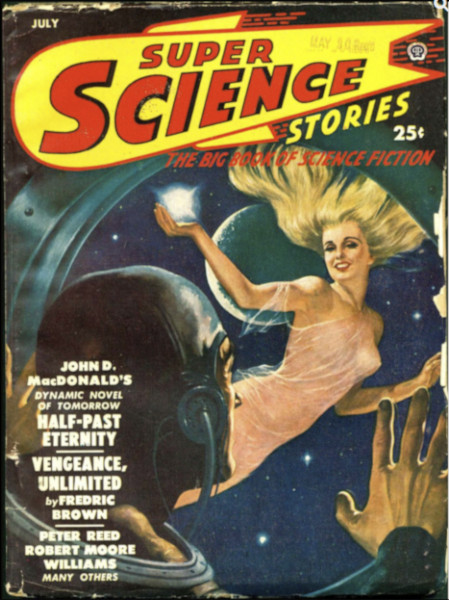
(Cover by Lawrence. Super Science Stories, July 1950.)
Who Goes There?
Did not think this post would get delayed by almost a week, but I got hit with the double whammy of being sick (some repiratory deal, like a chest cold), which I’m still dealing with, and more importantly being without internet at my apartment for four fucking days. This all happened over Easter weekend, so it felt like just bad luck. Apologies.
Fans of classic crime fiction will know John D. MacDonald for his prolific and popular Travis McGee series of novels, starring the titular detective, with some 21 novels published over a span of about as many years. MacDonald apparently wrote the first handful of Travis McGee novels in rapid succession, slowing down a bit after but still writing at an impressive speed. He’s also famous for his standalone crime novel The Executioners, which you would know better as Cape Fear. He earned the Grand Master Award for lifetime achievement from the Mystery Writers of America in 1972—by no means a small feat, especially given that he had only been writing crime fiction for not quite twenty years at that point. But before all this, before even Cape Fear, MacDonald cut his teeth by writing for various magazines from the late ’40s through much of the ’50s. He wasn’t very picky about what genres he would dabble in, although much of the fiction he wrote in these early years was sports stories, non-genre adventure stuff, and of course science fiction. The magazine market for SF was going through a renaissance at the time, which MacDonald capitalized on. “Half-Past Eternity” is one of MacDonald’s longer SF stories, being about 20,000 words, and in a way fitting for MacDonald it has a mix of SF, crime, and sports fiction. Like sure, why not combine all three?
Placing Coordinates
First published in the July 1950 issue of Super Science Stories. It’s only been reprinted twice, in The Human Equation (ed. William F. Nolan) and the MacDonald collection Other Times, Other Worlds.
Enhancing Image
Dr. Garfield Tomlinson goes to make a bet on a boxer, “the kid,” who in fact is in his early thirties and a loser with a soft swing. Tomlinson bets the kid will knock out his opponent in the first round, with an amount of money that surely would’ve been considered suicidal circa 1950. The bookie, Nat February, accepts the bet, but is really puzzled—both by how much money Tomlinson has put on the table and how confident the old doctor is that he’ll win. Which he does. The kid’s swings are unnaturally fast and swing, to the point of breaking his opponent’s jaw, on top of the first-round knockout. Despite the story starting with their perspectives, neither Tomlinson nor Nat is the protagonist (we never even see Nat again after this opening stretch), but instead Sam Banth, an ambitious and amoral con-man who makes it his mission to track down the doctor. He’s street smart, but he’s also smart enough to do some digging at the local library and find Tomlinson’s name, and even where he lives. The doctor had studied longevity in geriatrics, but his most recent research has to do with speeding up time for the young rather than slowing it down for the old. The short of it is that time is partly subjective, in that how each person understands the passing of time involves metabolism, reflexes, etc. For a swift boxer, time seems to move slowly, even if that’s not the case in reality. If you’re an athlete in the heat of the moment, time seems to stretch out like a rubber band, while conversely your reflexes are tuned as if every second counted.
More importantly, Sam realizes that athletes with such an enhancement could make him a fortune. But first, he has to get through to the doctor, along with Linda, Tomlinson’s daughter. Sam is quite a bastard; he would fit right in as the protagonist of a crime story of the sort that focuses on the criminal. He all but coerces Tomlinson into forming two companies with him: Research Laboratories, Inc and Champions, Inc.The idea is basically to “train” athletes who normally would have few prospects with the help of the old doctor’s method of time distortion, thus heightening reflexes and making these losers into stars. Of course, the angle for Sam is to scrape the profits off these athletes, along with having big shares in the company. You might say using such research to make superhuman athletes would be cheating and even rendering these demanding sports monotonous, and you’d be right! Not that Sam is all that concerned about what’s right or wrong. Meanwhile he’s getting smitten with Linda, who by her own admission wants enough money to “smother” herself with. Despite their initial hostility toward each other, since Linda’s well aware Sam wants to take advantage of her father, the two end up having a fair bit in common. While Sam already owns a large stage in the company, the ownership being split three ways, he gets the idea that maybe if something unfortunate were to happen to the old doctor, and also if Sam were to marry Linda, well…
The scheme at the center of “Half-Past Eternity” is a good deal of fun to read, even if we can guess that the whole thing will come crumbling down at some point and in some way. We don’t expect Sam to come out on top, nor do we want him to; but it’s the getting-to-that-point that’s fun. I’m reminded of one of the all-time quintessential noirs, Double Indemnity, that classic premise of a coniving woman and her lover plotting to get rich off her husband’s life insurance. This is all well and good, although the story does suffer a bit from MacDonald’s need to either pad out the word count or give us more of a perspective on the athletes being “trained.” There’s a B-plot involving Wally Christopher, a young man who has a passion for baseball but no future in it at the pro level, on account of not being very good at it. He starts having an affair with the much older Barbara Anson, a respected former tennis player who had quit the game on account of a leg injury. This plot thread ultimately doesn’t go anywhere much and sort of just fizzles out before the climax of the story proper, but we do at least get some insight on what it’s like to live day to day with these heightened reflexes. People who’ve gone through this treatment become so quick, in fact, that they become jittery, and have to train themselves to take things slow—for the sake of appearing normal to the outside world. The catch, like I said, is that the body is actually aging faster than it normally would, so that for someone like Wally time really go by quicker for them and slower for everyone else. I’m sure this will not factor into the story’s climax at all.
I don’t know how far back performance-enhancing drugs were treated as an issue in professional sports, but “Half-Past Eternity” deals with this subject in an SFnal manner, wherein instead of real-world drugs we’re given a vaguely explained time-distorting treatment. Of course, cheating has been a thing in sports for all recorded human history, or for as long as there have been sports with rules. I mentioned that MacDonald, very early in his career, wrote quite a few sports stories, although I’m not sure if you can find them in print anywhere. MacDonald’s short fiction is generally obscure compared to his novels. “Half-Past Eternity” is at an awkward spot where it’s too long to fit neatly in a short-story collection and too short to be honestly called a novel—despite what the front cover of Super Science Stories says. Certainly he could’ve shaved the word count down so that it fit more neatly as a novelette, namely by doing away with the aforementioned subplot. Even with the fat on it, though, this is a fast-moving yarn.
There Be Spoilers Here
Up this point the story has been nominally SFnal, but things are about to take a very Philip K. Dick direction, to the point where I wonder if by chance a young Dick had picked up this issue of Super Science Stories. Sam and Linda plot to kill the latter’s dad, and plan goes off without a hitch. If anything the plan succeeds a little too well. Sam, who himself has sociopathic tendencies, is disturbed by the ease with which Linda is able to get over having a part in her own father’s murder. Maybe it would be best to kill her as well, and take her stake in the company for himself. This plan both succeeds and fails. By the time of his death, Dr. Tomlinson had constructed an “iron maiden,” a portable chamber that would subject the lucky (or unlucky) person inside it to time distortion. If someone were to be trapped in this chamber, though, time for them would speed up such that they would die from a combination of thirst and old age—in just a matter of minutes. They had already seen this effect on animals, through testing, but a human being had never been put in the chamber and killed like this. Yet. Sam succeeds in killing Linda via the iron maiden, but is himself thrown inside and only narrowly avoids dying by breaking out. Having stripped himself of his clothes to escape, Sam is now alone, naked, and most strangely now, in a world where time has all but stopped for him. This is where “Half-Past Eternity” gets really fun. The final stretch of the novella sees Sam moving so fast that subjectively he’s stumbled into a world where everyone and everywhere has almost frozen solid. Even water has effectively turned into a solid, and MacDonald is happy to tell us the convoluted means by which Sam has to eat and drink anything. By this point the sports and crime tropes have fallen to the wayside, with the SF knob being turned all the way up.
In his introduction for this story in Other Times, Other Worlds, Martin H. Greenberg singles out the final chapter of “Half-Past Eternity” as impressive in its handling of “difficult material.” I thought this meant in the sense of graphic or “serious” stuff, but actually he meant something very different. Sam gets away with his crimes, in a sense, and he even lives to old age—all in the span of one day. By the end of his life, at which point mere hours have passed in the objective world, he’s become like Robinson Crusoe, a raggedy old man with long hair. This is a very strange punishment, but at the same time it’s not all bad for Sam, as he effectively becomes ruler of the world, being able to do whatever he wants—or at least anything that doesn’t get him killed. He even kills a man, by accident, early on and gets away with it. Even if the novella wasn’t exactly great up to now, I do think the final chapter is worth the price of admission.
A Step Farther Out
John D. MacDonald is the kind of author you’d think wouldn’t appear on a sci-fi/fantasy review blog more than once, but he wrote quite a bit of SF in just a handful of years, and I do like to cover SF by authors from outside the field sometimes. The last time I wrote about MacDonald was the magazine version of his novel Wine of the Dreamers, which I thought was middling. “Half-Past Eternity” is a marked improvement, in part because it plays more to MacDonald’s strengths. It’s hardboiled and no-nonsense, and the climax, while outlandish and maybe hard to believe if you think about it too long, is a lot of fun. It all goes by quickly, despite being a novella. Given that it’s not been reprinted ever in my lifetime, it’s safe to call this one a bit of a hidden gem. Just don’t take it too seriously.
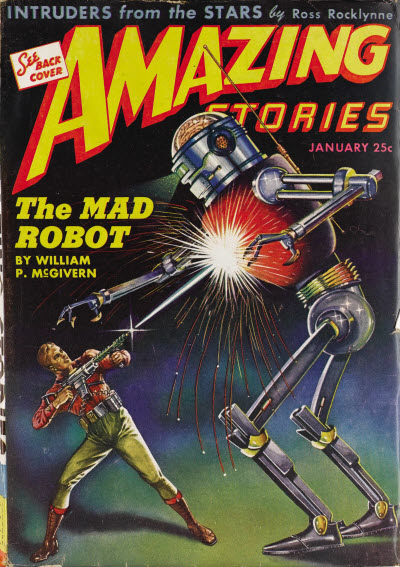
(Cover by Robert Fuqua. Amazing Stories, January 1944.)
Who Goes There?
Of the writers to get their start before John W. Campbell took over Astounding in late 1937, Ross Rocklynne was one of the few who adjusted well to the new regime. It could be because he and Campbell were close contemporaries, as well as Rocklynne being an early practitioner of what we now call “hard” SF. He made his debut in 1935 and had become an established writer by the time he attended the first ever Worldcon in 1939. He never gained the popularity of other contemporaries like Isaac Asimov or Robert Heinlein, or even Campbell under his Don A. Stuart pseudonym, perhaps because he only ever wrote two novels, neither of which has ever appeared in book form. Rocklynne went MIA for much of the ’50s and ’60s; the SF Encyclopedia entry on him says this was because of Dianetics (a sadly common occurrence with SF authors at the time), but it doesn’t mention he also stepped away from writing because of chronic pain in his face and jaw. When he returned to writing in the late ’60s his work was surprisingly well-received, and he even appeared in Again, Dangerous Visions with a new story, alongside the New Wave writers.
“Intruders from the Stars” marked a rare Rocklynne appearance in Amazing Stories, since he was much more in favor of Astounding. I only heard about it because it had gotten a Retro Hugo nomination for Best Novella. The pickings must’ve been slim, because unfortunately it’s not very good. In fairness, 1944 is typically considered a lull year for the field, largely on account of the war. If authors didn’t enlist or weren’t drafted, some (like Asimov and Heinlein) worked busy jobs as civilians in support of the war effort. It wasn’t all bad: it was during those few years when Henry Kuttner and C. L. Moore, often writing together, emerged as an intimidatingly strong creative duo. Clifford Simak also began the series of stories that would later form his “novel” City. Still, there were fewer authors active between 1943 and 1945 than usual.
Placing Coordinates
First published in the January 1944 issue of Amazing Stories. It remained stranded for three decades before being reprinted in the November 1973 issue of Science Fiction Adventures Classics.
Enhancing Image
It’s the last battle between an empire on its last legs and a more democratic faction. The empress of this civilization, a beautiful woman named Bess-Istra, faces death in battle, retreat from the planet, or a compromise with the leader of the enemy faction, a prime minister who wants Bess-Istra as his wife. Bess-Istra isn’t keen on this. For reasons that are never given, except maybe the implication that she’s really just that attractive, Bess-Istra passively draws in nearly every male character who crosses her path. Every man seems to feel intense love or hatred for her—sometimes both at the same time. Take Bandro, Bess-Istra’s right-hand man, who is loyal to her at the beginning, only for her to beat him and chew him out for suggesting she take the compromise, “his love for this girl at that moment turning into hate.” Said hate will fester over the course of the story, but we’re getting a bit ahead of ourselves. Then there’s the totally amoral scientist Sah-Hallo, who stays loyal to Bess-Istra, if only because he seems to be the only man around to not feel strongly about her, being rather preoccupied with his “toys.” The fallen empress and her thousand trops hop in their massive cylindrical escape ship and mark coordinates for a neighboring planet fit for colonization. Or maybe not. Given how small Bess-Istra’s army really is and the fact that they don’t know much of anything about who may be living on said planet, there’s a very real chance whoever’s there might see them coming. Which is what happens. The folks on this other planet, who seem pretty advanced, nudge the ship off course so it misses the planet, instead heading for a planet you and I would be familiar with.
We then jump forward in both time and space to Earth, specifically Mozambique in 1944. We have our token American character in the form of Bill van Astor-Smythe (what a name), a war correspondent who for some reason has been hanging out in the jungle. These Japanese have invaded the island of Madagascar and look to make headway in Mozambique, which is… also very strange. Okay, time to take a step back. “Intruders from the Stars” explicitly takes place in 1944, but it’s not our 1944. This issue of Amazing Stories would’ve appeared on newsstands in December 1943. Rocklynne could’ve written this story as far back as late 1942, when the frontlines of World War II in both theaters looked quite different. There was still fighting in North Africa, Mussolini was still in full control in Italy, and the tide had just turned in favor of the Americans in the Pacific. It’s possible Rocklynne wrote this story during the Guadalcanal campaign. It still doesn’t excuse some conspicuous inaccuracies, like the fact that Bill and other characters act as if Midway hadn’t happened. The Japanese are a lot better fortified in-story than they were in real life, especially by the time of the story’s publication. The European theater is also described repeatedly as being bad for the Allies, which simply wasn’t the case, even by the middle of 1943. You have to wonder how people in those days got their news, or rather when they got their news. Obviously you’d read newspapers, listen to the radio, watch newsreels at the movie theater, but information could be wrong or misleading, not to mention there was a time delay. The unfortunate thing is that “Intruders from the Stars” would’ve read as dated on the very day it appeared on newsstands.
In case you haven’t guessed, this is very much a wartime story, and in part it functions as wartime propaganda, complete with racism against the Japanese and the liberal usage of a certain slur. There’s racism elsewhere, like referring to Chinese laborers as “coolies,” a slur so outdated that your grandpa might not even know what it means. To an extent at least, the racism is a byproduct of the circumstances in which Rocklynne wrote his story. Looking at World War II propaganda, namely anti-Japanese propaganda, between movies, cartoons, comic strips, etc., we see that things could be a lot worse than in Rocklynne’s story. The Japanese empire is antagonistic force, but the much bigger problem is Bess-Istra’s ship, which has crash-landed in the jungle. Bill meets a young missionary named John (or Johnny, as Bill keeps calling him) Stevens and his assistant Thomas Reynolds. The three men find that the locals have been drawn to the empress and begun treating her as an idol, which is bad for Stevens’s business. Bess-Istra and her cronies have been in cold sleep, possibly for centuries, but now awaken to a world which is decidedly not the one they were aiming for. Well, ya know, when you’re given lemons you should try making some lemonade. It’s convenient that not only is Earth totally habitable for Bess-Istra and her kind, and not only are these aliens totally humanoid in appearance, and not only are they able to understand human language thanks to a fancy alien doohickey, but also they’re able to catch up quickly on what’s been going on in the world. This is all rather hard to stomach and unscientific by Rocklynne’s standards—not that he was the strictest of writers.
Both Bill and Stevens are immensely attracted to Bess-Istra, much to Stevens’s angst, on account of his religious duties. Sex, or rather sexual attraction, plays a big role here, such that Bess-Istra’s obvious plan to become ruler of Earth wouldn’t get far without it. For his part, Bill is no fool, and from the day they meet he knows Bess-Istra and her gang are up to no good. The problem is twofold: a) he finds himself drawn to her, almost against his will, and b) he thinks, or tries to convince himself, that maybe there’s the chance the empress really does mean well when she says she can end this war with minimal casualties. It’s a very tempting proposal, and it turns out that what the aliens lack in numbers they more than make up for in equipment. Bess-Istra also seems to be taking an interest in Christianity (it’s vahue as to what sect, but I have to assume Catholicism), listening patiently while Stevens yaps at her about it. The Christian God is quite different from the goddess on Bess-Istra’s world, who demanded blood sacrifices. Having lived some of her life as a slave, Bess-Istra knows a thing or two about pain and torture. What ensues is—honestly sort of hard to describe. The aliens incapacitate Japanese and German soldiers, with the Allies and resistance (it’s nice, at least, that we get mentions of Chinese and other non-white resistance forces) groups making major headway almost literally overnight. Hitler (for some reason his first name is spelled “Adolph” in-story) and other Axis higher-ups are captured with ease.
Before you know it the war has ended, which is good for humanity, but then the question is… What next? It’s obvious what Bess-Istra wants, but the real question is whether anything can be done about it. How can Bill, who has (against his better judgment) befriended the empress in a sense, hope to save the world from her clutches?
There Be Spoilers Here
The answer is a mix of religion and some tough love—by that, I mean what is admittedly a well-earned slap, coming from Bill. I will say that while the love triangle angle is unearned, it’s interesting that not only does Bess-Istra’s interest in Christianity turn out to be genuine, but this happens because she falls in love with Stevens. Not that they can even get their relationship started, for a few reasons. In a bit of a twist it isn’t Bess-Istra who is ultimately the villain, but her spurned right-hand man Bandro. Whereas the plan to capture the Axis leaders and hold them on trial for war crimes was genuine, Bandro has a much more violent idea, killing soldiers and civilians indiscriminately. Berlin and Tokyo are utterly destroyed, which disturbs Stevens and even Bess-Istra; and yet, in the story’s most baffling moment, Bill begs to differ. He says:
The people of Japan and Germany are hopelessly warped. The Japanese believe themselves to be the divine flower of the world, and worship their emperor as a god in his own right. They believe it is a privilege for ‘inferior’ races to be ruled by them. The same goes for the Germans. They literally believe themselves to be the chosen people. That belief has been drilled into them for long, long years.
Nothing, only death, can completely erase the utter cruelty that has been bred into the very minds of those people! The utter conceit and treachery. The utter inhumanness.
Up to this point, Bill’s been a pragmatist and not one given to combat, which makes his sudden genocidal lunacy all the more head-turning. No doubt this was a sentiment some people really had, not helped by the death camps discovered at the war’s end (Rocklynne and others would not have known the full extent of Nazi and Japanese crimes at this point), but it makes little sense to come from this character. The good news is that Bess-Istra has by this point turned a new leaf and tells Bill to shut the fuck up. Ultimately the story rejects the notion of so-called collective punishment, even against the omnicidal horror of Germany under Nazism. Ultimately everything works, except for Stevens, who dies heroically. The implication is that with Stevens dead Bill might be able to make moves on the (former) empress, but we never get a clear answer as to how Bess-Istra feels about the Yankee journalist. As soon as the action ends, the story’s over.
A Step Farther Out
This is, if anything, indicative of both wartime SF and adventure SF of the sort that didn’t appear often in Astounding. There were other outlets for such pulp, including Planet Stories and Startling Stories, and even then Amazing Stories played second fiddle to those at the time. The magazine’s readership was waning, and this was a time when there were also paper shortages. It’s impressive, really, that Amazing Stories survived the war. “Intruders from the Stars” is not something I can honestly recommend, but it does serve as a kind of time capsule for a particular brand of SF writing that died off when the war ended. Rocklynne was a consummate professional, and while he wrote better than this, he also wrote worse.
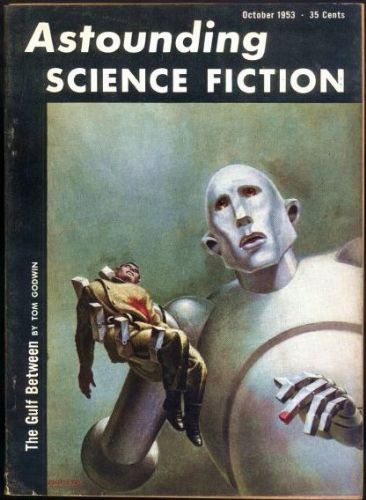
(Cover by Frank Kelly Freas. Astounding, October 1953.)
Who Goes There?
Tom Godwin is one of those semi-forgotten authors whose legacy is secured by a single work, the 1954 story “The Cold Equations.” While this story’s reputation is earned, in that it is understandably one of the most controversial SF stories ever published (people have been arguing over it for the past seventy years), its creator has sadly been left in the dust. Of the many writers to debut in the ’50s, Godwin was one of the few who contributed mainly to Astounding. Why he had such a chummy relationship with John W. Campbell, I’m not sure. Godwin himself came to writing SF relatively late in life, being already deep in his thirties when his debut story, “The Gulf Between,” was published, and his life was marked by tragedy and inner demons. He had a disability that gave him a hunched back, which cut his military career short, and he struggled with alcoholism over the course of many years, never getting entirely off the wagon. His mom and sister died when he was very young, and he had a troubled relationship with his dad despite living with him for a good deal of his adult life. Godwin’s most productive period as a writer was in the ’50s, and afterwards he dropped off somewhat, hampered by health problems. When Godwin died in 1980, seemingly a broken man, his short fiction had not even been collected outside of anthologies.
“The Gulf Between” has the rare distinction of being a debut story and getting a cover in Astounding. The only other example I can think of off the top of my head would be A. E. van Vogt’s “Black Destroyer.” Now, to bring up the elephant in the room, folks might find this cover to be familiar somehow. That’s because Queen had commissioned Frank Kelly Freas to redraw it for their album News of the World, with the only major difference being the one dead guy on the original being replaced with the band members. The album cover is leagues more famous than its inspiration, but “The Gulf Between” is a surprisingly good and brutal tale of Cold War paranoia which marked the introduction of an overlooked talent.
Placing Coordinates
First published in the October 1953 issue of Astounding Science Fiction. It was never reprinted in Godwin’s lifetime, only ever being reprinted in The Cold Equations & Other Stories.
Enhancing Image
The narrative shifts back and forth between the main plot and what seems to be flashforwards, all in italics, in which an unnamed man is dying on a ship, the robotic doctor onboard being able to prolong his life but being unable to save him. These flashforwards are deliberately vague and misleading, but we’ll get to them later. For now, the action starts in Korea, during that war which saw a ceasefire but which theoretically could go hot again any day of the week. The Korean War had just ended when “The Gulf Between” was published, but it was still going on when Godwin wrote the story. There are rumors in-story that the war will end in a stalemate, which is just what would happen in real life. Knight, a respectable soldier, is ordered along with his men to take a hill, a battle he knows will at best result in a pyrrhic victory. But his commander, Cullin, will not take no for an answer. Cullin is a genuine psychopath who sees the men under him as expendable, and who believes that human consciousness has no place on the battlefield. It’s his way or the highway. The battle is a success—at least on paper. The toll in lives for the Americans is perhaps too great. Knight makes it out alive with a fierce hatred for his commanding officer, and while he might not suspect it at the time, their rivalry will come back to play a role in world geopolitics. After all, the Cold War has been heating up.
Most of “The Gulf Between” takes place in what would’ve then been the near future, sometime in the latter half of the ’50s. In depictiing what the back end of that decade might be like, Godwin is actually not that far off. By the end of the ’50s the space race will have started, with Kennedy in his inauguration address promising fellow Americans that “we” will put a man on the moon in ten years’ time. The issue of The Bomb™ is on everyone’s minds, as well as the development of rocketry. This is a very ’50s story, although I don’t really mean that in a bad way. Following the war, Knight has become involved in robotics and rocketry, while Cullin (ironically, given his hard-as-nails military attitude) has since turned traitor and become an enforcer for “Russo-Asia,” what I have to assume is a coalition of the Soviet Union, China, and North Korea. I guess they put their petty differences aside as to what kind of socialism should dominate the world. Mind you that neither man is much of a patriot, and the first time they meet after the war it’s in Mexico: Knight’s there on siesta and if Cullin were to set foot in the US he’d probably be tried as a defector. Cullin is very interested in Knight’s work on a super-computer, called the Knight-Clarke Computer, that can think faster and more efficiently than a human being—but not of its own volition. The computer, like “AI” as we understand in the current climate, can’t think for itself; it’s a learning machine, and a very good one. It’s also (and this is the part that catches Cullin’s attention) totally obedient. A machine doesn’t lie, and it doesn’t get sentimental about orders. Such a computer could be used to guide weapons, is the idea.
“The Gulf Between” is an ambitious little story about nothing less than the necessity of human consciousness, not to mention conscience. Knight and Cullin are not deeply drawn characters, but they do clearly represent opposing philosophical positions. Knight is interested in intelligence and consciousness while Cullin finds such things to be abhorrent, his ideal army being a bunch of unthinking and subservient robots. It feels exaggerated, but it’s also not hard to believe there are people like Cullin in government or the military. It’s also worth mentioning, although it might be obvious to say, that of course Cullin would defect to Russo-Asia, what with the mindset at the time being that those dirty commies were a bunch of unthinking and mindlessly conforming stooges. And yet, putting the Cold War subtext aside, the message that each person needs to have their own intitiative and moral code still feels relevant. Hell, Henry David Thoreau wrote a whole essay on the matter, you may have heard of it. In fact I’ll quote one of the more famous passages in “Civil Disobedience,” which Thoreau wrote in the context of the Mexican-American War but which can just as well be applied to men like Cullin a century later. To wit:
In most cases there is no free exercise whatever of the judgment or of the moral sense; but they put themselves on a level with wood and earth and stones; and wooden men can perhaps be manufactured that will serve the purpose as well. Such command no more respect than men of straw, or a lump of dirt. They have the same sort of worth only as horses and dogs. Yet such as these even are commonly esteemed good citizens.
Knight has friends and colleagues, whereas Cullin doesn’t seem to have any friends and indeed barely even seems to have allies. Cullin has his job implicitly because he’s that good at it, and not because the higher-ups see him as a cuddly individual. Much to Cullin’s liking, the embrace of the Soviet and Asian commies is a cold one. I’m not sure what Godwin’s politics were (I’m not even sure what he looked like), but given his attempt at military service and his regular contributions to Astounding it’s a safe (although not sure) bet that he was a right-wringer. But if so, there’s a humanist element that muddies the waters. When reading Godwin there’s a sense that a tug-of-war between the belief in goodness in one’s fellow man and a deep pessimism, even a sadness, goes on with him. There’s more bloodshed here than I expected, but I’m getting a bit ahead of myself with that. A tour of Lab Four, where Knight and the others work, is underway. The most immediately impressive part is George the robot, which is intelligent but not really sentient. George can’t make decisions for himself, but he’s very good at following orders—regardless of who’s giving them. (I assume George is meant to be the robot on the cover, but in-story he’s about human-sized rather than giantic.) This is important to keep in mind. There’s also the robot-assisted rocket, set for liftoff with a human pilot. Would be a shame if something went wrong with other of those.
There Be Spoilers Here
The rocket has been sabotaged such that it can’t be launched remotely, but far worse is that Russo-Asian paratroopers have somehow made it behind enemy lines and launched an assault on Lab Four—Cullin being among them. The explanation is that relations between the US and Russo-Asia have been cooling down as of late, making special operations like this possible. (Remember, kids, that the commies are always waiting to strike, so don’t let your guard down.) Sure. The third act of “The Gulf Between” is logical, in that it makes sense that the rivalry between Knight and Cullin would escalate to this extent, but it also seems far-fetched. (I say this mere days after American spec ops kidnapped the leader of Venezuela and flew him out of the country quite literally overnight.) A whole fucking battle starts and some people get killed, including civilians, but Cullin taking over the rocket is not the victory he thinks it is. Turns out the dying man we’ve been following in the flashforward scene was not Knight, like you might expect, but Cullin. In an ending which is both grim and funnily literal, Cullin, the man who wanted to turn men into machines, finds himself clinging to life, strapped to the pilot’s seat, with an iron heart and an iron lung. By the end he is almost as much machine as man, but the machinery will not save him, as the rocket continues to accelerate through space.
A Step Farther Out
Why it took half a century for “The Gulf Between” to get reprinted at all is honestly beyond me, given how much middling or bad SF got treated more generously by editors. Godwin has a curious life story and career trajectory, which would already make him worthy of reading beyond “The Cold Equations,” but he was also a step or two above the average Astounding regular in terms of skill. It’s a shame he didn’t write that much. I recommend seeking this one out, although to this day you can count the number of ways to read it on one hand.
Jack Vance had one of the longest careers of any SFF writer, from his debut in 1945 to just before his death in 2013. For better or worse, Vance’s interests, along with his technique, didn’t evolve that much over the decades; the man’s work in, say, the ’80s, is recognizably akin to what he wrote in the ’50s. His importance to the field is certainly more dependant on his work as a whole than on any single book or story, even if The Dying Earth is one of the most innovative fantasy “novels” (it’s really a story cycle) of its era. He also wrote a lot, and consistently, to the point where he’s one of those authors I sometimes fall back on for material. But while he was prolific and respected in his time, he doesn’t seem much read today, which is maybe fine by him, since Vance always preferred to keep a low profile. Early in his career there was speculation among fans that he was actually a pseudonym for some other writer, namely Henry Kuttner, and it got to where at least one magazine editor had to dispel these rumors. Vance was indeed a real person, although even in his Hugo-winning memoir, This Is Me, Jack Vance! (or, More Properly, This Is “I”), he doesn’t talk much about his methods as a writer, or indeed much about his personal view of the world. Perhaps the idea is that his stories speak for themselves.
Reading enough of Vance’s work, one can ascertain certain parts of what makes the man tick, and somehow, despite not really being a “fan” of him (I like but have yet to really love any of his work), I’ve read my fair share of Vance. “The Dragon Masters” is a longish novella, just under 30,000 words maybe, which very much falls in line with some other Vance I’ve read, although taken on its own it’s a pretty compelling tale of far-future intrigue and swashbuckling action. Despite what the title would have you think, this is a work of pure science fiction, albeit one taking place on a distant planet wherein humanity has devolved into quasi-barbarism. By the way, if you read this I seriously recommend tracking down the copy of Galaxy it first appeared in, which comes with quite a few illustrations by Jack Gaughan. The interiors for “The Dragon Masters” show some of Gaughan’s best artwork from this period, and maybe singlehandedly earned him a Hugo nomination. I do feel like you lose a little something if you read Vance’s story on its own, which sadly goes for every reprint.
Placing Coordinates
First published in the August 1962 issue of Galaxy Science Fiction. This is one of Vance’s more famous stories, as well as acclaimed (it won a Hugo), so it’s no surprise to see it reprinted many times over the years. “The Dragon Masters” first appeared in book form as one half of an Ace Double, the other half being Vance’s earlier short novel The Five Gold Bands. The most convenient reprint nowadays would be The Dragon Masters and Other Stories, which comes with two of Vance’s strongest novellas, “The Last Castle” and “The Miracle Workers.”
Enhancing Image
Aerlith had, at some point, been colonized by humans, although while the colonization was basically a success, the human settlers are besieged, over and over again, by an advanced alien race called the grephs (now called Basics), who keep human slaves and kill the rest by bombarding their settlements from the air. The grephs are a strange mix of reptilian and insectoid, being vertebrates with scaley armor like reptiles but having more than four limbs and with the mobility of bugs. Of course, like most reptiles, they also lay eggs and spawn many at a time. They’re also big enough that a human can ride on one, which will come in handy for one daring human commander named Kergan Banbeck. Kergan and his troops manage to capture more than a dozen grephs, called “the Revered” by their brainwashed human soldiers. These slaves destroy the ship the grephs had come in on, leaving the settlers once again stranded; but the good news is that they’re able to take advantage of the imprisoned grephs, who serve as ground zero for generations of mutated grephs, hence why they’re called Basics in the present day. With the power of eugenics the humans are able to breed selectively quite a variety of beasts who come to be called dragons. Vance’s descriptions of the different subspecies of dragon are rather sparce, made more vivid by Gaughan’s interiors, so that’s another good reason to read the magazine version. Aerlith is a harsh environment, with long days and a rocky landscape, so naturally its inhabitants are also harsh.
There’s another party here, the sacerdotes, who don’t seem to be indigenous to the planet and who are, while humanoid, only somewhat related to homo sapiens. They’re a nomadic people who quite literally wander the earth, naked except for a torc each wears around their neck, and they’re also fiercely religious. The sacerdotes consider themselves to be both the first and last humanoids in the universe, the “Over-men” who maintain neutrality partly out of a sense of superiority over their human cousins. This becomes a problem in the present day, since Joaz Bandeck, Kergan’s descendant, hears of a sacerdote wandering into his laboratory when it was supposed to be guarded (the guard was taking a nap). Joaz has been studying the movements of the planets in Aerlith’s solar system and has come to the conclusion that, if prior visits from the Basics are any indication, another visit is due soon. Joaz is the head of Bandeck Vale, and despite being a military leader he’s also rather an intellectual, which is the opposite of his rival, Ervis Carcolo of Happy Valley. Ervis is ruthless, but also suffers from a case of Chronic Backstabbing Disorder, almost to the point of stupidity. So you have four parties in this mess, actually: Joaz, Ervis, the Basics, and the sacerdotes. Much of “The Dragon Masters” has to do with the years-long rivalry between Joaz and Ervis, and while neither of these men is all that heroic, Joaz is clearly the protagonist. In typical Vance fashion he’s sort of an anti-hero, but the parties he’s up against are much worse.
I had read this story a few years ago, but could barely remember anything about it. So, a reread was in order. I’m glad I did, although I have to put myself in the mindset of a Galaxy reader in 1962 and not someone who’s read a decent amount of what Vance wrote after this point. Reading too much Vance can give one a sense of déjà vu, since he does like to explore the same themes and character archetypes over and over. His virtues but also his limitations are on full display, albeit in a nicely self-contained novella here. For one, there is a single woman in-story, named Phade (no last name given), a “minstrel-maiden” who basically exists to act anxious about the stuff going on, and also to be a friendly face for Joaz. I mean, it could be a lot worse. There’s also intrigue as to what female sacerdotes might be like, since the only ones the humans have seen in the wild have been male, but nothing much comes of this. Vance also seems to be fixated on the idea that humanity, if gone astray from “civilized” life on Earth, will inevitably revert to a kind of medieval feudalism. The humans on Aerlith have lost touch with Earth to the point where that’s not even what they call it, but rather it’s often referred to as Eden—the sacred place from which humanity sprung. It’s worth mentioning that Vance was politically right-wing, although having read his memoir he doesn’t seem all that religious. This is not a Christian story so much as it’s an example (one of many) of Vance’s thesis that such a society might be the “natural state” of mankind. This is a bit of an odd thesis to have in a story that’s also ultimately about the so-called indominable spirit of man, with Joaz embodying that spirit.
(Interiors by Jack Gaughan.)
Joaz is at a crossroads, because he can’t trust Ervis, the latter being convinced that the warning about the Basics is just a ploy, and at the same time he can’t get the sacerdotes to do anything to help the humans. He even suspects that the sacerdotes, who act unconcerned about the impending Basic threat, are secretly in possession of a super-weapon. He knocks out a sacerdote and dons a disguise as one of them (which yes, means walking about in the buff), but this doesn’t work out. The sacerdotes are not given to violence, but they have a knack for trolling, or playing word games with those trying to interrogate them. Joaz finds this out the hard way. One of my favorite scenes is a lengthy exchange between Joaz and the sacerdote we saw at the beginning of the story, in which getting straight answers out of the latter is like a puzzle for the former. For while the sacerdotes are not given to lying, they’re like an old-school text-based adventure game in that they require weirdly specific lines from the questioner in order to be useful. Vance has a habit (in his more fantasy-tinged works, not the really early stuff) of writing dialogue for his characters such that they sound stately and more than a little theatrical, which at times can be distracting, but that’s not so much a problem here. Anyway, turns out that the sacerdotes have a complex network of tunnels that would give them shelter in the event of attack, but also ways to sneak around the enemy, including a passage that leads to Joaz’s lab. It’s a good thing these nudists aren’t hostile.
While Ervis is functionally the villain of the story (at least for most of it), and is by all accounts a bastard, he’s not totally without redeeming qualities. Joaz has a friend in Phade, so similarly Ervis has a shoulder to lean on in the form of Bast Givven, his right-hand man and one of the titular dragon-masters (it has a hyphen in-story but not in the title, how strange). Bast is the Horatio to Ervis’s Hamlet, in that he doesn’t seem to exist outside of Ervis’s role in the story, but he also functions as the straight man to Ervis’s theatrical antics. Happy Valley would pose more of a threat to Bandeck Vale, except it’s not as well-armed and, frankly, it suffers from subpar leadership. It also doesn’t help that by the time Ervis realizes the Basics really are invading, it’s too late to make amends with Joaz. Fighting the Basics would’ve been easier, and presumably the story would’ve been a bit shorter, if the human forces were able to unite for longer than literally a day. It’s a good that these characters are a step above cardboard, because we do need something to anchor us while so much shit happens in the span of almost ninety magazine pages. (That number is rather deceptive, though, since I would say at least a dozen pages are dedicated to Gaughan’s interiors.) Vance could’ve reasonable expanded this into a full novel, given how many variations of dragon and human slave there are (so many that Vance barely has time to describe them all), but the plot itself is worth novella-length. By modern standards especially this would come as compressed almost to the point of fitting on the head of a pin, but then it doesn’t overstay its welcome.
There Be Spoilers Here
The back end of “The Dragon Masters” is a clusterfuck, truth be told, in that I felt like I was almost being read a transcript for a session of Dungeons & Dragons or Warhammer 40,000. (Of course, you have to remember Vance was a big influence on the former.) The idea is that victory against the Basics is hardfought, and rather bittersweet. Joaz takes Ervis prisoner and decides to have him executed immediately, although it’s not a decision he makes happily or in haste. So yes, Ervis gets killed off-screen at the very end, which I can’t help but feel is anti-climactic. As tleast Joaz spares Bast, and even appoints him as the new leader of Happy Valley. Even so, the battle and the aftermath have taken at least somewhat of a toll on Joaz, who now has to help rebuild with the others. We’re left wondering if what the sacerdotes are right and that the humans on Aerlith are some of the last of their kind in the whole universe, or if there really is an Eden they can return to someday. Vance ran several series, but “The Dragon Masters” is a one-off, which means we never really get an answer—not that we need one. Some other writers would’ve taken the wealth of material here and at least turned it into a full novel, but Vance was content with what he wrote.
A Step Farther Out
Merry Christmas, by the way.
It’s been a while, or at least it feels like it’s been a while by my standards. I’m way behind on reviews, and for no particular reason except that I’ve felt lethargic as of late with both reading and writing. I keep getting into these slumps and I’m not really sure how to get out. On the bright side, taking longer than usual does make sense with reviewing “The Dragon Masters,” given its length, quality, and reputation. When it comes to Vance I generally like him best when he writes novellas, although the best of his short stories are about on par with those. Not big on his novels unless you count The Dying Earth, which I don’t. But “The Dragon Masters” is long, dense, baroque but not too baroque, and filled with action and intrigue. I gotta say, though, I do prefer “The Miracle Workers.”
Kage Baker would no doubt still be writing and garnering acclaim today, had she not died of cancer back in 2010. She was born in 1952 and grew up in Hollywood, so it makes sense that the world of acting, both on stage and in the movies, would interest her. She spent the last year of her life trying (and sadly failing) to finish a novel while also watching and writing reviews for a lot of films from the silent era. We even got a book of these reviews published after Baker’s death, Ancient Rockets: Treasures and Trainwrecks of the Silent Screen. As for writing genre fiction, Baker came to it rather late in life, when she was in her forties (this is a lesson that it’s not too late to try your hand at pursuing such a career), but she hit the ground running with a ton of short stories, novellas, and novels. For the dozen or so years that she spent as a writer, she worked on a few series, most prolifically (it was probably her favorite) the episodic series about The Company, a far-future league of time-traveling cyborgs. In this series there is history as we know it, and then there’s a second history, a secret history, in which these time-traveling agents meddle, and this is where the fun happens. “Welcome to Olympus, Mr. Hearst” is an entertaining, if also slight, tale of mystery and old Hollywood intrigue, involving one of the more infamous American figures from the early 20th century: William Randolph Hearst.
Placing Coordinates
First published in the October-November 2003 issue of Asimov’s Science Fiction. It’s since been reprinted in The Year’s Best Science Fiction: Twenty-First Annual Collection (ed. Gardner Dozois) and the Baker collections Gods and Pawns and The Best of Kage Baker.
Enhancing Image
We start in the year 1926, on the set of a real movie called The Son of the Sheik (it’s the sequel to The Sheik, go figure), with Rudolph Valentino. We’re told this scene from the viewpoint of Lewis, who is Valentino’s stunt double for the film, although he’s actually an 800-year-old cyborg working for The Company. Lewis asks Valentino for his autograph and somehow pulls out a copy of the shooting script for the film, which Valentino signs. Baker doesn’t tell us the significance of this interaction right away, but the autographed script copy will become a McGuffin for later in the novella. Valentino will, of course, die tragically in a number of weeks, The Son of the Sheik being his final role, while Lewis will live—well, who knows how many more years or decades? Lewis is an “immortal,” which does not literally mean he will live forever (he will surely die at some point), but that he lives an astoundingly long amount of time, being immune to the usual natural causes. Old age, hunger, and disease are not concerns of his. The same goes for Joseph, fellow “immortal” and narrator of this story. Joseph only makes us aware of his presence at the very end of the prologue, but he’s gonna be the protagonist from here on out. The main action sees us jumping from 1926 to 1933, which sees a radical change having come over Hollywood and America at large. The Great Depression has hit the country, talkies have completely supplanted the silent pictures, Prohibition has ended, and Rudolph Valentino has been dead for some years now.
Ah, but William Randolph Hearst is still alive! Born in 1863, Hearst grew up to become the head of a media empire which continues to this day, in large part helped by his father George being a politician and gold-miner. (It’s said that money doesn’t grow on trees, and similarly that wealth typically must come from somewhere.) Hearst is partly responsible (for better or worse) for journalism as we now understand it. For Hearst there is objectively true news, and then there’s news which strikes the reader or viewer as true, even if it’s not based in reality. Indeed we can thank William Randolph Hearst for the concept of “fake news,” even if the phrase had not been coined yet in his lifetime. In the world of Baker’s story, Hearst had just turned seventy, and for being an old man (especially for the time) he was still spritely—with a sort of fiendish cunning. This is a fact that really should’ve been on Joseph’s mind as he and Lewis stay at Hearst’s famous mansion, under the pretense of having been recommended to Hearst by George Bernard Shaw. Joseph and Lewis are very old (Joseph being over 2,000 years old, in fact), but appear and even seem to think like young men. These are not people whose minds have been profoundly wearied by the passing of centuries, having experienced first-hand the ups and downs of multiple civilizations, which implies that there might be a ceiling for mental maturity. Of course, you and I know that old people, in the real world, have a funny tendency to act and think in childish ways, as if their minds had, at some point, boomeranged back into the stubbornness and shortsightedness associated with adolescence. Hearst himself is not quite an exception to this.
So, what’s the plan? The idea if twofold, firstly that Joseph is to make a deal with Hearst about his estate being used as a safe haven for certain precious artifacts, which are to be “discovered” a few centuries hence. In particular there’s the question of a copy of the script for The Son of the Sheik, signed by Valentino himself, which the Hearst estate is supposed to guard for safe keeping, so that it may be eventually sold at auction for an insane amount of money. Time, according to the immortals, is something which cannot be defied; once something has happened, it can’t be undone. The signed script must be found in the Hearst estate at such a time, and Hearst himself must die in 1951, at the impressive old age of 88. The problem, naturally, is that for someone like Hearst “just” living to an old age is not enough: he wants what the immortals have. It’s a damned-if-you-do-damned-if-you-don’t situation, because in order to convince Hearst of the immortals’ plan, they have to let him in on at least some of the truth (but not all of it) as to why they’re at his mansion. Mind you that this is like if time-traveling agents went to that bald fuck Jeff Bezos to do some business for them. If there’s a theme in “Welcome to Olympus, Mr. Hearst” it’s the malleability and to some extent the unknowability of “the truth.” What is the difference between what really happened and what appears to have happened? This is an appropriate theme to explore using one of the most infamous figures in the history of journalism, although I don’t think Baker explores it as well as she could’ve. It could’ve worked well as a short story or a novelette, but this is a novella, which means there’s some fat.
There are a few supporting characters, at least some of whom are real people from history, such as Marion Davies, Hearst’s mistress. There’s also Greta Garbo, although if I recall correctly (and in keeping with her reputation) we never get even a line of dialogue from here. We even get a cameo from Clark Gable, one year away from starring in It Happened One Night. There’s Constance Talmadge, who had played “the Mountain Girl in Intolerance.” But the most important player here is Cartimandua Bryce, who seems to be a character Baker invented—her and her two fucking dogs, named Conqueror Worm (yeah) and Tcho-Tcho. Mrs. Bryce is a very superstitious and gossipy woman, and also a fascist sympathizer, complimenting Hitler and Mussolini while calling FDR “a young soul, blundering perhaps as it finds its way.” She is not a good person. She also throws a wrench into Joseph and Lewis’s plan and pads out the story’s length a fair deal. Said plan goes amiss when the Valentino-signed script goes missing, despite presumably nobody else at the party knowing about it. There’s also the issue of Joseph having to lie to Hearst about the possibility of becoming an immortal in order to placate him, although he does tell a lot more of the truth about the Company than people of the past are meant to know. It’s true, for one, that while the Company does have many agents, it’s still not omniscient with regards to history: there are little pockets (you might call them dead zones) in history as we know it where there’s flexibility as to what can happen. History as a whole is predestined, but there are exceptions. William Randolph Hearst, in this particular way, may be an exception.
There Be Spoilers Here
The mystery regarding the Valentino script basically resolves itself, which is anti-climactic, as if the story turns into a mystery (we even get shoutouts to Agatha Christie and Dashiell Hammett) and then quickly gets bored with it because it’s pretty obvious right away who the culprit is. Mrs. Bryce is, like I said, a huge gossip and much interested in scandalous material. While she doesn’t receive so much as a slap on the wrist for her misdeed, she does lose one of the dogs, which gets a fatal taste of Joseph’s boot (in fairness, Joseph was acting in self-defense). Our Heroes™ conspire to make the dog’s death look like it had died of natural causes, with Mrs. Bryce ultimately buys. Things are tied up neatly on that front—maybe too neatly. The thread regarding Hearst himself is more intriguing and does take advantage of the SFnal premise, but it’s also a lot messier. Unbeknownst to everyone except for Joseph when he makes the discovery, a secret that know even Hearst is aware of, the old man is a genetic anomaly. Joseph had been bullshitting Hearst about becoming an immortal, with a mixture of half-truths and outright lies, but in a kind of self-fulfilling prophecy this deal becomes true, quite unwittingly on Joseph’s part. The ramifications of Hearst not only being exposed to how news is conveyed to the masses in the far future but actually living to witness that point in time are… a bit ominous. The mission is a success, but maybe it should’ve failed.
A Step Farther Out
This story appeals to me to an extent, since like Baker I’m a film buff, although I don’t know that much about the pre-Hays Code years. I’ve never seen a Rudolph Valentino movie, although I do know enough about his story (Valentino was one of Hollywood’s first major tragedies) to get the importannce of what Baker does here. My major issue, aside from the length and uneven pacing, is that Baker can’t quite decide how seriously she wants to treat this material. There’s some comic relief, but the point that Baker wants to make about people like Hearst is very serious. I wouldn’t call it satirical, because it doesn’t go that far, but it does rag on a fact about journalism which, sadly, remains true. On a final note, I do appreciate that Baker sets the action at a point in time where she doesn’t feel tempted to reference the Citizen Kane controversy. If you’re a film buff (and certainly Baker knew about it) then you probably know about Hearst’s relationship with that movie.
Harlan Ellison has a complicated legacy, and we can say “legacy” confidently now, given that he died in 2018. Ellison is one of the most (in)famous American genre writers of the 20th century, for his writing but especially for his personality, which was a double-edged sword in that being the kind of person he was got him TV interviews and even his own segment on the Syfy Channel back in the day, but also got him into hot water repeatedly. He also garnered a lot of criticism and jokes with his mishandling of The Last Dangerous Visions, which only saw publication in kind of a neutered Swiss-cheesed state years after his death. This doesn’t matter too much, because for all the criticism, he’s still one of the most important short-story writers of the past fifty or sixty years. The run he had from 1965 to 1975 alone would probably have permanently secured his status, but he also continued to write some great short fiction even well into the ’90s. He rejected the term “science fiction” and didn’t consider himself to be a “sci-fi” writer, which in a way is fair since much of his work falls into fantasy and/or horror rather than SF. If anything “The Region Between” is an outlier, for being (almost) pure SF and also for being pretty long by Ellison’s standards. Still, despite clocking in at about eighty magazine pages, that page count is deceptive, since its publication in Galaxy is littered with illustrations and “calligraphy,” which is to say typographical experiments.
Let’s talk about the gimmick behind “The Region Between,” or rather the gimmick behind what made Ellison write it in the first place. There was an anthology book called Five Fates, in which five authors are given the same page-and-a-half prologue (probably written by Keith Laumer), about a schmuck in the future named William Bailey who at the beginning is at the Euthanasia Center, having opted for assisted suicide. Why he does this and what happens after he supposedly dies is left up the imaginations of Laumer, Ellison, Frank Herbert, Poul Anderson, and Gordon R. Dickson. Most of these stories were published in different magazines as standalone works in advance of the book’s publication. As such, you can read “The Region Between” on its own just fine.
Placing Coordinates
First published in the March 1970 issue of Galaxy Science Fiction. Aside from Five Fates it’s also been reprinted in The Mammoth Book of Extreme Science Fiction (ed. Mike Ashley) and the Ellison collections Angry Candy and The Top of the Volcano: The Award-Winning Stories of Harlan Ellison. Despite placing first in the Locus poll that year, as well as getting Hugo and Nebula nominations, it hasn’t been reprinted much, although the magazine version is arguably the best way to read it.
Enhancing Image
Bailey is dead, to begin with—only not quite. While William Bailey’s body may have perished in the Euthanasia Center, his soul went to a totally different place, or rather was snatched out of his body at the decisive moment, by an alien being called “the Succubus.” This is a bit of an odd choice for a name, since the Succubus is supposed to be male, but the idea is that this alien is a “soul-recruiter,” someone who takes the souls of beings deemed to have certain abilities that would be useful to the highest bidder. We’ve read about bodies getting snatched before, but now there’s soul-snatching, which as the Succubus points out is its own kind of graverobbing. Of course, Bailey was about to die anyway, so his consciousness getting spared and sent into someone else’s body shouldn’t make him too unhappy—or at least that’s the idea. Over the past sixty years the Succubus has cultivated unique ways of farming souls from several intelligent races, under the guise of having blessed these races with “gifts.” One alien race has started what amounts to a death cult while another had been given proof of the afterlife. As for humans, they got Euthanasia Centers, a neat and painless method for ending one’s life. These are intelligent beings who willingly risk or give up their own lives, and in doing so unwittingly provide “prime” souls for the Succubus’s trade. This is the shortened version, as the worldbuilding here is pretty densely packed. We’re introduced to a universe with an SFnal rationale for the existence of the soul, which is typically reserved for the realm of religion, if not fantasy. Ellison, who was a vocal atheist, didn’t actually believe in some spiritual afterlife, so this metaphysics is him showing off more than anything.
The plot of “The Region Between” is rather simple, although you wouldn’t think it from the combination of shifting perspectives and how Ellison plays with the text itself, to a degree that must’ve been mind-blowing for Galaxy readers in 1970. It also must’ve been a nightmare to print. To accommodate the strange typography, the text here is single- rather than double-column, which means there are fewer words per page right from the get-go, but this also makes it easier for full-page illustrations courtesy of Jack Gaughan. As for Bailey, “He was fired by hatred for the Succubus, inveigled by thoughts of destroying him and his feeder-lines, wonderstruck with being the only one—the only one!—who had ever thought of revenge.” Upon becoming pure soul, Bailey becomes pretty much omniscient, being quickly gifted (or maybe cursed) of knowledge of the past from all corners of the universe. In the decades that the Succubus has been essentially conning all these races for their souls, nobody has resisted him. It’s a bit contrived, because I do find that hard to believe, but it works fine. Of course the theme of rebelling against authority is a bit of a recurring one for Ellison, most famously in “‘Repent, Harlequin!’ Said the Ticktockman.” This anti-authoritarian streak isn’t so much a political move (although Ellison was left-leaning), but rather it more comes from Ellison’s temperament. He was someone who really didn’t like to take orders, and so it shouldn’t be surprising that he supported the New Wave, as a way to revitalized what had risked becoming a stale and safe field. Bailey, a sad fuck with a failed marriage and some war-induced PTSD behind him, is about as thorny as your typical Ellison protagonist, but then the role he plays here is less conventional.
“The Region Between” might be Ellison’s most New Wave-y story on a formal level, in that he plays with everything from how chapters are numbered to how Bailey communicates with the aliens whose bodies he inhabits and even how flashbacks are communicated to the reader. There is a good deal of what you might call fuckery on the page, which I imagine would be fun to play with if you had a physical copy of the magazine in your hands, turning it sideways and upside down to read some of these passages. This is showmanship of a sort one sees very rarely, even in modern short SF writing, not that it’s the kind of thing you wanna see done too often. (One reason I distrust audiobooks, aside from their passive nature, is that they don’t give you the idea of how text might look on the page. There are cases, albeit not too often, where the formation of the words themselves can only be understood if one were to read them.) The plot, with Bailey jumping across a couple bodies on different planets, most memorably Pinkh, a soldier taking part in a manufactured war between religious factions, is more classic sci-fi compared to how the plot is conveyed. This is by no means Ellison’s darkest or most graphic story, even up to this point, although there’s some profanity and mentioning of sex. There’s also a cosmic scale and an allegorical element to it that makes me think it might’ve been a precursor to Ellison’s more famous “The Deathbird,” which is one of my favorites of his. Bailey on his own is not too interesting a character, but then he’s not the focus for much of it, and ultimately the story is about something almost unimaginably larger than him. This is a novella (it’s only about 20,000 words, if I had to guess) about the universe as we know it.
There Be Spoilers Here
At one point Bailey gets put in the body of what seems to be a microscopic organism, this being the last major episode before the Succubus puts him in storage—for the time being. The good news, for Succubus, is that he’s able to figure out that something is off with Bailey, who’s been manipulating his hosts, but unfortunately for the Succubus, and indeed the universe as we know it, reawakening Bailey “one hundred thousand eternities later” is a mistake. He has let the evil genie out of the bottle, so the speak. By the end of this story, after having inhabited many bodies and “lived” apparently for millennia, Bailey has ascended to godhood, or more accurately to the position of a demiurge—a makeshift, destructive god. This is explained in the story’s last and more mind-bending typographical experiment, which I’ll just show here. You have to see it for yourself:
Yeah, imagine seeing this at the time. This is like something you’d see in House of Leaves thirty years later. It’s showy, but the circular shape of the passage quite literally illustrates (according to Ellison) the circular nature of the universe. The universe had started, at some point, with a cause or perhaps even a maker. Out for revenge while also wanting to put himself out of his misery at last, Bailey uses the means at his disposal and ends the universe, killing himself (his soul) in the process. Typically bleak for Ellison, but again I find it curious as a maybe unintended precursor to “The Deathbird,” which also involves death on a cosmic scale. Ellison didn’t believe in the God of Abraham, though he was raised Jewish, but he at least found the idea of such a God dying or going insane to be one worth exploring. Some atheists will say, maybe well-intentioned or maybe not, that it’d be nice if there was such a God as in the Bible, but Ellison supposes we’re lucky to live in a universe where God has seemingly gone silent.
A Step Farther Out
Sorry for the delay. I had read “The Region Between” several days ago, but unfortunately I had also been sick for about four days there, despite which I still had to go to work. I could hardly do a damn thing, except ironically go to work, on account of the person who would normally cover for me also being sick. Be sure to wash your hands and get your necessary shots as flu season is upon us, is maybe the lesson here. But also, Ellison’s story is a hard one to write about; indeed it’s one of those stories where the best way to go about it is simply to read it for yourself, especially if you’re already familiar with his work. I also recommend tracking down the magazine version since it comes with Jack Gaughan’s illustrations.