Who Goes There?
Pat Cadigan could be considered the queen of cyberpunk, as while she wasn’t the first woman to write it (that honor arguably goes to Joan D. Vinge, whose novella “Fireship” was indeed one of the first real examples of cyberpunk), she would become one of the major architects of the movement in the ’80s, alongside William Gibson and Bruce Sterling. Throughout that decade she made a name for herself with her short fiction, whereas Gibson and Sterling focused more on novels, which may go to explain their wider appeal with readers. (And also, you might say, the fact that they were men.) Her debut novel, Mindplayers, was well-received but didn’t become a bestseller. Another thing I’ve noticed with Cadigan is that, at least earlier in her career, she seemed fond of cannibalizing her short fiction for her novels. For example, her novella “Fool to Believe” was later turned into Fools. Today’s story, “Death in the Promised Land,” would itself later form part of the novel Tea from an Empty Cup, which might be why the novella version has only been reprinted a few times. Like “Fool to Believe,” this is at its core a detective story, in the fashion of Raymond Chandler and his ilk (incidentally Chandler also liked to cannibalize his short stories for the sake of his novels), so I was predisposed to enjoy it at least somewhat. And I did!
Placing Coordinates
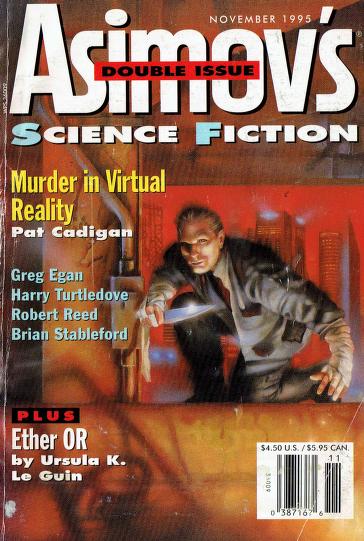
First published online in the March 1995 issue of Omni Online, which I don’t think you can even access with the Wayback Machine. The first physical appearance of “Death in the Promised Land” was the November 1995 issue of Asimov’s Science Fiction. It was reprinted in The Year’s Best Science Fiction: Thirteenth Annual Collection (ed. Gardner Dozois) and The Mammoth Book of Extreme Science Fiction (ed. Mike Ashley).
Enhancing Image
Artificial Reality is, for a lot of people, even better than the real thing—to the point where what happens in AR can feel totally real, both the good and the bad. Dore Konstantin’s most recent case puts this whole idea to the test, as a teen boy has been murdered, both in AR and, seemingly at the same time, in real life. The kid’s had his throat slashed, a death made stranger because his “persona” in AR suffered the same fate. The persona’s name is Shantih Love while the kid’s name is Tomoyuki Iguchi, although that can’t be his “real” name since the kid is not Japanese. I don’t think we ever find out his “real” name, not that it matters too much. It’s an unusual case: you have a kid with two fake names, one of which is copyrighted and which the killer seemed to have hijacked—a mask to be worn in AR. This is the eighth such case of someone being murdered while in AR in as many months, and yet the law has not been able to connect these killings to each other. Konstantin really has her work cut out for her, despite having been a detective for a dozen years at this point. She also basically has no experience using AR herself, which I have to admit is a point that does strain my suspension of disbelief a bit. How is it possible for her to have so much experience while a) still being squeamish about blood, and b) still being a “virgin” who doesn’t know the rules of AR? But I’m getting slightly sidetracked.
We don’t get to know a great deal about life outside of AR, but what we do learn implies the real world has really gone to shit, which tracks for cyberpunk. Konstantin herself barely seems to be getting by on her salary, having until recently shared a little hole in the ground with her partner, now called her ex. Actually we’re gonna be reminded, incessantly, that Konstantin is going through a recent breakup, to the point where she’ll be mentioning her ex on almost every single page of this novella. Having gone through a serious breakup a couple months ago myself, I can confirm that at least this part of her character is quite believable. She also does some classic detective work, like watching surveillance footage of Shantih Love’s final moments in AR and interviewing a few people who work at the building that holds this AR cubicle—people who, for the most part, would rather not talk to her much. Something they don’t tell you that’s a quintessential part of the detective experience (at least in fiction, but probably also in real life) is being sort of a public nuisance. The coroner and the cops on the scene are also not a great deal of help, not that there’s too much that can be said for the kid. He apparently has his throat slashed with some kind of knife, and also, much more strangely, he’s apparently married. He got killed just ten minutes into what was supposed to be a 260-minute session (Konstantin remarks that just being in AR for that long, over four years, would be unhealthy on its own) and nobody knows who did it.
“Death in the Promised Land” is a product of its time when it comes to how it deals with the possibilities of VR (inexplicably called AR here), and in a way it feels outdated even for 1995. Characters have this preoccupation with Japanese culture, to the point where “turning Japanese” is a phenomenon (see again the kid taking on a Japanese name), which would raise an eyebrow but not be unexpected had this story been published a decade earlier. Japan being treated as an economic and cultural power on par with the US is a pretty old cyberpunk trope, indeed being part of the package almost from the movement’s inception; but by this point, in 1995, the bubble had burst and Japan was no longer on top of the world. Why Cadigan decided to use this trope and take it at face value several years after its possibility in the real world came to look remote, I’m not sure. Granted, Japanese pop culture has left an irremovable mark on America well up to [the current year], since anime and manga are big cash cows here, but you don’t see white people cruising around dressed in kimonos in public. But then again, writing speculative fiction means speculating on the future, and speculating on such a thing means nine times out of ten you’ll be wrong. Still, the story’s attitude toward race and cultural appropriation is a bit strange. This is not helped by there, at least to my recollection, not being a single Japanese character past maybe a mention as part of the backstory. This issue seems to have been rectified for the novel version.
The novella can be basically split into two parts, those being the setup, which takes place in the real world, and the payoff, which takes place in AR, in a simulated world called post-apocalyptic New York City. Sorry, “Noo Yawk Sitty.” Her only hint to finding the killer lies in someone named Bodi Sativa (Get it? Like Bodhisattva?), or rather that’s the persona’s name. Bodi Sativa has a reputation in post-apocalyptic Noo Yawk Sitty as a kind of religious figure, which should be obvious given her name. Religion comes up, rather unsubtly, before we’ve even started reading the novella—just look at that title. But while Cadigan makes allusions to Buddhist and Abrahamic practices, it’s not something you’re rewarded for much if you choose to linger on it. Rather, the allusions are a means to an end, the end having to do with the blurry line between reality and simulation. Even for 1995 it’s not a new theme for cyberpunk, and even Cadigan had explored this theme more strikingly in the past. To be fair, though, in a vacuum it’s effective enough. Konstantin throws herself into the world of AR, specifically Noo Yaw Sitty, a shared hub world for people who wear headsets and so-called hotsuits (often simply called ‘suits), these ‘suits allowing them to better immerse themselves in the virtual world. There’s the line between your real body and your virtual body, and then there’s the line between your real-life persona and your virtual persona. We would now call these personae avatars, and like in modern video games these personae are things you can buy and own—unless you happen to get hijacked in AR, or if you died.
There Be Spoilers Here
The way Cadigan goes about solving the mystery at the heart of this story is a little anticlimactic, maybe by design. Combining the detective narrative with SF has presented an age-old problem and with many authors over the decades coming up with solutions to said problem. How do you write a compelling mystery in, for instance, a world where surveillance is practically omnipresent and the detective has a theoretically infinite number of tools at their disposal? What would be the mindset of the consummate criminal in such a world? In the case of “Death in the Promised Land” the solution is to throw the detective into a world whose rules are foreign to her and where the killer can be hiding in plain sight. The results are mixed. I assume this is not the case with Tea from an Empty Cup, but Noo Yawk Sitty feels a bit underdeveloped. We’re introduced to things like icons, which are basically equippable NPCs, but only have a faint idea of what an icon does. We barely get perspectives from other people Konstantin interacts with while in AR; instead she spends much of the time talking to guides, who like icons are not people but part of the program. Indeed, Konstantin spends a lot of time having stuff explained to her, which isn’t a bad thing in itself, but I was hoping for more action in the back end of the story. I came away feeling like I was reading the work of a very capable writer (as I know Cadigan is), but that the story wasn’t firing on all cylinders.
A Step Farther Out
This feels like minor Cadigan, if only because it covers similar ground to earlier cyberpunk work of hers while lacking the intensity of a masterpiece like “Pretty Boy Crossover.” I read the whole thing across two sessions, and while I would say it’s an easy enough read, I couldn’t help but feel that the pacing was uneven (we don’t spend that much time in AR) and that there’s some questionable character logic whose rationale is unclear. There are some questions regarding backstory that get left unanswered, although maybe this is not the case with the novel. Konstantin herself is weirdly timid and gullible for someone with her level of experience, not to mention her fixation on her ex as a major point with her characterization that never gets resolved. But still, it’s a decent time.
See you next time.

