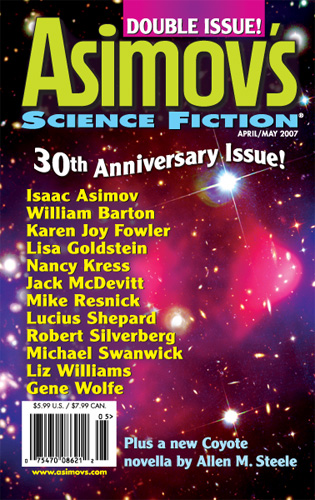
March was a bit of a marathon here at SFF Remembrance, but truth be told I had more fun writing about that very old and dusty science fiction than in the past few months. I had been suffering from fatigue, along with some real-life stuff that was getting to me and making it hard to sleep at night. Now I feel somewhat rejuvinated. I feel good enough about reviewing stuff here again, in fact, that I’m bringing back the two-short-stories two-novellas deal, although I’m still keeping it to one serial for the month. The serial in question is a three-parter, being the first appearance of one of the most important SF novels ever written—and yet one that has been totally lost to the sands of time. You might find references to The Skylark of Space if you’re a Star Wars fan, as a point of trivia, since it was this novel that in part invented the space opera subgenre. Edmond Hamilton was writing space opera at shorter lengths around the same time Smith made his debut, but there was nothing on the scale of Smith’s novel before it. Smith “revised” it for its eventual book publication, removing co-author Le Hawkins Garby’s contributions, but we’ll be reading it as it appeared in Amazing Stories. This was a long time coming for me.
For the dates of stories, we’re looking at one from the 1920s, two from the 1950s, one from the 1960s, and one from the 1990s. Both of the stories from the ’50s are from the first half of that decade, which was an incredibly productive period for magazine SF.
For the serial:
The Skylark of Space by E. E. Smith and Lee Hawkins Garby. Serialized in Amazing Stories, August to October 1928. When Smith studied chemistry at the University of Iowa, he didn’t think he would later become one of the pioneering authors of space opera. He didn’t even think he would write fiction, until he talked science fiction with Lee Hawkins Garby and her husband, who were friends from college. This was in 1915, before “science fiction” had even been coined as a label. The Skylark of Space took some years to gestate, but when it appeared in 1928 it made Smith a sensation among the then-niche SF readership. Garby’s contributions were later removed when the novel appeared belatedly in book form.
For the novellas:
“Half-Past Eternity” by John D. MacDonald. From the July 1950 issue of Super Science Stories. Fans of classic crime fiction will be familiar with MacDonald, at least by reputation. His Travis McGee series is one of the most prolific and widely read detective series ever. In 1972 he was given the Grand Master Award by the Mystery Writers of America. He also wrote a good deal of SF from the late ’40s through the early ’50s, along with nearly every other genre.
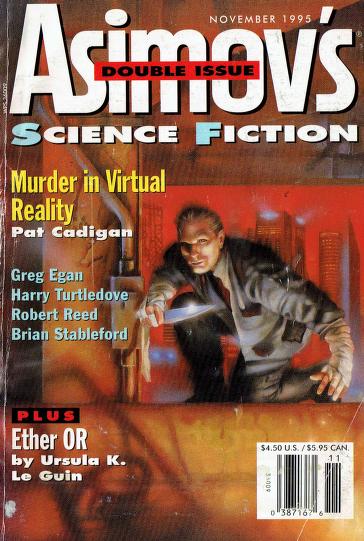
“Death in the Promised Land” by Pat Cadigan. From the November 1995 issue of Asimov’s Science Fiction. It was first published in the March 1995 issue of Omni, but that magazine had gone purely online by that point and the Asimov’s printing marked its first physical appearance. Cadigan is arguably the queen of cyberpunk, going back to the ’80s. She’s not as famous as William Gibson or Bruce Sterling, but she really should be more read than she is.
For the short stories:
“Dumb Martian” by John Wyndham. From the July 1952 issue of Galaxy Science Fiction. It’s surprising to think that Wyndham had made his SF debut in the early ’30s. His career peak came later than it does with most authors, since he was deep in his forties when The Day of the Triffids was published. The ’50s were a great time to be John Wyndham, between his novels and short stories.
“Timberline” by Brian W. Aldiss. From the September 1961 issue of The Magazine of Fantasy and Science Fiction. This is the fourth installment in Aldiss’s Hothouse series, which was then published as a novel. The series of stories, rather than the novel version, won Aldiss a Hugo, which was certainly a confusing move. It’s been almost a year since I reviewed the last Hothouse story, so here we go.
Kage Baker would no doubt still be writing and garnering acclaim today, had she not died of cancer back in 2010. She was born in 1952 and grew up in Hollywood, so it makes sense that the world of acting, both on stage and in the movies, would interest her. She spent the last year of her life trying (and sadly failing) to finish a novel while also watching and writing reviews for a lot of films from the silent era. We even got a book of these reviews published after Baker’s death, Ancient Rockets: Treasures and Trainwrecks of the Silent Screen. As for writing genre fiction, Baker came to it rather late in life, when she was in her forties (this is a lesson that it’s not too late to try your hand at pursuing such a career), but she hit the ground running with a ton of short stories, novellas, and novels. For the dozen or so years that she spent as a writer, she worked on a few series, most prolifically (it was probably her favorite) the episodic series about The Company, a far-future league of time-traveling cyborgs. In this series there is history as we know it, and then there’s a second history, a secret history, in which these time-traveling agents meddle, and this is where the fun happens. “Welcome to Olympus, Mr. Hearst” is an entertaining, if also slight, tale of mystery and old Hollywood intrigue, involving one of the more infamous American figures from the early 20th century: William Randolph Hearst.
Placing Coordinates
First published in the October-November 2003 issue of Asimov’s Science Fiction. It’s since been reprinted in The Year’s Best Science Fiction: Twenty-First Annual Collection (ed. Gardner Dozois) and the Baker collections Gods and Pawns and The Best of Kage Baker.
Enhancing Image
We start in the year 1926, on the set of a real movie called The Son of the Sheik (it’s the sequel to The Sheik, go figure), with Rudolph Valentino. We’re told this scene from the viewpoint of Lewis, who is Valentino’s stunt double for the film, although he’s actually an 800-year-old cyborg working for The Company. Lewis asks Valentino for his autograph and somehow pulls out a copy of the shooting script for the film, which Valentino signs. Baker doesn’t tell us the significance of this interaction right away, but the autographed script copy will become a McGuffin for later in the novella. Valentino will, of course, die tragically in a number of weeks, The Son of the Sheik being his final role, while Lewis will live—well, who knows how many more years or decades? Lewis is an “immortal,” which does not literally mean he will live forever (he will surely die at some point), but that he lives an astoundingly long amount of time, being immune to the usual natural causes. Old age, hunger, and disease are not concerns of his. The same goes for Joseph, fellow “immortal” and narrator of this story. Joseph only makes us aware of his presence at the very end of the prologue, but he’s gonna be the protagonist from here on out. The main action sees us jumping from 1926 to 1933, which sees a radical change having come over Hollywood and America at large. The Great Depression has hit the country, talkies have completely supplanted the silent pictures, Prohibition has ended, and Rudolph Valentino has been dead for some years now.
Ah, but William Randolph Hearst is still alive! Born in 1863, Hearst grew up to become the head of a media empire which continues to this day, in large part helped by his father George being a politician and gold-miner. (It’s said that money doesn’t grow on trees, and similarly that wealth typically must come from somewhere.) Hearst is partly responsible (for better or worse) for journalism as we now understand it. For Hearst there is objectively true news, and then there’s news which strikes the reader or viewer as true, even if it’s not based in reality. Indeed we can thank William Randolph Hearst for the concept of “fake news,” even if the phrase had not been coined yet in his lifetime. In the world of Baker’s story, Hearst had just turned seventy, and for being an old man (especially for the time) he was still spritely—with a sort of fiendish cunning. This is a fact that really should’ve been on Joseph’s mind as he and Lewis stay at Hearst’s famous mansion, under the pretense of having been recommended to Hearst by George Bernard Shaw. Joseph and Lewis are very old (Joseph being over 2,000 years old, in fact), but appear and even seem to think like young men. These are not people whose minds have been profoundly wearied by the passing of centuries, having experienced first-hand the ups and downs of multiple civilizations, which implies that there might be a ceiling for mental maturity. Of course, you and I know that old people, in the real world, have a funny tendency to act and think in childish ways, as if their minds had, at some point, boomeranged back into the stubbornness and shortsightedness associated with adolescence. Hearst himself is not quite an exception to this.
So, what’s the plan? The idea if twofold, firstly that Joseph is to make a deal with Hearst about his estate being used as a safe haven for certain precious artifacts, which are to be “discovered” a few centuries hence. In particular there’s the question of a copy of the script for The Son of the Sheik, signed by Valentino himself, which the Hearst estate is supposed to guard for safe keeping, so that it may be eventually sold at auction for an insane amount of money. Time, according to the immortals, is something which cannot be defied; once something has happened, it can’t be undone. The signed script must be found in the Hearst estate at such a time, and Hearst himself must die in 1951, at the impressive old age of 88. The problem, naturally, is that for someone like Hearst “just” living to an old age is not enough: he wants what the immortals have. It’s a damned-if-you-do-damned-if-you-don’t situation, because in order to convince Hearst of the immortals’ plan, they have to let him in on at least some of the truth (but not all of it) as to why they’re at his mansion. Mind you that this is like if time-traveling agents went to that bald fuck Jeff Bezos to do some business for them. If there’s a theme in “Welcome to Olympus, Mr. Hearst” it’s the malleability and to some extent the unknowability of “the truth.” What is the difference between what really happened and what appears to have happened? This is an appropriate theme to explore using one of the most infamous figures in the history of journalism, although I don’t think Baker explores it as well as she could’ve. It could’ve worked well as a short story or a novelette, but this is a novella, which means there’s some fat.
There are a few supporting characters, at least some of whom are real people from history, such as Marion Davies, Hearst’s mistress. There’s also Greta Garbo, although if I recall correctly (and in keeping with her reputation) we never get even a line of dialogue from here. We even get a cameo from Clark Gable, one year away from starring in It Happened One Night. There’s Constance Talmadge, who had played “the Mountain Girl in Intolerance.” But the most important player here is Cartimandua Bryce, who seems to be a character Baker invented—her and her two fucking dogs, named Conqueror Worm (yeah) and Tcho-Tcho. Mrs. Bryce is a very superstitious and gossipy woman, and also a fascist sympathizer, complimenting Hitler and Mussolini while calling FDR “a young soul, blundering perhaps as it finds its way.” She is not a good person. She also throws a wrench into Joseph and Lewis’s plan and pads out the story’s length a fair deal. Said plan goes amiss when the Valentino-signed script goes missing, despite presumably nobody else at the party knowing about it. There’s also the issue of Joseph having to lie to Hearst about the possibility of becoming an immortal in order to placate him, although he does tell a lot more of the truth about the Company than people of the past are meant to know. It’s true, for one, that while the Company does have many agents, it’s still not omniscient with regards to history: there are little pockets (you might call them dead zones) in history as we know it where there’s flexibility as to what can happen. History as a whole is predestined, but there are exceptions. William Randolph Hearst, in this particular way, may be an exception.
There Be Spoilers Here
The mystery regarding the Valentino script basically resolves itself, which is anti-climactic, as if the story turns into a mystery (we even get shoutouts to Agatha Christie and Dashiell Hammett) and then quickly gets bored with it because it’s pretty obvious right away who the culprit is. Mrs. Bryce is, like I said, a huge gossip and much interested in scandalous material. While she doesn’t receive so much as a slap on the wrist for her misdeed, she does lose one of the dogs, which gets a fatal taste of Joseph’s boot (in fairness, Joseph was acting in self-defense). Our Heroes™ conspire to make the dog’s death look like it had died of natural causes, with Mrs. Bryce ultimately buys. Things are tied up neatly on that front—maybe too neatly. The thread regarding Hearst himself is more intriguing and does take advantage of the SFnal premise, but it’s also a lot messier. Unbeknownst to everyone except for Joseph when he makes the discovery, a secret that know even Hearst is aware of, the old man is a genetic anomaly. Joseph had been bullshitting Hearst about becoming an immortal, with a mixture of half-truths and outright lies, but in a kind of self-fulfilling prophecy this deal becomes true, quite unwittingly on Joseph’s part. The ramifications of Hearst not only being exposed to how news is conveyed to the masses in the far future but actually living to witness that point in time are… a bit ominous. The mission is a success, but maybe it should’ve failed.
A Step Farther Out
This story appeals to me to an extent, since like Baker I’m a film buff, although I don’t know that much about the pre-Hays Code years. I’ve never seen a Rudolph Valentino movie, although I do know enough about his story (Valentino was one of Hollywood’s first major tragedies) to get the importannce of what Baker does here. My major issue, aside from the length and uneven pacing, is that Baker can’t quite decide how seriously she wants to treat this material. There’s some comic relief, but the point that Baker wants to make about people like Hearst is very serious. I wouldn’t call it satirical, because it doesn’t go that far, but it does rag on a fact about journalism which, sadly, remains true. On a final note, I do appreciate that Baker sets the action at a point in time where she doesn’t feel tempted to reference the Citizen Kane controversy. If you’re a film buff (and certainly Baker knew about it) then you probably know about Hearst’s relationship with that movie.
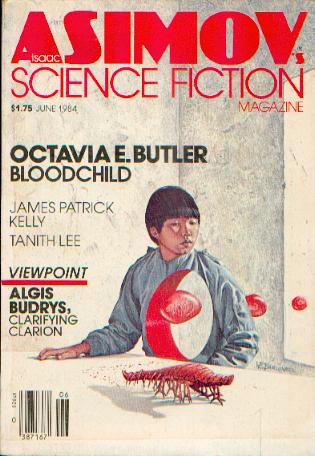
Some authors see their reputations wither after death, and indeed this is more often than not the case; but there are also authors who have the good fortune to receive a second wind posthumously. Octavia E. Butler was a pretty well-respected writer in her lifetime, but in the years since her untimely death in 2006 she has become one of the select few from the old school to be both widely read and respected among the modern SF readership. This is despite Butler not having written a great deal over the course of her life, going from fairly productive in the ’70s and ’80s to only writing two novels in the ’90s, and then finally just one in the 2000s. She also only wrote little more than half a dozen short stories, just enough to fill a single collection, Bloodchild and Other Stories, which is also padded out with an afterword for each story and a few essays. While Butler wrote very little short fiction, though, she won back-to-back Hugos for it, with “Bloodchild” itself winning her that second Hugo, plus a Nebula. “Bloodchild” is one of the most acclaimed and famous (or infamous) of all “modern” SF stories, being Cronenberg-esque body horror while also being surprisingly melancholy. It is Butler’s “pregnant man” story.
Placing Coordinates
First published in the June 1984 issue of Asimov’s Science Fiction. It’s been reprinted in The Year’s Best Science Fiction, Second Annual Collection (ed. Gardner Dozois), Best Science Fiction of the Year 14 (ed. Terry Carr), The New Hugo Winners (ed. Isaac Asimov and Martin H. Greenberg), Foundations of Fear (ed. David G. Hartwell), The Weird: A Compendium of Strange and Dark Stories (ed. Ann and Jeff VanderMeer), The Big Book of Science Fiction (ed. Ann and Jeff VanderMeer), and of course the Butler collection Bloodchild and Other Stories. Really it’s hard to not have at least one copy of this story on hand if you’re a serious SF reader.
Enhancing Image
I said before that “Bloodchild” is a “pregnant man” story (there were more of those being written back then than you would think), but it’s also a coming-of-age story, about Gan, our narrator, recalling a moment in his life that made him cross the shadow-line from adolescence to adulthood. This is a story about the loss of one’s innocence, which means it’s also about trauma. Gan and the rest of his family are Terran settlers who have come to a planet already host to at least one intelligent race, and now they’re stuck on “the Preserve,” with T’Gatoi, an elder of said intelligent race, being their local symapthizer. The Tlic, a somewhat mammalian but also insectoid (they have more than two arms and lay eggs) race, are the ones in control here. Historically, on Earth, there’s a nasty tendency for the colonizing force to overwhelm and then assimilate the indigenous populace, but this is not always so; in her afterword, Butler explains that she modeled the relations between the Terrans and Tlic off British colonialism in India. The humans here are thoroughly outnumbered and outmatched by their alien hosts, and unlike their real-world counterparts it seems like the Tlic can easily kill or drive out the settlers any day if they wanted to. The two parties thus have reached an agreement wherein the settlers are allowed a swath of land while also serving a specific use for the aliens.
The Tlic are some of the more interesting aliens in SF, in that they meet John W. Campbell’s criteria for an intelligent alien that could think as well as a human but not quite like a human. They’re big, at least as big as adult humans, and live considerably longer, with the nutrients from sterile eggs apparently contributing to slowed aging. They also have no issue with slavery, since they buy and sell Terrans, and back in the day they even split up Terran families for this purpose. (Does this remind you of anything?) They and the Terrans are biologically compatible enough that the latter can serve as hosts for Tlic eggs, which… more on that in a second. In her afterword Butler writes that she had taken inspiration for the Tlic when she was doing research for what eventually became her Xenogenesis trilogy. She looked into the workings of the botfly, which as you might know already is a bug found in the Amazon that lays its eggs in living hosts. The larvae, once ready, break out of the host’s skin, which for humans is a gross but by no means fatal business—unless there’s an infection. The Tlic similarly lay their eggs in living hosts, except it’s much worse here, since whatever has the misfortune of carrying Tlic eggs will die in gory fashion when those eggs hatch. The one gripe I have with how Butler conceived her aliens is that while they’re based on the botfly, it’s not a 1:1 comparison, and there are a few unanswered questions. The botfly is an insect, only yay big, and only lives for a few days, while the Tlic are the size of humans, and live for several decades at a time as opposed to days. How such a species would survive without completely ravaging the ecosystem, I’m not sure.
(Of course, given that humans have been ravaging Earth’s ecosystems for decades, it’s possible that our own species will not survive in the long run, or that much of life on Earth will die before us.)
In a sense the Tlic reflect a certain type of human endeavor, while the human settlers are put in the place of put-upon immigrants or enslaved peoples. Butler looks at the minority of whites living in British India, or indeed South Africa, and wonders what would happen if the tables were turned and the white minority were to be subject to the “colonized” populace’s whims. This is oversimplifying things a great deal, but it does make you wonder how it is that Dutch and British whites could make up not even 10% of South Africa’s population, yet to this day own the vast majority of the land there. Typically a minority demographic is beholden to the whims and prejudices of the majority, hence, despite some progress being made, nearly 30% of the population in the US being beholden to the 72% that’s white. So Gan, despite being part of a colonizing force, is not the one in control. In fact he is next in line in his family for carrying a nice batch of eggs, which makes today’s “delivery” quite the learning experience. Bram Lomas, an adult man, has been made pregnant with Tlic eggs, and the operation to get them out of him before they can kill him is most unpleasant. The delivery, which takes up the middle portion of “Bloodchild,” is undoubtedly the most memorable part, being pretty graphic but also serving a purpose in Gan’s character arc. I’m not gonna quote a whole passage from this section of the story, because I don’t hate you that much, but it’s a lot. It’s also worth mentioning that while a more conventional story might have the delivery as the big climax, Butler makes it so that it’s over and done with by the time we’re in the last third. After all, the delivery is not the point of the whole thing, but rather how the experience sparks an epiphany for Gan.
There Be Spoilers Here
The way this works is that delivering larvae for a human might be fatal if there’s a surrogate willing to take the fall. Doesn’t necessarily have to be a live body to receive the larvae. T’Gatoi gives Gan the thankless job of having to go out and kill one of the livestock, one that must be of suitable size, although he’s never done such a thing before and taking a knife to one of the “achti” (some native animal) would be risky. He opts to take a different kind of risk and gets out the gun that’s been hidden in the family home. Guns were outlawed among the settlers decades ago, but as with real-world countries with strict gun laws, one occasionally does find itself inside. After killing the achti and witnessing the finale of the delivery, Gan is understandably shaken by the whole thing, especially since he’s due to go through the same ordeal himself in the future. The final scene is a confrontation between Gan and T’Gatoi in which the former threatens to kill himself, in order to force his sister to be the one in the family to “give birth.” Ultimately he changes his mind and decides to take up the responsibility, but we’re not sure if his pregnancy has already happened by the time he’s relating this story to us or if it’s still off in the future. It’s a rather abrupt ending, which I’m not sure is exactly a negative criticism, but it kinda took me off-guard to have suddenly reached the end on this rereading. This is a setting you could certainly build a whole novel out of, but Butler is content to keep is contained within a single short story.
A Step Farther Out
Sometimes when I read something for this site, I groan with the realization that I won’t have much to write about, usually when it’s something that’s middle-of-the-road. (Unfortunately there is a lot of middle-of-the-road fiction in the SFF magazines, probably way more even than straight-up bad fiction.) On the one hand, “Bloodchild” is a reread for me, but my memory of it was pretty dim; at the same time I knew going in that there would be quite a bit to talk about, but then this is often the case with Butler. It’s not a personal favorite of mine, because it is, by design, a pretty unpleasant read, but it’s a very well-constructed story. I wish Butler wrote more short fiction, but I’m also not surprised that she didn’t.
There’s something about October that brings a change in me. It could be that autumn has now unambiguously started, as opposed to just going by the autumnal equinox. The weather is now colder and dryer. My hands and nose are getting dry, the latter occasionally resulting in a nosebleed. I now feel like I can put on a hoodie and jog around the city. The trees will start being stripped of their leaves. Overall it’s a time of changes, mostly for the better. October is also the month of Halloween, which is far and away my favorite holiday, to the point where it might the only one I really get festive about. Now is the time for watching horror movies, from the classices to some grade-A schlock. Time to catch up on some horror reads I’ve accumulated on my shelf. Time for pumpkin spice lattes, if you’re into that. In other words, this is for me what Christmastime is for some people—mind you that I tend to get depressed around Christmas.
For this month we’re back to reviews at regular intervals, all short stories, all featuring thrills, chills, and assorted horrors. For the first time in a while I’m actually excited with what I’m gonna be writing about. Hopefully you’ll be joining me in reading at least a few of these.
We have one story from the 1940s, three from the ’50s, three from the ’80s, one from the ’90s, and one from the 2020s.
For the short stories:
“The Hungry House” by Robert Bloch. From the April 1951 issue of Imagination. Bloch was correspondents with H. P. Lovecraft when the former was still in high school, and this friendship had an apparent influence on Bloch’s early fiction. While he’s most famous for writing Psycho, which is non-supernatural horror, most of Bloch’s work involves ghouls, cosmic horrors, and whatnot.
“Rabbit Test” by Samantha Mills. From the November-December 2022 issue of Uncanny Magazine. Winner of the Hugo, Nebula, and Theodore Sturgeon Memorial Award, being only the third story ever to win all three. Mills debuted in 2016, with her debut novel published in 2024. “Rabbit Test” was the last of a streak of short stories, as Mills stopped writing short fiction for three years.
“Punishment Without Crime” by Ray Bradbury. From the March 1950 issue of Other Worlds Science Fiction. Being one of the most famous American authors ever, it can be easy to forget that Bradbury started writing for the genre magazines, not all of them being of the first rate. He also wrote so much horror early in his career that only a fraction of it appeared in The October Country.
“Lost Memory” by Peter Phillips. From the May 1952 issue of Galaxy Science Fiction. I had ever heard of Peter Phillips before, which might be because he was only active for a short time, from about 1948 to 1958. He stopped writing SF for reasons I’m not sure of. He was also British, at a time when there weren’t too many active in the field, even appearing in the inaugural issue of New Worlds.
“Yellowjacket Summer” by Robert McCammon. From the October 1986 issue of Twilight Zone Magazine. McCammon made his debut in 1978, but it took him a bit to come to the forefront of contemporary horror fiction. His massive post-apocalyptic novel Swan Song tied for the inaugural Stoker for Best Novel. Disillusionment with the industry made him step away from writing for a decade.
“Bloodchild” by Octavia E. Butler. From the June 1984 issue of Asimov’s Science Fiction. Winner of the Hugo and Nebula for Best Novelette. This is a reread for me, but I’ve been meaning to return to it for a close read for a minute. Butler wrote only maybe a dozen short stories, but they’ve received a disproportinate amount of praise, with her winning Hugos for short fiction twice consecutively.
“Reckoning” by Kathe Koja. From the July 1990 issue of The Magazine of Fantasy and Science Fiction. Koja debuted in the late ’80s with a pretty strong string of short stories before her debut novel, The Cipher, hit stores in 1991. She was a formiddable horror talent in the ’90s, but in the 2000s onward took to writing novels aimed at young readers, and she hasn’t written much generally lately.
“Day of Judgment” by Edmond Hamilton. From the September 1946 issue of Weird Tales. While he’s most known as a pioneer of space opera, as well as his Captain Future series, Hamilton appeared frequently in Weird Tales from the beginning of his career, sometimes with SF but also sometimes with fantasy and horror. He was an old-school pulp writer in that he wrote for basically any market.
“The Pear-Shaped Man” by George R. R. Martin. From the October 1987 issue of Omni. Winner of the Stoker for Best Long Fiction. Martin is a case where a series (A Song of Ice and Fire) of his is so famous that it overshadows the rest of his work, which mind you is considerable. Martin’s gone on record as thinking of himself as instincively a horror writer, a fact which is on display here.
We have pretty much an all-star cast of authors here, so I hope this will help my recent writing slump. Of course, the most important thing is that we have fun with this. Happy Halloween.
Joan D. Vinge was one of the more acclaimed SF writers in the latter half of the ’70s through the ’80s, which makes her retreat from public notice all the more conspicuous. She debuted in 1974 and was one of the post-New Wave crowd, alongside the likes of George R. R. Martin and John Varley. As you can guess, she was also married to Vernor Vinge for much of the ’70s, although they split in 1979, which didn’t stop Joan from ditching Vinge’s last name for her byline going forward. She won a Hugo for the borderline metafictional story “Eyes of Amber,” and she won another Hugo for her second novel, The Snow Queen. After the ’80s her output went down massively, to the point where she disappeared for nearly all of the 2000s. One reason for this is that she suffered a car accident in 2002 that left her unable to write for some years, although that doesn’t explain her relative inactivity in the ’90s as well. She has also, weirdly enough, written about as many novelizations as original novels at this point, including novelizations of (I’m not kidding) Return of the Jedi, Willow, Return to Oz, Cowboys & Aliens, and the ’90s Lost in Space movie. She had written virtually no short fiction since 1990, which makes “The Storm King” one of her later stories, published the same year as The Snow Queen. Unlike most of Vinge’s work, “The Storm King” is fantasy, although it retains Vinge’s propensity for incorporating fairy tale elements.
Placing Coordinates
First published in the April 1980 issue of Asimov’s Science Fiction. It’s been reprinted in Isaac Asimov’s Wonders of the World (ed. Shawna McCarthy and Kathleen Moloney), A Dragon-Lover’s Treasury of the Fantastic (ed. Margaret Weis), and the Vinge collection Phoenix in the Ashes.
Enhancing Image
This will be a short and sweet review, because despite being nearly thirty magazine pages I don’t have much to say about “The Storm King.” I think it’s interesting to point out first that this really is a high fantasy story published in Asimov’s, early in the magazine’s history when such a thing was rare. Granted, Roger Zelazny’s “Unicorn Variation” was published there a year later and was just as much a fantasy story, and even won a Hugo for it. The market for short fantasy fiction, barring a brief period in the 1930s and more so the last decade or so, has never been that good. 1980 saw the death of Fantastic, so that F&SF was the only magazine in town that published a good deal of short fantasy. But Asimov’s, even in its first years, occasionally printed fantasy, and the results tended to be rewarding. I liked “The Storm King” enough, although I didn’t love it.
Lassan-din has a problem—actually he has two problems, but we’ll get to the second one in a minute. He is the heir apparent to the throne in Kwansai, but he’s a prince in exile and he’s willing to do anything to take back what is “rightfully” his, even to go against his homeland’s predominent religion by consulting an old witch. The witch in question and her servant girl, the latter calling herself Nothing, are pagans who work with the elements of Nature. There’s also a dragon who lords over this area called the Storm King, who like your typical Tolkien-esque dragon is an intelligent being who communicates with humans telepathically. Lassan-din wants to tame the Storm King and use its power to retake the throne, but as the witch says, “You don’t fight fire with fire. You fight fire with water.” The witch gives the prince a hint as to how to deal with the dragon and sends Nothing with him, but as she also says, as a kind of warning, “power always has a price.” Nothing will repeat this phrase verbatim much later, which of course means that we’re meant to take it as the story’s thesis. And indeed it is. It becomes clear quite early on that Vinge’s story is a fable about how power corrupts, to the point where it feels a little condescending and wearying; that the plot trajectory goes pretty much exactly the way I expected, going off of the thesis Vinge gives us, also means there’s not much surprising in store for us. Since “The Storm King” doesn’t have any real twists or turns, that forces us to turn to other things in looking for the story’s merits.
In all fairness. while this kind of high fantasy is commonplace now, such that I have precious little interest in modern fantasy writing, it would’ve been more novel in 1980, right after the sword-and-sorcery revival and right before we started getting the super-chunky multi-book sagas that have since dominated the genre. “The Storm King,” for better or worse, would’ve fit right in with short fantasy being published nowadays. There is, of course, also a sexual element, with Nothing being implied to be a prostitute as well as a witch’s apprentice; and while her relationship with Lassan-din never turns romantic exactly, it does get rather steamy. The problem on Lassan-din’s end is that he had suffered some unspecified abuse from his uncle, which has left him impotent, although Vinge is unclear as to what exactly is wrong with him. I thought at first that Lassan-din genitals must’ve gotten damaged, but this turns out not to be the case. There’s an obvious symbolic connection between Lassan-din’s impotence and his having fallen from the throne. Well, the damage can’t be that bad, for Lassan-din and Nothing have sex, and there’s a little something extra thrown into the deal that the former is not made aware of. (You can guess what it is.) The two proceed on their quest, which sees Our Anti-Hero™ finally meet the Storm King himself, and another deal is made. Lassan-din inherits the Storm King’s scales and his control of lightning, but obviously there wouldn’t be much of a story if things ended here.
There Be Spoilers Here
Lassan-din retakes the throne, but he doesn’t become respected so much as feared among his people, not to mention the dragon is still free to terrorize the populace. Lassan-din’s reign becomes so maligned that he too becomes known as the Storm King, by which point he realizes he might’ve made a mistake. He’s unable to reverse the deal he had made with the dragon, being unable to rid himself of those scales; even if the dragon wanted to, he could not undo what has been done. He comes to the conclusion that if he can’t save himself then he can at least save everybody else, so he decides to banish the Storm King from the land. We get what is more or less a happy ending. Hell, there’s even a baby in the mix, with Nothing (now named Fallatha) having a daughter by him. This all reeks a bit of wish fulfillment, at least from a modern perspective. This is a story about how power corrupts, and yet the one whose character is poisoned by power still has enough of a conscience to do the right thing at the end of the day, never mind retaining some of his humanity. Lassan-din is an anti-hero who would be a villain in some other stories, depending on the perspective one writes from, and while this is a nice arc for a character to have, it doesn’t feel real at all. Unfortunately, in real life, someone in Lassan-din’s position is unlikely to have any redeeming qualities of note, nor are they likely to suffer at all from the pain and oppression they bring on other people. “The Storm King” is fantasy due to its setting, but it’s also fantasy because it depicts someone with immense power actually facing consequences for their actions.
A Step Farther Out
Sorry for the delay. Depression and a bit of writer’s block. I was honestly stumped for a bit as to what my thoughts on this story even were, maybe because I tried thinking back on something I had perhaps missed, only to think I really had gotten everything on my initial reading and that I didn’t need to put much thought into it. Maybe not the first Joan D. Vinge story I should’ve written about her first, since in a way it’s an outlier among her short fiction, but it’s also one of her short stories that I’d not read yet that I really wanted to check out. I was mildly disappointed, if only because I expected there to be more to it, but Vinge is not a bad writer. Hell, at this point she was a better writer than her ex-husband. It’s just that “The Storm King” doesn’t show Vinge at her best.
(Cover by Hisaki Yasuda. Asimov’s, February 1990.)
Who Goes There?
Pat Cadigan is one of the most important writers behind the cyberpunk movement in the ’80s and early ’90s, although she doesn’t come up in conversation nearly as often as William Gibson or Bruce Sterling, probably because she’s more adept at short lengths than as a novelist. She actually made her debut a good bit before her rise to prominence in the ’80s, being an editor for one issue of the sword-and-sorcery magazine Chacal, as well as the SFF magazine Shayol. Speaking of Gibson, one strange way the two have crossed paths is that Cadigan wrote a novelization of Alien 3—not the film or the film’s script, but Gibson’s script which had gone unused, in the midst of that movie’s notoriously troubled production. She has written several film novelizations over the years, including, of all things, a novelization of Jason X. But it’s her association with cyberpunk that has secured her legacy. She even edited one of the better anthologies focused on the movement, The Ultimate Cyberpunk. “Fool to Believe” itself would serve as the germ for Cadigan’s 1992 novel Fools, although she had written the former first with the initial intent of it being a standalone story.
Placing Coordinates
First published in the February 1990 issue of Asimov’s Science Fiction. “Fool to Believe” has never appeared in book form, possibly because Fools has rendered it obsolete; unfortunately Fools itself is very much out of print, so neither is all that accessible.
Enhancing Image
Sorry for the wait, but I decided to take a bit of a mini-vacation from working on this site. I was feeling burnt out a little, although I have to admit it doesn’t help that “Fool to Believe” is a vast and nigh-indecipherable story which uses its length to good effect. It’s easily the longest Cadigan story I’ve read so far, and aside from “Pretty Boy Crossover” it’s the straightest example of cyberpunk coming from her that I’ve read. Apparently “Fool to Believe” (and by extension Fools) is set in the same continuity as Cadigan’s first novel, Mindplayers, although while Gardner Dozois’s introduction says this, ISFDB does not acknowledge the two as being in the same series. Maybe somebody should get on that? This is a detective story, which is unsurprising given that cyberpunk is basically the bastard child of science fiction and detective fiction. When you read Neuromancer you’re seeing Raymond Chandler’s influence at work, including a propensity for murky plotting. I’m gonna be upfront and say I barely understood what the fuck was happening in “Fool to Believe,” it being the kind of story one really ought to read twice, and unfortunately I was only able to get through it once. If I had my physical copy of this issue of Asimov’s on me I might’ve been able to do a second reading, but most of my SFF magazines are still at my parents’ house. Oh well. Cadigan is hunting intellectual big game and she crams a lot (maybe too much) into sixty magazine pages. I can see why she decided at some point to expand the thing into a novel.
What is the plot? Or rather, what is the premise? This is a murder mystery, of sorts, although a murder strictly speaking hasn’t happened. An up-and-coming actor named Sovay has had his mind wiped, his body technically alive but now a hollowed-out shell that will probably get refitted with a new personality. Personalities mean about as much as bodies in this future, wherein on top of the usual organ transplants you also have personality transplants—sometimes voluntarily, but sometimes not. There’s the regular police, but then there’s the Brain Police, having been founded to deal with such crimes as the involuntary wiping of people’s brains. (In one of the more unsettling little touches of how the Brain Police work, they remove the hollowed-out Sovay’s eyeballs, since apparently people change eyes in this world almost like one would change shoes, and linking and wiping minds is done via the optic nerve.) The mystery then is who wiped Sovay’s mind and who bought his personality.
As Mersine explains:
The involuntary mindwipe—mindsuck—is just as gone, except the trappings of a live body remain to confound the survivors. A mindsuck is interred not in a grave but in a special quarantine to allow the development of a new mind and personality. Sometimes the new person is a lot like the old one. Most of the time, however, it’s only spottily reminiscent of the person that had been, as though the suck had freed an auxiliary person that had always been there, just waiting for the elimination of the primary personality.
Mersine herself is part of the Brain Police, so this case falls to her. Her job is to go undercover and coax information out of people working in the criminal underworld, specifically the black market for personalities. She’s fitted with a second personality for this job, an “imp” (a personality implant) named Marya, who’s a “memory-junkie” and so is familiar with how the black market works—or rather she has memories of the black market. Cadigan depicts the alternating of the two personalities in a simple but effective way, not only changing fonts (actually it might be the same font for Marya but bolded, I’m not sure) but changing tenses, with Mersine narrating in the past tense while Marya narrates in the present tense. This changing of tenses, especially for first-person narration, is an odd choice that takes some getting used to, but given what happens near the end of the story I can see why they’re different. The metaphysical implications of mindswapping and mindsucking in “Fool to Believe” are a bit disturbing, since typically we think of the human body and the human personality as separate, to an extent, but ultimately necessary to each other’s existence. What qualifies as the soul and where does it lurk? The ancient Egyptians thought it was in one’s heart, but modern medicine has taught us that a person can survive without the heart they were given at birth—indeed, they can continue to live and be “themselves” with damn near every organ replaced. Except for the brain. The human personality seems to boil down to a working brain and at least one of the senses, which for the purposes of “Fool to Believe” is the sense of vision. Thus this is a story about personality and perception.
There is not a plot so much as there is a network of characters whose interests intersect and run at odds with each other, thus giving the appearance of a plot. I’m not sure if this is a negative criticism or just stemming from me being a dumbass who didn’t read the story thoroughly enough, but while the setting of “Fool to Believe” is gripping and at times disturbing, the actual mystery surrounding Sovay is not. We have quite a few characters, but aside from Marya each of them is only drawn so vividly. We’ve got Rowan, Sovay’s wife (or widow, it’s ambiguous when it comes to cases like this), who from the beginning acts suspiciously and who might have been plotting behind her husband’s back. We have Coney Loe, who’s arguably the closest the story has to a villain, a “hype-head” who peddles mind-altering procedures like one peddles drugs. I should probably take this as an opportunity to talk about mental illness in the context of “Fool to Believe,” namely what used to be called multiple personality disorder. Damn near everybody here has some kind of mental disorder, but it depression, mania (there’s a parlor for experiencing religious mania called Sojourn For Truth, which I might add is a good pun), schizophrenia, or what is now called dissociative identity disorder. Mersine is basically made to have DID, if only temporarily, but the effect sharing a head with Marya has on her psyche is considerable. The two personalities, both being quite individual and assertive, regularly alternate as to who gets to be the dominant personality, and the switching is not always voluntary. Of course, since personalities can be transplanted from body to body, and even appear in multiple bodies at the same time, this raises the question of if Mersine has always been in control of the body she currently has.
There Be Spoilers Here
After figuring out the conspiracy behind Sovay’s mindsucking (basically having his mind held for ransom, which Rowan was willing to pay with anything or anyone to get back) and narrowly avoided getting mindsucked herself, Mersine/Marya has encountered an existential problem: neither of them is the original personality behind Mersine’s body. Mersine goes dormant, leaving Marya in charge of the body. She decides to quit the force, although technically she chooses not to renew her contract, since it was about to expire anyway. The case proved to be too much. In fairness, being on the Brain Police sounds like a huge—well, you can guess what I’m about to say. The sharing of the minds ends up being permanent. The only question then is, what happens next? I assume Fools answers that question, in that it follows Mersine/Marya after this case, but we’ll have to wait and see. I’m intrigued enough that I might seek it out.
A Step Farther Out
When I finished reading “Fool to Believe” I was worried I wouldn’t have much to write about, hence another reason why this review got delayed—not because there wasn’t enough to write about, but simply because I didn’t understand what I was dealing with well enough. Cadigan is a challenging writer at times, which makes me wonder what her novels (well, her originals, not the novelizations) read like. I do not recommend getting into her with “Fool to Believe,” instead going for something that’s shorter and more satisfying on a conventional level, like “Roadside Rescue” or “Pretty Boy Crossover.” This has also been an object lesson in how if I have a physical copy of a story on hand, I really should go for that rather than trudge through a digital copy.
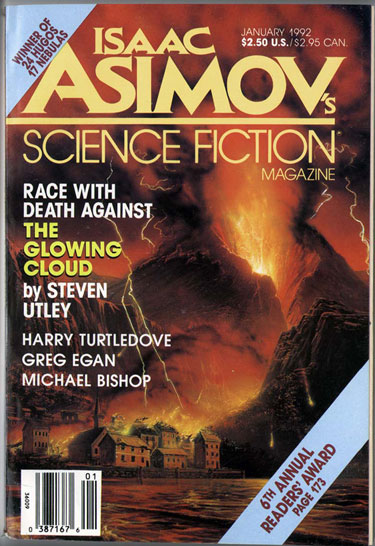
Steven Utley would probably be more known today had he taken to writing novels, but he was one of those exceedingly rare writers who never got into novels, preferring to stick purely to short fiction and poetry. Utley was born in Kentucky, at Fort Knox (he was a military brat), and understandably his family moved around when he was young before he settled in Texas (Austin) as an adult, then later Tennessee. He’s partly responsible for the discovery of fellow Austin weirdo Bruce Sterling. He was one of those authors who came about during the post-New Wave period, in the early ’70s, and he wrote prolifically during that decade before falling pretty much silent during the ’80s; then, for reasons I’ve not been able to look into, he came back to writing SF in the early ’90s and basically didn’t stop until his death in 2013. I must have read a few Utley stories before, just because he was a frequent presence in Asimov’s in the ’90s, but I’m struggling to think of their titles off the top of my head. I shouldn’t have such an issue with “The Glowing Cloud,” which, while a little bloated, is a harrowing time-travel story about one of the most horrifying natural disasters of the 20th century: the eruption of Mount Pelée and the destruction of St. Pierre.
Placing Coordinates
First published in the January 1992 issue of Asimov’s Science Fiction, almost on the 90th anniversary of the disaster. It’s only been reprinted twice, in The Year’s Best Science Fiction: Tenth Annual Collection (ed. Gardner Dozois) and the Utley collection Where or When.
Enhancing Image
Everyone knows about Pompeii; to this day it remains the most famous case of a whole town getting buried by volcanic eruption. In 79 CE Mount Vesuvius erupted and killed everyone who was in Pompeii on that day, and the city remained undisturbed and seemingly unnoticed for some 1,500 years until archeologists rediscovered it. Up to 20,000 people died from Mount Vesuvius eruption, but the case of the Mount Pelée eruption of 1902 is in some ways even more remarkable, for it being a relatively modern and well-documented tragedy, for having an even higher body count (nearly 30,000 people), and for the fact that such a disaster could have been easily minimized, yet it was not. St. Pierre (or Saint-Pierre as it’s also called) was a French settlement on the island of Martinique, densely populated and apparently brimming with night life, nicknamed the “Little Paris” of the West Indies. However, a minor character, one Father Hayot, in Utley’s story also calls it “Little Sodom,” which both indicates what the priest sees as a moral vacuum in the city, but also alludes to its imminent destruction—at the hands of Nature, if not a vengeful God. In his introductory blurb, Gardner Dozois says this story “was directly inspired by Gordon Thomas and Max Morgan Witt’s book The Day the World Ended,” and one does get the impression Utley did a good bit of research on the topic before he really began work on “The Glowing Cloud.” This is a story that’s effective at a couple things, not least sparking interest in its subject.
The actual plot is more of a standard cat-and-mouse time-travel thriller, although this is not necessarily a bad thing. Medlin is a time-traveling agent who’s been sent back to St. Pierre, not quite on the eve of its destruction but a little too close for comfort, in search of Garrick, a fellow agent who has gone rogue and apparently has been hiding out in St. Pierre. Another agent, Ranke, was supposed to accompany Medlin to this point, but so far is nowhere to be seen; not that this troubles Medlin too much, given that he has a rather strong dislike for Ranke and indeed it’s the latter’s arrival that the reader is supposed to dread. This manhunt has a couple complications, one being that Garrick is an older woman, a veteran of the profession, and also that she’s the one who had mentored Medlin in the first place. Medlin knows he’ll have to capture or kill Garrick, neither of which he really wants to do. So, there’s the internal conflict, but there’s also an invisible timer to make things more tense, because Medlin has about a week to bring back Garrick (dead or alive) before Mount Pelée engulfs the city, that final explosion and the “glowing cloud” of the story’s title. At this point the volcano has been belching and its environs have already gotten a taste of volcanic ash. The sky has mostly been blotted out. The townspeople are aware that the volcano will erupt, but also that St. Pierre is at a safe distance from what would be lava flow; unfortunately, what Medlin knows about the the townspeople don’t is pyroclastic flow. In case you forgot, pyroclastic flow is the worst that can happen in the event of a volcanic eruption, in which volcanic matter can hurtle downhill at hundreds of miles an hour. It would be impossible to escape on short notice.
Medlin already knows that everyone in town (there are only three people on record who had witnessed Mount Pelée’s eruption and lived to tell the tale) will die soon, which doesn’t help matters any. Conditions have become semi-apocalyptic, even as the government and businesses try to act like everything will turn out fine. Consider this:
It quickly became obvious to [Medlin] that the situation was not only as bad as Father Hayot had said, but becoming steadily worse. Groups of people stood about who seemed to have no place to go, no idea of what to do. These, too, had that unmistakable look of refugees; the authorities must have stopped confining them, but had not decided as yet what else to do with them. Livestock wandered loose. They seemed to be dropping dead faster than the soldiers could haul away the carcasses. Asphyxiated birds lay everywhere. The fountains were fouled with black mud.
“The Glowing Cloud” is indeed about a mini-apocalypse, which at least on a metaphorical level feels… timely. This is made more so because both Utley and Dozois make it clear that the disaster was itself inevitable, thousands of lives could have been spared had the local government evacuated the city—only they decided not to. Local news outlets (which in those days basically meant only print media), being in cahoots with the government, have been indulging in misinformation so as to disincentivize people from leaving St. Pierre. There’s an election going on, and also there seem to be genuine misunderstandings about the severity of the volcanic activity. The most infuriating instance, for both Medlin and the reader, happens much later in the story, when the mayor of St. Pierre has a speech plastered on public bulletin boards. Consider the following:
The occurrence of the eruption of Mount Pelée has thrown the whole island into consternation. But aided by the exalted intervention of the Governor and of superior authority, the Municipal Administration has provided, in so far as it has been able, for distribution of essential foods and supplies. The calmness and wisdom of which you have proved yourselves capable in these recent anguished days allows us to hope that you will not remain deaf to our appeals. In accordance with the Governor, whose devotion is ever in command of circumstances, we believe ourselves able to assure you that, in view of the immense valleys which separate us from the crater, we have no immediate danger to fear. The lava will not reach as far as the town. Any further manifestion [sic] will be restricted to those places already affected. Do not, therefore, allow yourselves to fall victims to groundless panic. Please allow us to advise you to return to your normal occupation, setting the necessary example of courage and strength during this time of public calamity.
Does this remind you of anything?
St. Pierre itself is an interesting locale, even if we get to know only a few of the locals. It’s a French settlement, founded way back in 1635, during the first age of European colonialism, and given its placement in the Caribbean Medlin notes that many if not most of the population is actually non-white, being black or biracial. There’s Madame Boislaville and her young daughter Elizabeth, who give Medlin shelter during the days spends searching for Garrick. (I assume Madame and her daughter are characters of Utley’s invention.) That’s about it, at least without getting into spoilers. Given that it’s a decently sized novella, the plot of “The Glowing Cloud” is rather straightforward and its cast rather small. Its length comes in no small part from it being such a chatty novella, with a few choice characters waxing philosophical about the nature of time travel and whether it’s ethical to try saving the lives of thousands, or even a few individuals, when history dictates these people are supposed to die. History will of course not be defied here, at least in broad strokes. Garrick herself is not trying to alter history, but rather went AWOL by stealing a special drug that would make time-traveling easier and less painful for the traveler, the result being that she can really leave whenever she feels like it. This is a bit of an anticlimax for such a long story, and unlike the other anticlimax it doesn’t feel deliberate on Utley’s part. It could be that while he at some point imagined Garrick as the villain, he simply could not fit her in that role, even thought she does come off as callous. I like Garrick less as a character and more how she compares with Medlin and Ranke, with Medlin being at a crossroads between agents who are more sociopathic than him, to varying degrees. This is ultimately a story about the capacity for human empathy.
There Be Spoilers Here
By the time Ranke shows up, it’s the day before St. Pierre’s appointment with annihilation, so he’s a bit late to the party. Right away he’s shown to be a bit of a hothead, never mind a threat to both of his fellow agents. Utley has been building up Ranke’s arrival for most of the story, so when he finally gets here, appearing as the closest “The Glowing Cloud” has to a human villain, he doesn’t disappoint—for all of the five or six pages he’s here. The most violent and surprising scene in the whole novella is when Ranke, apparently having bitten off more than he could chew with the locals, gets quite literally cut down by an angry mob “as if he were merely some obstinate jungle growth,” mere hours after landing in St. Pierre. By far the most “macho” character of the lot gets his just desserts rather promptly, and even Garrick points out that Ranke’s tough-guy act wouldn’t work.
So there’s that.
Just as curiously is that when it seems everything’s going to hell, Medlin gets rescued at the last minute by a group of fellow time-travelers, although evidently they’re not from the same organization; rather they’re a team of volcanologists from the future (even ahead of Medlin and Garrick’s future), here to observe the eruption of Mount Pelée from a safe distance. This is certainly what we call a happy coincidence, although it also makes sense for time travelers to go back and study a natural disaster like this first-hand, in a time when volcanology wasn’t a discipline yet. Medlin convinces Garrick to take Madame and Elizabeth, so that he might rescue just a couple people from the impending disaster, although the very end of the story is ambiguous if Our Heroes™ actually succeed in evading the glowing cloud. Utley opts (I suppose wisely) for a cautiously optimistic final note, which still feels like a happy ending given how grim this story is.
A Step Farther Out
I’ve seen people react to the current situation in the US like things can’t get much worse. Oh, they can get worse, it’s just a question of how much. Was totally not thinking about that while reading “The Glowing Cloud.” I wonder how many anthologies there are about SF involving natural disasters? I’m a bit surprised this story hasn’t been included in any.
(Cover by J. K. Potter. Asimov’s, September 1985.)
Who Goes There?
Kim Stanley Robinson debuted at the tail end of the ’70s, but as with William Gibson, Bruce Sterling, Connie Willis, and some others, he really came into his own in the ’80s. Nowadays he’s known for his leftist utopian novels and commentary, especially having to do with averting climate disaster, and indeed he’s one of the few living SF writers I can think of who’s over the age of sixty and also openly a socialist. He follows a lineage in the field that’s home to H. G. Wells and Ursula K. Le Guin, but he writes much more hard-nosed SF than either of them; it’s useful to think of him as the left-wing equivalent of a Poul Anderson or Larry Niven. This is to say that a good deal of Robinson’s wordage is spent on the mechanics of the worlds he builds, to the point where the mechanics can often overtake plot and character. His Mars trilogy (Red Mars, Green Mars, and Blue Mars) won major awards and stands collectively as one of the defining SF works of the ’90s. “Green Mars,” despite sharing a name with one of those aforementioned novels, has nothing to do with the Mars trilogy, other than the fact that Robinson would reuse a few ideas from this earlier novella. At this point Robinson had already shown his ambitions at novel length with The Wild Shore and Icehenge, with “Green Mars” feeling thematically akin to the latter, only on a much smaller scale.
Placing Coordinates
First published in the September 1985 issue of Asimov’s Science Fiction. It was then reprinted in The Year’s Best Science Fiction: Third Annual Collection (ed. Gardner Dozois), one half of a Tor Double with Arthur C. Clarke’s “A Meeting with Medusa,” and the Robinson collection The Martians. Given that it’s a solid 30,000-word novella it might be a bit too long to be reprinted more often.
Enhancing Image
Roger Claybome has had enough of politics on Mars, which is understandable given that a) he’s several centuries old at this point, and b) he’s a member of the Reds, conservationists who believe Mars’s pre-human ecological state should’ve been kept intact. The Greens, those who believe in terraforming Mars, have long since won the “war,” so to speak. It’s just taken 27 years for Roger to admit he’s lost.
Too many opponents, too many compromises, until the last unacceptable compromise arrived, and [Roger] found himself riding out of the city with Stephan, into the countryside he had avoided for twenty-seven years, over rolling hills covered by grasses and studded by stands of walnut, aspen, oak, maple, eucalyptus, pine: every leaf and every blade of grass a sign of his defeat. And Stephan wasn’t much help; though a conservationist like Roger, he had been a member of the Greens for years.
He’s become like a fish out of water, and he’ll continue to feel that way once he meets up with the rest of the time. Olympus Mons, a volcano that stands as the Mount Everest of Mars, is something that needs climbing, and for Roger there may even be remnants of the Mars he once knew up there, at the very top. Something neat Robinson does here that he also did in Icehenge is making the characters nigh-immortal, with people living a thousand years at a time; how this is made possible is not made clear, but it is the future and Robinson knows we don’t really need to know the science behind it. The result is that Roger and his contemporaries were of the generation that started colonizing Mars, back when it was like one vast desert, so rather than have a sense of nostalgia pushed on them by previous generations they lived to see the planet change before their very eyes. Despite having been part of the Martian government for three decades (a long time for us normal humans, surely), Roger looks like he’s barely reached middle age. This crunching of the passing of time is especially convenient for a novella, which doesn’t have the space of an epic novel.
Both the physical and narrative trajectory is mostly upward, and I have to say it’s pretty neat we get an illustration of the expedition, with camp locations and all that. The human members of the expedition are for the most part not as vividly drawn, sad to say, with the only exceptions being Eileen, a former short-term lover of Roger’s (it was long enough ago that she doesn’t remember their time together, although he does), and the terminally grumpy Marie, who sadly is left with that one defining trait. The other team members are basically expendable. It probably doesn’t help (although it does make the narrative more focused) that this is all told from Roger’s POV. From the start Robinson sets up Roger and Eileen’s unexpected reunion as the basis for romantic/sexual tension, but to his credit he also uses this tension to contrast our two leads, as they not only differ sharply in personalities but also worldviews. The budding romance serves a symbolic purpose which will become gradually more apparent as Roger’s character develops, which is what we call doing two things at once, i.e., good writing. Eileen herself is the closest we get to Robinson’s mouthpiece here, which is to say she vomits up what is clearly supposed to be the story’s thesis, that having to do with our perception of the past. As Eileen says, “Our past is never dead,” and then does the philosophy student thing (although chronologically she’s much older than college-age) of asking Roger if he’s read Jean-Paul Sartre. Roger says he’s much more of a Camus fan, actually. Okay, no, he just says he hasn’t read Sartre. Then she brings up Heidegger and that’s when we know we’re really in trouble. I won’t recite their whole conversation, because I’m not a philosophy major (although my Philosophy 101 professor tried hard to convince me), so we’ll move on.
Much of this story is about nostalgia and how we connect important moments in our lives, often distant memories, to places that were totally incidental. Roger has an intense fondness for Mars when it was red because he has childhood memories here that mean a lot to him, but which he is unable to recapture. He contrasts his own fond memories on the surface of the Martian desert with the minor character Pip from Moby-Dick, at the same time likening himself to the precocious and often depressed Pip of Great Expectations, two comparisons that link Roger as a literary figure but which also show a kind of latent narcissism in himself, that he should think himself comparable to characters in iconic works of literature. The comparison with the Pip of Moby-Dick does fit, though. For those of you who forgot, Pip is the cabin boy who at one point goes overboard and stays on the wide ocean, staring into its bleak depths, for an hour or so before being rescued, by which point the experience had driven him insane. (This is also a reminder that Moby-Dick is arguably cosmic horror.) Yet the two characters’ experiences could not be more different. “Someone had lived an hour very like his day on the polar desert, out in the infinite void of nature. And what had seemed to Roger rapture, had driven Pip insane.” And here Roger is again, surrounded by nature, with only half a dozen or so fellow humans for company—only this time it’s a nature that’s been perverted, a nature he doesn’t recognize. One person’s Eden is another person’s Hades. Roger wonders if his intense nostalgia and Pip’s madness are two sides of the same coin—the sensation that something has been lost, only coming from emotionally opposite directions.
The plot is simple—maybe too simple, given how long this novella is; but to compensate Robinson lovingly describes the cliffsides of Olympus Mons and the growing vegetation there, small signs of animal life, as the climbers ascend and the atmosphere gets thinner, like how it is on one of the tallest mountains on Earth. The campsites, the caves, the conserving of oxygen tanks and food supplies, it all becomes like a mountain-climbing story you might read today, or what Jack London might’ve written about. What the characters (aside from Roger and maybe Eileen) lack in depth the setting more than makes up for it, and not only that but the traversing of said setting. This is an adventure narrative, albeit an introspective one, and Robinson does his best to give the reader an impression of what it would be like to scale the tallest volcano on Mars.
Consider:
Verticality. Consider it. A balcony high on a tall building will give a meager analogy: experience it. On the side of this cliff, unlike the side of any building, there is no ground below. The world below is the world of belowness, the rush of air under your feet. The forbidding smooth wall of the cliff, black and upright beside you, halves the sky. Earth, air; the solid here and now, the airy infinite; the wall of basalt, the sea of gases. Another duality: to climb is to live on the most symbolic plane of existence and the most physical plane of existence at the same time. This too the climber treasures.
If Roger can’t take solace in a transformed Mars then at least he can take comfort in being an expert climber. There’s an incident with Frances, one of the other climbers (I wanna say she’s a redshirt, but that’s a bit mean), who gets an arm broken and has been escorted down to base for rescue, which itself is no easy feat. By this point the party has broken up into small groups, leaving only Roger and Eileen with each other as they ascend the volcano the rest of the way. Incidentally, as the human interference has lessened and the roughness of the setting has increased, Our Heroes™ find it easier and easier to communicate with each other, as if their growing isolation from the rest of the expedition is correlating with what might be a rekindling relationship. On one last note before we get to the climax, I think it’s worth reminding the both of us that the life we see on Mars is not native to it—at least not originally: the flora and fauna brought over have been given centuries of genetic engineering and adaptation. Nothing is the same anymore, but then again that means there’s room for growth, both for life on the planet and Roger’s own view towards it. The past haunts the present, but the past doesn’t have to mean just one thing to everyone; it’s possible to revise it, or at least to gain a different understanding of it.
There Be Spoilers Here
Just one line from Eileen: “Maybe I do remember you.”
A Step Farther Out
It’s a bit overlong, and I have to question the logistics of turning Mars green in just a few centuries; but still, it’s riveting, as personal as it is political. One of Robinson’s career-long obsessions has been our relationship with history, and the capacity for revisionism. Needless to say he agrees with Sartre, that history, or rather our understanding of it, is not fixed. This is unsurprising given Robinson’s leftist sympathies and academic background (he had recently earned his PhD when “Green Mars” was published), but what’s more surprising is how he’s able to synthesize his views on history with a planetary adventure narrative which has, within its confines, at least one character in the Shakespearean sense. That Roger is the only character here with a sense of an interior life would be a problem if this were a novel, but thankfully the novella mode is right for such a thing.
Walter Jon Williams made his debut at the start of the ’80s, and unlike most writers he began as a novelist before moving into short stories. He was already in his thirties when he sold his first short story, but the good news is that he was so adept at it from the outset that by the end of the ’80s he had emerged as one of the field’s major talents at short lengths. I especially recommend his 1987 story “Dinosaurs,” which is not about dinosaurs at all, but rather a far-future humanity that’s become so alien from us that they may as well be a different race. His affiliation with the cyberpunk movement (which coincided with his own emergence) gives one the impression he couldn’t have come about earlier than the ’80s, although Williams is not purely a cyberpunk writer. Williams’s writing is elegant and yet moody enough that it makes sense he would’ve written a distant sequel to a Roger Zelazny story, Williams’s “Elegy for Angels and Dogs” being a sequel to Zelazny’s classic “The Graveyard Heart.” “Surfacing” is itself a moody and rather dense novella, about alien contact, language, mental illness, and a future humanity that seems on its way to conquering the stars. It also has whales, and who can say no to that?
Placing Coordinates
First published in the April 1988 issue of Asimov’s Science Fiction, which is on the Archive. It was reprinted in The Year’s Best Science Fiction: Sixth Annual Collection (ed. Gardner Dozois), The Mammoth Book of Modern Science Fiction: Short Novels of the 1980s (ed. Isaac Asimov, Martin H. Greenberg, and Charles G. Waugh), The Best of the Best Volume 2: 20 Years of the Year’s Best Short Science Fiction Novels (ed. Gardner Dozois), and The Best of Walter Jon Williams.
Enhancing Image
Anthony is a 26-year-old scientist on some far-off planet, although he’s not along, for he’s brought humpback whales as translators of a sort—or as middle men. These whales, one of whom is named Two Notches (actually his name is longer than that, but let’s keep it simple), were imported to this planet, but have adapted to it splendidly. Anthony has very few in the way of humanoid friends, but he gets along with the humpbacks, even having a translation system via computer that allows him to talk to them; turns out the whales have a name for Anthony as well, “He Who Has Brought Us to the Sea of Rich Strangeness.” The real reason Anthony is here, though, is to study the Deep Dwellers, and possibly even to see one in its entirety. The Dwellers are like the giant squid on Earth: a truly massive marine animal that was once thought to be merely legend, but whose existence has been scientifically proven as of late. The problem is that nobody is totally sure what a Dweller looks like, only having parts of dead Dwellers to go on. The Dweller, so it’s suspected, is whale-like, but also with tentacles—and larger than even the blue whale. Thus the humpbacks are the closest the Dwellers would have to relatives (however distant) that can also communicate with humans. Anthony doesn’t mind the solitude of being on a boat by himself all day, not being much of a fan of other people.
Can you tell this was written in the years following the sudden popularity of whales? Incidentally the Roger Payne album Songs of the Humpback Whale (sold over a hundred thousand copies despite literally being whale noises) coincided with the hippie movement right before it went into decline, with “Save the Whales” becoming one of the big movements of the ’70s. Read some disco-era SF and notice how suddenly people give a fuck about whales. It’s a bit weird, with hindsight. Otherwise this story doesn’t show its age at all, and even then, why complain about a planetary SF adventure where whales are on the side of the good guys? Anthony himself is less appealing. On the one hand it makes sense someone who spends hours of his day, every day, with animals would be a bit misanthropic. (Meet any veterinarian and there’s a good chance they’re pessimistic enough about the human condition to make Mark Twain blush.) I can also see how Gardner Dozois, the editor of Asimov’s at the time, would’ve latched onto “Surfacing” enough to reprint it twice, as Anthony is a very Dozois-like protagonist. I do think that because Anthony is such a downer, a moodiness that infects the rest of the story, the downbeat nature of the story now reads as a bit been-there-done-that. I don’t think we, in [CURRENT YEAR], have yet properly reckoned with the fact that Dozois is the most influential SF editor of the past forty years, and that the reason why so much short SF is downbeat (to the point of tedium) is like that is at least partly because of his influence. My point is that I can tell you I would’ve liked “Surfacing” more in 1988.
At the beginning of the story we get a newsfeed of a famous Kyklops, named Telamon, making a tour of the planet. The Kyklops are basically a race of energy beings, like of many such races found in the Star Trek universe; they lack solid bodies of their own, instead using the bodies of others like puppets, including humans. This is important to keep in mind for later, although given how quickly this little scene comes and goes it’s easy to forget about its importance. Maybe this was by design, but I do wish the Kyklops were set up better so that them becoming relevant to the plot much later feels less random, since the first time we see them it comes off as insignificant and the reader is likely to forget.
While Anthony is easily the main character, and the setting rather desolate, this is not a one-man show—more like a two-people show. Anthony meets Philana, who despite being only 21 (this is especially conspicuous in a world where, for reasons I don’t recall being given, humans can now live centuries at a time) has own her yacht, which she uses to talk to the whales as well—particularly the females, which it turns out is a special skill. Anthony can talk to males and Philana the females. Each has what the other lacks. By the way, I said that aside from the timely fixation on whales this story doesn’t show its age, but that’s not entirely true.
Get a load of this:
It was harder to talk with the females; although they were curious and playful, they weren’t vocal like the bulls; their language was deeper, briefer, more personal. They made no songs. It was almost as if, solely in the realm of speech, the cows were autistic. Their psychology was different and complicated, and Anthony had had little success in establishing any lasting communication. The cows, he had realized, were speaking a second tongue: the humpbacks were essentially bilingual, and Anthony had only learned one of their languages.
No comment needed.
Okay, there’s a lot to unpack with that one passage, but let’s not.
I said before that Williams’s writing can at times come off as Zelazny-esque, and “Surfacing” has a relatively subtle example of this with the budding relationship between Anthony and Philana, the brooding young man with the spritely young woman, with allusions to mythology (locals call the Dwellers Leviathans) that you’d expect from Zelazny; yet there’s something to be said for how capable Philana is, despite her age. Of course, it turns out that Philana’s skills and her apparent wealth have a catch, or rather came at a hefty price. More on that later. “Surfacing” is at one point a love story, and also about trying to make contact with an alien species—possibly even more than one. Anthony has a direct line to the humpbacks but unfortunately the same can’t be said for the Dwellers, whose language is much trickier. A neat thing Williams does here is he shows us lines from the Dwellers that are basically dialogue trees, with branching paths and ambiguities with what words could mean. The Dwellers also have an issue with pronouns, not because of gender but because they have this problem with subjectivity. It would’ve been a pain in the ass to print, not to mention these dialogue trees take up a lot of space on the page, so I can see why Williams only does them a handful of times. Still, it’s neat. It helps that we get to know little about the Dwellers until the very end.
I’m getting ahead of myself.
There Be Spoilers Here
Philana is a puppet for Telamon, that Kyklops mentioned earlier, which comes to Anthony as a real shock considering the first time he sees Telamon take over Philana’s body the two are having sex, and Anthony isn’t sure why Philana starts acting very strangely—and violently. Telamon is “a decadent,” as Philana puts it, which is to say he’s a bit of a sadist and pervert. He does things often out of boredom. Telamon becomes the closest the story has to a villain, although he doesn’t really enter the plot until the back half. The thing about the Kyklops is that they’re energy beings, but they’re also basically immortal, and unspeakably old. Telamon (or Jockstrap as Anthony takes to calling him) is so much older than his human host that the gap is all but unfathomable. So you have a dirty old man who can’t be killed through conventional means and who can also teleport matter at will, sending the pesky Anthony anywhere he likes—indeed he can kill Anthony with a mere thought. Obviously this is a losing battle; aside from dishing out some snark there’s very little Anthony can do. To make matters worse, Telamon can take over Philana’s body whenever he likes, and the best Anthony can hope for is to look for the signs. There are at least a couple ways of looking at Philana and Telamon’s relationship. We can understand Philana as, metaphorically anyway, someone living with mental illness, more specifically a personality disorder that gives her blackouts when Telamon’s in control; for better or worse she doesn’t remember these episodes. Telamon can also be thought of as like Philana’s abusive sugar daddy, since he does provide for her, at what many would consider too hefty a price.
So Anthony can’t beat Telamon directly, fine; but he can outmatch his rival in a way that has to do with what he loves doing most. I was rather confused at first by this story’s open-ended climax, since it’s not clear what we’re meant to take away from Anthony contacting the Dweller he’s been studying and coaxing it into rising to the surface—a maneuver that may or may not kill the damn thing, never mind Anthony and Philana. We already figured Dwellers were massive, but this turned out to be something else, with the Dweller being host to a variety of deep-sea organisms. “The Dweller was so big, Anthony saw, it constituted an entire ecosystem.” As frightened as they are astounded, Our Heroes™ make contact with a creature whose entirety no one had ever seen before. What happens after this point is totally unclear. Maybe Telamon will give up Philana, on account of Anthony proving himself an exceptional scientist, doing something Telamon himself never could. The plotline with Anthony studying the Dwellers gets resolved satisfactorily, but the same can’t be said for the “love triangle” (if you really wanna call it that), which perhaps deliberately is left hanging.
A Step Farther Out
Occasionally you’ll get an SF story about the ocean, but Williams is one of the few writers I’ve seen to tackle the inherent alienness of the high seas. There’s a dash of Moby-Dick in there (as there should be with any oceanic narrative written after 1920), but Williams combines a high-seas adventure (with WHAAAAALES) with psychology such that ultimately this is not a story that would be possible without a few SFnal elements. I’ve had a few days to think about it, and I’d say it’s worth a look if you’re up for summerly reading—while we still have a month of summer left.
We last covered Greg Egan with his 2002 quantum computing novella “Singleton,” which was very typical Egan; now we have something more atypical. Egan is one of the quintessential transhumanist writers in SF and one of the leading figures of the post-cyberpunk era in the ’90s; but “Oceanic” is not cyberpunk at all. Here we have a coming-of-age story on an alien planet, about a young man’s crisis of faith through both religion and sex, apparently inspired by Egan’s own disillusionment with Christianity in his youth as recounted in his autobiographical essay “Born Again, Briefly,” which I highly recommend reading as a kind of double feature with “Oceanic.” Indeed despite the exotic locale this reads as one of Egan’s most personal works, and while it isn’t cyberpunk it does manage to veer back into some go-to Egan themes. The gambit paid off, as it remains Egan’s single most decorated story, having won the Hugo for Best Novella as well as placed first in the Locus and Asimov’s readers’ polls for that year. It might also be my favorite Egan story I’ve read so far.
Placing Coordinates
First published in the August 1998 issue of Asimov’s Science Fiction, which is on the Archive. Gardner Dozois liked this story so much he bought it for Asimov’s, but then reprinted it in The Year’s Best Science Fiction: Sixteenth Annual Collection and The Best of the Best Volume 2: 20 Years of the Year’s Best Short Science Fiction Novels. It’s in the Egan collection Oceanic, and of course it’s also in The Best of Greg Egan. You can read it free online at Egan’s site, so you don’t have an excuse!
Enhancing Image
Sometimes when I’m reviewing a story I feel like I’m struggling to come up with things to say about it, but with “Oceanic” there’s no such problem—especially if you know how autobiographical it is. But first some context. We’re on the planet Covenant, over a thousand years after humanoids (I say “humanoids” because it doesn’t look like normal humans had come to the planet in the first place), and we follow Martin, who as narrator is writing what you might call a fictional memoir, recounting from the time he was about ten to when he was deep in his twenties. Martin and his family are “Freelanders,” in that they live on the vast waters of the planet, unlike the “Firmlanders” who live primarily on land. Martin’s family are Transitional, that is to say mildly religious, but Martin’s older brother, Daniel, joins the Deep Church, a fundamentalist sect, when he’s fifteen (David being five years Martin’s senior). Daniel tries to convert Martin, and in a scene ripped straight from Egan’s own life (his older brother having split from their Anglican family and converted to Catholicism as a teenager), the two kneel by Martin’s bed one night and pray to Beatrice, the Christ-like figure of the religion. But Martin hasn’t really been converted yet. “I wasn’t sure that I wanted Beatrice to change my mind, and I was afraid that this display of fervour might actually persuade Her.” The practice starts as more out of respect for Daniel than believing his faith, but Martin will soon go through a rite of passage that will turn him into a firm believer—for a while. This is all told with melancholy hindsight.
“Oceanic” is a coming-of-age narrative, or a bildungsroman, about a boy crossing the shadow-line (to steal Conrad) into maturity—a crossing that tends to be not one experience but several key turning points. The first major turning point for Martin is arguably not kneeling with Daniel that one night, but taking part in the Drowning, a ritual in which someone is submerged in the depths of Covenant’s waters—so far down that it would seem suicidal, and yet this near-death experience is euphoric, at least if the person accepts Beatrice in their heart. Martin is Drowned one day, with Daniel as his second, and this experience in the depths, by his lonesome, makes him feel like he’s somehow become one with Beatrice. A switch gets flipped inside his head. Getting Drowned is something only the Deep Church people do, as others see it as dangerous and an aberration, something fundamentalists do; but his Drowning causes a religious awakening in Martin. As he struggles in the depths he recounts the story of Beatrice and the “Angels” as written in the Scriptures. This is where things gets pretty strange, and dense, in the sense that Egan seems to have developed a whole origin story for the people of this planet—one that is clearly adjacent to Christianity, although there’s a transhumanist twist that’s more implied than explained. While submerged, Martin takes in a gulp of the seawater, and at this moment light floods his vision, leaving “a violet afterimage” once it recedes and Daniel brings him back to the surface, the Drowning successful.
The irony is that after this point Martin and Daniel’s relationship weakens, granted that part of this is to be expected given their age gap. Martin gets involved with Daniel’s Prayer Group, but soon grows tired of it. “What did I have in common with them, really?” The brothers grow apart. Daniel gets married young to a fellow Deep Church person named Agnes and the two lead a boring, traditional life thereafter. Some years pass and now Martin’s a teenager. It’s at this point that I should probably mention the eccentric biology of the humans in this story. Something I noticed only after the fact is that Egan refrains from giving physical descriptions of characters really, and this could be for a few reasons, but one reason I can think of is that the characters are physically androgynous—they, in fact, have physical traits of both male and female, and even functioning sex organs that would normally be unique to either. They’re true hermaphrodites, “women and men were made indistinguishable in the sight of God.” What gender someone identifies as really does come down to their self-perception rather than their sex. I’m bringing this up now because it’ll soften the blow for when we get to what is perhaps the most important scene in the story—and also the most unusual. When Daniel gets married Martin meets up with one of Agnes’s cousins, Lena, a Firmlander who nonetheless is very interested in the way Freelanders live. The two hit it off and enter a sort of casual relationship, and it doesn’t take long for sex to enter the picture.
So, in a bildungsroman, it’s not uncommon for the protagonist’s first sexual experience to serve as a turning point in the narrative, as a euphoric or traumatic experience. One’s first time is rarely all that. I myself didn’t lose my virginity till I was 21, and it was with someone I was not in a relationship with; it was a one-time thing, but the important thing is that we were nice to each other and there was certainly no pain in it. A lot of people aren’t so lucky. Poor Martin over here has one of the strangest first times possible—not because the sex with Lena goes wrong exactly but because there’s a certain part of the exchange nobody had thought to warn him about in advance. Remember how I said that the people of Covenant are hermaphrodites? Not only that, but the penis is apparently detachable. If sex happens between someone with a penis and someone with a vagina there’s a literal exchange of “the bridge,” so that after he climaxes inside Lena Martin finds, to his horror, that Lena now has his cock and that Martin, with blood on his groin, finds that a pussy has formed where his cock once was. (There’s no mention of testicles that I can recall—and no, don’t ask me to go back through to see if there is. I would have to think then that the testes are internal, somehow, but still functional. For better or worse Egan doesn’t go into great detail as to how the anatomy of these future humans could function. The effect is akin to one of Dali’s paintings, or one of the more nightmarish scenes in a Buñuel film.) Eventually Martin and Lena have sex a second time so that Martin can get his dick back; but the relationship has done sour because of that first time and they seemingly never talk again.
A lot is happening, so let’s rewind the film and take this step by step. We’re never outright told this I believe, but it’s implied pretty heavily, even early on, that the humans on Covenant are the descendants of the so-called Angels, who apparently had foregone flesh-and-blood bodies but then decided to build organic yet artificial bodies for themselves so that they could experience bodily pleasures and even mortality again. The Angels, being basically noncorporeal, are now spoken of as if they were literal angels, the “present” of the story being so far into our future that even the far future of the Angels is spoken of as if it were ancient history or myth. Egan has gone out of his to imagine a future humanity that in some ways is not so different from us, but then there’s the biology of these people. Martin losing his virginity is a traumatic event for more than one reason: it gives him gender dysphoria, makes him feel ashamed because he’s had not only had sex while unmarried but lost his “bridge” in the process, and it’s the first time in his life where the hard reality of biology shakes his faith. I probably should’ve also mentioned “Oceanic” nearly made the shortlist for the Tiptree Award. Now, transphobes might read this story and be repulsed by its implications, because it becomes obvious that, as is regularly the case with Egan’s fiction, biology is framed as tyrannical. Martin and his kind are not beholden to biology but victims of it. (I saw someone theorize that Greg Egan is actually a woman, and while it’s true we’ve never seen or heard Egan, I find this a bit far-fetched.) Indeed Martin deciding to study microbiology, under an affable but ultimately dead-end professor named Barat, will prove to make him only more miserable.
Something I’ve had to do in writing this review is go back through “Oceanic” and reread some passages, which I’m not prone to doing for these—in no small part because I know with certainty there are details I had missed on my first reading. On the one hand you could try boiling this story down to a “religion sucks” narrative, but that really would not be doing the world Egan has built justice, nor would it encapsulate the thematic depths. Granted that showing “Oceanic” to a transphobic Christian would disgruntle them, it’s more a dramatization of Egan’s own coming of age; this is his Go Tell It on the Mountain. A mild criticism I have of Egan’s writing is that when it comes to first-person narrators they tend to have more or less the same voice, which I have to take to some extent as Egan’s own voice: brooding, seemingly teetering on the line between macho and a little feminine, a sort of overly sensitive film noir detective cadence. Martin might be the most Egan-ish of Egan narrators, and yet rather than distract me this ended up being more of an asset than a negative—indeed Martin being the quintessential Egan narrator might well be the whole point. The result is that despite not having anything to do (at least directly, though it’s very much part of the backstory) with computing or quantum uncertainty, “Oceanic” manages to be thematically kin with Egan’s other work, even if on the surface it seems to hark to a kind of old-school planetary science fiction. As someone who’s not very literate in computer science (like most people) I thus found it accessible by Egan’s standards.
There Be Spoilers Here
As he ages Martin distances himself more from organized religion—first from the Deep Church and even the Transitionals, increasingly finding fault and hypocrisy in the arguments of theologians. Among his own scientific colleagues he finds himself siding more with the earnest atheists than with whom he sees as weak-willed believers. “Theology aside, the whole dynamics of the group was starting to get under my skin; maybe I’d be better off spending my time in the lab, impressing Barat with my dedication to his pointless fucking microbes.” And then tragedy strikes. Martin’s mom comes down with a severe illness, and by the time he gets to hospital she has already died. Daniel was there, but this ends up being the final straw for Martin’s perception of him, for according to Daniel’s own faith their mother is destined for Hell since she was never drowned; but upon confronting him about this bit of theology Martin finds that his fundamentalist older brother has softened—for his own sake if nobody else’s. “There was no truth in anything he said, anything he believed. It was all just an expression of his own needs.” By this point Martin has become one of those devout but rebelliously individualistic religious people, but even his personal faith has been eroding, slowly but surely. “The God of the gaps,” to use an edgy atheist phrase. What breaks the camel’s back turns out to be Martin’s own work in the microbes of Covenant’s oceans.
So, to make a long story short, the microbes in the planet’s water have this hallucinatory fucky-wucky effect if taken into one’s body in concentrated form. The humans on Covenant have adapted to these microbes in moderation, but it’s still dangerous to interact with too much, which would explain the religious experiences had by those who have Drowned. Martin’s religiousus experience, which he had kept close to his heart all these years even as his understanding of the natural world expanded, has a scientific explanation: he saw some freaky shit because he had inhaled a concentrated amount of these microbes. It’s like the SFnal version of how people who suffer from epilepsy are prone to having “religious” visions—or indeed people with schizophrenia who claim to be in touch with the divine. Biology has its way with Martin; it caresses him, withers him, takes the moon and the sun from him, takes what is in front of him and even behind from him, and at the end of the day it takes God from him.
I was lucky: I’d been born in an era of moderation. I hadn’t killed in the name of Beatrice. I hadn’t suffered for my faith. I had no doubt that I’d been far happier for the last fifteen years than I would have been if I’d told Daniel to throw his rope and weights overboard without me.
But that didn’t change the fact that the heart of it all had been a lie.
At age 25 Martin becomes an atheist, incidentally around the same age when Egan gave up his own faith. This is not a victory for atheism or any dumb bullshit like that, but rather a melancholy crossing of the shadow-line, from youth to manhood. Something is lost and gained, at the same time, like a passing of the torch. While “Oceanic” is by no means Egan’s first “mature” story (he had already written Permutation City and Disapora at this point, not to mention some pretty great short fiction), it’s a reflection on the artist (or the scientist, who anyway is adjacent to the artist) coming into his own. Maturity is not sunshine and rainbows.
A Step Farther Out
I ended up reading “Born Again, Briefly” after I had read “Oceanic” but before starting this review, which turned out to be a good idea since it helped explain the strong personal touch of this story. It’s also a bit of a mind-bender, but not for the reasons typically associated with Egan, in that you don’t have to be an amateur computer programmer to understand the point he’s trying to make. Still, it’s a dense novella that almost demands a second reading, for pleasure but also so one can soak in all the details. Egan could’ve gone farther with the gender aspect, but for 1998 it’s still pretty wild and forward-thinking. People forget that even in 1998, which for some of you was not that long ago, queer representation in SF was very… mixed. And also nearly always evidently from a cishet perspective. With that in mind, “Oceanic” has aged pretty gracefully; it also happens to be a story people new to Egan can read without issue.