Who Goes There?
The ’50s saw a profound influx of new talent in magazine SF, which coincided with the magazine market itself experiencing a bubble. While C. M. Kornbluth was one of the best and most vicious of these talents to ride the bubble, and was indeed not much older than newcomers like Philip K. Dick and Robert Sheckley, he had in fact made his debut at the tail end of the ’30s. Kornbluth was born in 1923, and started writing fiction of professional quality when he was all of 15 years old, making him one of the few real prodigies in literature. He was a member of the Futurians, a New York-based left-leaning (but more on how that relates to Kornbluth later) group of fans, some of whom would go on to revolutionize the field at large. Its membership was pretty stacked, including but not limited to Frederik Pohl, Judith Merril, Donald Wollheim, James Blish, Isaac Asimov, and Damon Knight. Pohl especially was close friends with Kornbluth, and even as editor of a couple low-paying magazines got much of the latter’s earliest work printed. Maybe the best of these early stories, 1941’s “The Words of Guru,” is not science fiction at all but instead horror of a particularly nasty stripe, and despite Kornbluth being all of 17 when he wrote it it’s a story that still holds up pretty damn well to this day.
About half of Kornbluth’s short stories were published between 1939 and 1942. He got drafted into the war, and even saw action at the Battle of the Bulge as part of a heavy machine gun crew. This experience in the war seemed to have exacerbated a weak heart, which eventually led to his early death in 1958. It’s tempting to think of what might’ve happened had Kornbluth lived to a proper age, not least because on the day of his death he was due to interview for the editorship of The Magazine of Fantasy and Science Fiction. Robert P. Mills was managing editor of F&SF and editor of its sister magazine, Venture Science Fiction, and was due to meet with Kornbluth. But this meeting never happened. Instead Mills replaced Anthony Boucher as editor of F&SF, in what ended up being a few of the magazine’s strongest years. Mills was a very capable editor, but still, one has to wonder what F&SF under Kornbluth would’ve been like. According to Pohl, Kornbluth sent “Two Dooms” to F&SF, as “The Doomsman,” but for reasons never given it was published in Venture instead. It may have been the last story Kornbluth himself had sent out for purchase.
Placing Coordinates
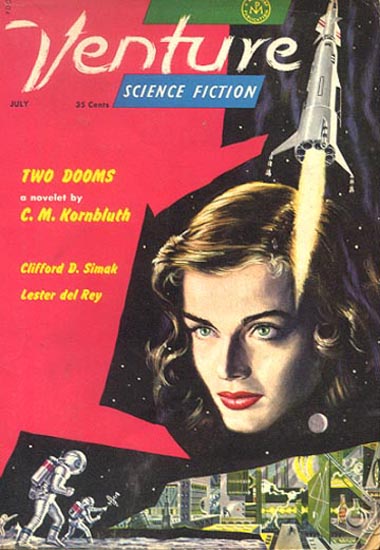
First published in the July 1958 issue of Venture Science Fiction. It was reprinted sometime later that year in the Kornbluth collection A Mile Beyond the Moon, although there’s at least one edition that doesn’t have this story. There’s also The Best of C. M. Kornbluth and His Share of Glory: The Complete Short Science Fiction of C. M. Kornbluth. As for anthology appearances we have Great Short Novels of Science Fiction (ed. Robert Silverberg), Hitler Victorious: Eleven Stories of the German Victory in World War II (ed. Gregory Benford and Martin H. Greenberg), and The World Treasury of Science Fiction (ed. David G. Hartwell).
Enhancing Image
There have been so many “Hitler wins” alternate history stories over the decades that frankly there are too many. The earliest example a lot of people think of would be Philip K. Dick’s The Man in the High Castle, but “Two Dooms” predates that novel by a few years, and may have possibly been a point of influence for Dick. Incidentally both stories involve some sort of mysticism, although both the means and ends are different. “Two Dooms” starts in our world but soon shifts over in time, not just into an alternate timeline but also about 150 years into the future. Edward Royland is a 23-year-old scientist, fresh out of college, working at Los Alamos. The year is 1944, and so far “the Bomb” is on its way to being tested but has yet to find a use in the war. Royland suspects that the atomic bomb might never be used at all, and he doesn’t know if this is good or bad. Really he’s come to hate his job, working under Oppenheimer, having heat rashes under his arms and sweating in what is quite literally a desert. After work one day he drives over to the hut of a friend of his, Nahataspe, a Hopi Indian who has something that might expand Royland’s mind—or maybe crack it like an egg. Royland takes some magic mushrooms which Nahataspe calls “the God Food,” wondering if he’s in for a mean trip. Well, he does go on a trip, of a sort, but it’s far beyond anything expected.
After an intense blackout Reynolds wakes up to find the hut empty. Both Nahataspe and his possessions are gone. This is bad enough, but what Raynolds finds once he leaves the hut is worse:
He went to the village well and found it choktxl with dust. It was while he stared into the dry hole that he first became afraid. Suddenly it all was real; he was no more an onlooker but a frightened and very thirsty man. He ransacked the dozen houses of the settlement and found nothing to his purpose—a child’s skeleton here, a couple of cartridge cases there.
The settlement had at some point been emptied of human life—by force, it seems. This is the first creepy moment in a story that’s full of such moments, although it must be said that not all of these may have been intentional. The immediate problem for Royland is that all of a sudden he finds he’s become terribly thirsty, and with the village well run dry he sets out on the road (barefoot, since the jeep he took has also disappeared) like a man already half-dead. First he hitches a ride with Martfield, a “Paymaster Seventh” who gives him some water, and who takes Royland back to civilization. Unfortunately for Martfield he’s reprimanded for “harboring a fugitive” (the assumption is that Royland had escaped from a German or Japanese labor camp) and expected to report himself, with the implication that he’s to be executed. Yet the German military men who take Royland in for examination find his story too outlandish and his very existence too open of a question. They interrogate him (at gunpoint, naturally), and Royland explains his job and WWII—the problem being that WWII, as these Germans understand it, did not happen. There was instead “the War of Triumph,” which lasted a decade longer than WWII did, and with Japan continuing to fight long after the Third Reich had fallen, giving the remnants of the Nazi regime time to take back control and beat the Allies.
That’s the short of it, anyway.
There’s a lot to unpack in what ends up being a protracted expositional scene, so let’s get to it. Not only had the War of Triumph ended, but it’s been over for over a century at this point. The Germans and Japanese have since taken control of the US, sharing ground not along broad regional lines but instead working quite literally side by side. This is very similar to how things work in The Man in the High Castle, although not quite. Let’s talk about Adolf Hitler. In Dick’s novel, Hitler remained in power for a time before the Reich higher-ups decided to lock him up in a mental institution, his brain having been eroded by late-stage syphilis. In “Two Dooms” Hitler never even became head of the Reich, but instead an “early Party agitator” who plotted to assassinate “the Leader,” who turns out to have been Joseph Goebbels. Instead of blowing his shit smooth off in his bunker, Hitler was executed during the War. There’s some irony here. Kornbluth makes some implausible predictions in creating his alternate timeline (it’s hard to believe the Japanese would’ve kept fighting for a whole decade after 1945), but the one big prediction he makes that rings true is the notion that Nazi Germany would’ve existed even without Hitler—indeed, Germany did not need Hitler per se in order to turn fascist, just a Hitler-esque figure. Maybe not even that. The ingredients for a fascist Germany were all there, in the years following WWI. Strictly speaking, “Two Dooms” is not an example of a “Hitler wins” story, but it at least follows the rules close enough.
Now, in order to engage with any story with such a premise we have do some suspension of disbelief, just right off the bat. Stories in which the Axis powers invade and then occupy the US are implausible for a few reasons, not the least of them being that neither Germany nor Japan considered such an operation to be practical. It’s improbable, if not outright impossible, that either of the remaining Axis powers would’ve orchestrated bombing campaigns against the US mainland, let alone set boots on the ground. Some savvy writers have found some alternative to this when writing such alternate history. Memorably in Philip Roth’s The Plot Against America the US threatens to turn fascist from within, thanks to Nazi sympathizers under the leadership of Charles Lindbergh, although this “plot” gets deferred (disappointingly, it must be said) at the last minute. In Robert Harris’s Fatherland, the victorious Reich looks to have friendly diplomatic relations with a susceptible America. These are both more believable than what Kornbluth and Dick had envisioned, but then it’s worth noting that those two did not have access to information about the war effort that would’ve still been classified. As to be expected of such an early example of the subgenre, “Two Dooms” is a victim of dated history, and unfortunately Kornbluth didn’t even live long enough to have read Dick’s novel. This in itself would be fine, but “Two Dooms” shows its age in other ways, and those ways happen to be a lot harder to stomach.
Royland escapes from some Nazi doctor asshole and makes way for the countryside once again. Too bad this is New Mexico. He meets a drunken Chinese man (he somehow guesses correctly that the man is Chinese just from looking at him, and also he does not say “Chinese man”) named Li Po. (Apparently this is supposed to be a reference to the ancient poet Li Bai, but sources must’ve transliterated it as Li Po at the time.) Li Po is a drunkard as well as in the midst of killing himself by drowning, to reclaim his honor, but Royland saves him and they become friends. The village Li Po belongs to is more ethnically diverse than you’d expect: “[The villagers] were a mixed lot of Chinese, Hindus, Dravidians and, to Royland’s surprise, low-caste and outcaste Japanese; he had not known there were such things.” Worryingly, however, white people are not allowed here, but Li Po manages to get Royland in on the basis of a great big lie. Over the next month or so, Royland goes native, in a sense, working the land as a farmer until his skin darkens and it becomes possible to mistake him for, say, a Latino. He has the right hair and physique for it. He comes to adjust to rough ways of the village, being on the brink of but not quite starving as he works. He even comes to acquire a fiancée, a submissive Indian (as in from India) woman. There is, sad to say, a joke or two about curry.
Speaking of which, there is some abhorrent racism in “Two Dooms,” at least some of which can be pinned on Royland’s own prejudices, but at some point you have to wonder how much Kornbluth agrees with his Orientalist and not-all-that-bright protagonist. Royland is shown to be a bit of a proto-otaku in his irrational admiration for Japanese culture, a country that would eventually be on the receiving end of the very weapon Royland has a part in developing. But Li Po and the other villagers, including (indeed especially) the young woman Royland is set to marry, are caricatures. The samurai (yes, complete with a sword) who comes to the village one night and cuts off Li Po’s head is another caricature. As he leaves the village for the last time Royland goes on a dazed rant about how these people need to stop having children “irresponsibly,” pointing towards the long-standing racist view that China and India are host to hordes of unwashed masses who can’t be trusted to take care of themselves. Royland’s racist tendencies are never seriously challenged in-story, and Kornbluth doesn’t comment on them. The only time these prejudices are challenges, in which Royland stops and has a thought, is when he remembers Bloom, a European Jewish refugee (the name might be a shoutout to Leo Bloom of Joyce’s Ulysses) who came to America. Bloom talks with a funny accent, but he’s at least given a bit more dignity than the non-white characters in the story.
There Be Spoilers Here
Before we get to the end, let’s talk about Kornbluth’s politics. I said before that the Furutians were a left-leaning fan group, ranging from liberals to card-carrying CPUSA members. Well, that was before the end of WWII anyway; needless to say people were quick to distance themselves from party politics once it became clear that the Cold War was underway. Kornbluth was one of the younger Futurians, and while he was friendly with some who were decidedly quite on the left end of things (namely Frederik Pohl and Judith Merril), his own politics are rather hard to gauge. The problem, or rather a limitation of Kornbluth’s writing, is that he seemed incapable of taking his own work all that seriously, at least when working on his own. There’s a jokiness with a lot of Kornbluth’s short fiction, even with the absence of proper jokes, and even when things take a turn for the morbid. Kornbluth can be thought as a somewhat more socially conscious (and more geared towards writing SF) counterpart to Robert Bloch. Both were part of the same generation, both were prodigies, both were culturally but not religiously Jewish, both were urbanites (Kornbluth from New York and Bloch from Chicago), both had a very dark sense of humor, and both were shrewder than their fiction often makes one assume. They were also, for better or worse, seemingly incapable of taking their own work all that seriously. There’s a deep-running disdain for the human condition that results in either writer sometimes coming off as reactionary.
Unsurprisingly Royland is able to find some of “the God Food” that got him into this alternate timeline in the first place and so, by simply repeating the process, is able to wake back up in our time. What’s curious is that there’s no firm reason to believe what Royland experienced was actually an alternate timeline and not just a psychoactive drug trip gone sideways. The implication, which Kornbluth may or may not want us to take at face value, is that Royland dipped into a timeline in which the US never dropped the atomic bombs on Japan, thereby resulting in a protacted war and the Third Reich eventually returning. This, of course, can’t be allowed to happen. The conclusion Royland reaches, which Kornbluth may or may not agree with, is a bit of an odd one, even for 1958, and on account of how Kornbluth wrote about nuclear weapons in other stories of his. Hell, not too long ago I wrote about a collaboration he did with Pohl, “Nightmare with Zeppelins,” which takes an unambiguously anti-nuclear stance. But was that more Pohl or Kornbluth’s idea? Pohl’s politics are much easier to gauge, not least because Pohl was pretty candid when writing about his evolving worldview and we have a lot more autobiographical material from him. It’s just one of those things you have to wonder about.
A Step Farther Out
I’m not sure how to feel about this one. At the very least “Two Dooms” is worth looking into as a pioneering example of a certain type of alternate history narrative, but much like other works of art that run on the cutting edge it has some issues. There have also, needless to say, been variations on this idea since then have been done better and with more depth, although I can’t imagine there are too many “Hitler wins” stories that are worth a damn to begin with. It’s such a tired idea now. But that was not the case when Kornbluth wrote it. I do suggest reading shorter stories from Kornbluth first, if you’re new to him.
See you next time.

