We are now knee-deep in spring, which means last month I narrowly survived a fit of allergies. (I’m not really exaggerating, I got hit with what the doctor called postnasal drip, and for some days it was difficult to even breathe, let alone sleep at night.) In terms of weather this might be my least favorite time of year, because of said allergies. In better news, it’s also time for applying for memberships at the yearly Worldcon, if you’re interested. This one is happening in LA, which is unfortunate because it’s the other side of the country for me and I don’t have any connections who live close enough to where the action’s happening. I have a few friends in California, but as you know, California is a big state. (That’s not even getting into people from outside the US who want to attend in person. It’s rough.) I did end up getting a WSFS membership, I think for the third year in a row. I mainly do this for all the free stuff you get, a very good I would say given it’s only $50. You get ebooks of novels and short fiction, and you even get files for the movies up for Best Dramatic Presentation.
As for what we’ll be reading this month, for the first time in a long while we have a complete novel, which I have to get around to this time. (Unlike last time.) We also have a novel in serialized form, by someone whom I’m sure will not raise any eyebrows. Incidentally, two of the stories here are related to World War II, although one was written on the eve of the war in Europe while the other is an early example of a “Hitler wins” alternate history. Such a scenario is pretty tired today, but it was not so when C. M. Kornbluth came up with it back in the ’50s. Another funny connection is that both Kornbluth and L. Ron Hubbard served in WWII, the former in the army and the latter in the navy. Hubbard’s time in the navy was respectable, and I’m sure nothing untoward or embarrassing happened when he was at sea. Unfortunately for Kornbluth, his time in the army caused a weakness in his heart that would later see him die quite young.
Anyway…
We have one story from the 1940s, two from the 1950s, one from the 1980s, one from the 2000s, and one from the 2020s.
For the serial:
Final Blackout by L. Ron Hubbard. Serialized in Astounding Science Fiction, April to June 1940. Where do we even start with Hubbard? One of the most controversial figures in not just SF but also modern religion and pseudo-science. Hubbard had Dianetics published in 1950, and in 1952 he founded the Church of Scientology, one of the most successful (if only because of the disproportionate number of rich people in its ranks) cults in recorded history. Before all that, he was a fairly respected genre writer, with the late ’30s and early ’40s marking his peak for both quality and quantity. Final Blackout is probably the most well-received of Hubbard’s SF novels, after the much more famous but also more controversial Battlefield Earth.
For the novellas:
“The Giants of the Violet Sea” by Eugenia Triantafyllou. From the September-October 2021 issue of Uncanny Magazine. Born and raised in Greece, and indeed currently living there, Triantafyllou writes her fiction in English. Her personal website says she has “a flair for dark things.” She made her debut in 2017, and so far has only written short fiction. This here novella is the longest work of Triantafyllou’s to have been published up to that point.
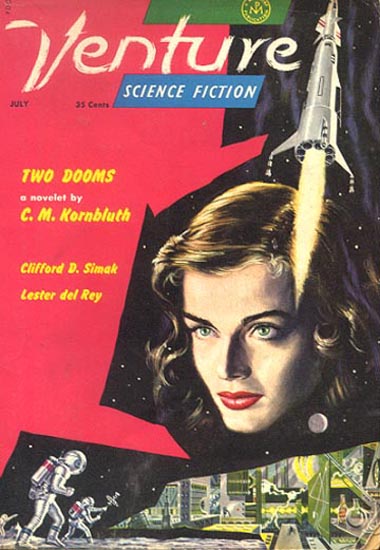
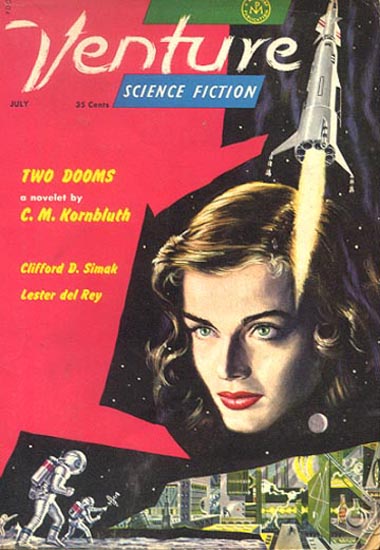
“Two Dooms” by C. M. Kornbluth. From the July 1958 issue of Venture Science Fiction. Kornbluth is maybe one of my favorite SF writers to have really flourished during the ’50s magazine boom-and-bust, although he had made his debut long before that. He was a prodigy whose earliest work was published when he was a literal teenager. Unfortunately he also died very young, at just 34, from a weak heart, robbing the field of one of its most incisive writers.
For the short stories:
“The Persecutor’s Tale” by John M. Ford. From the November 1982 issue of Amazing Stories. Speaking of very good writers gone too soon, Ford also made his debut when only in his teens, but he picked up on the trade pretty quickly. A writer’s writer, the best way to read a Ford novel is the read it twice. Sadly he died in 2006, at just 49, having not quite completed his final novel.
“Always” by Karen Joy Fowler. From the April-May 2007 issue of Asimov’s Science Fiction. Nebula winner for Best Short Story. Believe it or not, there’s an L. Ron Hubbard connection here. Fowler is maybe the most high-profile author to have made her debut in the annual (and Scientology-backed) Writers of the Future anthology series, although Fowler herself is not a Scientologist.
For the complete novel:
The Big Jump by Leigh Brackett. From the February 1953 issue of Space Stories. While Brackett’s first few stories were published in Astounding, she soon moved to other magazines that were more open to her brand of space adventure SF. By the end of World War II she’d come to be associated most with Planet Stories, in a mutually beneficial relationship. Indeed, after Edgar Rice Burroughs, Brackett can be considered the leading writer of planetary romance. She married fellow writer Edmond Hamilton in 1946, but they almost never collaborated. Nowadays she’s best known as a successful screenwriter, and for her grounded SF novel The Long Tomorrow, which is quite different from what she most often wrote. The Big Jump is a short novel, apparently published in magazine form unabridged, and later as one half of an Ace Double along with Philip K. Dick’s Solar Lottery.
As we near this marathon of stories from the first decade of Galaxy, I feel it’s now best to bring up Frederik Pohl, who in just a couple years would take over H. L. Gold’s position as editor in all but name before officially taking the magazine. Pohl is one of the most curious figures from old-timey SF, although he was one of the longest lived, having died in 2013. He worked in practically every stage of development in the world of SF writing, from author to editor to literary agent. I seriously recommend tracking down a copy of Pohl’s The Way the Future Was, which might be the single best memoir about the world of genre SF from the ’40s to the ’60s, from the perspective of someone who had lived through it. He officially became editor of Galaxy and If in 1961/1962 and would win the latter magazine three consecutive Hugos. He’s also pretty good as a writer, especially at short lengths, although his Hugo- and Nebula-winning novel Gateway is also one of the very best SF novels of the ’70s. He was a key member of the Futurians, a mostly left-leaning New York fan group that came about in the late ’30s, and which would serve as an entry point for some of the finest creative minds in the field, including C. M. Kornbluth, who himself was only a teenager when the group started.
Kornbluth was very young when he started writing professionally, but he needed that head start since he would also die tragically young, from a weak heart at the age of only 34. In fact today’s story, “Nightmare with Zeppelins,” would have been one of the last stories Kornbluth completed before his death in March 1958. The conventional narrative is that in the ’50s Kornbluth was the better writer at short lengths, while both authors at this point had their blind spots when writing novels. Pohl and Kornbluth were at their best together when writing novels, though, since they were able to make up for each other’s weaknesses; sadly they wrote only a few short stories together, not counting posthumous efforts wherein Pohl would work off a fragment or outline from the departed Kornbluth. One of these posthumous efforts, 1972’s “The Meeting,” won Kornbluth a Hugo more than a dozen years after his death, so that’s nice.
Placing Coordinates
First published in the December 1958 issue of Galaxy Science Fiction. It’s been reprinted in The Fifth Galaxy Reader (ed. H. L. Gold) and the Pohl-Kornbluth collections The Wonder Effect and Our Best: The Best of Frederik Pohl and C. M. Kornbluth.
Enhancing Image
Harry Lewes is a very old gentleman living in London during World War I, apparently having connections with H. G. Wells and George Bernard Shaw, the implication being that like those men, Lewes is or at least was a Fabian—that is to say basically a democratic socialist of the British sort. As far as I can make out, Lewes is a character of Pohl and Kornbluth’s invention, although I do have to wonder if they took inspiration from a certain historical figure. Anyway, Lewes is writing his autobiography, or rather an essay in place of a proper book, to recount something quite traumatic that had happened to him back in 1864, and which makes him worry about the German zeppelins looming overhead and a possibly more destructive war in the future. As a very young man Lewes had taken up an assignment from one Carlotta Cox (who also seems to be fictitious), a do-gooder who wanted Lewes to voyage out to “darkest Africa” and study some of the local peoples, in the name of combatting racism against black Africans. Her intentions are good. It doesn’t help either that, as Lewes notes, the American Civil War was happening at this time, which make no mistake was ultimately about the spreading of chattel slavery to the western territories. (People who say the American Civil War wasn’t about slavery and systemic persecution of black people are at best tragically misinformed.) However, once Lewes gets to the continent he nearly dies and is only saved by Herr Faesch, a “hardy Swiss” with his legion of native workers. While Lewes had by this point nearly died from illness, it wasn’t that near-death experience that haunts him to this day, as we discover in this taut little narrative.
(By the way, I do not suggest looking up this story on ISFDB, since whoever wrote the synopsis thought it was a good idea to give away the entire plot. Since it clocks in at under ten pages, however, and since its ending plays such a crucial role in understanding what Pohl and Kornbluth were going for, it’s hard to discuss without spoiling.)
When it comes to collab stories I often wonder about the process behind it, especially who was the main creative force behind it. Is this more of a Pohl story or a Kornbluth story? Both authors were, at this point, writing some of the most pessimistic genre SF the field has ever seen, and indeed one of the darkest SF stories from this period is Pohl’s own “The Census Takers” (review here). There is, however, a deep-running sense of dramatic irony here that feels very Kornbluth, albeit mixed with a prose style that mimics English writing from the Edwardian and late Victorian eras. “Nightmare with Zeppelins” on the one hand harks back to Wells in his prime (Wells being an important figure in-story, especially thematically, although he never actually appears to take part in the action), but it also is clearly written from a time Wells did not live to see, which was the Cold War at its height. That this is a Cold War-era story is a fact the authors can hardly be bothered to keep on the subtextual level; it becomes pretty obvious that while Lewes himself doesn’t name it, he is clearly looking into the future and seeing a world forever changed by the atomic bomb. Speaking of late Victorian and Edwardian shenanigans, an obvious point of reference for this story is Joseph Conrad’s Heart of Darkness, what with Herr Faesch being a Kurtz-like figure (albeit more benevolent than Kurtz) with his loyal band of black workers, the physically feeble but still dominant white figure who looms over a colonized Africa. But whereas Charles Marlow, the “hero” of Conrad’s novella, intentionally made his way along the Congo river to meet Kurtz, Lewes runs into Herr Faesch quite by accident. That Herr Faesch is less hateful and consumed by colonizer derangement syndrome than Kurtz, however, does not mean he hasn’t gone mad.
Herr Faesch runs a mine in this little corner of the continent, although it isn’t gold he’s mining but nuggets of Uranium-235, the properties of which he does not and sadly cannot understand fully. U-235, as you know, is the element crucial to the making of the nuclear fission bomb, which would be used on Hiroshima and Nagasaki; there’s a whole lot more to it, but that is really the gist of it. Early in the story Lewes talks about what Wells called a “radium bomb,” or a continuously exploding bomb; and it’s no coincidence that Wells around this time would’ve written The World Set Free, an otherwise obscure late novel of his that has gained some notoriety for anticipating something like nuclear weapons—in 1914. Mind you that despite being very much on the left, Wells, like most British intellectuals at the time, supported the UK’s participation in World War I. He reasoning seemed to be that with the right innovations in firepower, war as was understood would be rendered obsolete, feeding into the notion that World War I was “the war to end all wars.” There may be some grim irony in the fact that Wells lived long enough to witness the dropping of the atomic bomb, an event which struck him with profound horror, along with the realization that mankind is more likely to drive itself to extinction with such weaponry than it is to achieve world peace with said weaponry. It also doesn’t take a rocket scientist to get the feeling that Pohl and Kornbluth were hugely pessimistic about the use of nuclear weapons, in that they probably felt the US’s use of atomic bombs against Japan was morally reprehensible.
What’s impressive about “Nightmare with Zeppelins” is that it connects the dots between three very different periods of American-European history, positing that the so-called scramble for Africa in the latter half of the 19th century, the UK’s needless participating in World War I, and the years immediately following the end of World War II share a kinship that paints humanity in a dark light. It draws a direct line from European countries’ colonizing of Africa to the US committing some of the most heinous war crimes of the 20th century against Japanese civilians. The dramatic irony gets to be rather on-the-nose, in that it becomes impossible to ignore what Lewes himself is incapable of noticing, but the point that Pohl and Kornbluth wanted to make still gets across. This is a finely tuned little nugget of pessimistic Cold War-era SF.
There Be Spoilers Here
While he’s recovering in one of the tents, in what turns out to be a safe distance from the mine, Lewes gets the feeling that something horrible is about to happen, although he can’t put his finger on it. Then, one day, the mine explodes, with Herr Faesch and some of his workers inside it, the explosion forming a little mushroom cloud that can be seen from Lewes’s tent, himself only escaping injury because he happened to be covered against the blast at the time. Looking back on this, Lewes is both right and tragically wrong about the future of warfare, hoping in vane that the cursed nuggets of U-235 may never be used to build a new weapon, and that airships in the sky may never be used to drop such a weapon on people’s heads. It leans a bit too much into dramatic irony, but still the final passage is haunting, so I’ll quote it here, as Lewes writes in his essay:
One thing is sure: Count Zeppelin has made it impossible for Herr Faesch’s metal ever to be used for war. Fighting on the ground itself was terrible enough; this new dimension of warfare will end it. Imagine sending dirigibles across the skies to sow such horrors! Imagine what monstrous brains might plan such an assault! Merciful heaven. They wouldn’t dare.
If only he could know how wrong he is.
A Step Farther Out
I’d been curious about reading “Nightmare with Zeppelins” for a few years now, just going by its title, although thankfully I did not look up a synopsis before reading it. I really like Pohl and Kornbluth as writers individually, but together they pulled a Voltron and became one of the most socially keen-eyed SF writers of the ’50s. One has to wonder what might more they could’ve done had Kornbluth not died so young, since Pohl’s digging up his departed friend’s notes really doesn’t do the duo justice. It’s not a masterpiece exactly, but I do recommend it.
Let’s talk about where genre SF was at in 1950, because this year, perhaps more than any other year in the field’s history barring maybe 1926 (the launch of Amazing Stories) and 1953 (the year the magazine market reached critical mass). Changes in the field tend to come gradually; it’s not like, for example, one day you have a market that’s 95% WASPs and then the next it’s much more racially diverse. These things happen in movements, like the rest of history, or indeed like the waxing and waning of the tide. There really was a profound difference between how genre SF looked at the beginning of 1950 and how it looked by the end of the year. There were multiple changes happening at once, and not all of them were good. The less said about Dianetics the better. But you also had the publications of Isaac Asimov’s I, Robot and Ray Bradbury’s The Martian Chronicles, two “novels” (they’re really short story collections) that not only garnered acclaim from the usual suspects but even managed to break into the mainstream. This was practically unheard of at the time, to have science fiction that “normal” readers admitted to caring about. 1950 also saw the publication of other major SF books, like Robert Heinlein’s Farmer in the Sky, Theodore Sturgeon’s The Dreaming Jewels, A. E. van Vogt’s The Voyage of the Space Beagle, Asimov’s Pebble in the Sky, and the book version of Hal Clement’s Needle. Notice that with the exception of the van Vogt book, all the ones I just mentioned were aimed at younger readers—as in teenagers, those who might grow up to be SF enthusiasts.
A revolution, of a sort, was happening.
In the world of the genre magazines, things were shaking up at least much, even putting Dianetics aside. The Magazine of Fantasy and Science Fiction, which had launched in the fall of 1949, was finding its footing. There were signs of the coming deluge of new magazines, on top of the current rivals to Astounding, and the biggest of these new arrivals, by far, was Galaxy Science Fiction. Galaxy first hit newsstands with its October 1950 issue, which means it would’ve been available in September. Under the editorship of H. L. Gold, who had already proved himself a capable writer, this was a magazine that would do what Astounding could not, namely be socially conscious, with a focus on science fiction that was rather urbane and literate, while still being very much focused on science. But whereas Astounding was all about the hard sciences, Galaxy would focus just as much on the soft sciences, such as psychology and sociology. Being more socially conscious, there would also thus be much more of a focus on social satire, and one stereotype that would come to haunt Galaxy in the ’50s is that too many of its story would be misanthropic hehe-haha comedy pieces, aimed at the middle-class urbanites it was satirizing. As with The New Yorker around the same time (and indeed The New Yorker now), Galaxy ran the risk of coming off as incessantly liberal and middle-brow. This is a legitimate criticism, but it was also a risk one had to accept when changing the field this radically. To this day a lot of SF being published seemingly either takes after Galaxy under Gold’s editorship or Asimov’s Science Fiction under Gardner Dozois’s. There’s a third, more conservative (because Galaxy was kinda “woke” for its day) brand of SF writing that wants desperately to turn back the clock to a pre-Galaxy world, to a time before white people cared about things like social justice, but you can’t put the genie back in the bottle.
I had to think really hard about what stories and authors to cover this month, because the truth is that Galaxy at its peak had individual issues whose sheer quality and star power would put whole novels to shame. Nearly every story in a given issue would be a banger, or at least a fine read. There are people who wrote for Galaxy during its first decade that I had to leave behind, at least for the moment, including Theodore Sturgeon, Margaret St. Clair, Robert Sheckley, Philip K. Dick, Isaac Asimov, Clifford Simak, Cordwainer Smith, Poul Anderson, Ray Bradbury, and many others. But still we have a mix of usual suspects, as in those who regularly contributed to the magazine during this time, as well as a few lesser known authors. Of course I couldn’t have it all be now-famous selections.
Anyway, for the stories:
“Self Portrait” by Bernard Wolfe. From the November 1951 issue. If Wolfe is little known in the field, it could be because he wrote very little SF, putting out only one SF novel and a handful of short stories. Wolfe was a trained psychologist who also was a committed leftist, specifically a Trotskyist; he even knew the man himself personally, in the years right before Trotsky’s assassination.
“The Snowball Effect” by Katherine MacLean. From the September 1952 issue. I’ve covered MacLean before, actually not too long ago, but seeing as how her most prolific era was when she wrote for Galaxy in the ’50s, why not? She lived a very long time, although she didn’t write that much, making her debut in Astounding in 1949 before (for the most part) switching over to Galaxy.
“A Bad Day for Sales” by Fritz Leiber. From the July 1953 issue. Leiber is one of my favorite writers of old-timey SF, although he was also quite skilled (maybe even more so) in fantasy and horror. He debuted in 1939, and thus was one of the old guard, but he adapted to changes in the market with a chameleon’s touch. I picked this story specifically on a friend’s strong recommendation.
“The Big Trip Up Yonder” by Kurt Vonnegut. From the January 1954 issue. Vonnegut is one of those few authors who needs no introduction, but here it goes. He broke onto the scene in 1952 with his novel Player Piano, which was SF, as would be about half of his other novels. Despite not wanting to be pigeonholed as a “sci-fi” writer, he also occasionally appeared in the genre magazines.
“The Princess and the Physicist” by Evelyn E. Smith. From the June 1955 issue. We don’t know a lot about Smith, which unfortunately is not unusual for women in pre-New Wave SF, and incidentally she had mostly stepped away from the field by the time the New Wave and second-wave feminism kicked in. In the ’50s she wrote by far the most prolifically for Gold’s magazines.
“A Gun for Dinosaur” by L. Sprague de Camp. From the March 1956 issue. As with Leiber, de Camp was perhaps more adept at writing fantasy than SF, but then in the ’50s there wasn’t much of a demand for the former. He too was of the old guard, and was able to adapt to the changing times. He also lived an extremely long time, indeed having one of the longest careers in the field.
“Prime Difference” by Alan E. Nourse. From the June 1957 issue. Nourse is one of the lesser known of the original “hard” SF writers, and indeed the vast majority of his short fiction appeared in the ’50s when he was a very young man. He mostly stopped writing SF probably because he got a very well-paying job as a trained physician, but his work remains to be rediscovered.
“Nightmare with Zeppelins” by Frederik Pohl and C. M. Kornbluth. From the December 1958 issue. Pohl and Kornbluth were good friends for many years, but in the ’50s they collaborated on several novels and short stories, the most famous being The Space Merchants. Sadly Kornbluth died in early 1958, making “Nightmare with Zeppelins” one of the last stories he would’ve finished.
“The Man in the Mailbag” by Gordon R. Dickson. From the April 1959 issue. Dickson was born and raised in Canada (he’s from Alberta), but moved with his family to the US when he was a teenager. He’s most known for his regular collaborations with Poul Anderson, as well as his long-running and ambitious Childe cycle. He was one of the pioneers of what we now call military SF.
The ’50s—especially the first half—were a goldmine for satirical writing in genre SF, with writers like Robert Sheckley, William Tenn, and Philip K. Dick acting as court jesters for the scene; and then there was possibly the most talented of the satirists (or at least he could’ve been, had he lived longer), which was C. M. Kornbluth. Despite having died at the horribly young age of 34, of a weak heart, Kornbluth was prolific and at the time of his death he had been writing fiction for nearly twenty years. He debuted in 1939, about 15 years old, and wrote at a mile a minute (often under pseudonyms) until 1942, when he got pulled into the war effort. He would eventually return to writing circa 1949, just in time for the magazine boom that was about to take place, and he never looked back. He wrote quite a few novels, alone and in collaboration with Frederik Pohl, but his best stuff was short-form, which only got more ambitious as he aged.
“MS. Found in a Chinese Fortune Cookie” is arguably not even science fiction, but it is very much about science fiction, and about science fiction writers. It’s a self-reflexive dual narrative that, in only about ten pages, shows Kornbluth hunting intellectual big game. At first I wasn’t quite sure what to make of it, since it really is a weird fucking story; but, having sat on it for a few days now, I feel more qualified to talk about it. This is the kind of story that rewards the reader for already being familiar with the author’s work, but while it is fannish, it’s not exactly a flattering depiction of being into genre SF at a time when the genre got no respect.
Placing Coordinates
First published in the July 1957 issue of The Magazine of Fantasy and Science Fiction, which is on the Archive. It was then reprinted in The Best from Fantasy and Science Fiction, Seventh Series (ed. Anthony Boucher), the only book publication of this story Kornbluth lived to see. It appeared in the Kornbluth collections The Marching Morons and Other Science Fiction Stories, Thirteen O’Clock and Other Zero Hours, and His Share of Glory: The Complete Short Science Fiction of C. M. Kornbluth.
Enhancing Image
There are two threads, which I’ll call the primary and secondary narrative. The primary is a series of messages hidden inside fortune cookies (hence the title), written by one Cecil Corwin, science fiction writer; and the secondary is asides written by C. M. Kornbluth, whom you may have heard of. Corwin has apparently gone insane and vanished off the face of the earth, with only these secret messages detailing what happened to him, in his own words, while Kornbluth, being a long-time friend and Corwin’s literary executor, gives us some much-needed context. Thus we have the “Corwin Papers”—notes you’d find in place of those platitudes that are normally found inside delicious fortune cookies. It’d be accurate to title the story “MS. Found in Chinese Fortune Cookies,” but I understand that doesn’t quite as good. Still, we have two protagonists: Corwin and Kornbluth.
This is all a bit strange, not least because “Cecil Corwin” is one of the aforementioned pseudonyms Kornbluth used back when he started writing. I’m not sure how many readers in 1957 would’ve known this, but Anthony Boucher almost certainly knew, as did some other folks who knew Kornbluth personally. The implication is that Corwin and Kornbluth are meant to be taken as the same person, or maybe as two sides of the same persona, or maybe as two personalities inhabiting the same body a la A Scanner Darkly. Immediately we’re thrown into the deep end of metafictional hijinks, in a maneuver that probably would’ve made Jorge Luis Borges proud (although Kornbluth had almost no way of knowing about Borges in his lifetime). There are some other characters mentioned, very likely based on real people, whose names have been changed undoubtedly for legal reasons and because Kornbluth doesn’t wanna make too many enemies.
Corwin is a writer who thinks he has found what he calls The Answer—the one secret to life, the universe, and everything, which would end human suffering and initiate the kingdom of Heaven on Earth. Despite being on the brink of monumental success, Corwin suspects he might also be on the precipice of insanity. “Of course The Answer looked logical and unassailable, but so no doubt did poor Charlie McGandress’ project to unite mankind through science fiction fandom, at least to him.” I get the impression Kornbluth (the author) was trying desperately not to bring up L. Ron Hubbard or Scientology by name, but you’d have to be blind as a bat to not notice the allusions to what were then fandom hijinks. And in fairness to Corwin, he’s not wrong when he suspects that trying to write out The Answer will get him into serious trouble. Indeed the conspiracy surrounding The Answer is the closest the story gets to SF territory, which reminds me of the centuries-long feud at the heart of The Crying of Lot 49. I wonder if Thomas Pynchon has read Kornbluth?
I wouldn’t recommend “MS. Found in a Chinese Fortune Cookie” to people unfamiliar with Kornbluth for a few reasons: it assumes you know who Kornbluth is, that you have at least a cursory knowledge of SF fandom politics in the ’50s; and also, structurally, this is a tangled mess of a story. We’re given two unreliable narrators for the price of one. Immediately we’re signaled to doubt Corwin because he says, “They say I am mad, but I am not mad”—only to chide himself for opening on such a cliched line. Then there’s Kornbluth (the character), who cuts out parts of Corwin’s writing for a few given reasons, but the result is that the notes are left even more fractured than they would’ve been originally. Kornbluth (the character) will also sometimes cut in to voice his disagreement with something Corwin says, either because he genuinely believes what he’s saying or because he wants to make sure not to get caught in the conspiracy that would drive Corwin to write these messages. Needless to say the plot is hard to spoil, because of its layers but also the fact that the story is inextricably linked with Kornbluth’s career within the history of genre SF.
There is a key to this story, in a way, although it wouldn’t be published until after Kornbluth’s death. For people like myself who are actively interested in “old” science fiction there’s a little volume called The Science Fiction Novel: Imagination and Social Criticism (ed. Earl Kemp), published in 1959, which collects four lectures given by as many SFF writers, those being Robert Heinlein, C. M. Kornbluth, Alfred Bester, and Robert Bloch. These lectures were originally given a couple years earlier, which Kornbluth giving his in January 1957 at the University of Chicago. The name of the lecture is damning: “The Failure of the Science Fiction Novel as Social Criticism.” The idea, basically, is that while there have been works of SF that work as social criticism, there are too few such examples in a sea of pure entertainment; and, maybe more damningly, said examples fail to leave a tangible impression on the public consciousness. Aside from some excessive psychoanalyzing of George Orwell, it’s a good read.
At one point Kornbluth talks about Wilson Tucker’s 1952 novel The Long Loud Silence, a novel which he feels is effective as social criticism, but an abject failure in sparking any societal change. Unlike Harriet Beecher Stowe’s Uncle Tom’s Cabin and Upton Sinclair’s The Jungle, which (Kornbluth says) really did change how some people thought and acted (in the case of The Jungle it directly inspired government policy), The Long Loud Silence made no such impression; not only that, but it didn’t become a bestseller and is indeed now an obscure novel—forgotten. In trying to explain how this happened, Kornbluth goes further to explain what it was like being a “science fiction writer” in the ’50s, at a time when the market was more vibrant than ever before but which the mainstream dared not touch:
[The Long Loud Silence] was ignored because publishers think of their books in rigid categories. Tucker’s book fell into the category “science fiction.” Books in the category “science fiction” get no promotion or advertising to speak of, they get misleading jacket blurbs, and a sale of five thousand copies is considered a realistic target. The idea is to sell it to the science fiction readers, clear expenses, make a little money on the paperback reprint, pat the author on the back and tell him to write another book, boy, we love your stuff.
Even 1984, which was a bestseller and which Kornbluth praises immensely, had failed to spark any societal change. One of the most famous novels in the English language, often quoted (and misunderstood), and yet despite its immense popularity 1984 remains a novel of ideas that have never materialized. There has not been (to my knowledge) a libertarian socialist society that exists now past the extreme local level, let alone one that takes direct inspiration from Orwell’s warning. (The point of the novel, of course, was the scare readers away from capitalism and socialistic fascism [or fascistic socialism] and encourage a socialist change wherein people of all skin colors and class backgrounds would be allowed to flourish.) If even the most famous SF novel on the planet cannot do what mainstream literature has done, then why are we here? What is the purpose of writing science fiction other than for the lulz and the funzies? Is SF hopes to stand on the same level as mainstream literature then (Kornbluth says) there has to be a work on part with Uncle Tom’s Cabin in terms of societal impact. (That Uncle Tom’s Cabin is now often held as an “important” but poorly aged protest novel that one doesn’t read for pleasure is beside the point.)
The increasing existential dread for the SF writer is one both Corwin and Kornbluth sense, although unlike Kornbluth (the author), Corwin thinks he has found the answer—even The Answer. In a sense you could say this story is autobiographical, because I do think Corwin’s anxiety about the seeming unimportance of the SF writer mirrors Kornbluth’s own. It’s like what he says about the relationship between the reader and the SF writer (although you could argue this goes for any writer of fiction): “There’s a touch of intellectual sadism in us. We like to dominate the reader as a matador dominates the bull; we like to tease and mystify and at last show what great souls we are by generously flipping up the shade and letting the sunshine in.” Science fiction—the reading and writing of it—is like a game. But Corwin and Kornbluth argue this must not or at least should not be so—that science fiction should serve more purpose than as entertainment.
There Be Spoilers Here
[REDACTED]
A Step Farther Out
When Kornbluth died in March 1958 he was on his way to succeeding Anthony Boucher as editor of F&SF, and one can’t help but wonder where the magazine might’ve gone under his direction. Certainly he was becoming increasingly concerned with the bottom-tier position science fiction occupied in the zeitgeist, having at that point been relegated mostly to monster movies and speculation on new technology. The complexity and seriousness (despite its absurd premise) of “MS. Found in a Chinese Fortune Cookie” point toward Kornbluth trying to open a door—a door that would prematurely slam shut. I’m reminded of the SF Encyclopedia’s entry on Edgar Allan Poe, who like Kornbluth died young, before he could reach his full potential: “If his career had lasted longer, he might have awoken us more inescapably to his vision; as it stands, we must awaken ourselves to him.” The same can be said of Kornbluth.
Anthony Boucher and J. Francis McComas wanted to start a fantasy magazine in the mid-’40s, but couldn’t get it greenlit until the decade was about to end. They both were perfectly qualified for such an endeavor, at a time when the SFF magazine boom was still a year or two off: Boucher was an accomplished author and book reviewer while McComas had just co-edited what was, at the time, the definitive SF anthology with Adventures in Time and Space. According to Lawrence E. Spivak’s (F&SF‘s initial publisher) introduction in the inaugural issue, The Magazine of Fantasy would try to encompass the whole breadth of fantasy, “from the thrilling to the chilling, from the comic to the cosmic,” providing a safe haven for what must’ve at the time seemed like the endangered species that was short fantasy fiction. Unlike Weird Tales, which leaned towards horror, and Unknown, which leaned towards the comedic, The Magazine of Fantasy would take a jack-of-all-trades approach with what material was accepted.
Of course, It would only stay “just” a fantasy magazine for the first issue. From the Winter-Spring 1950 issue onward it would be the magazine we now know and love, incorporating SF and fantasy of almost every flavor. But just because the editors caved and hopped on the SF bandwagon doesn’t mean F&SF was any less unique than before; on the contrary, it remained the only SFF magazine of its kind in the ’50s, and even today it stands out as arguably the most progressive outlet in the field thanks to the efforts of current editor Sheree Renée Thomas. Indeed for most of its life F&SF has had a left-leaning mindset, with Boucher and McComas making it clear from day one that they would go out of their way to encourage women who were trying to make it in what was up to that point a thoroughly male-dominated market. When it came time for picking what stories by which authors I should cover this month, it would’ve been easy to have an entirely all-women lineup, given contributors to F&SF in the Boucher/McComas years: Zenna Henderson, Rosel George Brown, Miriam Allen deFord, Mildred Clingerman, Judith Merril, and the list keeps going.
F&SF turns 75 this year; it is the second oldest SFF magazine still active, only behind Analog Science Fiction. Whereas Analog intentionally appeals to an older and more hard-nosed sect of genre readership, however, F&SF is remarkable for its ability to change its colors chameleon-like with the times, and even being ahead of its time on occasion. It would be a fool’s errand to cover fiction from the whole span of F&SF‘s existence, so I decided to devote March, July, and October to the ’50s, ’60s, and ’70s respectively. As such, for this month, we’re looking at a small sample of what was published during the Boucher/McComas years, then during Boucher’s solo tenure, and finally the beginning of a short but very fruitful period with Robert P. Mills’s editorship. Something that really made F&SF stand above its contemporaries was its sense of dignity, being a digest with artsy and at times abstract covers that managed to snag authors from outside the genre SFF market. You have Shirley Jackson, who was definitely a genre author but who very rarely went outside the “slick” markets; and you have Robert Graves, who was totally outside the field but who would appear (with reprints) a few times in F&SF. I think I’ve said enough now; let’s get to it.
For the short stories:
“The Listening Child” by Margaret St. Clair. From the December 1950 issue. I covered St. Clair not long ago, although if I’m being honest I was in the midst of a horrible time in my life (long story), and thus I think she deserves another go now that I’m (for the moment) in a healthier state of mind. “The Listening Child” was the first published under St. Clair’s “Idris Seabright” pseudonym.
“The Shout” by Robert Graves. From the April 1952 issue. First published in 1929. The early years of F&SF were defined in part by its reprints, so I felt obligated to pick one. It helps that I had read I, Claudius and Claudius the God recently and loved them. “The Shout” sees Graves going for supernatural horror, published the same year as his star-making memoir Good-Bye to All That.
“The Silken-Swift” by Theodore Sturgeon. From the November 1953 issue. Sturgeon is one of my favorite writers; in terms of the short story I think he rivals Hemingway and Cheever. Nobody in the field at the time had a bigger heart, and impressively he hopped between SF, fantasy, and horror. “The Silken-Swift” is from Sturgeon during his peak era, and is also said to be one of his own favorites.
“Mousetrap” by Andre Norton. From the June 1954 issue. Readers of a certain age will tell you they got into SF by reading Heinlein’s juveniles, Norton’s, or both. Norton is one of the most prolific writers in the field’s history, with her Witch World series alone taking up a whole shelf or two. Strange thing is she wrote relatively little short fiction, and even less of it appeared in the magazines.
“Free Dirt” by Charles Beaumont. From the May 1955 issue. Beaumont was one of the best horror and fantasy writers of the ’50s and early ’60s, and would’ve kept at it had he not died of a horrific brain disease at 38. He was the third most prolific writer on The Twilight Zone, behind Richard Matheson and, of course, Rod Serling. He also had a movie review column in F&SF around this time.
“Steel” by Richard Matheson. From the May 1956 issue. Speaking of which, Matheson is a personal favorite of mine, and unlike Beaumont he did live (indeed a very long time) to see some degree of mainstream recognition. He’ll always be most famous for I Am Legend, but I’ll always think of him first as a short story writer and screenwriter. “Steel” was itself turned into a Twilight Zone episode.
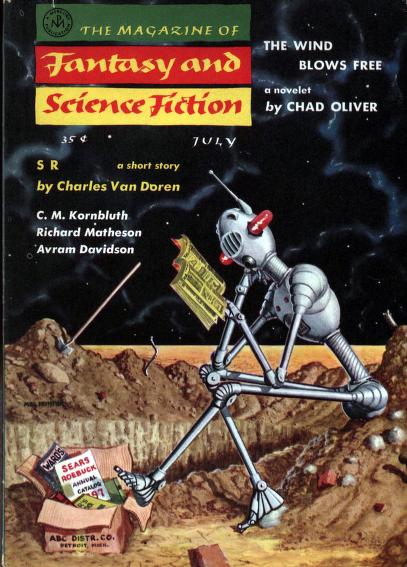
“MS. Found in a Chinese Fortune Cookie” by C. M. Kornbluth. From the July 1957 issue. Like Beaumont, Kornbluth died way too young, but he also got a lot of work done in the short time he had. He’s most known for The Space Merchants, written with Frederik Pohl, but for my money he was a better short story writer than novelist. This was one of the last stories of his published in his lifetime.
“The Omen” by Shirley Jackson. From the March 1958 issue. Jackson is one of those authors who needs no introduction. She’s one of the most famous American horror writers, and one of the few prior to the ’70s to find success with horror novels more specifically. Sadly she didn’t live to take advantage of the ’70s horror boom. “The Omen” is pretty obscure for Jackson, likely because it’s not horror.
“Day at the Beach” by Carol Emshwiller. From the August 1959 issue. Wife of artist and filmmaker Ed Emshwiller, Carol is just as talented as her husband, proving early on she had a knack for the short story. She started in the ’50s and kept writing until her death in 2019. In a case of creatives in a relationship supporting each other, Ed sometimes did art for Carol’s stories, as is the case here.
I think I struck enough of a balance between SF and fantasy with this roster. It’s very tempting to focus only on the SF part of F&SF, but fantasy of various flavors (except sword-and-sorcery, which Boucher and McComas were weirdly deaf to) has always played a part in the magazine, especially in those early years. Short stories, as opposed to novellas and serials, defined F&SF at the outset, so it also happens to make sense we’re reading nothing but short stories this month.
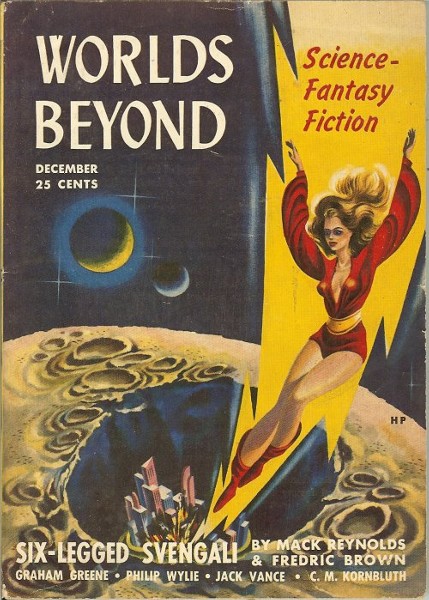
(Cover by Paul Calle. Worlds Beyond, December 1950.)
Who Goes There?
C. M. Kornbluth stands as one of the most gifted and emblematic practictioners of ’50s SFF, a connection made more tragically profound by the fact that he died almost at the time when that decade ended, at the age of 34. Despite dying so young, Kornbluth had a fairly long and productive career, making his first sales when he was only 16 or 17, and by the time he went off to serve in WWII he already had a considerable amount of short work under his belt, though unsurprisingly Kornbluth’s early work is considered minor. Cut to 1949 and Kornbluth, still only 25 but seemingly having learned the do’s and don’t’s of short story writing from his pre-war experience, has returned a more mature writer, and he would stay a fixture of the field until his death in 1958. The back-to-back deaths of Kornbluth and Henry Kuttner marked a dark point for SFF as a vehicle for social commentary, having lost two of its best satirists, but it also lost two of its best short story writers. With Kornbluth gone, the field would never quite be the same again.
On top of the many short stories and several novels he wrote solo, Kornbluth also collaborated with fellow Futurians Frederik Pohl and Judith Merril, the former on a few notable novels (including The Space Merchants) and the latter on a couple of less notable but competently written novels. The Futurians were a largely left-leaning New York-based fan group that included Kornbluth, Pohl, Merril, James Blish, Isaac Asimov, Damon Knight, Donald Wollheim, among others. Pohl, himself barely out of his teens, was made editor of two second-rate but historically important magazines, Astonishing Stories and Super Science Stories, in the early ’40s, and Pohl filled these magazines with amateur works from some of his fellow Futurians, including Kornbluth. In his mature phase, Kornbluth would be associated with the two most lauded SFF magazines of the ’50s, Galaxy Science Fiction and The Magazine of Fantasy and Science Fiction.
Placing Coordinates
“The Mindworm” was first published in the December 1950 issue of Worlds Beyond, that magazine’s first issue. Worlds Beyond is the perfect kind of magazine to talk about for my blog, because it’s forgotten now and it had a dreadfully short run, despite the quality of its fiction. Edited by a young Damon Knight (whose experience as assistant editor for the revived Super Science Stories seemed to encourage him to start his own magazine), and featuring new fiction by some of the most promising young voices in the field as well as a considerable amount of reprints by notable forerunners (Franz Kafka, Rudyard Kipling, etc.), Worlds Beyond looked to be a somewhat pulpier but much worthy counterpart to F&SF. In the first issue alone we have stories by C. M. Kornbluth, Mack Reynolds, Fredric Frown, Jack Vance, Franz Kafka, and Graham Greene. The Vance is especially notable because while “The Loom of Darkness” may sound unfamiliar to one’s ears, it would ring a lot more bells with its book title, “Liane the Wayfarer,” as part of The Dying Earth.
As for “The Mindworm,” it’s pretty easy to find. The December 1950 issue of Worlds Beyond is on the Archive, and it was reprinted in the November 1955 issue of Science Fantasy (possibly its first UK publication), also on the Archive. It’s also been collected fairly often, appearing in The Penguin Book of Vampire Stories (also titled simply Vampires, but if it’s edited by Alan Ryan then it’s literally the same anthology) and, of course, His Share of Glory: The Complete Short Science Fiction of C. M. Kornbluth. Both are in print and, needless to say, essential if you’re a fan of Kornbluth and/or vampire fiction.
Enhancing Image
We start with a chance encounter between a nurse and a j. g. (I don’t know what this abbreviation stands for) and are told, in so few words, that they hook up one night and the nurse gets pregnant as a result. Being young and aspiring, and in a time when abortion was pretty risky, the nurse drops her newborn son off at a “well-run foundling home” before getting the hell out of there. The son, who’s only called the Mindworm in-story, grows up to be quite the troublemaker, though this is not immediately apparent. We find out early, although nobody makes the connection outright, that the Mindworm can read people’s minds; he’s a telepath, but that’s not the end of it. Telepathy was already a well-worn SF trope by the time Kornbluth wrote “The Mindworm,” and the vampire story would’ve been much older and even more worn out, but I’m not sure if anyone up to this point had combined telepathy with vampirism. The result is a different kind of vampire story that still feels modern, kept even more fresh by Kornbluth’s snappy and highly condensed method of storytelling.
A few things to note. How much “The Mindworm” could be considered SF and how much it could be considered horror is somewhat up for debate; it seems to have been anthologized more often in horror anthologies than SF anthologies. While the Mindworm being telepathic is unquestionably SF, we’re not given a science-fictional explanation for his powers—indeed we’re not given an explanation at all, except for the faintly implied explanation that the Mindworm is a mutant, but more on that later. What’s impressive here is that Kornbluth lays out a man’s entire life in about a dozen pages while also giving us characters who, while not characterized with too much depth, are written vividly enough that we at least get a strong impression of them. Kornbluth may not be the most philosophical or humane of writers (actually he’s sadistic quite a bit of the time), but he does have an intimidating sense of economy, turning potentially a novel’s worth of story into a dozen pages that need not have one page added to them.
Take the following paragraph, for instance, which sums up most of the Mindworm’s boyhood (a series of events that you could dedicate a whole chapter in a novel to, or even several chapters) so neatly and so quickly while also making things just a little ominous.
The boy survived three months with the Berrymans. Hard-drinking Mimi alternately caressed and shrieked at him; Edward W. tried to be a good scout and just gradually lost interest, looking clean through him. He hit the road in June and got by with it for a while. He wore a Boy Scout uniform, and Boy Scouts can turn up anywhere, any time. The money he had taken with him lasted a month. When the last penny of the last dollar was three days spent, he was adrift on a Nebraska prairie. He had walked out of the last small town because the constable was beginning to wonder what on earth he was hanging around for and who he belonged to. The town was miles behind on the two-lane highway; the infrequent cars did not stop.
The Mindworm is a drifter, a bastard who doesn’t lurk in a castle but rather haunts highways and alleys, who doesn’t live in seclusion away from civilization but rather uses civilization as a feeding ground; in other words, he’s a modern vampire. I’m not a scholar on the history of vampire literature, although I’ve not a total ignoramous on it; I’ve read Dracula and “Carmilla” and some of the other classics, and of course I’ve seen my fair share of vampire movies. I can’t imagine there was much of a market for vampire fiction in the late ’40s or early ’50s, what with Weird Tales being on its last legs, Unknown having gone under years prior, and the newly created F&SF not having much space for horror. I’m also not sure if there are any vampire novels from this period of significance; I certainly haven’t heard of any. Yes, there’s Richard Matheson’s famous short novel I Am Legend, but that would not come out for a few more years. I say all this because “The Mindworm” must’ve struck Damon Knight, a man who would turn out to have an appetite for the weird and experimental, as a real breath of fresh air.
The Mindworm himself is an interesting spin on the vampire because he’s one of the few vampires I can think of off the top of my head who’s closer to a beast than a human, and to make things more interesting he’s physiologically totally human. A beastly vampire tends to be just as beastly in a physical way, but the Mindworm looks like a normal guy—he’s even described, in adulthood, as resembling a few of-the-time movie stars. Yet the Mindworm seemingly exists only to feed, being a parasite like his name implies, not forming any human connections or having any even remotely human aspirations. The terror of the Mindworm is twofold: his method of killing is unseen, almost esoteric (we’re not really told how these people die), and also he can’t be reasoned with. You could be sitting in your living room, watching Deep Space Nine, minding your own business, when the Mindworm, having probed your mind from just outside your window and gotten info on the things you care about most, barges in and fucks your shit up.
Eventually the Mindworm takes up residence in one of those West Virginian-type industrial towns, where he continues to wreak havoc. Unbeknownst to the Mindworm, however, there are some in town who have been tracing his steps, waiting for the opportunity to catch him in the act…
There Be Spoilers Here
“The Mindworm” is hard to spoil, not least because the blurb at the beginning pretty much gives away the ending already, which I’m not a fan of. Get a load of this:
You might think of him as an ascetic, for he lived on nothing more substantial than human emotion. Or you might call him a sadist, for the deaths of other men were his life. The coal-town Slavs he despised had another, simpler name for him; and a very simple, very ancient remedy for the terror he brought.
Explains too much, especially after having read the story. We’re told what the Mindworm does, what he feeds off of, and that he’s gonna get his comeuppance at the end. The how of the Mindworm’s demise is less predictable, but if you know your classic vampire lore then you can figure that out easy enough. I’m not sure who writes these blurbs, honestly, if the authors write them of if the editor does it, because I can’t imagine Kornbluth would give himself away like this; if he did, that’d be disappointing. Never mind that the phrasing in the blurb makes it sound like the Mindworm is just another pest, like a rat, as opposed to a serial killer who’s killed at least a dozen people (probably dozens more off-screen) in-story. Of course much of the fun of reading “The Mindworm” is the different perspectives we get in so short a time, all the people the Mindworm comes across and how everyone is totally clueless as to what’s happening except for a small group of people. Eight people are killed in a dark movie theater and nobody can figure out what happened—nobody except the vampire hunters.
The Mindworm gets caught because for one, despite being a telepath, he’s not very smart and he doesn’t cover his tracks well, but he’s also unable to read the minds of people who think in languages other than English. Sure, he can technically read those minds, but he can’t understand them, which gives the Eastern European vampire hunters a sort of camouflage. My favorite scene actually comes toward the end and doesn’t involve the Mindworm but rather the vampire hunters, the “other town” that operates outside of public law. As I’ve said before, Kornbluth does a lot with few words, and there’s a lot of history here that’s implied but not said outright. This comes after the Mindworm has taken another victim, a young girl who presented herself as a prostitute but who apparently had no experience, and who apparently was related to the vampire hunters in some way.
The countless eyes of the other town, with more than two thousand years of experience in such things, had been following him. What he had sensed as a meaningless hash of noise was actually an impassioned outburst in a nearby darkened house.
“Fools! fools! Now he has taken a virgin! I said not to wait. What will we say to her mother?”
An old man with handlebar mustache and, in spite of the heat, his shirt sleeves decently rolled down and buttoned at the cuffs, evenly replied: “My heart in me died with hers, Casimir, but one must be sure. It would be a terrible thing to make a mistake in such an affair.”
The weight of conservative elder opinion was with him. Other old men with mustaches, some perhaps remembering mistakes long ago, nodded and said: “A terrible thing. A terrible thing.”
The ending, which follows this scene, is incredibly brief. The hunters barge into the Mindworm’s room once they pick up his telepathic projections (how they’re able to do this is not explained) and do what you do with vampires, the whole stake-and-scythe routine. The Mindworm’s death is treated quite casually, as if he was a big pimple being popped, which I suppose backs up the blurb’s description of the Mindworm being like a pest even if it downplays the threat. I also like this notion that while the Mindworm is a mutation, he’s not the only one of his kind; in other words, he’s not that unique, and that his exaggerated image of himself as this totally unique thing contributed to his downfall. A shame he never picked up a copy of Dracula, or like… anything vampire-related.
A Step Farther Out
Despite being uncharacteristically horror-tinged for him, Kornbluth’s bitterness and penchant for satire still shines through in “The Mindworm.” The victims are largely shown to be obnoxious and feeble-minded Americans whose vanity makes them easy prey. The ending is brought about not by the boys in blue but by a third party, a band of immigrants who know better and who have delt with this problem before; it’s one of those things that makes me wonder where Kornbluth falls on the political spectrum. Certainly an anti-capitalist (or at the very least anti-corporate) streak runs through much of Kornbluth’s fiction, but there are also sentiments in there that come off as proto-libertarian. His 1953 novel The Syndic postulates that the US may be better off in the hands of old-style gangsters than with a conventional government and a mixed economy, and I get a similar impression with the immigrant vampire hunters in “The Mindworm.” State law enforcement proves totally inept about dealing with the vampire problem, so it’s left up to a small grassroots organization to take care of things.
Is it scary, though? I’m not the best person to answer that, just because the vast majority of horror (yes, even the good stuff) fails to spook me, and I can’t say I was sufficiently spooked with “The Mindworm.” I do think, however, that it is effectively written horror with an SF bent, with a mature Kornbluth evidently having come into his own as a sharp-tongued craftsman. I dare say that I prefer “The Mindworm” over another early “mature” work of Kornbluth’s, “The Little Black Back,” which itself is also an effective and inventive (not to mention violent) yarn which borders on horror, but which is not as economically told as the subject of today’s review. “The Little Black Bag” ends on a stronger note, but “The Mindworm” feels more modern, more transgressive, more literary, and I don’t think it’s a coincidence that the former was published in Astounding Science Fiction while the latter saw print in a much newer and more literary-minded magazine. Kornbluth may have started at the tail end of the ’30s, but his vicious wit and sheer crastsmanship at short lengths made him a harbinger of things to come for ’50s SFF.
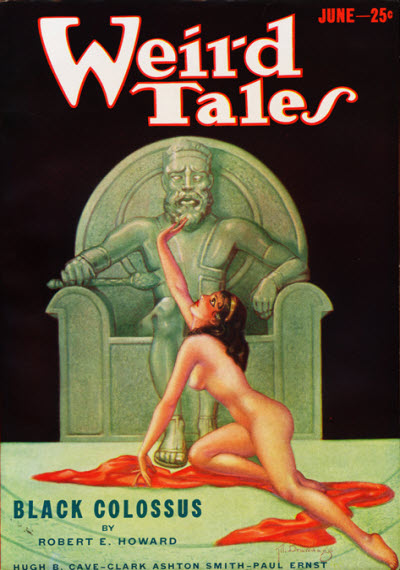
(Cover by Margaret Brundage. Weird Tales, June 1933.)
Halloween is getting close, and you know that means: a Halloween-appropriate story lineup! I feel no shame when I say I fucking love Halloween; it’s the only holiday I really get in the mood for. As such I figured I ought to do something special for October, not only picking more horror-centric stories but also changing my rotation method. Normally I would cycle short stories and novellas with serials, but something I’ve realized about horror (and you can say this is just my opinion) is that it works best in small doses. There wasn’t even much of a market for horror novels until the ’80s, and aside from Weird Tales there has, historically, not been much magazine space given to longer horror tales unless they’re reprints. As such, serials are OUT this month, and so are novellas, much as I love the things. Instead of getting only a few short stories and novellas we’re looking at nine short stories and novelettes, which is a considerable number!
For a while, when picking stories for my schedule, I had planned on including works by Lovecraft, Bradbury, and Stephen King, but decided at the last minute that I didn’t wanna deal with those who are unquestionably the most popular in the field; instead I went for deeper cuts, some by established horror authors, others by authors who are not normally associated with horror. I had almost included “Colony” by Philip K. Dick, but seeing as how I had already read it before and since I had come to the conclusion that I wanted all of these to be first reads, I ejected it. I’m sorry, Phil, I STILL LOVE YOU. This is also the first lineup where there are more female authors than male authors—that’s right, there are five women against four men! But to “compensate” we have the raw male chauvinism of James Blish and Harlan Ellison.
Now, as for the short stories…
“The Mindworm” by C. M. Kornbluth. Published in the December 1950 issue of Worlds Beyond. While not usually associated with horror, Kornbluth’s fiction tends to run in a morbid vein, being incredibly pessimistic and clearly disguted with the human condition. Despite dying at the horribly young age of 34, Kornbluth was both something of a prodigy (he started getting published professionally while still a teenager) and prolific at short lengths, especially from 1949 to his death in 1958. “The Mindworm” belongs to that streak of fiction, and is apparently a rare instance of Kornbluth writing straight horror.
“Hungry Daughters of Starving Mothers” by Alyssa Wong. Published in the October 2015 issue of Nightmare Magazine. Wong is a young author in the field, and their body of work remains fairly small, but their interests are spread impressively wide and they’ve already gotten their fair share of accolades. On top of being a productive short story writer (no novel as of yet, though), Wong has also written for comic books and even video games, with Overwatch being their big credit in the latter medium. “Hungry Daughters of Starving Mothers” won the Nebula as well as the World Fantasy Award.
“Bite-Me-Not or, Fleur de Feu” by Tanith Lee. Published in the October 1984 issue of Asimov’s Science Fiction. Lee is (or was) a startlingly prolific author of mostly fantasy and horror, writing dozens of novels plus a small army of short stories. Her reputation is apparently quite high, but unfortunately I’ve not read anything by her before. I found out through someone on Twitter that she’s one of the very few authors in SFF history to have more than one magazine issue made in tribute to her, including but not limited to an issue the revived Weird Tales.
“Genius Loci” by Clark Ashton Smith. Published in the June 1933 issue of Weird Tales. Smith was, along with H. P. Lovecraft and Robert E. Howard, one of the defining authors contributing to Weird Tales during its “classic” run. A poet first and foremost, Smith turned to writing short stories as a way of paying the bills, and during that brief time in the early to mid-1930s he gave Lovecraft a run for his money with both his lavish prose and his tales of cosmic speculation. Smith virtually stopped writing fiction by 1937, but his legacy very much lives on.
“Daemon” by C. L. Moore. Published in the October 1946 issue of Famous Fantastic Mysteries. Aside from the trio of Lovecraft, Howard, and Smith, no author defined the glory days of Weird Tales more than C. L. Moore, although unlike her aforementioned contemporaries she would move on to bigger and better things. Moore was, alongside her husband Henry Kuttner, one of the great masters of Golden Age SF, but “Daemon” sees her try her hand at horror and fantasy once again, at a time when the market for both genres had shrunk greatly.
“The Horse Lord” by Lisa Tuttle. Published in the June 1977 issue of The Magazine of Fantasy and Science Fiction. Tuttle debuted in 1972 and immediately made some sort of impression with the SFF readership, being barely out of her teens when she tied with Spider Robinson for the Astounding Award for Best New Writer. While she sometimes writes science fiction, most famously collaborating with George R. R. Martin, Tuttle’s home turf would remain feminist-tinged horror, and more often at short lengths.
“Grail” by Harlan Ellison. From the April 1981 issue of Twilight Zone Magazine. Ellison has to be onf of the most acclaimed and yet divisive personae in SFF history. When his career gained direction in the mid-’60s he seemingly catapulted from a second-rate hack to one of the biggest names in the field, eventually winning the Hugo, Nebula, Bram Stoker, and other awards. Much of Ellison’s fiction can be classified as horror, despite Ellison himself not being thought of as primarily a horror author, but “Grail” sees him in pure terror mode.
“The Idol of the Flies” by Jane Rice. Published in the June 1942 issue of Unknown. Rice is pretty obscure nowadays, which isn’t surprising considering she never had a novel published (she did write one, but for reasons I’ll get into it’s lost media) and her output became highly sporadic after Unknown shut down. A shame, because Rice was one of the more interesting young horror authors coming about at a time when there wasn’t much of a market for horror. “The Idol of the Flies” is considered major enough to have Rice’s single collection named after it.
“There Shall Be No Darkness” by James Blish. Published in the April 1950 issue of Thrilling Wonder Stories. Like Kornbluth, Blish was a member of the Futurians, a New York-based SF fan group that would prove unspeakably influential on the field, especially in the ’50s. Also like Kornbluth, Blish would die fairly young, albeit under different circumstances. 1950 saw the start of Blish’s iconic Cities in Flight series, but he also produced a curious SF-horror mashup with “There Shall Be No Darkness,” which supposedly explains werewolves in science-fictional terms.
As of late I’ve been struggling a bit to keep up the read/review schedule as my day job has gotten a bit more hectic lately (though my natural tendency toward procrastination doesn’t help things), but with all short stories this month it looks like I’ll get a breather for the moment. I’m in the mood for SPOOKY MONTH and I hope these stories won’t let me down.