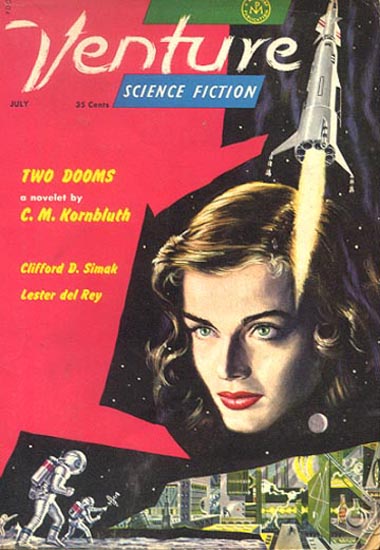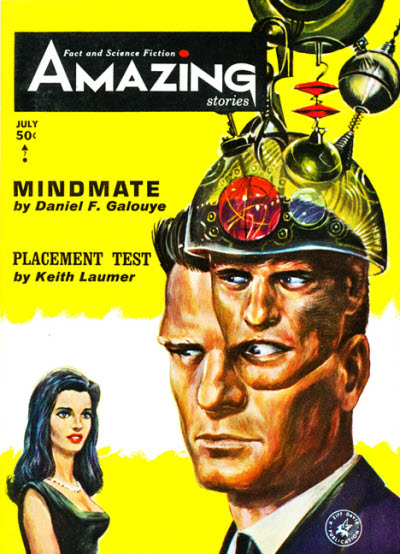
We are now knee-deep in spring, which means last month I narrowly survived a fit of allergies. (I’m not really exaggerating, I got hit with what the doctor called postnasal drip, and for some days it was difficult to even breathe, let alone sleep at night.) In terms of weather this might be my least favorite time of year, because of said allergies. In better news, it’s also time for applying for memberships at the yearly Worldcon, if you’re interested. This one is happening in LA, which is unfortunate because it’s the other side of the country for me and I don’t have any connections who live close enough to where the action’s happening. I have a few friends in California, but as you know, California is a big state. (That’s not even getting into people from outside the US who want to attend in person. It’s rough.) I did end up getting a WSFS membership, I think for the third year in a row. I mainly do this for all the free stuff you get, a very good I would say given it’s only $50. You get ebooks of novels and short fiction, and you even get files for the movies up for Best Dramatic Presentation.
As for what we’ll be reading this month, for the first time in a long while we have a complete novel, which I have to get around to this time. (Unlike last time.) We also have a novel in serialized form, by someone whom I’m sure will not raise any eyebrows. Incidentally, two of the stories here are related to World War II, although one was written on the eve of the war in Europe while the other is an early example of a “Hitler wins” alternate history. Such a scenario is pretty tired today, but it was not so when C. M. Kornbluth came up with it back in the ’50s. Another funny connection is that both Kornbluth and L. Ron Hubbard served in WWII, the former in the army and the latter in the navy. Hubbard’s time in the navy was respectable, and I’m sure nothing untoward or embarrassing happened when he was at sea. Unfortunately for Kornbluth, his time in the army caused a weakness in his heart that would later see him die quite young.
Anyway…
We have one story from the 1940s, two from the 1950s, one from the 1980s, one from the 2000s, and one from the 2020s.
For the serial:
Final Blackout by L. Ron Hubbard. Serialized in Astounding Science Fiction, April to June 1940. Where do we even start with Hubbard? One of the most controversial figures in not just SF but also modern religion and pseudo-science. Hubbard had Dianetics published in 1950, and in 1952 he founded the Church of Scientology, one of the most successful (if only because of the disproportionate number of rich people in its ranks) cults in recorded history. Before all that, he was a fairly respected genre writer, with the late ’30s and early ’40s marking his peak for both quality and quantity. Final Blackout is probably the most well-received of Hubbard’s SF novels, after the much more famous but also more controversial Battlefield Earth.
For the novellas:
“The Giants of the Violet Sea” by Eugenia Triantafyllou. From the September-October 2021 issue of Uncanny Magazine. Born and raised in Greece, and indeed currently living there, Triantafyllou writes her fiction in English. Her personal website says she has “a flair for dark things.” She made her debut in 2017, and so far has only written short fiction. This here novella is the longest work of Triantafyllou’s to have been published up to that point.
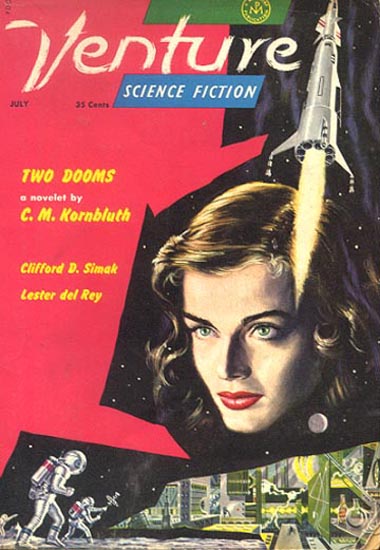
“Two Dooms” by C. M. Kornbluth. From the July 1958 issue of Venture Science Fiction. Kornbluth is maybe one of my favorite SF writers to have really flourished during the ’50s magazine boom-and-bust, although he had made his debut long before that. He was a prodigy whose earliest work was published when he was a literal teenager. Unfortunately he also died very young, at just 34, from a weak heart, robbing the field of one of its most incisive writers.
For the short stories:
“The Persecutor’s Tale” by John M. Ford. From the November 1982 issue of Amazing Stories. Speaking of very good writers gone too soon, Ford also made his debut when only in his teens, but he picked up on the trade pretty quickly. A writer’s writer, the best way to read a Ford novel is the read it twice. Sadly he died in 2006, at just 49, having not quite completed his final novel.
“Always” by Karen Joy Fowler. From the April-May 2007 issue of Asimov’s Science Fiction. Nebula winner for Best Short Story. Believe it or not, there’s an L. Ron Hubbard connection here. Fowler is maybe the most high-profile author to have made her debut in the annual (and Scientology-backed) Writers of the Future anthology series, although Fowler herself is not a Scientologist.
For the complete novel:
The Big Jump by Leigh Brackett. From the February 1953 issue of Space Stories. While Brackett’s first few stories were published in Astounding, she soon moved to other magazines that were more open to her brand of space adventure SF. By the end of World War II she’d come to be associated most with Planet Stories, in a mutually beneficial relationship. Indeed, after Edgar Rice Burroughs, Brackett can be considered the leading writer of planetary romance. She married fellow writer Edmond Hamilton in 1946, but they almost never collaborated. Nowadays she’s best known as a successful screenwriter, and for her grounded SF novel The Long Tomorrow, which is quite different from what she most often wrote. The Big Jump is a short novel, apparently published in magazine form unabridged, and later as one half of an Ace Double along with Philip K. Dick’s Solar Lottery.
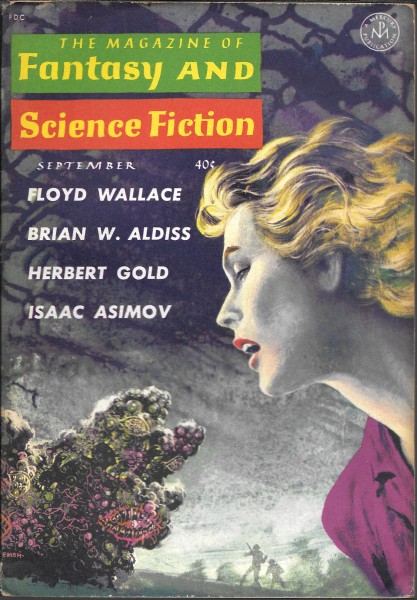
Brian Aldiss was born in England in 1925, and he actually lived a very long time, dying literally one day after his 92nd birthday. He starting writing SF in the mid-’50s, being a generation younger than that first wave of British authors to write magazine SF like Arthur C. Clark and John Wyndham, and yet also a generation older than the New Wave crowd he would later fall in with. And whereas Clarke and Wyndham wanted popularity, preferably on both sides of the Antlantic, Aldiss had other ideas. Unfortunately by the late ’50s, when Aldiss’s work was appearing in the US, the magazine market was in the midst of a collapse; but the good news was that The Magazine of Fantasy and Science Fiction was thriving and also the perfect outlet for his fiction, said fiction being sort of dark and literary. The Hothouse stories, which were published in F&SF throughout 1961, were probably Aldiss’s most ambitious project up to that point. The series (but not the fix-up novel, which in the US was actually a bit shorter than the UK and magazine versions) won him a Hugo. It’s only been, what… ten months since I reviewed the previous entry in the series? Seems like only yesterday. We’re almost done here, since “Timberline” is the penultimate story. It’s also, unfortunately, the weakest entry in the series so far.
Placing Coordinates
First published in the September 1961 issue of The Magazine of Fantasy and Science Fiction. It’s never been reprinted outside of Hothouse, which makes sense because if you were to hop into this story without having read what came before it, you would be lost.
Enhancing Image
Remember Poyly? Maybe not. She died near the end of “Undergrowth,” and rather unceremoniously, despite having been Gren’s love interest for a minute. Gren himself doesn’t seem too troubled or grief-stricken by this. In fact, I’m struggling to recall if “Timberline” mentions her at all. Of course, the team of humans already had a spare girl, in the form of Yattmur, who becomes Gren’s new girlfriend seemingly overnight. The two are accompanied by four tummy-belly men, who are short, hair, and cowardly by nature. Also dim-witted, not that Gren and Yattmur are all that intelligent. Arguably the only reason they’ve even made it this far is the help of the morel, a sentient and indeed highly intelligent fungus, on Gren’s head. The morel acts as like a second brain, although given the conflict it has with Gren the relationship they have is more like Eddie Brock and the symbiote. They will need all the help they can get, though, since humans are scarce, and for maybe the first time in history, plant life totally rules the world. There are also large carnivorous insects, but those don’t play much of a factor in “Timberline.” Instead, vegetable life has evolved to such a point as to replace practically all fauna on land.
It could be because Gren is the POV character (I hesitate to call him the “hero”), but the way Aldiss writes women in the Hothouse series really leaves something to be desired. Women are treated as disposable, and already we’ve seen multiple fridge-stuffings. This doesn’t even align with what would make sense in such a world: you’d think women would be treated as more valuable, in a world where mankind is endangered and has also become a prey animal, but no, their deaths are treated with as much (or rather with as little) gravity as when the men die. And that goes for the ones who don’t make it. As for Yattmur, she spends virtually all of “Timberline” sulking and complaining about Gren being mean to her, which is understandable on its own, but then she doesn’t do much of anything—not that Gren proves to be much better in that regard. Generally Aldiss’s view of humanity seems to be a dim one, which sometimes works, but sometimes it also results in some fatigued storytelling. It’s strange, and a bit funny, that the most active character in “Timberline” is a parasitic fungus.
The boat Our Heroes™ took at the end of the last story ends up crashing into an iceberg, but that’s okay, since all six survive and even make it onto an islet, in which there is enough food and shelter for the time being. Hell, there aren’t even any enemies here worth mentioning, so that for once Gren and Yattmur are able to have a good time. Maybe too good. The central conflict of this story is that the morel wants to keep moving, since it knows the team can’t stay here forever, while Gren is content to sit back and soak in the sun. This is all framed as serious, but it’s really not as serious as it sounds. The morel wants to progress the plot while Gren doesn’t. Both have valid arguments for their points of view, namely that yes, supplies will eventually run out on the islet, but also getting off the islet will be its own challenge, on account of the boat being wrecked. Meanwhile Gren becomes grumpier because of this, to the point where he becomes borderline abusive with Yattmur. The tummy-belly men are of no help whatsoever in all this; actually their so useless and whiny that it’s a wonder why Gren doesn’t just opt to murder them. Being both stupid and submissive, it’s not like the tummy-belly men would’ve resisted much on that front.
There is a somewhat humorous digression when Our Heroes™ uncover a (I’m not sure how else to put this) centuries-old robotic bird whose purpose seems to be to spew political slogans. That the bird is still in working order after all this time would strain one’s suspension of disbelief, if not for this being a world where Earth and its moon have become interlocked via a kind of plant-constructed elevator. And also there’s one half of the world where the sun always shines, while the other half lies in eternal darkness. Naturally Gren and the gang don’t even try to make sense of what the bird (which they name Beauty) is saying, since not only is there no such thing as “Monkey Labour” anymore, the physical land of India probably no longer exists. Politics, like human life in general, is transient. I said before that Aldiss strikes me as a pessimist, and the comic relief with Beauty is a case of that pessimism being used to inspire good writing. Beauty is an operational but now totally obsolete and worthless piece of machinery whose election-year ramblings are lost on the characters, who indeed would have nothing to gain from it even if they understood it.
There Be Spoilers Here
Their ticket off the islet turns out to be a species of bug-like vegetable called a “stalker,” a giant long-legged veggie that’s sort of like the tripods from H. G. Wells’s The War of the Worlds. It’s a nice image, but unfortunately this sequence of Gren and the others riding atop the stalkers goes on for half an eternity. Another good image that sadly gets drawn out is the moment they cross the “timberline,” i.e., the shadow-line separating the sunlit world from the land of night. Mind you that “Timberline” is about as long as “Hothouse,” so it’s a rather meaty novelette. For the first time in the series I feel like there’s some filler that could’ve been cut.
A Step Farther Out
Hopefully it will not take me another ten months to get to the final Hothouse story. Maybe eight. I do feel like returns on this series have been diminishing somewhat, but then maybe I wouldn’t feel that way if I was reading these stories in novel form. I have to assume the short passages of exposition at the beginning, which would strike the reader as obvious if they were to read these stories in quick succession, were removed for the novel. I remember James Blish got his panties in a twist over the world of Aldiss’s series being absurd, in that it’s really science-fantasy rather than properly SFnal, but the strange world of Hothouse is its selling point. Certainly the characters are not much to write home about, although the morel is a very fine creation. We’ll have to see how this all turns out.
Our first ’60s Galaxy story for this retrospective is by someone who actually did not appear in Galaxy often. The last time I covered Zenna Henderson it was as part of a retrospective on F&SF, the magazine which seemed to be Henderson’s preferred outlet. Henderson made her debut in 1952, as part of a wave of female writers who would help shape ’50s SF as being a very different ball game from the previous decade—indeed also the decade to come after, since there wouldn’t be as many active female SFF writers in the ’60s. Henderson specialized in short fiction, and one reason she lost traction by the end of the ’60s is that she refused to change her tune with the market; her single “novel,” Pilgrimage: The Book of the People, is a fix-up. Given her day job as a schoolteacher, it makes sense that her fiction tends to focus on relationships between adults (specifically parents and teachers) and children, with children especially getting attention, which for the time was novel. SF at the time was, let’s say averse to understanding the day-to-day lives of children, but Henderson’s fiction was a major exception. Today’s story, “Something Bright,” is a standalone work (Henderson’s fiction can be split into two groups: standalone stories and those about “The People”) that I found a good deal more compelling than “Subcommittee,” the last Henderson story I reviewed. This is a good one, and it’s understandably one of her more reprinted stories.
Placing Coordinates
First published in the February 1960 issue of Galaxy Science Fiction. It was reprinted in The 6th Annual of the Year’s Best S-F (ed. Judith Merril), The Seventh Galaxy Reader (ed. Frederik Pohl), Galaxy: Thirty Years of Innovative Science Fiction (ed. Martin H. Greenberg, Joseph D. Olander, and Frederik Pohl), and the Henderson collections The Anything Box and Believing: The Other Stories of Zenna Henderson.
Enhancing Image
The exact year is not given, but right away we’re told that “Something Bright” takes place during “the Depression,” so probably anywhere between 1930 and 1935. Anna is an adult now, but she’s telling us about a strange thing that happened to her when she was eleven years old, living in a “court” that her family shared with an older couple, the Klevitys. Mr. Klevity isn’t around (in fact he doesn’t appear until the story’s end), but Mrs. Klevity is, especially whenever Anna’s mom has to go out for errands. Obviously there is something off about the Klevitys, not least because they somehow have fresh eggs every morning, in an economy where even eggs are treated as a delicacy. The SFnal twist is by itself easy to detect in advamce, to the point where it hardly even counts as a twist; but it’s what Henderson does around the twist that makes it a pretty good story. As such I’m gonna work on the assumption that you, the reader, have already figured out that the Klevitys are aliens in disguise, become come on, we’re all adults here, and the fact that Henderson waits until the back end to confirm our suspicions is merely a formality. This is a story about childhood and memory, far more than it is a story about aliens, yet the SFnal element is integral to its makeup. Both in style and substance it would strike the average reader as “literary”—except for the part about the aliens, of course.
The key ingredient that elevates “Something Bright” is the sense that while it is not autobiographical at face value, there is the strong sense that Henderson is writing about personal experiences that she herself probably had first-hand knowledge of. I’m not sure how much Henderson and Anna share in terms of personality, but we do know that they both spent at least some of their formative years during the Depression, and incidentally each is an older child in a family with five kids. When Henderson/Anna asks at the beginning, “Do you remember the Depression?” she’s being at least partly rhetorical: she absolutely does remember. Despite being only about a dozen pages, the setting is vividly set, with Anna lamenting being the eldest of five kids in a home that amounted to two rooms, in which nobody had any privacy, least of all her mother. We’re not told directly what happened with Anna’s dad, that I can recall anyway, but at one point it’s implied he either went off in search of work or abandoned the family outright. Anna’s mom is effectively a single parent, but that’s where Mrs. Klevity comes in. It would have been commonplace, during the Depression, for kids to either be left to fend for themselves much of the time or to be kept under watch by multiple people who were not their biological parents—out of economic necessity more than anything. You may remember in To Kill a Mockingbird that Scout and her brother Jem are left to their own devices for way longer than what would nowadays be considered a good idea, on account of their single dad only being able to do so much.
“Something Bright” must’ve struck a cord at the time, on account of being reprinted multiple times within just a few years, but it also speaks to today’s post-COVID environment. The economic fallout from the COVID-19 pandemic is, along with the housing market crash of 2008, the closest we have to a modern-day analog to the Great Depression. These are times in which the machinery of capitalism comes almost to a grinding halt, in which the system “failed” (but, on the other hand, if we’re to take capitalism as a system that works to benefit a rich minority at the expense of the majority, then it more or less kept working as intended), and in which even the nuclear family as a viable model for child care seemed on the brink of becoming a thing of the past. Ironically the nuclear family, which conservatives love to hold up as being traditional and “natural,” has, for practical reasons, been in fact a fairly modern phenomenon. The idea that two parents would take care of their own biological kids was unviable for many during the Depression, during which you’d be lucky if even one of your parents had a steady job, and said job was unlikely to both pay the bills and feed everyone. Thus in this story we’re given a depiction of a nontraditional family setup, in which the father figure is absent and so Anna and her siblings are left with at least one adult figure in their lives who is a constant and yet is not related to them. Mrs. Klevity sticks out in Anna’s memory not just for her strangeness and her conspicuous and yet unexplained ability to provide for both herself and her husband (Anna points out that the Klevitys have three rooms to themselves, compared to Anna’s two), but also the fact that she at least temporarily acted as a surrogate parent.
There Be Spoilers Here
The back end of “Something Bright” takes a turn towards horror, although it doesn’t quite go there, because it turns out Anna is not in any real danger. Her first encounter with Mrs. Klevity without the disguise, which she hears but does not see, is genuinely chilling, not to mention an unexpected bit of restraint of Henderson’s part. We figured in advance that the Klevitys were not strictly speaking human, but how this reveal is made is what makes the twist memorable despite its predictability. That Anna ultimately helps Mrs. Klevity and her husband (who only shows up at the end to find that his wife has flown the coop, so to speak) go back to wherever it is they came from, and gets something material out of it (the Klevitys leave behind their half of the court and bestow it to Anna’s family, in a thank-you note), makes for a pretty upbeat conclusion. Yet despite it being a happy ending, there’s still a strong eeriness about the whole thing, as if Anna, who is telling us this story many years after the fact, is trying to explain some peculiar childhood trauma that had happened to her. I have to wonder what the context could be that Anna is telling this story to us, since this is not the kind of thing you’d tell to just anyone, but this is a quibble. Then again, when you’re looking back on childhood memories, the line between what really happened and one’s own imagination can be hard to separate. I barely remember my own childhood, as an autistic person who also dissociated a lot, to the point where a lot of what I “remember” might not have actually happened. Our own histories become stranger and more disconnected as time passes, to where they no longer seem real to us.
A Step Farther Out
Henderson working with children as part of her day job is very much reflected here, as it captures a genuineness about childhood experience that very few SF stories at the time had even attempted. The twist is obvious, to the point where I don’t even count it as a spoiler really, but the twist is not why we’re here. When I read “Subcommittee” I was ambivalent about its glorifying of the nuclear family, which probably did not read as old-hat in the early ’60s but which now reads as stuffy and too old-fashioned; but “Something Bright” shows us an alternative family dynamic and doesn’t do anything to demonize it. It also helps that Anna is a likable narrator who relates her past experiences such that you get a vivid impression of what her childhood was like, even if you didn’t (and indeed most people in the US don’t now) go through exactly what she did. I recommend it! It’s very good proto-feminist pew-New Wave SF.
Brian Aldiss is what the SF Encyclopedia calls a leading “man of letters” in the field, which is to say he’s adept at both fiction and nonfiction, being one of the field’s great jack-of-all-trades writers. He won a Hugo for the stories comprising Hothouse (strangely as a series of short stories and not for the novel version), but he also won a Hugo for the hefty nonfiction book Trillion Year Spree (co-authored with David Wingrove), which is an opinionated overview of genre SF history, and which is itself a revamped version of the earlier Billion Year Spree. Aldiss had a combative personality and whereas authors nowadays, being their own PR staff, are incentivized to play nice with fellow authors in public, Aldiss made no secret of how he felt about his peers. He debuted a whole decade before the New Wave kicked off, but fit right in with that movement, being probably more influenced by William S. Burroughs than Edgar Rice Burroughs. In other words, despite being born in 1925 and debuting in the ’50s, Aldiss’s fiction can come off as pretty literary—sometimes a little too literary. I’ve been trudging through the Hothouse stories for the past several months, and now it’s time to tackle the third and longest story so far. Mind you that I don’t have a great deal to say about “Undergrowth,” so bear with me.
Placing Coordinates
First published in the July 1961 issue of The Magazine of Fantasy and Science Fiction. It has never been reprinted on its own, which makes sense since it’s the third entry in a series.
Enhancing Image
I actually didn’t know it had already been what, seven months since I reviewed “Nomansland”? It’s been way longer than I had assumed. Granted, these stories are similar enough to each other that to write about them in quick succession would’ve been a chore for me. The Hothouse series can be considered a picaresque of sorts, in which a young person (Gren) goes off on a series of adventures in the name of self-discovery. It becomes apparent by the end of “Nomansland” that Gren is to be our main character throughout the series, and that conversely anyone not named Gren can expect to have a short life and a brutal death. The beginning of “Undergrowth” briefly recaps what happened in the previous story, although I have to assume this opening passage is removed for the novel version since it would certainly strike the reader as redundant. These stories make up a serial in all but name, albeit published a couple months apart at somewhat irregular intervals. It would be necessary to remind the reader of what the fuck is happening, especially since the world Aldiss establishes is so multifaceted, so this recap bit was the best he could’ve done. Gren and his companion Poyly are exiled from their small group of humans and, just when it seems all hope is lost, they come across the morels, a race of sentient fungi that communicate telepathically with the host in a symbiotic relationship. Gren and Poyly get some free hats and head off, out of what is clearly an homage to Eden, with their talking fungus buddies on their heads.
Each story in Hothouse leans into a different subgenre, or so it seems. Generally I would call it science-fantasy, in that while it’s ostensibly SF it so brazenly goes against known laws of physics and biology that it’s clear Aldiss did not intend the world of Hothouse to be an extrapolation of our world, or indeed our universe. In “Hothouse” we’re introduced to mankind in a world where mankind has been relegated to the bottom of the food chain, wherein bugs and carnivorous vegetation have long since taken the top spot. The result is a kind of pseudo-documentary, or rather pseudo-nonfiction, being about as much a sociological study as it is adventure fiction. “Nomansland” downplays the sociological aspect and zooms in to focus on Gren, a teen boy among a group of people who are even younger and dumber than he is; and, more strangely, “Nomansland” has a gothic horror angle, complete with a dark castle built by termites (sorry, termights). Now that we’ve met the morels, one of whom becomes Gren’s headmate so that he always has someone to talk to, the series switches gears yet again. This time it becomes more like a “lost race” adventure of the sort that was popular in the late 19th and early 20th centuries. We’re introduced to the herders, a tribe of humans who live in a congealed lava pit and fear what they call the Black Mouth. One of these herders, Yattmur, serves as Gren and Poyly’s guide to the tribe’s ways and later as a companion. We’re given insight into Gren’s thought processes, but not so with Poyly and Yattmur, the result being that we’re stuck in the male protagonist’s shoes whilst only the female characters’ actions are known to us. I would have very little to tell you about Poyly as a person; she spends much of her time being a load despite having a morel like Gren, which should have granted her more intelligence.
The first revelation to come in this story is that the morels and mankind have a shared history that goes back centuries, indeed back to when mankind was a young fledgling species. This seems to be an alternate reality in which mankind’s evolutionary history is inextricably connected with morels, the latter being like beacons of intelligence but without bodies of their own to command. The central conflict of Hothouse can be considered to be one between thought and action, or rather the tug-of-war between humanity’s capacity for unique thought and our place as animals. In “Hothouse” the humans we read about are little more than animals you’d find in a zoo, having rituals and ways of communicating, but without anything that you would call civilization and without that Shakespearean capacity for interiority. These people do not have thoughts by default; it’s only with the morels that they’re able to recapture what was once a common human ability, which is the ability to think. Or rather Gren’s ability to think. Conversely the other humans they meet, namely the herders and later the Fishers (the latter being a tribe of cowardly people who have tails, these tails in fact being connected with a parasitic tree), who act much in the way Gren’s tribe had acted before Gren got his funny fungus on his head. This is a story about discovering intelligence in a world that is overwhelmingly based in instinct, as in being opposed to intelligence. That Aldiss is interested in a boy gaining this intelligence but is not so interested in the women (well, they’re young girls) Gren meets is a blotch on what is otherwise clearly the work of someone who knows what he’s doing.
There Be Spoilers Here
Once Gren’s freed the Fishers of their parasites, he becomes their new leader, and by extension he also leads Poyly and Yattmur. The back end of “Undergrowth” takes the form of a seafaring adventure, in which at one point Poyly accidentally gets thrown overboard and drowns. It’s a scene that’s striking for its brevity and its sheer violence, as Aldiss kills Poyly off about as sadistically as any other character thus far, but we also get the most memorable line from this story, coming from Gren’s morel: “Half of me is dead.” It’s the one moment in “Undergrowth” where loss as humans experience it is experienced, and Gren isn’t even the one who most profoundly expresses this sense of loss. But that’s okay, since it’s implied that Yattmur will replace Poyly as Gren’s girlfriend, given enough time. On the one hand I appreciate that Aldiss is willing to kill anybody for the right effect, and in keeping with the savagery of the world he has created, but also fridging Poyly like this is a bit concerning in the context of a narrative that treats women as accessories.
A Step Farther Out
Hopefully it won’t take me as long to tackle the next story in the series, although I can’t guarantee anything. It took me a whole week to hunker down and write anything more substantive than a paragraph for this site, and it took some locking-in to do so. I’ve recently come to feel resentful of what I so, this being supposedly a hobby. Ya know, something to take the edge off, for when I’m not working. But Aldiss is not someone you read casually; he’s more intellectual than most of his peers and he wants you to know this. The Hothouse stories were evidently big hits with American readers, but while they do focus more on adventure, with a good deal of violence thrown in, Aldiss is not half-assing it.
Overall we know about as much about Sylvia Jacobs as we know about Jesus of Nazareth. I can’t find any pictures of her, or find out when she was born or when she died; but then we at least have writings from her, so there’s that. I was pointed towards a useful piece by Rich Horton which covers what little we know about Jacobs’s life and what little fiction and non-fiction she had published in the genre magazines. She had studied oceanography, and was married to a professional deep-sea diver. She apparently had done some research for Robert Heinlein (regarding the ocean, of course) for a juvenile novel he had planned but sadly never got to write. She was a California denizen for at least some of her adult life. She wrote about half a dozen SF stories, mostly in the early ’50s, which is unsurprising given that was when the magazine market saw an immense bubble; and, just as unsurprisingly, she mostly went dormant after 1960. This is the basic narrative of a lot of lady SF writers from that period, although by no means all of them. Horton describes “The Pilot and the Bushman” as like a prototype for the light satire Christopher Anvil later wrote nonstop, although I don’t think he gives Jacobs’s story quite enough credit—not to say it’s a hidden gem, really, but there’s a fair bit going on here.
Placing Coordinates
First published in the August 1951 issue of Galaxy Science Fiction. This is my third time plundering this issue for gold, and it’s quite possible I will have covered all of this issue’s fiction contents eventually. The copyright must’ve run out at some point, because “The Pilot and the Bushman,” along with a couple other Jacobs stories, is on Project Gutenberg. It’s also been reprinted in Women Wrote the Future: Vol. 1: Tales from Galaxy (ed. J. LaRue). Other than that it’s not seen print at all.
Enhancing Image
The first and easily longest scene is a Socratic dialogue between two men, although despite both appearing to be human one of them is, in fact, an alien. The Ambassador from Outer Space (we never get his actual name) is having a behind-closed-doors meeting with Jerry Jergins, a marketing man and predictably a bit of a scoundrel. The two are in the situation because the Ambassador had made what was called a “boner” in the old days, by that I mean he had made a slip at the UN Assembly by saying the aliens have what they call a Matter Repositor. The problem is that the Matter Repositor can replicate anything, and I do mean anything, which is no real issue for a society that does not run on industrial capitalism. (The Ambassador is quick to point out that the aliens’ economic model is NOT some brand of socialism, IT’S NOT SOCIALISM, GUYS.) The Matter Repositor may as well be magic, but the point is that mankind is too “primitive” to have it. The problem is that once you inform someone of something’s existence and then tell them they can’t have that thing, then that someone is no less incentivized to take the whatever-it-is. God told Adam and Eve to not eat fruit from the tree of knowledge, but that did nothing to stop Eve from having a bite. If you tell your kid they can’t have more cookies from the cookie jar than they ought to, what do you think they’re gonna do at some point? The aliens, as you can tell by the comparisons I’ve made, see themselves as being in a parental or patronizing position with regards to the humans. Jerry isn’t happy about the Ambassador’s smarmy attitude, but if he has a plan (and he does), he’s not upfront about what he has in mind.
This is a story about two races from radically different cultures, with one actually immersing itself in the other’s culture for the first time. “The Pilot and the Bushman” is, on its surface, about the immediate aftermath of mankind making first contact with a fellow intelligent race, but it takes no more than a single brain cell to figure out Jacobs is comparing her SFnal situation with the real-life occurrences of one human culture making first contact with another human culture, with one side being far more advanced on a technological level than the other. I have to italicize that one part because, of course, the Spaniards and later the English who set foot in North America were no more inherently intelligent or morally upright than the indigenous peoples of the land. There were things the indigenous peoples were not and could not be prepared for, namely diseases they had no prior contact with or knowledge of, and thus you had whole populations introduced to diseases they had no immunity against. Similarly the Ambassador fears that introducing mankind to the Matter Repositor would have apocalyptic consequences, since virtually every country on Earth has (whether lefties wanna admit it or not) a capitalist economy based on scarcity. The people of the Ambassador’s home world have been born and raised into a post-scarcity environment, which understandably has created a radically different mindset from what humans are acquainted with. The aliens are not necessarily superior but are certainly very different—the huge gap in cultures being the races being the problem.
As the Ambassador says:
To a Micronesian bushman, the pilot who can be trusted with the power and speed of a B-29 seems a veritable god. But the pilot is only an ordinary Joe, very likely no more intelligent than the bushman—he just had a different background. Fighting each other for necessities and luxuries, the process that you people call business competition, has so long been needless to our people that they would no more think of competitive gain than you would do an Indian harvest dance before you signed a contract. They aren’t necessarily more intelligent or more virtuous than your people—they just have a different background.
Of course, the aliens are the pilot and the humans are the bushman. It’s not exactly a hard comparison to make. What’s strange, reading it now, is that Jacobs goes about it with the mindset that the aliens really do mean well despite their smug attitude around humans, or at the very least that they aren’t looking to divide and conquer Earth as hot new real estate, like with their real-life counterparts. It’s a commentary on colonialism and the relationships invasive cultures have historically had with indigenous peoples, but it lacks serious bite because it does not interrogate the myriad ways in which a colonizing force can subjugate a colonized people’s development. The biggest complaint I have with this story, other than it being overly chatty (there is nonstop talking for over half of it, which can dull one’s attention span), is that Jacobs does not treat her own subject matter with enough seriousness. Horton compares it to Christopher Anvil, but I also thought of a less funny and less vicious Robert Sheckley—granted that Jacobs’s story was published about a year before Sheckley made his debut. My point is that it’s easy to overlook the territory “The Pilot and the Bushman” covers because the story itself doesn’t pay said territory that much mind. It’s a social satire, of the sort that appeared quite often in Galaxy, especially in its early years, and for that it’s an adequate example.
But it could’ve been better.
There Be Spoilers Here
Conditions improve, thankfully, when we finally see an end to the dialogue and some action can kick in, although it’s not much. The back end of this story has enough of a sense of humor and also a viciousness that the first half or so was rather lacking; like I would’ve appreciated it if Jacobs had not spent so much time setting things up. The gist is that Jerry agrees to coordinate a huge propaganda campaign to disincentivize people from looking into the Matter Repositor, while at the same time playing up humanity’s quickly growing reputation as “savage” compared to the aliens. The plan works—in fact it works better than the Ambassador would’ve wanted, although Jerry is perfectly happy with the results. Earth becomes a tourist destination for the aliens, who are so unaccustomed to things to like drinking, whoring, theft, and other vices that they see it all as an alluring novelty. They think stealing some doodad from a convenience store and spending a night in jail is fun. They’re totally unprepared for the eccentricates of human culture and are thus unequipped to resist it. This is clearly a satire of how people in the Anglosphere see certain “backwards” countries as lovely tourist spots. Even circa 1950 this would’ve been very the case with how Americans treated Hawaii, which was a US territory but a state yet. The othering of indigenous people and East-Asians in Hawaii has been a thing for decades now, but ya know, nobody likes a tourist.
A Step Farther Out
I have to assume, given how little she wrote, that Jacobs saw writing SF as like a hobby more than anything. In the early ’50s it was possibly to write SF for a living, so long as you wrote at a mile a minute and knew how to sell a story to the right editor. Maybe Jacobs was into it but not that into it; she did, after all, have a respectable day job. “The Pilot and the Bushman” was her second published story, and I’d be interested in reading the rest of her SF, although I don’t expect to find a hidden master of the form. Jacobs’s career as an SF writer is like a ship that passed in the night.
A recurring thing that I totally did not intend with the author selected for this marathon thus far is that these people lived a long time. Fritz Leiber died at 81, Kurt Vonnegut died at 84, Katherine MacLean died at 94, and so on. About as impressive as MacLean’s longevity, and in some ways even more so, is that of L. Sprague de Camp, who was born in 1907 and died in 2000, being more or less active from 1937 until his death. De Camp technically entered the field before John W. Campbell took over Astounding, but he quickly became one of Campbell’s court jesters, his early fiction often being comedic in tone. He was a forerunner to what we now call hard SF, with a keen eye for historical and scientific accuracy (his first solo novel, Lest Darkness Fall, was a major inspiration for alternate history writers to come), or at least as he saw those things. Unlike most of the rest of Campbell’s stable in the late ’30s through the ’40s, de Camp was just as comfortable if not more so writing fantasy, which made him, along with (God help us) stablemate L. Ron Hubbard, an ideal fit for the short-lived fantasy magazine Unknown. Like a chameleon, de Camp would change his colors as the market demanded it, such that he was able to still thrive as the field changed radically in the ’50s. “A Gun for Dinosaur” is, on the one hand, an adventure story that harks back to the writings of H. Rider Haggard, but it’s also a grim cautionary tale that probably would not have seen print in Astounding. This is a rare case where I had heard the X Minus One adaptation long before reading the source material, which gave the impression, going in, that this would be a more straightforward story than it is.
Placing Coordinates
First published in the March 1956 issue of Galaxy Science Fiction. It’s been reprinted in The World That Couldn’t Be and 8 Other Novelets from Galaxy (ed. H. L. Gold), Dawn of Time: Prehistory Through Science Fiction (ed. Martin H. Greenberg, Joseph Olander, and Robert Silverberg), Dinosaurs! (ed. Jack Dann and Gardner Dozois), Timescapes: Stories of Time Travel (ed. Peter Haining), The Best Time Travel Stories of the 20th Century (ed. Martin H. Greenberg and Harry Turtledove), The World Turned Upside Down (ed. Jim Baen, David Drake, and Eric Flint), and the de Camp collections Rivers of Time and The Best of L. Sprague de Camp.
Enhancing Image
As you can guess, “A Gun for Dinosaur” is about using a time machine to hunt dinosaurs, since the big game of our current world has been all but exhausted and rich white dudes with guns have gotten bored with shooting lions, elephants, and black people for sport. The story takes place in presumably what would’ve then been the present day, but our narrator, Reginald Rivers, is a man who seems to be stuck outside of his time and place, having more in common with Allan Quatermain than a modern-day Englishman (for he is very English), being quite burly even in his middle age. De Camp tells the story in technically the second person, since Rivers is talking to one Mr. Seligman, whom we never hear a word from because Seligman is in the place of the reader, the result being that Rivers is narrating to us as if we were a character in the story. We know upfront that Rivers survives the adventure he’s about to tell us about, which even in the 1950s would’ve been thought of as an old-fashioned narrative technique; but it serves a purpose. The tension comes from the fact that while we know Rivers made it out alive, the same does not go for everyone who was around Rivers at the time, hence his telling this story to Seligman so as to why he refuses to take him on a trip hunting big dinosaurs. We’re introduced thus to two men who went on this trip, Courtney James and August Holtzinger, and given Rivers’s tone we can gather that something bad happened with these men, although we’re not told exactly what. We also have the Raja, an Indian hunter who functions as Rivers’s partner and fellow guide. So we have four characters who really matter, and we have our premise.
Since “A Gun for Dinosaur” is not an obscure story I decided to look up what other people have said about it after reading it for myself, and was a bit dismayed to find James Wallace Harris had already done a pretty thorough review of it, even bringing up a few points that I was going to as well. Turns out I’m not unique at all in thinking de Camp had probably written this story in response to Ray Bradbury’s even more famous “A Sound of Thunder,” which had been published a few years earlier. Both stories involve hunting dinosaurs for sport and how this might leads to issues with time travel, not to mention extreme risk for the hunter. For those of you who forgot, “A Sound of Thunder” (oh yeah, spoilers) is about a dumbass with money who goes back in time to hunt a T. rex, although he’s supposed to stay on a set path lest he causes the butterfly effect to kick in. Naturally he goes off the path and kills a butterfly, which somehow has a domino effect on what would be the present day. I’ve always found this to be implausible, since I could never for the life of me make sense of how this one innocuous event could have changed the future so radically; but then you could argue that’s the whole point of the butterfly effect: unintended consequences. I think it’s lazy writing on Bradbury’s part, though, since it feels like he’s asking the reader to do the author’s job for him. De Camp seemed to think the same thing, since he really goes out of his way to explain the mechanics of time travel in “A Gun for Dinosaur.” No butterfly effect here. The rules of the time safari (yes, one story that clearly took notes from de Camp’s is David Drake’s “Time Safari,” which I reviewed a hot minute ago) are pretty clear. The real question, then, is left up to human error.
James and Holtzinger suffer from cases of hubris, but in different ways. Neither of them is an experienced hunter, but whereas James in it for the sake of thrill-saking, Holtzinger did it because he’s a pretty average guy who wants to do something truly risky for once in his life. I feel like there are better ways of averting existential dread that going off hunting dinosaurs, but you do you. But basically Holtzinger means well. James, not so much. Not only is James even more incompetent with handling weaponry and hunting gear than Holtzinger, but he also seems to have a screw loose. (I’ve read enough “time travel dinosaur-hunting” stories to figure that one surefire trope is the affluent white man who has some undiagnosed mental illness.) Rivers, in telling this story to us, goes into quite a bit of detail about what it takes to go on one of these trips, especially the physical brunt of it—that being the main reason why women are not allowed. So yeah, both the story and the private company that hosts these safaris are sausage fests. James tries bribing his way into taking his mistress along for the ride, but Rivers wisely refuses; this ended up being good for both Rivers and the mistress, who very likely would not have survived. As you can see, there’s a bit of racism and sexism on display, although there’s some plausible deniability as to how much of it is Rivers’s and how much de Camp’s, not to mention that it does (unfortunately) make sense, given the rather heavy inspiration taken from Victorian-era adventure fiction.
You may be wondering, then, what makes “A Gun for Dinosaur” worth recommending to this day, since there are quite a few old-timey readers and authors who still swear by it. The key is at least twofold: the foreboding tone, which is established from the very beginning, and also de Camp’s attention to detail. As someone who’s been obsessed with dinosaurs since my earliest childhood, I firstly found interest in “A Gun for Dinosaur” as a snapshot of how we understood the prehistoric world some seven decades ago, long before Jurassic Park caused a profound increase in people becoming paleontologists. Paleontology was still a very niche discipline in 1956, and de Camp, while not a paleontologist himself, gave the field as much respect as he gave any of the other hard sciences, which is to say quite a bit. Granted that the science is laughably outdated, the world of the mid-Cretaceous as depicted in-story is remarkably consistent. The dinosaurs, from the big theropods (there’s a tyrannosaur, although Rivers is quick to point out it is not specifically a T. rex) to the duck-billed parasaurolophus, are thoroughly lizard-like, in both how they move and how they think. The speculation that dinosaurs, especially the theropods, were at least if not more akin to birds than reptiles was still a few decades off. Dinosaurs in this story, including the tyrannosaur, are lumbering brutes with shit for brains, who have to be shot in the heart rather than the head in order to go down. Rivers recommends using the comically large .600-caliber hunting rifle to take down the tyrannosaur, the sheer weight and kickback of the gun being a big reason why people under a certain weight and musculature are prohibited. This is, quite literally, not a game for lightweights.
There Be Spoilers Here
We know a tyrannosaur will show up, and so it does. The hunters’ efforts to take down the tyrannosaur ends up being a disaster, with Hortzinger sacrificing himself to save James’s “worthless life,” getting carried off by the big dinosaur screaming. It’s a rather disturbing sequence, in no small part because Rivers and the Raja try tracking down the wounded tyrannosaur in the hopes of at least recovering Hortzinger’s body; but alas, the trail of blood soon runs cold, with the tyrannosaur and its prey having seemingly vanished into the wilderness. This is the kind of casualty that would probably result in a lawsuit, if not for legal protections that hunting preserves pull in order to relieve themselves of responsibility. In fairness, it was a mix of lack of foresight and sheer stupidity that made them come to this conclusion. Rivers loses his cool with James once they get back to camp, which he now admits was a bad idea with hindsight. James threatens to kill Rivers and the Raja himself, in a moment of apparent insanity, but thankfully the two veteran hunters are able to overpower him. But that’s not where the story ends. Oh no, it would be too easy if Rivers simply brought back James to the present day and had him arrested. The actual ending is much bleaker, and truth be told I don’t recall if the X Minus One episode adapts this part of the story. Needless to say that de Camp takes the grimness of how “A Sound of Thunder” ended and kicks it up a notch, using a time paradox rather than the butterfly effect. It’s this bleaknesss, bordering on nihilism, that Brian Aldiss seemingly took and ran with when he wrote his own take on the “time travel dinosaur-hunting” story with “Poor Little Warrior!” a couple years after “A Gun for Dinosaur” was published.
A Step Farther Out
For decades “A Gun for Dinosaur” was a one-off story, although de Camp would eventually return to Reginald Rivers and his adventures in the early ’90s, possibly influenced by the immense success of Jurassic Park (the book), or maybe it was just serendipity. Despite having several sequels, albeit from a much older de Camp, I suspect there’s a reason why “A Gun for Dinosaur” is the only entry old-timey SF fans talk about. This was a surprisingly vicious, if a little too documentary-like, story about a couple men who got in way over their heads. The attention to detail, given what we knew about dinosaurs in the 1950s (which was not much, mind you), is admirable, and despite being a novelette I didn’t really feel its length. De Camp was at this point considered one of the “old guard,” but he had quite a bit of energy left to both humor the reader and make them think. It seems that when he wrote this story he wanted to write a better time-travel story than “A Sound of Thunder,” and—hot take—I think he did.
Fritz Leiber is one of the great chameleons of 20th century genre fiction, being more or less equally talented in writing SF, fantasy, and horror, with Leiber’s use of the genres not being mutually exclusive. That he was also one of the great prose stylists among genre writers in his lifetime is made more impressive by the fact that he was one of the “old guard,” having debuted in the field in 1939. He had a short but intense correspondence with H. P. Lovecraft shortly before the latter’s death, making him one of the last members of the Lovecraft circle to have known the man himself; and indeed Leiber wrote a few Cthulhu Mythos stories. His jack-of-all-trades approach, combined with his prolificity and longevity, make him a favorite on this site. I will never even come close to running out of Leiber stories to talk about. Today’s story, “A Bad Day for Sales,” is brief but potent, being grim but still humorous social commentary of the sort that H. L. Gold, the first editor of Galaxy, loved. Leiber had a streak of productivity in the early ’50s that coincided with Galaxy’s launch and arguably its very best years, even appearing in the first issue. This is quite a short story, only about 2,250 words, so I won’t keep you long today, but I very much recommend it.
Placing Coordinates
First published in the July 1953 issue of Galaxy Science Fiction. It’s been reprinted in Shadow of Tomorrow (ed. Frederik Pohl), Second Galaxy Reader of Science Fiction (ed. H. L. Gold), Fifty Short Science Fiction Tales (ed. Isaac Asimov and Groff Conklin), Nightmare Age (ed. Frederik Pohl), Science Fiction of the Fifties (ed. Martin H. Greenberg and Joseph Olander), The Arbor House Treasury of Science Fiction Masterpieces (ed. Martin H. Greenberg and Robert Silverberg), Robots Through the Ages (ed. Bryan Thomas Schmidt and Robert Silverberg), and really too many times to count. It’s also out of copyright, so you can read it on Project Gutenberg.
Enhancing Image
New York City in the future is different, but not so much; really in some ways it’s more recognizable to us now than it would have been in 1953. In Times Square, advertisements take up the whole sides of buildings—only they’ve gone digital, with people “watching the fifty-foot-tall girl on the clothing billboard get dressed, or reading the latest news about the Hot Truce scrawl itself in yard-high script.” That “Hot Truce” will come into play later, although given the brevity of the story one is unlikely to forget about it. In the first few paragraphs we’re introduced to three major themes in Leiber’s fiction: sex, death, and post-war consumerism. Then there’s the latest advancement in advertising technology, a Roomba robot named Robie, a sentient vending machine with legs—or rather treads. Robie is not humanoid, but rather looks like a tortoise had sex with a tank. “The lower part of Robie’s body was a metal hemisphere hemmed with sponge rubber and not quite touching the sidewalk. The upper was a metal box with black holes in it.” Robie is the first in what may become a line of sales robots like himself, assuming the investors are impressed enough; he doesn’t go around selling cars or property, but small things, including fashion items and even candy for children. A crowd quickly gathers around Robie and this is where the action is set, as if on a stage. Leiber’s background in theatre figures into several of his stories, most notably his Hugo-winning novel The Big Time, but “A Bad Day for Sales” also feels like a one-act play.
(Interior art by Ed Emshwiller.)
Robie offers treads to come kids who come by, a boy and a girl at different times, although in maybe the funniest bit in the story Robie, apparently unsure at first as to the girl’s gender, offers her a nudie magazine. Also a “polly-lop,” which at first I thought was a typo but it’s repeated a few times consistently so I guess not. The girl’s mother is looking for her. Robie’s attempts at appealing to his customers depending on age and gender very much feel like a precursor to what have become “personalized” ads in the internet age. Companies asking to know your age, gender, tracking your location so they know where you are on the map, etc. It’s creepy, no doubt, but also Robie is by no means a malevolent robot; he’s merely doing what he was programmed to do, which is to pull in customers. Certainly he’s not as invasive of people’s privacy as his real-world descendants would become. This portrait of NYC is, on the one hand, very of its time, but it also tracks rather closely with how consumerism will progress (or maybe devolve) in the US, with an increasing reliance on AI and machinery, because I guess for companies it costs less time and money in the long run to do things this way than to hire real people. Leiber’s doing what conventionally a good SF writer ought to do, which is to observe cultural trends in his own time and place, and then extrapolate on them.
It’s hard to talk about this story too much without getting into spoilers, or more specifically the abrupt change in tone it goes through—although tonally it’s not that big of a change. What started as a satirical slice-of-life narrative soon turns into something quite different, which honestly I should have expected but somehow did not. The title clearly has a double meaning, since for one Robie has a hard time selling his junk to people in the crowd, but also his day (or rather the day of everyone around him) is about to get much worse. Leiber’s very clever about all this.
There Be Spoilers Here
Leiber does something he could’ve done in 1953 but probably not 2003 (because he was dead by then, but also because of 9/11): he bombs New York. Specifically the “Hot Truce” mentioned at the beginning apparently fell through, because the enemy (whoever it is) has a nasty surprise for these New Yorkers. Get a load of this:
(But way, way up, where the crowd could not see, the sky was darker still. Purple-dark, with stars showing. And in that purple-dark, a silver-green something, the color of a bud, plunged down at better than three miles a second. The silver-green was a newly developed paint that foiled radar.)
And yes, it is in parentheticals, the only paragraph in the story to be designated at such. I’m not sure if the bomb is a nuke or not, but it does enough damage that Times Square gets turned into rubble seemingly in an instant, with Robie being surrounded by the bodies of the dead and dying. Robie himself is fine, of course, albeit damaged. The little girl mentioned earlier is fine too, thankfully. “A white dress and the once taller bodies around her had shielded her from the brilliance and the blast.” This is… grim. At least she’s reunited with her mom at the end, so it’s not totally bleak. There are a few survivors, a rescue team arrives at the very end, and a little inconvenience like a bomb dropping on Manhattan doesn’t stop Robie from doing what he does best—indeed the only thing he knows how to do. Even with fewer customers, on account of mass murder, the machinery of modern capitalism will keep trudging onward.
A Step Farther Out
The fact that I very rarely see Leiber books in the wild, even in used condition (a lot of his books, from what I can tell, are out of print), is depressing. The conventional narrative is that Leiber wasn’t as good an SF writer as he was with fantasy and horror, but once we take out The Wanderer (it’s quite bad), Leiber was still one of the best SF writers of his time. He had a sense of humor and a keenness of perception, along with a fluidity of style, that put him head and shoulders above most of his peers. (This sharp eye for cultural trends shows through even when he isn’t writing SF, see “The Girl with the Hungry Eyes,” which is ostensibly horror but reads as kin to his socially conscious SF.) “A Bad Day for Sales” is a very good introduction to what Leiber’s SF—a view of the future that continues to feel bleak, specifically because it feels true.
Let’s talk about where genre SF was at in 1950, because this year, perhaps more than any other year in the field’s history barring maybe 1926 (the launch of Amazing Stories) and 1953 (the year the magazine market reached critical mass). Changes in the field tend to come gradually; it’s not like, for example, one day you have a market that’s 95% WASPs and then the next it’s much more racially diverse. These things happen in movements, like the rest of history, or indeed like the waxing and waning of the tide. There really was a profound difference between how genre SF looked at the beginning of 1950 and how it looked by the end of the year. There were multiple changes happening at once, and not all of them were good. The less said about Dianetics the better. But you also had the publications of Isaac Asimov’s I, Robot and Ray Bradbury’s The Martian Chronicles, two “novels” (they’re really short story collections) that not only garnered acclaim from the usual suspects but even managed to break into the mainstream. This was practically unheard of at the time, to have science fiction that “normal” readers admitted to caring about. 1950 also saw the publication of other major SF books, like Robert Heinlein’s Farmer in the Sky, Theodore Sturgeon’s The Dreaming Jewels, A. E. van Vogt’s The Voyage of the Space Beagle, Asimov’s Pebble in the Sky, and the book version of Hal Clement’s Needle. Notice that with the exception of the van Vogt book, all the ones I just mentioned were aimed at younger readers—as in teenagers, those who might grow up to be SF enthusiasts.
A revolution, of a sort, was happening.
In the world of the genre magazines, things were shaking up at least much, even putting Dianetics aside. The Magazine of Fantasy and Science Fiction, which had launched in the fall of 1949, was finding its footing. There were signs of the coming deluge of new magazines, on top of the current rivals to Astounding, and the biggest of these new arrivals, by far, was Galaxy Science Fiction. Galaxy first hit newsstands with its October 1950 issue, which means it would’ve been available in September. Under the editorship of H. L. Gold, who had already proved himself a capable writer, this was a magazine that would do what Astounding could not, namely be socially conscious, with a focus on science fiction that was rather urbane and literate, while still being very much focused on science. But whereas Astounding was all about the hard sciences, Galaxy would focus just as much on the soft sciences, such as psychology and sociology. Being more socially conscious, there would also thus be much more of a focus on social satire, and one stereotype that would come to haunt Galaxy in the ’50s is that too many of its story would be misanthropic hehe-haha comedy pieces, aimed at the middle-class urbanites it was satirizing. As with The New Yorker around the same time (and indeed The New Yorker now), Galaxy ran the risk of coming off as incessantly liberal and middle-brow. This is a legitimate criticism, but it was also a risk one had to accept when changing the field this radically. To this day a lot of SF being published seemingly either takes after Galaxy under Gold’s editorship or Asimov’s Science Fiction under Gardner Dozois’s. There’s a third, more conservative (because Galaxy was kinda “woke” for its day) brand of SF writing that wants desperately to turn back the clock to a pre-Galaxy world, to a time before white people cared about things like social justice, but you can’t put the genie back in the bottle.
I had to think really hard about what stories and authors to cover this month, because the truth is that Galaxy at its peak had individual issues whose sheer quality and star power would put whole novels to shame. Nearly every story in a given issue would be a banger, or at least a fine read. There are people who wrote for Galaxy during its first decade that I had to leave behind, at least for the moment, including Theodore Sturgeon, Margaret St. Clair, Robert Sheckley, Philip K. Dick, Isaac Asimov, Clifford Simak, Cordwainer Smith, Poul Anderson, Ray Bradbury, and many others. But still we have a mix of usual suspects, as in those who regularly contributed to the magazine during this time, as well as a few lesser known authors. Of course I couldn’t have it all be now-famous selections.
Anyway, for the stories:
“Self Portrait” by Bernard Wolfe. From the November 1951 issue. If Wolfe is little known in the field, it could be because he wrote very little SF, putting out only one SF novel and a handful of short stories. Wolfe was a trained psychologist who also was a committed leftist, specifically a Trotskyist; he even knew the man himself personally, in the years right before Trotsky’s assassination.
“The Snowball Effect” by Katherine MacLean. From the September 1952 issue. I’ve covered MacLean before, actually not too long ago, but seeing as how her most prolific era was when she wrote for Galaxy in the ’50s, why not? She lived a very long time, although she didn’t write that much, making her debut in Astounding in 1949 before (for the most part) switching over to Galaxy.
“A Bad Day for Sales” by Fritz Leiber. From the July 1953 issue. Leiber is one of my favorite writers of old-timey SF, although he was also quite skilled (maybe even more so) in fantasy and horror. He debuted in 1939, and thus was one of the old guard, but he adapted to changes in the market with a chameleon’s touch. I picked this story specifically on a friend’s strong recommendation.
“The Big Trip Up Yonder” by Kurt Vonnegut. From the January 1954 issue. Vonnegut is one of those few authors who needs no introduction, but here it goes. He broke onto the scene in 1952 with his novel Player Piano, which was SF, as would be about half of his other novels. Despite not wanting to be pigeonholed as a “sci-fi” writer, he also occasionally appeared in the genre magazines.
“The Princess and the Physicist” by Evelyn E. Smith. From the June 1955 issue. We don’t know a lot about Smith, which unfortunately is not unusual for women in pre-New Wave SF, and incidentally she had mostly stepped away from the field by the time the New Wave and second-wave feminism kicked in. In the ’50s she wrote by far the most prolifically for Gold’s magazines.
“A Gun for Dinosaur” by L. Sprague de Camp. From the March 1956 issue. As with Leiber, de Camp was perhaps more adept at writing fantasy than SF, but then in the ’50s there wasn’t much of a demand for the former. He too was of the old guard, and was able to adapt to the changing times. He also lived an extremely long time, indeed having one of the longest careers in the field.
“Prime Difference” by Alan E. Nourse. From the June 1957 issue. Nourse is one of the lesser known of the original “hard” SF writers, and indeed the vast majority of his short fiction appeared in the ’50s when he was a very young man. He mostly stopped writing SF probably because he got a very well-paying job as a trained physician, but his work remains to be rediscovered.
“Nightmare with Zeppelins” by Frederik Pohl and C. M. Kornbluth. From the December 1958 issue. Pohl and Kornbluth were good friends for many years, but in the ’50s they collaborated on several novels and short stories, the most famous being The Space Merchants. Sadly Kornbluth died in early 1958, making “Nightmare with Zeppelins” one of the last stories he would’ve finished.
“The Man in the Mailbag” by Gordon R. Dickson. From the April 1959 issue. Dickson was born and raised in Canada (he’s from Alberta), but moved with his family to the US when he was a teenager. He’s most known for his regular collaborations with Poul Anderson, as well as his long-running and ambitious Childe cycle. He was one of the pioneers of what we now call military SF.
(Cover by Ed Emshwiller. Astounding, October 1957.)
The Story So Far
On the planet Jubbul, in the city of Jubbulpore, a boy is sold at auction. Thorby is a slave, in a distant future where slavery has made a big comeback, of unknown ancestry, but luckily for him his buyer is the beggar Baslim, who takes the boy in as if he were a son. Of course, Baslim only appears to be a beggar, for he turns out to be a very wise and well-connected man, who has a lot more resources than he lets on. Baslim teaches Thorby the ways of acting a beggar, which involves knowing several languages, as well as how to get what you want through morally grey means; but considering Baslim is just one man he provides the boy with a very fine education. Aware that his death is imminent, however, given his connections to the abolutionist movement, Baslim nudges Thorby in the direction of a skipper who commands one of the so-called Free Traders, ships that roam freely throughout the galaxy in the name of pursuing trade, not to mention abolitionist causes. After one of his courier jobs, Thorby finds out that Baslim is dead, having been cornered by police but opted to commit suicide via poison rather than be “shortened.” Eventually Thorby finds one Captain Krausa, of the Sisu, a Free Trader, and he gets smuggled aboard the ship, presumably never to see Jubbul again. This brings us more or less up to speed.
Enhancing Image
A new setting means a new cast of characters, and Heinlein does not disappoint. The Sisu is a much cleaner but more cramped space than Jubbulpore, which means everyone knows everyone else. Despite his education under Baslim, Thorby quickly finds that the social dynamics of the ship are totally out of his realm of expertise. The ship’s crew is like one big foster family, and that’s not even really an exaggeration: everyone has a rank on the ship, but also everyone has familial relations to each other, which can make things confusing. You might outrank someone, but be of lower familial standing. Most of Part 2 of Citizen of the Galaxy is Thorby getting acquainted with his new foster family, namely Captain Krausa, Grandmother Krausa, Jeri Kingsolver, Jeri’s sister Mata, and Dr. Margaret Mader, the only non-relative aboard the ship and a fluent speaker of Expositionese. If you really wanted to you could certainly do a feminist reading of this novel and put together the jigsaw puzzle of how women figure into Thorby’s life, often as guiding authority figures, because there’s a surprising number of them for a Heinlein story. Heinlein had a, let’s say complicated relationship with women: he was by no means a feminist, but at the same time he wrote women in authority positions at a time when this was decidedly uncommon in genre SF. This had some real-world precedent, considering that when Heinlein met Virginia, his third and final wife, she actually outranked him in the military (needless to say she was not in a combat position), and it can hardly be doubted that Virginia would influence her husband in a few ways, not least with her conservative politics.
In the first installment Thorby took shelter with the help of Mother Shaum, after Baslim’s death, and in the second installment he has at least two new women to lord over him, namely Grandmother and Dr. Mader. While Captain Krausa is skipper and at least on paper in charge of the ship, he goes through Grandmother and she is effectively the ship’s matriarch. It would be fair to say that while Captain Krausa ranks top in terms of ship’s rank, Grandmother is the highest ranking member of the ship’s family. There’s kind of a push-pull seesaw effect with the ship’s hierarchy that Thorby has to learn to live with if he wants to at some point become an honorary member of “the People.” When it comes to joining the People and really entering the life of a Free Trader there are a few ways of doing it, such as marrying a member of the People, or being born on a Free Trader ship, or you have exceptions like Baslim who are considered honorary members despite not doing either of the aforementioned things. Thorby is somewhere in his teens, and while he’s not quite ready to be looking for a wife, it’s an idea Grandmother and Captain Krausa put in his head. As is typical of Heinlein’s juvenile protagonists, Thorby is not only ignorant of romance and sex but doesn’t seem to have any initiative with them, which as we all know is a totally realistic mindset for a teen boy to have. (There are teen boys who find that they’re asexual, which is perfectly valid, I’m simply saying that the vast majority of dudes between the ages of fourteen and eighteen are terminally horny scoundrels.) What makes Thorby’s dilemma different from most of his fellow juvenile heroes is that the question of romance/sex comes up in the first place, whereas normally Heinlein (lest he provoke his editor’s wrath) would leave such matters to the wayside.
Another preoccupation of Heinlein’s that normally would stay completely out of his juveniles is the topic of incest, but Citizen of the Galaxy does delve into the topic. Granted that no “real” incest is featured here, something that complicates the prospect of Thorby finding a wife among the People is that he can marry a girl who was taken aboard ship as a foster child, like himself, but he can’t marry someone who was born into it. Mata was born into it, which means she’s one of the girls who would be off limits for Thorby—a problem for Mata, if not Thorby, given that she’s also formed a crush on him. The solution the top brass on the Sisu come up with is to ship Mata out, as they consider it too much a risk for her to stay, even if separating her from her brother is a sadistic choice. Thorby has been so oblivious to Mata’s yearning for him that he has no idea something is amiss until it’s too late, and there’s nothing he can do to get Mata back. Normally Heinlein’s juvenile heroes having a total blind spot for romance does nothing to hinder them in their journeys, but in the case of Thorby it’s played for tragedy. Reading Heinlein’s juveniles in order, one gets the impression that he was gradually becoming frustrated with the restrictions his editor at Scribner’s imposed on him, to the point where Starship Troopers, which was originally meant to be another entry in this series, went off the rails. By 1957 he has been writing these juveniles long enough that he maybe sensed he stood in danger of repeating himself, or slipping into formula. Not only are there little subversions in the plot’s trajectory, but by the end of Part 2 we’re hit with hard questions about slavery and freedom that one would not expect from a novel aimed at teenagers.
A Step Farther Out
The plot loosens up a bit, as this installment serves first and foremost to introduce us to a new setting and group dynamic; but by the end, or about halfway through the novel, it’s become clear that Heinlein has something else in mind than just, say, an SFnal retelling of Kim. Reading Citizen of the Galaxy on an installment-by-installment basis, I would also say Part 2 starts off rather shaky, since it is such a switching of gears after Part 1, but that it ramps up such that I have to say I was genuinely engrossed by the end of this installment. Let’s see where it goes.
Robert Sheckley debuted in 1952, the same year as Philip K. Dick and Algis Budrys, and quickly established himself as one of genre SF’s court jesters, especially in the recently launched Galaxy, which would print a good portion of Sheckley’s work throughout the ’50s. It was practically a match made in heaven: Galaxy was rather liberal and socially conscious, with a lot of fiction about average middle-class working people, and Sheckley was (or at least got pigeonholed as being) quite the urbanite. Galaxy leaned towards social commentary and Sheckley was only too happy to provide some social commentary of his own. He’s also an easy writer to dig into, in that one need not think too hard when writing about a Sheckley story. Once you’ve read a few Sheckley stories you can figure out a pattern of his that he was prone to, at least in his early years. Sheckley’s work at its best is major enough that he’s actually one of the few genre SF writers to have gotten a volume in NYRB Classics. Because he wrote a lot, he sometimes wrote bland or just plain bad stuff, for the sake of a paycheck, although “Skulking Permit” shows Sheckley at perhaps his most fun-loving.
Placing Coordinates
First published in the December 1954 issue of Galaxy Science Fiction. It was reprinted the following year in the Sheckley collection Citizen in Space, and would seemingly be included in every Sheckley collection going forward except for The Store of the Worlds: The Stories of Robert Sheckley. It would also be anthologized in Overruled! (ed. Hank Davis and Christopher Ruocchio). It also has an X Minus One adaptation.
Enhancing Image
The planetary colony of New Delaware has been doing pretty well for itself, except for the fact that contact with Earth has been cut for several decades—indeed, the people of New Delaware have had to fend for themselves for the past 200 years. But then one day, miraculously, contact is regained between the settlers and the government of Earth. This is not necessarily great news. Tom Fisher is a perfectly average fisherman and law-abiding citizen (but then there are no laws to break), who suddenly has found himself with a new job to do. See, the problem is that the apparently sole superpower on Earth has, after a couple centuries, become a totalitarian shithole, being overtly against free speech, democracy, and “aliens.” The people of New Delaware don’t even know what an alien is, although the planet does seem to have indigenous (albeit non-sentient) life of its own. Earth is gonna send an inspector, or rather the Inspector, with some armed men, to see that the people of the colony have conformed to Earth standards of living. The problem, then, is that there is no problem: New Delaware, while a small village and rather agrarian, is also something of a socialist utopia. There’s a mayor, simply called the Mayor, so presumably there’s a local government, but there’s no prison, nor are there pigs cops; and there’s no prison and no police because there’s no crime. There’s not been a murder (or at least a recorded one, for all we know) on New Delaware in 200 years. This is indeed the problem, because one of the ways the colony is supposed to conform to Earth standards is that there must be police, which means there must also be crime. But the village doesn’t have a criminal class.
The Mayor designates Tom as the village’s legalized, bona fide criminal, complete with a skulking permit—an authorization from the Mayor, in writing, to commit crimes. Yes, that includes murder. What could possibly go wrong? In the early years, there are basically two types of Sheckley story: humanity encountering a problem and only making the problem worse by trying to solve it, and humanity encountering a paradox in social norms and trying (in vain) to untangle this paradox. “Skulking Permit” very much fits in the latter category, but it’s a lot of fun. Sheckley pokes fun at the idea of a human civilization that is bereft of crime, and much more pointedly he pokes fun at the increasing militarization and paranoia in the US following the end of World War II. The Earth authority of the far future has gone down the rabbit hole of McCarthy-era anti-socialism (in other words, the rabbit hole we still find ourselves facing), to the point where the government of Earth has become actively genocidal and is looking to exterminate any intelligent alien life it can find. “Conformity” is the word of the day. The people of New Delaware must conform if they wish to regain partnership with the Earth authority, but conformity means actively making life in the village worse. In order to help the village meet standards for the Inspector, Tom must steal, cheat, skulk in places “of ill repute,” and yes, even kill (although thankfully sexual assault is not part of the deal), which are all things he has never done before. How do you introduce something as heinous as murder to a place that has never even known the word, among people who have never killed anything intelligent? Sheckley was one of the most persistent social critics among genre SF writers in the ’50s, although, probably intentionally, he never seemed to suggest an alternative to what he clearly saw as a slippery slope of totalitarianism in the US. New Delaware is not a valid alternative because, in true utopian fashion, it is by its nature impossible. The colonists, for some reason, have taught themselves over the course of generations of be as about as harmful to each other as baby birds. It’s more like Eden than a real place.
The convenient thing about Sheckley from a reader’s perspective, but not so from a reviewer’s, is that Sheckley was not what you would call a deep writer. His stories can be read almost like one can eat very good potato chips: they taste nice and provide some nice sodium, depending on your blood sugar, but they’re not terribly complicated. “Skulking Permit” has a loose plot and a cast of basically one-note characters, but this is fine—for one because it’s a comedy, but also the characters, while one step above cardboard, would be pretty colorful cardboard. Tom being an everyman works in service of the plot, since he is a totally unassuming guy who has to do some unsavory things for the sake of his village. Also, I’m not sure why he did this, but Sheckley gave characters last names that are professions; sure, you might think nothing of it at first, with Tom Fisher, but then you see Billy Painter, Ed Weaver, the Carpenter brothers, and so on. It’s a fucking cartoon, but for a quick read (or about as quick as you can be at 25 pages), I have to admit I chuckled quite a few times. The point of a Sheckley story is often to be funny, first and foremost, which I thought this was. It helps that, continuing with the cartoon comparison, some absurd things happen, such as the local tavern becoming more popular once it becomes known as a “place of ill repute,” or that the villagers aren’t even sure what a prison is supposed to look like, or that a group of villagers cheer like they’re at a baseball game when Tom finally steals something, or the fact that Tom “must” kill one of his fellow villagers but lacks a real motive to do so, being too friendly with everyone. It’s morbid, at least on paper, but in practice it’s perfectly upbeat, in typical Sheckley fashion.
There Be Spoilers Here
Of course, Tom can’t do it. He tries killing the Mayor, and actually comes pretty close, but the Mayor has recently gotten kicked upstairs to the position of General (a rank he doesn’t understand as the village doesn’t have a military) and tells Tom that since he’s a military figure now, to kill him would count as mutiny and not murder per se. Sure, whatever you say. Tom can’t even bring himself to kill the Inspector, someone he has never met and who’s basically an ambassador for a fascist hellscape; but even then, he simply doesn’t have that killer instinct—indeed none of the villagers have it. Seeing that the villagers are unable to kill and thus useless as would-be soldiers in an interplanetary war, the Inspector and his goons decide to just leave the planet and its “uncivilized” people in peace. This is an unusually happy ending for Sheckley, although in a bit of irony, since he was unable to prove himself as a killer, Tom sleeps “very badly” that night. New Delaware fails at becoming a “proper” society, but may have succeeded at retaining its innocence. There’s a lot you could unpack with what Sheckley is implying, but I’m sure he wanted us to enjoy it for what it is: a comedy.
A Step Farther Out
It’s a good fun read, that’s all I can really say.