Who Goes There?
Lafayette Ronald Hubbard was born in Nebraska in 1911, and spent his early years between that region of the US and traveling abroad. He attended but did not graduate from George Washington University, where he met Paul Linebarger, better known to SF readers as Cordwainer Smith. Both Hubbard and Smith could be understood as mavericks in the field later on, in that they were men with rather unique and fiery imaginations; but whereas Smith spawned a passionate cult following, Hubbard quite literally became a cult figure. But more on that in a second. For much of the ’30s, Hubbard wrote Westerns and other non-SFF pulp fiction, but he made he SFF debut in 1938, in Astounding, being part of that first wave of writers John W. Campbell nourished when he took over the magazine. Hubbard and Campbell quickly struck up a symbiotic partnership, although said partnership eventually soured. I could’ve sworn I had read somewhere that Hubbard was the most prolific contribot to Unknown, Astounding‘s sister magazine. He was quite popular at the time, if reader polls are anything to go by; but unlike Robert Heinlein, who reinvented the wheel with his Future History series, or Isaac Asimov, or who wrote one of the most famous SF stories of all time with “Nightfall,” Hubbard’s work did not leave such a lasting impression as that. Instead he can be thought of as a successor (one of a few likely candidates) to Edgar Rice Burroughs, in that he wrote high-octane science-fantasy in the pulp tradition. And in the late ’30s through the early ’40s he was very good at it.
Unfortunately, Hubbard’s gift for storytelling became severely misdirected by the late ’40s, when he began writing a series of articles that would ultimately result in Dianetics. Maybe the “great” pseudo-scientific text of the 20th century, Dianetics sold—as in it sold a lot. Campbell was also pushing for Dianetics with his editorials in Astounding at this time, and indeed the aforementioned partnership between Hubbard and Campbell was crucial for both men’s descents into shilling woo-woo nonsense. By the early ’50s Hubbard stopped writing fiction (or at least literature marketed as fiction) to focus on something even bigger than a bestselling book: the founding of a new religion. Turns out, if you have the right connections and lure in enough people, and (it must be said) have such an amount of charisma, you can get rich off of founding a new church. The Church of Scientology was founded in 1952, and it stands out as the religion to have emerged from the irradiated depths of the 20th century. It’s still going strong to this day, although that could be because a disproportionate number of its ranks are the rich and famous. Indeed Scientology seems to have been engineered from the beginning as a bourgeois religion, whose lifeblood is comprised of a cocktail of money and secrecy. Those who belong to the Church have a funny habit of being averse to discussing their faith in public, although that doesn’t stop them from trying to sell said faith.
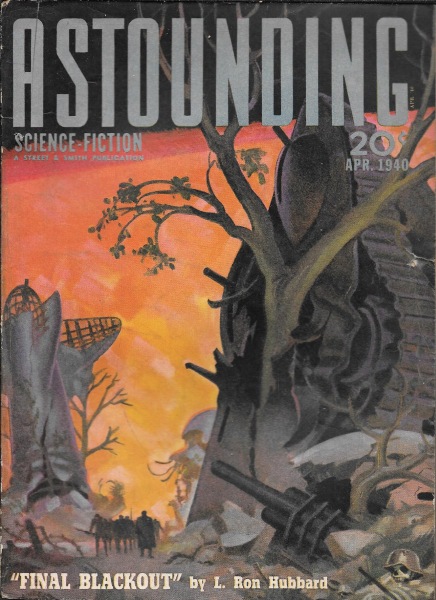
Hubbard took a thirty-year hiatus from writing fiction to focus on his new religion, and when he finally did return to writing with Battlefield Earth in 1982, he had apparently forgotten how to write a novel. Whoever was responsible for editing the manuscript at St. Martin’s Press seemingly decided to take the week off, without taking a hacksaw to the novel’s immense bloat, or even checking for basic errors. Nowadays Hubbard’s fiction is printed by less respectable publishers, namely houses like Galaxy Press that are backed by Church dollars. The irony of all this is that not only are you unlikely to find any of Hubbard’s fiction outside maybe Battlefield Earth, but it looks like Hubbard’s own people have been doing a poor job of preserving his pre-hiatus fiction. This is a bit of a shame, because I do have a soft spot (you might say a guilty pleasure) for early Hubbard, which includes probably his most notable SF story from those days, Final Blackout. 1940 was unquestionably Hubbard’s annus mirabilis, as it saw the publication of not only Final Blackout but also the short novels Fear and Typewriter in the Sky. These three stories, taken collectively, show someone who honestly could’ve become one of the greats.
Placing Coordinates
Serialized in Astounding Science Fiction, April to June 1940. It wouldn’t see book form until 1948, and in fact is one of the few works of Hubbard to be published in book form pre-Dianetics. Aside from an added dedication at the beginning and some small textual revisions, it’s the same novel. I’m not really sure if it’s in print right now.
Enhancing Image
We’re far enough into the future that not only has World War III happened, but so have several more conflicts on such a scale. Mainland Europe has been rendered one giant tombstone for the millions of civilians and soldiers killed. The result is a post-apocalyptic landscape, in which warface has evolved (or maybe devolved) such that only the infantry unit has remained really useful. Tanks, aircraft, and even artillery have been rendered obsolete, if only because the industrial power needed to make them, never mind the fuel needed for them, is no longer feasible. Centuries from now, politics have naturally changed for certain countries, but in funny ways. The UK has seen its monarch assassinated and the government went through “every known kind of political buffoonery culminating in Communism.” Russia, meanwhile, has turned away from Soviet socialism and once again fallen under the rule of a czar. (We’re not given any details as to how such a monarchy came about, which is odd considering what happened to the last czar in the real world.) So the tables have been turned. The UK and Russia have been at war for God knows how long, but by the time the novel starts it’s become clear that this war is about over. There simply aren’t enough fighting men left on either side for things to go on much longer. It doesn’t help that the British troops are prohibited from returning to their home turf, the official cause of this being an epidemic of “soldier’s sickness” that’s been ravaging Great Britain. But maybe there’s an ulterior motive.
And then there’s the lieutenant.
In his review of Battlefield Earth (a pretty negative review, made more damning because he sympathized with Hubbard to an extent), Algis Budrys mentions the lieutenant of Final Blackout as an example of a “superbly detailed caricature,” alongside the likes of Sherlock Holmes and Tarzan. This is to say (and Budrys means this in a positive sense) that the lieutenant is not to be understood as like a real person with interiority, but rather as a mythical figure whose first impression made upon us will turn out to be consistent with his characterization throughout the rest of the story. Like so many figures in the Bible and classical mythology, the lieutenant is not so much a person as maybe a stand-in for several people. There probably was no such historical man who fit the lieutenant’s shoes, and it’s a very deliberate (and clever) choice on Hubbard’s part that not only are we not given the lieutenant’s name, but he doesn’t even seem to have one. The leader os a brigade of hungry but fiercely loyal men, the lieutenant is told of as being fearless, pragmatic, and very well versed in warfare, having been born and raised quite literally in the midst of it. He is, in his heart, a true warrior, in that his home is the battlefield. The duality of the lieutenant is that he is kind towards his men and wishes to see as few casualties on his side as possible, yet he’s quick to put a bullet in someone’s brain if they’re shown to be a small threat to his men. He is, in a sense, the ideal soldier, although calling him heroic might not be accurate.
I’ve read enough SF from the Campbell era that I can say Final Blackout is very different from other material being published in Astounding at the time. People who are used to reading SF of this vintage and having stuff like spaceships and psi powers forced upon them will be surprised that no such far-future staples exist in this novel. Hubbard wrote the novel in 1939, on the eve of war starting in Europe (again); but while reviewers have taken Final Blackout as a “warning” story, and while it no doubt works well as one, it also takes after WWI and its immediate aftermath. France, as depicted in Hubbard’s novel, far more resembles the war-torn rural stretch of the country in WWI and the Nazi-occupied country of that war’s sequel. The Russians, like in WWI, are under the rule of a czar, and there’s even a contagious and deadly illness sweeping across the land like the flu epidemic of 1918. To get even more specific, the lieutenant’s men use chemical warfare (gas attacks) to coax out enemy troops and unfriendly civilians. The lack of armored vehicles on the battlefield is another connection, although in the case of Final Blackout it’s because the tech and resources are no longer there. The only things left are the soldiers and their guns, with ammunition now being precious and the bayonet being preferred. We do get a few characters with names, and even personalities, although they don’t amount to that much. We have Captain Malcolm, who rivals the lieutenant for command of his brigade. More memorably we have Bulger, the brigade’s cook and sort of a bloodhound with how his nose works.
The plot of this first installment is rather loose, but that’s what I like about it. We’re given time to soak in the dire atmosphere and living conditions of the troops, as well as given some backstory on the conflict. Any story of this stripe should have a goal for the protagonist, though, and in fact the lieutenant has two of them, a short-term and a long-term goal. The short-term goal is to find food and shelter for the men, which is no easy task since villages and townsfolk have become scarce. The long-term goal is to return to GHQ, as the lieutenant’s brigade has been recalled. Without vehicles, they’ll have to make the trip on foot. Splendid. Is this realistic? Not really, but then it seems to be that Hubbard intended Final Blackout to be understood as a dark fable rather than as a “realistic” depiction of warfare. This is far from the norm with SF printed in Astounding at the time, since Campbell wanted fiction that was both plausible and “realistic,” i.e., things are meant to be taken literally. Symbolism and metaphor were not strictly excluded, but Campbell also didn’t encourage such a mindset when writing. As such, there is very little actual science in Final Blackout, at least with this opening stretch. You could call it speculative fiction, but it doesn’t take notes from the hard or even soft sciences; this is for the best, because Hubbard was not rigorous about the sciences at all. His fast and loose approach doesn’t work so well for his SF, but Final Blackout is an exception.
There Be Spoilers Here
The climax of this installment involves the brigade forcing their way into a French village, where tensions are high, not least because the troops had deployed gas and the lieutenants makes it clear he’s not above killing a few villagers if they become too inconvenient. One of the few able-bodied men left in the village finds this out the hard way: a bullet turns his head into a goddamn bowl of spaghetti. It’s not the first killing we see in the novel (a “duke” [so he claimed] informed the troops of the village in the first place, and got summarily executed for his troubles), but it’s the most sudden and graphically described so far. Even more disturbing is the reveal that the villagers had secretly been keeping more than a dozen soldiers from a different brigade as slaves. In just a handful of pages Hubbard shows us how cutthroat this ruined world has become, in which conditions for both soldiers and civilians have become dire. There’s really so little left here that’s worth saving. In his introductory blurb, Campbell (I assume Campbell wrote it) calls Final Blackout a novel “of grim and desolate power,” and it’s easy to see where he’s coming from. Things are not looking good for the lieutenant and his men, although we can gather from the exposition dump at the beginning that the lieutenant is destined for greatness—or at least something bigger than a ragtag bunch of half-starved men.
A Step Farther Out
It took eight years for Hubbard’s novel to be published in book form, which was not unusual for Campbell-era SF. By the time Final Blackout found its way to hardcover, WWII had both come and gone, and Hubbard himself had gone through a rather embarrassing stint in the navy. Even reading this novel, I get the creeping feeling that the person who wrote it had not seen combat at the time, and indeed probably would not after the fact. It’s such a heightened reading experience, though, that the lack of realism is easy enough to forgive. Like with the equally effective novel Fear, Hubbard taps into the dark corners of the human spirit, unflinchingly, so that Final Blackout is looking to be one of the bloodier SF novels of its era. I blazed through much of this first installment, despite the seeming lack of plot progression, and I await more.
See you next time.

