The Story So Far
In the 25th century, mankind has not only voyaged beyond our solar system but long since colonized a multitude of planets. Aside from Earth, Mars, and Venus (that last one being famous for its technological advancements, which is ironic considering we know Venus to be an uninhabitable gaseous shithole), there are others such as the predominantly Catholic St. Marie, the twin planets Harmony and Association, the backwater Dunnin’s World, and the planet where Donal Graeme hails from, the Dorsai (for some reason it’s the Dorsai), another backwater whose chief export is its fighting men and women. See, the planets trade amongst each other mainly in people with certain skills, and these people are trained for said skills partly through positive eugenics, such that someone can be made to be the best, say, carpenter, or diplomat, quite literally from birth. The Dorsai (the people) have honed themselves over generations to be the best fighters and military strategists money can buy. I’m not even exaggerating when I say that, since rather than go fight battles on other worlds with some nonsensical patriotic notion in mind, the Dorsai join other worlds’ armies and even command said armies primarily for money. Donal happens to be a bright young commander even by the standards of a culture renowned for its cunning, but this doesn’t mean everyone (with the exception of Hendrick Galt, a marshal and a fellow Dorsai) trusts him by default.
Quite the contrary…
Not long after graduating from the academy and looking for his first assignment, Donal gets involved with Anea Marlivana, a Select of Kultis specially bred for the job, who wants him to destroy a contract she had made with Prince William, one of the most powerful men in the known universe. Not only would it be nigh-impossible to destroy the contract physically, but doing so would mean the death penalty. Clearly Anea must be off her rocker to jeopardize both her own life and Donal’s. Or is she? What’s going on with William and why would the girl, who is not much older than Donal, want to get out of her contract with him? Hugh Killien, a commandant who ends up serving under Donal, has eyes on Anea while also secretly being a way for William to watch over Donal. Well, this is inconvenient. In the heat of battle (or maybe not so hot, as there’s very little action described), in the back end of the first installment, Donal has Hugh executed on somewhat trumped-up charges—or rather, the charge on paper is legitimate, but the real reason Donal has Hugh killed off is to spite William and keep Anea safe. He finds himself unable to explain his rationale for this after the fact, though, with Anea assuming Donal got rid of Hugh out of jealousy. It’ll be a long time before they see each other again. In the meantime, Donal has a reputation to build and money to make.
Enhancing Image
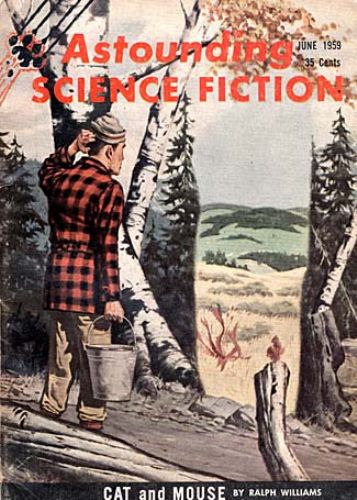
Let’s talk about Donal as a person, because I’m not sure how much of his characterization was what Dickson had intended or if maybe Dickson had calibrated his protagonist to be agreeable to the prudish John W. Campbell. Sex, needless to say, is off the table, although the fact that Donal brings up attraction to women (or more accurately, his conspicuous lack of attraction) is worth discussing. First we have his romantic tension with Anea, which at least for the time being goes nowhere. Later he sparks a friendship with Elvine Rhy, Galt’s niece, but Elvine takes such a fierce liking to Donal while Donal feels not even the slightest attraction toward her, despite her being a conventionally attractive woman—a conspicuous absence that troubles him. Granted, Dickson also writes Elvine as shrewish and possessive, so it’s not hard to blame Donal for wanting to go to space rather than deal with more of her. The misogyny in this novel is mild, but almost pervasive. Back to Donal himself, his interactions with other characters, namely his tendency to be blunt and to take things literally, on top of the aforementioned awkwardness regarding romance, point to him being on the autism spectrum, although I seriously doubt Dickson had thought of this. Public understanding of autism has changed so radically in just the past few decades, never mind a novel from 1959, and unfortunately we still have a long way to go. Still, Dickson may have inadvertently written a sympathetic autistic protagonist for what is one of the first military SF novels.
We’ve come to expect certain things from military SF, a subgenre that’s been a codified thing for about half a century now, and because Dorsai! is such an early example there was not yet a formula for Dickson to abide. People going in expecting action will probably come out disappointed; if anything Donal’s great gift is his ability to win battles without even really starting them. The climax of the second installment sees Donal gain control of Zombri, an otherwise barren moon which happens to be strategically important for Harmony and Association. He does this by deceiving the enemy commander, whom we’re told is a skilled and respectable man but who has a gambling problem, with his fleet of ships, and the two agree to peace. Virtually no casualties, and Donal’s bosses get an outpost on Zombri. This is part of a recurring theme with Dickson, as someone who’s read a decent amount of his work, which is that the best kind of victory is that which involves the fewest losses on either side. I’m not saying Dickson was a pacifist, because I’m pretty sure he wasn’t; but I do think, in connection with him serving his adopted country in WWII, that Dickson had a better idea as to the loss of human life in times of war than most SF writers of his generation, who stayed civilians during the war. Donal’s superior, a religious zealot who was looking to escalate things to the point of genocidal lunacy, doesn’t take kindly to Donal’s quasi-pacifistic method of capturing Zombri. Donal is too smart, and too good with a gun, to not have seen this coming. The good news is that there’s always another contract to be made.
A Step Farther Out
The end of the second installment is a thrilling and fitting closer, although I have to wonder how the last third of the novel is supposed to pan out. It seems like Dickson was so preoccupied with introducing the reader to a vast future setting, which indeed he’ll spend the next few decades of his life fleshing out, that he did not take much time to formulate a plot. Everything is anchored by Donal, who’s a curious choice for a protagonist, if only Dickson can refrain from playing the whole “superman” thing straight as an arrow. Miraculously Donal has won every combat scenario thrown at him so far, even with some obstacles in the way, but his interpersonal troubles will or at least should provide some genuine conflict for the rest of the novel. The problem is that a lot of stuff here just happens. There’s almost a randomness to it. This is yet another similarity Dorsai! has with Starship Troopers, which was published just a few months later, in that both novels have episodic plot structures that could benefit from some subtle trimming. Of course, this is all one big coincidence. I’m enjoying Dorsai!, but while it’s more agreeable than Heinlein’s novel, the controversial (some would say fascistic) parts of Starship Troopers are also very memorable.
See you next time.

