The Story So Far
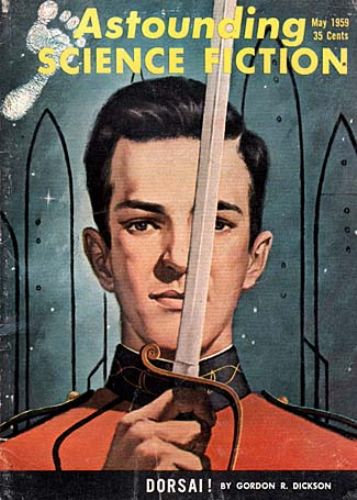
Donal Graeme has begun to make a name for himself rather quickly after graduating from the academy, even with a few obstacles in the way. Chief among these is Prince William of Ceta, one of the most powerful individuals in the known universe—a real feat, given that there’s something like over a dozen human-colonized worlds across multiple solar systems. William keeps Anea under his thumb, in a contract the latter cannot destroy without risk of being put to death. One-on-one contracts like this are not unusual; actually they’re pretty common, especially in Donal’s line of work. Donal is of the Dorsai, a society of people born and raised to become professional soldiers, indeed the finest soldiers and military strategists money can buy. The Dorsai fight not for patriotism or some other abstract thing, but simply because it is their trade and how they make a living. Soldiers are their chief export. Nearly every planet (except for something like Dunnin’s World, which is still in the early stages of being settled) has some specialized trade that it exchanges with other worlds in the form of specialized workers. Anea herself is young, but she’s been raised to become the Select of Kultis, Kultis being one of the Exotics, a group of planets whose cultures excel in genetic engineering. As to what a “Select” is or its importance, we’re only told in the final installment, which seems a bit late to me.
Beyond the episodic narrative of Donal hopping from job to job, including narrowly surviving a spaceship disaster and hiring a psychopath (by his own admission) named Tage Lee in one of those private contracts, the rivalry between Donal and Williams is far-off but inevitable. There’s also been some bad news in the family. Kensie, Donal’s uncle, has died, and Ian, Kensie’s brother, has become emotionally compromised, distraught over his brother’s sudden death. Ian may be depressed, even suicidal, but he’s still a Dorsai, and Dorsai don’t leave each other behind. Donal, despite being much young, has already risen above his uncle in the ranks and so decides to take him in, putting him in a position where he can do minimal harm. Speaking of family, it’s been a long time since Donal has been able to get in touch with his brother Mor, surely this will not come into play regarding the novel’s climax. We’ve followed the ups and downs of Donal’s career for the past two installments, but now it’s time for the novel to have a point become more focused in its plotting, maybe even more action-packed. Dickson has gotten away with mostly withholding thrills from the reader, in no small part because the minimal amount of violence makes sense for Donal’s character, but now shit is getting serious.
Enhancing Image
Before getting into the final plot revelations, I would like go into the treatment of Ian as character, since it falls on the side of prescient. Ian, Donal’s uncle, is a side character who unfortunaely doesn’t get much of a chance to speak for himself, but what’s telling is how Donal treats his uncle’s mental illness, in that he takes said mental illness seriously. Granted, the scientific explanation we get for Ian’s condition reads as bogus, i.e., Ian and Kensie were a gestalt wherein one cannot function at full capacity without the other. It’s the “modern” equivalent of the long-standing superstitious belief that twin siblings share a single soul, which is fine for Edgar Allan Poe but not as fine for science fiction. Still, Donal cares for his uncle and doesn’t hold his mental illness against as some kind of moreal failing. This is unusually humanistic for something printed in Astounding, and it’s not even that unusual in the context of the novel, but rather feeds into the overarching theme Dickson’s playing with here.
As for the plot, it’s become clear by now that William will either find some way to put Donal under his thumb or have him assassinated. William is a shithead, but he understands Donal is too smart and too talented to have as an enemy, and at the same time too dangerous. By this point some five years have elapsed since the last time they met, and by extension the last time Donal and Anea saw each other. They’re in their twenties now, and not exactly kids anymore. There’s some romantic tension that has gone unresolved, not helped by the fact that Anea has spent years resenting Donal and misunderstanding his intentions. It would be a stretch to say Dorsai! has a villain in the mustache-twirling sense; it’d be more accurate to say there are a few characters who give Donal an especially hard time, with William being like the final boss of a video game. William, when we finally do sit down with him and figure out what he wants with the colonized worlds, comes off as more melancholy than anything. Of course, he’s about to become even more like that once Donal sends his ships and does what is considered by everyone to be impossible: he conquers a civilized world. With the help of Ian, Lee, and friends, he captures Ceta.
The victory is not all sweet, however. The final confrontation between Donal and the defeated William is a strange one, not least because we’re sudduenly introduced to what seems to be a psi power Donal has with basically no explanation, albeit it’s something the novel has alluded to before (if only vaguely). Dickson’s priorities with explaining the mechanics of his future worlds are slightly skewed, in that we’re subjected to paragraph upon paragraph of exposition about different cultures, but not so much about how genetics factor into people’s lives and individual psychologies. Hell, sex is basically not discussed at all, which might be a result of this being printed in Astounding, Dickson’s own prudishness, or both. This aversion to sex becomes most conspicuous when we’re given the explanation at the tail end of the novel that (and I’m not kidding) Anea is genetically predisposed to fall in love with the most powerful man in the known universe, which would be either Donal or William. Yeah, I can’t defend that. For how much more reactionary Starship Troopers is on the whole it is, strangely enough, more forward-thinking than Dorsai! when it comes to gender relations. On the other hand I have to give Dorsai! credit for its emphasis on compassion and aversion to bloodlust typical of military SF.
A Step Farther Out
What an oddly paced book, and with a mish-mash of different viewpoints. This is somewhat early Dickson, but you can see clearly what would make him different from even close contemporaries of his like Poul Anderson. No doubt the eugenics and (only vaguely explained) psi powers appealed to John W. Campbell, but while Dorsai! is in some ways a prototypical military SF novels, it’s far less hawkish and, conversely, more compassionate than what the subgenre would become known for. There’s a lot of tell-don’t-show here, and Dickson is not that elegant a stylist, no matter how many times he pays homage to Rudyard Kipling; but then, sometimes (indeed, often this is the case with old-timey SF) the style is not the thing, but the substance. I’d hate to think of reading the first book version, which was an abridgment and the only way to read Dorsai! for some 15 years, since even the magazine version strikes me as a bit too short.
See you next time.