A change is coming to this site, and unfortunately it’s not for the better. I was supposed to review Leigh Brackett’s The Big Jump last month, but while I had finished reading the novel on time, I could not bring myself to write anything all that substantive about it. It’s fine, basically. It’s a short novel that is sort of spacefaring but decidedly unlike the swashbuckling planetary romances Brackett had made her bread and butter. Novels, for the most part, were also not really her strong suit, which makes her 1955 novel The Long Tomorrow all the more an outlier. I wanted to write about Brackett still, though, so this month we’ll be downsizing and looking at a short story of hers from earlier in her career, “The Halfling,” which got a Retro Hugo nomination. It’s also not a planetary romance, though; instead Poul Anderson, who for a time early in his career wrote some Brackett-esque science-fantasy, will take up that mantel. Incidentally I was supposed to write about an Anderson novella sometime last year, but never got around to it, so I’ll be making up for lost time.
The increasing habit I’ve made of missing out on pieces I had set out to cover has made me think this site could use some downsizing of its own. Thankfully not much will change except, sad to say, I will no longer be covering “complete” novels, i.e., stories 40,000 words or longer that are printed whole in magazine issues. This was a niche department to begin with, which I would only make use of a few times each year, but it seems with my life circumstances in mind that such a department is no longer viable. Of course, I’ll still be covering novels in serial form (indeed we have one such novel for this month), but the Complete Novels section you see at the top of the page of now dead. Those reviews will be kept up, because why not, but I will no longer be updating that department for the foreseeable future. Instead I will simply not post anything on the 31st of the month going forward, which gives me a bit of extra time to relax as well as the previous post more time to marinate at the top of the page. Really I think this is the best move for everyone, and I also think the price for no longer reviewing such stories is a rather small one.
July will see all short stories from Amazing Stories, but for this month it’s pretty much just more of the same. Nothing unusual here. Aside from Brackett and Anderson, authors I’d meant to cover earlier but couldn’t, we have the serial version of Gordon R. Dickson’s first major novel, as well as a novella from Katherine MacLean and an out-of-left-field SF-horror yarn from the now-obscure Raymond F. Jones. I had temporarily forgotten about my thing of reviewing as least one piece from Amazing Stories this month and almost replaced Jones with a Bruce Sterling Omni story. But Sterling is gonna have to way a bit, probably a few months.
We’re leaning vintage this month, with one story from the 1940s, three from the 1950s, and one from the 1960s.
For the serial:
- Dorsai! by Gordon R. Dickson. Serialized in Astounding Science Fiction, May to July 1959. Born and raised up to a point in Canada, but moving with his family to the US when he was 13, Dickson can now strike one as oddly mild-mannered and sympathetic for being a major forerunner of what we now call military SF. The Childe Cycle, which contains the Dorsai stories, would encompass his life’s work, although he never lived to give it a proper ending. Dorsai! was not the first story in the cycle, but apparently the second, as well as the first novel. The magazine version was nominated for a Hugo.
For the novellas:
- “The Diploids” by Katherine MacLean. From the April 1953 issue of Thrilling Wonder Stories. MacLean was one of the last major discoveries John W. Campbell had made, and indeed she would appear regularly in Astounding/Analog over the course of many years. Despite living an exceedingly long time (she died in 2019), she mostly stopped writing after the 1970s. She trained in psychology and had apparently taken in interest in Dianetics at one point.
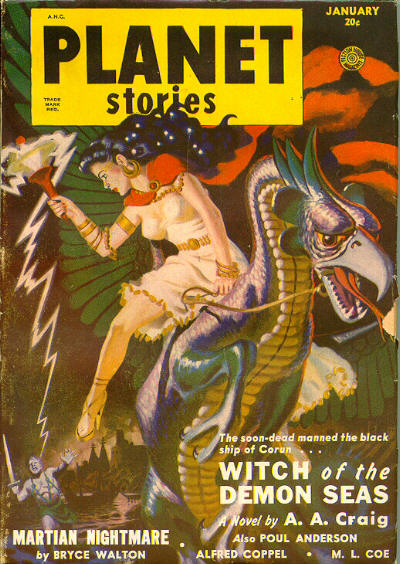
- “Witch of the Demon Seas” by Poul Anderson. From the January 1951 issue of Planet Stories. Anderson was another Astounding/Analog regular, although he also appeared basically everywhere else. Born American but raised by Danish immigrants, there’s a strong sense of the “Nordic twilight” in Anderson’s writing, especially but not exclusively his later work. Early in his career he followed in the footsteps of Leigh Brackett and wrote some planetary romances.
For the short stories:
- “The Halfling” by Leigh Brackett. From the February 1943 issue of Astonishing Stories. Retro Hugo nominee for Best Novelette. Instead of reviewing a novel I guess we’ll settle for something more small-scale. Brackett had made her debut in 1940, in Astounding, but she quickly turned to other magazines despite the lesser pay. She would eventually find much success as a screenwriter.
- “Stay Off the Moon!” by Raymond F. Jones. From the December 1962 issue of Amazing Stories. Born and raised in Utah, Jones seems to have been the first Mormon SF writer of note, so in that sense he was ahead of his time. He was active through much of the ’40s and ’50s. Fans of Mystery Science Theater 3000 may recognize him for having written This Island Earth (the novel, not the movie).
Alright, let’s do some reading.

