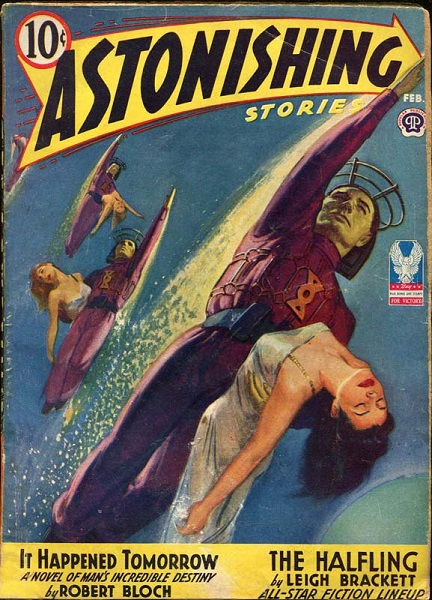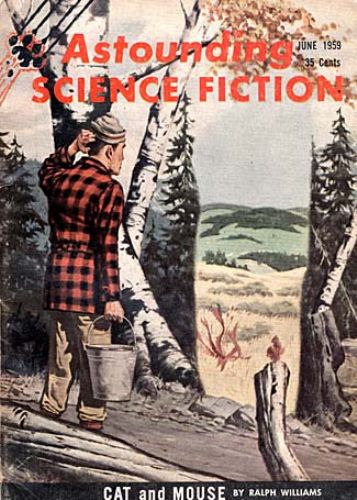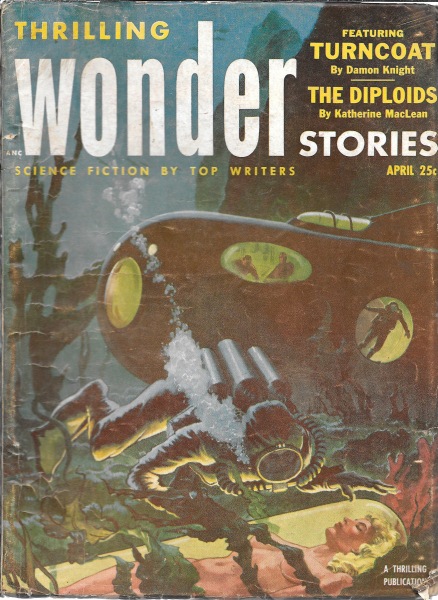
(Cover by Robert Fuqua. Amazing Stories, January 1944.)
What a year, huh? And we just started.
Since a lot of us are snowed in, or at least dealing with some pesky snow and ice (and ICE) in the midst of our everyday activities, we may as well pass the time by cozying up with some good reading. Or maybe not so good. Truth be told, I’m not so sure about the quality of what I’ll be tackling this month, with maybe one exception, the short story. Why yes, it’s been a while (a couple years) since I reviewed and quite enjoyed Philip José Farmer’s story “Mother,” which you may remember as being strange and pretty risqué for early 1950s SF. Farmer did write a sequel, “Daughter,” which from what I’ve heard is just as good if not better. As for choosing the obligatory item from Amazing Stories, to celebrate that magazine’s centennial, I decided to pick something from the rather neglected and maligned ’40s period. At the same time, Ross Rocklynne is not just some hack writer, so we’ll see. It had also been, for my money, too long since I’d scavenged the pages of If, namely for a serialized novel or novella, of which many were published in that magazine. For February it’s all sci-fi and all retro.
Now, there is an announcement I’d been wanting to make here, and maybe should have with last month’s review forecast, but now is as good a time. I recently launched a sister blog on Substack, Sketches from a Reader’s Album, which is not focused on genre fiction at all (although genre fiction will inevitably figure into it on occasion), but is like SFF Remembrance a review blog with the occasional editorial. At least that’s the idea. There I’ll be writing about literary fiction, nonfiction, and poetry, namely books that have won the National Book Award. (The National Book Award is sort of like to the Pulitzer Prize what the Nebula is to the Hugo, if you care for that sort of thing.) With both sites you can expect only so many posts a month, but they’ll be lengthy and hopefully entertaining.
As far as time frames go, we have one story from the 1940s, one from the 1950s, and one from the 1960s. Because I’ll be covering stories published in Amazing Stories in the 1920s and ’30s, we unfortunately will not be getting to more recent stuff until April at the earliest.
For the serial:
Earthblood by Keith Laumer and Rosel George Brown. Serialized in If, April to July 1966. Such a collaboration sounds out of the blue, and honestly I’m not even sure how or why Laumer and Brown came together to work on a novel. But it’s not totally unexpected. Laumer and Brown made their debuts at almost the exact same time, at the tail end of the ’50s, and both were prolific during the pre-New Wave years. They were also very close in age. Sadly Brown died at just 41 years old in 1967, one year after Earthblood was published, while Laumer suffered a stroke in 1971 which left him unable to write for a time. I know little about Earthblood aside from it being an adventure novel, of the sort that was common in If in the ’60s.
For the novella:
“Intruders from the Stars” by Ross Rocklynne. From the January 1944 issue of Amazing Stories. Retro Hugo finalist for Best Novella. Rocklynne is one of those unexpected survivors from the pre-Campbell years, having made his debut in 1935 when he was just 22, and continuing up to the early ’50s before going on hiatus. (Like too many SF writers of his generation he became interested in Dianetics.) He eventually made a comeback in the late ’60s, and even appeared in Again, Dangerous Visions. Despite the Retro Hugo nomination, “Intruders from the Stars” has almost never been reprinted.
For the short story:
“Daughter” by Philip José Farmer. From the Winter 1954 issue of Thrilling Wonder Stories. The SF market in the early ’50s was such that you could get your story published even if it was more daring than average, provided you accepted selling to one of the second-rate magazines. By 1954, Farmer had already become notorious for his novella “The Lovers,” about a sexually explicit (for the time) romance between an Earthman and an alien woman who is more bug-like than she appears. Early Farmer is pulpy in style, but he can be rather big and provocative with his ideas.
(Cover by Frank R. Paul. Amazing Stories, February 1927.)
The Story So Far
Bedford and Cavor are a failed businessman and an eccentric scientist respectively, who strike up an unlikely friendship and business partnership. Cavor, being the inventor, perfects a metal of his own design which he christens Cavorite, while Bedford orchestrates the construction (not the invention, of course) of a giant metal sphere which takes advantage of this anti-gravity metal called Cavorite. To test the viability of this new metal, after an accident gets nearly the both of them killed, Cavor and Bedford agree (reluctantly on Bedford’s part) to take this big metal ball to the moon. They pack some provisions, although strangely (from a modern standpoint) it doesn’t occur to them to build pressure suits for a world which very well might not even have an atmosphere. But of course, in the year 1899, it was speculated that the moon might not only have an atmosphere, but be home to life of its own. And so it does here.
Of course, nearly everything that could go wrong does, short of the two men dying straightaway. They lose track of the sphere, finding that it had been stolen or sunken into the landscape. They eventually battle hunger and thirst, although due to the lower gravity it takes longer for their bodily functions to call upon them. The biggest issue becomes the moon’s indigenous intelligent race, a bunch of “ant-men,” some of whom are man-sized, and somewhat humanoid, but otherwise have nothing in common with the men. These aliens, which Cavor comes to call Selenites, live in a complex network of underground caverns, and since the plant life on the moon isn’t useful for crafting wood-based equipment, Selenite civilization is metal-based, the moon apparently being rich in metals. At the end of the second installment Bedford and Cavor decide to split up in search of the sphere, leaving a handkerchief as a landmark.
Enhancing Image
The plan doesn’t go well at all, although the bright side is that Bedford finds the sphere and is able to leave the moon, albeit without Cavor. Unfortunately the two will never see each other again, although this is not the last time they hear from each other. In what I can only think of as a major contrivance, Bedford lands in the UK, in the seaside town of Littlestone, which is quite lucky for him. He loses the sphere again, for the last time it seems, but he’s able to make some money off of publishing the story of his and Cavort’s journey to the moon. (Funnily enough Bedford’s story appears in The Strand Magazine, which is also where The First Men in the Moon first appeared in the UK.) Normally this would be where the story (as in this novel) ends, but eventually a scientist by the name of Julius Wendigee, a Dutchman living in Britain, “who has been experimenting with certain apparatus akin to the apparatus used by Mr. Tesla in America, in the hope of discovering some method of communication with Mars,” picks up coded messages from the moon. Bedford gets in on this, having hitherto assumed Cavor was dead, seeing that his former buddy is not only alive but in contact with the Selenites. This is good news!
The back end of the novel is a series of transcripts of Cavor explaining Selenite culture and biology, among other things. Bedford effectively disappears as a character while Cavor takes control, relating his story to us like the unnamed protagonist does in The Time Machine. I must admit that these last few chapters are my favorite part of the book, which is a shame considering that, by Bedford’s own admission, the story had already come to an end in one sense, but also it feels like too little and too late. We learn important details about life for the Selenites that we really should’ve been given insight to earlier in the book, since up this point they came off as generic hostile aliens. The novel is at its best when it stops being an adventure narrative and instead swerves into territory Wells is better with, namely speculation on the future of human civilization. Cavor is led into an impossibly grand hall and introduced to the ruler of the Selenites, the Grand Lunar, an immobile mass of flesh whose brain is literally several yards across. (Intelligence among the Selenites is determined by the size of their heads, at the cost of body strength and mobility. This is something that became a cliche in pulp-era SF, but it was not so in Wells’s time.) It’s here that we finally get what the point of the book seems to be—a point that Wells had rather neglected to explore up till now.
There’s a big case of culture clash between the humans (or at least humanity as told by Cavor) and Selenites, indeed every facet of culture there is. The Selenites, in keeping with their insectoid appearance, are a race of specialized workers with a single absolute ruler, although the Grand Lunar represents supreme intelligence rather than supreme fertility like a queen bee. There’s no war here, nor does there seem to be poverty. Despite their reliance on metal, the Selenites are pre-industrials. The evil and filth of Victorian England has not reached them. Unfortunately, in trying to describe life on Earth, Cavor can’t help but yap about the nastier parts of human nature and act as if these are just things one ought to expect, namely the human tendency to wage war. This understandably concerns the Selenites, and Cavor’s fate is left ambiguous, although it doesn’t look good for him. Regardless, we never hear from Cavor again. There’s an anti-war slant crammed into the climax of the novel, which I can’t help but take as hypocritical on Wells’s part, considering he would later support British involvement in World War I. (Wells was, among other things, a hypocrite: he was a womanizer, even fathering a child out of wedlock, while at the same time being prudish about sex in literature, like the good Victorian gentleman he was.) The climax is good on its own, but if only the rest of the novel had properly built up to it.
A Step Farther Out
When C. S. Lewis wrote Out of the Silent Planet he intended it as a not-very-subtle rebuke of Wells’s writing, and The First Men in the Moon in particular. For what it’s worth, I’m not a fan of either novel. I don’t think The First Men in the Moon plays to Wells’s strengths, for the most part. It’s a weirdly structured thing that feels lopsided and at times bloated, despite coming to only about 200 pages in paperback. It’s a simple idea that could’ve worked better had it been the length of The Time Machine, or even The Invisible Man. Wells, who was never one to hide his beliefs, is less didactic here than in those other novels, but I wish he maybe didn’t bury the lede with what he wanted to say. The First Men in the Moon is actually less didactic than Lewis’s novel, but that’s not really a positive for the former. Maybe I would like it more had I read it as a book, in a short burst of time, rather than stretch it out over a few weeks, but I’m not sure.
(Cover by Frank R. Paul. Amazing Stories, January 1927.)
The Story So Far
Bedford is an aspiring playwright and a failed businessman who strikes up an unlikely friendship with the scientist Cavor. Bedford is working on a play whilst licking some financial wounds and Cavor has been trying to perfect a metal of his own design, so that each man has been struggling with his own goals. Their friendship takes on a business aspect, with Bedford basically acting as Cavor’s manager while the latter messes around with the elements and God knows what. Because this novel is narrated from Bedford’s perspective and because Bedford himself is not a scientist at all, the details of how Cavorite is perfected are rather sketchy. It’s a combination of metals that works like helium, despite being solid, in that it has an anti-gravity effect. The accidental perfecting of this man-made element results in a cyclone that damn near kills Our Heroes™, but the good news is that it works. The question then becomes what to do with Cavorite. Mind you Wells wrote the novel around 1899, the years it takes place, so airplanes were just a little bit off in the future, with hot air balloons being up to this point the only practical way man could take flight.
Cavor gets the “brilliant” notion to not only construct a giant metal sphere made partly of Cavorite, but to test it by flying himself and Bedford to the moon. Thus our means of getting to the moon is not via rocket ship, or even like Jules Verne’s From the Earth to the Moon where we’re shot out of a cannon, but what amounts to an anti-gravity metal sphere. How these two Englishmen plan on getting back to Earth, let alone England, remains to be seen. When they land on the moon they find that the air is breathable, if also taking some getting used to, and that there is plant life here at the very least—albeit plant life of an exotic sort. The gravity is also only a fraction of Earth’s, which Bedford struggles with. And yet despite the breathable atmosphere there doesn’t seem to be any alien life possessing anything like human intelligence… at least so far.
Enhancing Image
The second installment opens with Bedford and Cavor actually stepping out of the sphere and getting a whiff of that comparatively thin moon air. I need not tell the reader (but I will) that aside from the lower gravity, the moon in Wells’s novel is completely different from the moon as we know it—so different that it may as well be a fantasy realm. What was scientifically plausible in 1901 was very much not so even a few decades later, never mind in 2026. If The First Men in the Moon suffers from anything, aside from being heavier on the adventure elements than Wells’s more iconic novels, it’s not being nearly as plausible as The Time Machine or The Island of Dr. Moreau. Granted that all science fiction is founded on at least one big lie (and more likely several lies in concert), The First Men in the Moon now almost reads more like fantasy than SF. It’s more scientifically grounded than Edgar Rice Burroughs’s Barsoom novels, but not by a whole lot. What’s interesting is how the atmosphere and gravity affect Bedford and Cavor’s sense of time and even hunger, with them realizing after a while that they’d not eaten in hours, yet don’t feel like they’re starving. It’s also easy (and fun) to traverse the moon by jumping around. The only problem (well, the first problem) is that they at some point lose track of the sphere.
It takes nearly halfway through the novel, but it does live up to its title. I said that the moon here is radically different from how it is in real life, another difference being that the moon here has a vast network of underground tunnels. Not only is the moon alive, with plants and “mooncalves” to serve as livestock, but there is indeed a race of intelligent beings here. The Selenites are about man-sized and bipedal, but insectoid. More to the point, there’s no overlap in language between the Englishmen and the aliens, except maybe basic body language. The Selenites don’t intend to kill them, at least not right away, instead taking them prisoner and holding them in this underground cavern. This isn’t quite as cool as it sounds. It could be because Bedford and Cavor, while being eccentric (especially the latter), are not natural-born adventurers like John Carter or Conan, but much of the conflict in this stretch of the novel comes down to Our Heroes™ bickering with each other rather than working together to fight their captors. Not that there’s anyone else around to converse with. Even the human cast of The Time Machine is bigger, by virtue of the framing narrative. Something I’ve just noticed about protagonists in Wells’s stories, be it his novels or short stories, is that a) they’re not given to introspection, b) they’re reacting to strange happening, rather than causing them, and c) they’re always dudes, without fail. When I say “protagonist” I also mean the narrator, since there tends to be a secondary character, the deuteroganist, who acts rather than reacts. Cavor is thus the deuteroganist to Bedford’s protagonist.
A Step Farther Out
Wells was not known for writing long novels, but even being about the same length as The War of the Worlds, The First Men in the Moon feels smaller in scale and less intellectual. We’re two thirds of the way in and the Selenites are still mostly a mystery. I can’t help but feel like this novel is missing something Wells’s best novels have, although I can’t quite put my finger on it. I’m gonna wait until the final stretch to pass judgment, but this is not looking to be one of my favorites of his. Oh well.
(Cover by Frank Kelly Freas. Astounding, October 1953.)
Who Goes There?
Tom Godwin is one of those semi-forgotten authors whose legacy is secured by a single work, the 1954 story “The Cold Equations.” While this story’s reputation is earned, in that it is understandably one of the most controversial SF stories ever published (people have been arguing over it for the past seventy years), its creator has sadly been left in the dust. Of the many writers to debut in the ’50s, Godwin was one of the few who contributed mainly to Astounding. Why he had such a chummy relationship with John W. Campbell, I’m not sure. Godwin himself came to writing SF relatively late in life, being already deep in his thirties when his debut story, “The Gulf Between,” was published, and his life was marked by tragedy and inner demons. He had a disability that gave him a hunched back, which cut his military career short, and he struggled with alcoholism over the course of many years, never getting entirely off the wagon. His mom and sister died when he was very young, and he had a troubled relationship with his dad despite living with him for a good deal of his adult life. Godwin’s most productive period as a writer was in the ’50s, and afterwards he dropped off somewhat, hampered by health problems. When Godwin died in 1980, seemingly a broken man, his short fiction had not even been collected outside of anthologies.
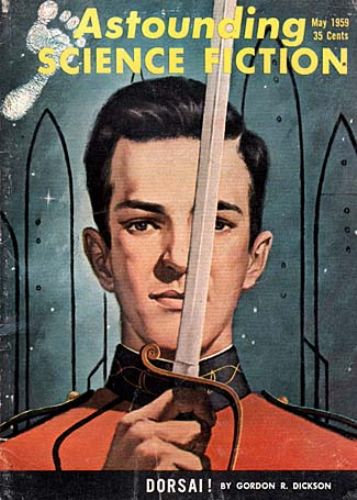
“The Gulf Between” has the rare distinction of being a debut story and getting a cover in Astounding. The only other example I can think of off the top of my head would be A. E. van Vogt’s “Black Destroyer.” Now, to bring up the elephant in the room, folks might find this cover to be familiar somehow. That’s because Queen had commissioned Frank Kelly Freas to redraw it for their album News of the World, with the only major difference being the one dead guy on the original being replaced with the band members. The album cover is leagues more famous than its inspiration, but “The Gulf Between” is a surprisingly good and brutal tale of Cold War paranoia which marked the introduction of an overlooked talent.
Placing Coordinates
First published in the October 1953 issue of Astounding Science Fiction. It was never reprinted in Godwin’s lifetime, only ever being reprinted in The Cold Equations & Other Stories.
Enhancing Image
The narrative shifts back and forth between the main plot and what seems to be flashforwards, all in italics, in which an unnamed man is dying on a ship, the robotic doctor onboard being able to prolong his life but being unable to save him. These flashforwards are deliberately vague and misleading, but we’ll get to them later. For now, the action starts in Korea, during that war which saw a ceasefire but which theoretically could go hot again any day of the week. The Korean War had just ended when “The Gulf Between” was published, but it was still going on when Godwin wrote the story. There are rumors in-story that the war will end in a stalemate, which is just what would happen in real life. Knight, a respectable soldier, is ordered along with his men to take a hill, a battle he knows will at best result in a pyrrhic victory. But his commander, Cullin, will not take no for an answer. Cullin is a genuine psychopath who sees the men under him as expendable, and who believes that human consciousness has no place on the battlefield. It’s his way or the highway. The battle is a success—at least on paper. The toll in lives for the Americans is perhaps too great. Knight makes it out alive with a fierce hatred for his commanding officer, and while he might not suspect it at the time, their rivalry will come back to play a role in world geopolitics. After all, the Cold War has been heating up.
Most of “The Gulf Between” takes place in what would’ve then been the near future, sometime in the latter half of the ’50s. In depictiing what the back end of that decade might be like, Godwin is actually not that far off. By the end of the ’50s the space race will have started, with Kennedy in his inauguration address promising fellow Americans that “we” will put a man on the moon in ten years’ time. The issue of The Bomb™ is on everyone’s minds, as well as the development of rocketry. This is a very ’50s story, although I don’t really mean that in a bad way. Following the war, Knight has become involved in robotics and rocketry, while Cullin (ironically, given his hard-as-nails military attitude) has since turned traitor and become an enforcer for “Russo-Asia,” what I have to assume is a coalition of the Soviet Union, China, and North Korea. I guess they put their petty differences aside as to what kind of socialism should dominate the world. Mind you that neither man is much of a patriot, and the first time they meet after the war it’s in Mexico: Knight’s there on siesta and if Cullin were to set foot in the US he’d probably be tried as a defector. Cullin is very interested in Knight’s work on a super-computer, called the Knight-Clarke Computer, that can think faster and more efficiently than a human being—but not of its own volition. The computer, like “AI” as we understand in the current climate, can’t think for itself; it’s a learning machine, and a very good one. It’s also (and this is the part that catches Cullin’s attention) totally obedient. A machine doesn’t lie, and it doesn’t get sentimental about orders. Such a computer could be used to guide weapons, is the idea.
“The Gulf Between” is an ambitious little story about nothing less than the necessity of human consciousness, not to mention conscience. Knight and Cullin are not deeply drawn characters, but they do clearly represent opposing philosophical positions. Knight is interested in intelligence and consciousness while Cullin finds such things to be abhorrent, his ideal army being a bunch of unthinking and subservient robots. It feels exaggerated, but it’s also not hard to believe there are people like Cullin in government or the military. It’s also worth mentioning, although it might be obvious to say, that of course Cullin would defect to Russo-Asia, what with the mindset at the time being that those dirty commies were a bunch of unthinking and mindlessly conforming stooges. And yet, putting the Cold War subtext aside, the message that each person needs to have their own intitiative and moral code still feels relevant. Hell, Henry David Thoreau wrote a whole essay on the matter, you may have heard of it. In fact I’ll quote one of the more famous passages in “Civil Disobedience,” which Thoreau wrote in the context of the Mexican-American War but which can just as well be applied to men like Cullin a century later. To wit:
In most cases there is no free exercise whatever of the judgment or of the moral sense; but they put themselves on a level with wood and earth and stones; and wooden men can perhaps be manufactured that will serve the purpose as well. Such command no more respect than men of straw, or a lump of dirt. They have the same sort of worth only as horses and dogs. Yet such as these even are commonly esteemed good citizens.
Knight has friends and colleagues, whereas Cullin doesn’t seem to have any friends and indeed barely even seems to have allies. Cullin has his job implicitly because he’s that good at it, and not because the higher-ups see him as a cuddly individual. Much to Cullin’s liking, the embrace of the Soviet and Asian commies is a cold one. I’m not sure what Godwin’s politics were (I’m not even sure what he looked like), but given his attempt at military service and his regular contributions to Astounding it’s a safe (although not sure) bet that he was a right-wringer. But if so, there’s a humanist element that muddies the waters. When reading Godwin there’s a sense that a tug-of-war between the belief in goodness in one’s fellow man and a deep pessimism, even a sadness, goes on with him. There’s more bloodshed here than I expected, but I’m getting a bit ahead of myself with that. A tour of Lab Four, where Knight and the others work, is underway. The most immediately impressive part is George the robot, which is intelligent but not really sentient. George can’t make decisions for himself, but he’s very good at following orders—regardless of who’s giving them. (I assume George is meant to be the robot on the cover, but in-story he’s about human-sized rather than giantic.) This is important to keep in mind. There’s also the robot-assisted rocket, set for liftoff with a human pilot. Would be a shame if something went wrong with other of those.
There Be Spoilers Here
The rocket has been sabotaged such that it can’t be launched remotely, but far worse is that Russo-Asian paratroopers have somehow made it behind enemy lines and launched an assault on Lab Four—Cullin being among them. The explanation is that relations between the US and Russo-Asia have been cooling down as of late, making special operations like this possible. (Remember, kids, that the commies are always waiting to strike, so don’t let your guard down.) Sure. The third act of “The Gulf Between” is logical, in that it makes sense that the rivalry between Knight and Cullin would escalate to this extent, but it also seems far-fetched. (I say this mere days after American spec ops kidnapped the leader of Venezuela and flew him out of the country quite literally overnight.) A whole fucking battle starts and some people get killed, including civilians, but Cullin taking over the rocket is not the victory he thinks it is. Turns out the dying man we’ve been following in the flashforward scene was not Knight, like you might expect, but Cullin. In an ending which is both grim and funnily literal, Cullin, the man who wanted to turn men into machines, finds himself clinging to life, strapped to the pilot’s seat, with an iron heart and an iron lung. By the end he is almost as much machine as man, but the machinery will not save him, as the rocket continues to accelerate through space.
A Step Farther Out
Why it took half a century for “The Gulf Between” to get reprinted at all is honestly beyond me, given how much middling or bad SF got treated more generously by editors. Godwin has a curious life story and career trajectory, which would already make him worthy of reading beyond “The Cold Equations,” but he was also a step or two above the average Astounding regular in terms of skill. It’s a shame he didn’t write that much. I recommend seeking this one out, although to this day you can count the number of ways to read it on one hand.
(Cover by Frank R. Paul. Amazing Stories, December 1926.)
Who Goes There?
Herbert George Wells was born in 1866 and died in 1946, meaning he lived to see both World Wars, as well as the dropping of the first nuclear bombs. By the end of his life he came to believe humanity was in a pretty sorry state, but for much of his career he could be considered an optimist. He was an early advocate for Darwin’s theory of evolution and was what we’d now call a democratic socialist, both of these beliefs playing major roles in his fiction writing. While he wrote essays and articles prolifically, and wrote quite a bit of non-genre fiction, it’s his SF that secured his legacy. Between 1895 and 1901 alone he either invented or codified multiple subgenres of SF, between a handful of novels and a fair number of short stories. That his output became increasingly sporadic and lacking in vitality after that point is a relatively small price to pay, given the heights of his major work. He’s arguably the most important SF writer to ever live, even taking into account authors who wrote SF before him, such as Jules Verne and Edgar Allan Poe. The First Men in the Moon was first published in book form in 1901 and is perhaps Wells’s last major novel, although he did write some very good short stories after this point.
Starting my Amazing Stories run with a reprint might seem odd for those who are not in the know, but reprints played a big role in the first years of that magazine’s history. Hugo Gernsback quickly became infamous for not paying his writers in a timely fashion, and the original work he received was often of pretty dire quality anyway. Therefore, reprints of classic (from the perspective of the 1920s) SF sounded like a logical choice. The relationship between Gernsback and Wells eventually soured, but it’s hard to come across an early issue that doesn’t feature a Wells short story or novel in serial form. There was a generation of young readers who, lacking in hardcover books, associated Wells with Amazing Stories and those colorful Frank R. Paul covers, and that’s not a bad thing.
Placing Coordinates
First serialized from 1900 to 1901 in The Cosmopolitan and The Strand Magazine, in the US and UK respectively. It was first published in book form in 1901. It was serialized in Amazing Stories from December 1926 to February 1927. Obviously it’s still very much in print, but because it’s public domain it’s also on Project Gutenberg.
Enhancing Image
Wells is famous for a lot of things, but his protagonists (except maybe the unnamed hero of The Time Machine) are not among them. Here we have Mr. Bedford, a businessman who’s recently come into hard times by way of bankruptcy. He’s the narrator of this story, but it’s hard to call him a hero; on the bright side, he’s at least affable. Bedford’s chosen to put his money issues aside for the moment and concentrate on writing a play. During this retreat he has a series of encounters with Mr. Cavor, who turns out to be an eccentric scientist. Cavor is mildly and passively annoying, and when Bedford makes this known to him Cavor threatens to buy his bungalow. The two men come to an understanding, though, and even start a business relationship that might evolve into friendship. It’s a case of how opposites might attract, since Bedford is “practical” and business-minded while Cavor, despite being highly intelligent, has yet to make much of a living off of his inventions. His latest invention might prove profitable, though, being an artificial element called Cavorite, which is missing an ingredient. The making of Cavorite is rather vague, with Bedford, himself far from being a scientist, not knowing “the particulars” of its final (and accidental() making. The basic idea is that Cavorite is an anti-gravity amalgamation of metals, in that it’s like helium but a solid rather than a gas. It’s worth mentioning that Wells wrote The First Men in the Moon just prior to the first modern plane taking flight, and the novel itself is set at the very end of the Victorian era. The only practical way a man could take flight in 1899 was with the hot air balloon, which of course is mentioned.
Also mentioned is Verne’s From the Earth to the Moon, which in case you don’t know involves a bunch of adventurers building a huge fucking gun and firing themselves out of it, their capsule being like a bullet. It’s pretty hard to take seriously nowadays, not that Wells’s solution to the moon problem is much better. Cavorite is a made-up element that may as well be magic, and the ship the two men (with the help of some laborers) build is a sphere made partly of this element. It’s not really a rocket ship, but rather an anti-gravity ship. Maybe the most unserious part is that Bedford and Cavor are not astronauts, which goes without saying, but also they don’t bring any equipment that even a child nowadays would understand as required for space travel. No pressure suits in this novel. The men also don’t experience the ill effects of low or zero gravity. We really didn’t know anything about our moon in 1899, did we? There’s speculation that the moon might have a breathable atmosphere (it doesn’t) and even life (not that either). Of course, since this is a Wells novel, the air is perfectly breathable and some of the first things we see are flowers indigenous to the moon.
But I’m getting ahead of myself a bit.
It’s hard to spoil this novel, since even having not read it before I’m aware of the general trajectory of its plot. We wait until nearly a third into it to witness the revelation of life on the moon, but this fact is made apparent even on the covers of some modern editions. Like with Wells’s other famous works, it suffers nowadays from seeming too familiar, although not to the level of, say, The War of the Worlds. It doesn’t help that Wells is big on using archetypes for his characters, so that Bedford and Covar are about one step above the level of cardboard. The stakes are also low, or at least so it appears at this point, since Our Heroes™ only decide to journey to the moon as a sensational way of testing the sphere. You may then be wondering what the appeal of reading Wells in [the current year] might be, if the science is laughably outdated and his characters lack the dimensions found in the works of Wells’s more literary contemporaries. The secret is that Wells, at his best or even just close to it, is a pretty engrossing storyteller. Wells is like his close contemporaries Arthur Conan Doyle and Rudyard Kipling, in that a) he wrote a fair amount of SF and horror, and b) he had a knack for titillating the reader’s imagination. Despite not much happening in terms of plot with this opening installment, I did read most of it with ease.
There Be Spoilers Here
Well, they do land in the moon, or rather on it.
A Step Farther Out
Funny thing about reading this novel and Wells generally is how one can see his influence on other authors pretty readily, be it on Robert Heinlein or Michael Crichton. (I wouldn’t be surprised if the anti-gravity sphere here was an influence on the reality-warping chamber in Crichton’s Sphere.) As with Wells’s other major novels it can also be better understood as adventure fiction than SF of the more serious/modern sort, even if those authors partly got their game from Wells. The question then is, what happens next? We’ve technically already made first contact, but surely there will be aliens that can converse with a couple of Englishmen.
(Cover by Frank R. Paul. Amazing Stories, February 1927.)
Since it’s now the new year for everyone, it’s only natural that we have some new things to look forward to or new things to do. I have a few New Year’s resolutions myself: some movies on my watchlist, quite a few video games I hope to get around to playing. I have hundreds of games in my backlog and even more books to be read in my personal library. I have multiple hobbies, which is something I would recommend to everyone. Unfortunately another thing on my to-do list for 2026 is to either get a second job or to try my hand at writing professionally, which would take time away from this hobbies, including this here blog.
Truth be told, I’ve been winding down productivity here for a minute, so this shouldn’t come as a surprise. I’m seemingly incapable of uploading posts “on time” (but of course who’s keeping time except for myself), and I’ve been missing one or even two reviews every month for the past several months. I wouldn’t be too worried, for the few of you who read this, since I’m not gonna be shutting down this site—just lowering my productivity. Granted, for the first couple years I ran this site I was writing at a feverish pace; in hindsight I’ve not really sure how I did that while also having a day job. In 2023 and 2024 I wrote over 200,000 words a year, according to the stats, which is a lot for one person. There was less wordage for 2025, and now for 2026 you can expect fewer posts as well. But this is like being on a flight and going from 20,000 feet to 10,000 feet.
Now, as you may know, Amazing Stories turns 100 this year. It was revived (again) not too long ago as basically a fanzine, but I would like to celebrate Amazing Stories as a professional magazine, which still means going through material that spans seven decades or so. It’s a lot, not helped by the fact that it has a pretty messy history as far as changes in editorship and publisher go. Except for maybe the beginning of its life it always played second fiddle to competing magazines, but it survived (sometimes even thrived) for an impressive stretch of time, given the circumstances. So, every month (except for March, July, and October, where you can expect short-story marathons) I’ll be covering a serial, novella, or short story from the pages of Amazing Stories. This should be interesting.
With the exception of the aforementioned months we’ll be doing only one serial, one novella, and one short story every month from now on, plus at least one editorial. Anyway, we have one story from the 1900s, one from the 1930s, and one from the 1950s.
For the serial:
The First Men in the Moon by H. G. Wells. Serialized in Amazing Stories, December 1926 to February 1927. First published in 1901. Feel like it would be criminal to pay tribute to Amazing Stories without bringing up Wells at least once, possibly even twice, since he was heavily associated with the magazine in its first few years. Wells himself is arguably the most important SF writer to have ever lived, with his influence being felt to this day practically everywhere you look. Any given SFnal premise likely has its roots in something Wells did over a century ago. This is even more impressive when you consider that Wells at the height of his powers lasted only half a dozen years or so. The First Men in the Moon is one of the last of his classic novels.
For the novella:
“The Gulf Between” by Tom Godwin. From the October 1953 issue of Astounding Science Fiction. Godwin became somewhat famous in SF circles for exactly one story, “The Cold Equations,” which he wrote pretty much in collaboration in John W. Campbell. It might surprise some people that Godwin had in fact written other stuff, and I admit I’m part of the problem because I don’t think I’ve read any Godwin aside from “The Cold Equations.” But I’m gonna fix that. “The Gulf Between” was Godwin’s first story, and it’s notable, if for no other reason than that the cover it inspired would later be reworked as the iconic cover for a certain Queen album.
For the short story:
“The Cairn on the Headland” by Robert E. Howard. From the January 1933 issue of Strange Tales. Over the course of about a dozen years, Howard wrote nonstop for every outlet that would accept his work, and he was not just a fantasy writer, also writing horror, Westerns, sports stories, and non-supernatural adventure pulp. He wrote everything except for SF, which he didn’t seem to have an interest in. Conan the Cimmerian occupied much of Howard’s later years, to the point where he began to resent his creation, but this didn’t stop him from doing standalone yarns like this one.
You’re very likely reading this after December 31, 2025, in which case “Happy New Year” is not so relevant.
But still, Happy New Year!
Nancy Kress has had a pretty long career, even just a bit longer than people would think. It’s easy to think of her as one of many authors who came about in the ’80s, and indeed her first novel was published in 1981; but like with William Gibson and Bruce Sterling, she made her debut in the ’70s. “The Earth Dwellers” was her first story, published when she was 28, and it would take some years for her to come into her own as a writer. This is not unusual; if anything it was much weirder at this time to see someone like the late John Varley, who pretty much hit the ground running. Of course, decades later and with multiple Hugos and Nebulas under her belt, it’s easy to see that Kress was wise to hone her craft. Her debut story over here ain’t half bad either, being a short mood piece that feels just a little off-brand for Galaxy under Jim Baen’s editorship. It’s competently constructed, but unfortunately there’s not a whole lot too it either. This is similarly a short and not very demanding review for New Year’s Eve.
Placing Coordinates
First published in the December 1976 issue of Galaxy Science Fiction. It has never been reprinted.
Enhancing Image
Rachel has just said farewell to her daughter Susan, along with Susan’s husband and small child. Susan, at this point in her twenties, went to college to study astrophysics, and now she and her family are on the spaceship Oregon as colonists, heading for Sirius V. It’s a one-way trip, and the trip alone will take 16 years in objective time, while the passengers aboard will be in cold sleep. Rachel and her husband Duncan knew this day was coming, but still these just-past-middle-aged parents are each handling the situation quite differently. The launch of the Oregon itself is anticlimactic, going off without a hitch and without much ceremony, with the “ugly utilitarian structures” of the spacefield around them. They go home together as if they had just sent their girl off to college, and not to a planet where they will never hear from her (or their grandson, it must be said) again. The treatment of space travel in this story is generally ambivalent, although Rachel is biased considering she herself has no interest in it. The topic would’ve appealed to Jim Baen and a certain type of space-colonization-now freak, but Kress’s treatment of it is more as a “necessary” evil than anything. I personally don’t see space travel as necessary, or even desirable, but if I went on a rant about that on a day like this then I’d feel like an asshole.
As for Rachel, she’s an environmentalist of sorts, being concerned with the ailanthus (misspelled in-story as “alianthus”), which unlike in real life has become endangered. Dodderson’s blight, seemingly of Kress’s invention, is threatening the species. “[Rachel] wasn’t usually a Joiner of Causes, but this one was different.” What little we’re told about the world of this future implies that environmental collapse on Earth is perhaps imminent, which really is not much different from how things are going in our world. Something I now appreciate about “The Earth Dwellers” that I did not in the heat of the moment is that this feels like a believable future setting. While published in 1976, it doesn’t have that burnt-out post-hippie stink a lot of ’70s SF has; there are no clear indicators that this was written from the perspective of just four out from the last moon landing. If there’s any indication of when it was written, it’s the sense that the Space Race was winding down and that NASA was at risk of losing funding. This is something quite a few SF people, including Baen and Jerry Pournelle, were concerned about. Whether Kress herself thought much of it at the time is hard to say. At the end of the day this is only nominally an SF story, since this is a character study where technology only plays a peripheral part. Rachel lives in a world that doesn’t seem all that futuristic, and Rachel herself turns inward and retrospective.
Something that’s struck me after having read “The Earth Dwellers” is what could’ve compelled Kress to center a story on a woman who is at least deep in her fifties, given Kress’s age at the time. Kress was about the same age as Susan, and she was also married (her first marriage) at the time, and may or may not have had her first kid by this point. Yet she seems to identify more with Rachel than Susan, the latter coming off as selfish and reckless. Having read my fair share of Kress’s more recent SF, from the ’80s onward, I assumed her sympathizing with middle-aged characters was an indicator of her own age, but it turns out this was a hallmark of hers from the very beginning. Also evident here is a style that borders on purple, but at the very least it’s more pleasant to read than much SF then being written. Kress’s style would fit well in the pages of Asimov’s and F&SF, but we see a rougher and less ambitious version of here in Galaxy.
There Be Spoilers Here
Really not much I can say here, given that there’s hardly even the skeleton of a plot to begin with and “The Earth Dwellers” more stops rather than ends. Like I said, it’s a mood piece.
A Step Farther Out
I have a couple announcements to make regarding this site tomorrow, which sounds vaguely ominous, but it’s really not all that. It’s also the end of the year and naturally I’ve been in a sort of retrospective mood. I like Kress, and I was curious about her no-doubt modest beginnings as a writer. “The Earth Dwellers” is not something I would seek out unless you’re a Kress fan or completionist, but it’s perfectly decent.
(Cover by Williams Timmins. Astounding, July 1947.)
The Story So Far
Sam Reed is ugly both physically and as a person. He’s a remorseless thug and grifter who makes money in the underworld of Delaware Keep, but he’s also rough-skinned and bald as an egg. It wasn’t always supposed to be like this, though. When he was born, Sam Reed was actually Sam Harker, of the Immortal (long-lived) Harker family, perhaps the single most powerful family in the Keeps. Unfortunately his mother died in childbirth and the father, his mental state in a downward spiral, decided to take revenge on Sam by giving him up as well as having him modified to make him appear like a “short-termer.” Sam grew up unaware of his lineage, and also the fact that he would live for centuries—assuming someone doesn’t kill him first. The possibility of getting murdered is quite real, considering Sam already had enemies to begin with, but also he gets into dealing with the Harkers and more specifically Zachariah, the patriarch of the family and Sam’s grandfather, unbeknownst to either of them at first. A love triangle of sorts develops between Sam and Kedre Walton, Zachariah’s mistress, which naturally irks the old man. Still, Zachariah finds Sam useful and hires him to assasinate Robin Hale, a fellow Immortal and a former Free Companion who’s looking to revive efforts to colonize the hostile islands of Venus. Sam goes along with this at first, but quickly realizes he’s as likely to get killed himself after killing Hale. Thus the two men, when they meet, decide to come up with a scheme behind the Harkers’ backs, and within this scheme Sam forms a plan to fuck over Hale for the sake of a ton of money.
Just when it seems like Sam has pulled off a successful grift, he gets blasted with dream-dust by Rosale, a popular dancer who’s been looking to double cross Sam this whole time. Our Anti-Hero™ finds himself coming out of this drug-induced stupor—a whole forty goddamn years later. All this without having aged at all, which means he must be an Immortal. That’s like the only explanation, right? Really he should’ve died, but Kedre, apparently out of genuine fondness for him, had him drugged, walking the streets as an addict for decades, until one day he snapped out of it. Despite having no prospects and no money, and even his own name being cursed after the grift he pulled on the colony, Sam manages to get back on his feet and even strike a new deal with Hale—as Joel Reed, Sam’s long-lost son. The landside colony did happen, but it’s been lacking in manpower and resources for years, as the Immortals have made sure it won’t prosper. Sam sees a new grift on the horizon, but also a chance to get revenge on Zachariah and the others. In a big fat lie that he’s sure will be found out, in time, Sam claims to have found a way to immortality landside.
Enhancing Image
A character I did not mention before and probably should have, although she only appears in a couple scenes throughout the novel and not at all in the final installment, is Sari Walton. Sari is Kedre’s granddaughter, and bears enough of a resemblance to her that when they first meet early in the novel Sam actually confuses her for Kedre. She’s also, by extension of being both Walton and Harker, Sam’s cousin(?), although neither picks up on this family connection. She’s less a character and more an example of the Immortals’ sleazy decadence, being a hedonist and a barely functioning drug addict. Similarly Sam can’t even take revenge on his father, Blaze, who has long since lost his mind and been confined to a padded cell, a development that would’ve happened even if Sam had never started on his warpath against Zachariah. Of course, Blaze being institutionalized is bad PR for the Immortals, who while being a bunch of idlers and schemers take pride in their ability to govern over the proletariat. On the one hand I take issue with how with maybe the exception of Kedre, every female character in this novel serves a plot function as a warning sign with legs for Sam, but characters of either gender come off pretty badly. This is a Kuttner-driven story, and Kuttner had a rather dim view of humanity. Sadly even Kedre takes a backseat in the final installment, really just being there as someone for Zachariah to explain his plans to.
Much of the final installment takes place landside, in which, over the span of quite a few years, the new wave of colonists set up on several islands. We get very little description as to what life is like landside, but the idea is that it’s rough, made more so because now there is a ticking-clock element. Sam and Hale both know that the lie about immortality is just that, and that at some point the young settlers will notice that they’re not quite as young as they were, say, five years ago. At some point they will come for Sam’s head. Sam, on his part, had given the settlers some bogus explanation, something about radiation that only works on the very young, which now sounds even more ridiculous than was intended in 1947. Somehow the ploy works, despite an underground group of dissenters threatening to overthrow Sam. The Logician, who you may have forgotten about, has even decided to join in on the fun, although eavesdropping on the dissenters gets him into quite a bit of trouble, and only his connection with Hale saves him. The Logician (he has a name, but that’s not very important) is the unlikeliest character in the whole novel, both for the power he possesses and how he has a tendency to show up in just the right place at just the right time. Indeed without the Logician the ending would not have happened, but I’m getting ahead of myself slightly. This is a curious subplot, if only it didn’t suffer from the same problem as the rest of the novel, which is that it feels underdeveloped to the point of malnourishment. I’m not sure how much time Kuttner and Moore spent on writing Fury, but even by the standards of ’40s SF it strikes me as rushed and stripped-back to a fault.
Speaking of which, there is one new character of note introduced, although I’m barely exaggerating when I say she exists as plot device. See, we’re told over and over that the Immortals are fond of playing the long game, partly because of their extremely long lifespans but also implicitly because they’re lazy. Zachariah comes up with an assassination plan for Sam that would take a couple decades at least to come to fruition, but… I was going to say it’s all but foolproof, but it’s so strange. The Harkers, through the power of eugenics, are able to breed selecively a girl whom Sam would unconsciously trust, which is important for a man who is (rightfully) paranoid about everyone around him. The girl in question, Signa, eventually gets hired as Sam’s secretary when she comes of age, but little does Sam know that this is like The Manchurian Candidate and that Signa has been brainwashed to kill him upon a specific unconscious trigger. This is pseudo-science of the highest order, and it’s one of those things that makes me wonder if Fury had been written specifically with John W. Campbell’s tastes in mind. Certainly it feels more made-to-order than “Clash by Night,” which at least has a touch of the personal. Fury leans much harder on what you might generously call oudated psychology, to its detriment, and while the scene where Signa nearly kills Sam is a tense one, this is all such a last-minute development that the impact is minimal. Sam spends several years with Signa as a secretary, but we get very little impression of what they’re working relationship is like, only that they’re not romantically or sexually involved. I guess that’s all well and good, considering Sam is over a century old by this point and old enough to be Signa’s great-great-grandfather.
On the one hand Fury is about man quite literally crawling out of the swampy waters of Venus onto dry land, as a sort of retelling of man’s evolution, both as a descendant of amphibians and as homo sapiens evolved from hunter-gatherers to “civilized” people. Taken less as allegory and more as political commentary, it becomes more ominous. After the failed attempt on Sam’s life he’s essentially put into cold sleep by the Logician, after it’s become apparent that the colony might succeed without him, and just as apparent that if Sam continues in his position he’ll emerge as a Mussolini-esque figure. Democracy was already a fugazi landside, and it’s implied that the Immortals, who by this point had been forced out of the Keeps, will govern alonside Hale. This probably won’t be much of an improvement, if we’re being honest. If we’re to take the Logician at his word then we’re supposed to believe that there are times and places where strongmen like Sam are necessary for the betterment of humanity. The novel doesn’t challenge this notion at all. Sam may have been raised to be a criminal, but his Harker genes made sure he be destined for greatness—even if it comes at a rather high price. Intentionally or not, Fury is one of the more overtly fascistic works I’ve read from Astounding‘s so-called golden age, which sounds disconcerting (because it is).
A Step Farther Out
This is the longest Kuttner-Moore story I’ve read, as while the two wrote a mindboggling amount of fiction they wrote relatively few novels, and I have to admit it’s not one of my favorites. The virtues that mark the best of Kuttner and Moore’s (alone or together) short fiction is here, sort of, but these good qualities are held back by strange pacing and characters who are not totally worth caring about. This is not to say I wish the characters were lovable little woobies, as Sam being an asshole is indeed critical to the plot happening in the first place, but it can be hard to stay invested when, for instance, conversations between Sam and Zachariah are basically like Zoom calls between you and that coworker you hate. It’s also a disappointing follow-up to “Clash by Night,” which with a much smaller cast and in less than half the word count managed to evoke a vaster and more lively world. The problem ultimately is that while Moore did write parts of Fury, her contributions as a stylist and a sort of humanist (although like Kuttner she was a pessimist) are sorely missed.
Jack Vance had one of the longest careers of any SFF writer, from his debut in 1945 to just before his death in 2013. For better or worse, Vance’s interests, along with his technique, didn’t evolve that much over the decades; the man’s work in, say, the ’80s, is recognizably akin to what he wrote in the ’50s. His importance to the field is certainly more dependant on his work as a whole than on any single book or story, even if The Dying Earth is one of the most innovative fantasy “novels” (it’s really a story cycle) of its era. He also wrote a lot, and consistently, to the point where he’s one of those authors I sometimes fall back on for material. But while he was prolific and respected in his time, he doesn’t seem much read today, which is maybe fine by him, since Vance always preferred to keep a low profile. Early in his career there was speculation among fans that he was actually a pseudonym for some other writer, namely Henry Kuttner, and it got to where at least one magazine editor had to dispel these rumors. Vance was indeed a real person, although even in his Hugo-winning memoir, This Is Me, Jack Vance! (or, More Properly, This Is “I”), he doesn’t talk much about his methods as a writer, or indeed much about his personal view of the world. Perhaps the idea is that his stories speak for themselves.
Reading enough of Vance’s work, one can ascertain certain parts of what makes the man tick, and somehow, despite not really being a “fan” of him (I like but have yet to really love any of his work), I’ve read my fair share of Vance. “The Dragon Masters” is a longish novella, just under 30,000 words maybe, which very much falls in line with some other Vance I’ve read, although taken on its own it’s a pretty compelling tale of far-future intrigue and swashbuckling action. Despite what the title would have you think, this is a work of pure science fiction, albeit one taking place on a distant planet wherein humanity has devolved into quasi-barbarism. By the way, if you read this I seriously recommend tracking down the copy of Galaxy it first appeared in, which comes with quite a few illustrations by Jack Gaughan. The interiors for “The Dragon Masters” show some of Gaughan’s best artwork from this period, and maybe singlehandedly earned him a Hugo nomination. I do feel like you lose a little something if you read Vance’s story on its own, which sadly goes for every reprint.
Placing Coordinates
First published in the August 1962 issue of Galaxy Science Fiction. This is one of Vance’s more famous stories, as well as acclaimed (it won a Hugo), so it’s no surprise to see it reprinted many times over the years. “The Dragon Masters” first appeared in book form as one half of an Ace Double, the other half being Vance’s earlier short novel The Five Gold Bands. The most convenient reprint nowadays would be The Dragon Masters and Other Stories, which comes with two of Vance’s strongest novellas, “The Last Castle” and “The Miracle Workers.”
Enhancing Image
Aerlith had, at some point, been colonized by humans, although while the colonization was basically a success, the human settlers are besieged, over and over again, by an advanced alien race called the grephs (now called Basics), who keep human slaves and kill the rest by bombarding their settlements from the air. The grephs are a strange mix of reptilian and insectoid, being vertebrates with scaley armor like reptiles but having more than four limbs and with the mobility of bugs. Of course, like most reptiles, they also lay eggs and spawn many at a time. They’re also big enough that a human can ride on one, which will come in handy for one daring human commander named Kergan Banbeck. Kergan and his troops manage to capture more than a dozen grephs, called “the Revered” by their brainwashed human soldiers. These slaves destroy the ship the grephs had come in on, leaving the settlers once again stranded; but the good news is that they’re able to take advantage of the imprisoned grephs, who serve as ground zero for generations of mutated grephs, hence why they’re called Basics in the present day. With the power of eugenics the humans are able to breed selectively quite a variety of beasts who come to be called dragons. Vance’s descriptions of the different subspecies of dragon are rather sparce, made more vivid by Gaughan’s interiors, so that’s another good reason to read the magazine version. Aerlith is a harsh environment, with long days and a rocky landscape, so naturally its inhabitants are also harsh.
There’s another party here, the sacerdotes, who don’t seem to be indigenous to the planet and who are, while humanoid, only somewhat related to homo sapiens. They’re a nomadic people who quite literally wander the earth, naked except for a torc each wears around their neck, and they’re also fiercely religious. The sacerdotes consider themselves to be both the first and last humanoids in the universe, the “Over-men” who maintain neutrality partly out of a sense of superiority over their human cousins. This becomes a problem in the present day, since Joaz Bandeck, Kergan’s descendant, hears of a sacerdote wandering into his laboratory when it was supposed to be guarded (the guard was taking a nap). Joaz has been studying the movements of the planets in Aerlith’s solar system and has come to the conclusion that, if prior visits from the Basics are any indication, another visit is due soon. Joaz is the head of Bandeck Vale, and despite being a military leader he’s also rather an intellectual, which is the opposite of his rival, Ervis Carcolo of Happy Valley. Ervis is ruthless, but also suffers from a case of Chronic Backstabbing Disorder, almost to the point of stupidity. So you have four parties in this mess, actually: Joaz, Ervis, the Basics, and the sacerdotes. Much of “The Dragon Masters” has to do with the years-long rivalry between Joaz and Ervis, and while neither of these men is all that heroic, Joaz is clearly the protagonist. In typical Vance fashion he’s sort of an anti-hero, but the parties he’s up against are much worse.
I had read this story a few years ago, but could barely remember anything about it. So, a reread was in order. I’m glad I did, although I have to put myself in the mindset of a Galaxy reader in 1962 and not someone who’s read a decent amount of what Vance wrote after this point. Reading too much Vance can give one a sense of déjà vu, since he does like to explore the same themes and character archetypes over and over. His virtues but also his limitations are on full display, albeit in a nicely self-contained novella here. For one, there is a single woman in-story, named Phade (no last name given), a “minstrel-maiden” who basically exists to act anxious about the stuff going on, and also to be a friendly face for Joaz. I mean, it could be a lot worse. There’s also intrigue as to what female sacerdotes might be like, since the only ones the humans have seen in the wild have been male, but nothing much comes of this. Vance also seems to be fixated on the idea that humanity, if gone astray from “civilized” life on Earth, will inevitably revert to a kind of medieval feudalism. The humans on Aerlith have lost touch with Earth to the point where that’s not even what they call it, but rather it’s often referred to as Eden—the sacred place from which humanity sprung. It’s worth mentioning that Vance was politically right-wing, although having read his memoir he doesn’t seem all that religious. This is not a Christian story so much as it’s an example (one of many) of Vance’s thesis that such a society might be the “natural state” of mankind. This is a bit of an odd thesis to have in a story that’s also ultimately about the so-called indominable spirit of man, with Joaz embodying that spirit.
(Interiors by Jack Gaughan.)
Joaz is at a crossroads, because he can’t trust Ervis, the latter being convinced that the warning about the Basics is just a ploy, and at the same time he can’t get the sacerdotes to do anything to help the humans. He even suspects that the sacerdotes, who act unconcerned about the impending Basic threat, are secretly in possession of a super-weapon. He knocks out a sacerdote and dons a disguise as one of them (which yes, means walking about in the buff), but this doesn’t work out. The sacerdotes are not given to violence, but they have a knack for trolling, or playing word games with those trying to interrogate them. Joaz finds this out the hard way. One of my favorite scenes is a lengthy exchange between Joaz and the sacerdote we saw at the beginning of the story, in which getting straight answers out of the latter is like a puzzle for the former. For while the sacerdotes are not given to lying, they’re like an old-school text-based adventure game in that they require weirdly specific lines from the questioner in order to be useful. Vance has a habit (in his more fantasy-tinged works, not the really early stuff) of writing dialogue for his characters such that they sound stately and more than a little theatrical, which at times can be distracting, but that’s not so much a problem here. Anyway, turns out that the sacerdotes have a complex network of tunnels that would give them shelter in the event of attack, but also ways to sneak around the enemy, including a passage that leads to Joaz’s lab. It’s a good thing these nudists aren’t hostile.
While Ervis is functionally the villain of the story (at least for most of it), and is by all accounts a bastard, he’s not totally without redeeming qualities. Joaz has a friend in Phade, so similarly Ervis has a shoulder to lean on in the form of Bast Givven, his right-hand man and one of the titular dragon-masters (it has a hyphen in-story but not in the title, how strange). Bast is the Horatio to Ervis’s Hamlet, in that he doesn’t seem to exist outside of Ervis’s role in the story, but he also functions as the straight man to Ervis’s theatrical antics. Happy Valley would pose more of a threat to Bandeck Vale, except it’s not as well-armed and, frankly, it suffers from subpar leadership. It also doesn’t help that by the time Ervis realizes the Basics really are invading, it’s too late to make amends with Joaz. Fighting the Basics would’ve been easier, and presumably the story would’ve been a bit shorter, if the human forces were able to unite for longer than literally a day. It’s a good that these characters are a step above cardboard, because we do need something to anchor us while so much shit happens in the span of almost ninety magazine pages. (That number is rather deceptive, though, since I would say at least a dozen pages are dedicated to Gaughan’s interiors.) Vance could’ve reasonable expanded this into a full novel, given how many variations of dragon and human slave there are (so many that Vance barely has time to describe them all), but the plot itself is worth novella-length. By modern standards especially this would come as compressed almost to the point of fitting on the head of a pin, but then it doesn’t overstay its welcome.
There Be Spoilers Here
The back end of “The Dragon Masters” is a clusterfuck, truth be told, in that I felt like I was almost being read a transcript for a session of Dungeons & Dragons or Warhammer 40,000. (Of course, you have to remember Vance was a big influence on the former.) The idea is that victory against the Basics is hardfought, and rather bittersweet. Joaz takes Ervis prisoner and decides to have him executed immediately, although it’s not a decision he makes happily or in haste. So yes, Ervis gets killed off-screen at the very end, which I can’t help but feel is anti-climactic. As tleast Joaz spares Bast, and even appoints him as the new leader of Happy Valley. Even so, the battle and the aftermath have taken at least somewhat of a toll on Joaz, who now has to help rebuild with the others. We’re left wondering if what the sacerdotes are right and that the humans on Aerlith are some of the last of their kind in the whole universe, or if there really is an Eden they can return to someday. Vance ran several series, but “The Dragon Masters” is a one-off, which means we never really get an answer—not that we need one. Some other writers would’ve taken the wealth of material here and at least turned it into a full novel, but Vance was content with what he wrote.
A Step Farther Out
Merry Christmas, by the way.
It’s been a while, or at least it feels like it’s been a while by my standards. I’m way behind on reviews, and for no particular reason except that I’ve felt lethargic as of late with both reading and writing. I keep getting into these slumps and I’m not really sure how to get out. On the bright side, taking longer than usual does make sense with reviewing “The Dragon Masters,” given its length, quality, and reputation. When it comes to Vance I generally like him best when he writes novellas, although the best of his short stories are about on par with those. Not big on his novels unless you count The Dying Earth, which I don’t. But “The Dragon Masters” is long, dense, baroque but not too baroque, and filled with action and intrigue. I gotta say, though, I do prefer “The Miracle Workers.”
(Cover by Charles Schneeman. Astounding, June 1947.)
The Story So Far
600 years ago, mankind on Earth blew itself to smithereens via a nuclear chain reaction, with the saving grace being the human colony on Venus. Venus, as depicted in-story, is not only habitable but absolutely teeming with indigenous life—the problem being that said life is also totally hostile to human habitation. Unable to make “landside,” the settlers built undersea domed dwellings known as the Keeps, each Keep named after an American state, so New York Keep, Delaware Keep, etc. Long ago, before the Keeps unified, these city-states employed Free Companies, that is to say teams of mercenaries, to fight proxy battles for them, and for a good price. By the start of Fury, the Free Companies have long since disbanded, the Keeps now living more or less in harmony, or at least in complacency. There’s been peace among the Keeps for so long, actually, that things have gotten too peaceful, which is where Sam Reed and Robin Hale come in. Sam thinks of himself as just an ambitious hustler in Delaware Keep’s underworld but is, in fact, a member of the “Immortal” Harker family, having been denied knowledge of his lineage by his vengeful father. Hale is also an Immortal, that is to say an extremely long-lived person and a member of the Keeps’ upper crust, but he’s a former Free Companion who remembers the glory days when there were naval battles on the swampy surface of Venus. Hale wants to unite the common people of the Keeps and start a colonization effort for landside, something many thought to be impossible. Meanwhile Sam sees a business opportunity in such a venture.
The problem for Sam is that his goals are mixing business with the need for personal vengeance. He’s resentful towards the Immortals generally, believing himself to be just another common man, but he ends up having a complicated relationship with the Harkers especially. Sam has romantic (or at least sexual) tension with Kedre Walton, an Immortal who’s the mistress of Zachariah Harker, Zachariah being Sam’s grandfather. Sam doesn’t know about this blood relation, although it’s unclear at this point if Zachariah is also unaware. The older man hires Sam for a job: to kill Robin Hale. Hale’s landside idea troubles the Harkers and the other Immortal families, whose idleness depends on the proletariat themselves being complacent. A colonization effort, even if it fails, would inconvenience the families. Figuring himself expendable in all this, Sam decides to team up with Hale rather than kill him, although he also plans to take advantage of Hale’s campaign. At the same time Sam has his eyes on Rosale, a popular dancer who is secretly (to Sam, but not the reader) in cahoots with the Harkers. Sam pulls a grift once Hale’s campaign takes off, on the assumption that the colonization effort will fail, but this doesn’t do him any good since Rosale doops him by blowing some dream-dust in his face, just as Sam thinks he’s won. He wakes up, or rather regains consciousness, after forty years of total blackout. Sam, now eighty years old, finds that he’s barely aged in the intervening time, which means he’s an Immortal himself!
Enhancing Image
Censorship in Astounding was a funny matter, because on the one hand, sex was pretty much off the table and manuscripts were scrubbed for salty language, but violence and drugs (at least SFnal drugs) were just fine. Rosale basically roofied Sam with dream-dust, a drug so addictive that people hooked on it walk around for years like zombies before, eventually, dropping dead from malnutrition. Drugs are very bad, kids. Sam is relatively lucky, because not only is he still alive and in relative good health, it doesn’t take him long to acquire a bit of cash. Through illicit means, of course. The bigger problem is that he quite literally can’t afford to get back on his feet as Sam Reed. Sam Reed is not only disgraced for having screwed over Hale’s campaign, but also broke. The government had confiscated not only the money he got from selling his stock, but the caches of hard money he had left hidden in case of an emergency. Forty years is a long time—for “short-timers.” A lot has happened since he got knocked out. Now, one of the first questions the reader should be asking is why the Harkers decided to spare Sam when they could’ve just as easily killed him. We do actually get an answer to this, which is that while Zacharia wanted Sam killed, Kedre managed to argue for his being drugged instead, apparently out of genuine fondness for him. This is a bit strange, because Sam is about as cuddly as a cactus, but I guess it’s a matter of different strokes for different folks. Anyway, compared to his grandpa Sam still comes off as somewhat affable. That’s really the key to Fury working at all: the fact that while Sam is objectively a shithead, the people he’s up against are even worse.
It is awfully convenient how Sam, despite being homeless for decades, is not horribly starved or marred by disease, and also that he’s able to get a foothold again relatively easily. He does have to retrace his steps, but thankfully he still has some connections in Delaware Keep, including the Slider, his old (and now even older) mentor, and the Logician, an oracle who was selectively bred to calculate future events with almost perfect precision. (That’s right, this novel follows the RPG logic of having stats for intelligence and luck.) Sam also gets some help in donning a disguise, since he can’t go around looking like Sam Reed. Ah, but everyone thinks that Sam Reed would be, if not dead then visibly quite old, by now. Another question is how Robin Hale is still alive at this point, since the Harkers wanted him dead, but the logic seems to be that once the colonization campaign got underway the cat was out of the bag. There was no stopping it, at least without the people turning on the Immortals, but the Immortals could work to make sure the landside colony did not prosper. The colony is not totally a failure, but it’s also not really a success either. Despite the setbacks, both from the Harkers and Sam himself, Hale is surprisingly still determined to see his dream through; but then, being an Immortal, he has all the time in the world. We’re told multiple times that Immortals do not think in the same way as short-termers, which is an interesting observation if we’re to take this dynamic as analogous to real-world class division. The rich are, in some way, fundamentally different from the rest of humanity. This was quite deliberate on the authors’ part, which makes the dissonance between Fury‘s class politics and the hawkishness of the rest of it rather jarring.
The second installment is pretty long, I would say close to twenty pages longer than the first installment, so it feels both long and compressed. A lot happens, between Sam recovering from getting roofied, reuniting with Hale under the guise of being Sam’s long-lost son (nobody asks who the mother would’ve been), and his rivalry with Zachariah, but we’re not given much time with any one of these for the most part. It doesn’t help that this novel doesn’t have chapter breaks, and the scene breaks (as seems to be typical of stuff printed in magazines for the time) are also inexplicable at times. The pacing is very strange. The most exciting part of this installment happens at the very end when Sam, going toe to toe with Zachariah, makes a gambit which may or may not blow up in his face. See, Sam knows by this point that he’s an Immortal and a Harker, and Zachariah knows he’s actually Sam Reed, but the people listening are still sort of in the dark. Sam throws a Hail Mary and announces to the world (well, the Keeps) that yes, he’s an Immortal, and that something he had found landside (mind you he’s not been to the colony) somehow made him an Immortal. There’s something immensely precious in that colony, if only the common people of the Keeps would get behind it again! I do have to admit, I’m intrigued to see how this turns out, although I’m sure Sam will win at the end.
A Step Farther Out
It can be easy to complain about how long SFF (especially fantasy, it must be said) novels can run nowadays, so I wanna take a moment to say that back in the old days these novels instead sometimes erred on the side of being too short. With Fury there’s the bluntness of the style itself, which reads as more Kuttner than Moore, but also I feel as if I’m reading the abridged version of a longer novel. I don’t mean this to say the serial version is abridged compared to the book version, because they seem to be about the same length, but that in writing Fury so that it might fit neatly as a three-installment serial, Kuttner and Moore decided to tell a lot more than show. Indeed it has the opposite problem of its prequel, “Clash by Night,” which leans more on Moore’s strengths and limitations. I’m enjoying Fury enough, in that I’m curious how it ends, but I’m not loving it.