Who Goes There?
Eugenia Triantafyllou made her debut in 2017, and within a few years was writing some evocative and award-winning short fiction. She has yet to write a novel, or maybe she doesn’t have one in mind—not that she’s obligated. (More importantly, we’re still waiting on a collection of her short fiction.) The online magazine boom of the 2010s made it easier for authors from outside the Anglosphere to at least have their work translated into English and published in the US; and while Triantafyllou was born and raised in Greece, she writes her fiction in English. Her debut also nearly coincided with the launch of Uncanny Magazine, where she’s been a regular contributor ever since. This is actually not my first time reading Triantafyllou, since I did also read (although I don’t remember it vividly) her Hugo-nominated story “Loneliness Universe.” Unfortunately “The Giants of the Violet Sea” left me feeling rather cold, which is weird because on paper this is the sort of thing that should appeal to me: it has dolphins (of a sort), themes exploring colonialism and environmentalism, and even a murder-mystery plot. But I will try to explain myself.
Placing Coordinates
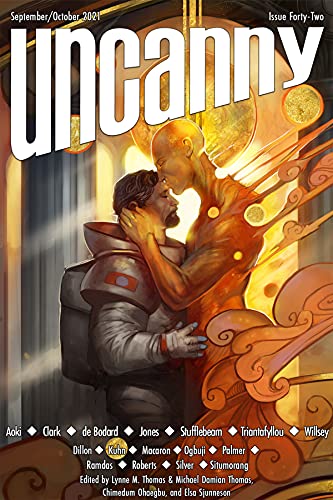
First published in the September-October 2021 issue of Uncanny Magazine. It has yet to be reprinted anywhere.
Enhancing Image
Themis is the prodigal daughter, having returned to the remote seaside village of Tafros, the place of her childhood, after some years. It’s too bad that the circumstances for her return could not have been better. Her brother Melas has died, or rather been killed. Poison ink, courtesy of a venedolphin. This is unusual, because not only was Melas a venedolphin tamer who worked with the big animals (the titular giants) regularly, but these animals are simply not known to do such a thing. Themis knows this. “This isn’t the first time they have killed people. But not tamers like Melas. Never tamers. Some poachers in the past, and rightfully so. A couple of stupid kids a long time ago, who did not have the gift my brother had.” The venedolphins are known for their ink sacks, which are harvested when the animal reaches a certain age by a tamer, without killing it. Poachers, on the other hand, don’t care so much for the animal’s wellbeing. Melas had apparently gotten himself caught in a net and poisoned, and he died a slow and very painful death. It doesn’t take long, upon a doctor examining Melas’s body, for us to figure that it was not a venedolphin, but (drum roll) foul play. Somebody had injected Melas with the poisonous ink while he was stuck in the net. But why would someone do such a thing? This will be the biggest question driving the rest of the (very long at 27,000 words) story.
A few things are going on here. Themis, despite not being a detective, wants to avenge her brother, and at the same time she has mommy issues, on account of not staying in Tafros and taking up her mother’s profession of tattooing the dead. There’s also this fellow Clem, a humanoid alien (the fact that he’s not human matters in terms of how Themis and others interact with him, but not that much) from “the Central Colony” who’s been working with Melas on this planet. To complicate things further there’s also Pirros, a fellow villager who is functionally Themis and Melas’s adopted brother, since their family has found him when he was an orphaned child. There are at least three people who have a personal connection to Melas’s death, which means (so detective-story logic dictates) at least one of them has a motive for killing him. In a classic detective story the killer and the victim tend to have a shared history, a trope that applies here as well. Themis immediately suspects Clem is up to something fishy, on account of her own xenophobia and because of Clem’s business with the colony. While she ends up being right about Clem having an ulterior motive for being here, she’s not right in the way she was thinking. Clem doesn’t really help his own case, since he’s awkward around humans and even has to wear a pressure suit while on this planet, he and his people not being adapted for it.
This is all well and good, but I struggled to stay invested in “The Giants of the Violet Sea” for two major reasons. The first is that this is about as long as Hemingway’s The Old Man and the Sea, yet it reads as longer. The pacing is all out of sorts, with some scenes being almost constipated in length, and the final stretch being so protracted that there came a point where I almost forgot we were supposed to be looking for the son of a bitch who killed Melas. I should thereotically be able to read through a story of this length in one, maybe two sittings, but I simply could not. The bigger issue has to do with grammar and typos, which are not issues I tend to bring up when reviewing literature. Maybe it’s because I’m not a professional editor or some academic, but I don’t get too fussed over ungrammatical sentences, and actually I think it’s fine to be a little ungrammatical if you as the writer are aiming for a certain effect. With that said, I can’t imagine why (and I don’t recall this being an issue in “Loneliness Universe”) Triantafyllou would so frequently resort to sentence fragments and obvious run-on sentences in this story. I also don’t understand why she uses the semi-colon maybe a handful of times throughout the whole thing, refraining from using it even in cases where it’s easily a more sensible option than a comma or a period. There’s a truly incessant number of sentence fragments and comma splices, so that sentences suddenly stop and start, or sentences where the whole is awkwardly stitched together with a comma, or maybe the lack of a comma where there should be on.
I’m gonna give a couple examples, so you can see what I mean. The first is from a scene in which Themis sees a young boy from the village swimming too close to some venedolphins.
Here it goes:
I try to summon my mother’s voice. Or what my mother might have sounded like if she ever needed to raise her voice to make me feel like dirt. The child doesn’t seem to care, instead he dives back into the mucky darkness and before I realize it, I am waist deep in the water, paddling my way through flotsam. The guttural noise of the venedolphins rises up. Like an underwater storm. I can’t find the kid anywhere.
Not that I’m a professional, or that I know the game of writing better than Triantafyllou, but if I were to do some minimal rewriting, that paragraph would come out like the following:
I try to summon my mother’s voice, or what my mother might have sounded like if she ever needed to raise her voice to make me feel like dirt. The child doesn’t seem to care; instead he dives back into the mucky darkness. Before I realize it, I am waist deep in the water, paddling my way through flotsam. The guttural noise of the venedolphins rises up, like an underwater storm. But I can’t find the kid anywhere.
It’s at least 90% the same, but I’ve merged some sentence fragments together to create whole sentences, fixed a comma splice, fixed a run-on sentence with a period and thus created two sentences, and finally I tweaked that last line so that it sounds slightly more dramatic. The result is a passage that (I should think) is easier on the eyes.
Here’s a shorter and more mild example. This is from a later scene, in a subplot where Themis and Clem visit the Alimniots, a group of human colonists with a culture similar to that of Themis’s people. The big difference is that the Alimniots have an omnivorous diet, and they’re not opposed to killing venedolphins for their meat.
Here:
They are less rigid than us. No wonder they eat the beasts. It’s a very thin line though, between this and poaching, maybe they have already crossed it. Or perhaps it was never there but we didn’t know.
The passage can just as easily look like this:
They are less ridig than us. No wonder they eat the beasts. It’s a very thin line, though, between this and poaching; maybe they have already crossed it, or perhaps it was never there but we didn’t know.
You now have a comma where there should probably be one, as well as the comma splice being fixed by turning the comma into a semi-colon, thus making a less awkward connecting bridge between the two halves of this sentence. You seen what I mean, right?
Then there are the typos and inconsistencies, of which there are a few. I’m used to seeing typos in magazine stories, especially old ones, but there is a degree of sloppiness here that begs the question of how much the editors were handling Triantafyllou’s story. Something that especially irked me was whether Mother/Father should be capitalized in a certain context, as Themis refers to her mother and (deceased) father as Mother and Father respectively—but not always. “Mother” and “Father” are titles and thus capitalized, like when you say President Harry Truman or whatever. Ah, but except for when it’s the mother, or the president. But Triantafyllou or the editors do not take this into account. Also, while it’s perfectly natural for there to be a typo or three in a manuscript, like a misspelled word, these should be scrubbed out before publication. Nobody’s perfect, of course, but there are several instances in Triantafyllou’s story where there’s, say, a missing quotation mark, and in at least one case there’s a word that’s clearly misspelled. What sucks is that I have no other version of this story to compare it with, as it has yet to find a home in book form. Surely part of the reason for the lack of reprints is the length, which is awkward for an anthology, and also there’s no collection of Triantafyllou’s work as of yet.
It seems like we don’t think about how a magazine editor might play with the text of a story they’ve bought, or about the collaborative nature between the editor and the author. The job is not just to buy and reject stories that have made it past the slush pile, but to work with the author. Some of the most famous/beloved SF stories in the “canon” only turned out the way they did because of some judicious and even inspirational editing. Sure, he was an asshole with some very bad opinions, but John W. Campbell really set the gold standard by writing detailed rejection letters to his writers. What I’m saying is that (and it pains me to say this) it feels like Triantafyllou’s editors failed her here. “The Giants of the Violet Sea” needed an editor’s helping hand, and for some reason it didn’t get one. You can trim the length quite feasibly, but also there are frequent lapses of inelegant sentence structure that read as almost unprofessional. Hell, I even spotted a few cases of tense slippage, since this was written in first-person present tense (not a mode I’m a fan of, but to each their own) and occasionally Themis slips into the past tense to describe a current action.
There Be Spoilers Here
We learn early on that the venedolphins didn’t kill Melas, and it turns out the poachers (who I don’t think we ever even encounter within the story) didn’t kill him either. It was Pirros. Well, he was one of about two viable suspects. I do like how this is revealed, though, with Themis seeing Pirros torture an immature venedolphin in extracting its ink sack. She deduses that while Melas was not as perfect person, he was too experienced a tamer to let someone get the upper hand on him—unless it was someone he knew and trusted. Pirros himself being a poacher is kind of an obvious twist, not helped by his vibes being kinda off throughout the story, but I feel like I should give credit where it’s due.
A Step Farther Out
I feel like an asshole for not liking this one, and also for going on a rant about editing. Clearly the professionals who make up SFWA disagreed with me, though, because “The Giants of the Violet Sea” got a Nebula nomination. On the one hand, it’s nice (and all too rare) for a novella published in a magazine to get awards attention in our current era. Not only are chapbooks in vogue, but Tor have taken it upon themselves to take a truly obscene slice of the market, to the point where they have virtually a monopoly on SFF chapbooks and by extension on stories of novella length. I wish I could recommend this one, but I honestly can’t, as it’s far too unpolished, to such an extent that it may well have gone through zero editing between the manuscript arriving in the (virtual) mail and the story being published in Uncanny Magazine. It’s a real shame.
See you next time.