(Cover by C. C. Senf. Weird Tales, November 1929.)
The Story So Far
Stephen Costigan is a traumatized World War I veteran and drug addict who’s taken up residence in London’s Limehouse district, at first a slave to hashish and then a slave to the enigmatic sorcerer Kathulos, a strange man of ambiguous ethnicity who draws Stephen into the underworld, promising him new vitality with an elixir that’ll grant him near-superhuman powers—but whose addictive power is lethal. As he gets further ensnared in the underworld Stephen comes across a beautiful woman named Zuleika who, aside from obviously being the love interest, lets Stephen in on how evil Kathulos’s machinations are. Our Hero™ soon gets wrapped up in an assassination plot that (I kid you not) involved a gorilla costume and Stephen allying with John Gordon of the British secret police.
Stephen and Gordon team up to take Kathulos and his goons into custody, but naturally things don’t go well and the skull-faced sorcerer escapes via a secret tunnel, taking Zuleika with him. Both sides have taken a few casualties in the fight, but now Our Heroes™ are left with the question of where Kathulos could’ve gone, what he might be planning, and perhaps most importantly, where the hell he came from.
Enhancing Image
Part 2 is hard to summarize as it’s not only the shortest installment, but very little actually happens in it; indeed, the plot moves hardly an inch forward between the start and end of this installment. Stephen and Gordon, now like buddies in a detective narrative, retrace their steps in an effort to find out Kathulos’s origins, in doing so hoping they can figure out what his endgame is. By the way, if you’re reading Skull-Face I recommend reading the text on Project Gutenberg as it’s not only easier to read but does away with the recap sections. In the case of Part 2 the recap givess away the big revelation in the installment to follow, which frustrated me because a) it made me worry I had missed a big plot point in Part 1 (I did not), and b) it sort of just hits you over the head with something major before you’ve had a chance to read it for yourself and digest it properly.
Gordon, who apparently knew more than he let on, givess us a truly massive infodump about a series of revolts in Africa as of late had had a common element about them, with Kathulos being involved and encouraging unrest among African and Asian peoples. There’s been a prophecy spreading that a man “from the sea” will unite the marginalized ethnicities of the world and overthrow the “white races.” There are apparently multiple white races; be sure to put a pin in that one. So… to make a long story short, Kathulos is not of Egypt like he claims, nor is he from any known country on the planet, but from Atlantis. Kathulos is an Atlantean who mummified himself and lay at the bottom of the ocean, only to be discovered and subsequently either resurrected or brought out of cold sleep. Kathulos doesn’t seem to have a personal desire to topple white supremacy but, it’s implied, is taking advantage of racial strife by crowning himself as emperor of a new society where non-white people are on top.
I have a few questions.
I had heard about the race war plot of this novella in advance, and yet even reading it now I feel like I wasn’t prepared for it. Howard has a rather messy relationship with racism, being a Texan in the early 20th century, but he was also a proud Irishman surrounded by WASPs, at a time when people still made distinctions between “types” of whiteness. Nowadays Jews are often considered white (I say often, but admittedly not always), but this was obviously much more of a point of contention a hundred years ago. At what point were Jews considered white? Evidently not at the time of Howard’s writing Skull-Face. Rather than the huge gelatinous blob with arbitrary boundaries that we now understand whiteness to be, it was like a school with different cliques in Howard’s time, thus in Skull-Face we have “the white races” pitted against several non-white races. This all sounds a bit cracked, but I’m trying to make sense of an understanding of racism that’s totally alien to modern conceptions, except maybe the most backwards parts of the US (i.e., the parts that think the Confederacy meant well).
You may be thinking, “Brian, you handsome devil, how come there’s no content warning for racism that came with this review?” The answer is simply that if you’re reading a Weird Tales pulp adventure from the ’20s, you ought to go in expecting at least some racism. I know this is gonna sound like a bit of a “these darn kids” rant, but I’m peeved whenever people fail to engage with old genre fiction because of the simple fact that values change over time and even left-liberal writers from more than half a century ago generally did not believe in intersectionality. Was Howard a racist? I’m gonna say no. In fact it seems Howard was vocally againsst notions of racial supramcy, at least in his later years. Did he have preconceived notions about race, and did he use white people’s ignorance of other cultures to give his fiction an “Orientalist” appeal? Absolutely to both those parts. I would be lying if I said a good portion of this installment of Skull-Face wasn’t baffling or painful to read, not to mention the plot grinds to a hault. By the end of Part 2 nothing except lore-dumping has been accomplished.
A Step Farther Out
This is a major step down from the first installment. Howard has a knack for writing action and there basically isn’t any here; worse than that, it’s almost entirely dialogue-driven, which I have to admit has never been Howard’s strong suit. It’s short, but even so I started to wonder when John Gordon’s borderline monologuing would come to an end so we can get back to the actual plot. Kathulos and his goons are pushed totally off-stage, and by extension we get zero development with Zuleika, instead being stuck with Stephen, who’s a hot mess of a person, and Gordon, who for this particular part of the novella acts as Mr. Exposition. Hopefully the final installment can bring back the momentum I so dearly missed in Part 2… and, ya know, maybe not make the race war plot as painful to read.
(Cover by Hugh Rankin. Weird Tales, October 1929.)
Who Goes There?
Robert E. Howard is a favorite on this site for a few reasons: he wrote a lot, pretty much all his work was published in the magazines, and he writes action that doesn’t bore me—a real achievement if you know my reading habits. Howard’s career was tragically short-lived but he got started very young and never stopped, debuting in 1924 at the age of 18 and only stopping with his suicide in 1936, aged thirty. Most authors barely get their feet off the ground by the time they’re thirty, but Howard was such a prolific and restless writer that he had accumulated what would be several hefty volumes of fiction when he died, and that’s not even counting posthumous releases. Nowadays Howard is most known for creating Conan the Barbarian (or the Cimmerian, yes I know that’s technically the correct title), which by itself would prove profoundly influential on American fantasy. True, he was not the first American fantasist, but Howard set the standard for a mode of fantasy writing that could not be confused with British fantasy a la J. R. R. Tolkien or Lord Dunsany.
Howard was only 23 when Skull-Face was serialized, but he had already been in the game for five years and his growing adeptness at storytelling shows. At about 33,000 words Skull-Face was also his longest work of fiction up to that point, and the first installment is also the longest. While Howard ran a ton of series and contributed to other people’s series, most notably the Cthulhu Mythos, Skull-Face is a complete standalone work. How does it measure up to his more mature stories? Hmmm.
Placing Coordinates
Serialized in Weird Tales, October to December 1929. You can read Part 1 on the Archive here, and subsequent installments are also available there. Skull-Face was later reprinted whole in the December 1952 issue of Famous Fantastic Mysteries, found here. This was added to Project Gutenberg pretty recently (and by that I mean two weeks ago, I’m not kidding), because as far as I can tell Howard’s work is basically all in the public domain, and you can read it here in the format of your choosing.
Enhancing Image
Stephen Costigan is what you might call a fuck-up, being a shell-shocked World War I veteran from America who now spends his days smoking hashish basically nonstop in a London opium den, called the Temple of Dreams. We start with Stephen recounting one of his hashish dreams, in which he sees what at first seems a skull floating midair but which is in fact attached to a person, yellow skin tightly wrapping it and the skull “endowed with some horrid form of life.” This is totally not the villain of the story and Stephen is totally not gonna meet him later.
For now we’re stuck with Stephen’s daily routine, which is to wallow in London’s Limehouse district, in the aforementioned opium den run by some shady Chinese individual (not the words Howard uses) named Yun Shatu. It’s pretty clear, although the term “post traumatic stress disorder” would not be invented for several more decades, that Stephen has become both an expat and a drug addict in no small part due to PTSD. Howard would’ve been a grade-schooler when World War I happened, but Stephen is at least thirty years old here, having survived No Man’s Land surrounded by mud and corpses. “My body recovered, how I know not; my mind never did.” Stephen’s wartime experiences go to explain his character in at least two ways: by giving context to his vulnerable state at the story’s beginning, and by justifying some rather heroic acts he commits later. Howard had a lot to write in so short a time so that every detail here contributes something to the narrative, for we do not have time to waste.
After a brief dream sequence we’re off to the races—at such a breakneck speed that when I reading I actually did not figure at first that we had transitioned from the dream world to the real one; it doesn’t help that the opium den is called the Temple of Dreams, which admittedly does add to the nightmarish atmosphere about to envelope Stephen. Since Howard’s not gonna stop the plot train, I figure I may as well take a break here and talk about a few things that caught my eye—for better or worse. Apparently in 1929 you couldn’t write about sex past some descriptions of scantily clad women in your pulp fiction, but drug addiction is fine. I find it a bit hard to believe Stephen is this much of a wreck because he smokes too much weed; a shame, in 2023 he could’ve started a YouTube channel as a charismatic stoner. We also know weed is not that harmful, although it’s possible (I’m not sure what first-hand experience he had) that Howard is pointing a finger at what would’ve been an enormous stigma against drug use at the time—for Stephen is about to come across a far worse drug than hashish.
Also, I shouldn’t have to explain this, but I do because I wanna recommend Howard’s fiction to people but not have them be blindsided by remarks that are very much part of the vocabulary of Howard’s time. To quote Walter from The Big Lebowski, “‘Chinaman’ is not the preferred nomenclature.” I do suspect Howard picked London because it’s a locale outside of what his American readership would be familiar with, and there’s undoubtedly a good deal of playing to exoticism with all the non-white characters who are described in racialized terms. For what it’s worth, no, Howard does not use the N-word (at least here), although he makes fair use of “negro,” which was a perfectly innocuous word in 1929 and would actually remain so for several more decades. I’m not sure when “negro” would stop being used by well-meaning white folks but it could not have been earlier than the ’70s. Anyway, there’s also a character whose ethnicity combined with her attire are a little dubious, but we’ll get to her in a minute.
Stephen gets taken by some brute named Hassim to an out-of-the-way part of the opium den, and this is where we’re introduced to the villain of the story (I’m just gonna say it here because why bother), Kathulos, the skull-face (get it) Stephen saw in his dream earlier. Kathulos turns out to be a man—sort of. He’s not a walking corpse, although he has unusual proportions, never mind that despite claiming to be of Egypt his skin complexion doesn’t align with any known ethnicity. It’s clear (at least to us) that Kathulos is a sorcerer of a sort, maybe even a zombie; regardless there’s something about him that pushes him into the realm of the supernatural.
A skull to which no vestige of flesh seemed to remain but on which taut brownish-yellow skin grew fast, etching out every detail of that terrible death’s-head. The forehead was high and in a way magnificent, but the head was curiously narrow through the temples, and from under penthouse brows great eyes glimmered like pools of yellow fire. The nose was high-bridged and very thin; the mouth was a mere colorless gash between thin, cruel lips. A long, bony neck supported this frightful vision and completed the effect of a reptilian demon from some mediæval hell.
Kathulos, seeing potential in Stephen, has a job offer for him, although it’s not out of the “kindness” of his heart. Unfortunately for Stephen the means by which Kathulos keeps him leashed to this new job is an elixir—a drug of such power (indeed life-restoring properties) but so addictive that withdrawal would mean death. Stephen’s hashish addiction is nothing compared to the hell Kathulos is about to put him through; on the upside, the elixir gives him near-superhuman abilities that’ll prove useful. Kathulos’s goons are also not all eye sores, as there’s a woman under his spell: Zuleika. Circassian “by blood and birth” and spending her youth in Turkey before being bought by Kathulos, Zuleika is a bit of a… problem. She’s a bit of a damsel, which for pulp fiction is not unusual, but this is more conspicuous by Howard’s standards, coming from the man who would write some strong-willed women later in his career. It’s also clear from her background and how she dresses (in a mix of “Oriental” and Western fashions) that Zuleika is acting as the exotic woman whom the white man will woo.
Lastly we’re introduced to John Gordon of the London secret police, whose role in things is vague at first but who will prove useful in Part 1’s climax. By the time we get to the back end of Part 1 we have a few parties involved, each other their own goalss in mind and, more importantly, these goals are not made clear to the reader. It’s clear Kathulos wants to use Stephen as his slave, to accomplish a mission whose bigger goal remains utterly a mystery to Our Hero™. What could the skull-face be planning? (By the way, Kathulos sounds a bit like Cthulhu, which, being correspondents with Lovecraft, Howard would’ve been well aware of at the time, though I’m sure it’s just a coincidence.) The elixir Stephen has become horribly addicted to will be both the ssaving and death of him as he takes part in a mission of impersonation, and later murder, that goes amiss.
There Be Spoilers Here
What happens from hereon is a bit much, but it involves, among other things, an assassination plot and Stephen dressing up in a gorilla costume. I’m not kidding about that last part. Stephen explains the situation to Gordon and the two agree to team up with, with Stephen lying about his mission and confronting Kathulos while Gordon and his men surround the opium den so as to block off escape routes. Since these are London cops I assume Gordon and his men plan to apprehend Kathulos using nothing more severe than harsh language. It doesn’t matter, because naturally Kathulos expected Stephen would betray him, and not only that but there’s a secret tunnel the cops could not have anticipated; that said tunnel turns out to be filled with “scores of hideous reptiles” only adds insult to injury.
So bad news, Kathulos has gotten away and he took Zuleika with him; the good news is that Stephen drank enough of that elixir that it should last him a few days before he starts going into withdrawal. The hunt is on, between a shattered veteran and an aloof plain-clothes cop for a sorcerer who is probably even more powerful than what we’ve seen up to this point. Howard wrote his stories with magazine publication in mind and as such he knew how serials worked, with the end of each installment leaving bread crumbs for intrigue but making the reader excited for more. Howard’s writing itself has a drug-like effect wherein it transports the reader to a mindset that is not lucid, but rather based primarily on imagery and action, with anything not action being omitted; as such you have potentially a 50,000-word narrative compressed to 2/3 that length.
A Step Farther Out
Every time I read a Howard story I feel tempted to become one who those nerds who digs up his letters to try to see how his brain worked. Not that Howard was an unparalleled genius whose inner workings would be a treasure trove, a Shakespeare for us to bow to, but more that his interests strike me as so human that reading much of his fiction almost reads like having a conversation for me. There’s a lot to unpack with Skull-Face and we’re only just getting started, so I’ll say for now that I feel the way I ought to feel when it comes to the opening salvo of a serial: that is to say intrigued. I would’ve read it all in one sitting if not for work, which I think again speaks to Howard’s skill with keeping the reader’s attention.
(Cover by Chesley Bonestell. F&SF, September 1968.)
Who Goes There?
Maybe Piers Anthony hits the spot if you’re really horny and/or are not a very discerning reader; in other words, if you’re in your teens. I am very much not in my teens anymore (although some of my peers would say 27 is still babby) so Anthony’s writing just kind of osculates between boring and repulsive for me. I hear Macroscope is supposed to be good but that’s one novel from an author who has, over the course of six decades, written dozens—many of them series entries. Speaking of which, Sos the Rope is the first entry in the Battle Circle trilogy, and having just finished the last installment I can see how it would lend itself to a sequel—not that I wanna read more. I was awfully slow finishing this, not because it was a difficult read exactly but because I didn’t like it and I kept putting it off.
Placing Coordinates
Part 3 was published in the September 1968 issue of The Magazine of Fantasy and Science Fiction. You can find used copies of the Battle Circle trilogy as an omnibus if you feel like it.
Enhancing Image
First things first, I cannot tell if there was a printing error in Part 2 or if Anthony somehow forgot to write a whole scene, but the recap section of Part 3 tells us about something that we are straight-up not told about in the previous installment. Last time, you may recall, Sos and Sol enter the battle circle to see who gets Sola and Soli, Sol’s wife and daughter (by way of adoption) respectively, and that is where it ended. We were not told the outcome of the fight at the end of Part 2 (indeed it ended just as the fight was about to start), but before we get to Part 3 proper we’re told that Sos had lost his fight with Sol. I was greatly confused becausse it made me think that I had somehow forgotten what had happened at the end of Part 2, but no, I did not miss anything; we’re just told about a scene in the recap that we did not get to read for ourselves. This is clearly bullshit.
Anyway, Sos lost the fight OFFSCREEN and now, in shame, he goes to “the mountain” to commit ritual suicide. I feel for him. His pet bird Stupid (still not funny) stays with him out of loyalty and sadly freezes to death as they climb the mountain, although Sos himself ultimately just loses consciousness before being rescued. It’s here that we’re introduced to the ssecond major female character of the novel and yet another reminder that Anthony cannot write about women for shit. I’m calling her Sosa now as opposed to later for the sake of my sanity, because you guessed it, she does not have a name at first. Sosa is a very short but very athletic woman who challenges Sos to be his wife, stealing his bracelet and making him work for it. I have nothing against short girls, but I have a creeping suspicion of what Anthony is trying when he repeatedly describes her as childlike and “Elfin,” and I don’t like it. I don’t like fanservice when it’s this creepy and manipulative.
Gonna go on two rants for the price of one here. The first is that I still can’t get over how fucking stupid the naming convention in this novel is. Women do not have names unless they have a husband, whereupon they take the husband’s name, just slightly altered. Is it patriarchal that the custom for marriage in Anglosphere involves the woman taking the man’s last name? Yes, but at last the woman had a name of her own to begin with. How would anything get done in the world of the novel if half the adult population is nameless and presumably unable to own or transfer property? We are told, of course, that things aren’t the same everywhere—that, for instance, things in South America are apparently not as dire; with that said, we’re given such a dim picture of life in this post-nuclear future that it actually strains one’s suspension of disbelief. I know the idea is that “the Blast” sent mankind (at least in North America) back to the stone age, with only small pockets of civilized humanity left, but women were able to carry titles even in the time of Richard III. This future society is untenable, which seems to be the point somewhat, but it’s also utterly implausible.
The other thing is that even if we’re to put the mechanics of the novel’s world aside, Anthony’s third-person narration cannot help but exhibit a profound distrust of women that goes beyond world-building. I sometimes wonder if I’m too easy on misogynistic writing in old-timey SFF, or if young readers are too harsh about such a matter; it’s fine, everyone has a different threshold. With that said, Anthony crosses my threshold repeatedly, to the point where I’m not sure what a defense of it is supposed to sound like. Early on Sos ponders what would’ve happened had that bitch Sola not entered the picture and complicated his totally platonic relationship with Sol, not even Sola in particular but the idea that a woman ruined everything. “It was not the particular girl that mattered, but her presence at the inception.” I wonder if people who complain about Robert Heinlein’s sexism (which is certainly valid to criticize, mind you) would survive if they encountered Anthony. I personally can’t stand this shit; I think it’s grotesque.
Anyway, we’re at the “hero’s lowest point” part of the narrative and so Sos, now weaponless (oh right, he gave up the rope as the result of losing his fight with Sol, ALSO SOMETHING WE WERE NOT TOLD ABOUT UNTIL AFTER THE FACT), has to regain confidence by fucking the shit out of Sosa, now his wife by getting to know the people of “the mountain,” which are not exactly crazies but who are considerably more civilized than the nomads who roam the wasteland. Sosa and others convince Sos he has to head back down the mountain, to “come back from the dead” as it were, and claim his spot as the true leader of Sol’s empire. Keep in mind that Part 3 is about twice the length of Part 2 and that despite the difference in length there’s about as much plot meat on the story’s bones; in other words there’s a lot of (bad) dialogue and not much real action here.
There Be Spoilers Here
Sos returns and meets up with some of his former homies, having done something I honestly would’ve expected to have seen earlier: go full barbarian class and adopt fists as his weapon in the battle circle. It’s a gamble, but after training Sos is really able to kick ass in the circle, gaining tribes and chipping away at Sol’s ground one battle at a time. Why Sos feels the need to do all this is not made clear, even to himself, which is something Anthony will probably elaborate on in the sequels but which I fortunately don’t have to get into. Sos’s biggest challenge once again is Bog, the big dumb club-swinger from before, who remains the best character simply by virtue of the fact that he likes hitting things and does not care about the big picture. Unfortunately their fight does not go how Sos had wanted and he ends up injuring Bog irreparably by breaking his neck accidentally. “If he survived it would be as a paralytic.” So Bog gets mercy killed.
Sos then narrowly beats Sol in their rematch, with Sol giving Sola over to Sos (as the two are still in love, God knows why) but keeping Soli. Father and daughter wander to the mountain where they may or may not be taking in by the people there. Sos thinks Sosa (whom he had left behind) will gladly accept Soli as an adopted daughter, but I have my doubts. Now if thousands of men at his disposal, both in name and in fact, Sos figuratively looks to the horizon and wonders if this empire of his will prove to save humanity or repeat the old mistakes—if he is “the hero, or the villain.” I mean clearly the villain here is Piers Anthony, but who am I to judge. The back end of Part 3 was a breezy read for me if only because the fight scenes kept going in one ear and out the other, as it were. It could just be that my deep ambivalence to the characters and nature of the novel’s world made the action uninteresting, but if I had a watch I would’ve been glancing at it.
A Step Farther Out
Can I go home now?
Thus far Sos the Rope is the worst thing I’ve reviewed for this site, narrowly beating out Lovecraft’s “The Dreams in the Witch-House” because of the length and because its woman-hating is so rabid. There are many bad serials out there, though, and covering one of those turkeys was inevitable. I went in hoping the experience would change my mind about Anthony and I have to say it really did not. For better or worse the next two entries in the Battle Circle trilogy did not see magazine publication, which means I don’t have an excuse to cover them here or to read them ever. Unfortunately, because Anthony did have a few other novels serialized early in his career, I’ll be at some point compelled (or rather coerced) to cover those…
To give Piers Anthony some credit, I’m sure he’s written something good, given he’s been writing continuously for about 60 years now; you know the thing about stopped clocks. With that said I can’t bring myself to read a great deal of Anthony. The last time (actually it was also the first time) I had read Anthony was his 1972 short story “In the Barn,” which was a few years ago and which put me off from reading more Anthony for that span of time. I hear Macroscope is supposed to be good…
Placing Coordinates
Part 2 was published in the August 1968 issue of The Magazine of Fantasy and Science Fiction. I can’t tell if it’s in print or not, but used paperback copies are easy to find. For the morbidly curious, the whole trilogy (all three novels being mercifully short) can be found easily as an omnibus. Why someone would want this is beyond me.
Enhancing Image
As you know I didn’t like Part 1, but I’ll admit Part 2 is an improvement—partly because it’s much shorter. Not much happens and there’s not a lot for me to talk about, so this review will be just as succinct. Last time on Dragon Ball Z we had Sol enter the battle circle in an effort to recruit Bog, a big dumb brute who has impressive stamina and is real mean with the club. The match ends in a draw and Bog chooses to not join Sol’s tribe; he simply likes to fight people in the circle for the fun of it. Bog is dumber than a bag of hammers but he’s still the most relatable character in the novel. Sos will run into Bog much later (in the installment) after a time-skip and it’ll be the most enjoyable sequence in Part 2. Did I say “enjoyable”…?
Why yes, Part 2 is, surprisingly, not constant pain and suffering; this is due largely to the absence of Sola, who does not reappear until towards the end (regrettably but inevitably) of this installment. Indeed women are mostly absent from the narrative at this point, which is great because Anthony is about as good at writing women as John F. Kennedy was at staying faithful to his wife. The trio that defined Part 1 has dispersed, with Sos reaching the end of his one-year “contract” with Sol and splitting off from the tribe. To do what? Not really sure. He comes to a crazy-run hospital and has a chat with one Dr. Jones, who by all appearances is a normal modern-day doctor. We find out that Sol was an orphan and that he is in fact a eunuch, not that these fact change anything profoundly. It’s here that Sos also finally gets the bright idea to take on a new weapon, and you can guess what it is.
Sos, previously weaponless and bitchless, decides to adopt the rope as his new weapon; it’s not conventional but it functions similarly to the whip, which Dr. Jones points out as a viable offensive tool. “That day Sos gained a weapon—but it was five months before he felt proficient enough with it to undertake the trail again.” That’s right, we get another time-skip! The pacing in this installment is a little too fast if anything, to the point where I struggle to get invested in what’s happening; there’s so little time to get attached to characters and action. The speed at which Anthony pushes the plot forward reminds me, as someone who’s written fanfiction (don’t ask for what) in his time, of competent but underwritten adventure fanfiction you’d find on AO3. The wish-fulfillment element doesn’t help.
Dr. Jones brings up something I had thought of before but which the world of the novel seemingly did not have an answer for, which is the fact that even in the sword family there are many distinct types of sword that require different technique and levels of physicality. Someone who kicks ass with a broadsword may not be so effective with a rapier. Thus Sos uses this loophole to adopt such a niche tool as the rope for his new weapon. What if someone were to use a shield as their weapon of choice? Random thought. The shield is known mainly for defense but it could also serve as a gnarly weapon in a pinch, especially depending on the materials of the shield. I wanna be more interested in the mechanics of the novel’s world-building than I actually am, saying this as a bit of a Dark Souls fan. I’m just saying if combat is the focal point of your story, whether it be literature or a video game, you should put more thought and energy into making that compelling.
There Be Spoilers Here
Eventually Sos runs into Bog again and they have their own match, mainly to test Sos’s proficiency with his set of rope; it’s another draw! Then Bog watches cartoons on a TV set; this is the best part of the installment. Then we’re finally reunited with Sol and Sola… sort of. Sola had gotten pregnant with Sos’s kid at the end of Part 1, and well, it’s been over a year since that happened. It’s a baby girl and her name is Soli. Cute. One problem: even though Sol is perfectly fin with Sos taking Sola as his wife (he’s actually quite happy to get cucked like that), he wants to keep Soli. Admirable that Sol wants to raise a child as a single parents, and it’s not even technically his, but the question is: who does Soli belong to, her mom or her “legal” dad? I feel like this whole situation would be solved with polygamy, what with Sos and Sol respecting each other a great deal and certainly the three of them would agree to share. But oh well, we need drama…
What’s to become of the baby? Will Sos and Sol’s friendship end over this dilemma? Should we care? Stay tuned to find out!
Piers Anthony is a totally uncontroversial and universally beloved author whose genre fiction, often aimed at a younger audience, has inspired generations of readers with wholesome Christian values. Whereas some fantasy authors are content to rely on gore and fanservice to boost sales, Anthony, in the more than half-century that he’s been active, would surely never stoop so low as to pander to a horny and passively misogynistic base of teen boys with boobs as the carrot at the end of the stick!
I cannot keep doing this.
Look, I know that for people of a certain age (i.e., people old enough to have bought Titanic on VHS), Anthony may or may not have been a part of their formative years as young impressionable readers—ya know, when they were not old enough to have acquired taste yet. With that said I have to wonder how promising a guy can be whose books have such lovely titles as Roc and a Hard Place (very funny, Piers) and The Color of Her Panties (I feel dirty just for typing this one). And then there’s the one ecounter I had with Anthony prior to all this, which was “In the Barn,” his story for Again, Dangerous Visions, one of the most disgusting pieces of writing I’ve ever come across. I’ve read Blood Meridian and American Psycho, and I will gladly take those (which are, after all, pretty great novels) over “In the Barn.” When something is compared to “In the Barn” it should serve as your cue to run in the opposite direction. Not a great first impression.
Sos the Rope was Anthony’s second novel, and by this point he was a Hugo finalist for his first novel, Chthon, which everyone I know loathes; well somebody must’ve liked it. I try to be the optimist, but assuming the quality doesn’t change then Sos the Rope looks to be the first bad serial I’ve covered for this site, which I get was inevitable; there are more bad serials than good. Oh, but how bad can it be? It’s not as bad as “In the Barn,” but…
Placing Coordinates
Part 1 was published in the July 1968 issue of The Magazine of Fantasy and Science Fiction. I advise against downloading this one as for some reason the PDF compression messes up this particular issue pretty badly; so I went and used the print copy I already had! Although, as if to warn me of what I was in for, the front cover nearly completely tore off and had to be taped together. There is a somewhat recent paperback edition from Planet Stories (not the magazine), but if you’re feeling brave and wanna read the whole Battle Circle trilogy, you can! There’s an omnibus containing all three novels (which are mercifully short) and while out of print it can be found used for pretty cheap. If you daaaaare.
Enhancing Image
We start with the most confusing of dynamics, in which two men have the same name—Sol—and fight over who gets to keep the name. We have Sol the sword and Sol of all weapons, with the latter proving to be the more skilled warrior and robbing the first Sol of his name and weapon. Let’s retrace our steps a bit. In this far future, adult males in this part of the world base their livelihoods on their ability to beat others in what are called battle circles, “heart of the world’s culture.” The rules are simple: whoever gets thrown outside the circle loses. There are many reasons for these fights and indeed they mirror somewhat the duels noblemen would have in olden times, although from what I can gather fights in the battle circle tend to not be fatal. A man has his name, which apparently he can change in much the way we change shoes (put a pin in this one), and his weapon of choice, which becomes part of his name. Thus, if your weapon is the sword (never mind if it’s a short sword, long sword, etc.), your name might be Sol the sword; or in the case of the Sol who wins the fight at the story’s opening, you’re a jack of all trades who goes by Sol of all weapons.
I have too many questions, but we’ll get to some of those.
Sol, because he’s such a nice guy, not only gives the former Sol a new name but also recruits him to be his right-hand man, despite being weaponless temporarily. Sol wants to build an empire, recruiting dozens of men over a span of months to form a tribe that in time will hopefully form a new civilization; the criterion for recruits is trial by combat. The former Sol is now Sos, and the two men are quickly joined by a woman residing at the hostel they fought at, who “marries” Sol and takes on his status as well as the name of Sola, the “a” at the end denoting her as Sol’s property. There isn’t even a ceremony for a marriage; only a bracelet is required, and it can be removed presumably with the husband’s consent at any time.
Before I go on a rant about how marriage works and how women are treated in the world of the novel, I do wanna give Anthony a point for bending genres here a bit—in the spirit of Jack Vance of all people. Reading the opening stretch, you may think that Sos the Rope is a fantasy novel not too removed from the likes of Vance and Robert E. Howard, but like Vance at times it soon reveals itself to be science fiction masquerading as fantasy, the setting being a post-apocalyptic America a good century after some vague nuclear holocaust. Mankind has devolved back to the stone age, with the only spots of civilization (as far as we know) being hostels that are scattered throughout the land and which are run by “the crazies,” people who somehow are able to remember (probably by way of an oral or written tradition) what the beforetimes were like; but these people keep themselves apart from the nomads who roam the landscape alone or in small groups. The nomads themselves are good survivors but not much skilled otherwise.
Anyway, Sola iss clearly hitched to Sol for his status as future emperor and not because she magically thinks he’s a nice guy; the two do not even seem to like each other much as people, never mind as partners. Sos is frustrated by this, in part because he’s very obviously horny over Sola but is unable to bed her because to bed another man’s wife would be dishonorable. “Could sex mean so much?” A funny question! Actually I have a few questions of my own, such as: If all it takes to change partners is a changing of bracelets then how come Sos doesn’t ask Sol if they could switch up every now and again? It’s not like there’s a signed contract for the marriage. Come to think of it, given the tribal nature of so much of humanity, how come there’s no plural marriage? We have something of a love triangle here (really a lust triangle, since no reasonable person can suppose any of the three parties are in love with each other) whose tension could be resolved by Sos and Sol agreeing to share Sola—with her consent, of course. Why does Sola agree to marry Sol now and not much later when he has proven himself as a leader more? I assume this is so that she doesn’t look like even more of an opportunist than she already does, which still does not help much.
A few more questions not strictly related to the interpersonal conflict of the novel but which I think are worth asking, such as: So women, when hitched, take the names of their husbands and simply add a letter to the end. What if there was same-sex marriage? What if two men got married? Would their names change? There seems to be a pattern that all the adult males have monosyllables for names. What if two women got married? This one is doubly vexing because as far as I can make out, women literally do not have names in the world of the novel if they’re not hitched to some guy. How does that work? How would anything in the legal realm get done here? How would there be a transference of property without names or even agreement in writing? Is there such a thing as property aside from what people are able to carry on their backs? The answer to that last one is probably “no.” No wonder civilization is in ruins, without the concept of property outside the micro scale (for the socialists in the crowd who are wondering, there does not seem to be an overarching government that would allocate land) and with the vast majority of the populace being illiterate.
The misogynistic implications—no, never mind, I wouldn’t even say implications—simply the misogyny deeply embedded in the novel is impossible for me to get around, even as someone who tends to be apologetic with misogynistic writing in old SFF. I know sexism is a problem that has to be called out as such, but I also understand that people from different places and times are often writing under different personal and economic circumstances than what someone reading in [CURRENT YEAR] would have personal context for. The rampant woman-hating in Anthony’s novel is not something I can excuse because not only does it badly skew our understanding of one of the main characters but it also contributes to some incredibly sloppy worldbuilding, such that the novel is built on a shaky foundation of misogyny. Sola is the most rounded character of the trio, even more than Sos (ya know, the protagonist), but she also acts as the malicious temptress who repeatedly and not so subtly tries coaxing Sos into doing something that he’ll most likely regret.
A pet peeve I have with modern reviewers is when they seem to think that a female character being physically active in a narrative must mean then that said female character is well-written. With all due respect to these people, because some of them really are astute critics, this is a lousy line of thinking when it comes to character writing. Sola lacks even a hint of interior life; her goals are all external in that they’re physical, which are a) to one day rule an empire as Sol’s wife/property, and b) to get her pussy licked. Sadly (for both Sola and the reader) these two goals are mutually exclusive, for a reason I have the misfortune of knowing. It’s time to get into spoilers, but I do wanna make one more criticism that may not be as much of a deal-breaker for some people: the action is somewhat boring. I don’t know what Anthony’s status as a writer of action scenes is, but whenever there’s a battle circle fight (and there are a few in the back end of Part 1), my eyes glaze over. Our Heroes™ also have run-ins with creatures of the wasteland such as killer shrews (yeah) and poisonous white moths that are little better to read about. Still better than some of the dialogue, which threatened to kill me.
Okay, enough fucking around, let’s get to spoilers.
There Be Spoilers Here
Particularly I wanna talk about a section in the middle when Sol is out of commission, having been bitten by one of the aforementioned white moths and with Sos having to carry him. It’s here, when the trio are in the badlands (later to serve as a training ground for men in Sol’s tribe), that the sexual tension between Sos and Sola reaches painful levels. A question that had been simmering in our minds (both mine and Sos’s) is why Sola and Sol agree to stay together despite being like oil and water; at first Sos thinks it’s that they’re dynamite in the sack, but it turns out there would not even be a fizzle in their bed. Undressing an unconscious Sol at one point, Sos and Sola discover to their horror that something is wrong with Sol’s junk. “Sol would never be a father. No wonder he sought success in his own lifetime. There would be no sons to follow him.” There’s the implication that Sol is a eunich, although I like to think his cock just looks really funny. In a show of mercy Anthony refrains from describing Sol’s deformity in detail; he also spares us of having to read the inevitable sex scene between Sos and Sola (the latter all but blackmailing the former into it), although that probably has more to do with editorial precaution than Anthony’s own.
For a time Sos is basically the one running the show, and after the trio’s encounter with the shrews (but why shrews) they start recruiting men deemed able enough to join the tribe. Like I said, trial by combat. Sos is intelligent and physically attractive enough to catch the eye of several women (who, being unmarried, are nameless), but turns them down because he is still weaponless; he also has his eyes set on Sola still, in spite of his better judgment. “Possession of a woman was the other half of manhood,” (ech) and clearly Sos’s lack of a weapon would be a metaphor for his lack of manhood (as in his dick). I do appreciate the irony of Sos being quite capable as both a fighter and lover despite being weaponless while Sol, the warrior who can do well with any weapon, is impotent; it’s a shame that this is buried under a shit-colored pile of male chauvinism and treating women as things to be owned. Why Sos has not started training with a new weapon I don’t know. We know that Sos will at some point apparently take on rope (huh) as his new weapon of choice, going by the novel’s title. I assume we’ll get more answers in the next installment, but something tells me thosse answered will be unsatisfying, not to mention there are simply too many holes in the worldbuilding for the ship to not sink.
James White was one of the more successful British SF authors who did not (as far as I can tell) partake in New Wave antics in the ’60s. His loose Sector General series started in the ’50s and remained steadfast as a conventionally written setting for hospital dramas IN SPAAAAAAAACE, and his novel that I’ve reviewed, All Judgment Fled, is, excepting a couple passages (there’s a bit toward the end of Part 3 that references LSD), a pretty vanilla affair—which is not to say it’s boring. On the contrary, White is clearly a writer who considers the logical implications of his narratives, which naturally then snowball into ethical implications; he also has a sarcastic whit which at no point rang as irritating to mine ears. While my feelings on the novel are a bit mixed I do look forward to future adventures with White, especially since he’s one of those prolific magazine contributors and therefore someone (like Poul Anderson and Jack Vance) I fall back on for emergencies.
Placing Coordinates
Part 3 was published in the February 1968 issue of If, which is on the Archive. I’m not usually a fan of If‘s cover art, but the Bodé covers (we got too few of them, sadly) are very well done and eye-catching, including this one. As for book publication we only have a few editions to work with, for a novel that’s over half a century old, but you can find used copies cheap.
Enhancing Image
Before I get into the installment itself, I wanna talk a bit about what the past week has been like for me. If you’re reading this it means it’s May 22nd and by extention this post is two days late. I set deadlines for myself with these but I found out the hard way that there was just no doing this post on-time. I didn’t even finish reading Part 3 until the night of the 21st. Last week round this time I guested on a certain podcast, which went well and which you can expect to see at the beginning of June, probably back-to-back with my review forecast; that was not the hard part. No, the irony is that going on vacation can make it very hard to do things you normally do in your spare time. I had requested time off work and flew to Chicago (from Newark) on Friday, and only got back Monday. I was there to visit a couple friends I very rarely get the chance to hang out with in person; as such, combined with the brief time window I’d given myself, we crunched a week’s worth of fun times into three days. It was a good time, needless to say, but I also got precious little time to work on this site, hence the delay.
Now that I’ve said that, it’s time to finish this damn serial.
Last time we were with the boys, the mission had gone to hell. Morrison got killed by a Type Two, a tentacled creature with a giant horn and without any capacity to reason with the explorers. As violence has broken out on the Ship, a mysterious object orbiting between Mars and Jupiter, the higher-ups at Prometheus Control have been chastising McCullough (the audience surrogate) and company for their lack of professionalism. The Twos are hostile to the point of seeing the humans as food, which results in much of Part 3 being an all-out skirmish between the explorers and a horde of Twos, making for an extended action sequence that admittedly sort of struggled to hold my interest. A weakness of mine as a reader is that my eyes tend to glaze over when it comes to action, whith it being too easy for me to lose track of who’s dealing with what and who’s still alive and who has bitten the big bazooka. The action in Part 3 is especially confusing, partly (I suspect) deliberately and also because White refuses to give us a clear picture of the ship’s interior. The illustrations do a lot of leg work.
The most egregious example of White’s confusing laying out of action happens at the very beginning, wherein we’re told via narration that Drew has died—somehow. I wondered if I had missed something at the end of the previous installment, made worse because the recap section makes no mention of it—but no, Drew is not dead, he’s actually fine. The logic seems to be that in the heat of battle McCullough thinks Drew is dead, but this turns out to be a false alarm; the third-person narration sharing McCullough’s confusion is a hard pill to swallow, however. A similar case happens toward the end when (not getting into specifics here, because spoilers) a character has apparently died and the narration does not tell us this explicitly (unless I missed something, which is possible) until after the fact. Did he die offscreen? What happened? I’m getting ahead of myself.
We’ve discovered by now that the Ship is, or was, operated in all likelihood by a very small crew, and that the Twos wandering about looking for scraps are either non-sentient or driven (by something) to insanity. We never get a clear answer as to the nature of the Twos, but we do know that they’re an active threat to the explorers. Drew’s maddened call for extermination of the Twos (which is supposed to inform us that the explorers have basically reached rock bottom) does not come off as too unreasonable. Regardless, the mission has degenerated to such an extent that Prometheus Control and the explorers are all but no longer on speaking terms—a relationship that is about to get even rockier, if you can believe it.
McCullough sums it up nicely:
He realized suddenly that although he was terribly afraid for his own immediate safety he was furiously angry about the things they had done and were doing on the Ship. From the very beginning they had no control of the situation. It had been a stupid if well-intentioned muddle. And while they had changed their minds several times when new data became available they had not really used their brains. They had been panicked into things. They had not allowed themselves time to think. And when threatened with danger they thought only of survival.
The higher-ups at one point bring in a woman on the speaker to calm the men and reassure them with an incoming supply drop, but this doesn’t work too well. Keep in mind that said woman, whose name we never learn and who is called “Tokyo Rose” at one point (I get the reference, but it’s also a cute bit of symbolism with how the woman’s reassuring voice functions as and is acknowledged as basically propaganda), is the only female character in the novel; and she’s not really a character at that. From here on it’s all a war of nerves, of the explorers fighting off Twos while trying not to have total mental breakdowns. We do get some relief in the form of a new alien species with the Threes, which are like a cross between a snake and a teddy bear; I know that sounds like a weird combination. The Threes appear to be friendly, but are still not the intelligent alien(s) running the Ship that the explorers are looking for. This is the longest installment, so be prepared for a big third-act blowout and the summit of the conflict.
All Judgment Fled is technically a Big Dumb Object™ story, but that’s desceptive given how close-quarters the novel’s scale is. From start to finish we’re stuck with two small ships from the Prometheus Project and the Ship, which while nearly half a mile long is not spacious like the interior of, say, Rama. Comparisons will inevitably be drawn between White’s novel and Arthur C. Clarke’s undying classic, which depending on your worldview may or may not be favorable. If you’re looking for gosh-wow moments that provoke your inner child (what Rendezvous with Rama does in spades) then you’ll have no such luck with White’s novel. The setting is cramped, paranoid, claustrophobic, verging on inner space rather than outer with how much we’re stuck with the flawed humanity of the characters, but this is still a hard-headed old-school SF tale at the end of the day. McCullough, our lead, never becomes fully human in that his conscience never wanders from the physical problem at hand for long, but the novel still deals with the ethical equations of first contact more than some of its ilk.
It’s respectable is what I’m saying, if also cagey.
There Be Spoilers Here
After losing Drew (for real this time) and Berryman we finally get to have a “chat” with the alien that’s really running the Ship, and it looks—interesting. Another thing I gotta give White credit for is that we do not get any humanoid aliens here, with the different types vaguely resembling Earth animals but having nothing that could be mistaken for human. (I bring this up just so we can rest easy that none of the explorers go chasing lustily after some blue-skinned space babe.) The intelligent—and benevolent, wow how lucky—alien running the Ship is itself nightmarish in appearance to our battered explorers, “a great, fat, caterpillar, an LSD nightmare with too many eyes and mouths in all the wrong places.” Still the two species are able to communicate through visuals, since obviously verbal communication will do nothing, and ultimately we get a sort of cultural exchange.
Since half the human crew is dead there’s now few enough people to accommodate the reduced number of space suits, along with one of the P-ships no longer working. Which is all rather… convenient? If also morbid. I don’t totally buy the happy ending here, but then maybe White is not the kind of writer to totally fuck his characters over. J. G. Ballard would fuck shit up with this premise, which makes me wonder what this novel would’ve been like had it been a more ruthless deconstruction of first contact narratives—a premise that’s started here but not completely fulfilled.
A Step Farther Out
I know a couple people who prefer this over Rendezvous with Rama, and I can see the argument for it even though I ultimately have to disagree, because in some ways All Judgment Fled is the anti-Rama. Whereas the explorers in Clarker’s novel are always up against some tangible external problem that can be solved fine with bruce force or swiftness of speed, the conflict in White’s novel comes largely from the fact that the people heading the Prometheus Project failed to consider the possibility of interacting with alien lifeforms, not to mention explorers who might not be the most rational people; yet All Judgment Fled also feels incomplete somehow, whereas Rama is undoubtedly the complete package. This is a short novel, coming in at no more than 55,000 words, and truth be told it could’ve been 5,000 words longer, much of that devoted to scenery and character moments. The characters are not the flattest, but it can be easy to confuse some of them; half of them lack clearly defined roles but also nuance. White also has this thing for not describing places in any great detail, which made the action-heavy back end of the novel read as too abstract for my tastes.
James White was most popular in his time for the Sector General series, about a giant hospital station in space where conflicts comes not from epic space battles but doctors dealing with bizarre alien biology. White wanted to become a doctor but financial concerns at the time prevented this, although frankly I would’ve just assumed he was a doctor, going by what I’ve read of All Judgment Fled so far. I’m very curious about exploring White more, given his fascination with non-violent causes for conflict, and how violence isn’t treated as a solution but a catalyst for bigger problems.
Placing Coordinates
Part 2 was published in the January 1968 issue of If, which is on the Archive. Bad news is All Judgment Fled has not been given many paperback editions; good news is the few editions we have go for cheap used.
Enhancing Image
Now that we’re on the Ship, it’s time to do some exploring! The men of P-One (Drew, Morrison, and Hollis) and P-Two (McCullough, Walters, and Berryman) are officially stuck together, with the two small ships being now conjoined near the Ship to make moving between the two easy. Last time we hung out with the boys, Walters narrowly survived an encounter with one of the starfish aliens (now called a Type Two), and his suit is now basically unusable. This is a bit of a problem. For the men the suits are like a second layer of skin that, if removed, would greatly increase the risk of death, even though they don’t need the suits in the Prometheus ships; on the Ship it’s a different story. And apparently the aliens are hostile!
On top of all this, the men also have to deal with an increasingly cranky Prometheus Command, the top brass back home who are relaying the men’s actions back to Earth, with millions people (at least a billion, actually) tuning their radios to hear about what happens next. There’s a bit of meta hijinks going on here since McCullough is made all too vividly aware that the men’s sense of privacy has been eroded, that nearly their every move and word is being judged by a vast unseen audience—although unbeknownst to the characters that audience also encompasses readers. We’re given a better idea as to the relationship between the explorers and the rest of mankind, with this lop-sided arrangement that’s probably not good for the explorers’ mental health. Hollis was already on the verge of a breakdown in Part 1, but that turns out to be the least of the men’s problems.
Then there’s the question of the aliens’ intelligence. Frankly there’s no way to be sure. Somebody must’ve been intelligent enough to have built the ship, but the aliens that are actually onboard are unlikely to have been the culprits. The Type Two, for instance, is almost certainly non-sentient, but even then there’s no guarantee about that. Maybe up to now there’s just been failure to communicate. There are also at least two types of alien (as in, aliens that cannot be of the same species) that are on the Ship, and likely there’s a third species waiting for Our Heroes™ down the road. Still, despite the close encounters with aliens, the question as to who built the Ship remains perfectly unanswered—and yet conceivably it has to be something of at least the same intelligence as humans, and more likely of greater intelligence. White understands that in the highly unlikely event of first contact the aliens in question would be akin to angels—or an amoeba.
Their idea was simply that any piece of machinery beyond a certain degree of complexity—from a car or light airplane up to and including spaceships half a mile long—required an enormous amount of prior design work, planning and tooling long before the first simple parts and sub-assemblies became three-dimensional metal on someone’s workbench. The number of general assembly and detail drawings, material specification charts, wiring diagrams and so on for a vessel of this size must have been mind-staggering, and the purpose of all this paperwork was simply to instruct people of average intelligence in the manufacture and fitting together the parts of this gigantic three-dimensional jigsaw puzzle.
Speaking of first contact, Murray Leinster doesn’t quite get namedropped, but he gets the next best thing: a not very subtle hint directed his way. At one point McCullough, evidently a science fiction fan, thinks about “the old-time author responsible for a story called First Contact.” We also get a reference to another classic Leinster story, “The Ethical Equations,” and both these stories are indeed very much relevant to the current situation. White’s fannish side comes to the surface here, but at the same time it makes sense for the explorers to have been made at least somewhat familiar with classic science fiction, since SF would be the only even remotely useful reference point for their mission. I could fault White for a couple things, but over and over I find his logical outlook admirable; he takes something that with most writers would get pushed under the rug with some handwavium and he guides it along to a logical conclusion. There are no easy answers.
Part 2 does suffer a bit from what we might call Middle Installment Syndrome, in which the middle entry of a trilogy has to contend with not having a beginning or a conclusion, but making do as a big gelatinous second act. Why do people remember The Two Towers less than Fellowship of the Ring and Return of the King? Well, what happens in The Two Towers? We’re introduced to Gollum properly, that’s gotta be worth something; and we get the Battle of Helm’s Deep, often the most cited action set piece in the trilogy—yet going by IMDB and Letterboxd scores people aren’t quite as fond of The Two Towers as its siblings. Middle Installment Syndrome. I’ve come to realize that this also applies to novel serials, although I probably wouldn’t feel the “gelatinous second act” thing as much if I was reading All Judgment Fled as a single unit. Still, it’s short enough to not drag much.
There Be Spoilers Here
Things really go to shit in the second half of Part 2. The explorers kill a Type Two in another encounter, which is more or less accidental but which starts a snowball of paranoia and calls for violence among the men. As I supposed should be expected with White, violence is treated as something to be prevented as much as possible, since it will not solve issues but instead cause a snowball effect of greater violence. Command is not happy with how things are turning out, since at the outset this was supposed to be a mission that would unite mankind, rather than cause people to splinter on, for example, the treatment of alien lifeforms. “But now that the meeting had degenerated into violence, had become literally a blow-by-blow affair, the idea had backfired.” This culminates in the first fatality among the explorers, with Morrison, one of the most experienced men on the team, getting brutally killed by a Type Two. Even though we don’t get to know any of these men (except for McCullough) too much as individuals, Morrison’s death still works as a point of no return for the venture.
For better or worse, the men can only move forward.
After Morrison’s body is tucked away, the men keep searching through the big corridors of the Ship, coming upon rooms of different kinds, although McCullough seems to be the only one keeping his eye on the prize at this point. Most disconcerting is a room that almost resembles something humans would use—like a bedroom or a drawing-room. “A lab animal would not require a furnished room. Which meant that there were intelligent extraterrestrials on the Ship.” Maybe the Type Twos aren’t sentient, but somebody here sure is. And just as it looks like the men are about to hit a big clue as to the aliens’ nature, the Ship has started moving—away from the Prometheus ships. The Ship, which hitherto had been orbiting freely, is now moving on its own again. Well gosh darn it!
A Step Farther Out
It’s enjoyable, but there’s also something missing about it that I can’t put my finger on. It could be that there are too many characters that can be thought of as “nondescript white guy,” with only a couple standing out. That can’t be it, though. The characters in Rendezvous with Rama are made of cardboard, but that doesn’t bother me. I think it may be that White, unlike Clarke, is not concerned with evoking a Sense of Wonder™, which no doubt contributes to Rama remaining popular after half a century. White obviously has different goals from Clarke, which so far he’s been meeting admirably; it’s just that if you’re expecting a first contact narrative that’ll leave you breathless you’ll be disappointed. White does, however, have a special talent for making me think about the situation these characters are in—about logistical problems that would naturally arise from such a situation, but also the deep moral quandary that would come about in the event of first contact with a spacefaring alien race. Looking forward to how White’s gonna end this!
James White was an Irish SF fan-turned-writer who was one of the many authors to have found his footing in the ’50s, and it was in that decade when he started his Sector General series—about a massive hospital in space that deals with many alien species. Rather than focus on hardboiled adventure narratives, White seemed to prefer to write about issues that naturally arise from psychology and biology; he wanted to practice medicine, but economic troubles apparently led him elsewhere. With this in mind I’m ashamed to say I’ve not read anything by White prior to today’s novel, All Judgment Fled, which is a one-off and which was serialized in If, as opposed to New Worlds, where the Sector General series was published. All Judgment Fled is a Big Dumb Object™ story, published in the midst of several famous BDO stories (notably Ringworld, and, more regrettably, The Wanderer), but White looks to add his own flavor to the basic premise.
Placing Coordinates
Part 1 was published in the December 1967 issue of If, which is on the Archive. (You may notice that this issue has been mislabeled on the Archive as the May 1967 issue. Somebody fucked up.) Also be aware that If and Galaxy under Fred Pohl’s editorship well actually Galaxy also had this issue when H. L. Gold was in charge have some pretty sloppy copy-editing, which may distract from the experience. Sadly there aren’t many paperback editions either; the most recent edition, from Old Earth Books, predates 9/11. The good news is that used copies still go for cheap.
Enhancing Image
In the near future (a future which rather closely resembles the space race in the years following the moon landing), a mysterious vessel is spotted orbiting our sun between Mars and Jupiter, “shaped like a blunt topedo with a pattern of bulges encircling its mid-section and just under half a mile long.” The Ship (with a capital S) is a massive cylindrical object that is no doubt artificial, and which has not responded to any attempts to contact it. Thus we have the Prometheus Project, a first contact mission wherein two small ships, P-One and P-Two, are sent out to rendezvous with the Ship. (If this sounds a bit like Rendezvous with Rama, keep in mind that All Judgment Fled came first.) Six of the sharpest minds in the space program, three to each ship, are set to spend more than five months locked up in tight quarters on their way to the Ship, with McCullough, the doctor on P-Two, as the closest we get to a protagonist. Perhaps not coincidentally, all six of the men chosen are unmarried; survival is not guaranteed.
Aside from McCullough on P-Two we have Berryman and Walters; and on P-One we have Drew, Morrison, and Hollis. McCullough is the only one of the six to have sufficient medical training, and while the ships are always in communication with each other, they’re still a good distance apart as they voyage out to the Ship. Berryman and Walters are trained astronauts while McCullough is the outlier; meanwhile on P-One Hollis is the noobie while Drew and Morrison are the veterans. While it must’ve been tempting for command to hire all veteran spacers for the voyage, a more diverse team (in profession, though it must be said not in skin color or nationality) was probably for the best. Certain skills might be needed…
Instead of six of the world’s acknowledged scientific geniuses there had been chosen four experienced astronauts and two under training who were not even known in scientific circles and were respected only by friends. All that could be said for them was that they had a fairly good chance of surviving the trip.
Something about this novel that struck me is that you can tell that it was written when the space race about the reach its climax. The moon landing was still more than a year off, but Yuri Gagarin had left Earth’s orbit several years prior and it’s quite possible White wrote the novel immediately following the Apollo 1 tragedy. It was widely known by this point that being an astronaut was dangerous—that blood had already been spilled in the name of the US and Soviet Union outdoing each other. As such, despite the peppering of light sarcastic humor throughout (more on this in a bit), there’s still this persistent sense that Our Heroes™ could meet an unfortunate end at pretty much any moment. Of course, space is scary enough; the astronauts also have to deal with each other.
The boys are stuck with each other, in living quarters “which compared unfavorably with the most unenlightened penal institutions,” having to eat paste through tubes, having to wipe themselves down with alcohol periodically since they can’t take water baths, having no idea at all what they’re gonna do exactly when they arrive at their destination. When Hollis comes down with a skin condition and McCullough has to venture out to P-One to take care of him, there’s some worry—not just for Hollis’s body, but his mentality, which doesn’t look good either. McCullough doesn’t have to prod Hollis for long before the latter starts ranting about his co-workers. “A person could say an awful lot about themselves by the way they talked about someone else.” It’s clear to McCullough that Hollis is threatening to have a mental breakdown—that he’s having paranoid delusions about Drew and Morrison, whom he claims have snuck a “Dirty Annie,” a small nuclear weapon, into P-One. Even after Hollis is calmed down, it’s clear that this man’s instability will probably contribute to later problems.
Both the characters and the third-person narrator engage in some banter, which makes sense given the situation; few things deflate tension like humor. Actually while I have my reservations about the characters themselves, I don’t fault White for bordering the narrative with jokes—helped by White’s sense of humor (in my opinion) being often effective and unintrusive. While the BDO story had certainly not been done to death at this point (give it another decade), White’s deconstructing of the premise almost feels like commentary on the basic premise and how in reality, if we were to make contact with some alien vessel in our solar system, things would be much less glamorous than what Hollywood gives us. The lack of imput from the outside world, despite us being told about millions of eyes and ears keeping track of the voyage, only adds to the isolation and claustrophobia.
There Be Spoilers Here
So we finally get to the Ship, and we even meet some aliens, although these are far from little green men. The aliens are obviously intelligent enough to have built the Ship, but whether they’re capable of understanding human speech or even gestures is another question. “We know,” says McCullough at one point, “that they do not have fingers, and may have a two-digit pincer arrangement.” Turns out they have even less than that (or more, depending on how you look at it), with one alien looking like an actual starfish while another resembles a dumbbell. Between Hollis’s paranoia, Walters nearly dying from getting a tear in his spacesuit, and the aliens being totally unintelligible, Our Heroes™ have some work to do.
Stay tuned.
A Step Farther Out
I’m cautiously optimistic about this one. I occasionally find White’s attempts at dry humor chuckle-worthy, but I’m not sure if this is the norm for him or something unique to this novel. We’re also about a third into All Judgment Fled and the action has barely started; this is not the fastest of reads, despite being short overall. At the same time White is focusing on things that are not normally dwelled on in Big Dumb Object™ stories, namely the logistical and psychological cost of coming into contact with a BDO in the first place. McCullough and crew are not the most vividly drawn of characters, but their uneasy dynamic should be fruitful for future conflicts. Given the nature of the aliens this may also prove to be an unorthodox first contact narrative, since we’re not dealing with humanoids or even seemingly aliens capable of verbal speech. I’m already prepping to start Part 2.
(Cover by Richard Hamilton. New Worlds, October 1967.)
Who Goes There?
Thomas M. Disch would’ve been no older than 26 when he wrote Camp Concentration, and yet he already had three novels under his belt, including the immensely bleak The Genocides. Like other New Wavers, Disch was edgy, transgressive, but also cultured, bringing a literary flair to the field that was previously the exception and not the rule. In terms of installments Camp Concentration is the longest serial covered on this site thus far, but going by actual word count it is certainly not the longest; indeed the book version is only about 180 pages, or I’d reckon round 50,000 words. A lot of that word count is spent on monologues, by the way. This is a very chatty novel that substitutes plot for character (kinda) and symbolism (oh yes), which may rub some people the wrong way. Disch is showing off here at least a little, but most of it I think is worth the trouble—most of it.
Placing Coordinates
Part 4 was published in the October 1967 issue of New Worlds, which is not on the Archive but which can be found on Luminist, link to the New Worlds page here. Camp Concentration in book form can be found used easily, and if you want a fresh copy then the Vintage paperback is still in print.
Enhancing Image
Part 4 is the shortest installment, which means I won’t have as much to talk about—at least on paper. There’s about as much plot here as in the previous installment, which is not a compliment towards Part 3 I might add, but what’s more, Disch has one hell of an ending to give us; more on that later. To start things off, Louis has gone blind by this point: one of the inevitable symptoms of the super-syphilis (that’s what I’m calling it now) as we reach the end of the victim’s life. Shit’s not looking good for Our Anti-Hero™, and Louis is an anti-hero if anything; it’s not like he does anything heroic or has any grand scheme for escaping the prison. Indeed the novel’s ending depends on Louis being deliberately kept out of the loop by his fellow prisoners at Camp Archimedes, a true innocent who has no idea there’s been a secret plan to escape the prison this whole time.
But I’m getting ahead of myself.
Last time we heard that Dr. Busk had left the prison, or rather vanished into thin fucking air, and even at the end we still don’t know what exactly became of her. We do know that Busk had apparently contracted the disease, all but certainly of her volition, and in the months since we’ve been seeing the work of a super-syphilis super-spreader in the outside world. This is all a little silly. I have to wonder if Disch would’ve written this subplot the way he did had he written the novel in a post-AIDS world; more specifically Louis’s projections about the disease spreading, evidenced by quite a few stories being connected and making it clear that at least a couple million people now have the super-syphilis. To quote Louis:
Within two more months 30 to 55 per cent of the adult population will be on their way to soaring genius. Unless the government immediately reveals all the facts in the case. Less specific warnings against venereal disease will have no more effect on promiscuity than thirty years of Army training films have had. Less, because nowadays we’ve come to place our faith in penicillin rather than in condoms. Penicillin, sad to tell, has no efficacy against Pallidine.
Yeah, would not be the case if this was 1985 and not the novel’s version of 1975. I could go into a long tirade about how the Reagan administration completely denied the public knowledge of AIDS for four years after the first reported case in the US, and how misinformation from both news media and the government contributed to the spread of AIDS even after the public was made aware of the threat, but we’d be here for a while. In some ways Camp Concentration is creepy and prescient, helped by most of the novel only being nominally science fiction, but in other ways it very much comes from a point in time when the worst thing you could catch from doing the nasty was syphilis, which could be treated with penicillin—although that (rather conveniently) has no effect on the super-syphilis. Death is certain unless someone can invent a cure, and even if you were to become impossibly intelligent you only have months to use that intelligence.
My point is that even if you had someone deliberately spreading the disease, the actual number of people infected after, say, a five-month period, would be waaaaaaay lower than what’s Louis’s estimating; his stats are bogus. Sadly as the novel creeps more and more into outlandish territory the harder it becomes to take seriously. I wanna point out that when I say “outlandish” I don’t mean stuff like Louis having dinner with a grossly obese Thomas Aquinas—stuff that’s clearly a product of Louis’s psyche—I’m talking real things that are supposed to be really happening in the world of the novel. Keep this in mind, because the ending Disch decides to go with is a real doozy. It’s here, in the home stretch, that the novel stretches my suspension of disbelief before finally snapping it in two with what is admittedly, to Disch’s credit, a clever twist if totally removed from reality.
One more thing…
It’s here, a bit in the last installment but especially here, where we’re introduced to yet another batch of characters who, like what’s-his-face from before, serve no purpose other than to mark time in the narrative. The cast of characters we actually care about has whittled down to Louis and Haast, which I know is not entirely accurate if you know the ending, but from the perspective of a first-time reader we’re left with two main characters, a goofy replacement villain, and some redshirts. In a way I can see why Disch opted for a bombastic and ludicrous ending, because the back end of the novel is otherwise lacking in both plot and character, only kept afloat by some poetry and musings on symbolic connections with other works.
There Be Spoilers Here
After having gone blind and suffered a stroke, it looks like Louis will be put out of his misery at the hands of Skilliman and his henchmen, with Skilliman (so it seems) having overpowered Haast but who may be losing control of the prison guards. For the first time in months Louis gets taken outside, into the cool air of the real world, and in a nice little exchange he asks if it’s day or night. Now of course we know that Louis can’t die because if he did then he wouldn’t be able to write about said near-death experience, but let’s put that aside for a moment. Haast ends up killing Skilliman and reveals that a) the guards are in cahoots with Haast, and b) Haast is not really himself. I wanted to build up to this more, but I may as well say it now: Haast is actually Mordecai, who you may recall had died two installments ago. A switcheroo of epic proportions had been committed a while back.
I won’t dignify the explanation by going deep into it, but apparently Mordecai and the prisoners under his leadership had conspired to save themselves by… swapping their minds with the bodies of the prison staff. Okay. So Haast was in Mordecai’s body when “Mordecai” died of an embolism at the end of Part 2. Haast has, in fact, been dead for about half the novel. “Mordecai maintains that it was the thought of being a Negro.” What’s more is that Louis’s own life is miraculously saved when his mind gets moved into the body of one of the prison guards. This is rather hard to explain, and even harder to justify given what we’ve known about the mechanics of the novel’s world up to this point. I don’t think I’m being unfair when I say Disch jumped the shark when he came up with this deus ex machina, and yet I don’t think he did it because he was pressured by Michael Moorcock or anyone else. Looking back, the twist had been established as early as Part 2, although even so the bread crumbs Disch leaves are so small that only the most desperate of rodents would deem them a fine meal.
I’m reminded of the A. E. van Vogt story “The Great Judge,” which has a twist ending very similar to the one in Camp Concentration, to the point where I have to wonder if Disch was inspired. In “The Great Judge” you’re given a mad scientist, an evil dictator, and the solution the mad scientist uses to take out the evil dictator, all in the spance of half a dozen pages; and yet even within the tight confines of a short-short story van Vogt alludes to the solution early on and implies that such a solution, though incredible, would be possible given what we know about the story’s world. Mind you that “The Great Judge” is far more removed from everyday reality than Camp Concentration and thus the mind-swapping is much easier to digest. I’ll give Disch credit in that the ruse is a good one because it’s nigh-impossible to predict, but it’s also like that because it’s so far-fetched. You wouldn’t expect the twist because it totally goes against your understanding of what is possible in what is, like I said, only nominally science fiction otherwise.
I’m conflicted about the ending because while I think it’s ridiculous, and snaps my suspension of disbelief in half like a twig, it’s not predictable and it’s not boring—unlike a couple stretches earlier in the novel. There’s debate as to whether the ending of Camp Concentration breaks or redeems the novel, and I think that debate wouldn’t be happening if it wasn’t such a flabby and uneven novel, even at its short length. It’s a fine novel, but it could’ve been even better had it been a 30,000-word novella, cutting out tangents and monologues that lead nowhere; then again I’m biased, as I think a lot of flawed SF novels would be better if they were novellas.
A Step Farther Out
I have issues with the endings, which brings it down half a point, but I can’t say it wasn’t memorable. I wanna accuse Disch of being outrageous for the same of itself, but I don’t think that’s the case. I also have to wonder how this novel would read as one unit, as opposed to four short installments, because goddamn did it feel longer than it actually was when stretched out like that. Not helping was also the microscopic type used in New Worlds during this period, which was seemingly made to be read by ANTS. And my ass is legally blind. Doesn’t matter too much, because if you want a taste of what New Wave science fiction is all about (sex, drugs, foul language, snobby literary references), then Camp Concentration is a good choice.
(Cover by Peter Phillips. New Worlds, September 1967.)
Who Goes There?
A bit of a tangent here, but I do recommend reading Disch’s “The Brave Little Toaster,” also the film based on it. People of a certain generation might remember The Brave Little Toaster, but it’s a relatively obscure movie now and the source novella is doubly obscure. A shame, because even when he’s deliberately writing for a younger audience (or at least a less jaded audience), Disch has tricks up his sleeve. Disch’s writing sometimes raises questions of gender, of war, of the human condition in general—which is to be expected considering he was part of a wave of queer SF writers who happened to come along around the same time in the ’60s. Another thing Disch and his fellow New Wavers had in common was a love of literature that fell well outside the confines of magazine SF; he had read Dante’s The Divine Comedy and Joyce’s Ulysses, and he wanted to make sure you knew that.
Placing Coordinates
Part 3 was published in the September 1967 issue of New Worlds, which is… not on the Archive. But it’s on Luminist! Just gonna link to the magazine’s page here, rather than the specific PDF; you’ll know where it is. You can get a used copy, as far as the book version is concerned, or you could buy a fresh paperback from Vintage. Apparently there’s an SF Masterworks edition of Camp Concentration as well, if you don’t mind it being British.
Enhancing Image
Last time we were with Louis he was in the midst of an existential crisis—which continues quite merrily here! Now, in reviewing novels installment by installment I’ve come to notice more the workings of structure, and how a novel that’s being serialized on a monthly or bimonthly schedule might be written in such a way that the author deliverately deploys peaks and valleys in the narrative. With Camp Concentration there have been crescendos of action and/or plot revelation at the end of each installment, with the stakes and scale of the action widening or even narrowing accordingly. Most of Part 3 sees a profound narrowing of scope, but the intensity of the action has not ebbed—only been funneled into what amounts to a drama of values between two characters. Interestingly, we’ve done away with dates for Louis’s journal entries at this point, not that I noticed much of a difference.
Not only is Mordecai dead, but Camp Archemedes has become generally a much smaller and quieter place in the months since that event. That’s right, we’re experiencing not so much a time skip as a time slippage, and like water through the gaps between his fingers the people Louis has come to know and (maybe) love have all left him, to go the way of Abraham. By this point he doesn’t even have fellow prisoners to chat with, now being stuck with Haast, the man he despises most and yet feels a strange pity for. And what about Dr. Busk, the token woman of the group? She’s left house. “She has been out of sight, in fact, since the very evening of Mordecai’s death.” Make sure to put a pin in this one, because it’ll come back much later.
While the cast has shrunk, however, we do get a new character in that we’re finally introduced to the camp administrator—man by the name of Skilliman. Does that sound a lot like “skeleton”? Hmm. And oh boy, he’s Haast’s boss! Holding your breath for his actual arrival will be quite the challenge, though, as we don’t see or hear much from him for most of Part 3. Before we’ve even gotten a good word from the guy we’re immediately told, rather indirectly, to be wary of him, partly because of his name and partly his backstory, which does not give the impression of a fine role model. A (thankfully small) portion of this installment concerns Louis writing a short story that’s based maybe a little too much on Skilliman’s life, with Haast does not approve; and, though I would not be eager to agree with Haast, I also would not approve, more so for the reason I found the story-with-in-a-story borderline unreadable. The best I can say of Disch’s little experiment here is that since it went in one ear and out the other, I can’t say it was painful.
What’s of more interest is the changing relationship between Louis and Haast, which is naturally adversarial to an extent but which also seems to strike both men as a necessary evil. Sure, Louis could give Haast the silent treatment, but then who else would he talk to? He’s already losing his mind, and his body is following suit as well. (I’m not sure how much time Louis has left, since he’s been infected with the Pallidine for at least a few months now, and the physical symptoms of the disease have made themselves very much known. Our boy is having a bad time.) It’s here that we get what might be the most telling exhange in the whole novel up to this point, and unlike the fiery monologues that came before this is but a brief dialogue between Louis and Haast that says a lot about both the latter’s character and the integrity of Camp Archimedes—or rather the lack of it.
I did ask him, jokingly, if he too had volunteered for the Pallidine. Though he tried to make of his denial another joke, I could see that the suggestion offended him. A little later he asked: “Why? Do I seem smarter than I used to?”
“A bit,” I admitted. “Wouldn’t you like to be smarter?”
“No,” he said. “Definitely not.”
Even the director doesn’t want it. In case it wasn’t clear before, Disch does not think highly of the prospect of artificially heightened intelligence, not that this is a unique view among SF writers. How many cautionary tales have there been, especially in old-timey SF, where the protagonist or some other character experiments so as to raise their brain power, or even to force themselves into evolving beyond normal human capacity? I’ve mentioned Flowers for Algernon before, but I’m also thinking of Poul Anderson’s Brain Wave, wherein the suddenly heightened intelligence proves to be as much a curse for some people as it does a blessing for others. If you think about it, Camp Concentration is not unique in its pessimism, although the delivering of said pessimism certainly raises eyebrows. I honestly can’t think of a magazine SF story published prior to Camp Concentration that was as vulgar, as shameless, as filthy, and yet as literary in combination with the vulgarity. While he teeters on being edgy, Disch knows what he’s doing.
There Be Spoilers Here
So, about Dr. Busk. Apparently the camp staff, even with the help of a nigh-infinite budget, have been unable to track her down; not only has she left the reservation, she’s seemingly gone into hiding completely. Personally I find the mystery of Busk’s whereabouts a bit hard to believe. I was also reminded about the plot point that, at least according to Haast, Busk was, despite being a fairly aged woman, a virgin; the keyword here, though, is “was.” Oh yes, now we’re getting to the big reveal of Part 3, and I have to admit it’s quite the climax despite Skilliman’s lengthy and kind of insane monologue toward Louis threatening to weigh down everything. Skilliman, being a late addition to the play that is the novel, is not as convincing an antagonist as Haast or even Busk, and it’s possible that Disch is aware of Skilliman’s lack of actual personality; even Louis is ultimately unconvinced. “Suddenly he [Skilliman] was not Satan at all, but only a middle-aged balding seedy administrator of not quite the first rate.” Just as well, because soon human villains will be outdone but a much larger and more shadowy threat.
(One more thing: we did get another new character, in the form of Bobby Fredgren, Busk’s replacement, but if I’m being honest I totally forgot about him while in the midst of writing this review; I had to check my notes again to be reminded of his existence. Indeed the few characters introduced in this installment seem mere shadows of their predecessors, which might be intentional; I hesitate to call this shallowness a flaw.)
You may recall that the prisoners of Camp Archimedes were infected with a special kind of syphilis, and syphilis is an STI. Sexuality—specifically the grotesque side of it—permeates much of Camp Concentration, but it comes back with a vengeance at the end of Part 3 as we find out that the disease, previously contained within the camp’s walls, has found its way into the outside world. It’s implied, and most likely true, that Mordecai had sex with Dr. Busk not long before the former died, presumably with the latter’s knowledge (I mean it would be impossible for her to not know)—specifically that the good doctor took it in the rear. I know, the “it doesn’t count if it’s anal” joke, some things never change. More importantly, Busk has possibly been spreading the disease among other people, which sounds evil as fuck if I’m being honest, but also coldly logical from Busk’s perspective. After all, the terminal status of the disease has no known cure, but suppose you infected enough people and someone were to find that cure…
Well shit, we may have a crisis on our hands.
A Step Farther Out
The plot thickens!
For a bit there I was worried we had run out of momentum and were just gonna devolve into mad ramblings from Louis, but things pick up again and we’ve reached the precipice of what might be a delicious climax. We’ve been stuck in Camp Archimedes so long that I forgot there was even an outside world to think about, but that’s just what Disch was counting on anyway. The world suddenly opens up again, but not in a ray-of-hope kind of way; rather the horrors inflicted on the prisoners of Camp Archimedes now reveal themselves as a real danger to the outside world. I have heard from some reliable sources, however, that the ending for this novel is… not good; so I’ll be going into the final installment with modest expectations.


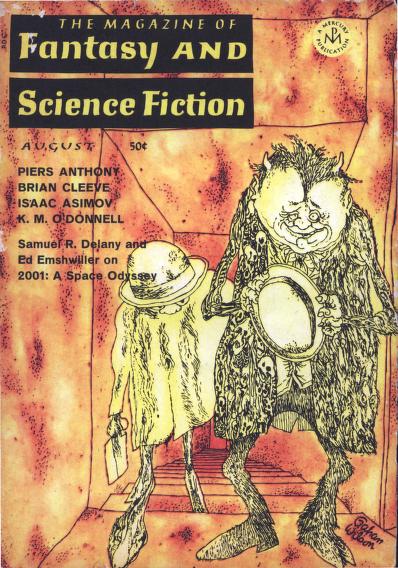
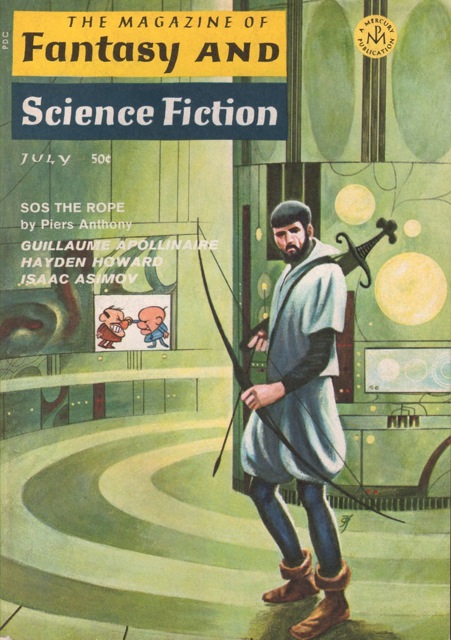
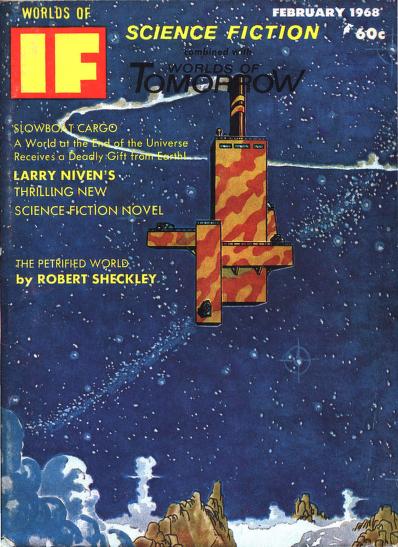

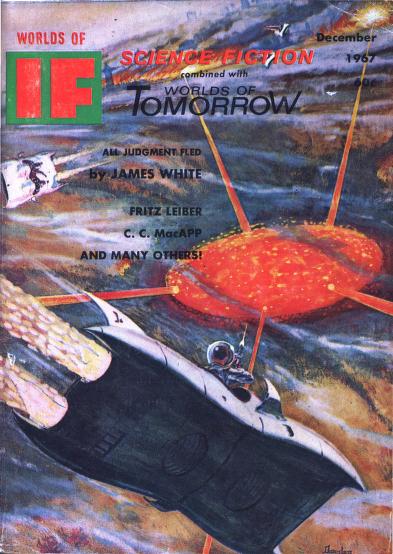

 Science Fiction & Fantasy Remembrance