Who Goes There?
We’re keeping things short and sweet today, with a rather self-explanatory story by an author who has little need for an introduction. Ray Bradbury is one of those rare people who’s a canonical SF writer as well as having a place in the mainstream American literary canon; and yet this was by no means inevitable for Bradbury, who started out as a fan at the tail end of the ’30s, writing for niche publications. He spent the next few years honing his craft, until he began getting his first really good short fiction published in 1943, with the next decade being very productive. Bradbury advised young writers to try for one short story a week, a rule he himself seemed to abide for a while, since by by the time he was 27 he’d written more than enough short fiction for his first collection, Dark Carnival. Despite being known best for his science fiction, much of Bradbury’s early work has a horror bent to it, enough that he felt the need to update his first collection with a revised table of contents and a new title: The October Country. “Punishment Without Crime” was not printed in one of the famous collections, but it combines SF with horror and crime fiction in a way that encapsulates some of Bradbury’s interests—if also his shortcomings. It’s also the last in a trilogy of stories about Marionettes, Inc., a company that produces lifelike telepathic androids. Weirdly enough these were all published in different magazines, but each one seems to work as a standalone.
Placing Coordinates
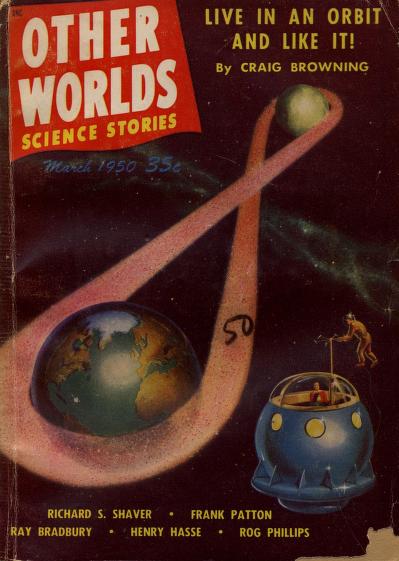
First published in the March 1950 issue of Other Worlds Science Fiction. It’s been reprinted in Science Fiction Terror Tales (ed. Groff Conklin) and the Bradbury collections Long After Midnight, The Stories of Ray Bradbury, and Killer, Come Back to Me: The Crime Stories of Ray Bradbury.
Enhancing Image
It’s America in the 2000s, and middle-aged middle-class husbands still have not considered that it might be better to divorce one’s wife on grounds of adultery than to kill her. George Hill, our protagonist, at least apparently doesn’t consider divorce to be an option, since lately he’s been thinking about murdering Katherine, his wife. Katherine (or Katie) is about twenty years George’s junior, while George is about fifty, which might explain why Katie’s been having an affair with Leonard Phelps, who is, if nothing else, closer to her age. “Better men than he had taken young wives only to have them dissolve away in their hands like sugar crystals under water.” But still, George is too mannerly, and maybe too decent, to kill his wife; so instead he’s come to the next best thing, which is Marionettes, Inc. Sure, to have a doll, a simulacrum of Katie, and to “kill” this doll, is in itself illegal, but it beats doing the real thing, at least morally. That much should go without saying. What George doesn’t realize, though, is that confronting a simulacrum of his wife may prove just as deadly to him as if he had tried murdering the real Katie. “The violent unviolence. The death without death. The murder without murdering.” And so there might also be, ironically for George, punishment without crime.
Sorry, I was trying out my Rod Serling voice.
This is very much a Twilight Zone episode in spirit, never mind it was published almost a whole decade before TZ‘s premiere. Bradbury consciously fell in with the O. Henry school of short-story writing, which is to say his stories are often structures as akin to jokes, with a setup and a punchline. The punchline is often a cruel one. A contemporary of Bradbury’s, John Collier, wrote along the same lines, to the point where “Punishment Without Crime” could be taken as Bradbury paying homage to Collier, what with the strange preoccupation with husbands conspiring to murder their wives. Bradbury had very likely read some Collier stories by 1949, so it’s possible. (There’s a misoginistic streak running through some of Bradbury’s work that I don’t see people bring up, really.) Anyway, George gets what he asks for, but he also gets something a bit extra in the bargain, what with the doll, being telepathic and sentient to some degree, practically taunting him. This stretch of the story, in which George must reckon with his conflicting feelings about his wife via the fake Katie, is easily my favorite, even if it also quotes liberally from what I’m pretty sure is the Song of Songs. Then again, having George’s sexual insecurity be not only overt but the focal point of “Punishment Without Crime” would’ve been all but unthinkable for a genre SF story just five years earlier. You could get away with something like this in Weird Tales, but the SF magazines of the ’40s were relatively chaste (incidentally Weird Tales was where Bradbury really cut his teeth). There were also the crime fiction magazines, and more importantly the “slicks” (which Bradbury frequented), but “Punishment Without Crime” might’ve been too pulpy and at the same time SFnal for the latter.
If Bradbury has a drawback, it’s that he seems to know only one woman: his wife. The gender politics here are rather off. The fake Katie is a femme fatale, of sorts, while the real Katie is implied to not be any better. Without giving away anything too specific in this section, the ending paints the real Katie as a ruthless schemer who really can’t be bothered if George lives or dies. Is this some weird future where you’re just not allowed to get divorced? Would it really be easier to kill your spouse than the other option? There will be legal trouble either way. Obviously I’m putting too much thought into it. This is a story that’ll take you maybe twenty minutes to read, and it’s written in that fast-paced breezy style Bradbury often used, the result being that even though I have issues with it, at least it goes down smoothly. If you’re a Bradbury fan then you’ll probably enjoy it.
There Be Spoilers Here
When George finally does “kill” the fake Katie, it works a little too well and is a little too convincing, with the Marionettes, Inc. people having even installed fake blood. Maybe it would be enough for George to just have a screw loose and to slip into psychosis over having wanted to murder his wife, but unfortunately for him his creator is Ray Bradbury. George and other clients of Marionettes, Inc. are promptly arrested afterward on charges of murder, even though nobody had actually been killed. As George’s lawyer explains it, it’s a damn shame that the government’s been cracking down on androids as of late, since had this all happened ten years earlier or even ten years later, he’d probably get off fine. As it is, George is sentenced to death, and while we’re not told how much time passes, it can’t be long before he’s on death row, waiting for the electric chair. He’s surprisingly calm about all this, since he’s had a psychotic break, but in a final ironic twist he sees the real Katie outside his cell one day and slips back into lucidity, having enough time to realize that he’s been massively screwed over by the system. It doesn’t matter. Katie’s off with her young boyfriend. Like I said, Bradbury tended to follow the O. Henry line of storytelling.
A Step Farther Out
For someone who’s read quite a bit of Bradbury over the years, I’ve become a bit more ambivalent towards him as I’ve gotten older. Not that he was ever in my top five SF authors or anything, but there’s something too whimsical and childish (in a bad way) about Bradbury’s writing that also reminds me of the worst of, say, Connie Willis, or Stephen King. Hokey? Saccharine? Whatever you wanna call it. Willfully immature. “Punishment Without Crime” is a curious combination of a few genres, on top of being clearly a moral allegory, but it doesn’t quite take advantage of any of its inspirations. It’s also too short and fast-paced to feel like something I should take seriously. I can believe it’s something Bradbury wrote in a week or less, then shuffled off to what was a second-rate magazine. Nowadays I like Bradbury most when he leans all the way into horror, hence my favorite stories tend to be in The October Country and The Illustrated Man.
See you next time.






 Science Fiction & Fantasy Remembrance