Who Goes There?
Edgar Pangborn’s career spanned about 25 years, encompassing more or less the third quarter of the 20th century. He took part in the market boom of the ’50s and then remained uniquely himself through the New Wave and post-New Wave periods, although his work got noticeably darker in hue, as is the case with today’s story. He was a New Yorker, although he did spend a few years farming in rural Maine before he entered the world of genre fiction, which more than likely inspired “Longtooth” as well. There’s not too much we know about Pangborn, not helped by the fact that he was never that prolific a writer and he didn’t exactly write bestsellers in his time. He did win the International Fantasy Award for his 1954 novel A Mirror for Observers, and was eventually given the Cordwainer Smith Rediscovery Award as a token of his overlooked talent. He was a lifelong bachelor, never had children, and he was probably gay, although there’s only some circumstantial evidence to suggest this. Nevertheless, Pangborn’s writing often has a stark loneliness about it (at times romanticizing said loneliness a little too much), and a gentleness that for the rather non-humanistic 1950s made him a bit of an outlier. “Longtooth” is a very rare venture into horror for Pangborn, but it still feels characteristic of him.
Placing Coordinates
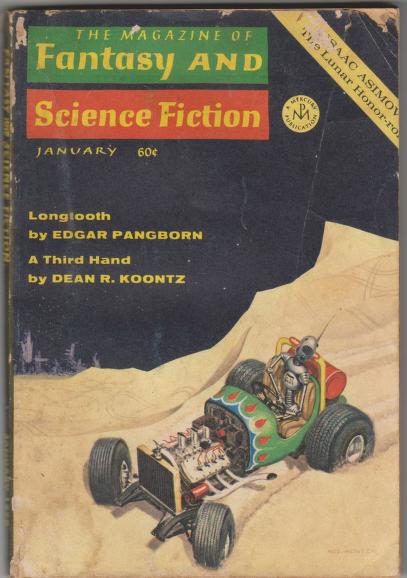
First published in the January 1970 issue of The Magazine of Fantasy and Science Fiction. It’s since been reprinted in The Best from Fantasy and Science Fiction: Nineteenth Series (ed. Edward L. Ferman), A Treasury of Modern Fantasy (ed. Terry Carr and Martin H. Greenberg), The Best Horror Stories from the Magazine of Fantasy and Science Fiction (ed. Edward L. Ferman and Anne Jordan), Foundations of Fear (ed. David G. Hartwell), Strange Dreams (ed. Stephen R. Donaldson), and the Pangborn collection Good Neighbors and Other Strangers.
Enhancing Image
Ben and Harp are two New England hicks in their fifties, so a little past middle age. Ben is a widower and his son died tragically young, while Harp married Leda, the “problem” being that Leda is 28 while Harp is 56. The other problem is that Leda doesn’t wanna live in the country, but Harp is dead set on staying in the cabin his ancestors had built—never mind the harsh weather, or the lack of local prospects for someone of Leda’s age and disposition, or the fact that someone (or something) has been killing the chickens. Ben is narrating and he tells us that his “word is good,” which should immediately raise alarm bells for the reader. I’m starting to resent the term “unreliable narrator” partly because, as Gene Wolfe (or maybe it was Nabokov) had said, every narrator is unreliable, even if it’s an “omniscient” third-person narrator. There’s always information the reader is not given, which you could say is an inherent limitation of literature, but more often this openness of detail can be an asset. Ben is fairly old, and as we find out he also survived a heart attack and a stroke, although how that happened won’t be revealed until much later. The idea is that Ben is not so much a liar as the equally viable reason for a narrator being unreliable, in that his memory might be faulty. Pangborn is informing us upfront that we probably shouldn’t take the narrative at face value.
“Longtooth” is ostensibly a horror story, but it could also be considered a domestic drama, albeit one where the conflict between the domestic partners is more implied than shown. Harp and Leda don’t exactly have a happy marriage, not that Ben is quick to say anything about it. “You walked on eggs, with Harp,” as he says. The two had married seven years ago, and there’s a room decorated with things meant for a baby, including a crib; yet there’s no baby. Apparently the two tried to have kids, but it didn’t work out. The only thing they have that isn’t a farm animal is a fat old dacshund mix named Droopy. It doesn’t help that Leda had a reputation as the town bicycle before getting hitched with Harp, and even as a married woman she still gets gossiped about. (By the way, Darkfield is such a fucking spooky name for a town, in that rural New England fashion, that I have to wonder if Stephen King copped it at some point. He has almost certainly read “Longtooth.”) Leda also wants to get a job, but Harp won’t let her, or at least he’s not keen on the idea. And then there’s the age gap. Leda was 21 when they married, which, as someone who was 21 at one point, is mighty young, although there’s nothing illegal about the arrangement. The stranger part is that Harp (like Pangborn) was a bachelor deep into his forties, who had never married before or seemingly even had a long-term relationship, when he met Leda. One has to wonder why the two hit it off in the first place; it wasn’t for the money or status, Harp being a poor farmer, and Leda herself being of ill repute. “I suppose [Leda] had the usual 20th-Century mishmash of television dreams until some impulse or maybe false signs of pregnancy tricked her into marrying a man out of the 19th.”
But that’s just one mystery.
The other is that Harp confides in Ben that he’s seen the thing (for he struggles to call it a person) that’s been terrorizing his farm: a humanoid, unnaturally tall, more or less covered head to toe in fur, and with teeth big enough to tear a person’s head off with ease. Ben takes to calling this creature Longtooth. Of course Ben has never seen Longtooth himself, so he can only take Harp’s word on the matter; but Harp, for all his faults, is not a liar. So we’re told. At the very least Harp is convinced it’s not a bear, given he’s hunted those and knows damn well what they look like. But it would also be hard to believe that a man could live in the forests of Darkfield by himself, in which the area gets quite literally several feet of snow in the winter, as happens to be the case now. It becomes even harder to believe when, while Ben and Harp are outdoors, Longtooth breaks into the cabin through the window on the second floor, kills Droopy, and kidnaps Leda. What a Yeti-like creature could want with a human woman makes the two friends shudder, and they figure that even if they do find her she’ll most likely be dead. To their credit, though, and despite the fact that the story Harp would have to give is absurd on its face, they do call the local authorities. Ben and Harp (especially Harp) are not book-smart, but I do like it when even rustic characters like these try to make smart decisions. “Longtooth” is a meaty 15,000-word novelette, and while the plot is by no means complicated if taken literally, there’s a lot of setting detail and psychology, less about action and more about characters thinking about what actions to take. As expected with Pangborn, it has layers.
The authorities suspect Harp killed Leda and hid her body in the wilderness somewhere, and that Ben is in cahoots with Harp, but as Our Heroes™ are quick to point out, this would be a very hard task for two slightly-past-middle-age men, not least the window which had been broken from the outside. But then the idea of a Yeti kidnapping Leda is also ridiculous. It’s the improbable versus the impossible, and the only witnesses claim the latter is, in fact, possible. It’s possible that Harp and Ben have made the whole thing up and that some ordinary man kidnapped Leda, or that maybe Leda hadn’t been kidnapped at all, but as we’re told multiple times, neither of these men is given to making things up; they might have faulty memory, or only see part of the reality, but they don’t lie. Then again, the average person may consider it easy to believe an unusually tall and brawn man caused all this trouble rather than a Yeti with abnormally large teeth, yet Harp is convinced he saw such a creature. Maybe he wants to believe he’s seen such a creature? As Dr. Malcolm (not that Dr. Malcolm), a biologist and friend of Ben’s, points out, “Men can’t stand it not to have closed doors and a chance to push at them.” Harp, in his grief, may be mistaking something improbable for something utterly fantastical—or he may be trying to cover his own tracks. We’re stuck in Ben’s head the whole time, and even his motives are sort of up in the air; meanwhile Harp remains such a mystery to us, despite spending a lot of time with him and after some backstory. We’re not sure if we can trust this man who may have killed his wife.
There Be Spoilers Here
Of course, when Ben and Harp finally do find Leda, who is still alive, albeit deranged, something very strange happens. Upon finding her in the cave Longtooth had taken her to, Harp kills his wife, shooting her “between the eyes,” without any words spoken between them. Harp never gives a reason for why he does this and, just as strangely, Ben never questions it. Is this an honor killing? Did Harp think his young wife had been violated by the creature? Did he think she had utterly lost her mind and sought to put her out of her misery? Was it… somehow out of jealousy? We never get an answer, because soon Harp and Longtooth have a showdown and kill each other, Longtooth strangling Harp while Harp shoves his hunting knife in the creature’s side. Afterward the authorities fail to find the creature’s body, yet surely something or someone must’ve killed Harp. Ben, in the wake of all this, has a heart attack and a stroke, and miraculously survives both despite being on his own, in the freezing wilderness. Yet this might be only slightly less miraculous than a long-tooth Yeti in Maine. Ben has been in the hospital this whole time, and can barely move his body, but he’s mobile enough to write this memoir of sorts, or account—maybe to absolve himself of a crime, if there really was no Longtooth. The creepiness of the story comes partly from the creature’s inexplicable and uncanny existence, but Pangborn also uses ambiguity to unease the reader, raising questions and giving surprisingly few answers, in effect leaving a door open. It’s not viscerally scary, but its openness makes it discomforting.
A Step Farther Out
It took me a few hours to get through this one, which I know is quite slow for a short story, but mind you that a) I was taking notes, and b) I was reading a scanned copy of the F&SF issue, which is simply a more laborious process than reading a physical book. This is certainly a story that demands some notes, though, and also time to think about it. It feels both unusual for Pangborn and something that would’ve been in his wheelhouse, especially late in his career when he seemed to have become more weary of humanity. It’s creepy, but it’s also sad and in parts ambiguous. The whole strange ordeal might’ve really happened, or maybe not.
See you next time.





 Science Fiction & Fantasy Remembrance