Skip to content

Science Fiction & Fantasy Remembrance

Celebrating the genre magazines, one story at a time…

  • About
  • Serial Reviews
  • Novella Reviews
  • Short Story Reviews
  • Complete Novel Reviews
  • Things Beyond
  • The Observatory
  • The Author Index
  • Novella Review: “Beyond Bedlam” by Wyman Guin

    August 31st, 2023
    (Cover by Ed Emshwiller. Galaxy, August 1951.)

    Who Goes There?

    Well, we’ve been bamboozled again. I was gonna write a review of A. Merritt’s 1932 novel The Dwellers in the Mirage, but I basically fizzled out halfway through reading that novel; not that it was a bad read, it was more that somehow the timing did not seem right. I was struggling with Jack Williamson’s The Reign of Wizardry at the same time, a novel whose opening stretch is rather tough going, and reading both at the same time with a deadline in mind wearied me. Whereas the Williamson serial did pick up steam in its second half, giving me the energy to persist, I kept putting Merritt’s novel off and on, until I realized I probably wouldn’t have it finished in time. I’ll cover Merritt someday (considering his influence on other writers and how nearly everything he wrote appeared in the magazines), but I found out first-hand that sadly today will not be that day. Thus a shorter alternative was needed.

    One thing I said in my review forecast was that only the novellas covered this month would be science fiction, and that remains true because we’re talking about a novella today that is very much science fiction. “Beyond Bedlam” had been in the back of my mind for a minute, because it apparently encapsulates what made the early years of Galaxy so unique and so ahead of the competition. Truth be told I thought “Wyman Guin” was a pseudonym at first, because it sounds like one. Guin did debut in the field under a pseudonym, but then started using his real name; maybe he was hesitant to do that as he already had a respectable day job. Anyway, he didn’t write much, but it was enough to earn him the Cordwainer Smith Rediscovery Award. “Beyond Bedlam” marked Guin’s first story under his own name and it remains his most well known.

    Placing Coordinates

    First published in the August 1951 issue of Galaxy Science Fiction. It’s been anthologized a few times, as well as collected in Beyond Bedlam, which has all of Guin’s short fiction; sadly these are all out of print, although the latter has an e-book edition. Good news is that you don’t even have to pay to read it in an unambiguously legitimate fashion, as it fell out of copyright and is available on Project Gutenberg.

    Enhancing Image

    (Before we get into the thick of it, be aware that “Beyond Bedlam” discusses mental illness at length in terms that are outdated; not that the language Guin uses is insensitive, but rather that our understanding of mental illness has, like everything else about ourselves, advanced massively since 1950. For the sake of staying consistent with the story, and for my own sanity, I’ll be referring to the condition described in-story as schizophrenia, even though it’s actually recognized as a different condition today.)

    Sharpen your pencils, because class is in session.

    It’s the 29th century, and things are… a little different. Sure, we have some future tech that one would expect in old-timey science fiction about “the future,” but the technology is not the focus of the story. No, the people have changed far more radically than the tech. We start out in a classroom, with Mary Walden, who is not the protagonist but who will eventually figure profoundly into the central conflict. Thing is, Mary is only half a person—or rather she’s a whole person, but only gets to use the body she’s in half the time. She shares her body with a filthy brat named Susan Shorrs, whom Mary knows nothing about other than she leaves the body shared with Mary in rough shape whenever the “shift” happens. The problem is that Mary is a schizophrenic, which is actually not a problem because so is everybody else. Schizophrenia, a mental illness that was very much frowned upon by “the ancient Moderns” (i.e., us), became more acceptable in the 20th century once psychiatric drugs started developing and became more accessible, not only treating schizophrenics but ushering them into normal society. “The drugs worked so well that the ancients had to let millions of schizophrenic people out from behind the bars of ‘crazy’ houses. That was the Great Emancipation of the 1990s.” After several generations schizophrenics were so entrenched in normal society that they actually started to outbreed non-schizophrenics, and because the Medicorps (mind the “the”) developed a monopoly on psychiatric drugs, and because said drugs became so accessible, schizophrenics soon had to take their drugs as mandated by law. Cut to 900 years later and you have a society (at least in the US, as we learn shockingly little about life outside of it) where everybody (with exceptions, who are themselves now pariahs) is a functioning schizophrenic. The “normal” person is now a body housing two totally separated and autonomous personalities, each in effect a whole person.

    I mentioned earlier that Guin had a respectable day job that did not incentivize him to write fiction prolifically; more specifically he was a pharmacologist and advertising executive, so you bet he knew a thing or two about the latest in psychiatric medicine. The strange result is that the premise of “Beyond Bedlam” is patently ridiculous and whose foundations are a little shaky if you go asking too many questions, but for what the story asks of itself it is remarkably internally consistent. Basically, it works off assumptions made in 1950 (so when Guin wrote the story) about how people suffering from mental illnesses like schizophrenia seem to be growing in relation to the general populace. We know of course that as psychiatry has advanced by leaps and bounds that people with mental illness do not necessarily take up a greater percentage of the population, but that doctors have been able to diagnose people with greater understanding, never mind empathy. It’s a fallacy, but it’s necessary in presenting a distant future society wherein the “lunatics” have literally taken over the asylum.

    (I could go on for a long fucking while about how this story’s setup clearly anticipates some of Philip K. Dick’s works regarding mental illness [Clans of the Alphane Moon, Martian Time-Slip, and A Scanner Darkly especially], but I won’t, becaue believe it or not I do value your time. I would just be shocked if Dick didn’t read “Beyond Bedlam” when it was first published as it very much reads as proto-Dickian, and also it’s great.)

    So how does this work? You have, say, 10,000 bodies in a town but effectively 20,000 people running it. We’re told that historically there have been bodies with three or even four personalities, but while the word “eugenics” isn’t used, it’s made clear that these abnormal schizophrenics have been weeded out, or at best incentivized to not reproduce. A society wherein you have two personalities for every body would present enough of a problem, so it only stands to reason that more would be worse. People are forced into five-day shifts wherein each personality takes over for that duration, followed by a day of rest, between a “hyperalter” and “hypoalter.” The hyperalter is the so-called dominant personality that can, if they really want, interfere with the hypoalter’s consciousness, even invading their dreams. As such, on top of the drugs taken for compartmentalizing personalities, people are also required to take a “sleeping compound” that’ll prevent hypoalters from dreaming and thus risk invasion from their hyperalters.

    The system in place to keep people’s lives in order is regimented and also imperfect, which is where the plot comes in; but we’re not quite there yet. “Aren’t you gonna get the plot already?” Soon. The thing about “Beyond Bedlam” is that the plot itself is straightforward, at least when put up against worldbuilding this dense. It’s like when people talk about Stand on Zanzibar but rarely discuss its main storyline; it’s because we all know the real meat of both of these works is in the background, and I do think “Beyond Bedlam” approaches that level of density. H. L. Gold’s editorial for this issue of Galaxy focuses pretty much entirely on “Beyond Bedlam” and how Guin went about writing it, and with good reason. Not only is this a first-rate story, but it probably could not have materialized in the way it did without the intense back-and-forth between Gold and Guin in refining it. Gold is unclear if Guin always intended this to be a novella, but he says that, with his help, Guin revised and rewrote “Beyond Bedlam” a couple times each, going through 80,000 words of drafts. The effort was worth it; this is a three-dimensional depiction of possible life in the future.

    Now for the plot…

    Mary is the “assigned” child (as people are not raised by their birth parents) of Bill and Helen Walden, who seem to lead a decent middle-class life, except for a couple things. For one, Bill and Helen’s alters, Conrad and Clara Manz, are also married to each other, which it turns out is very much out of the norm. “Such rare marriages in which the same bodies lived together on both halves of a shift were something to snicker about.” Conrad, being the hypoalter, knows that Bill has been “cheating” by messing with Conrad’s shifts for a few hours, but what Conrad does not know is that Bill has been having an affair with Clara, whom as you know is Helen’s hypoalter. Now, monogamy is not taken too seriously in this future society; people have affairs pretty casually, and the Waldens and Manzs are chill about messing around behind each other’s backs. The problem is that Bill is not only messing with a hypoalter (hypers and hypos are kept strictly apart, and never the twain shall meet) but his own alter’s spouse.

    What starts as Bill and Clara worming their way around regulations to have their meet-and-fuck sessions soon snowballs into Bill jeopardizing both his own “life” and Conrad’s, both physically and by tempting the wrath of the Medicorps. This is all made worse by Mary becoming depressed and fed up with being neglected by her parents, causing her to break a different taboo by tracking down Conrad and Clara. Having the story start with Mary is sort of misleading since she only appears sporadically, but the classroom setting at the beginning gives us a healthy dose of exposition while also establishing how people in this future might want to break out of their regimented relationships with their alters. Since this is a strictly drug-induced culture, it’s also emotionally stifled, with the positives being that war is apparently a thing of the past (again, at least for the US) and crime seems to have gone down massively. The result is a more peaceful but also less free society where even one’s emotional spectrum is narrowed.

    There Be Spoilers Here

    The outcome is not surprising. Bill gets caught and put on trial by the Medicorps for a gross breach of conduct, with a guilty verdict resulting in either hospitalization for life or “mnemonic erasure,” i.e., death of the personality. If you’ve read a few dystopian narratives in your time then you’ve been here before, and you also know that Bill has to lose—to play the role of Winston Smith and John Savage. Yet even during what would normally be a been-here-done-that sequence in a dystopian narrative (the third-act breakdown of the rebellious hero), Guin once again shows off the wonderful density of the world he’s made. Mnemonic erasure will affect Conrad’s life almost as profoundly as Bill’s, as, being a single persona in a body, Conrad can’t just go around like one of the ancient Moderns. He still has his five-day shift, but during what would be Bill’s shift he gets put in deep freeze, so as to not interfere with the world of his late hyperalter. (Again, never the twain shall meet.) While Conrad is sort of pleased to see his alter put to death, since Bill’s been a huge recurring pain to him, there’s a cost to all this. With Bill gone, Conrad will now be sort of an outcast, and he will not be any freer than he was before.

    So it goes.

    A Step Farther Out

    I have a two-part argument about SF and novellas. The first part is that SF is imaginative literature, in that it’s a literature chiefly concerned with ideas; the second is that the novella is the ideal mode for a literature of ideas, and by extension ideal for SF. “Beyond Bedlam” has enough meat on its bones to justify a novel, but it gets its point across in 21,000 words. It’s a densely packed depiction of a future society that, while absurd if considered too closely, does what it ought to do, in that it makes the reader think about how this society may be a distant descendent of ours. Guin does what most SF writers don’t in that he envisions a future that is mostly unrecognizable and yet just recognizable enough that we have context. The result is a nuanced dystopian narrative that does not provide easy answers, nor even an easily discernable perspective. If Orwell clearly sides with the individual in 1984, Guin seems unsure about the seesaw balance between individual freedom and public safety. It’s a haunting and mind-bending story, being one of the finest miniature gems of ’50s science fiction.

    See you next time.
  • Serial Review: The Reign of Wizardry by Jack Williamson (Part 1/3)

    August 27th, 2023
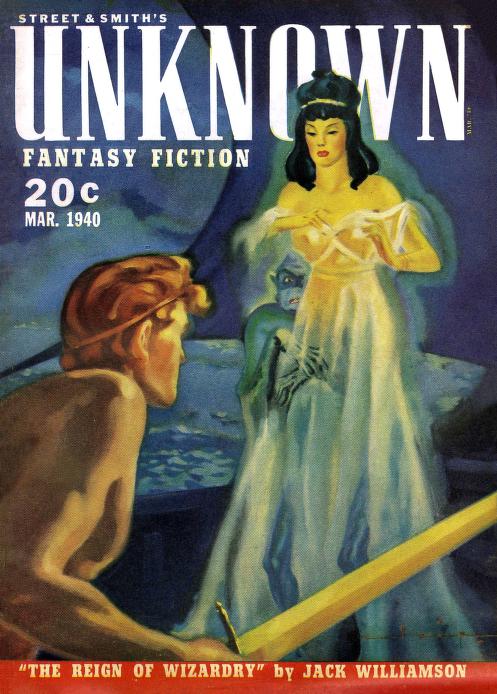
    (Cover by M. Isip. Unknown, March 1940.)

    Who Goes There?

    Jack Williamson was the second author to be made an SFWA Grand Master, after Robert Heinlein, and yet he is little read nowadays. Actually, past the first decade of his career, I’m not sure when Williamson would’ve been “popular.” That’s not a knock. This man right here is one of the most respectable old-timey SF writers, never quite reaching the heights of Heinlein, true, but also never sinking nearly to such lows as latter day Heinlein. Remarkably, unlike most writers of his generation, Williamson caught a second wind at such a late point in his career, putting out some pretty good work in the ’90s and 2000s—so, ya know, when he was in his 80s and 90s. He remains, by a good margin, the oldest person to have won a Hugo in any of the fiction categories.

    I recently read Williamson’s autobiography, Wonder’s Child (which also won him a Hugo), and I’ve somehow gained an even greater respect for the man. He discusses, to some degree, all the fiction he wrote up to 1980 he thought worth mentioning, although of course the book is more about his life and how he tried balancing that (various jobs, romantic/sexual false starts) with trying to make it as a pulp writer. Curiously, today’s novel only got a single paragraph to itself, and Williamson says little about it even within that space. The Reign of Wizardry was his first published work in Unknown, the fantasy sister magazine to Astounding Science Fiction, and for both readers and Williamson himself it does not hold the esteem of his subsequent Unknown effort, “Darker Than You Think.”

    There may be a reason for this.

    Placing Coordinates

    Started serialization in the March 1940 issue of Unknown, which is on the Archive. It has an e-book edition, wooo. For print versions your best bet would be either the Phantasia Press hardcover (out of print) or the Williamson collection Gateway to Paradise (also out of print). Yeah it’s a novel, but it’s apparently short enough to fit in the latter.

    Enhancing Image

    The prologue is a curious one, in that while the story to come is unabashedly fantasy, Williamson takes the effort to root it in actual science: in this case archaeology. Crete is an island, still existing today with its own people, off the coast of Greece, but what in modern times (i.e., the 19th century onward) archaeologists uncovered what must’ve been as advanced a civilization as ancient Egypt, during a time when Greece itself would not have been so prosperous. For centuries there were only hints, combined with legends, as to the workings of ancient Crete, whose golden age came to an abrupt end before being occupied by several empires over the centuries. The narrator proposes that the myth of the minotaur and the labyrinth, and the Greek hero Theseus, may have some historical legitimacy in explaining the golden age of ancient Crete coming to an end.

    Now we’re on the high seas, with Our Hero™, whom to us is known as Theseus but to other characters as Captain Firebrand—a redheaded pirate who patrols the waters between Greece and Crete. One day, upon raiding a Cretan ship, Theseus and his right-hand man Cyron take in what appears to be a woman of incredible beauty as part of the loot, but who turns out to be an impish Babylonian wizard named Snish; this character, at least so far, seems to be Williamson’s biggest contribution to the myth. Snish is a low-level wizard who, for all his physical weakness, can get through trouble by disguising himself, although the illusion is an audio-visual one that will evaporate if touched and especially if kissed. Curiously the narrator refers to Snish as a “she” when in his female disguise. Anyway, Theseus considers killing the little man, but Snish convinces the crew he’d be of more use in infiltrating the island empire of Crete, at that point the most powerful nation in the Mediterranean—and host to evil wizardry.

    While obviously not historically sound, we’re led to believe that Crete is such a powerful nation at this point in history because it is ruled with an iron fist by Minos, the most powerful wizard in the known world. Minos, who apparently is immortal, has ruled Crete for a thousand years, but there is at least theoretically a chance that such a tyrant can be overthrown. We’re told that every nine years (why not ten is beyond me) games are held to test the finest warriors in the land, to see if any survive the trials. “And if any man wins the contests, the old Minos must give up his life, and go down into the dread Labyrinth of the Dark One.” The Dark One being the minotaur—one part bull, one part man, one part god. Being a pirate, Theseus hates authority, and especially authority with magic powers. The games are set to begin in a couple days. If he could get to the shores of Crete, and into Knossos, that magical palace just in time to participate…

    I might not be making it obvious, but the first half of this installment (which is really the first quarter of the novel) is messy. The goal is simple: Get Theseus from point A to point B, i.e., from off the island to on the island. Sounds simple, right? But this is a 50,000-word novel and said novel is frontloaded with lore, a few characters who will not matter later, and a couple action scenes that lack the pulpy zest of Williamson’s earlier writing. This was his attempt at writing a “serious” fantasy tale, and I also think there’s a reason why he would only show up in Unknown two more times; in fairness, the second of these three appearances was “Darker Than You Think,” which really is one of the standout fantasy narratives of the ’40s. But whereas that novella captivates with its grimness and psychological implications, The Reign of Wizardry starts out as too convoluted for people not already familiar with what its retelling and yet too shallowly written to be considered a demanding-but-it’s-worth-it reexamination of old material. It’s a remix of a song that barely stands on its own.

    But it’s not all bad. A shipwreck puts Theseus on the shores of Crete but separates him from both Cyron and Snish, and this is where the plot goes from a series of random events to something more cohesive. Snish is not exactly Williamson’s best attempt at humor, being the closest we have to a comic relief character, so him being absent for most of the latter half of this installment is no loss. It’s here that we meet Talos, the living statue who serves Minos’s will, although sadly unlike his depiction in Jason and the Argonauts he’s not the size of a goddamn building, just a twelve-foot-tall man with an odd skin condition. He also talks. Then there’s Ariadne, Minos’s daughter, who serves the role of the single female character of any significance. (There’s also a haggard old woman who is implied to be a prostitute, but that’s the closest this novel gets to acknowledging sexuality thus far.) It took a while to get started, but once we’ve met all the key players, including Daedalus, Minos’s right-hand man, it’s time to (quite literally) let the games begin. Took long enough.

    There Be Spoilers Here

    Entering the games at Knossos under the disguise of a “Northman” (a viking) named Gothung, since apparently Minos was expecting Captain Firebrand to participate, the plot gets funneled into a series of action scenes wherein Theseus proves his might against a series of opponents, first bulls and then other men. This ties into the nature of the minotaur, which as said is part bull and part man, and of course there will be the final trial: judgment by the dark god himself. This section of the novel is the strongest part, but even so the action is not as grippingly written as it would be in a Robert E. Howard or Fritz Leiber fantasy adventure. There’s a bit of gore, but surprisingly it’s not as violent as the back end of the other Williamson novel I’ve covered, The Legion of Time, despite Williamson giving himself the perfect pretext for blood and guts. It could be that in an attempt to write something more dignified he wrote something that’s not as fun.

    You may be thinking, “Brian, what are you saying? Violence isn’t fun!” And in the context of real life I agree. Violence, in the real world, is usually horrific and completely unnecessary. As Asimov said, violence is the last refuge of the incompetent—and there are a lot of incompetent people out there. But in fiction, especially when it’s a couple degrees removed from reality, violence can be immensely satisfying. Unfortunately that level of carnage was reserved for the “pulpy trash” of Weird Tales, which John W. Campbell wanted to counter. As such, even in this opening installment’s most gripping moments, it seems underwritten—like it’s afraid to go all out.

    Anyway, Theseus succeeds in his trials, and a little too easily at that. This skepticism turns out to be justified as Minos, Daedalus, and the bitchy Ariadne pull a fast one on him and reveal his true identity. It’s implied that Minos knew Theseus would come to Crete in disguise well in advance, and just as it looks like Theseus will take to the throne as the new ruler of Crete, the rug gets pulled out from under him. We know that something like this had to happen, because this is the first part of a three-part serial, but we also know, and are all but told at the beginning, that Theseus will ultimately succeed in ending the Cretan empire’s reign of wizardry (get it?). It’s possible Williamson has a few tricks up his sleeve, but I have to wonder how much he can change given that ultimately he has to abide the trajectory of the myth. Or does he? We’ll have to wait and see… and hope.

    A Step Farther Out

    Ehhhhhhhhhhhhhhhhhhhhhhh…

    At first I wasn’t feeling it, and even by the end of this first installment I wouldn’t say I was onboard. Something is wrong here. It could be that I need to catch up on my Greek mythology, but this seems like a straightforward retelling of a myth that would’ve probably been common knowledge for readers in 1940. That Theseus starts out as a pirate and mostly uses his wits instead of his brawn to get the job done can only go so far. The thing about much of the material published in Unknown is that while a lot of it would now be called urban fantasy, the stuff that wasn’t still had a sense of humor—you could say a lust for life—that defined the magazine. Yet at least so far Williamson’s retelling of the minotaur-and-labryinth routine is humorless, and Williamson is not one for straight-faced action—pulpy action, sure, but not something trying to be this serious.

    See you next time.

  • Short Story Review: “Travels with My Cats” by Mike Resnick

    August 24th, 2023
    (Cover by Dan O’Driscoll. Asimov’s, February 2004.)

    Who Goes There?

    When Asimov’s was practically the be-all-end-all SFF magazine of the ’90s, certain authors were sitting at the very top of that tower. If you asked someone in 1995 who the most popular contributors to Asimov’s were, the two likeliest answers would be Connie Willis and Mike Resnick. Resnick had in fact been around (first as a fan) since the ’60s, but it was his 1988 story “Kirinyaga” that catapulted him to noteriety; ironically said story was published in The Magazine of Fantasy and Science Fiction, but Resnick quickly moved to Asimov’s and took the sequels to “Kirinyaga” there. He would end up with a record-breaking number of Hugo nominations, plus five wins, with today’s story being the fifth winner. This is not something you just do by accident. Resnick clearly had talent and a vibrant charisma that endeared him to readers as author and editor.

    What’s strange about Resnick is that despite having died only a few years ago and being generally well-liked among the genre readership (those who still subscribe to magazines), his work reads like it’s—let’s say from a different era. Which is true. The ’90s may not seem like a long time ago in terms of how literature has evolved, but back when Resnick was at the top of his game he wrote for an audience that was damn close to lily-white, and it shows, especially in those aforementioned Kirinyaga stories. “Travels with My Cats” doess not have such a problem… up to a point.

    Placing Coordinates

    First published in the February 2004 issue of Asimov’s Science Fiction, which is on the Archive. You’d think winning a Hugo (never mind also placing first in the Asimov’s readers’ poll) would guarantee more reprints, but “Travels with My Cats” has been reprinted only a few times. If you want an audio reading then there’s the Escape Pod episode for “Travels with My Cats,” found here. For book reprints there’s the collection Win Some, Lose Some, which collects all of Resnick’s Hugo-winning and -nominated short fiction up to 2012; unsurprisingly it’s quite thick.

    Enhancing Image

    Ethan, the narrator, reflects back on what would turn out to be a turning point in his childhood, although he could not have known it at the time. As a kid he went to a garage sale, which objectively speaking had nothing unusual—not even in the books section, which like any decent person he checked. There were some fetching books, but they all cost 50 cents each, “and a whole dollar for Kiss Me Deadly,” and Ethan only had a nickel. Well, there was one book that fit his budget: a very old travel book titled Travels with My Cats, authored by Priscilla Wallace. The lack of pictures on the inside at first put Ethan off, but he checked further and saw it was a limited edition—one of only 200 copies. Any self-respecting bibliophile knows a limited edition like that would be a must-buy, especially for a nickel.

    It’s here that we get some names dropped, as to be expected of a story that panders to the base. You have the usual: Asimov, Heinlein, Bradbury. Some detective fiction as well, what with Raymond Chandler and aforementioned Kiss Me Deadly. The book Ethan picked up was like none of those, but he ended up enjoying it still as it presented a different kind of adventure, about Priscilla’s globe-trotting travels with her cats Giggle and Goggle, seeing places Ethan could barely comprehend as an 11-year-old. I have to wonder if Resnick had a similar flashpoint in his childhood; maybe he picked up a book at a library, or an issue of National Geographic, and grew fixated on this idea of “seeing the world.” It goes a long way to explaining his fetish for exoticism, which now reads as problematic.

    Ethan read Travels with My Cats several times in his childhood, but like all childish things he eventually put it aside, not even giving it a thought until many years later when he has a sort of madeleine-cake-in-tea moment and it all comes back to him. This opening stretch of the story (admittedly this is a story you can read in half an hour), wherein Ethan discovers and then rediscovers Travels with My Cats, is the best part. It could be that I’m a sucker for reminations of the nature of memory, but to Resnick’s credit he makes Ethan a fleshed-out person in those opening pages, perhaps with a bit of autobiography. It’s not hard to imagine Ethan as an alternate version of Resnick, some twenty years younger, who does not go on to “see the world” and become a respected author; instead he becomes a nobody. Ethan, now in middle age, lives a peaceful but unproductive existence, not being in love or fueling a passion that would get him away from his meaningless job. But finding this book again gives him a purpose.

    Ethan’s life is basically a series of false starts. He reads all about exotic places but he never travels himself. He forms a sort of fanboy crush on Priscilla (who after all is just an idea to him), but never finds someone in real life who fills this role. He buys what amounts to a log cabin by a lake and that’s the most adventurous he gets—until suddenly he has a mission. How rare is Travels with My Cats actually? Whatever became of Priscilla Wallace, that author only he seems to remember? So like any good bibliophile he ventures out to the library and goes digging. Turns out the book was even older than Ethan had thought. Priscilla died in 1926, age 34. “So much for fan letters, then or now; she’d died decades before I’d been born.” In fairness, given that the current action takes place in 2004, Priscilla would be dead regardless; but the fact that she died so young is a bitter pill. Some people would have the plot be Ethan’s quest to track down the origins of this obscure book from his childhood and leave it at that, and I would even argue that, in the right hands, this might’ve made for a better story.

    You may notice that nothing supernatural has happened yet, but that’s about to change when Ethan gets a special visitor at his doorstep. Priscilla is here, along with her cats, looking and acting like a real person.

    I have a hypothesis that’s been slowly gaining ground in my brain, and it goes like this: Every author worth their salt will, at some point, write a ghost story, or at least something that can be construed for a ghost story. It’s actually a hard subgenre of fantasy (if you wanna call it that) to avoid. “Travels with My Cats” is a ghost story wherein we’re not sure if what we’re encountering is the supernatural or an elaborate prank the protagonist is playing on himself. Some will call it “magic realism,” but this is a useless label for my money. Anyway, Ethan is awe-struck by the visitation, especially because he had committed the one photo of Priscilla he knew to memory. Here she is, someone who’s been dead for 75+ years, with her two ghost cats, and she’s really just here to talk for a bit.

    A few odd things about Priscilla, since she doesn’t act like an ordinary ghost. For one, she knows she’s dead, but she doesn’t know when or how she died. She also doesn’t know what time it is. There’s one other thing, but that’s for spoilers. She appears not once, but several times, coming to Ethan in the night before disappearing. Where she goes is anyone’s guess. In a way I don’t blame Ethan for acting the way he does, because when we meet our favorite authors we’re bound to say some embarrassing shit, like we’re cracking under the pressure of it, but I would be lying if I said his “confession” to Priscilla didn’t make me cringe. The mid-section of “Travels with My Cats” is about their quasi-romantic relationship and it occurred to me at some point that this plot wouldn’t be happening if Priscilla was a man. It could also be that I had read Richard Matheson’s Somewhere in Time only a week ago and that had basically the same problem.

    You could argue that “Travels with My Cats” is not a romance, and I’d agree, except it’s obvious that Ethan’s newly revived crush on Priscilla (someone who’s been dead for 75+ years) fuels the plot; it gives his character any reason to grow at all. Heterosexual romances in fiction often strike me as hollow, as they do for a lot of queer people, and I suspect this is because we’re not given a reason for these people to be in the same room together aside from being physically attracted to each other. They would not be friends. I’ve had crushes on several male friends in my life and there’s a profound difference between crushing on someone you like being with simply for the sake of being around them and crushing on someone because your hormones are going turbo and you’re getting funny ideas. Making Ethan and Priscilla’s relationship quasi-romantic (I say “quasi-” because Priscilla doesn’t seem to love Ethan, although she does encourage his behavior somewhat) disappointed me more than a little.

    There Be Spoilers Here

    One day a raccoon breaks into Ethan’s cabin and tears his copy of Travels with My Cats to shreds. “Pages were ripped to shreds, the cover was in pieces, and he had even urinated on what was left.” The book cannot be salvaged. What’s strange is that while Priscilla has gone, presumably never to return without a copy of the book, her cats are still here. Giggle and Goggle not only look but feel real to Ethan, and he’s convinced these cats have somehow been brought back to life. This can all be written off easily as Ethan losing his marbles, since we never get a third party’s perspective (indeed the world does not seem to exist outside Ethan’s bubble) on the whole thing, but I assume we’re supposed to take the cats existing at face value. But still, Priscilla is gone, and even if she’s just of a figment of Ethan’s imagination, he can’t just wish her back with a thought. All is lost.

    Or is it? After much digging, first trying and failing to comb online booksellers (shoutout to AbeBooks), Ethan gets in touch with a guy who knows a guy who can verify even the exitence of Travels with My Cats. True enough, it’s a real book, although it was self-published, only printed 200 copies (not even sold, printed), and didn’t even get an ISBN. To find another copy of Travels with My Cats would take years. Good thing (for him, anyway) Ethan has nothing much to lose. The non-ending of the story sees Ethan hit the road with Giggle and Goggle, using what money he has left to travel cross-country in search of a book that means a great deal to him, if nobody else. I’m sure this has thematic reonsance, what with Ethan finally learning to reach outside his comfort zone by following in his favorite author’s footsteps, but part of me wonders if Resnick ends the story on this open note because he could not figure out where else to take it.

    A Step Farther Out

    There’s a certain stereotype about Hugo winners, that they’re not demanding reads, but rather crowd-pleasers that play to readers’ emotions. Sometimes this is true. “Travels with My Cats” is one such weepy tale, a bittersweet ghost story with a hint of wish-fulfillment (“What if the dead author I have this weird crush on came to me one night?!”) that’s more rewarding the more familiar you are with Resnick’s reoutine in advance. I’ve read several Resnick stories and have even enjoyed a couple of them thoroughly, but I don’t think “Travels with My Cats” ranks up there. In the introductory blurb, Gardner Dozois claims that Resnick thought “Travels with My Cats” to be one of the three best stories he ever wrote. I don’t know about that.

    See you next time.

  • Serial Review: Skull-Face by Robert E. Howard (Part 3/3)

    August 20th, 2023
    (Cover by Hugh Rankin. Weird Tales, December 1929.)

    The Story So Far

    Stephen Costigan is a drug addict and traumatized World War I veteran spending his days in the Limehouse district of London, wasting away in an opium den, until he is called upon by Kathulos, a strange man who claims to be of Egypt but whose ethnicity is ambiguous. Kathulos frees Stephen of his hashish addiction but instead gets him hooked on a much more powerful drug, an elixir whose ingredients only Kathulos knows. Stephen is hired to carry out a rather strange assassination plot, but he goes to John Gordon of the London secret police and conspires with him to double-cross Kathulos and his gang. Part 2 is concerned with Stephen and Gordon playing detective and discovering both the whereabouts and origin of Kathulos, who had escaped with Zuleika, Stephen’s love interest. Turns out Kathulos is an Atlantean—found in a coffin in the ocean and either awakened or resurrected. The sorcerer’s plan is to overthrow “the white races” and take over the world, with Africans and Asians as his underlings.

    Funny thing about the recap section for this installment is that because so little progress was made in Part 2 the synopsis is expanded from the front so that we start with backstory before ending on basically where Part 1 ended. I said this before, but Part 2 really ground the plot to a halt and generally this novella could’ve used an editor’s judgment.

    Enhancing Image

    This will be mostly a series of notes, since right now I don’t have the motivation to do otherwise. Skull-Face isn’t very good, but it is certainly strange—and baffling, especially for the modern reader.

    Let’s consider the following:

    1. If you thought we were done with Gordon’s monologuing from Part 2, think again. Given he is supposed to be of the secret police, Gordon has no qualms pouring out every little bit of information he knows to Stephen, who after all is a civilian and not even a British subject at that. His eagerness to trust Stephen turns out to not be ill-founded, of course, but it does ring as implausible.
    2. Speaking of implausibility, Kathulos being from Atlantis and Atlantis being a real place are taken basically at face value, with Our Heroes™ not having a hard time accepting these as fast. I genuinely wonder how many people back in the ’20s believed in the Atlantis myth, but upon reflection it would not surprise me if a good portion of the Weird Tales readership bought into it.
    3. So let’s talk about how this is sort of a white supremacist narrative. To put it simply, the villain of the story is a non-white person who has kicked off several revolts in Africa and Asia against white colonists, and we’re supposed to believe these oppressed peoples taking back their land is a bad thing. The phrase “white supremacy” is actually used at one point, quite literally, coming out of Gordon’s mouth if I recall correctly. Of course, being a British cop, Gordon has the perfect motivation to back white supremacist interests.
    4. This is, however, complicated by Kathulos being open about using said revolts and building an empire of non-white people for his own gain. He’s essentially a grifter who has radicalized people into anti-colonialist action so that he can reap the benefits. I’m not sure if Howard did this because he realized that the villain of his story might come off too sympathetically or if he wanted to placate his readership, a fraction of whom would’ve been bona fide white supremacists.
    5. Further complicated by the Atlanteans apparently viewing whites as little more than barbarians in suits, being still inferior to the Atlanteans who see themselves as the truly supreme race. Genocide against whites would be the cherry on top to Kathulos’s empire, although as he points out, he does not view blacks as any better, with Atlanteans (at least in the old days) thriving on racialized slavery not unlike much of the US leading up to the Civil War. I’m not sure if Howard, who came from a former slave state and who became increasingly aware of his country’s blood guilt as he got older, is making a comment here.
    6. The story climaxes with Stephen rescuing Gordon from bloody sacrifice and Gordon shooting Kathulos in the chest point-blank, which may or may not have killed him. While I do find it funny that a sorcerer with plans to rule a billion people gets taken down by A GUN, I was also intrigued by the fact that we don’t know if Kathulos died or if he somehow survived both the gunshot and his underground tunnel network getting blown to bits. His body is never found. The ending hints at a possible sequel, but we never got one.
    7. The romance with Zuleika is about as rushed and unconvincing as you would expect, although for what it’s worth we do get a romance between a white man and a non-white woman that ends happily. As far as I can tell interracial marriage was totes legal in the UK at the time, although the social acceptability of such a union is a different question, especially since Stephen is himself an immigrant.

    Reading Skull-Face after having read some later Howard works, it seems like Howard was on the verge of becoming more socially aware of the world outside of lily-whiteness, which is to take most of the world. His sympathies for black Americans would become more pronounced as he aged, to the point where he would get into arguments with Lovecraft and others with regards to white supremacy, but I’m not quite sure when he reached that point. Keep in mind that Howard grew up in a time and place where he would’ve been force-fed pro-Confederacy falsehoods almost from birth. He took more pains than most of his peers to understand people who come from outside the white Southern bubble. Gone with the Wind came out the year of Howard’s death, and for being a thousand pages of Confederacy apologia it won the Pulitzer Prize and became an enormous bestseller.

    I realize I sound like I’m excusing the obvious racism of Skull-Face, but to make it clear, I don’t blame anyone for disliking this story on the basis of its problematic elements, which are indeed appalling.

    A Step Farther Out

    Skull-Face is not something I would recommend unless you’re already a Howard fan and/or a completionist, since it’s not very good, for one, but it’s also likely to alienate readers who are not already familiar with the trajectory of Howard’s writing. Being the oldest Howard story I’ve reviewed, it’s easily the weakest and shows the most signs of having been penned by someone who was still honing his craft; and then there’s the racism. The absurd race war plot is probably what people will take away from it, which does not bode well for how much one can enjoy it. Howard would go on to write a few equally long works and structure them far more ambitiously than here while also justifying that length. He gets better.

    See you next time.

  • Novella Review: “Singleton” by Greg Egan

    August 17th, 2023
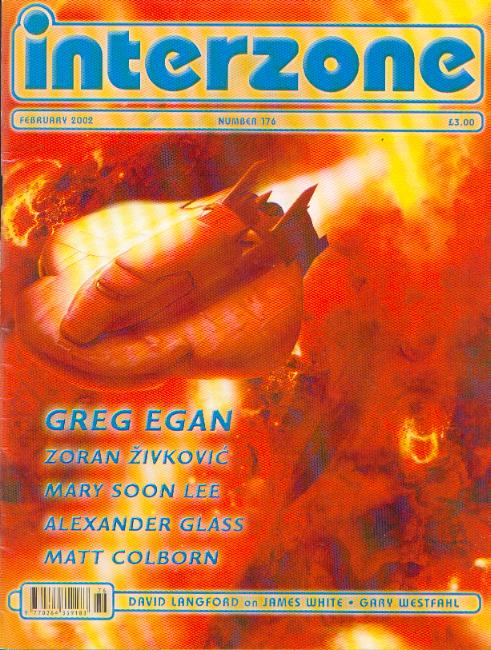
    (Cover by Jason Hurst. Interzone, February 2002.)

    Who Goes There?

    He made his debut in the ’80s, but Greg Egan is one of the quintessential voices of ’90s SF—a bridge connecting cyberpunk and transhumanist SF, sometimes wandering well outside the boundaries of either. Egan’s fiction is notorious for its incorporating of biology, computer science, quantum physics, and what have you. Egan started out as a programmer and his work often reads like the product of someone from that profession who also happens to read a lot of detective fiction. The typical Egan narrator, including the one for today’s story, is a rather melancholy white man who struggles with emotional honesty, and as such, depending on your frame of reference, it’s easier to understand Egan’s stories as detective narratives with cybernetics involved, rather than hard science fiction.

    Placing Coordinates

    First published in the February 2002 issue of Interzone, which is on the Archive. If you have qualms with reading a scan of a 21-year-old back issue of a magazine that you would have to buy used anyway, rest assured you can read this story perfectly legit on Greg Egan’s site, found here. You can also find “Singleton” in The Best of Greg Egan.

    Enhancing Image

    We start in the now-ancient year of 2003, with Ben, the narrator, a snot-nosed college geek, being witness to what is likely a gang-related beatdown in an alley, with a ton of other people watching. A kitchen hand is getting his ass beat by two guys who don’t seem to be carrying guns but do seem to mean to kill this man with their bare hands. Nobody intends to interrupt the killing. “Keeping your distance from something like that was just common sense.” Something, however, snaps in Ben—maybe a jolt of guilt. He steps in and gets beat for his troubles, but the kitchen hand comes out the situation alive and Ben gets to feel like not just another bystander. Now, for most people an act of heroism like this would be a shining moment in their lives, maybe a fond memory, but the prossibility of not helping the kitchen hand will haunt Ben for the rest of his years.

    The details of this first section are the foggiest in the story. We never learn exactly why those goons wanted to beat this man to a pulp, nor do we even learn the man’s name. We’ll never get the full context for some things—even the most important days of our lives. This haziness makes sense when you consider Ben is narrating this many years down the road, reflecting on when he was a teenager and the world seemed a fundamentally different place. Not unlike Marcel Proust in his search for lost time, there details of the past that time has simply devoured.

    Ben, while still an undergrad, kicks it off with Francine, who will turn out to be his college sweetheart and life partner. The incident with the kitchen hand had, in the short term, given Ben a confidence that normally would be absent in young scientists, and he’s well aware that it was that incident which probably motivated him to pursue Francine. “There was no denying that if I’d walked away from the alley, and the kitchen hand had died, I would have felt like shit for a long time afterwards. I would not have felt entitled to much out of my own life.” But why shouldn’t they get together? They’re both scientists, albeit in different fields of study. Much of their relationshio will be long-distance due to work, but that will not be unusual in the coming years (as indeed it’s not out of the ordinary now); it may even strengthen their bond, that distance. “Singleton” is, among other things, a love story, and the romance is believable because there’s so little of it.

    (A note here: There are several time-skips throughout the novella. We start in 2003 but creep across decades, well into even our own future. “Singleton” was published in early 2002 but it would’ve been written probably a whole year prior, which means Egan did not, for instance, take 9/11 and the War on Terror into account. This is like publishing an SF story in 1946 that was written, evidently, pre-Hiroshima.)

    Some years go by and unfortunately the two hit a major speed bump in their relationship when Francine suffers a miscarriage that’s painful both physically and psychologically, possibly caused by Ben handling radioactive dust in a previous job but never confirmed. Regardless the two are not confident about the prospect of producing a child, and while adoption is on the table, their relationship is in enough of a rough patch that they don’t agree right away on the proper course of action. Not to say the romance aspect of “Singleton” is great, because that’s not its main purpose, but I do like how Egan shows the often banal (from the outside, anyway) downside of relationships. Ben and Francine love each other, but there are real-life issues standing in the way of an Eden-like existence, which of course also applies to a lot of real-life couples. Never mind that the idea of becoming a parent, as to be expected, fills Ben with an anxiety that’s both terrible and exhilarating. “I wasn’t ready,” he admits at one point, but for better or worse he would have to wait some more to become a parent after all.

    Before we get into the actual science-fictional aspect of “Singleton,” I wanna take a moment to talk about how short fiction may be structured so as to resemble a novel; this is not exclusive to novellas as I’ve also seen it done with shorter works. The time skips and the conservation of detail (achieved via first-person narration, which you may notice is easier to do in that mode than in the third person) give the impression of a story being longer than it is, since it covers enough time and events to fit into a novel. We cover a lot of ground here in the development of Ben and Francine’s relationship, but there’s still plenty of room for Egan to explain, in language that is mostly beyond my dumb-dumb brain, quantum mechanics, the Many Worlds Interpretation, and how they relate to the major action of the narrative—which, to boil it down, is the raising of an AI.

    Putting it as basically as I can, Ben builds a device, the Qusp, “the quantum singleton processor,” which basically acts as a funnel for a quantum computer. What separates a quantum computer from a normal or “classical” computer, you may ask? As a layman my explanation would be that while a classical computer can make decisions with incredible speed, it can only make one decision at a time, in other words being a linear thought processor. A classical computer, no matter how intelligent, even if it were sentient as with a true AI, would only be able to comprehend one decision at a time. A quantum computer, meanwhile, is able to see, with the naked eye so to speak, dozens or even hundreds of possible decisions simultaneously. Imagine you’re in a maze and you’re wondering which way to go; if you were a classical computer you would consider each direction one at a time, but as a quantum computer you would have all these decisions superimposed on top of each other, like cutting into a cake and seeing all the layers on the inside. I’ll let Egan explain more in his own words:

    The Qusp would employ all the techniques designed to shield the latest generation of quantum computers from entanglement with their environment, but it would use them to a very different end. A quantum computer was shielded so it could perform a multitude of parallel calculations, without each one spawning a separate history of its own, in which only one answer was accessible. The Qusp would perform just a single calculation at a time, but on its way to the unique result it would be able to pass safely through superpositions that included any number of alternatives, without those alternatives being made real. Cut off from the outside world during each computational step, it would keep its temporary quantum ambivalence as private and inconsequential as a daydream, never being forced to act out every possibility it dared to entertain.

    As such, a quantum computer that passes the Turing test could, with the Qusp installed, consider decisions simultaneously whilst being able to come to a single result and without being overwhelmed with information. Or so that’s the idea. The Many Worlds Interpretation is of course tied to quantum mechanics, wherein basically (I’m saying that word a lot, I know, but bear with me) every decision has its own branch, resulting in what would probably be billions (or functionally an infinite amount) of alternate universes—many of them very similar, but some very different. Ben and Francine eventually agree to try again at having a child—only this time they won’t make or adopt, but build a child. The result will be a quantum computer with the Qusp as its anchor, wrapped in a plastic human body. A ghost in a shell. Such a child would be tapped into many worlds, being able to consider decisions at a speed and complexity incomprehensible to humans.

    What could possibly go wrong?

    There Be Spoilers Here

    In some robot/AI narratives the intelligence in question would turn out to be malicious, or perhaps too smart to relate to its human creators. Thanks to the Qusp, however, the resulting child, Helen, is not much more intelligent than a smartypants like Ben or Francine. There are certain things that are uncanny about her, such as the variety of plastic shells she can inhabit, but she is by no means an evil AI run amok. It does turn out, though, that of course there would be several issues that are not Helen’s fault. Our Heroes™ have functionally created a synthetic person or android, although it’s made clear that Helen only has her human body for the sake of her “parents.” The introduction of true AI in human form naturally causes a major stir throughout the world, with cultists both pro- and anti-AI popping out of the woodwork to make our characters’ lives worse.

    (Another note: I appreciate that the future world Egan conjures is still very much recognizable as our own, albeit with a couple changes. We don’t get rayguns and flying cars, but we do get to see how an invention—in this case adais, or “Autonomously Developing Artificial Intelligences”—would interact with the known world. Aside from the whole pre-9/11 thing this is a plausible depiction of the near future.)

    The back end of “Singleton” is concerned with raising Helen and how such a “unique” child poses a problem for Our Heroes™, who after all are doing this more so out of personal trauma than a need to do good. Ben eventually admits that he took on this extended project because he had become consumed by the implications of the Many Worlds Interpretation, with it all going back to that fateful day in the alley when he was but a teenager. The results are somewhat tragic, with Ben’s relationships with Helen and Francine eroding over time, but there is a ray-of-hope ending that hints at something which may bring an understanding between human and AI. If you’ve read enough Egan then you know that he’s in sympathy with transhumanism—more specifically the notion that consciousness can be totally divorced from organic biology. While there are several questions raied about Helen’s inner workings and how she may survive in the human world, what’s not questioned is that she is a thinking creature who deserves to be treated as such, and indeed the story ends with Helen caught in an act of contemplation. For better or worse, the machine is alive.

    A Step Farther Out

    “Singleton” is a curious novella (or, as I said before, a compressed novel) that would probably hit stronger on a reread—preferably after I’ve done more research on computing. I’ve read several Egan short stories throughout this year in preparation for reviewing a longer work of his, and yet—maybe it’s because I had read short stories from early in his career—”Singleton” is still a more demanding read than I had expected. I recommend it, because I’ve sat on it for a couple days now and it’s left an impression on me that’s hard to articulate (usually a good sign for a work of art), but it’s not what I would recommend for someone just starting to get into Egan; either shorter works or his most famous novels (so I’m told) would do the trick.

    My Egan journey has been progressing at a pace where I’ll be getting to his novels, particularly Permutation City and Diaspora, soon enough. I hear the former is the best thing since sliced bread.

    See you next time.

  • The Observatory: Why Review Old Science Fiction?

    August 15th, 2023
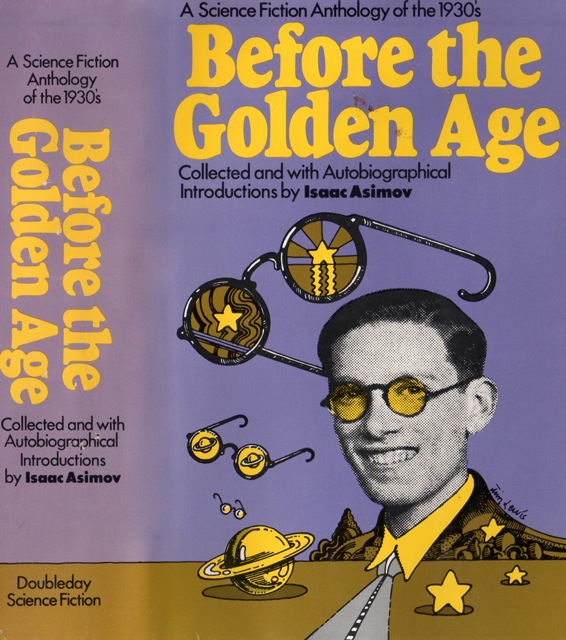
    (Before the Golden Age. Cover by Tim Lewis. Doubleday, 1974.)

    This month’s editorial will be rambling and not straightforward. For one, now is the time to reveal my thought process with regards to how I pick review materials and why I do that; so in a way this will be a bit of a meta post. You’ll get to see how the sausage is made. You see, I’m not a book reviewer who gets paid to receive review copies of upcoming releases and give them my honest (but not too honest) opinions, wrapped in professional plastic and safe for toddlers and small dogs to chew on. There may come a point when I take on a review column for some publication, but that’s not now, nor is it in the immediate future. After all, SFF Remembrance is already time-consuming and it serves a different purpose. This is my blog that I run for the fun of it and I get to review what I want, without some editor breathing down my neck.

    This still raises the question: Why do I do it? Why, so far, have I tackled only a handful of stories from the 2010s and nothing from the 2020s (yet) in favor of dusty, pulpy, uncouth genre fiction from the time before my parents were even in diapers? This is a question that actually involves several questions within it, like one of those Russian nesting dolls, especially for someone of my age who does not have the ability to remember any of these stories from when they had that fresh car smell.

    We have to ask the following:

    1. What counts as “old” science fiction?
    2. What differentiates “old” science fiction from “classic” science fiction?
    3. Why read the damn things in the first place?
    4. If we should read them, why should we write about them?
    5. If we’re to write about them, should it be as a reader or as a pseudo-academic?
    6. When all is said and done, who would want to read these reviews?

    That first question sounds like it has an obvious answer, but it doesn’t; nor does “old” necessarily mean “classic” science fiction, hence the second question. Most old SF is not considered classic by today’s readers. Here’s another way to look at it: Dune is a classic novel, without question. It has been continuously in print since 1965, won awards, and has now received multiple film and TV adaptations. It is a classic by reputation, which really is what makes something a classic; that is to say there’s a collective agreement among a set of people that this work is still worth celebrating. Contrast this with a novel that came out only one year prior, Robert Heinlein’s Farnham’s Freehold, which despite having Heinlein’s name attached to it is often reviled, with even contemporary reviews being unkind towards it; it’s old, but not really a classic. Then again, 1965 is over half a century ago, so surely anything from then would be deemed old by anyone now living—certainly by anyone in my age bracket. There’s a certain point where people can agree that something has gathered enough wrinkles to be considered old—only we don’t always agree on when.

    Much like how beauty is in the eye of the beholder, so one could also argue the age of a work of art is relative to the person perceiving it. I mentioned 1965, but let’s turn the dial to the year of my birth: 1995. For some people 1995 was not that long ago—maybe even too recent to be considered old, let alone grounds for now-classic works. I used to think the same way myself, that SF from 1995 is still fairly contemporary; only problem is it’s not. While many of the authors who were active then are still active and producing good work now (Nancy Kress, James Patrick Kelly, Michael Swanwick, to name a few), and while writing techniques have not evolved greatly in the past 28 years (certainly not as jarring a shift as, say, between 1932 and 1960), the recurring concerns and, more importantly, the perspectives of SF writing have changed greatly. Now we see not so much white American writers spouting about other cultures as people of those other cultures having their seat at the table. This is a good change, mind you. While there is still much exciting and fresh fiction from 28 years ago, there’s some dust gathering on the surface, visible to the naked eye.

    (To put this in context, and with all due respect, it’s hard to imagine Mike Resnick’s Kirinyaga stories, which won him awards in the ’80s and ’90s, would get such a glowing reception if published today.)

    If such fiction now strikes us as a little (or very) dusty, why should we still read it then? I am not referring to the work that still reads as fresh but that which does not read as fresh. These are stories whose style and morals have since been superseded by works that are at least superficially better. Why go back and read Jack Williamson’s The Legion of Time when there have been many time war narratives since then that are more sophisticated and less problematic? Indeed, why do we still read Dune whilst acknowledging that Frank Herbert’s prose now reads as confusing and overcrowded? Surely there are novels that are reminiscent of Dune that are also more delicate with the English language? Why are Heinlein’s books all still in print despite his being a lecherous right-wing militant with a penchant for monologuing? These are not easy questions, nor do they seem to have an “objective” answer that can be gathered via the scientific method.

    I’m also asking these questions specifically with regards to old science fiction, and not old fantasy or horror. Nobody asks why we still read Tolkien (although I do) despite his being a lackluster stylist and a puritan. Nobody doubts the immense power and importance of Edgar Allan Poe’s writing despite its vintage and Poe’s own stylistic flaws. Even that most controversial of old-timey horror writers, Lovecraft, is still held as the sun around which cosmic horror orbits, despite efforts (lousy efforts, mind you) over the decades to discredit him. The viability of these fine and flawed gentlemen and their flawed works need not be thrown out the window casually. To be fair, there is a straightforward reason for this attitude that does not carry over to science fiction: fantasy and horror are genres that have not been subjected to change nearly as viciously as SF. Time, who is always a harsh mistress, has devoured entire worlds with SF for the simple reason that SF, far more than its sister genres, hinges on discoveries of the moment. Our understanding of the natural world has changed over time, and so by extension what was considered cutting-edge in the past is now quaint—or even worse, incompatible with current understanding.

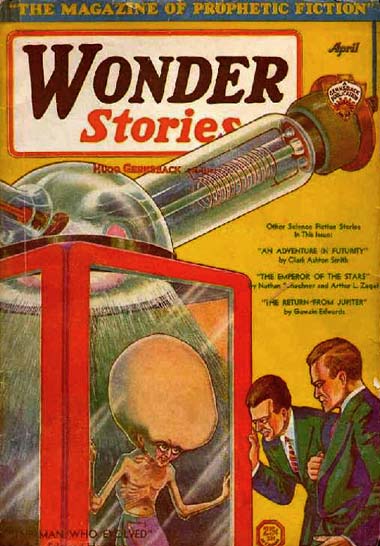
    Consider that Frankenstein, that most foundational of SF novels, is still widely read and beloved—but not as science fiction. It’s still effective as horror, and as a cautionary tale, but as a narrative supposedly rooted in science it now reads as nigh incomprehensible. Even when I read it for the first time as a semi-literate high schooler I knew that Dr. Frankenstein’s method for resurrecting a corpse, and especially his subsequent fear that the monster would breed deformed hellspawn, made no sense. Mary Shelley wrote in a world that would not know Darwinian evolution for a few more decades, and it shows. Here’s another example: In the 1920s and ’30s there were a lot of stories about “cosmic rays” playing a part in evolution, perhaps best encapsulated in Edmond Hamilton’s “The Man Who Evolved.” This is total nonsense that cannot be taken seriously with a modern lens. Why, then, do people still read Frankenstein but “The Man Who Evolved” will forever be deemed a relic of the super-science era? Probably because, aside from being such a monumental work, Frankenstein can be understood as something other than science fiction, whereas Hamilton’s story can only be understood as a story founded on bad science.

    And yet…

    (Cover by Frank R. Paul. Wonder Stories, April 1931.)

    We still see reprints, from time to time, of very old and very dusty SF, and there are several blogs running right now that specialize in engaging with vintage SF. I myself started as part of the online book club Young People Read Old SFF before creating my own blog. Unfortunately said book club has dwindled in number over the past couple years, and outside of it I’ve seen scarcely any interest from people my age in the old stuff. I suspect this is for a few reasons. If you’re a part of fandom and you don’t have the memory capacity of a goldfish then you may recall several incidents in the past decade (most infamously the Sad Puppies fiasco) wherein old folks and reactionaries would rant about how kids these days don’t respect “the classics” and how SF is absolutely 100% for sure on its way out. It’s true that we may be heading into another dark age for SFF magazine publishing, but never before has the field been more inclusive, more niche-filling, and more accepting of ideas that go against heteronormativity, capitalism, etc. And yet there is the grain of truth that young readers (I’m thinking people aged thirty and under) fail to engage with where the field has been.

    It’s true also that SF with a fine layer of dust on it does present a problem for young readers—one which reviewers like myself should but are unlikely to solve. You see, you can’t force somebody to enjoy a work of art. You could contextualize art and give it the proper platform for which to be understood, but enjoying something, much like romance or the urge to produce children, is totally beyond rational understanding. Ultimately I have to say I read this or that because I enjoy it, and then try to apply a veil of reason to my desire. Even when I come out of a story not liking it I usually feel joy from thinking and writing about it—because I like to think and write about science fiction as something that has changed over time, as indeed it does. If I wanted to read something and enjoy it in a vacuum I could do that, which is basically how most readers go about it, and true enough when I sit down and dig into a novella or serial installment I’d been anticipating I do it for the same reason as the rest of us: for the pleasure of it. My reviews and other posts are not as professional-sounding as those of my peers, in part because I wanna make it clear that I come from the place of someone who reads because he finds the act of reading pleasurable and thus unbusinesslike; it could also be that I’m from New Jersey, so pardon me on that.

    A little bit of a story here.

    I have a lot of SF anthologies on my shelves, and almost entirely ones published prior to 2010, which means that inherently these volumes cover pre-2010 material; most of those are from the 20th century, which they cover (necessarily) even older material. There are two books I have that are of particularly relevant note to this month’s editorial, which have a strange amount in common, including their mission statements and the era in which they were published. These are Isaac Asimov’s Before the Golden Age and Damon Knight’s Science Fiction of the Thirties, from 1974 and 1976 respectively. Asimov and Knight are pretty close in age, the former born in 1920 (the official story, that is, although Asimov was probably born in late 1919) and the latter in 1922, and so these two men grew up reading mostly the same fiction. Even so, their temperaments are radically different. Asimov has a nostalgic view of the super-science stuff of the ’30s and his writing technique is a dot that connects perfectly with that era, his prose thoroughly beige (which is not to say dull); then in Knight’s case we have someone who started out as a critic before moving into writing and editing fiction, and thus someone who is more willing to experiment.

    Asimov, for his anthology, picked 25 of what he considered the best SF stories he had read during his formative years—stories which he still enjoyed upon rereading as an adult. Knight, for his part, scouts the same time period (1931 to 1938 or thereabouts) but with a more “objective” stance, picking stories he had found whilst digging through old magazine issues that he thinks are worth rediscovering. Asimov’s book is autobiographical while Knight’s serves more as a brief history of short SF in the ’30s, and while I think the latter has stronger fiction on average (there are some truly awful picks in the Asimov), it seems people gravitate much more towards the Asimov because of that copious and shameless subjectivity. Before the Golden Age is a 900-page monster and about a hundred of those pages are Asimov reflecting on both his life and the stories he chose. We’re given, on top of a handful of still pretty good stories and a lot of clunkers, a look into Asimov’s mindset as reader, writer, and, for a brief time, reviewer. It’s an essential anthology, not so much for the stories but in how it argues for the need to return to old science fiction.

    Something to think about is that when Asimov and Knight put together their anthologies, these being books deliberately collecting very old and outmoded fiction, the oldest story from was a mere 43 years old when Before the Golden Age was published; and yet the science fiction of 1931 and the ’70s were worlds apart. Time is relative, and merciless.

  • Serial Review: Skull-Face by Robert E. Howard (Part 2/3)

    August 13th, 2023
    (Cover by C. C. Senf. Weird Tales, November 1929.)

    The Story So Far

    Stephen Costigan is a traumatized World War I veteran and drug addict who’s taken up residence in London’s Limehouse district, at first a slave to hashish and then a slave to the enigmatic sorcerer Kathulos, a strange man of ambiguous ethnicity who draws Stephen into the underworld, promising him new vitality with an elixir that’ll grant him near-superhuman powers—but whose addictive power is lethal. As he gets further ensnared in the underworld Stephen comes across a beautiful woman named Zuleika who, aside from obviously being the love interest, lets Stephen in on how evil Kathulos’s machinations are. Our Hero™ soon gets wrapped up in an assassination plot that (I kid you not) involved a gorilla costume and Stephen allying with John Gordon of the British secret police.

    Stephen and Gordon team up to take Kathulos and his goons into custody, but naturally things don’t go well and the skull-faced sorcerer escapes via a secret tunnel, taking Zuleika with him. Both sides have taken a few casualties in the fight, but now Our Heroes™ are left with the question of where Kathulos could’ve gone, what he might be planning, and perhaps most importantly, where the hell he came from.

    Enhancing Image

    Part 2 is hard to summarize as it’s not only the shortest installment, but very little actually happens in it; indeed, the plot moves hardly an inch forward between the start and end of this installment. Stephen and Gordon, now like buddies in a detective narrative, retrace their steps in an effort to find out Kathulos’s origins, in doing so hoping they can figure out what his endgame is. By the way, if you’re reading Skull-Face I recommend reading the text on Project Gutenberg as it’s not only easier to read but does away with the recap sections. In the case of Part 2 the recap givess away the big revelation in the installment to follow, which frustrated me because a) it made me worry I had missed a big plot point in Part 1 (I did not), and b) it sort of just hits you over the head with something major before you’ve had a chance to read it for yourself and digest it properly.

    Gordon, who apparently knew more than he let on, givess us a truly massive infodump about a series of revolts in Africa as of late had had a common element about them, with Kathulos being involved and encouraging unrest among African and Asian peoples. There’s been a prophecy spreading that a man “from the sea” will unite the marginalized ethnicities of the world and overthrow the “white races.” There are apparently multiple white races; be sure to put a pin in that one. So… to make a long story short, Kathulos is not of Egypt like he claims, nor is he from any known country on the planet, but from Atlantis. Kathulos is an Atlantean who mummified himself and lay at the bottom of the ocean, only to be discovered and subsequently either resurrected or brought out of cold sleep. Kathulos doesn’t seem to have a personal desire to topple white supremacy but, it’s implied, is taking advantage of racial strife by crowning himself as emperor of a new society where non-white people are on top.

    I have a few questions.

    I had heard about the race war plot of this novella in advance, and yet even reading it now I feel like I wasn’t prepared for it. Howard has a rather messy relationship with racism, being a Texan in the early 20th century, but he was also a proud Irishman surrounded by WASPs, at a time when people still made distinctions between “types” of whiteness. Nowadays Jews are often considered white (I say often, but admittedly not always), but this was obviously much more of a point of contention a hundred years ago. At what point were Jews considered white? Evidently not at the time of Howard’s writing Skull-Face. Rather than the huge gelatinous blob with arbitrary boundaries that we now understand whiteness to be, it was like a school with different cliques in Howard’s time, thus in Skull-Face we have “the white races” pitted against several non-white races. This all sounds a bit cracked, but I’m trying to make sense of an understanding of racism that’s totally alien to modern conceptions, except maybe the most backwards parts of the US (i.e., the parts that think the Confederacy meant well).

    You may be thinking, “Brian, you handsome devil, how come there’s no content warning for racism that came with this review?” The answer is simply that if you’re reading a Weird Tales pulp adventure from the ’20s, you ought to go in expecting at least some racism. I know this is gonna sound like a bit of a “these darn kids” rant, but I’m peeved whenever people fail to engage with old genre fiction because of the simple fact that values change over time and even left-liberal writers from more than half a century ago generally did not believe in intersectionality. Was Howard a racist? I’m gonna say no. In fact it seems Howard was vocally againsst notions of racial supramcy, at least in his later years. Did he have preconceived notions about race, and did he use white people’s ignorance of other cultures to give his fiction an “Orientalist” appeal? Absolutely to both those parts. I would be lying if I said a good portion of this installment of Skull-Face wasn’t baffling or painful to read, not to mention the plot grinds to a hault. By the end of Part 2 nothing except lore-dumping has been accomplished.

    A Step Farther Out

    This is a major step down from the first installment. Howard has a knack for writing action and there basically isn’t any here; worse than that, it’s almost entirely dialogue-driven, which I have to admit has never been Howard’s strong suit. It’s short, but even so I started to wonder when John Gordon’s borderline monologuing would come to an end so we can get back to the actual plot. Kathulos and his goons are pushed totally off-stage, and by extension we get zero development with Zuleika, instead being stuck with Stephen, who’s a hot mess of a person, and Gordon, who for this particular part of the novella acts as Mr. Exposition. Hopefully the final installment can bring back the momentum I so dearly missed in Part 2… and, ya know, maybe not make the race war plot as painful to read.

    See you next time.

  • Short Story Review: “The Dreaming City” by Michael Moorcock

    August 10th, 2023
    (Cover by Brian Lewis. Science Fantasy, June 1961.)

    Who Goes There?

    Truth be told I feel almost the same way introducing Michael Moorcock as I did when I introduced H. P. Lovecraft, in that while my feelings on these men as writers is mixed, I have to admit their importance to genre writing (each in his own way) is immense. I get the irony is that Moorcock really dislikes Lovecraft (as both a writer and person) to the point of basically denying his influence on other writers, but… goddamnit, I couldn’t hold back on this for even a few more sentences. I would’ve read more Moorcock by now, especially since I’ve been getting more into heroic fantasy, but the first memory I have of reading Moorcock was not any of his fiction, but his essay “Starship Stormtroopers,” which is a no-good-very-bad piece of work that, among other things, argues Starship Troopers was hand-crafted to appeal to reactionary young men in the pages of Astounding (it was actually serialized in the left-leaning Magazine of Fantasy and Science Fiction but never mind) and that Heinlein and his ilk promoted fascist tendencies in their writing. And he also took pot shots at Lovecraft with points that simply have not aged well. (He does the annoying thing people still do to this day where he seems to think Lovecraft’s views never changed on anything.) So I was not keen on reading more Moorcock.

    Still, it must be said that the field would look a fair bit different without Moorcock’s efforts, especially as an editor. Moorcock was a world-weary 25-year-old when he took over New Worlds, which in the ’60s threatened to become a bit stale but which gained new vitality under Moorcock, publishing works that would not have seen magazine publication in the US for being too sexually charged and/or too vulgar. Writers like J. G. Ballard and Thomas M. Disch really let their nuts hang in New Worlds, whereas elsewhere they had to contend with censorship. The result is that we owe the New Wave (both its successes and follies) at least partly to Moorcock, who after all wanted so desperately for science fiction to “come of age.” But before he became a revolutionary editor Moorcock was already a skilled writer, recognized for his Elric saga, being one of the more important heroic fantasy series in the genre’s history. Despite this, “The Dreaming City” marks my first encounter with Elric, although considering it’s the first Elric story (both published and I believe in internal chronology) I think it fits.

    Placing Coordinates

    First published in the June 1961 issue of Science Fantasy, which is on the Archive. “The Dreaming City” has been included in several Moorcock collections over the decades, but it did not get anthologized in English until very recently, in The Big Book of Modern Fantasy (ed. Ann and Jeff VanderMeer). Actually I’m sure it was that chunky anthology that made me aware of the Elric saga and this story in particular.

    Enhancing Image

    We’re introduced to a distant and yet alternate past, not unlike the worlds of Robert E. Howard and Clark Ashton Smith, wherein there was an ancient civilization, Melniboné, that lasted thousands of years and yet, at the start of “The Dreaming City,” is on its last leg. Warlords are conspiring around a campfire; there will be a raid on Imyrrir, the titular dreaming city, the last stronghold of Melniboné. Normally these shady characters would be the antagonissts, only they’re helped by Our Hero™, Elric, last of the rulers of Melniboné—and a king in exile. By his own choice, mind you. The opening pages give us something not dissimilar from Howard’s Hyborian Age, but soon we find there are a few major changes, mostly having to do with Elric himself, who is a darker shade of grey than Conan.

    Whereas Conan is a beefcake, a tower of Irish muscle, Elric is “a pure albino” whose eyesight is bad and which will only get worse with age, whose physique is not exactly impressive, and who generally would be a weakling if not for his weapon of choice, Stormbringer, a cursed sword passsed down his line that will both make him and probably be the death of him. Can’t say I’m a fan of Elric. Then again, I don’t think we’re supposed to “like” him; he does not have the courage of Conan, nor the comradery of Fafhrd and the Gray Mouser. If Elric lived in the 21st century he would have most likely been a Jordan Peterson fan as a teenager. It’s hard to appreciate now (and I know because I also find it hard to appreciate from this vantage point), but in 1961 Moorcock gave us a sword-and-sorcery “hero” who was subversive in that he was not a model for power fantasies, but a quishy piece of shit who survives because he has the right tools for it. Okay, there still be a bit of power fantasy involved, which I’ll get to in a minute.

    Before I get into the plot, which is deceptively simple (although it’s framed rather confusingly at first), let’s talk a bit more about Elric’s character in the context of fantasy heroes. I’ve already told you Elric is a sword wielder, with Stormbringer getting him out of sticky situations, but the kings of Melniboné also have a long tradition of sorcery. In RPG language we might call Elric a red mage or a combat mage, since on top of swordplay he’s also a skilled magic user—although his capacity to work spells is capped “since he did not have the reservoir of strength, either of soul or of body, to work them.” Moorcock, in so many words, calling the “hero” of his sword-and-sorcery epic a bitch baby is not something other authors were likely to do beforehand. Even C. L. Moore’s Jirel of Joiry, who psychologically might be as battered as Elric, is still a naturally strong warrior who earns her keep. It also turns out that Elric does not seem to feel loyal to anyone in particular, since it takes all of about twelve hours for him to bamboozle the warlords he’s conspired with and to follow his own path into the city—his city—where the real villain dwells. “He planned to leave the fighting to those he had led to Imrryr, for he had other things to do—and quickly.”

    I’m about to escalate things here and say that the real dramatic hinge of the story is an incestuous love triangle between Elric, his tyrannical cousin Yrkoon, and Yrkoon’s sister Cymoril. Yrkoon is the current ruler of Imyrrir by virtue of Elric leaving his post, but also by force; there’s the strong implication that if not for most of the city’s people being perpetually stoned and sleepy (the city having degenerated into little more than a massive opium den at this point), Yrkoon would’ve been overthrown. Everybody knows Elric is the “rightful” ruler, but Elric sort of disagrees. Whereas in much fantasy the hero’s hometown is looked upon with a nostalgic fondness, Imyrrir is in such a state of disarray and given to such debauchery that like one of the cities of the plain it seems destined to get torched by the hand of God. Getting sacked by a fleet of despots might not actually be the worst thing that can happen to it. Unfortunately because this is a short story and because Moorcock’s descriptions are rather sparse, we get to know extremely little about the city and its people. Then again…

    I normally don’t bring up the quality of the prose itself when reviewing stuff here because I’m one of those people who thinks that not everything need evoke Joseph Conrad in its delicate use of the English language. Different writers have different strengths when it comes to crafting narratives; you might have someone who is great at character psychology but who is average at best with constructing plots. Moorcock would’ve been all of twenty years old when he wrote “The Dreaming City,” and while it was not his first story published (he had been around for a few years at that point), “creaky” is a word that keeps coming to mind for me when I think of the prose here. There are turns of phrase here that I personally would not use. I didn’t think the word “frenziedly” would pop up, let alone more than once. There also seem to be a few times where Moorcock uses a word that sounds exactly like another word he intended to use but which is a different word with a different meaning. Not sure how Elric can “steal” himself. Pardon me, I know I’m picking on a story from towards the start of an author’s career and which itself is now older than most people.

    Anyway, Elric takes his own boat and sneaks into the port city via a secret passage only he knowss, being intimate with the city’s layout. This move is less to save the city and more to rescue Cymoril from the gross incestuous claws of his cousin (as opposed to Elric’s benign incest). Little aside here, but when Elric finds Cymoril she’s in a druggy slumber, like most of Imyrrir’s populace, and kisses her on the lips while she’s unconscious. Interesting. It’s also never made clear if Cymoril actually reciprocates Elric’s feelings or if she just finds him preferrable to Yrkoon, who after all totally lacks redeeming qualities. We’re also introduced to Elric’s mentor, Tangleboness (what a quirky name), whose death is so telegraphed that if he said he had two more days until retirement it would not have been surprising. Oh, and a raid is about to start, but that’s easy to forget. It’s clever that Elric would help stage a raid so as to distract Yrkoon and his troops, but it’s also a subplot that mostly happens offscreen and whose conclusion is immaterial.

    There Be Spoilers Here

    Elric, in trying to save Cymoril and then to avenge his mentor’s death (as was all but foretold), kills an impresssive number of mooks—at least partly without even trying. If you’re looking for bloodlust in your fantasy then the central action sequence here will satiate your appetite somewhat. Of course this is only buildup for the duel with Yrkoon, wherein the traiterous cousin pulls out a magical sword of his own and the two combatants are rendered nigh immortal from their sorcery. Elric defeats his cousin, naturally, but tragedy unfolds as a result, for Cymoril has all of two or three lines before getting caught in the crossfire and dying on Elric’s sword. In his dying moments Yrkoon throws Cymoril onto Stormbringer and she dies basically instantly and without saying anything in reaction; it’s such an abrupt death scene that I had to do a double take.

    So Yrkoon is dead, Cymoril has done a good job of getting fridged (I do find it funny that Moorcock, an outspoken supporter of Women’s Lib, would kill off the sole female character in the first Elric story so unceremoniously and without granting her actual character), and Imyrrir is basically in ruins. A good day’s work, I think! Not that Elric feels good about it. At the time Elric killing his own love interest by accident might’ve hit differently, but now it reads as almost inevitable—like a job requirement. Truth be told the last quarter of the story could’ve been shortened extensively, since we’ve already hit the climax, both of the action that matters to Elric and the trauma that will probably define future series entries; it’s rather overlong. We do, however, get a meaty passage at the end that could be thought of as the flashpoint of Elric’s superhero (or -villain) origin story, as he contemplates his lopsided relationship with Stormbringer.

    Elric brooded, and he held the black runesword in his two hands. Stormbringer was more than an ordinary battle-blade, this he had known for years, but now he realised that it was possessed of more sentience than he had imagined. The frightful thing had used its wielder and had made Elric destroy Cymoril. Yet he was horribly dependant upon it; he realised this with soul-rending certainty. He was an albino—a type rare among animals and rarer still among men. He was an albino, owning no natural reserves of vitality. Normally, he would be slothful, his reactions sluggish, his mind hazed. His eyesight would grow steadily worse as he grew older and he would probably die prematurely. His life would be dependent upon the grace of others; he knew this—he would become this if he lost the runesword’s alien aid. But he feared and resented the sword’s power—hated it bitterly for the chaos it had wrought in his brain and spirit. In an agony of uncertainty he held the blade in his hands and forced himself to weigh the factors involved. Without the sinister sword, he would lose pride—perhaps even life—but he might know the soothing tranquility of pure rest; with it he would have power and strength—but the sword would guide him on to evil paths and into a doom-racked future. He would savour power—but never peace. Never calm, sad peacefulness.

    To give Moorcock credit this is certainly a foreboding ending, especially for the time, as Elric has accomplished his goal but ultimately has gained nothing from it. Things probably would have turned out better for certain parties had he not intervened, and Moorcock wants to make it very clear (maybe a little too clear, given how much he harps on Elric’s disability) that Elric is both a weakling and probably a bad person. Still, he’s a more powerful magic user than 99% of humanity and his sword is so good that it literally does the heavy lifting, making sure that for all his personal failures Elric is likely to always win encounters so long as he has Stormbringer. I wouldn’t call him a tragic figure, because true tragedy requires that people fail nobly and despite his royal bloodline I would not call Elric “noble,” but his success and failure being so closely intertwined serves as a fine blueprint for a real anti-hero, as opposed to a tough-but-means-well figure like Conan. That’s right, we have our prototypical incel fantasy hero with Elric.

    A Step Farther

    I feel like I’m being a little unfair with this, but then am I really? Moorcock would’ve been all of twenty when he wrote “The Dreaming City” and it shows, but at the same time it serves as the beginning of what would become an immense sprawling series that Moorcock would work on, albeit sporadically, up to the present day. A lot can change in 62 years, including (especially) an author’s skill and how they feel towards the series that has defined their career more than anything else. No doubt I’ll be covering more Elric stories in the future, but since the only way is forward I’m comforted knowing I’ll be coming across a more mature Moorcock. On its own I can’t really recommend it. I know it’s not fair to compare a very young Moorcock with mid-career Fritz Leiber, but there’s a creakiness to the wording in “The Dreaming City” that gives the strong impression of someone who was only just starting to hone their writing chops.

    See you next time.

  • Serial Review: Skull-Face by Robert E. Howard (Part 1/3)

    August 6th, 2023
    (Cover by Hugh Rankin. Weird Tales, October 1929.)

    Who Goes There?

    Robert E. Howard is a favorite on this site for a few reasons: he wrote a lot, pretty much all his work was published in the magazines, and he writes action that doesn’t bore me—a real achievement if you know my reading habits. Howard’s career was tragically short-lived but he got started very young and never stopped, debuting in 1924 at the age of 18 and only stopping with his suicide in 1936, aged thirty. Most authors barely get their feet off the ground by the time they’re thirty, but Howard was such a prolific and restless writer that he had accumulated what would be several hefty volumes of fiction when he died, and that’s not even counting posthumous releases. Nowadays Howard is most known for creating Conan the Barbarian (or the Cimmerian, yes I know that’s technically the correct title), which by itself would prove profoundly influential on American fantasy. True, he was not the first American fantasist, but Howard set the standard for a mode of fantasy writing that could not be confused with British fantasy a la J. R. R. Tolkien or Lord Dunsany.

    Howard was only 23 when Skull-Face was serialized, but he had already been in the game for five years and his growing adeptness at storytelling shows. At about 33,000 words Skull-Face was also his longest work of fiction up to that point, and the first installment is also the longest. While Howard ran a ton of series and contributed to other people’s series, most notably the Cthulhu Mythos, Skull-Face is a complete standalone work. How does it measure up to his more mature stories? Hmmm.

    Placing Coordinates

    Serialized in Weird Tales, October to December 1929. You can read Part 1 on the Archive here, and subsequent installments are also available there. Skull-Face was later reprinted whole in the December 1952 issue of Famous Fantastic Mysteries, found here. This was added to Project Gutenberg pretty recently (and by that I mean two weeks ago, I’m not kidding), because as far as I can tell Howard’s work is basically all in the public domain, and you can read it here in the format of your choosing.

    Enhancing Image

    Stephen Costigan is what you might call a fuck-up, being a shell-shocked World War I veteran from America who now spends his days smoking hashish basically nonstop in a London opium den, called the Temple of Dreams. We start with Stephen recounting one of his hashish dreams, in which he sees what at first seems a skull floating midair but which is in fact attached to a person, yellow skin tightly wrapping it and the skull “endowed with some horrid form of life.” This is totally not the villain of the story and Stephen is totally not gonna meet him later.

    For now we’re stuck with Stephen’s daily routine, which is to wallow in London’s Limehouse district, in the aforementioned opium den run by some shady Chinese individual (not the words Howard uses) named Yun Shatu. It’s pretty clear, although the term “post traumatic stress disorder” would not be invented for several more decades, that Stephen has become both an expat and a drug addict in no small part due to PTSD. Howard would’ve been a grade-schooler when World War I happened, but Stephen is at least thirty years old here, having survived No Man’s Land surrounded by mud and corpses. “My body recovered, how I know not; my mind never did.” Stephen’s wartime experiences go to explain his character in at least two ways: by giving context to his vulnerable state at the story’s beginning, and by justifying some rather heroic acts he commits later. Howard had a lot to write in so short a time so that every detail here contributes something to the narrative, for we do not have time to waste.

    After a brief dream sequence we’re off to the races—at such a breakneck speed that when I reading I actually did not figure at first that we had transitioned from the dream world to the real one; it doesn’t help that the opium den is called the Temple of Dreams, which admittedly does add to the nightmarish atmosphere about to envelope Stephen. Since Howard’s not gonna stop the plot train, I figure I may as well take a break here and talk about a few things that caught my eye—for better or worse. Apparently in 1929 you couldn’t write about sex past some descriptions of scantily clad women in your pulp fiction, but drug addiction is fine. I find it a bit hard to believe Stephen is this much of a wreck because he smokes too much weed; a shame, in 2023 he could’ve started a YouTube channel as a charismatic stoner. We also know weed is not that harmful, although it’s possible (I’m not sure what first-hand experience he had) that Howard is pointing a finger at what would’ve been an enormous stigma against drug use at the time—for Stephen is about to come across a far worse drug than hashish.

    Also, I shouldn’t have to explain this, but I do because I wanna recommend Howard’s fiction to people but not have them be blindsided by remarks that are very much part of the vocabulary of Howard’s time. To quote Walter from The Big Lebowski, “‘Chinaman’ is not the preferred nomenclature.” I do suspect Howard picked London because it’s a locale outside of what his American readership would be familiar with, and there’s undoubtedly a good deal of playing to exoticism with all the non-white characters who are described in racialized terms. For what it’s worth, no, Howard does not use the N-word (at least here), although he makes fair use of “negro,” which was a perfectly innocuous word in 1929 and would actually remain so for several more decades. I’m not sure when “negro” would stop being used by well-meaning white folks but it could not have been earlier than the ’70s. Anyway, there’s also a character whose ethnicity combined with her attire are a little dubious, but we’ll get to her in a minute.

    Stephen gets taken by some brute named Hassim to an out-of-the-way part of the opium den, and this is where we’re introduced to the villain of the story (I’m just gonna say it here because why bother), Kathulos, the skull-face (get it) Stephen saw in his dream earlier. Kathulos turns out to be a man—sort of. He’s not a walking corpse, although he has unusual proportions, never mind that despite claiming to be of Egypt his skin complexion doesn’t align with any known ethnicity. It’s clear (at least to us) that Kathulos is a sorcerer of a sort, maybe even a zombie; regardless there’s something about him that pushes him into the realm of the supernatural.

    A skull to which no vestige of flesh seemed to remain but on which taut brownish-yellow skin grew fast, etching out every detail of that terrible death’s-head. The forehead was high and in a way magnificent, but the head was curiously narrow through the temples, and from under penthouse brows great eyes glimmered like pools of yellow fire. The nose was high-bridged and very thin; the mouth was a mere colorless gash between thin, cruel lips. A long, bony neck supported this frightful vision and completed the effect of a reptilian demon from some mediæval hell.

    Kathulos, seeing potential in Stephen, has a job offer for him, although it’s not out of the “kindness” of his heart. Unfortunately for Stephen the means by which Kathulos keeps him leashed to this new job is an elixir—a drug of such power (indeed life-restoring properties) but so addictive that withdrawal would mean death. Stephen’s hashish addiction is nothing compared to the hell Kathulos is about to put him through; on the upside, the elixir gives him near-superhuman abilities that’ll prove useful. Kathulos’s goons are also not all eye sores, as there’s a woman under his spell: Zuleika. Circassian “by blood and birth” and spending her youth in Turkey before being bought by Kathulos, Zuleika is a bit of a… problem. She’s a bit of a damsel, which for pulp fiction is not unusual, but this is more conspicuous by Howard’s standards, coming from the man who would write some strong-willed women later in his career. It’s also clear from her background and how she dresses (in a mix of “Oriental” and Western fashions) that Zuleika is acting as the exotic woman whom the white man will woo.

    Lastly we’re introduced to John Gordon of the London secret police, whose role in things is vague at first but who will prove useful in Part 1’s climax. By the time we get to the back end of Part 1 we have a few parties involved, each other their own goalss in mind and, more importantly, these goals are not made clear to the reader. It’s clear Kathulos wants to use Stephen as his slave, to accomplish a mission whose bigger goal remains utterly a mystery to Our Hero™. What could the skull-face be planning? (By the way, Kathulos sounds a bit like Cthulhu, which, being correspondents with Lovecraft, Howard would’ve been well aware of at the time, though I’m sure it’s just a coincidence.) The elixir Stephen has become horribly addicted to will be both the ssaving and death of him as he takes part in a mission of impersonation, and later murder, that goes amiss.

    There Be Spoilers Here

    What happens from hereon is a bit much, but it involves, among other things, an assassination plot and Stephen dressing up in a gorilla costume. I’m not kidding about that last part. Stephen explains the situation to Gordon and the two agree to team up with, with Stephen lying about his mission and confronting Kathulos while Gordon and his men surround the opium den so as to block off escape routes. Since these are London cops I assume Gordon and his men plan to apprehend Kathulos using nothing more severe than harsh language. It doesn’t matter, because naturally Kathulos expected Stephen would betray him, and not only that but there’s a secret tunnel the cops could not have anticipated; that said tunnel turns out to be filled with “scores of hideous reptiles” only adds insult to injury.

    So bad news, Kathulos has gotten away and he took Zuleika with him; the good news is that Stephen drank enough of that elixir that it should last him a few days before he starts going into withdrawal. The hunt is on, between a shattered veteran and an aloof plain-clothes cop for a sorcerer who is probably even more powerful than what we’ve seen up to this point. Howard wrote his stories with magazine publication in mind and as such he knew how serials worked, with the end of each installment leaving bread crumbs for intrigue but making the reader excited for more. Howard’s writing itself has a drug-like effect wherein it transports the reader to a mindset that is not lucid, but rather based primarily on imagery and action, with anything not action being omitted; as such you have potentially a 50,000-word narrative compressed to 2/3 that length.

    A Step Farther Out

    Every time I read a Howard story I feel tempted to become one who those nerds who digs up his letters to try to see how his brain worked. Not that Howard was an unparalleled genius whose inner workings would be a treasure trove, a Shakespeare for us to bow to, but more that his interests strike me as so human that reading much of his fiction almost reads like having a conversation for me. There’s a lot to unpack with Skull-Face and we’re only just getting started, so I’ll say for now that I feel the way I ought to feel when it comes to the opening salvo of a serial: that is to say intrigued. I would’ve read it all in one sitting if not for work, which I think again speaks to Howard’s skill with keeping the reader’s attention.

    See you next time.

  • Novella Review: “Immigrant” by Clifford D. Simak

    August 3rd, 2023
    (Cover by Frank Kelly Freas. Astounding, March 1954.)

    Who Goes There?

    Clifford Simak is one of my favorite discoveries of the past few years, in that he’s exactly the kind of author I like to show off to people who think so-called Golden Age SF is just this or that. Simak debuted in 1931, which would make him a bit of an oldster by the time John W. Campbell took over Astounding in late 1937; but whereas some authors merely adapted to the new standard and were lucky to do that, Simak actually got better as time went on. He wrote most of the stories that would comprise City in the ’40s, with 1944 alone seeing four of them in print. These were some of the best and most emotionally fulfilling short stories of the era, even surpassing most literary fiction of the time in my opinion. The ’50s then saw a period of immense productivity for Simak, mostly in the pages of Galaxy, where he played well with authors two decades his junior.

    “Immigrant” was one of the few major Simak stories in the ’50s to be published in Astounding, and without giving the game away at the start, I can see why it was published there and not in Galaxy. This is a bit of an unusual Simak story in that it takes place entirely away from Earth, as instead we find ourselves on an alien planet with a race of powerful and condescending aliens. It’s also rather foreboding—for the most part.

    Placing Coordinates

    First published in the March 1954 issue of Astounding Science Fiction, which is on the Archive. It was most recently reprinted in The Shipshape Miracle and Other Stories, which seems to only have an ebook edition. Sigh. You gotta go back to the ’90s for a paperback reprint. The most relevant for me has to be Galactic Empires Volume One (ed. Brian Aldiss), which is not an anthology you’d expect to see a Simak story in.

    Enhancing Image

    Going into this I thought it would be a coming-of-age narrative featuring a juvenile protagonist; well, it is a coming-of-age narrative in a sense, but there are a few twists. Our Hero™ is Selden Bishop, a 29-year-old genius who, through rigorous testing and passing a certain exam, gained the privilege of traveling to Kimon, apparently the most prosperous and alluring planet in the known galaxy. In this distant future, humanity knows it’s far from the only sentient race in the galaxy, and yet Kimon stands out among its neighbors as being where you wanna go if you wanna make it big; only thing is that a tiny fraction of humans (such that they can only be an extreme minority on Kimon) are allowed to enter.

    Kimon was a galactic El Dorado, a never-never land, the country at the rainbow’s foot. There were few who did not dream of going there, and there were many who aspired, but those who were chosen were a very small percentage of those who tried to make the grade and failed.

    The other thing is that those who are lucky enough to land on Kimon have been awfully cryptic in their letters to Earth for decades. It’s a shame Simak did not anticipate social media, as it would then be much harder to keep the exact relationship between humans and Kimonians a secret. Anyway, Bishop is here because he earned it, but also to do a sort of job for Morley, his Earth contact, which is to figure out what is actually happening on Kimon and what the humans are supposed to be doing there. No, despite the Kimonians being humanoid and very handsome (akin to tall bronze statues), there’s no implication of cross-breeding between humans and Kimonians; this is still a John W. Campbell magazine, after all. What Bishop discovered will be much more aligned with Campbell’s interests, but that’s for later. Much of the first half of “Immigrant” involves Bishop figuring out the basics and how to get a job, since he still needs one of those.

    Like other immigrants from Earth, Bishop is sent to stay at a hotel that’s almost quite literally in the middle of nowhere, with “nothing, absolutely nothing, but rolling countryside” outside the hotel. There are no roads on Kimone, nor do there seem to be cities. While Simak does pander to Campbell somewhat in this story, the pastoralism of Kimon is surely Simak’s treat to himself. Actually the decadent ruralism of the Kimonians reminds me of what became of future humanity in Campbell’s own “Forgetfulness,” wherein mankind, in developing psi powers, forgets how to use technology as said technology becomes no longer needed. The Kimonians themselves are natural psi users, being able to communicate with each other across distances without tech via telepathy and teleportation; naturally, and more creepily, they can also read human minds.

    As for the Kimonians themselves, they’re kinda… well, they’re like Vulcans: they’re a bunch of assholes. Not in an actively malicious way, but more in that they clearly think of humans as “cute.” Bishop can’t have a real conversation with them. The good news is that while the number of humans on Kimon is incredibly small, the humans have been clustered together such that it doesn’t take long for Bishop to make at least one new friend, namely Maxine, who to her credit does not exist to be Bishop’s love interest. Maxine has been here for a while now and not only understands the Kimonians to a better degree, but is capable of doing a couple things that normal humans ought not to be able to do. Unfortunately Maxine is also a pessimist who assumes the Kimonians just wanna play an epic prank of their human visitors—not that the Kimonians try hard to disprove this.

    To make it in this new world, as surely the Irish and Italians had to in 19th century America, Bishop will have to know a whole new rulebook. “You have to adapt,” he thinks at one point. “You’d have to adapt and play the Kimon game, for they were the ones who would set the rules.” Whatever that game is. Eventually he sucks up his pride and goes to ask for a job, which true enough will have a very healthy paycheck by human standards, though it’s far from glamorous. Occupation? Babysitter.

    What I like about “Immigrant” is that it’s too packed to work as a short story but too slight to be stretched to a 50,000-word novel; it’s a fine example of what can be done with the novella mode—specifically the short novella where we’re looking at 17,500 to 25,000 words. I suspect Simak wrote this for Astounding because of the paycheck, but also because Astounding usually ran a novella in each issue, with the only rival to both have such a policy and offer such a healthy paycheck being Galaxy. Still, this is not what I would call “major” Simak. It took me four days to read “Immigrant,” partly due to work but also I was not exactly glued to my screen. It’s hard to call boring, but it also meanders enough that I was not sure, while reading, about the point Simak was trying to make until the end. For those of you who are wary of Simak because of his sentimentality, though, you may be pleasantly surprised at how not sentimental “Immigrant” is.

    There Be Spoilers Here

    The “babysitting” job turns out to be a lot more taxing than Bishop assumed. For one, the Kimonian children he looks after seem totally capable of taking care of themselves, but worse is that they don’t seem to even acknowledge him as an adult figure; indeed, to the Kimonian children, Bishop is, at best, like a fellow child. When being introduced to the children they give him human names—for the sake of his convenience. “They are approximations,” says one. “They are as close […] as he can pronounce them,” says another. These are Kimonian names which Bishop is not equipped to understand; like with most everything else on the planet it’s a door he’s not allowed to open—at least not yet. Sure, the pay is extravagant, but Bishop finds “babysitting” these kids to be profoundly demeaning.

    At first Bishop gets the idea that humans are allowed on Kimon to serve as pets, or at best as playmates for their children, since clearly a Kimonian child is treated as a more advanced being than an adult human with a college education. Most authors writing for most other outlets probably would’ve gone with the “humans are pets” option, predictable as that may sound now, but Simak is not like most authors; he believes, usually, that it’s possible for humans and other sentient races to treat each other with respect. I’m convinced at some point that Simak may have envisioned a downer ending wherein Bishop realizes that he and his fellow humans are mere playthings for the Kimonians—except for the fact that the Kimonians are natural psi users. Now, why would a story published in Astounding depict a “superior” alien race with psi powers while humans come off as a bunch of weaklings? Surely there’s a catch to this—and there is!

    While overall I enjoy the previous Simak story I’ve covered, “The Big Front Yard,” (review here) more, I do think the solution to “Immigrant” is more justified, even if it still plays to Campbell’s interest. Simak may well have thought of the ending well in advance of writing the rest of the story; it doesn’t read like a last-minute addition. While I did not know how this story would end, I really should’ve made an educated guess from before the story even officially starts, as there’s a major clue. The opening blurb (probably written by Campbell) is clever in that while with hindsight it’s easy to see as spoiling the whole trajectory of the plot, there’s not enough context given to make a certain guess at the start.

    After many years of work, the child graduates from grammar school—and is a freshman, in high school. After more years of work—he gets to be a freshman again. And if he is very, very wise, he might even get to be a
    kindergarten student again…

    Bishop thinks back on a few things, such as Maxine’s ability to teleport (a rudimentary ability by her estimate) and other strange things that have happened, and realizes something: these psi powers can be learned. Over time, and with the right mindset, humans can evolve to read minds, move objects, and yes, teleport to other places, just as the Kimonians do. “But before you could even start to absorb the culture, before you could start to learn, before you ever went to school, you’d have to admit that you didn’t know.” In order to learn these abilities (in which it would take years to do so), Bishop has to, in a way, become a child again. This 29-year-old man with a high IQ has to start his life over, with a new mindset, with the expectation that he’ll have to think as the Kimonians think if he wants to get to their level. But it can be done. The very last line of the story confirms Bishop’s theory: that the humans bright enough to go to Kimon are going back to school—this time to learn psi powers.

    A Step Farther Out

    I’m not quite sure how to feel about “Immigrant.” This is a story that ultimately plays to Campbell’s obsessions, namely his thing for psi powers and humanity evolving to a higher state of consciousness. I don’t think Simak’s view of humanity is so optimistic as depicted here and in “The Big Front Yard,” although he certainly wasn’t a misanthrope. On the other hand, much as I wanna think Simak may have had a different ending in mind in the event he could’ve sold it to Galaxy, I do think the ending was as intended from the start. It’s a bit of an eerie story, not horror but a little uneasy with how Kimon is depicted, until its swings upward at the end, like someone waving a flag in triumph. I may question the sincerity of it, but as is typical with Simak I respect the swerving-away from what might’ve been a horrific conclusion and instead choosing an ending that bodes well for everyone involved. Simak probably doesn’t believe humans can evolve into telepathic superbeings in a matter of months, but he may well believe that with some hard work and humility, mankind can redeem itself.

    See you next time.

←Previous Page
1 … 28 29 30 31 32 … 43
Next Page→

Blog at WordPress.com.


Loading Comments...
 

    • Subscribe Subscribed
      • Science Fiction & Fantasy Remembrance
      • Join 139 other subscribers
      • Already have a WordPress.com account? Log in now.
      • Science Fiction & Fantasy Remembrance
      • Subscribe Subscribed
      • Sign up
      • Log in
      • Report this content
      • View site in Reader
      • Manage subscriptions
      • Collapse this bar