Skip to content

Science Fiction & Fantasy Remembrance

Celebrating the genre magazines, one story at a time…

  • About
  • Serial Reviews
  • Novella Reviews
  • Short Story Reviews
  • Complete Novel Reviews
  • Things Beyond
  • The Observatory
  • The Author Index
  • Short Story Review: “An Important Failure” by Rebecca Campbell

    December 13th, 2025
    (Cover by Joseph Diaz. Clarkesworld, August 2020.)

    Who Goes There?

    Rebecca Campbell was born and raised in Canada, although last I checked she’s been living in the UK for a minute. Unusually she made her debut with a novel, The Paradise Engine, in 2013, which has not been reprinted as of yet. So far it’s her only full novel, with the rest of her work being short stories and novellas, and she’s been pretty successful in that area. Today’s story was itself expanded into a novella, Arboreality, a couple years later. Campbell is part of a generation of writers who breathed new life into SFF short fiction in the 2010s, when there was an online magazine boom and a healthy market for bringing these stories into physical print. In hindsight this was a bit of a golden age for the field. Even 2020, just five years ago, now strikes me as a healthier publishing environment than what we’re now facing. Well, “An Important Failure” caught my attention because it won the Sturgeon, although curiously it did not get a Hugo or Nebula nomination. My feelings on this story are a bit mixed, which I’ll try to articulate, but I did have to sit on this one for a couple days.

    Placing Coordinates

    First published in the August 2020 issue of Clarkesworld. It’s been reprinted in The Year’s Best Science Fiction: Volume 2 (ed. Jonathan Strahan), The Best Science Fiction of the Year: Volume 6 (ed. Neil Clarke), and The Year’s Best Science Fiction & Fantasy, 2021 Edition (ed. Rich Horton).

    Enhancing Image

    “An Important Failure” starts oddly. The opening scene is not really a scene at all, but a little exposition dump about “the Little Ice Age,” so called because in the 17th century there was, in North America, a slight but important overall drop in temperature; this coincided, and indeed may have been caused by, the (mostly unintended) mass deaths of indigenous peoples who came into contact with European settlers. Many of the natives, who were completely defenseless against the diseases the settlers carried with them, died, and when they did they left empty land behind them. The changing of the land itself, the revival of woodlands, will be instrumental to the rest of the story, but this is not apparent at first. Even more seemingly tangential is the mentioning of the famous luthier Antonio Stradivari, who lived in the 17th and early 18th centuries, who crafted instruments (mostly violins) by hand. These instruments were so finely made and so durable that many of them still exist today, naturally in the hands of wealthy collectors. Hand-crafted wood instruments logically require some very fine and aged wood to be chopped and carved, so that the felling of trees is necessary to the production of these instruments. Campbell introduces a key theme, although not the plot, in this opening scene.

    I said at the beginning that 2020 already feels like a long time ago, and Campbell agrees. Life in 2020 was itself changing radically, even in ways we may not have considered at the time, and this story is about one of those ways, namely the altering of the landscape. Of course when I say “landscape” I mean the environment of the Vancouver woodlands and little islands, the closest American equivalent I can think of being Oregon and Washington, which hell, are driving distance from Vancouver anyway. The point is that this is a very Canadian story.

    On her blog Where is Here?, Campbell wrote:

    I started writing [“An Important Failure’] while watching the bushfires in Australia back in January, and finished it in June, while in lockdown. The world seemed to transform several times in those months, and the story reflects my disorientation. It’s a story about processing change—how we do it, how we fail to do it. It’s also about the giant trees of [British Columbia]—the “Champion Trees” of UBC’s big tree registry. The miraculous old growth they show you on fifth grade field trips to Cathedral Grove, or just off the road between Lake Cowichan and Port Renfrew. They’re vulnerable, of course: logging, poaching, climate change, wildfires. They’re so old, they belong, quite literally, to a different world.

    While I’m mixed on the plot (I’ll get to that in a second) and the tone Campbell goes for, I do like how she writes about the setting around her characters, even if I’m not too keen on the characters themselves. I’ve never been to Canada, let alone the region of it Campbell writes about, but (and maybe this is partly because I’ve been reading Robert Frost again recently) I feel as if I could travel to these locations and smell the air, the greenery, the wildlife. (I actually don’t even live close at all to Vancouver, I’m on the wrong coast. I live much closer to Toronto. Oh well.) This is a lovely piece of environmentalist SF, although when I say “SF” I do think speculative fiction is a totally valid label here, rather than science fiction. I say this as someone who’s not fond of “speculative fiction” as a term. We don’t get aliens or time travel here, but rather speculation on how the world might change for a luthier over the span of a couple decades, starting in the 2030s. It’s a near-future story, and wisely Campbell doesn’t pull anything that outlandish, even though we seem now to be living in an outlandish and DeLillo-esque world. The plot itself is also, at its core, pretty straightforward, although the implications and the juicy little details are what really make it worth reading. It doesn’t reinvent the wheel, indeed it reminds me too much of certain other stories I’ve read, but I liked it.

    Mason-Chris (the third-person narrator mostly calls him just Mason while some characters call him just Chris) is a luthier-in-training, fittingly somewhere in his twenties at the start of the story, who we’re introduced to as participating in some illicit lumber work. Mason going outside the boundaries of the law, and even once or twice betraying his own sense of morality, for the sake of his art is a personality quirk that will drive the rest of the plot. We then go back a bit to the birth of a girl who would become a very talented violinist, “magnificently named Masami Lucretia Delgado,” who Mason and his boss Eddie meet when she’s a precocious 13-year-old player and something of a charity case. They make her a violin that the government loans to her for three years—only three years. The transient nature of this bothers Mason such that he vows to make a violin for Delgado and give it to her as a present, which she will be able to play for the rest of her life and which in fact will last decades (perhaps centuries) after her death. Crafting such a violin is, of course, easier said than done, especially since Mason is working in the midst of climate catastrophe, deforestation, and certain species of tree being on the verge of extinction. Campbell speculates (I think correctly) that the physical world will continue to change in the decades to come, and not for the better.

    I’m conflicted, because I do have a soft spot for stories about artists who dedicate an unreasonable amount of time and effort to their craft, especially if we get to see the downside to that level of dedication, but Mason himself is… not that interesting? It could be that the nigh-omniscience of the narrator means we’re given a bird’s-eye view of the action but not much insight into what these characters are thinking, but despite following this man from his twenties into middle age I never felt like I got to know him much. His obsession with Delgado is also rather inexplicable, and it doesn’t help that we get to know very little about Delgado as well. From the time she was a small child she’s been obsessed with being a violinist, and her physical ailments (she’s described as frail, overall, but with strong hands and shoulders, just right for playing a certain instrument), but she doesn’t seem to have much else going on in her life. She’s shown to have what you might call a one-track mind, and Mason is similarly preoccupied with crafting the “perfect” violin for her, pretty much to the exclusion of everything else. It’s a level of obsession that doesn’t strike me as believable, although it’s possible that the novella expansion fleshes these characters out. Basically, you have probably seen this kind of story before, albeit on a different subject. There’s a rough-hewn melancholy quality that I’ve seen elsewhere, to the point where I can easily imagine “An Important Failure” as appearing in Asimov’s a couple decades earlier.

    There Be Spoilers Here

    A couple characters I’ve not mentioned until now are Jake, Mason’s brother, and Sophie, Jake’s wife. Sophie makes money from growing weed and other plants, illicitly. There’s a special crop she grows, which she calls Nepenthe, and which I’m trying to remember is a strand of weed or some opioid. It has painkilling properties, which ends up being useful when Mason hurts his shoulder really bad in a lumbering accident. The shoulder never totally heals, but at least the Nepenthe is good. That name, which the reader is likely to forget about, comes back when Mason finally finishes his violin many years down the road. Delgado loves the violin, naturally, but she thinks it should have a name, as if it were a person or an animal. Mason pulls Nepenthe out of his memory, like some near-lost and hazy childhood thing, and hell, that does the job just fine. If Campbell asks the question of whether all this was worth the effort, if partaking in the demolishing of forest and precious trees is worth the creation of a single instrument, she doesn’t do so explicitly, which I have to respect. Mason realizes by the end of it that he is no longer a young man, that Delgado went off, got married, and even had a kid, in all the time that has passed. The world continues to slide downward into a pit of chaos and blackness.

    A Step Farther Out

    This is a depressing story, if I’m being honest, and I don’t mean that as necessarily a positive or negative criticism, more so that it’s not the kind of story I was in the right mindset for. I’ve been having depressive episodes more frequently than usual as of late, and I admit I had to drag myself (not literally) to the keyboard and write a review here. Depression, as a vibe if not as a mental aberration depicted in-story, is maybe too common in modern SF as it is. Of course, there’s a lot to be gloomy about. I do sort of recommend “An Important Failure,” but be aware going in that it has that special Canadian flavor of doom-and-gloom.

    See you next time.
  • Serial Review: Fury by Henry Kuttner and C. L. Moore (Part 1/3)

    December 8th, 2025
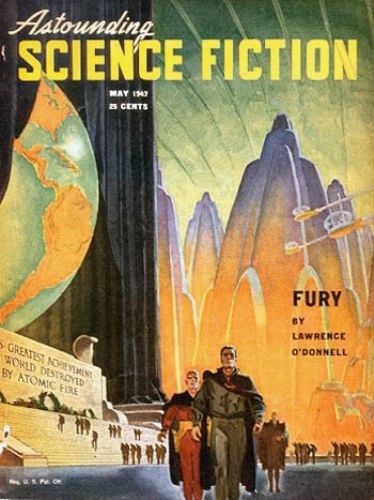
    (Cover by Hubert Rogers. Astounding, May 1947.)

    Who Goes There?

    There have been power couples throughout the history of science fiction: Ed and Carol Emshwiller, Edmond Hamilton and Leigh Brackett, Damon Knight and Kate Wilhelm, and so on. These are creatives, be they writers, artists, editors, or what have you, who supported each other and fed into each other’s work. But the biggest power couple of the pre-New Wave years, even if it was laced with tragedy, had to be the marriage of Henry Kuttner and C. L. Moore. Kuttner and Moore both started in the ’30s, incidentally making their debuts in the same magazine (Weird Tales), and Kuttner even made contact with Moore as a fan of her work. They started as correspondents, but since they lived close together it didn’t take long for them to meet in person, and by 1940 they were married. They tried, and sadly failed, to have kids, but their bountiful output as writers would serve as their offspring. Each was prolific on their own (especially Kuttner, who was maybe one of the last of the old-school pulp writers), but together they formed a gestalt which called for a few pseudonyms. The ’40s saw the two contributing massively to Astounding, especially during the war years since several of John W. Campbell stable writers took a break from writing to join the war effort, with the ’50s seeing a downturn in productivity. It’s possible that Kuttner and Moore would’ve returned to writing full-time by the end of the ’50s, had Kuttner not died suddenly in 1958, just short of his 43rd birthday. Moore remarried, but she gave up the pen soon after.

    A couple years ago I reviewed “Clash by Night,” written under Kuttner-Moore’s Lawrence O’Donnell pseudonym, which is an effective mood piece as well as one of the earliest examples of military SF I’ve encountered. SF historians tend to say that the O’Donnell name signaled a story in which Moore had primary creative input, which sounds accurate enough given that “Clash by Night” speaks to Moore’s style and emphasis on atmosphere over plotting. They eventually returned to the setting of that novella, it being a swampy and very much inhabited Venus. In stark contrast to Venus as we know it, the Venus of “Clash by Night” and Fury teems with alien life—much of it very hostile to humans. The human settlers, unable to take to land, built underwater cities known as the Keeps. But whereas “Clash by Night” is assumed to be Moore-driven, Fury was long thought to have been written by Kuttner alone, although Moore late in her life claimed to have been a minor collaborator on it. I’ve yet to find an edition of Fury that credits Moore as co-author, but I feel comfortable with crediting her here. Also, despite being marketed as the “sequel” to “Clash by Night,” Fury doesn’t share anything with that story aside from setting.

    Placing Coordinates

    Serialized in Astounding Science Fiction, May to July 1947. It was published in hardcover in 1950 as by Kuttner alone, which has been the case with every subsequent reprinting (at least in English). It’s in print at least in the UK now, although it’s not hard to find used.

    Enhancing Image

    Similarly to “Clash by Night,” Fury begins with a fictionalized introduction which establishes the ensuing story as already having happened in some distant future. You could say it’s an attempt at a future history. Once we get past that section, though, Fury reveals itself to be quite a different beast from the earlier story, in subject matter and even in how it’s written. While “Clash by Night” has a more elegiac tone, Fury reads more like a pulpy detective novel. The protagonist, fittingly, is rather hardboiled. Of course, Sam Reed (born Sam Harker) has a good reason to be the way he is. But first, a bit of backstory, since Fury treats the reader as if they might not have read the earlier story, which is understandable considering it had been four years. About 600 years ago, humanity destroyed life on Earth in some nuclear castrophe, which meant that the only way humanity hadn’t gone extinct right then was a colony on Venus. The problem was that the flora and fauna on land would’ve had mankind for breakfast, so the settlers had constructed undersea domes called the Keeps. (How these cities would’ve been built in the first place, I’m not sure. Stories about man-made underwater cities tend to be vague about that part.) Life in the Keeps is hard knocks really no matter what your status is, but there has indeed come about an upper crust in this society, defined not so much by money as by genetics. “The Immortals” are not literally immortal, but they are extremely long-lived thanks to selective breeding. This was not a new idea, even in 1947 (see Robert Heinlein’s Methuselah’s Children from 1941), that eugenics may result in a group of people who can live, virtually without aging, for centuries. Eugenics comes up several times in Kuttner-Moore stories (more often, it must be said, when Kuttner is the one primarily in control), and its legitimacy is never really questioned, which is disquieting.

    The Immortals are long-lived, and also conventionally attractive, in a world where the average person tends to be short and ugly, in keeping with the cramped environments of the Keeps. Sam would have enjoyed being handsome and long-lived himself, as a member of the Harker family, but his mother dying in childbirth compels his father to take revenge on baby Sam, which even Sam’s grandfather and great-grandfather (mind you that these people live for centuries at a time) think is a bad idea. The father not only gives up Sam but has him tinkered with before doing so, so that Sam grows up bald as an egg and decidedly unhandsome. Most importantly, Sam grows up without the knowledge of being a Harker, and without knowing he is himself an Immortal. As is typical among the Immortals, Sam’s parents were “hedonists,” which is to say they were basically drug addicts (sex being a big no-no in Astounding) who sat around doing nothing. The Immortals are generally given to being idle, as befits their status as the ruling class, although while they certainly are not in desperate need of money, what they really have over the rest of the Keeps is time. As for Sam, he grows up in the city’s underbelly, having been orphaned and denied his birthright. He thus comes to think of himself as Sam Reed. You may notice, if you’re reading Fury, that Sam’s a bit more unlikable (by design) than the standard SF protagonist of the day, which is saying something considering “heroes” in SF magazines at the time tended to be actually anti-heroes. Sam is an unrepentant criminal who has a strong resentment towards the Immortals (understandably), and he’s not above doing anything heinous in the name of getting his way. He’s also, ya know, rather ugly.

    During Carnival, Sam, now forty years old and notorious in the underworld, meets Kedre Walton, a lovely woman and an Immortal, being some 220 years old, although she looks maybe middle-aged. There’s some romantic tension between the two, although it’s complicated by a) Sam (so they both think) not being an immortal, and b) Kedre being Zachariah’s mistress. Zachariah is Sam’s grandfather, although Sam doesn’t know this. So there’s a bit of an age gap between Sam and Kedre, but that turns out to be the least of their problems. (It’s also worth mentioning, at this point, that the Immortals seem to play fast and loose with regards to monogamy. This is similar to the Free Companions, defunct by the time of Fury, who in their day had so-called “free-marriages” which were basically open. This is a progressive view of relationships, all things considered.) The Immortals know Sam is hot shit in the underworld, and they want him to do some dirty work for them: to kill Robin Hale. Hale is a former Free Companion, which is to say he used to be a mercenary, waging naval warfare on Venus for hard cash, but the Free Companies have long been disbanded and Hale has become disillusioned with the Keeps’ complacency. Surely humanity has to conquer “landside” somehow or slowly perish underwater, if only from decadence. Kedre and the others think Hale’s plan to unify the Keeps for a colonization effort will fail, for one, but also it will jeopardize Immortal supremacy. If there’s anything the Immortals hate, it’s change. Sam agrees to the job, but realizes pretty quickly that he’s totally expendable in this affair, since as far as anyone knows he’s just one of the proletariat. There’s also the issue of Jim Sheffield, a rival of Sam’s in the underworld, although Sam forgets about this for a while once he takes on the Hale job.

    Quite a few characters are introduced in this first installment, and unfortunately while Kuttner was good at many things, writing three-dimensional characters wasn’t really one of them. The women here, namely Kedre and the popular dancer Rosathe, are made to be temptresses who are as likely to lead Sam to his doom as anything. The men are better, but not by that much. Maybe the most curious character here, if only because his function and powers strains one’s suspension of disbelief, is the Logician, an oracle who disguises himself as a super-computer, for the sake of the people who converse with him. I mentioned that faith in eugenics is very much played straight here, and that includes the Logician having been selectively breed to (get this) predict future events with supernatural accuracy. I mean fuck, it may as well be magic. The Logician himself is aware that his ability is a tough pill to swallow, hence his wizard-of-Oz routine. Sam himself is more interesting as a symbol than as a character with a Shakespearean personality. It’s made clear from his genetics that Sam is meant to be highly intelligent and even charming, and that had he been raised among the Harkers he might’ve used these traits for good—or maybe not. It’s actually not clear at all that Sam’s positive qualities would’ve been better put to use as a patrician than as a member of the criminal class. As it is he’s totally amoral, a man who loathes the Immortal less out of moral conviction and more out of jealousy, and even his opting to help Hale instead of killing him is done more as a pragmatic maneuver than anything. Would Sam have become a better person had his dipshit father accepted him?

    There Be Spoilers Here

    At lot happens in the back half of this installment, so only twenty or so pages. This is a fast-moving novel, considerably more so than its prequel, and in book form it totals only about 180 pages. Now, Sam and Hale conspire to garner public approval for colonization of landside in record time, and they need to do it fast because “the Families” expect Hale to be dead within 48 hours, and then if he isn’t by then it’ll be both of their heads. Just when the Immortals will take their vengeance on Sam, he’s not sure of, because the Immortals understand time itself differently from everyone else. (As an aside, I still find it amusing that they use physical film reels. Technology in the Keeps is very analog, despite this being like the 27th century. Writers at the time could envision undersea cities on Venus, but they couldn’t envision the microprocessor.) The plans, miraculously, at least in the short term, and Sam is even able to make a ton of money off the situation. Unfortunately he forgot about Sheffield, and he’s also unaware that Rosathe has been scheming behind his back this whole time. They don’t kill him, however, instead drugging him and making him unconscious for forty years. Or at least he blacked out, as he doesn’t remember the past forty years at all. So he’s eighty now, and yet when he looks at himself he finds that he hasn’t aged, which should be impossible. Unless—?

    A Step Farther Out

    There’s a literary quality to “Clash by Night” which Fury noticeably lacks, although given the change in subject matter it’s easy to understand why the style here is pulpier. Kuttner was not as precise a writer as Moore, but here the ruggedness of Kuttner’s style fits with the grimy underbelly of the Keeps. We’re talking about a story that, even in its opening stretch, involves murder, backstabbing, and forced drugging. This is less proto-military SF and more consciously (it seems to me) taking after Heinlein’s ’40s work. It also, by sheer coincidence, has a twist at the end of the first installment which anticipates Heinlein’s The Door into Summer by a decade. If “Clash by Night” is somber then Fury is a lot more vicious.

    See you next time.

  • Novella Review: “Welcome to Olympus, Mr. Hearst” by Kage Baker

    December 5th, 2025
    (Cover by Fred Gambino. Asimov’s, Oct-Nov 2003.)

    Who Goes There?

    Kage Baker would no doubt still be writing and garnering acclaim today, had she not died of cancer back in 2010. She was born in 1952 and grew up in Hollywood, so it makes sense that the world of acting, both on stage and in the movies, would interest her. She spent the last year of her life trying (and sadly failing) to finish a novel while also watching and writing reviews for a lot of films from the silent era. We even got a book of these reviews published after Baker’s death, Ancient Rockets: Treasures and Trainwrecks of the Silent Screen. As for writing genre fiction, Baker came to it rather late in life, when she was in her forties (this is a lesson that it’s not too late to try your hand at pursuing such a career), but she hit the ground running with a ton of short stories, novellas, and novels. For the dozen or so years that she spent as a writer, she worked on a few series, most prolifically (it was probably her favorite) the episodic series about The Company, a far-future league of time-traveling cyborgs. In this series there is history as we know it, and then there’s a second history, a secret history, in which these time-traveling agents meddle, and this is where the fun happens. “Welcome to Olympus, Mr. Hearst” is an entertaining, if also slight, tale of mystery and old Hollywood intrigue, involving one of the more infamous American figures from the early 20th century: William Randolph Hearst.

    Placing Coordinates

    First published in the October-November 2003 issue of Asimov’s Science Fiction. It’s since been reprinted in The Year’s Best Science Fiction: Twenty-First Annual Collection (ed. Gardner Dozois) and the Baker collections Gods and Pawns and The Best of Kage Baker.

    Enhancing Image

    We start in the year 1926, on the set of a real movie called The Son of the Sheik (it’s the sequel to The Sheik, go figure), with Rudolph Valentino. We’re told this scene from the viewpoint of Lewis, who is Valentino’s stunt double for the film, although he’s actually an 800-year-old cyborg working for The Company. Lewis asks Valentino for his autograph and somehow pulls out a copy of the shooting script for the film, which Valentino signs. Baker doesn’t tell us the significance of this interaction right away, but the autographed script copy will become a McGuffin for later in the novella. Valentino will, of course, die tragically in a number of weeks, The Son of the Sheik being his final role, while Lewis will live—well, who knows how many more years or decades? Lewis is an “immortal,” which does not literally mean he will live forever (he will surely die at some point), but that he lives an astoundingly long amount of time, being immune to the usual natural causes. Old age, hunger, and disease are not concerns of his. The same goes for Joseph, fellow “immortal” and narrator of this story. Joseph only makes us aware of his presence at the very end of the prologue, but he’s gonna be the protagonist from here on out. The main action sees us jumping from 1926 to 1933, which sees a radical change having come over Hollywood and America at large. The Great Depression has hit the country, talkies have completely supplanted the silent pictures, Prohibition has ended, and Rudolph Valentino has been dead for some years now.

    Ah, but William Randolph Hearst is still alive! Born in 1863, Hearst grew up to become the head of a media empire which continues to this day, in large part helped by his father George being a politician and gold-miner. (It’s said that money doesn’t grow on trees, and similarly that wealth typically must come from somewhere.) Hearst is partly responsible (for better or worse) for journalism as we now understand it. For Hearst there is objectively true news, and then there’s news which strikes the reader or viewer as true, even if it’s not based in reality. Indeed we can thank William Randolph Hearst for the concept of “fake news,” even if the phrase had not been coined yet in his lifetime. In the world of Baker’s story, Hearst had just turned seventy, and for being an old man (especially for the time) he was still spritely—with a sort of fiendish cunning. This is a fact that really should’ve been on Joseph’s mind as he and Lewis stay at Hearst’s famous mansion, under the pretense of having been recommended to Hearst by George Bernard Shaw. Joseph and Lewis are very old (Joseph being over 2,000 years old, in fact), but appear and even seem to think like young men. These are not people whose minds have been profoundly wearied by the passing of centuries, having experienced first-hand the ups and downs of multiple civilizations, which implies that there might be a ceiling for mental maturity. Of course, you and I know that old people, in the real world, have a funny tendency to act and think in childish ways, as if their minds had, at some point, boomeranged back into the stubbornness and shortsightedness associated with adolescence. Hearst himself is not quite an exception to this.

    So, what’s the plan? The idea if twofold, firstly that Joseph is to make a deal with Hearst about his estate being used as a safe haven for certain precious artifacts, which are to be “discovered” a few centuries hence. In particular there’s the question of a copy of the script for The Son of the Sheik, signed by Valentino himself, which the Hearst estate is supposed to guard for safe keeping, so that it may be eventually sold at auction for an insane amount of money. Time, according to the immortals, is something which cannot be defied; once something has happened, it can’t be undone. The signed script must be found in the Hearst estate at such a time, and Hearst himself must die in 1951, at the impressive old age of 88. The problem, naturally, is that for someone like Hearst “just” living to an old age is not enough: he wants what the immortals have. It’s a damned-if-you-do-damned-if-you-don’t situation, because in order to convince Hearst of the immortals’ plan, they have to let him in on at least some of the truth (but not all of it) as to why they’re at his mansion. Mind you that this is like if time-traveling agents went to that bald fuck Jeff Bezos to do some business for them. If there’s a theme in “Welcome to Olympus, Mr. Hearst” it’s the malleability and to some extent the unknowability of “the truth.” What is the difference between what really happened and what appears to have happened? This is an appropriate theme to explore using one of the most infamous figures in the history of journalism, although I don’t think Baker explores it as well as she could’ve. It could’ve worked well as a short story or a novelette, but this is a novella, which means there’s some fat.

    There are a few supporting characters, at least some of whom are real people from history, such as Marion Davies, Hearst’s mistress. There’s also Greta Garbo, although if I recall correctly (and in keeping with her reputation) we never get even a line of dialogue from here. We even get a cameo from Clark Gable, one year away from starring in It Happened One Night. There’s Constance Talmadge, who had played “the Mountain Girl in Intolerance.” But the most important player here is Cartimandua Bryce, who seems to be a character Baker invented—her and her two fucking dogs, named Conqueror Worm (yeah) and Tcho-Tcho. Mrs. Bryce is a very superstitious and gossipy woman, and also a fascist sympathizer, complimenting Hitler and Mussolini while calling FDR “a young soul, blundering perhaps as it finds its way.” She is not a good person. She also throws a wrench into Joseph and Lewis’s plan and pads out the story’s length a fair deal. Said plan goes amiss when the Valentino-signed script goes missing, despite presumably nobody else at the party knowing about it. There’s also the issue of Joseph having to lie to Hearst about the possibility of becoming an immortal in order to placate him, although he does tell a lot more of the truth about the Company than people of the past are meant to know. It’s true, for one, that while the Company does have many agents, it’s still not omniscient with regards to history: there are little pockets (you might call them dead zones) in history as we know it where there’s flexibility as to what can happen. History as a whole is predestined, but there are exceptions. William Randolph Hearst, in this particular way, may be an exception.

    There Be Spoilers Here

    The mystery regarding the Valentino script basically resolves itself, which is anti-climactic, as if the story turns into a mystery (we even get shoutouts to Agatha Christie and Dashiell Hammett) and then quickly gets bored with it because it’s pretty obvious right away who the culprit is. Mrs. Bryce is, like I said, a huge gossip and much interested in scandalous material. While she doesn’t receive so much as a slap on the wrist for her misdeed, she does lose one of the dogs, which gets a fatal taste of Joseph’s boot (in fairness, Joseph was acting in self-defense). Our Heroes™ conspire to make the dog’s death look like it had died of natural causes, with Mrs. Bryce ultimately buys. Things are tied up neatly on that front—maybe too neatly. The thread regarding Hearst himself is more intriguing and does take advantage of the SFnal premise, but it’s also a lot messier. Unbeknownst to everyone except for Joseph when he makes the discovery, a secret that know even Hearst is aware of, the old man is a genetic anomaly. Joseph had been bullshitting Hearst about becoming an immortal, with a mixture of half-truths and outright lies, but in a kind of self-fulfilling prophecy this deal becomes true, quite unwittingly on Joseph’s part. The ramifications of Hearst not only being exposed to how news is conveyed to the masses in the far future but actually living to witness that point in time are… a bit ominous. The mission is a success, but maybe it should’ve failed.

    A Step Farther Out

    This story appeals to me to an extent, since like Baker I’m a film buff, although I don’t know that much about the pre-Hays Code years. I’ve never seen a Rudolph Valentino movie, although I do know enough about his story (Valentino was one of Hollywood’s first major tragedies) to get the importannce of what Baker does here. My major issue, aside from the length and uneven pacing, is that Baker can’t quite decide how seriously she wants to treat this material. There’s some comic relief, but the point that Baker wants to make about people like Hearst is very serious. I wouldn’t call it satirical, because it doesn’t go that far, but it does rag on a fact about journalism which, sadly, remains true. On a final note, I do appreciate that Baker sets the action at a point in time where she doesn’t feel tempted to reference the Citizen Kane controversy. If you’re a film buff (and certainly Baker knew about it) then you probably know about Hearst’s relationship with that movie.

    See you next time.

  • Things Beyond: December 2025

    December 1st, 2025
    (Cover by Frank Kelly Freas. Satellite, December 1956.)

    Merry Christmas, happy birthday to me, and all that.

    People who keep up with my posts may have noticed that I missed a couple things last month, including what was to be the start of the second serialized novel, Kuttner and Moore’s Fury. Let’s say I’ve been slow about it. Generally I’ve been slower about keeping up with this blog than I was a year ago, and there could be a few reasons for this, but the point is that I’ve come to understand I’m not as on top of my own blog as I once was. I’ve slowed down with the “required” reading, and I’ve been slower about writing, although (not to toot my own horn) I still write here more than some other fan writers I know. Maybe nowadays the load I give myself is just a bit too much, especially since I’ve also been wanting to get into writing professionally, for that bit of extra money, only I’ve not been able to find the time and/or motivation for it. So, I’ll lighten the load a bit. From now on I’ll only be covering one serial a month, regardless of length. Of course, if the serial is four parts or longer this won’t make a difference, but a lot of serials are three-parters, which should give me an extra day to myself. Other than that, it’s gonna be business as usual.

    What do we have on our table? All science fiction, which isn’t very diverse, but when these stories were published is certainly more diverse. One story from the 1940s, one from the ’50s, one from the ’60s, one from the ’70s, one from the 2000s, and one from the 2020s.

    For the serial:

    1. Fury by Henry Kuttner and C. L. Moore. Serialized in Astounding Science Fiction, May to July 1947. Kuttner and Moore wrote so much, both together and each solo, that they resorted to a few pseudonyms, one of them being Lawrence O’Donnell. Fury takes place in the same universe as the earlier Kuttner-Moore story “Clash by Night.” Despite Fury historically being credited to Kuttner alone, Moore claimed years later to having been a minor collaborator.

    For the novellas:

    1. “Welcome to Olympus, Mr. Hearst” by Kage Baker. From the October-November 2003 issue of Asimov’s Science Fiction. Baker had spent much of her adult life working in insurance and with theatre as her primary hobby, before pivoting to writing SF in her forties. No doubt she would still be writing SF today, had she not died all too soon in 2010. Still, for about a dozen years she wrote furiously, with her big series following a team of time-traveling secret agents.
    2. “The Dragon Masters” by Jack Vance. From the August 1962 issue of Galaxy Science Fiction. Winner of the Hugo for Best Short Fiction. This is a reread, although I only have a vague memory of having read it in the first place, and that was without Jack Gaughan’s accompanying artwork. Despite what the title might make you think, “The Dragon Masters” is pure planetary SF, albeit with fantasy-esque coloring that Vance had become known for at this point.

    For the short stories:

    1. “An Important Failure” by Rebecca Campbell. From the August 2020 issue of Clarkesworld. Winner of the Theodore Sturgeon Memorial Award. Born and raised in Canada but now living in the UK, Campbell has written only one novel so far, which in fact was her first SF writing of any sort. Good news is she’s been somewhat prolific in writing short stories and novellas over the past decade.
    2. “The Earth Dwellers” by Nancy Kress. From the December 1976 issue of Galaxy Science Fiction. This is the third time now that I’ve come to Kress, and why not? Her career now spands nearly half a century, and her stories, if not always entertaining, often provide some food for thought. I know nothing about “The Earth Dwellers,” except it marked Kress’s very first appearance in the field.

    For the complete novel:

    1. A Glass of Darkness by Philip K. Dick. From the December 1956 issue of Satellite Science Fiction. This book sounds unfamiliar, even for seasoned Dick fans, although it may ring a bell under its book title: The Cosmic Puppets. Dick had burst onto the scene in the early ’50s as one of the most promising short-story writers at the time, in a generation that included such bright newcomers as Robert Sheckley, Algis Budrys, and Katherine MacLean. It only stood to reason, then, that while writing short stories nonstop was all well and good, writing a novel was the logical next step. A Glass of Darkness wasn’t the first novel Dick wrote, but it was the first to be published.

    Hopefully you’ll be reading along with me.

  • Short Story Review: “I Live with You” by Carol Emshwiller

    November 26th, 2025
    (Cover by David A. Hardy. F&SF, March 2005.)

    Who Goes There?

    Carol Emshwiller was one of the most acclaimed short-story writers of her generation, made more impressive because she kept doing good work for about half a century, longer than most authors’ careers. She started in the ’50s, at the tail end of the magazine boom, and kept writing, albeit mostly in the realm of short fiction and never too prolifically, until her death in 2019. She likely would’ve still become a favorite of readers from across a few generations even had she not been married to Ed Emshwiller, but that certainly helped, with Ed even illustrating some of her stories. It was one of those rare marriages where you had two very talented artists, and whose works even sometimes fed into each other. Emshwiller (Carol, that is) was also not an SF doctrinaire, but someone who was open to experimenting with genre boundaries from pretty early in her career, so it makes sense that she was one of the few women to appear in Dangerous Visions. Today’s story is itself very much outside the boundaries of SF, although I hesitate to call it horror as well, even though that’s what it is marketed as. “I Live with You” is a short and simple story that doesn’t easily fall into any genre; if it’s horror then it’s by virtue of the uncanny nature of the relationship between the two women at its center. This is a story that’s meant to be taken allegorically, rather than literally.

    Placing Coordinates

    First published in the March 2005 issue of The Magazine of Fantasy and Science Fiction. It’s been reprinted in The Mammoth Book of Best New Horror 17 (ed. Stephen Jones) and the Emshwiller collections I Live with You and The Collected Stories of Carol Emshwiller Vol. 2.

    Enhancing Image

    The narrator is a ghost, maybe, or perhaps just unhoused lady who has somehow been living off of table scraps, in a book store for a while and in a department store before that. She’s been hiding for who knows how long, but nobody has caught her yet, and as she says, “I never steal.” At least this was the case before she started hiding in Nora’s house. The narrator looks enough like Nora to be her doppelganger, but the two don’t seem to be related. The only other company at this house is the cat, which Nora doesn’t get along with very well, although the little beast takes much more of a liking to the doppelganger. She spends her time in the attic, when Nora is home, but otherwise she has the whole house to herself. It takes weeks for Nora to figure that someone might be intruding, and even then she doesn’t call the cops, but instead has a deadbolt installed for her bedroom door. Nora is so out of it, so passive in her day-to-day life, that she doesn’t even notice when her doppelganger is just one room over from her. The narrator, partly out of pity for Nora and partly as a means of entertainment for herself, figures it’s time for Nora to get herself a man—or rather for the narrator to get one for her. The more pitiable the better. In stories in which a “normal” person meets their doppelganger, the latter is typically more adventurous or mischievous, if not outright evil, and the same holds true here. The disparity is such, in fact, that Nora comes off as the uncanny one in the pair, rather than the narrator, on account of how empty she is as a person. The narrator schemes to bring a man to Nora’s home because she’s frustrated with how dull Nora is. As the narrator says:

    At the book store and grocery store at least things happened all day long. You keep watching the same TV programs. You go off to work. You make enough money (I see the bank statements), but what do you do with it? I want to change your life into something worth watching.

    There’s the question, firstly, of why the narrator continues to live with Nora if she finds her so boring, and it’s a question she doesn’t answer in any straightforward fashion. There’s also the question (also never quite answered) of what the narrator is supposed to be and why she’s a dead ringer for Nora. There’s something supernatural going on, maybe, but Emshwiller doesn’t care to give us answers to these questions, if for no other reason than that an explanation might distract from the unusual dynamic between the women. As a rule of thumb, good horror (and “I Live with You” is ostensibly horror) should abstain from explaining or rationalizing the horrors of its world. Certainly from Nora’s perspective this ordeal would count as horror, as it uneases her enough to get deadbolts for her bedroom door—for the inside and then, rather irrationally, for the outside. The real question is, who is really the woman living in the attic? Literally it’s the narrator, but she’s so comfortable living in Nora’s house that it’s Nora who comes off as the one living here as an outsider. The narrator comes and goes as she pleases, taking bits and pieces of Nora’s stuff, although it’s always stuff Nora was unlikely to appreciate in the first place.

    Things get more interesting once the two women finally meet face to face, and of course it’s by accident. This is in the midst of the narrator’s scheming to have a guy with a gimp leg, named Willard. It’s possibly the most memorable passage in the whole story, if only because of how neatly it illustrates the contrast between the women. As the narrator says, “I’m wearing your green sweater and your black slacks. We look at each other, my brown eyes to your brown eyes. Only difference is, your hair is pushed back and mine hangs down over my forehead.” Worth mentioning that while “I Live with You” is technically a first-person narrative, the doppelganger refers to “you” as if you were Nora, or rather as if she were talking directly to Nora. The reader is meant to be in the place in this plain, unassuming, seemingly empty-headed woman. In a way it makes sense, because who else could she be talking to? If it has to be told in the first person, then making it border on second-person like this makes sense enough. It also adds a touch of creepiness, since the doppelganger, this unnatural person, is talking directly to us, although she means no harm.

    There Be Spoilers Here

    The threeway(?) doesn’t exactly go well. Willard comes over under the impression that the woman who wrote him the letter was Nora and not the narrator, a confusion compounded because of the ladies’ identical looks. Nora seems to be taken in, though, after some initial fumbling (quite literally at one point, as the narrator trips her on purpose), and it seems like the two might at least be hitting off for a one-night stand. It’s implied that the narrator is here to watch, except that when things do get steamy she’s disappointed by the lack of spectacle. (Given that Emshwiller would’ve just turned eighty, I’m a bit surprised that sex plays as big a factor in this story as it does.) Nora fumbles for the last time, though, and Willard leaves. The narrator also decides to leave at this time, having left Nora traumatized but also a more mature woman than before. I’m actually not sure how old the two women are supposed to be, certainly old enough that Nora has a house and a job; but despite her assumed age, Nora’s implied to possess a certain innocence which by the end of the story has been taken and replaced with something. Maybe something better, who’s to say? Even for full-grown adults there are events in our lives in which we feel like we’ve been compelled, or maybe pushed or shoved violently, into being one step closer to enlightenment. As with the stories of Theodore Sturgeon and Robert Aickman, whom Emshwiller may have been thinking of, the crossing of the shadow-line is framed as traumatic.

    A Step Farther Out

    “I Live with You” won the Nebula for Best Short Story that year, which is curious, for one because it’s pretty unassuming, but also this was in the sixth decade of Emshwiller’s career. The fact that she had won her first Nebula just a few years earlier is in itself unusual; authors typically don’t write work this solid this deep into their careers. I unfortunately can’t say I agree with the Nebula win for “I Live with You,” but it is a tightly knit and moody story with a feminist bent. It’s hard to write about something that’s both this self-contained and which more or less already speaks for itself, so the only thing I can really do is recommend you read some Emshwiller, especially since her career coincides with much of genre SF’s history, from the pre-New Wave years into the 21st century.

    See you next time.

  • Serial Review: Inferno by Larry Niven and Jerry Pournelle (Part 3/3)

    November 23rd, 2025
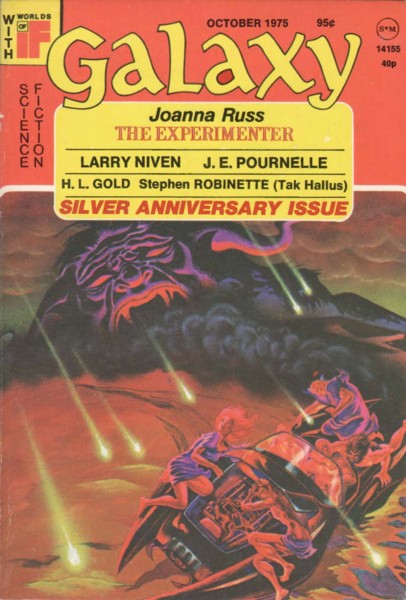
    (Cover by Richard and Wendy Peni. Galaxy, October 1975.)

    The Story So Far

    Allen Carpentier has died, which turns out to be only the beginning of his suffering. He’s in Hell now, or Infernoland as he calls it, at first stuck in a little bottle like he were a genie before being released by a fat balding guy named Benito. Benito what? You’ll see. Now, Benito has been in Hell for a long time, and seems to know a way to get out. To where? Who’s to say. He’s to act as the Virgil to Allen’s Dante, and after all, Infernoland does seem to be modeled after Dante Alighieri’s vision of Hell. Funnily enough, the only way to get out of Hell and possibly into Heaven (or at least purgatory) is to go down, through each circle, each being stranger and more torturous than the last. For a while Allen has a hard time believe he’s in the real Hell and not some simulacrum; after all, he’s an SF writer and a rational man, not one given to superstition. But if Infernoland is a prank, or some sado-masochistic theme park, it’s extremely elaborate. “The Builders” have put a lot of work into it. Of course, it’d probably be easier just to take the whole setting as supernatural than to try some mental gymnastics, but that’s where some of the humor comes in—this being kind of a dark comedy. People have gone to Hell for all kind of reasons, not all of them seemingly reasonable. Niven and Pournelle get a lot of mileage out of depicting kinds of people they don’t like (mostly, but not always, people with left-wing bents) suffering in Hell, although the suffering itself is not always so bad either. There are a few times where they get more specific about whom they’ve thrown into Hell, although not too specific if the person was still alive in 1975. There’s a pretty memorable scene where Kurt Vonnegut (not named, but it’s very clearly meant to be him) is locked up in a big tomb, much to Allen’s annoyance.

    Of course, it isn’t just Allen and Benito stuck together on this voyage, since their party does grow some, if also only temporarily. In an episode where the gang builds a glider, they get the help of Corbett, who was a pilot in life, and later they also recruit Billy the Kid—or at least a guy who claims to be Billy the Kid. Eventually they lose Corbett when he loses his nerve and decides to trudge his way back up to one of the higher circles. The thing is that nobody can die in Hell, on account of already being dead, and even though you may suffer incredibly gruesome torment that would have killed a normal person, you’ll not only live but heal in record time. So, this must be the real deal, then. Not helping is that aside from people populating Hell there are also black-skinned demons, a beast with an impossibly long tail named Midos, and a fishman named Geryon. Allen can barely bring himself to trust Benito as well, since the man knows a bit too much and acts more than a little off, like Allen is supposed to know who he is—or, more specificially, like Benito is some infamous figure from history.

    Enhancing Image

    We’re in the last stretch of Inferno, and it’s actually the shortest, which makes me think there’s more in the book version than what made it into the serial. I’m starting to think that yeah, there had to be some stuff cut out, because this feels stripped down within an inch of its life. Overall it feels more like the skeleton of a novel than the full picture, but I do have to say I like the bones on this thing enough. Then again, I’m not sure how much you can add to it and I’m even less sure why Niven and Pournelle felt compelled to return to it a few decades later. Something genre writers, both old and young, should learn is that more often than not, you should leave a good story well enough alone. Quit while you’re ahead.

    It doesn’t take much time at all for Billy the Kid to quite literally get carried out of the novel, which in a world where nobody can die if I guess one way to do it. Just yoink a character out and put them in a location that’s virtually unreachable, it’s kinda like killing them off but not exactly. The party disintegrates rather quickly thereafter, since some World War II guys are all too happy (by that I mean outraged) to tell Allen he’s been traveling with Benito Mussolini this whole time. Yes, that Benito Mussolini. It really isn’t a shocker at all if you’ve been reading along and have not been living under a rock since the time of the pharaohs. I do genuinely have to wonder if the authors intended this to be a big reveal or if it’s meant to be like a joke, because I found it straining on my suspension of disbelief that Allen never figured it out for himself when it should’ve taken him maybe a few minutes. Also it sure is convenient that every historical figure we’d met up to this point where not know who Mussolini is, although that doesn’t go to explain why nobody who lived in a post-WWII world pointed out (or at least more strongly than merely hinted) that Benito looks and sounds familiar. It’s a contrived twist while also being laid on pretty thick, although maybe it was not so thick for readers in 1975. The reveal now feels demeaningly obvious, but given what Americans were allowed to learn in high schools in the days before the internet it’s possible that Mussolini was a semi-obscure figure for those not much interested in politics.

    Well, anyway, Allen does what any reasonable person who’s confronted with the so-called father fascism: he chucks him into a goddamn fiery pit. Benito doesn’t even resist Allen turning on him, as if he expected and maybe even wanted this to happen. Of course, nobody can die here, which includes Benito, and you bet we’ll be seeing him again before the end. I do think the decision to make Benito Mussolini a pretty flawed but ultimately heroic character is certainly a choice. The former dictator, who was an avowed atheist in life, seems to have caught a second wind of Catholicism in Hell, and it seems to be an earnest religious awakening. The idea is that if Hell is meant to be punishment, then someone can choose to either better themself admist the horror or wallow in their sins until the end of time, and Benito has chosen the former. Niven and Pournelle are clearly trying to make an example of Benito, as to the potential of Hell’s cleansing flames, although they don’t go so far as to, say, rehabilitate Hitler or Stalin, who are mentioned but (for better or worse) never seen in-story. If Inferno were published as a new novel today it would probably cause a minor stir on social media and in SF fandom, what with how it handles real-life people; but in 1975, if it stirred any controversy then I’ve yet to find evidence of such a thing happening. I have to admit I like the audaciousness of such a move, even if it’s wrongheaded (and it probably is).

    Eventually Allen and Benito do reunite, and despite having a good reason to wanna have a go at Allen’s neck, Benito’s pretty understanding about the whole thing. If for much of the novel we were stuck with Benito in the throws of religious mania, then this last stretch sees him having sunk into a depression. Speaking of religious mania, I mentioned that Kurt Vonnegut is one of the few then-living people featured in Hell. For those who think what the authors did with Vonnegut was really petty, just be aware that L. Ron Hubbard gets treated so much worse that it’s almost incomparable. As we reach the final circle of Hell and are about to meet Lucifer himself, Hubbard (again, not named, but context clues make it obvious) makes a cameo as a strange and disfigured monster which shambles around. For some reason Niven and Pournelle have a real bone to pick with people who create “false” religions, or who found religions chiefly for the purpose of making money off of gullible would-be followers.

    The ending of Inferno is a bit of an anticlimax, although this seems to be by design, after the increasingly horrific bodily harm Allen has gone through. The iced-over lake, the final area, is relatively easy to traverse, and Lucifer, in the brief time he appears, seems like a chill guy. He only has a couple lines, but he does hit Allen with an epiphany about the purpose of Hell. There’s been a running debate among Christians for centuries as to the purpose of Hell, whether punishment in Hell is eternal or temporary, and so on. The authors here reach a compromise of sorts: Hell is eternal if you choose to stay there. Most of the people stuck in Hell are there either because they refuse to admit to their sins or because they see their punishment as appropriate. There have been at least a handful of people who’ve been escorted out of Hell thanks to Benito, so God knows how many others must have voyaged out over the eons. Benito has chosen to stay in Hell up to now because, well, he’s Benito Mussolini. (I think it needs be mentioned that Niven and Pournelle, while arguing that of course fascism is bad, also downplay just how instrumental a role Mussolini played in the world political climate unto the present day.) Allen convinces Benito that his time in Hell is finally up and that he can go on without him, for ironically, given that his goal this whole time has been to escape Hell, Allen chooses ultimately to stay. The ending is really abrupt, to the point where I’m convinced there’s more to it in the book version, but there’s a passing of the torch between Allen and Benito, the former taking the latter’s place.

    A Step Farther Out

    I remember years ago trying to read The Mote in God’s Eye, which is supposed to be the best of the Niven-Pournelle collaborations, and even after a couple false starts I couldn’t through it much. Mind you this was years ago, I’ve changed quite a bit as a reader, but I remember it being a rather stuffy and conservative (in a bad way) novel. I did not have such an issue with Inferno, although even in its book form it’s still less than half the length of The Mote in God’s Eye. Cut out the language and the most violent of the gore and you have something that could’ve appeared in Unknown a few decades earlier, since Inferno is essentially a fantasy novel, but with an evident SFnal bent to it that gives one the impression that its authors (or at least one of them, since Niven has occasionally written fantasy) are more accustomed to writing science fiction. It’s a detour for both its authors that more or less works, assuming you’re not too bothered by the humor and the fact that Inferno almost reads like fanfiction.

    See you next time.

  • Novella Review: “The Region Between” by Harlan Ellison

    November 19th, 2025
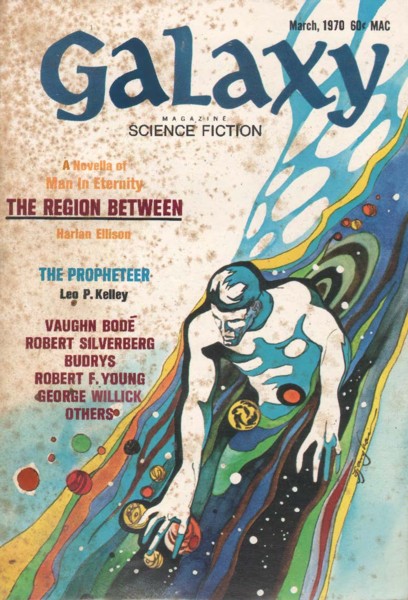
    (Cover by Jack Gaughan. Galaxy, March 1970.)

    Who Goes There?

    Harlan Ellison has a complicated legacy, and we can say “legacy” confidently now, given that he died in 2018. Ellison is one of the most (in)famous American genre writers of the 20th century, for his writing but especially for his personality, which was a double-edged sword in that being the kind of person he was got him TV interviews and even his own segment on the Syfy Channel back in the day, but also got him into hot water repeatedly. He also garnered a lot of criticism and jokes with his mishandling of The Last Dangerous Visions, which only saw publication in kind of a neutered Swiss-cheesed state years after his death. This doesn’t matter too much, because for all the criticism, he’s still one of the most important short-story writers of the past fifty or sixty years. The run he had from 1965 to 1975 alone would probably have permanently secured his status, but he also continued to write some great short fiction even well into the ’90s. He rejected the term “science fiction” and didn’t consider himself to be a “sci-fi” writer, which in a way is fair since much of his work falls into fantasy and/or horror rather than SF. If anything “The Region Between” is an outlier, for being (almost) pure SF and also for being pretty long by Ellison’s standards. Still, despite clocking in at about eighty magazine pages, that page count is deceptive, since its publication in Galaxy is littered with illustrations and “calligraphy,” which is to say typographical experiments.

    Let’s talk about the gimmick behind “The Region Between,” or rather the gimmick behind what made Ellison write it in the first place. There was an anthology book called Five Fates, in which five authors are given the same page-and-a-half prologue (probably written by Keith Laumer), about a schmuck in the future named William Bailey who at the beginning is at the Euthanasia Center, having opted for assisted suicide. Why he does this and what happens after he supposedly dies is left up the imaginations of Laumer, Ellison, Frank Herbert, Poul Anderson, and Gordon R. Dickson. Most of these stories were published in different magazines as standalone works in advance of the book’s publication. As such, you can read “The Region Between” on its own just fine.

    Placing Coordinates

    First published in the March 1970 issue of Galaxy Science Fiction. Aside from Five Fates it’s also been reprinted in The Mammoth Book of Extreme Science Fiction (ed. Mike Ashley) and the Ellison collections Angry Candy and The Top of the Volcano: The Award-Winning Stories of Harlan Ellison. Despite placing first in the Locus poll that year, as well as getting Hugo and Nebula nominations, it hasn’t been reprinted much, although the magazine version is arguably the best way to read it.

    Enhancing Image

    Bailey is dead, to begin with—only not quite. While William Bailey’s body may have perished in the Euthanasia Center, his soul went to a totally different place, or rather was snatched out of his body at the decisive moment, by an alien being called “the Succubus.” This is a bit of an odd choice for a name, since the Succubus is supposed to be male, but the idea is that this alien is a “soul-recruiter,” someone who takes the souls of beings deemed to have certain abilities that would be useful to the highest bidder. We’ve read about bodies getting snatched before, but now there’s soul-snatching, which as the Succubus points out is its own kind of graverobbing. Of course, Bailey was about to die anyway, so his consciousness getting spared and sent into someone else’s body shouldn’t make him too unhappy—or at least that’s the idea. Over the past sixty years the Succubus has cultivated unique ways of farming souls from several intelligent races, under the guise of having blessed these races with “gifts.” One alien race has started what amounts to a death cult while another had been given proof of the afterlife. As for humans, they got Euthanasia Centers, a neat and painless method for ending one’s life. These are intelligent beings who willingly risk or give up their own lives, and in doing so unwittingly provide “prime” souls for the Succubus’s trade. This is the shortened version, as the worldbuilding here is pretty densely packed. We’re introduced to a universe with an SFnal rationale for the existence of the soul, which is typically reserved for the realm of religion, if not fantasy. Ellison, who was a vocal atheist, didn’t actually believe in some spiritual afterlife, so this metaphysics is him showing off more than anything.

    The plot of “The Region Between” is rather simple, although you wouldn’t think it from the combination of shifting perspectives and how Ellison plays with the text itself, to a degree that must’ve been mind-blowing for Galaxy readers in 1970. It also must’ve been a nightmare to print. To accommodate the strange typography, the text here is single- rather than double-column, which means there are fewer words per page right from the get-go, but this also makes it easier for full-page illustrations courtesy of Jack Gaughan. As for Bailey, “He was fired by hatred for the Succubus, inveigled by thoughts of destroying him and his feeder-lines, wonderstruck with being the only one—the only one!—who had ever thought of revenge.” Upon becoming pure soul, Bailey becomes pretty much omniscient, being quickly gifted (or maybe cursed) of knowledge of the past from all corners of the universe. In the decades that the Succubus has been essentially conning all these races for their souls, nobody has resisted him. It’s a bit contrived, because I do find that hard to believe, but it works fine. Of course the theme of rebelling against authority is a bit of a recurring one for Ellison, most famously in “‘Repent, Harlequin!’ Said the Ticktockman.” This anti-authoritarian streak isn’t so much a political move (although Ellison was left-leaning), but rather it more comes from Ellison’s temperament. He was someone who really didn’t like to take orders, and so it shouldn’t be surprising that he supported the New Wave, as a way to revitalized what had risked becoming a stale and safe field. Bailey, a sad fuck with a failed marriage and some war-induced PTSD behind him, is about as thorny as your typical Ellison protagonist, but then the role he plays here is less conventional.

    “The Region Between” might be Ellison’s most New Wave-y story on a formal level, in that he plays with everything from how chapters are numbered to how Bailey communicates with the aliens whose bodies he inhabits and even how flashbacks are communicated to the reader. There is a good deal of what you might call fuckery on the page, which I imagine would be fun to play with if you had a physical copy of the magazine in your hands, turning it sideways and upside down to read some of these passages. This is showmanship of a sort one sees very rarely, even in modern short SF writing, not that it’s the kind of thing you wanna see done too often. (One reason I distrust audiobooks, aside from their passive nature, is that they don’t give you the idea of how text might look on the page. There are cases, albeit not too often, where the formation of the words themselves can only be understood if one were to read them.) The plot, with Bailey jumping across a couple bodies on different planets, most memorably Pinkh, a soldier taking part in a manufactured war between religious factions, is more classic sci-fi compared to how the plot is conveyed. This is by no means Ellison’s darkest or most graphic story, even up to this point, although there’s some profanity and mentioning of sex. There’s also a cosmic scale and an allegorical element to it that makes me think it might’ve been a precursor to Ellison’s more famous “The Deathbird,” which is one of my favorites of his. Bailey on his own is not too interesting a character, but then he’s not the focus for much of it, and ultimately the story is about something almost unimaginably larger than him. This is a novella (it’s only about 20,000 words, if I had to guess) about the universe as we know it.

    There Be Spoilers Here

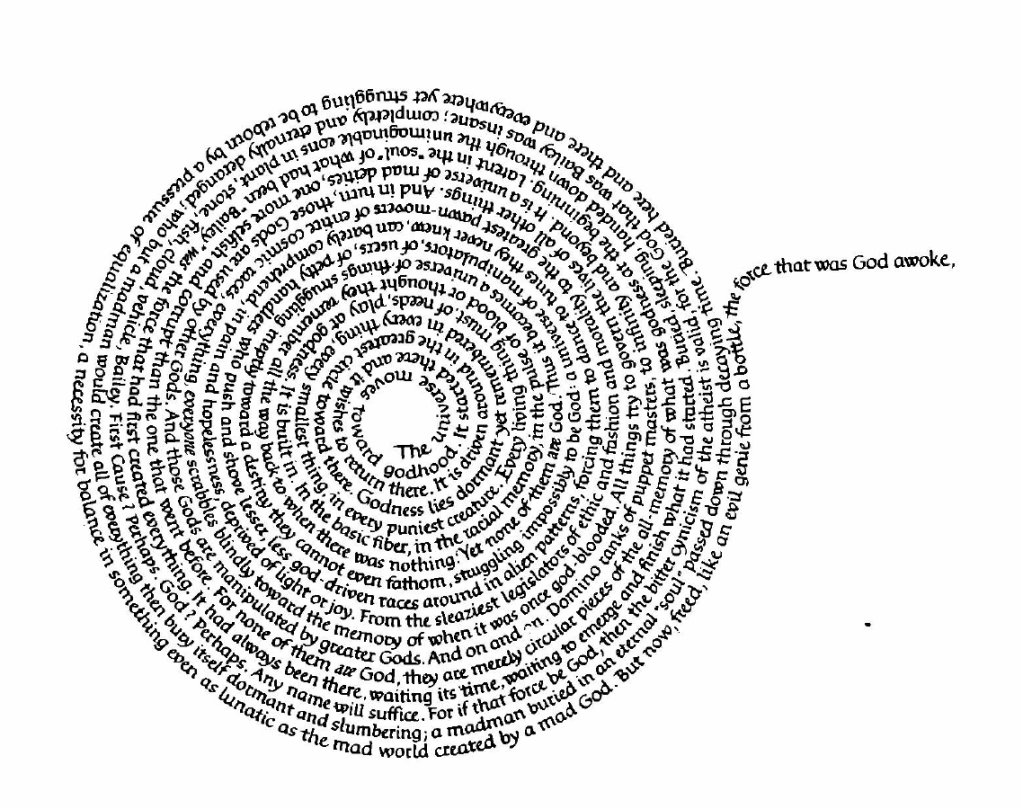
    At one point Bailey gets put in the body of what seems to be a microscopic organism, this being the last major episode before the Succubus puts him in storage—for the time being. The good news, for Succubus, is that he’s able to figure out that something is off with Bailey, who’s been manipulating his hosts, but unfortunately for the Succubus, and indeed the universe as we know it, reawakening Bailey “one hundred thousand eternities later” is a mistake. He has let the evil genie out of the bottle, so the speak. By the end of this story, after having inhabited many bodies and “lived” apparently for millennia, Bailey has ascended to godhood, or more accurately to the position of a demiurge—a makeshift, destructive god. This is explained in the story’s last and more mind-bending typographical experiment, which I’ll just show here. You have to see it for yourself:

    Yeah, imagine seeing this at the time. This is like something you’d see in House of Leaves thirty years later. It’s showy, but the circular shape of the passage quite literally illustrates (according to Ellison) the circular nature of the universe. The universe had started, at some point, with a cause or perhaps even a maker. Out for revenge while also wanting to put himself out of his misery at last, Bailey uses the means at his disposal and ends the universe, killing himself (his soul) in the process. Typically bleak for Ellison, but again I find it curious as a maybe unintended precursor to “The Deathbird,” which also involves death on a cosmic scale. Ellison didn’t believe in the God of Abraham, though he was raised Jewish, but he at least found the idea of such a God dying or going insane to be one worth exploring. Some atheists will say, maybe well-intentioned or maybe not, that it’d be nice if there was such a God as in the Bible, but Ellison supposes we’re lucky to live in a universe where God has seemingly gone silent.

    A Step Farther Out

    Sorry for the delay. I had read “The Region Between” several days ago, but unfortunately I had also been sick for about four days there, despite which I still had to go to work. I could hardly do a damn thing, except ironically go to work, on account of the person who would normally cover for me also being sick. Be sure to wash your hands and get your necessary shots as flu season is upon us, is maybe the lesson here. But also, Ellison’s story is a hard one to write about; indeed it’s one of those stories where the best way to go about it is simply to read it for yourself, especially if you’re already familiar with his work. I also recommend tracking down the magazine version since it comes with Jack Gaughan’s illustrations.

    See you next time.

  • Serial Review: Inferno by Larry Niven and Jerry Pournelle (Part 2/3)

    November 15th, 2025
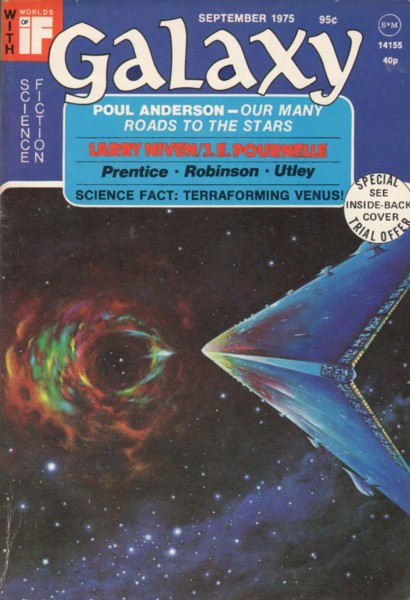
    (Cover by Stephen Fabian. Galaxy, September 1975.)

    The Story So Far

    Allen Carpentier was once a bestselling if not very respected science fiction writer, but in the world of the living he recently became a mesh of blood and bones on pavement. At a sci-fi convention he decided to impress some fans by doing a drinking challenging on a window sill, only for Isaac Asimov to come in at the last second and steal his thunder. Even if Asimov had not done what he did best, Allen still would’ve fallen to his death, in what is perhaps one of the more embarrassing ways a person can go. Almost without skipping a beat, Allen regains consciousness, soon finding himself in the Vestibule of what he comes to call Infernoland. The good news (or maybe not so good) is that he has company in this strange room, in the form of Benito, a fat balding man with a weird accent and an even weirder sense of zealotry that the agnostic Allen finds suspicious. Still, Benito has been here for a hot minute, and he’s come up with a plan for how the two of them might get out of Hell—for of course it is Hell as Benito understands it. This place is modeled after Dante Alighieri’s The Divine Comedy, and with Benito as the Virgil to Allen’s Dante, the two of them set out to escape Hell by going straight through it, ever downward, circle after circle. One of the problems here is that Allen, being a committed rationalist, isn’t even convinced that he is in Hell, but rather thinks this is all an extremely elaborate (and far-fetched) science-fictional scenario.

    Benito theorizes that Hell is one giant funnel, with the end of it being at the bottom. This sound simple, except that Allen and Benito have go through the circles of Hell, each one more painful (and weirder) than the last. So we have a start point and an end point, with a simple goal, the result being that this is a quest narrative. Allen, who doesn’t done anything particularly bad in his life, must find a way out of Hell while also figuring out why Hell (or Infernoland) is the way that it is. He meets one or two friends along the way, as in people who had died and been sent to Hell for seemingly minor infractions. We also meet a variety of cartoon characters, from food diet freaks to anti-nuclear activisits—so, in other words, the kinds of people a couple of right-wing authors wouldn’t like. It’s more complicated than that, not least because while these people the authors don’t like are being tortured, the torturing itself seems wildly disproportionate with what wrongs these people committed, and Allen himself points this out. As he says, in what has to be the most memorable line in the whole novel (if only because it gets repeated more than once, like a mantra): “We’re in the hands of infinite power and infinite sadism.” Not that there aren’t sympathetic characters in Hell, and Allen is not left alone with Benito all the time, namely that the two acquire the help of Corbett in building a glider. Unfortunately the glider doesn’t work out, so walking it is, then.

    Enhancing Image

    We’ve come to the scene in Inferno that’s probably the most (in)famous, in that it comes up as a first example of Niven and Pournelle’s biases, but it’s also an encapsulation of the novel’s leaning on bitchy SF fandom hijinks. At some point Kurt Vonnegut died in-story and got sent to Hell, although unlike every other character we’ve met so far he specifically gets special treatment, being locked up in a big monument, like he was one of the pharaohs. A sentence, one of Vonnegut’s most famous lines, is quoted ad nauseum, “SO IT GOES.” It nearly drives Allen crazy, both from the realization that he himself really is dead and in Hell, and also that Vonnegut, a fellow SF writer whom he didn’t like, has this big tomb dedicated to him in Hell. Vonnegut is not named, but it’s very clearly meant to be him. Real-life figures who appear in Inferno are generally people who’d been dead in Niven and Pournelle’s world for a good minute, whereas Vonnegut was very much alive still; but at some point after Allen went over to the other side, so did he. On the one hand, they clearly have a bone to pick with the man (as Allen says, ““If you must know, I was writing better than Vonnegut ever did before I left high school!”), but as Benito and Corbett point out, there’s also some palpable jealousy, which may or may not be reflective of the authors. Vonnegut had become a highly respected literary figure by the ’70s, and while Niven and Pournelle would write a few bestselling novels, they never even came close to that level of acclaim and acceptance.

    Now, one can go on a whole tangent about Kurt Vonnegut, his troubled relationship with SF, and also his outspoken atheism and leftist viewpoint, with how Niven and Pournelle would find all of those objectionable. But I’m not going to. Okay, maybe a little bit. I kinda have to, since I did read a lot of Vonnegut in high school and college, and he’s one of those authors who played a big role in my formative years as an avid reader, even if I don’t read him much nowadays. Keep in mind that a few of Vonnegut’s early stories appeared in the very magazine Inferno was serialized in, and also that while he tried distancing himself from SF as a literary ghetto, this didn’t stop him from appearing in Again, Dangerous Visions. To a seasoned reader who hopefully has read their fair share of “classic” literature, not just classic SF but the likes of Faulkner and George Eliot, Vonnegut can now come off as maybe too simplistic and cloying, both in his style and how he tries to boil complex morality down to simple statements. Along with John Steinbeck he’s probably the first openly leftist fiction author a young American reader would encounter. Of course, in Inferno it’s less about Vonnegut’s politics and more his mocking of religion.

    Anyway, we do meet a couple other historical figures in this installment, including a guy who claims to be Billy the Kid. The big revelation Allen has, aside from already being dead, is that nobody in Hell can die again. For better or worse. You can be put through all kinds of hideous and bloody torture, even having your skin and meat literally melted off your bones, and you will still come out of it alive; not only that, but you’ll heal so rapidly that you won’t even get to taste the sweet release of death temporarily. Allen’s party does grow over the course of this installment, although Corbett leaves and starts crawling his way back to a higher circle in Hell. You can’t really blame him, since going through this shit means, among other things, wading through a swamp of burning hot blood and being stalked by Geryon, a mythological fishman with webbed hands and feet. There are some humanoid creatures in Hell that are decidedly not human, including literal demons (black-skinned as opposed to red-skinned, though), which are scary, sure, but which also poke holes in Allen’s theorizing about “the Builders” and Hell being one giant theme park. I wanna mention that while being rather tame at first, Inferno by this point has gotten more graphic and unforgiving in its depiction of Hell. There’s gore that’s described in stomach-churning detail, and there’s even (unusually for magazine SF at the time) some pretty salty language, including a “fuck” or two. I thought at first that maybe the magazine version of Inferno is censored compared to the book version, but this doesn’t seem to be the case.

    A Step Farther Out

    You could definitely pick apart this novel, especially from a modern left-leaning perspective, but I think it’s fun! I’m willing to forgive right-wing tendencies in art if a) it achieves its goals as art, and b) there was clear thought put into it. It would be hypocritical for me to say I still love reading Yukio Mishima and Rudyard Kipling while also trashing Niven and Pournelle’s grudge against people who are really into health foods. If the novel were not entertaining and occasionally thought-provoking, things would be different. There is good right-wing art and there is bad right-wing art, although we’ve gotten so much of the latter, corresponding with the former shrinking, in recent years, that it’s easy to say all right-wing art is bad. This is understandable, especially since it seems like with a few hand-picked exceptions we simply don’t have any good right-wing artists anymore. Inferno really does feel like a novel from a different era, in that it is dated, but also it’s unserious in a way that most science-fantasy novels dare not be nowadays, or so it seems to me. I could be biased.

    See you next time.

  • Short Story Review: “The Old Nurse’s Story” by Elizabeth Gaskell

    November 10th, 2025
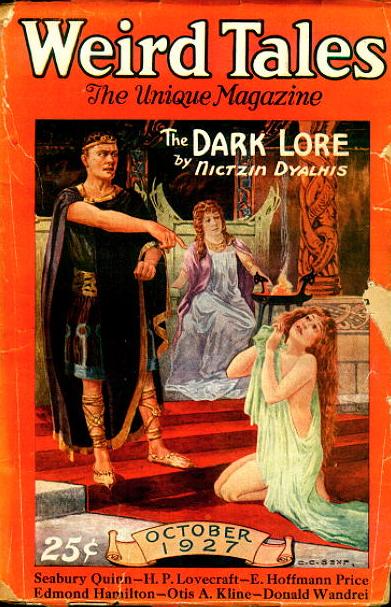
    (Cover by C. C. Senf. Weird Tales, October 1927.)

    Who Goes There?

    Here we have one of the most respected Victorian writers, if also perhaps underread to this day, with Mrs. Gaskell. A lot of her work was, even after her dead, accompanied with the byline of “Mrs. Gaskell,” but Elizabeth Gaskell was very much her own woman. She was born in 1810 and was close contemporaries with the likes of George Eliot and the Brontë sisters, to the point of being close friends with Charlotte Brontë and writing the first major biography of her. Gaskell was also an accomplished novelist, in part helped by her friendship with Charles Dickens at a time when Dickens was the most popular author in England. “The Old Nurse’s Story” was itself first published in the Christmas 1852 issue of Household Words, a magazine Dickens was editing at the time. While she’s not as popular now as Eliot or the Brontë sisters nowadays, her novels, especially Cranford, North and South, and the sadly unfinished (on account of Gaskell dying suddenly just before she could write the ending) Wives and Daughters, are very well-liked. Her biography of Charlotte Brontë, whilst now being acknowledged as a biased account, also guarantees her a spot in Victorian literature that will probably always be considered worth remembering.

    Gaskell, aside from writing novels about social justice (namely the downtrodden lives of those living in the newly industrial parts of England) and more personal topics, partook in what was becoming a fine tradition among British (and to a lesser extent American) writers: the ghost story. In the years long before Fortnite and even the internet, long before even the horror story got walled off and put in its own genre ghetto, it was quite common for “literary” authors in the Anglosphere to write spooky tales of the supernatural, especially with the intention of them being read aloud at Christmastime. Ya know, for the fun of it. “The Old Nurse’s Story” is a very good example of such a tale, as well as being a Gothic narrative in the most classic sense. While the Gothic novel had waned in both popularity and works being written by the 1820s, the Gothic short story picked up the pieces a couple decades down the road.

    Placing Coordinates

    First published in 1852 and reprinted in the October 1927 issue of Weird Tales. It’s also been reprinted in The Fontana Book of Great Ghost Stories (ed. Robert Aickman), The Gentlewomen of Evil: An Anthology of Rare Supernatural Stories from the Pens of Victorian Ladies (ed. Peter Haining), Minor Hauntings: Chilling Tales of Spectral Youth (ed. Jen Baker), The Valancourt Book of Victorian Christmas Ghost Stories (ed. Tera Moore), The Penguin Book of Ghost Stories: From Elizabeth Gaskell to Ambrose Bierce (ed. Michael Newton), and the Gaskell collection Curious, If True. Because it’s very old and very public domain, you can find it online easily.

    Enhancing Image

    Hester, the titular nurse, relates to us (in the position of Rosamond’s children) the story of a particularly strange and traumatic series of events in both their lives. Rosamond, now a grown woman and a mother, was once a child in Hester’s care, at first part of the time and then full-time, following the deaths of both of Rosamond’s parents. Her father died of fever while her mother died shortly after childbirth, to a stillborn baby which would’ve been Rosamond’s younger sibling. (Sounds dramatic, I know, but it would not have been so unusual back in those days.) On her deathbed the mother makes Hester promise to look after the little Rosamond, although really she didn’t have to say anything about that, for “if she had never spoken a word, I would have gone with the little child to the end of the world.” Hester, herself barely an adult at this time, is made to be both Rosamond’s nurse and surrogate mother whilst the two are taken in by the Furnivalls, that is Rosamond’s mother’s relatives. After that slightly convoluted prelude, we find ourselves at Furnivall Manor, the big spooky mansion where the rest of the action is to take place. Given that the framing device sees Hester and Rosamond alive and in good health, we can safely assume that they will come out of these spooky happenings more or less fine, but then we’re not reading this story for the question of if Our Heroines™ will persevere, but rather how. That Hester is also telling us this story in first-person, in a conversational tone, gives the impression that this is a story one should read aloud to an audience, perhaps on the night before Christmas.

    (Of course, I say “conservational,” but this is by the standards of mid-Victorian speech, which is more verbose and long-winded than what we’re used to nowadays. Let’s say that Gaskell, in a way not untypical for her time, likes to abuse the semi-colon.)

    Furnivall Manor is home to four old farts, namely Grace Furnivall, her maid “and companion” Mrs. Stark, and James and his wife Dorothy. The only exception is Agnes, the one servant in the house who does not have a close relationship with anyone else. As for the current Lord Furnivall, he’s always away from the manor, and I don’t think we ever see him. The west drawing-room is open, but the east drawing-room is locked shut and nobody ever goes in there, for reasons Ms. Furnivall refrains from giving. It doesn’t take long at all for us to find that this mansion has a dark family secret, and we can infer this straight from the fact that Ms. Furnivall had an older sister who died many years ago, from decidedly unnatural circumstances. There’s also eerie organ music that plays in the halls at night, despite there being no one playing the instrument and everyone having gone to bed. Oh yeah, “The Old Nurse’s Story” wastes no time in getting to the good stuff. In fact, despite its length, this is by no means slowly paced, but rather is as long as it is because of Gaskell’s style that she uses here, where there’s no stone left unturned and paragraphs tend to go on for nearly a page at a time. There’s a whole family history delved into here, in a story that’s only about 25 pages, much like in Poe’s “The Fall of the House of Usher.” But whereas “Usher” has to do with a rich family dooming itself via an incestuous streak, the Furnivalls are cursed from a combination of pride and jealousy. Just how exactly these sins play into the ghostly proceedings, we will soon see, for as I said, it’s a question of how the manor is haunted.

    For one, we know (or rather are told) that Old Lord Furnivall loved music, both to hear and to play it, and also that he was quite the bastard when he was alive. He apparently mistreated his two daughters, Maude and Grace, although just to what extent we can’t say for sure. We know that the Furnivalls are dominated by pride in their wealth, or at least the appearance of wealth, even in the living relatives, to where James can’t help but look down on his wife Dorothy a bit for having been a farmer’s daughter. Rosamond’s own mother, despite being from a high-born family, had chosen to marry a man of the cloth (I believe it was Anglican, not Catholic, kinda goes without saying), who while virtuous also didn’t make much money. Class figures greatly into “The Old Nurse’s Story,” both thematically and even how it plays a major role in the underlying conflict. This is unsprising, given that Gaskell, like Dickens, was politically progressive, despite being actively religious (specifically she was a Unitarian Christian). The idea that one can be both a practicing Christian and decidedly on the political left may sound far-fetched now, but believe it or not, such strange creatures can occasionally be found in the wild to this day. As for the characters in the story, religion doesn’t play much of a role; but still there’s a palpable class tension between the modest Hester and Rosamond and the rather haughty upper-class Ms. Furnivall and Mrs. Stark. And then there are the ghosts, who are a different matter entirely. There’s Old Lord Furnivall at his organ in the dead of night, and more distressingly there’s a child, slightly younger than Rosamond, who prowls the frosty manor grounds…

    (It’s worth mentioning that Hester says winter has hit the manor when it’s only October, which sounds weird, but it’s also worth mentioning that in the northernmost part of England the murderous chill of winter would have set in quite early in the year.)

    The first big scare, and the most effective (mostly because it’s something that can happen in real life), is when Rosamond goes missing one day, and it’s both frightfully cold and snowing outside the manor. Hester nearly scares herself to death with fright in trying to find Rosamond, who herself is only rescued thanks to a farmer who lives not too far from the manor, the child nearly frozen to death. Yet strangely Rosamond is not scared of what she found in the snowy outdoors, namely a child who beckons Rosamond to come play with her. The child is obviously a ghost, and is implied not to be leading Rosamond to her death out of malice, but rather out of loneliness, not being fully aware of what she’s doing. It’s unclear if the ghost child is even aware that she’s a ghost. But between the ghost child and the ghost of Old Lord Furnivall, there are a few spirits lurking at the manor that have not yet been laid to rest. Ms. Furnivall has been keeping a secret all these years, and despite being somewhere in her seventies and being deaf enough that she has to use a horn, she’s not too feeble to confess a wrongdoing of the past. Again it’s worth observing that Rosamond is saved by a man of low stature, and that Hester, being merely a nurse-maid, is unequivocally the most heroic figure in the story—which is not to say that all the low-born characters in the are story are virtuous. Gaskell generally sides with the working class, but her view of individual virtue and how it relates to class conflict is more nuanced, as we are about to discover.

    There Be Spoilers Here

    Back when they were young, Maude and Grace Furnivall were the starlets of the manor and two fine ladies from that part of the country. Old Lord Furnivall wanted nothing less than the best for his daughters, although when I say “the best” I specifically mean the best in terms of status. Only a man with high enough status is deserving of either of these sisters, which doesn’t stop the ladies from having ambitions of their own. There was a time when a “dark foreigner” would visit the manor from abroad once a year, being a talented musician but naturally also one who was not rich. Old Lord Furnivall admired the man’s talent, and also loved to have the foreigner listen to his own playing, but he probably would not have approved of the musician marrying one of his daughters. This didn’t stop the musician from “walking abroad in the woods” (going on walks between man and woman was like going on a date) with each of the sisters at different points. The musician and Maude got married in secret and the musician knocked her up. Maude managed to hide her pregnancy and even to raise her daughter, under the guise that the child was a charity case from some working-class home. But the musician had skipped town, never to return, and Grace was the only other person who knew the secret; so, in a moment of fiery jealousy, she ratted out her sister to their father, who was not pleased. Maude and her child were evicted from the manor, with her later being found under a tree, crazed and nearly frozen to death, her child dead in her arms. Maude died not long after that, and the guilt never left Grace.

    Hester coming to the manor with Rosamond reopened a wound that seemed to have nearly healed, or at least would have probably died along with Ms. Furnivall. The climax is theatrical, and if I had a gripe with this story I think the final confrontation is a bit overblown, compared to what came previously, although the very end is haunting. Having confessed to what she had done to Maude, Ms. Furnivall has lifted the curse from the manor and placed all on her own shoulders. There’s peace for everyone else, but not for her. She dies in her bed shortly after, in agony, with the words: “Alas! alas! what is done in youth can never be undone in age! What is done in youth can never be undone in age!” It’s a pretty bleak ending, the only thing preventing it from being a total downer being that Hester and Rosamond come out of the ordeal in one piece. If we can infer from the framing device, Rosamond (although we hear not a word from her adult self) has not repeated the mistakes of her relatives.

    A Step Farther Out

    I had read this one only yesterday, and part of me wishes I got to sat it on longer. This is a story that requires some retracing of steps and understanding the whole of it in order to better appreciate. The syntax Gaskell uses here also takes some time getting accommodated with, but this is coming from the perspective of someone who hasn’t read that much Victorian literature. While the walls of text and the convoluted family dynamics can be a bit intimidating, I do very much recommend seeking out “The Old Nurse’s Story,” especially if you’re into ghost stories by the likes of Robert Aickman and M. R. James.

    See you next time.

  • Serial Review: Inferno by Larry Niven and Jerry Pournelle (Part 1/3)

    November 7th, 2025
    (Cover by Ames. Galaxy, August 1975.)

    Who Goes There?

    Niven and Pournelle had similar temperaments and politics, but their career trajectories were a fair bit different. Larry Niven emerged as arguably the best new hard SF writer of the ’60s, after being discovered by Frederik Pohl, winning a Hugo for his story “Neutron Star” and appearing in Dangerous Visions. Despite being just the kind of writer John W. Campbell would want, at least on paper, Niven stuck to Pohl’s magazines, and even appeared several times in F&SF. Niven’s biggest contribution to SF is undoubtedly his Known Space universe, in which mankind inhabits the galaxy alongside several intelligent alien races, most famously the Kzinti, a warmongering catlike race that are technically also canonical to the Star Trek universe. Niven’s most famous novel, Ringworld, also won a Hugo (and a Nebula), and served as an influence on the Halo franchise. (The titular halos are basically like Niven’s ringworld, but smaller and serving a different function.) Jerry Pournelle took a bit longer to go pro than Niven, despite being a few years older. He had been active as a fan since at least the early ’60s, but didn’t appear professionally in the field until 1971, just in time to have his first stuff bought by Campbell’s before the latter’s passing. Pournelle has his own ambitious universe, called the CoDominium universe, involving a future history that very much takes after those by Robert Heinlein and Poul Anderson. Eventually Pournelle stuck more to writing nonfiction rather than fiction, although he still collaborated with Niven sometimes, with their novels often being bestsellers.

    At the time that Inferno was published, it came between two of Niven and Pournelle’s biggest successes, those being The Mote in God’s Eye (set in the CoDominium universe) and the massive standalone Lucifer’s Hammer. Despite being much shorter than these novels, Inferno is considerably more obscure, maybe because it’s harder to get a read on in terms of its genre. It’s been labeled at different times as SF and/or fantasy, being serialized in Galaxy (granted that Galaxy occasionally published fantasy) and with Jim Baen himself calling it SF, but with other sources calling it a fantasy novel. So, let’s call it science-fantasy. Obviously this is a riff on Dante’s The Divine Comedy (says someone who has not read The Divine Comedy yet), but also with a heavy metatextual element. Contemporary reviewers in the genre magazines also ignored Inferno, inexplicably, which didn’t stop it from getting Hugo and Nebula nominations.

    Placing Coordinates

    Inferno was serialized in Galaxy, August to October 1975. It was published in book form the following year, supposedly expanded although I can’t imagine by much. It seems to still be in print.

    Enhancing Image

    Allen Carpentier is dead, to begin with. Allen (I’m gonna be calling him by his first rather than last name) has died, in what has to be one of the more embarrassing ways someone can die. In life he was a bestselling (although not that respected) science fiction author, and the first scene he recounts is that at some unspecified science fiction convention. By the way, his real last name is Carpenter, but he added the i so as to appear more distinctive on book covers, although even in his internal monologue he refers to himself as Carpentier. Well, he was an author, and historically there’ve been a lot of hijinks at conventions like these, some more innocuous than others. Allen takes part in a bet, or you could say it’s a drinking game. He’s to finish a fifth of rum while sitting on an opened window sill, some eight stories above ground level. Not only does he fail the bet, falling to his death, but nobody even sees him do so, since the crowd got distracted by Isaac Asimov (I’m not kidding) entering the scene and naturally hogging all the attention. That Asimov is depicted as an egomaniac is accurate enough, although his penchant for sexual harassment (something which at this point was kind of an open secret) goes unmentioned.

    For a while Allen finds himself miraculously conscious but without any of his senses. He is somehow nowhere at no particular point in time, but soon he really wakes up to find himself in the Vestibule, in Hell. Well, it’s supposed to be like Hell, although Allen is not convinced that it’s the real deal. He would be totally lost if not for the help of a fat, balding, middle-aged, and “Mediterranean” man who simply calls himself Benito. Both Allen and Benito are very much aware of Dante’s epic poem, although Allen is irreligious while Benito seems to be some flavor of zealous Christian, and as such they have very different interpretations of the situation. Benito thinks that they’re really in Hell, of course, as modeled after Dante’s version of it, whereas Allen thinks they’re in a man-made reproduction of said version, which he decides to call Infernoland. Allen takes on the position of Dante (the self-insert character, not the author) while Benito takes on the role of Virgil. This implies a couple things: that Allen is himself a self-insert for the authors, and that Benito, like Virgil, is a real historical figure. I’m gonna hold off on saying it outright, but who Benito is supposed to be has to be this novel’s most poorly kept secret. It’s apparently supposed to be a twist, but I’ve seen at least one reviewer casually give that away. It’s not hard to figure out, though, and knowing the answer makes Benito’s interactions with other characters, along with the authors’ implicit view of him, a lot more… let’s say awkward. I have some thoughts.

    Similarly to Allen thinking of Infernoland as like a theme park, the novel itself feels like a darkly funny theme park ride, rather than a serious novel. Actually, from what I can tell, it seems like people who’ve read Inferno have a bad habit of taking it a little too seriously. More understandably your enjoyment of this novel will depend on a) your sense of humor, and b) how much you can tolerate Niven and Pournelle’s “I just wanna grill, for God’s sake!” conservatism. Just like how the real Dante used his epic poem to rag on people and historical figures he didn’t like, Niven and Pournelle use the setting of their novel as a pretext for taking potshots at certain types of people, and even occasionally named individuals. Granted that I’m only a third in so far, I was expecting worse. Some of the authors’ targets are what you’d expect from a couple of right-wingers (there’s a scene where they poke fun at treehuggers), but their targets aren’t always people on the so-called left (scene with said treehugger also depicts a real estate yuppie type just as unflatteringly). The people that Allen and Benito find in Infernoland are not necessarily “bad” people either, but often people who simply indulged in one of the deadly sins too much. While in the circle for gluttons they meet Jan Petri, whom Allen was friends with in life, Petri having died suddenly some years before. Petri is a decent guy, except he’s also one of those people who’s neurotic about dieting, which, as Benito (if I remember right) points out, is its own kind of gluttony. There’s also the first circle of Infernoland the two men go through, which the inhabitants see as purgatory, and indeed it’s not half bad an existence. The first circle includes people who died without having heard of The Word™, as well as unbaptized children. Allen is understandably disturbed by all this, but he’s also of the mind that really these people are robotic doubles of real people.

    At this point, Inferno could be considered fantasy but as envisioned by writers who normally write science fiction. Allen writes (or wrote) SF, and being a rationalist he tries to find a non-supernatural explanation for Infernoland—even if the explanations he comes up with may as well be magical. He thinks of Infernoland as an incredibly ambitious theme park, one not made for entertainment but for the sadistic pleasure of “the Builders.” Allen doesn’t seem to believe in the God of Abraham, but rather he finds it easier to believe that Infernoland was made by a kind of demiurge, or a team of human-hating demigods. The absurdity of Allen trying to find a “natural” explanation for Infernoland when a supernatural explanation would do just as well says something about the religious stances of the authors, although it’s a bit complicated. Pournelle was a practicing Catholic while Niven is an atheist, but both men took a materialist stance on things, with Pournelle (as far as I can tell) keeping his religious beliefs walled off from his nonfiction writing. It’s worth mentioning that Pournelle, along with being friends with Niven, was also good friends with H. Beam Piper, who was also an outspoken atheist. Of course, science fiction has a long history of authors who are, if not agnostic or atheistic outright, prone to keeping their religious leanings on the sidelines when it comes to their work. Obviously there are some notable exceptions, but the idea that one need not be a Catholic or even a Christian to “get” Inferno.

    There Be Spoilers Here

    The back end of this installment is basically a quest, in which Allen and Benito try to build a glider from scraps that they might fly a high rim wall, by which they might be able to escape Hell. Assuming there’s anything “outside” the wall. How this will turn out, we don’t know—or at least Allen doesn’t know. We can safely guess the glider will not work, because we still have two installments to go. This is like when a movie tries tricking you into thinking it’s about to end, but you’re watching it on streaming or home video so you can look at the time stamp and know it’s LYING. At least the making of the glider, including Benito conning a not very smart desk worker (there is, of course, bureaucracy in Hell), is fun.

    A Step Farther Out

    I’ve seen some pretty mixed opinions on Inferno, but I’m enjoying it so far. Not sure why Niven and Pournelle felt it necessary to write a sequel thirty-odd years later, given that this feels like very much a standalone. While the setting is big, there’s also only so much you can do with it, at least with these two particular characters. You can only do the “sci-fi author doesn’t believe he’s in a fantasy world” routine for so long. For a comedy, which Inferno more or less is, you don’t wanna overdo a joke. I can see why the book version’s only about 240 pages, compared to the behemoths that came before and after it, since it’s meant to be more lightweight.

    See you next time.

←Previous Page
1 2 3 4 5 6 … 43
Next Page→

Blog at WordPress.com.


Loading Comments...
 

    • Subscribe Subscribed
      • Science Fiction & Fantasy Remembrance
      • Join 139 other subscribers
      • Already have a WordPress.com account? Log in now.
      • Science Fiction & Fantasy Remembrance
      • Subscribe Subscribed
      • Sign up
      • Log in
      • Report this content
      • View site in Reader
      • Manage subscriptions
      • Collapse this bar