Who Goes There?
I don’t think I’ve read anything by Alan E. Nourse prior to today’s story, which isn’t surprising since his work seems to have fallen massively out of print, to the point where a decent portion of it has also fallen out of copyright. Nourse was one of many SF writers who came about in the early ’50s, some very young people (well, mostly men) who took advantage of the ballooning magazine market. It also helped that for some reason there were a lot of very talented writers, including Philip K. Dick, Robert Sheckley, and Algis Budrys, who were too young to have seen action in World War II but who had entered the field at almost the exact same time. By far the most productive period for Nourse was in the ’50s; once the balloon popped he mostly stopped writing SF, presumably to focus on his respectable day job as a physician. “Prime Difference” is very Galaxy and very 1950s, for both good and ill; it’s not exactly a forgotten gem, although it apparently warranted enough attention to get an X Minus One adaptation. It is on the one hand a deeply of-its-time story when it comes to its gender politics, but also those same gender politics are the point of the whole thing, rather than merely a byproduct of when Nourse wrote it.
Placing Coordinates
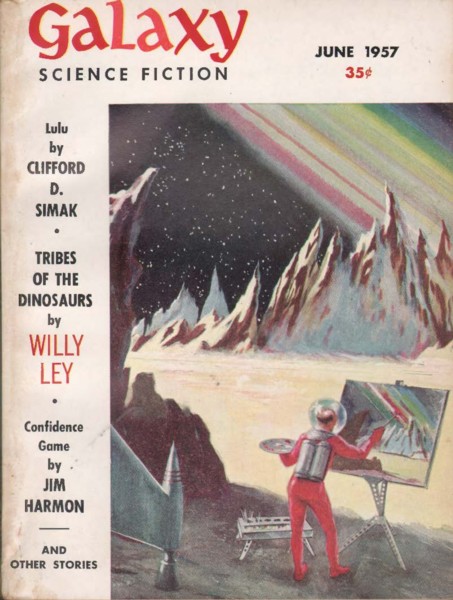
First published in the June 1957 issue of Galaxy Science Fiction. It remained stuck there for six decades before someone transcribed it for Project Gutenberg. I guess the copyright ran out.
Enhancing Image
George and Marge’s marriage is on the skids, but then it’s been that way for almost eight years now. It’s painfully obvious, at least to George, that it would be best for the best of them if they got a divorce, “but with the Family Solidarity Amendment of 1968, and all the divorce taxes we have these days since the women got their teeth into politics, to say nothing of the Aggrieved Spouse Compensation Act,” it wouldn’t be financially a good idea. I knew, from the first goddamn sentence, that this was gonna be one of those stories. Reading ’50s SF, there are some things you have to keep in mind if you wanna adapt to the somewhat different literary environment. Misogyny is rampant, although not the same sort of misogyny one would find in New Wave SF a decade later, which was more sexually explicit and in some ways somehow more revolting (to my sensibilities, anyway) than what you’d find in the average ’50s SF story. Marriage sucks, right? If you’re a white middle-class fellow in 1957 then marriage might be your top concern, along with tax season. It was the age of John Cheever, John Updike, and John O’Hara. A lot of Johns. It was the age we started to get the signature Ingmar Bergman drama. Marriage between dreary heterosexuals was the order of the day. What’s strange about the future as depicted in “Prime Difference” is not only that it’s completely the opposite of how gender relations in the ’60s would turn out, but also that it would perceptive in a totally different and unexpected way. See, George says that “the women” getting into politics made it harder for divorce proceedings, which… if anything is the opposite of what women in politics would want. Unless they’re conservative women. Of course this was before the birth control pill and second-wave feminism, and apparently Nourse did not suspect such a thing was gonna happen in just a few years; but at the same time he posited that white conservative women with money would pose a bigger problem than “the feminists.” This is a pretty thorny story, because George is a thorny and rather unlikable character, but it also argues in favor of no-fault divorce.
Then there are the Primes, which are lifelike robots, basically perfect replicas of their human counterparts—and illegal. It makes sense that robots that can pose as normal humans would be outlawed, given the possible repercussions, although how technicians in the black market are able to afford the resources, let alone build these things, is left up in the air. George is desperate to take a siesta from his wife and he finally gets to the point where he orders a Prime—specifically a Super Deluxe model, which is I guess more lifelike than the standard. Looking at George Prime, George can’t even tell the two of them apart. “The only physical difference apparent even to an expert was the tiny finger-depression buried in the hair above his ear. A little pressure there would stop George Prime dead in his tracks.” Put a pin in that. Now, I must confess that I found a stretch of “Prime Difference” to be a bit of a chore, in no small part because of how Nourse decided to tell it. George is the protagonist by virtue of being the perspectice character, “Prime Difference” being written in the first person. The problem is that George is a gaping asshole. He is! And not in an endearing or even often an entertaining way. This may well be the point (it probably is), but then why force us to tumble around inside this man’s head? It would’ve been more bearable, and its ending (which I do like) would’ve had more impact, had Nourse written “Prime Difference” in the third person. We also would’ve been able to understand Marge more, who as of now is given minimal personality. The idea is that George Prime will at times serve in the real George’s place for when the latter wants to go around fucking other women take a break from Marge, and Marge will not know the difference. The “problem” is that George Prime is so good at being the real thing that he’s actually superior to the real George in every way. You’ve seen this sort of plot trajectory with stories about androids before.
There Be Spoilers Here
That George Prime has been loving up on Marge, to the real George’s growing concern, is unsurprising; what’s more surprising is that Marge has had her own plan this whole time, albeit off the page. The ending implies that in a sense George and Marge were made for each other, in that they’re both conniving neurotics, but we only see one side of the story. “That Marge always had been a sly one,” George thinks once he realizes what she’s done, having run off with George Prime and replaced herself with Marge Prime, but we never get to see how that even could’ve happened. Of course George is only able to tell it’s a Prime by feeling for the little dent on Marge Prime’s head; that he figures it out pretty much immediately is a consolation. This is one of two possible endings I had anticipated, the other being that Marge finds out about the Prime and proceeds to kick George out of the house. But this way, everyone more or less gets what they want. Their marriage is “saved.” Mind you that Nourse was married for a few years at this point, although being in what I have to assume is a happy marriage doesn’t stop one from being a pessimist about the institution.
A Step Farther Out
Would I recommend it? Not really. It’s a frustrating read, even when compared to other stories about robotics from the period. Nourse wrote so much during the ’50s, though, that it’s quite possible that I caught him on an off day, or that readers thought well of “Prime Difference” at the time but time has not been kind to it.
See you next time.

 Science Fiction & Fantasy Remembrance