
Who Goes There?
When Stanley G. Weinbaum died from cancer in December 1935, at the age of just 33, he was maybe the most beloved author in the field at the time, only rivaled by E. E. Smith and maybe John W. Campbell under his Don E. Stuart pseudonym. Certainly his rise to prominence was speedy and brilliant as could only have been challenged by Smith’s debut. Weinbaum made his own SF debut (he had written some non-genre work before this) with “A Martian Odyssey,” in the July 1934 issue of Wonder Stories, this one story basically rewriting the book on alien life in SF. With this story and its sequel, “Valley of Dreams,” Weinbaum became like a god to the niche world of magazine SF practically overnight. He wrote prolifically for the magazines, especially Astounding, over the next year or so, so that despite having been active in the field for a shockingly brief amount of time he had written a thick volume’s worth of short fiction. Reading Weinbaum now, he comes off as “quaint and quirky,” as Alexei Panshin put it in his review of The Best of Stanley G. Weinbaum, but there’s a childlike appeal to Weinbaum that serves as an alternative to the super-serious and downbeat SF that has saturated the market in the decades since his death.
Funnily enough, Weinbaum never appeared in Amazing Stories during his lifetime, presumably because even by 1935 it thoroughly played second fiddle to Astounding. I’m not sure when T. O’Conor Sloane got his hands on “Shifting Seas,” as while it took Sloane an infamously long time between him receiving a story and doing anything with it, I doubt Weinbaum himself had sent this story to this particular magazine. Several of Weinbaum’s stories, including a couple novels, were published after his death, but I’m not sure how his estate would’ve handled his work. The thing with Weinbaum is that his magazine stories can be more or less put into one of two categories, as either a contemporary “gadget” story or a space adventure having to do with exotic alien life. “Shifting Seas” is an outlier in that it doesn’t fit into either of these categories, but is instead a climate catastrophe story with a good dose of political intrigue. It’s interesting and a bit odd, but it’s certainly not what I would suggest for one’s first Weinbaum.
Placing Coordinates
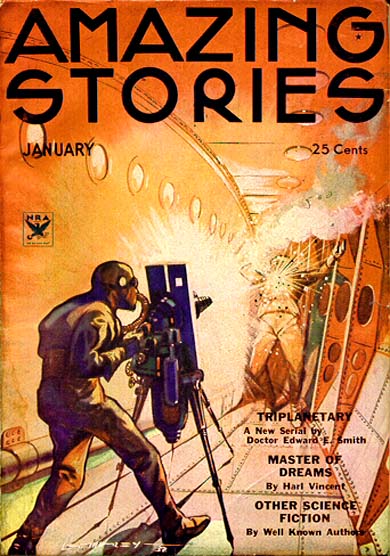
First published in the April 1937 issue of Amazing Stories. It was first reprinted in the Weinbaum collection The Red Peri, and has since also appeared in the collections The Best of Stanley G. Weinbaum and A Martian Odyssey and Other Science Fiction Tales.
Enhancing Image
Ted Welling happens to be at the right place and at the right time, in the sense that he’s in the air, in a “Colquist gyro,” taking aerial photos when disaster his the isthmus connecting North and South America. Had he been on the ground when that lethal combo of earthquakes and volcanic activity hit, he would’ve died along with the million and a half people who ended up perishing. This incident, which is quite literally earth-shaking and would go down as one of the worst natural disasters of the 20th century, will have geological and even political implications in the long run. Even with his flying contraption, Ted barely makes it out of the whirlwind of smoke and ash, landing in Honduras (still a British colony at the time) and realizing that the strip of land, the isthmus, had sunk into the sea. The short-term consequences of this are apparent enough, but it’s only once the world’s attention has turned to this catastrophe and scientists have studied this literal sea change that an even bigger problem emerges. The sinking of the isthmus has changed the trajectory of the Gulf Stream, which, to make a long story short, spells very bad news for the British isles and mainland Europe. While North America will come out of this mostly unaffected, Europe is looking at a sort of ice age, to the extent that millions will die if they don’t evacuate. But to where? That is the main conflict.
There are actually two conflicts in “Shifting Seas,” but before I get to the second one, I wanna talk about the unusual politics and racism of this story. Something I think worth mentioning is that Weinbaum was white, but he was also Jewish, at a time when Jews in America (and Europe, it should go without saying) faced persecution on a systemic level. I think it was Sam Moskowitz who said Weinbaum was the first Jewish magazine SF writer to get published under his own name—a little factoid that’s pretty easy to take for granted now. There’s some racism in “Shifting Seas,” but I’m unsure how much of it is really just Weinbaum depicting the average WASP’s way of thinking or if it reflected his own racism. The deaths of over a million Hispanics at the story’s outset is treated by the white cast as bad, but not that bad, while, in the midst of discussing countries capable of housing European refugees, India’s dismissed as “hopelessly overcrowded.” The stereotype of India being a hive of unwashed masses and too many babies to feed goes back a long way. On the other hand, these countries of the third world are also counted as “civilized” by the third-person narrator, and for reasons that have since been totally lost to time, Japan is put on about the same level as the European empires. I assume this story is set in the 1930s, but that does raise some questions, like, How come no mention is made of the Nazis? Or Italy having turned fascist? Obviously Weinbaum would’ve been aware, which makes their absence all the more conspicious. Maybe this all takes place in a similar but alternate timeline.
Now, as for the love story, because there is one. The large-scale problem is with half of Europe freezing to death, but the small-scale problem is between Ted and Kay, his British wife-to-be. By the standards of ’30s SF, Kay is actually a well-drawn female character, if only because she isn’t helpless, nor is she hopelessly obsessed with her fiancé. She’s a fairly independent woman who unfortunately has been handed the worst of scenarios, seeing as how her home country and family there are facing extinction levels of crisis. She can marry Ted and stay in America, but that would be like a band-aid or splash of disinfectant on a gunshot wound. The crisis of immigration and moving some 200 million people, with countries’ allegiances changing in all this, understandably strains their relationship. Sure, Kay is highly emotional and says some rather strange things, especially as we reach the story’s climax, but it’s hard to blame her, given the circumstances. As for Ted, he—well, he exists. He’s a pretty vanilla pulp hero, although he’s by no means an action star. Hell, there’s not really any action in the conventional sense; instead it’s people talking in a bunch of rooms, plus passages about the worsening climate as if ripped from newspaper clippings. Of course, we’re not here for the characters, and even the romance drama between Ted and Kay is merely there to give us a more on-the-ground perspective of the larger conflict. Weinbaum is not very good at writing human characters: he’s better at describing places or aliens. We don’t get aliens here, but we do get a radically different version of life on Earth.
There Be Spoilers Here
Part of me was hoping there would be no easy solution, but Weinbaum, for better or worse, has a knack for meeting his strange SFnal problems with equally strange SFnal solutions. The ice age ravaging much of Europe ends up being short-lived, at least in the grand scheme of things. Indeed the issues of immigration and xenophobia that Weinbaum raises are way more intriguing than his playing with tectonic plates, ocean currents, and all that. “Shifting Seas” is a fine story, but it would’ve been even better had its author paid more attention to the real-world political issues he raises. Like how does Russia being communist (well, “communist”) relate to its treatment of refugees, or its hostile relationship with imperial Japan? The latter only gets mentioned in passing, and honestly you could read this story that was written circa 1935 and have no idea the USSR was a thing. Or Nazi Germany. The lack of a Nazi Germany or any mention of Hitler still strikes me as strange and inexplicable. I would’ve loved to get Weinbaum’s reasoning for these decisions, but not only has he been dead for almost a century, he was already dead when “Shifting Seas” was published. We don’t eve have any interviews with Weinbaum; the only thing of real substance we have by him about himself is an autobiographical sketch.
Read said sketch, which is included in A Martian Odyssey and Other Science Fiction Tales, Weinbaum comes off as well-read, shrewd, somewhat cynical, and quite intelligent. A passage that stuck out to me is the following, where Weinbaum talks about magazine SF:
[Science fiction] can criticize social, moral, technical, political, or intellectual conditions—or any others. It’s a weapon for intelligent writers, of which there are several, but they won’t practice its use.
Oh, a few have tried it. Dr. Keller does it well occasionally, and Miles J. Breuer did it magnificently once or twice. Dr. Bell (John Taine) touches on it at times, but won’t descend to practical suggestions. And by far the most of this sort of writing, when couched in the usual form of satire, is heavy, obvious, and directed at unimportant targets. No one has attempted it on the scale of [Edward] Bellamy [author of Looking Backward], who actually did criticize world social conditions in the form of a science fiction story, and presented a sort of solution.
“Shifting Seas” seems to criticize Europe’s xenophobic streak, and how said xenophobia (its collective persecution of Jews especially would’ve struck Weinbaum as no doubt concerning) might contribute to another war on that continent (something Weinbaum would be sort of right about, although he died years before World War II), but unfortunately it stays at the level of implication without much in the way of exploration. Even more unfortunate is the fact that while Weinbaum was prolific, he also died young, through no fault of his own, before he could hone his craft much. He wrote SF professionally for only a couple years, so that if anything “Shifting Seas” reads like a rough draft of a more ambitious and mature work we never got to see. The solution here is too clean, given how messy the problem is, which indicates a talent that’s promising but still in need of failures and trials. We never got to see that with Weinbaum.
A Step Farther Out
If “Shifting Seas” commits a huge sin at all, it’s that it doesn’t show Weinbaum quite in his natural habitat. What made Weinbaum so unique among his peers was that he wrote aliens who could think and act as well as humans, but who were decidedly not human in any recognizable sense. Or in his less serious stories, those set on Earth, he introduces a nifty gadget or puts a new spin on an idea that went back to H. G. Wells. Jack Williamson or Edmond Hamilton could probably not have written “A Martian Odyssey” or “The Lotus Eaters,” but a Williamson or Hamilton could have feasibly written “Shifting Seas.” As such, this is an outlier both in its subject matter and where it was first published. Maybe the next time I write about Weinbaum I’ll do something more in-character for him.
See you next time.


 Science Fiction & Fantasy Remembrance