
Who Goes There?
Kristine Kathryn Rusch has had a far-ranging career over the past 35 years, as both author and editor, even winning a Hugo for the latter in editing The Magazine of Fantasy and Science Fiction. I feel bad that not being fond of today’s story, as I know Rusch can at times be a pretty good writer, and her contributions to the field have been pretty considerable, albeit understated. Before she took on editorship of F&SF (in so doing becoming that famously egalitarian magazine’s first female editor), she edited the experimental book-magazine hybrid Pulphouse: The Hardback Magazine, which printed a wide range of genre fiction, including early stuff by those who would later break into the literary “mainstream” like Jonathan Lethem. She’s also been writing fiction, mostly SF but occasionally horror as well (the latter sometimes also bleeding into the former when it comes to Rusch), since the late ’80s, making her one of those people in the field who can say she’s adept at judging other people’s works while also submitting her own. She can take as good as she gives. Today’s story is uncharacteristically optimistic for Rusch, which unfortunately is to its detriment.
Placing Coordinates
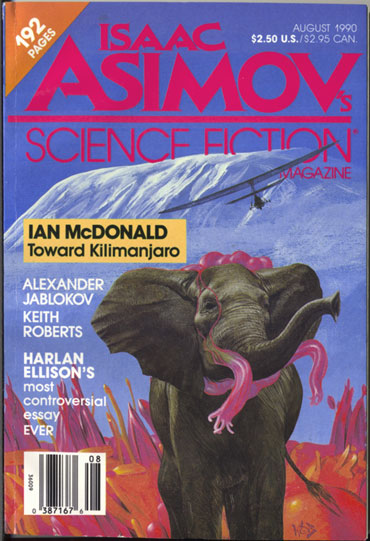
First published in the February 2007 issue of Asimov’s Science Fiction. Despite the awards attention, this has been reprinted in English only twice so far, in the Rusch collection Recovering Apollo 8 and Other Stories and as a chapbook from WMG Publishing.
Enhancing Image
As you may or may not know, Apollo 8 was the first manned space flight to reach the moon, although not to land on it. The mission happened around Christmastime, as the astronauts Frank Borman, James Lovell, and William Anders orbited the moon ten times before turning to Earth. They spent that year’s Christmas in what from today’s perspective looks to be a giant tin can. The mission was of course a success, as it had to be, this being not quite two years after the tragic Apollo 1 accident which killed its crew, as well as nine months after the no-less tragic death of celebrated Soviet cosmonaut Yuri Gagarin. “Recovering Apollo 8” then asks the simple question of what might happen had the Apollo 8 mission failed, that there had been a miscalculation that resulted in the ship missing the moon’s orbital pull, and that the men on board would be left presumably to die. There is no rescue attempt as NASA does not have the technology yet, so the men’s fates are sealed. A young Richard Johansenn, a character of Rusch’s own invention, witnesses the mission go wrong and vows to spend the rest of his life contributing to the rescue of these men—or what’s left of them. His secondary goal is to do what he always wanted to do, which is to voyage out into space. He’s the sort of person who does a thing once he’s set on it.
“Recovering Apollo 8” is such a cheery fucking thing that I’m surprised it wasn’t printed in Analog. Richard is a basically well-meaning fellow who, so the third-person narrator tells us early on, also happens to be a genius. He’s such a genius, in fact, that he’s able to put his skills to use and patent them, becoming unspeakably rich in the process, with seemingly little effort. This is rather pernicious. The first thing that struck me (in a negative way) about this story is that it’s more or less a retelling of Robert Heinlein’s “Requiem,” which itself is not exactly an original narrative. For those of you who forgot or don’t know, “Requiem” is about D. D. Harriman, an unspeakably rich genius (not unlike Richard), who in his old age hires a couple of guys illegally to get him to the moon in a tin can, since due to regulations he himself had a part in he’s unable to get a flight to the moon the proper way. Harriman is also the protagonist of the later story “The Man Who Sold the Moon,” although that one takes place before “Requiem.” Anyway, Heinlein’s story is easily superior to Rusch’s, for a number of reasons, and admittedly at least one of those is to neither author’s fault or credit. See, when Heinlein wrote “Requiem,” the moon landing was still thirty years away; NASA hadn’t even come into existence yet. It was reasonable to think that maybe if humanity was to reach the moon that it might be accomplished through some determined rich fellow rather than the government. That this prediction ended up being totally wrong isn’t Heinlein’s fault.
The problem for “Recovering Apollo 8” is that not only is Rusch’s anticipation of entrepreneur-driven space exploration dead wrong, but it was arguably wrong even in 2007. Her speculation on a diverging timeline in which a single rich guy with the right connections essentially keeping public interest in space exploration alive after the point (the ’70s) where in our timeline such interest would’ve died off strikes me as deeply wrong-headed. I’m not sure what Rusch’s actual politics are, but within the confines of this one story they are quite bad. The person Rusch imagines in Richard simply does not exist in the real world, but as if to rub salt on the wound, the closest we have as analogous to Richard is… Elon Musk. Musk, who is transphobic, antisemitic, sociopathic, and at the very least a fascist sympathizer, is, like Richard and Harriman, a “genius” (I’m using heavy quotation marks here) who is obsessed with getting humanity into space. Unfortunately in the past decade or so of our timeline it has become increasingly evident that the space-loving technocrats idolized in Heinlein’s work, as well as a lot of old-timey SF, are, at least in practice, little more than endlessly greedy, conniving, self-centered man-children. Technocracy itself, a model of society idolized ever since the term “science fiction” was invented, back in the Gernsback days, has become a totally hollow shell. Technological progress without human empathy is, if anything, more likely to destroy humanity than help it. But Rusch tells us that ultra-capitalists like Richard, really the apex predators of a society that values property and capital above human life, really do have our best interests at heart. Please.
While I do find the story’s politics to be rubbish, and Richard himself a rather empty perspective character, it’s not all bad. Despite being a novella, about 20,000 words, “Recovering Apollo 8” does feel shorter than it is. We’re given the most important parts of Richard’s life, from the time that he’s a boy to when he’s a very old man, and while there’s no subplot to distract us, this is the kind of narrow-minded-story-of-one-person’s-life deal that one can get away with specifically in a novella, rather than a short story or novel. At least on a sentence-by-sentence level, Rusch clearly knows her stuff; she’s a much less clunky writer than Heinlein, although I must say that even when taken on its own, going off of just what we know about him in “Requiem,” Harriman is a much more likable protagonist than Richard. This is due in no small part to “Requiem” starting in media res, indeed at the tail end of Harriman’s life; we miss all the money-grubbing climbing-to-the-top because we start out at the top. It’s easier to think of Harriman as someone who actually cares about other people rather than as the money-grubbing ultra-capitalist he objectively is because it’s easier to forget he’s the latter, whereas Richard does not have that “luxury.” We watch as Richard spends literally decades of his life retrieving the bodies of the lost astronauts, one by one, getting obscenely rich and basically changing the world in the process. This story’s politics are impossible to ignore since it is filled to the brim with capitalist propaganda, maybe the most annoying example being the insinuation that because he’s so smart, Richard almost accidentally becomes rich. You can become rich, if you’re smart enough. Of course, we know a lot of rich people are fucking morons.
There Be Spoilers Here
Getting back to positive things to say for a moment, the Apollo 8 mission failing is by no means the only point of historical divergence. The Soviet Union collapses in 1979, about a decade ahead of schedule, and a decidedly not-so-Maoist China soon emerges as the US’s chief rival on the world stage. There’s a bit of espionage involved as at one point Richard has to meet an embassador in China with regards to a contact who may have traced the location of one of the astronauts—assuming the contact isn’t lying. As we jump farther into the future, past our own timeline, things get a bit more far-fetched, but nothing patently ridiculous—except for the fully functioning colony on Mars, which is running by the 2060s. Apparently also due to advances in medicine people live longer now, to the point where Richard is over a hundred years old by the story’s climax and still in good enough physical shape to rescue the final astronaut himself. As you may have guessed, Richard is also basically responsible for the Mars colony starting up. Elon Musk. The narrative does briefly question of Richard’s lifelong pursuit of these dead men was worth the work, or if maybe he should use his virtually infinite wealth to, say, better mankind in a material fashion; but ultimately we’re supposed to believe that what Richard has been doing really is for the best. What a crock of shit.
A Step Farther Out
Would not recommend.
See you next time.
 Science Fiction & Fantasy Remembrance