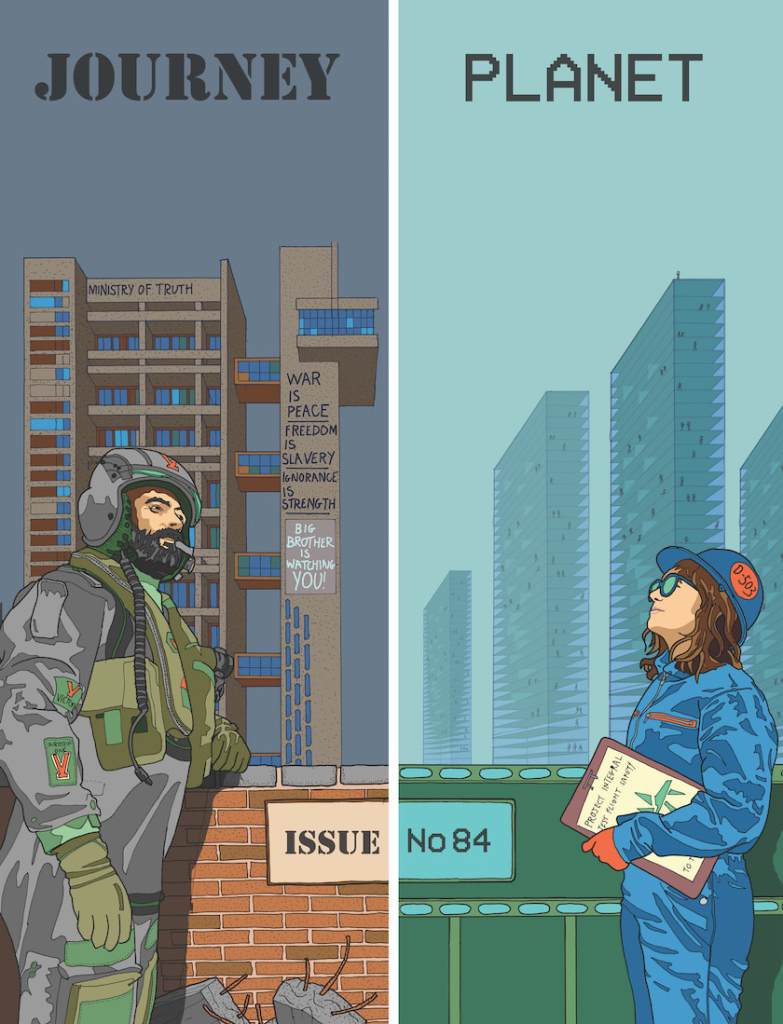
Note #1: A few months ago I was asked to write an article for the lauded fanzine Journey Planet, which was putting together an issue centered around the theme of labor rights in genre fiction. Truth be told, I was scrambling for a juicy idea until I remembered that I had covered Richard Matheson’s 1956 boxing-of-the-future story “Steel” early this year, and I still had quite a bit to say about it. You can read the Journey Planet version of this editorial here, as well as articles and even a few short stories by writers who put in a lot more work than I did. I didn’t simply copy-paste my article here, as I did make some small changes, to expand on a couple things and to make the whole thing fit more with the conversational tone of this blog. I also removed the Commonwealth spelling that was forced upon me by a couple of dastardly Canadians. I’m an American, goddamnit!
Note #2: I shouldn’t have to say this, but I’ll be discussing spoilers for the short story “Steel,” and by extension the Twilight Zone adaptation starring Lee Marvin. The two are basically 1:1 in terms of plot. I will not, however, be discussing the 2011 film Real Steel, which is a much looser adaptation of Matheson’s story.
Many of Richard Matheson’s most famous stories involve alienation, and this is something that can be traced throughout pretty much his whole career. The unnamed child in his very first short story, “Born of Man and Woman,” is rendered unable to adapt to normal domestic life because of an odd mutation. The tortured protagonist of “Nightmare at 20,000 Feet” (one of William Shatner’s finest roles) feels estranged from the people around him, including his own wife, after he has suffered a nervous breakdown. Scott Carey, the anti-hero (there’s very little “heroic” about him) of Matheson’s novel The Shrinking Man, finds his marriage eroding after a freak incident causes him to shrink to the size of an ant. The traveling salesman of Duel is already separated from the rest of humanity, stuck on a deserted and seemingly endless stretch of highway with only the radio for companionship, when a faceless trucker starts tormenting him. Similarly, “Steel” Kelly, a former boxer who had at one point made a name for himself, has been relegated to owning a robot built expressly for boxing in Matheson’s 1956 short story “Steel.” This is a very fine story, but more importantly it continues to feel prescient, not least because boxing has been all but replaced by MMA nowadays. It’s a story about the athlete-as-worker, the athlete-as-machine, and about a possible (even plausible) future in which the professional athlete has been reduced to a product.
“Steel” was first published in the May 1956 issue of The Magazine of Fantasy and Science Fiction, the same year as The Shrinking Man (it was a good year for Matheson), and it reads as an outlier in what is already a pretty diverse body of work—not thematically but rather in how it attempts to speculate on how human (read: American) culture might change in the future. Matheson’s science fiction is usually set in The Now™, with an average person being thrown into an SFnal situation through some accident or coincidence; so it shouldn’t be surprising that more often than not Matheson wrote horror or fantasy instead. As the man himself admitted in an interview, in the September 1981 issue of Twilight Zone Magazine, “I never even knew what science fiction was until I sold my first story.” He was not what you would call an SF writer by inclination, which makes the genuinely speculative nature of “Steel” so different. (Even I Am Legend, published in 1954 and set in 1976, engages in very little speculation about society’s future, on account of the human populace having come down with a bad case of vampirism, and thus there’s no human culture left—at least of the non-vampire variety.) “Steel” is also unusual for Matheson in that it directly touches upon the question of labor—more specifically alienation from one’s own labor—as it may pertain to a future (but not too in the future) America. Kelly’s conflict is external (he needs money), but also internal (he needs to reconnect with the work from which he has been alienated).
The year is 1980 (I know, the futuristic year of 1980) and boxing between humans has been outlawed in the US for about a decade. “Steel” Kelly was a heavyweight and a reasonably respected boxer a decade ago (“Called me ‘Steel’ cause I never got knocked down once. Not once. I was even number nine in the ranks once.”), but since then he’s gotten older, has started losing his hair, and has taken to the road with Pole, his friend and the team’s mechanic, with their boxing robot, Battling Maxor. The initial problem is that Maxor is in dire need of repairs, requiring money the two men don’t have. Even if they were to repair the robot it’s still a B-2, set to go up against a B-7. Maybe five years ago Maxor would’ve done fine, but now he’s little more than a bucket of bolts; but if Kelly and Pole back out of the match now they don’t get any money. Their robot is badly outdated, and even ignoring that, it would barely be able to get in the ring. Kelly has been having a bad day, not helped by reminiscing openly about when he was in Maxor’s position, and it looks like he’s stuck in a corner. There is, of course, one possible alternative: get in the ring posing as Maxor. The robot has not been in a public match in three years, and apparently this is a future where people don’t record sports matches, so it’s a safe bet that nobody in the audience knows what Maxor looks like.
Kelly is a classic Matheson protagonist, in that he feels cut off from his fellow man and has a bit of a temper; even his friendship with Pole seems to be strained by the bad luck the two have been having, on top of Kelly clearly feeling demeaned by being the “manager” of his own replacement. A question we must ask ourselves is this: If an athlete is a worker, then can the athlete be replaced? I do wonder how many of us think of professional athletes as workers, despite the pay being real and the bodily risk certainly being no less real. I wonder how many people think, subconsciously, of athletes as products—or machinery. The real problem is that regardless of whether the athlete is more akin to a human worker or a machine, we still have to wonder if such a worker/machine can or even should be replaced. God knows an increasingly large portion of the labor market has been replaced by automation. Carpenters and blacksmiths must have felt this inner turmoil, at their own livelihoods being rendered obsolete, decades ago, and yet they probably weren’t listened to. Most carpenters’ hands have been replaced by machinery, so why not an athlete’s entire body? In the heat of the moment, with hard cash on the line, the prospect of getting back in the ring—even if he were to go down in the first round—appeals to Kelly. He hungers to return to doing what he loved most, to the point that the prospect of a robot beating the shit out of him doesn’t faze him much. The robots, while not sentient, are lifelike enough that if he acts right, he can dupe the audience. “Even from ringside the flesh tones looked human. Mawling had a special patent on that.” And hell, when he inevitably starts sweating that can be explained by Maxor having an oil leakage. Happens with old models. (This part isn’t explained in the TZ adaptation, such that Kelly visibly sweating comes off as a bit of a plot hole.)
Indeed, the plot is only allowed to happen because Kelly takes advantage of the fact that the robots have only gotten more convincing with each iteration, to the satisfaction of the audience. We’re never told why human boxing was made illegal, but given how physically grueling this sport in particular can be it’s not hard to imagine what spurred legal action. When “Steel” was adapted for an episode of The Twilight Zone, the in-story year had been moved from 1980 to “circa 1974,” even though the episode would air in 1963. In the TZ episode, human boxing was outlawed in 1968, a mere five years after the episode would have aired—which sounds outlandish, but consider that in 1962 welterweight boxer Emile Griffith practically beat opponent Benny Paret to a pulp, the latter dying of his injuries several hours after the match. The possibility of boxing being outlawed must have seemed very much that in the moment—a possibility. Yet while there are valid safety concerns with regards to boxing, Matheson paints a depressing picture of what a future where boxers are forcibly removed from their profession might look like. Even the audience members, while having become accustomed to the robot replacements, clearly miss the days when it was man against man in the ring, back when the ring had a referee and when fighters were able to get back up when they were knocked down. “The new B-nine, it was claimed by the Mawling publicity staff, would be able to get up, which would make for livelier and longer bouts.” The robots seem to get closer to emulating the humans they’ve replaced accurately, but Matheson implies there will always be that human touch missing from the equation. Kelly and his kind can’t be replaced completely.
Of course, Kelly goes down in the first round; and because he’s posing as a B-2 he can’t get back up. Not that he could have reasonably expected to beat a robot—simply speaking as a human, never mind that he’s no longer a spring chicken. Despite losing the match, getting a rib or two broken, plus getting only a fraction of the pay they were supposed to earn (you get paid just for getting in the ring, but going down in the first round nabs you the lowest payout), Kelly feels vindicated in a way that is perhaps hard for a man of his disposition to articulate—a kind of spiritual victory. Something about the capacity of the human spirit to persevere. It could be that when Matheson wrote “Steel” he merely wanted to incorporate a popular sport (at the time) into a fable about a unique quality—a je ne sais quoi—in humans when compared to their would-be robot counterparts. The athlete is a worker, and the worker, in his heart, wants liberation; we can accept nothing less. We cannot accept this divorce, between ourselves and our labor. This may not have been intended, but I would say boxing was the perfect sport to use for such a story, as it’s a deeply individualistic and physically intimate sport. Kelly’s struggle would not have hit quite as hard if this was about baseball or American football. There’s a degree of ambiguity to this story’s ending, as to what will become of Kelly and Pole after this, or what they could possibly do next; but that would be missing the point, I think. Kelly lost the fight, but he’s gone to prove he’s not quite out of a job yet. 1980 is behind us, if only physically, but “Steel” is one of those rare SF narratives that seems determined to project its concerns perpetually into the creeping and possibly condemned future—our future.
 Science Fiction & Fantasy Remembrance