Who Goes There?
As we approach the climax of this year-long tribute to F&SF, it’s about time we cover an author who was also one-time editor of that magazine. There’ve been a few writers who also picked up the editing torch with F&SF (Anthony Boucher and J. Francis McComas, Kristine Kathryn Rusch, and most recently Sheree Renée Thomas), but Avram Davidson might’ve been the most prepped to become editor, although his tenure would be short. He debuted in F&SF in 1954 with “My Boy Friend’s Name Is Jello” and would remain a quirky presence in that magazine (among others) for many years to come. By the time he became editor in 1962 he was already a Hugo winner, for his 1958 SF-horror story “Or All the Seas with Oysters.” Under Davidson F&SF took on a rather different character from both before and after, making it something of a black sheep era for the magazine. After he stepped down from editing Davidson went back to writing regularly, with a vengeance. Known mostly for standalone stories, Davidson started the episodic Jack Limekiller series in the ’70s, of which today’s story is the second entry. “Manatee Gal Ain’t You Coming Out Tonight” shows its age nowadays, and its big twist is obvious (perhaps by design), but it does have, as Edward L. Ferman says, quite the atmosphere.
Placing Coordinates
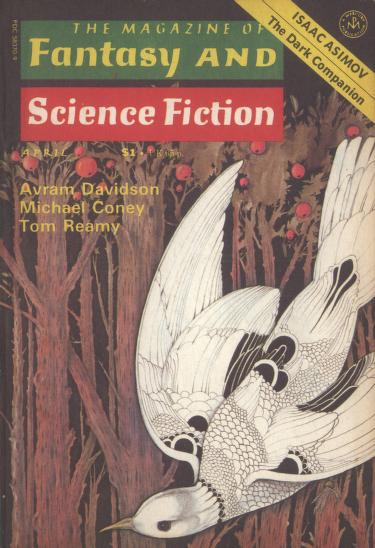
First published in the April 1977 issue of The Magazine of Fantasy and Science Fiction. It’s been reprinted in Year’s Finest Fantasy (ed. Terry Carr), Under South American Skies (ed. Gardner Dozois and Mike Resnick), Modern Classics of Fantasy (ed. Gardner Dozois), and the Davidson collections Limekiller! and The Avram Davidson Treasury.
Enhancing Image
The first question is, who is Jack Limekiller? He’s a Canadian expat, apparently from Toronto, which goes to explain a lot. The Limekiller stories have a strong international flavor, being set in “British Hidalgo” (there’s also an independent sister country called Spanish Hidalgo “though it had not been Spain’s for a century and a half”), a fictional South American country that, despite these stories being set very much post-World War II (although not much more specific than that), is still under British guardianship. What does Limekiller do for a living? Not sure. Supposedly he deals in trading, but for the whole course of this story he’s not doing work at all; on the contrary, he spends some of it thinking of ways to avoid his creditors. He has some debt he’s not currently able to pay off. The good news is that despite the inherent exploitation required in maintaining a colony like British Hidalgo, and also the fact (this is not a spoiler really) that “Manatee Gal” will turn into borderline Lovecraftian horror down the road, things are easy-going here. Limekiller’s main creditor will probably catch up with him, but not tonight, or tomorrow either. He’s a bit of a wish-fulfillment character, in that he is too individualistic (and maybe too drunk) to work a 9-to-5 job, but he’s still very cool and sociable, and we know in advance that he’ll come out of whatever weird situation Davidson tosses his way basically unscathed. Everybody around Limekiller, on the other hand…
Something tricky Davidson does in the first few pages is set up the first of a few mysteries, the only thing being we’re unlikely to take it as a mystery that needs solving. Bob Blaine, a notorious trader in these parts, has gone missing. This will not come up again until much later, so put a pin in that one. This is less about the plot and more about the place and characters. British Hidalgo is somewhere in South America but seems as home to Caribbeans and white Europeans, including folks like Limekiller. The most elusive of these characters would have to be John Samuel, a white Creole with one eye, and Captain Cudgel, a mysterious old man who frequents the same bar Limekiller goes to. Cudgel is more of a walking mystery while Samuel is a bit of an eccentric; it’s a shame I can barely understand what the latter is saying. A problem I encountered almost immediately here is that most of the characters have some kind of “accent,” and Davidson writes them out phonetically—maybe a little too much. Davidson traveled around a lot, in fact if I remember right he edited F&SF while living in Mexico, which posed a problem; but that doesn’t automatically give one license to give non-white (or also in this case, as with Samuel, white characters who are not from the US or Canada) goofy accents that are hard to parse. He even does the “t’ing” thing for Caribbean characters, except he applies that logic to seemingly every other word, the result being a meaty novelette that’s rather chatty, and much of that dialogue is hard to read.
“Manatee Gal” has a loose plot, made up more of episodes than a cohesive narrative, so with that said my favorite part is one that is only very loosely related to the overarching mystery, in which Limekiller (seemingly because he has nothing better to do) gets taken on a ride to Shiloh, the remnants of a Confederate colony that had been founded in British Hidalgo over a century, and which still hosts a small group of people who are making a decent living. The colony “had not been wiped out in a year or two, like the Mormon colonies in Mexico—there had been no Revolution here, no gringo-hating Villistas—it had just ebbed away.” But still there’s something left. Colonialism always leaves scars. Of course, Limekiller and Davidson don’t seriously question the ghost-like presence colonialism has on the land, the past haunting the present. The idea seems to be that these expats and settlers will eventually wither away, as with Shiloh, or get killed off (burn out or fade away, your choice), but then, while the dinosaurs did go extinct, they left a certain feathered animal behind as their legacy. British Hidalgo is a scarred land, and clearly haunted, but not just by supernatural creatures. The double-edged sword of Davidson’s setting is that because it’s fictitious it also means Davidson is free to put his thumb on the scales, so to speak. There is no place on Earth quite like British Hidalgo, which does lend a surreal quality to it, perfect for supernatural shenanigans, but also it’s ultimately a white author’s exotic fantasy land.
There Be Spoilers Here
Manatees get brought up from time to time throughout the story. Sea-cows. They’re cute, harmless marine mammals, but Davidson also raises kind of an odd question: There are all kinds of were-animals, not just werewolves, so why not a were-manatee? Someone who is amphibious, who can change between a person on land and a manatee in the water, just off the coast. They do eventually find Bob Blaine—or what’s left of him. Something had killed him. We never see the were-manatee, but the implication is that Samuel is the killer, although he is never seen again. Limekiller connects some dots and comes to the conclusion that such a creature could exist, here, in British Hidalgo. But of course that’s not his problem. Limekiller’s debt problem also clears itself up at the last minute, as a freak accident has led to his trading position (namely his boat) becoming very sought after again. All’s well ends well, more or less. Nothing will fundamentally change. We would see Limekiller again, even I don’t.
A Step Farther Out
I’ve not read a great deal of Avram Davidson for the simple reason I find him to be a little too quirky and at times misogynistic (basically the same reason I don’t often read R. A. Lafferty), and admittedly “Manatee Gal” might be too obtuse for a story with ultimately such a straightforward reveal. I also get the impression that, given Limekiller is wearing a thick coat of plot armor with this series, there’s no real sense of danger. Limekiller comes upon a mystery or two, connects a few dots, goes “Well that’s weird,” and moves on, perhaps taking comfort in the knowledge that said weirdness won’t happen to him. I also struggle to believe the exoticism of the locale would fly as well if published today, but judging by awards attention for this and future Limekiller stories there was clearly an audience for it back in ye olden times. I’m also pretty sure Lucius Shepard read it and got a few ideas, so you could say it’s influential in kind of a niche way.
See you next time.

 Science Fiction & Fantasy Remembrance