(A Canticle for Leibowitz. J. B. Lippincott. Cover by Milton Glaser.)
About a year ago I had read a couple books, which in hindsight I maybe should not have. But then maybe I should’ve. They were Mark Fisher’s Ghosts of My Life and Thomas Ligotti’s The Conspiracy Against the Human Race. You may know Fisher for his landmark book Capitalist Realism, and of course Ligotti is one of the most esteemed horror writers in living memory. Ghosts of My Life is the follow-up book to Capitalist Realism, being a collection of essays that have to do with (you guessed it) the bleakness of late capitalism, but with Fisher’s analyses of popular media in this context. It also has to do with Fisher’s long-standing battle with depression, which he ultimately lost. Ghosts of My Life was published in 2014, and Fisher committed suicide in 2017, around the same time as the publication of his third book, The Weird and the Eerie. Ligotti, thankfully, is still very much with us, although you might not assumed that since he hasn’t written much in the past decade or so. The Conspiracy Against the Human Race, published in 2010, was arguably Ligotti’s last big effort, and interestingly it’s both a nonfiction book and Ligotti’s single longest work. These are both books having to do, directly in the former case and more indirectly in the latter, with depression and pessimism, the former being more autobiographical and the latter being rather philosophical. I recommend them, but only if you’re the sort of person whose mindset is not easily influenced by media you interact with, otherwise they might be too much. I have to admit I’ve not been quite the same since then, but that has less to do with the books and more with the world around me as I was reading them.
These books don’t have much to do directly with science fiction, except for some media covered in Ghosts of My Life, but indirectly they relate to SF in that they speculate on the future—or rather the lack of it. There will, of course, strictly in how time moves, be “a future,” but Fisher and Ligotti posit that “the future,” subjectively, is shrinking, and that being alive in this present moment, we feel this strange paralysis, as if trapped in a quagmire or quicksand of in-the-moment horror. There’s future shock, and then there’s lack-of-future shock. There are psychological, political, and even ecological elements to this. Depending on where you live in the world, which can range in specificity from what continent to even what region of a certain country, you may be feeling any one or all three of these elements to varying degrees of severity. If you’re a farmer in India then you would be feeling, maybe to your despair, future-shrinking of the ecological kind. If you work customer service in the US then you’d be feeling future-shrinking of the psychological kind. Both of these are, of course, influenced by politics. There is always a political (capitalist) reason, although depending on your income and level of education you might not be aware of it, or you might be willfully ignorant of it. Someone living in an urban area in the so-called global north might be blissfully unaware that there is, in fact, a water crisis that’s been ravaging the global south, and which will at some point come for the rest of us. The air becomes just slightly more unclean with each passing year. We see record-breaking heat waves, whose record highs are then soon beat. There is (although I don’t think anyone wants to admit it) no liberal capitalist means of reversing climate catastrophe.
I don’t think it’s a coincidence that Fisher and Ligotti, in being keenly aware of the sticky situation humanity has made for itself, are both some flavor of socialist. Fisher posits that there was a point somewhere in the not-so-distant past where we could’ve prevented this while Ligotti thinks that, quite the contrary, the cards were always stacked against humanity, by virtue of the inherent curse (so Ligotti argues) of having been born in the first place. Science fiction doesn’t deal so much with philosophical pessimism, nor is it really much equipped to deal with that kind of philosophy, but it is equipped to deal with bad and lost futures. If anything science fiction is the genre which we can use to speculate on futures which can be prevented, or if not prevented then maybe coped with. The post-apocalypse, in which society as we know it has totally collapsed, leaving an orphaned and maybe savage humanity in its wake, is indeed a hallmark of the genre; and as Fisher famously said (in echoing Frederic Jameson), “It’s easier to imagine the end of the world than the end of capitalism.” There’s been no short of post-apocalyptic SF over the decades, although relatively little of it deals with a global machine which is slowly grinding down, rather than stopping suddenly. We do not live in a world that’s likely to experience “the deluge” of A Canticle for Leibowitz, or a civilization-ending virus (although the COVID-19 pandemic gave us a sort of test run for such a scenario) like in I Am Legend. SF during the Cold War reckoned with the possibility of the machine stopping because of nuclear devastation; and while this was plausible in the 1950s, it’s not so plausible now.
So the rules of the game have changed somewhat. Following the “end of history” in the years immediately after the Cold War ended, it was argued (most famously by Francis Fukuyama) that the world of politics had profoundly and irreversibly changed, that the dynamic between capitalism and Soviet-style socialism had come to an end. Since capitalism had come out the “winner,” it was clear (so these people argued) that such a system of money and government will be the status quo for the foreseeable future. In a sense this remains to be the case, even in [current year], given that socialism in China (having effectively replaced the Soviet Union on the world stage) does not provide an adequate alternative to capitalism—indeed it’s barely an alternative at all. During the Cold War there was no shortage of media (think Dr. Strangelove and the Modern English song “I Melt with You”) that posited the world might end because of The Bomb™, but now it’s far more likely the world might end because of the dollar. We live in a world where at the UN, time and again, the US and Israel have voted that food and shelter are not basic human rights. Even water has a price. Modern post-apocalyptic SF, if it’s to speak to readers now and in the future, should ideally reflect this change. There is a bit of a problem, naturally, in that such a kind of SF would presumably be made by those who are disillusioned with a system in which profit takes precedent over human lives. Anyone of pretty much any political leaning would say that of course nuclear war would be a bad thing, but far fewer would both express dissatisfaction with our system and also express a desire for an alternative.
Admittedly I haven’t read as much recent SF as I should, and even with this blog I’ve only been able to get a drop of water out of what has turned out to be a rather sizable pond. Very recently I reviewed Rebecca Campbell’s award-winning “An Important Failure,” which is about pursuing one’s lifelong passion in the midst of slow-burning environmental collapse. Most memorably I got to read Naomi Kritzer’s stunning (and surprisingly optimistic) “The Year Without Sunshine,” which tackles a plausible scenario in which a long-term and widespread power outage results in the formation of a makeshift socialist community. God knows how many novels and short stories are worth reading which cover similar ground, and that’s not even getting into the speculative articles. Not too many, I imagine, because, as I said, there would be fewer authors willing to tackle this subject in such a way; but at the same time there still probably isn’t enough, especially in perspectives from the global south. If we can’t even create the future then we can at least learn to live with the horrible, at times unbearable present. When we say the future is getting dimmer, we mean it’s getting bleaker, but also harder to perceive. Science fiction is not meant to be predictive, but it should tell us something about where we might be heading. I don’t where we’re heading myself. For all I know we might be heading nowhere, and fast. To paraphrase the opening line of Bernard Malamud’s The Assistant, it’s dark, even though night has ended.
(Cover by Frank Kelly Freas. Satellite, December 1956.)
Merry Christmas, happy birthday to me, and all that.
People who keep up with my posts may have noticed that I missed a couple things last month, including what was to be the start of the second serialized novel, Kuttner and Moore’s Fury. Let’s say I’ve been slow about it. Generally I’ve been slower about keeping up with this blog than I was a year ago, and there could be a few reasons for this, but the point is that I’ve come to understand I’m not as on top of my own blog as I once was. I’ve slowed down with the “required” reading, and I’ve been slower about writing, although (not to toot my own horn) I still write here more than some other fan writers I know. Maybe nowadays the load I give myself is just a bit too much, especially since I’ve also been wanting to get into writing professionally, for that bit of extra money, only I’ve not been able to find the time and/or motivation for it. So, I’ll lighten the load a bit. From now on I’ll only be covering one serial a month, regardless of length. Of course, if the serial is four parts or longer this won’t make a difference, but a lot of serials are three-parters, which should give me an extra day to myself. Other than that, it’s gonna be business as usual.
What do we have on our table? All science fiction, which isn’t very diverse, but when these stories were published is certainly more diverse. One story from the 1940s, one from the ’50s, one from the ’60s, one from the ’70s, one from the 2000s, and one from the 2020s.
For the serial:
Fury by Henry Kuttner and C. L. Moore. Serialized in Astounding Science Fiction, May to July 1947. Kuttner and Moore wrote so much, both together and each solo, that they resorted to a few pseudonyms, one of them being Lawrence O’Donnell. Fury takes place in the same universe as the earlier Kuttner-Moore story “Clash by Night.” Despite Fury historically being credited to Kuttner alone, Moore claimed years later to having been a minor collaborator.
For the novellas:
“Welcome to Olympus, Mr. Hearst” by Kage Baker. From the October-November 2003 issue of Asimov’s Science Fiction. Baker had spent much of her adult life working in insurance and with theatre as her primary hobby, before pivoting to writing SF in her forties. No doubt she would still be writing SF today, had she not died all too soon in 2010. Still, for about a dozen years she wrote furiously, with her big series following a team of time-traveling secret agents.
“The Dragon Masters” by Jack Vance. From the August 1962 issue of Galaxy Science Fiction. Winner of the Hugo for Best Short Fiction. This is a reread, although I only have a vague memory of having read it in the first place, and that was without Jack Gaughan’s accompanying artwork. Despite what the title might make you think, “The Dragon Masters” is pure planetary SF, albeit with fantasy-esque coloring that Vance had become known for at this point.
For the short stories:
“An Important Failure” by Rebecca Campbell. From the August 2020 issue of Clarkesworld. Winner of the Theodore Sturgeon Memorial Award. Born and raised in Canada but now living in the UK, Campbell has written only one novel so far, which in fact was her first SF writing of any sort. Good news is she’s been somewhat prolific in writing short stories and novellas over the past decade.
“The Earth Dwellers” by Nancy Kress. From the December 1976 issue of Galaxy Science Fiction. This is the third time now that I’ve come to Kress, and why not? Her career now spands nearly half a century, and her stories, if not always entertaining, often provide some food for thought. I know nothing about “The Earth Dwellers,” except it marked Kress’s very first appearance in the field.
For the complete novel:
A Glass of Darkness by Philip K. Dick. From the December 1956 issue of Satellite Science Fiction. This book sounds unfamiliar, even for seasoned Dick fans, although it may ring a bell under its book title: The Cosmic Puppets. Dick had burst onto the scene in the early ’50s as one of the most promising short-story writers at the time, in a generation that included such bright newcomers as Robert Sheckley, Algis Budrys, and Katherine MacLean. It only stood to reason, then, that while writing short stories nonstop was all well and good, writing a novel was the logical next step. A Glass of Darkness wasn’t the first novel Dick wrote, but it was the first to be published.
(This post will be discussing spoilers for Carnival of Souls, including the twist ending, so if you haven’t seen the movie already I suggest you do just that before reading any further.)
I was supposed to write a review two goddamn days ago, except I realized that I had made a mistake and somehow gotten my own schedule wrong. I had read the first installment of Larry Niven and Jerry Pournelle’s Inferno, except I was actually supposed to read Arthur C. Clarke’s “Against the Fall of Night.” So, no review happened for the 3rd or the 4th. With any luck I’ll get around to Clarke’s novella sometime this month, and of course you can expect my review of Inferno (the first stretch) very soon, as in tomorrow or the day after. For now, let’s content ourselves with an editorial I had in mind for last month but couldn’t find the time or proper motivation for at the time, a not-review of a certain cult classic. Carnival of Souls is one of the best horror movies of the ’60s, almost in spite of itself, being made on a very low budget by a crew comprised of people who had not worked on a feature film before, and whose cast was similarly comprised of non-actors and people (including its lead actress) who would not have a future in movies. There’s a lot to say about it, but one can only say so much without giving away the whole plot, so it’s best to start at the ending and then slingshot back to the beginning. It’s that kind of movie.
Mary Henry is dead, to begin with. We start with a logo for Harcourt Productions, which I have to think was made specifically for this movie, since this is the only movie ever to be produced by this company. Before said logo can even fade to black we’re met with a jarring (maybe deliberate, maybe not) shift in the form of the opening scene: an impromptu drag race between two cars, one filled with dudes, the other filled with Mary and her gal pals. A few things are going on in this first scene, which seems to me an effort in disorienting the viewer. At the very beginning here, Mary doesn’t say anything, and she has kind of this quizzical expression on her face, as if she’s unsure about the race but is too shy to discourage her friends from taking part. Her skepticism is more than justified, since it takes all of about one minute for the race to go wrong, as the cars go across a rickety bridge and the girls’ car tips over into the river below. You would think the girls, if not killed from the impact, would at least drown, and you’d be right. A rescue team comes in, more to salvage the car than anything, and if you pay attention to the dialogue you can hear that they’ve been looking for three hours. Obviously nobody can be alive still.
Except for Mary—or so it seems.
(The film’s director as a ghostly visitor.)
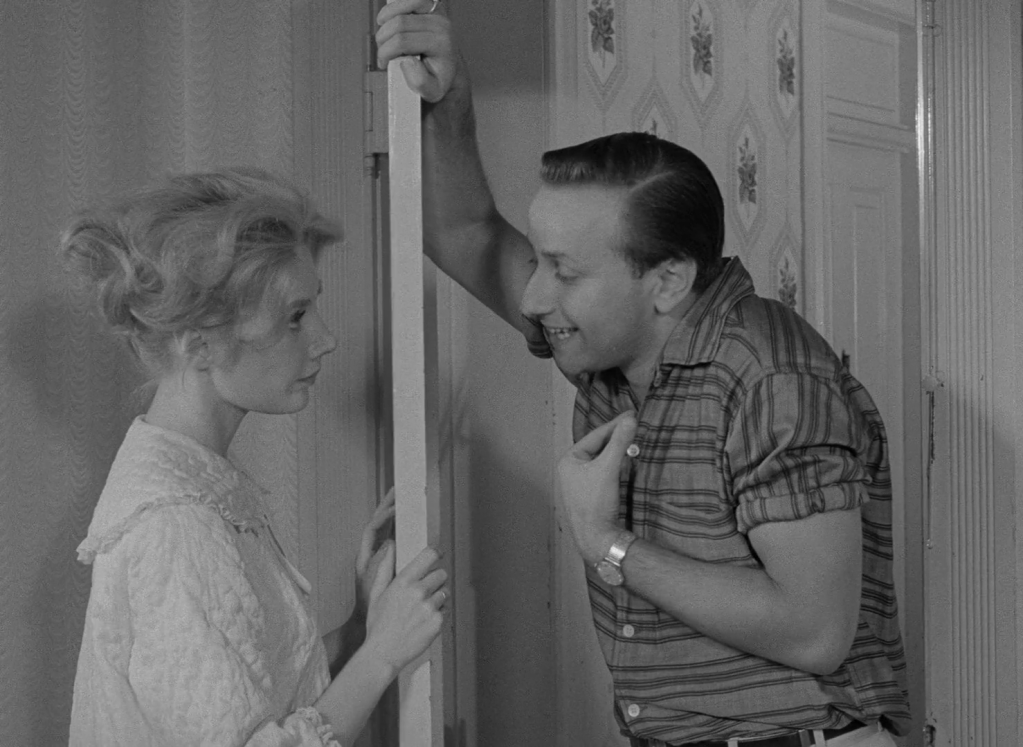
Wet from the river and caked with mud, Mary walks dizzily out of the water, as if some kind of ghoul emerging from a swamp, quite miraculously to everyone around her. It’s telling that when asked about what happened Mary can only say, “I don’t remember.” It’s her first line of dialogue, and in a striking formal decision it’s spoken offscreen. From this scene to the next there’s an unexplainable gap in time, and it’s only then that we see Mary talk for the first time. Having apparently recovered from the accident, Mary takes up a job as an organist for a church in Utah, despite being irreligious herself. The man at the organ factory doesn’t mind Mary’s disposition much, but the minister at the church where she’ll be working is more concerned. (We know that this must take place in fantasy land because somehow Mary is able to afford rent with a non-job like “church organist.”) Interestingly, the only woman of note that Mary interacts with throughout the rest of the movie is Mrs. Thomas, her landlady; otherwise she’s beholden to a handful of male figures. These men fall on a spectrum that ranges from uselessly benevolent to openly hostile, but the point is that they either try and fail to help her or are looking to make her day worse. The worst of these might be John, the neighbor in the apartment building, who unsubtly creeps on Mary and tries to get her in his bed at all costs. If this movie took place in modern times, John would be an incel and/or one of those guys who follows macho influencers for “dating advice.”
(Mary and a typically pushy John.)
Let’s take a step back to talk about the acting and directing, since this is a movie that does a lot with only a few resources, and also where a lot happens despite clocking in at just under 80 minutes. The director, Herk Harvey, had experience as a filmmaker from making PSA-type shorts about urban and industrial areas, with Carnival of Souls being his first and only narrative feature. He directed, produced, worked on the script with John Clifford, and even plays a major role as an actor here, as a pale-skinned ghostly man who stalks Mary throughout the film. Like I said earlier, the people acting in Carnival of Souls have never been in a movie before, with maybe an exception or two in there. This is quite a surprise with Candace Hilligoss as Mary, since she gives unquestionably one of the defining lead performances of ’60s horror, and her presence gives one the impression that she could’ve been in a hundred movies. The way she often stares off into the distance, dissociating, or sometimes how she cranes her neck like a flightless bird, gives one the impression of Mary being like a confused animal. The closest reference point I can think of with Hilligoss’s performance is Elsa Lanchester’s performance as the bride in Bride of Frankenstein, where similarly Lanchester plays a worried and at times frightened animal in human skin. Lanchester as the bride only shows up for a few minutes in her movie, nevertheless leaving a mark on people’s imaginations; but luckily for us we have a whole movie to spend with Hilligoss as Mary.
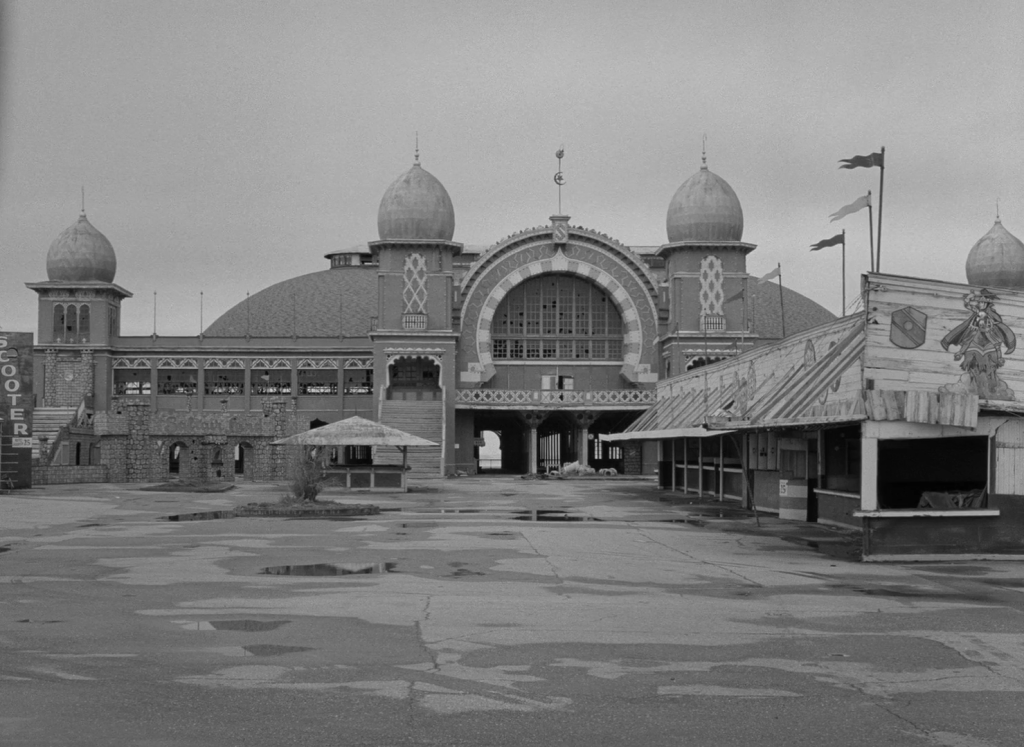
Harvey and his crew shot on location in Utah, on a budget of just over $30,000 in 1962 money, and since they obviously couldn’t afford sets they shot the scenes of the titular carnival at the Saltair Pavilion (specifically Saltair II), a resort that hit hard times during the Great Depression and which wss finally abandoned a few years before Carnival of Souls was shot. Securing a permit for shooting at Saltair II was cheap and easy. There are a few scenes set in urban locations, namely Salt Lake City, but the most memorable stuff in this movie has to do with the shabby apartment building Mary lives in and the industrial shithole just out her window, namely the abandoned carnival that haunts her dreams. The lack of sets, combined with harsh lighting and industrial locales, gives one the feeling that maybe David Lynch had taken notes from this movie during the long process of making Eraserhead. Mary, being a ghost unbeknownst to herself, lives in a world that itself comes off as ghostly. Of course, it is not the abandoned carnival which turns out to be haunted, but rather Mary. I have a soft spot for ghost stories in which a person instead of a place is haunted, either because the person is a member of the undead or attracts the undead like a magnet. Harvey and Clifford took inspiration from the Ambrose Bierce story “An Occurrence at Owl Creek Bridge,” which (spoilers for a short story that’s over a century old) is similarly about someone who seemingly survives being killed, only to find out afterward that they are a ghost. So we have a ghost who unwittingly haunts people, and who herself is haunted by a dead (abandoned) place. I know it can be a little hard to believe, given its cheap and grimy aesthetics, but this is an intelligently crafted film.
(An exterior shot of Saltair II.)
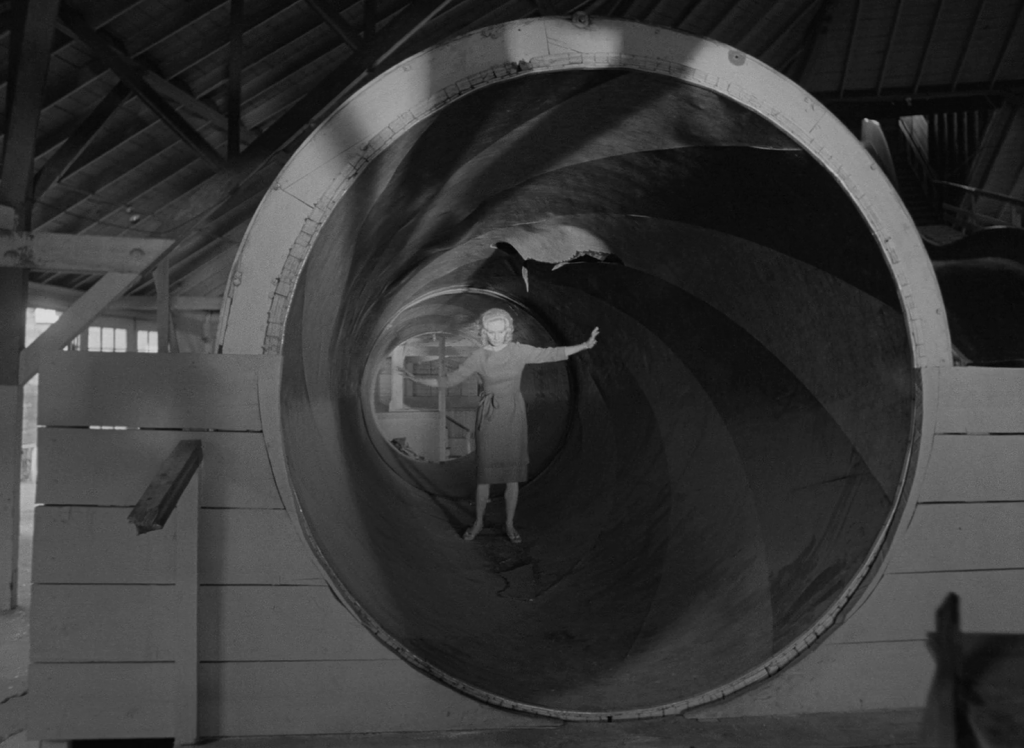
If taken literally, Carnival of Souls is a spooky story about a woman who thinks she has cheated death, but if you try even slightly you’ll find that this is a resonant and prescient study of a woman suffering from some undiagnosed mental illness, trying to live in a world dominated by “normal” people. It is at the very least explicitly about a woman who, following her accident, lives in a permanent state of disconnect from the rest of humanity, a kind of switch being flipped in her brain which she may or may not be able to flip back the other way. It’s ambiguous if Mary’s unusual mental state is something she had before the accident or if it’s brought on from trauma, but regardless she acts as if being around people for longer than short controlled bursts is a burden on her—to other people’s dismay. As the minister says during their first meeting, “But my dear, you cannot live in isolation from the human race, you know.” At first Mary is content to live on her own, with her crummy job and not having any friends, but eventually the loneliness does get to her; but at the same time she has some unwanted company, with John from the side of the living and the pale man from that of the dead. She quite literally phases in and out of reality at a few points in the movie, where people can’t see or hear her and she fully becomes a ghost. She’s stuck in a liminal position, between wanting but being unable to socialize with the living while also being scared of the ghosts she sees dancing at the carnival at night. During the daytime the carnival just a normal industrial area, totally empty of human life; but while there’s no ghost who can torment her here during the day, it’s eerily missing that human touch. It shouldn’t come as a surprise that the sequence at the halfway point of the movie, where Mary explores Saltair II, might be my favorite.
(Mary in a huge pipe, in one of the more memorable shots.)
The most helpful character is Dr. Samuels, a psychologist who just so happens to run into Mary during one of her daytime scares. (How is she paying for this? Is she paying for it? Does Samuels put their first session on the house? We don’t ask these questions when watching a movie.) The best thing he does is allow Mary to articulate her state of mind, especially her strange (to other characters) indifference to intimacy with those of the opposite sex. The language wasn’t around at the time, but the idea is that Mary is queer, by virtue of being asexual and possibly also aromantic. This quirk with her sexuality is treated as unusual, but not harmful, which for a movie of this vintage is pretty forward-thinking. Indeed what modern viewers might appreciate most about Carnival of Souls, more than what it’s able to accomplish on a tight budget and its capacity for genuine chills, is its sympathetic depiction of someone who is both mentally ill and outside the realm of cisgender-heterosexual normality. We have a complex figure with Mary, helped by Hilligoss’s nuanced performance, a woman who is tormented by men who either shun her or try to coerce her into unwanted sex—and that’s not even going into the literal ghouls following her. The ending of the movie is obviously meant to be taken as eerie, but Mary’s ultimate fate, as a ghost who gets dragged screaming into the afterlife, also has a tragic aspect. The “dead all along” twist has arguably been done with more elegance in one or two other movies, but the inevitability of it in Carnival of Souls is crushing.
Carnival of Souls is not a perfect movie by any means; on the contrary it’s pretty rough around the edges. Actually the whole movie is rough. The lighting is amateurish at times, the acting is a mixed bag (understandably), there are a few shots I can think of that could’ve used another take, and of course someone watching this today would find the twist to be pretty obvious—although this was not so much the case back then. As typically goes with B-movies, it languished in obscurity for a couple decades, until it was revived thanks to late-night TV airings and being discovered by the international arthouse crowd. Roger Ebert wrote a positive review of it in 1989. It’s now in the Criterion Collection. I’ve seen three or four times myself over the years, and each time I’ve found more small and subtle things about it to like. This is a pulpy exploration of mental illness via supernatural horror, which nowadays feels almost overdone as one of the genre’s many modes. But trust me, it’s a good one.
A short and sweet review forecast for this month, partly because I’m running behind on my writing a bit and so am pressed for time, but also because I don’t have a particular theme in mind here. Of course, if you thought I was gonna take a break from reviewing spooky fiction altogether after last month, you’d be mistaken, as both of the short stories due for November are horror pieces. We’re still deep in autumn, after all, and honestly my thirst for spooky shit has not been quenched.
Another thing I just randomly decided to throw in there is that both of the serials are novels written in collaboration, by authors who gained a good deal of acclaim and presumably money from working together. In one case there’s decades-long besties Larry Niven and the late Jerry Pournelle, who shared similar politics and also writing philosophies. There’s also the husband-wife duo of Henry Kuttner and C. L. Moore, perennial favorites on this site, who wrote most of their novels together, although for decades Fury has been erroneously credited to just Kuttner.
We’ve got one story from the 1850s (the oldest I will have reviewed thus far), two from the 1940s, two from the 1970s, and one from the 2000s.
For the serials:
Inferno by Larry Niven and Jerry Pournelle. Serialized in Galaxy Science Fiction, August to October 1975. Niven had quickly established himself as one of the major hard SF writers by the end of the ’60s, but Pournelle had a longer road to success, first being active as a fan and then not writing his first stories and articles professionally till he was deep in his thirties. In the ’70s and ’80s Niven and Pournelle wrote several successful novels in collaboration.
Fury by Henry Kuttner and C. L. Moore. Serialized in Astounding Science Fiction, May to July 1947. Kuttner and Moore wrote so much, both together and each solo, that they resorted to a few pseudonyms, one of them being Lawrence O’Donnell. Fury takes place in the same universe as the earlier Kuttner-Moore story “Clash by Night.” Despite Fury historically being credited to Kuttner alone, Moore claimed years later to having been a minor collaborator.
For the novellas:
“Against the Fall of Night” by Arthur C. Clarke. From the November 1948 issue of Startling Stories. Clarke is one of the most famous SF writers ever, to the point that by the ’60s he had become, along with Isaac Asimov and Robert Heinlein, a media personality. He collaborated with Stanley Kubrick on the script for 2001: A Space Odyssey whilst writing the novel version parallel to it.
“The Region Between” by Harlan Ellison. From the March 1970 issue of Galaxy Science Fiction. Ellison is similarly a pretty famous (if more controversial) figure, being just as notorious for his real-life antics and combative nature as for his writing. This novella, one of Ellison’s longest stories, works as a standalone but was commissioned as part of a series which features the same main character.
For the short stories:
“The Old Nurse’s Story” by Elizabeth Gaskell. From the October 1927 issue of Weird Tales. First published in 1852. Now here’s a name you probably didn’t see coming. For someone who gained notoriety as one of the finest novelists of the mid-Victorian period, as well as being Charlotte Brontë’s first major biographer, Gaskell also wrote a fair amount of supernatural fiction.
“I Live with You” by Carol Emshwiller. From the March 2005 issue of The Magazine of Fantasy and Science Fiction. By this point Carol had outlived her late husband, Ed Emshwiller, by over a decade, but she had long since made a name for herself. The last Emshwiller story I wrote about was from the late ’50s, but nearly half a century later we still find her seemingly in her prime.
(Dark Forces. Cover by One Plus One Studio. The Viking Press, 1980.)
Something I don’t typically get to write about here is the topic of original anthologies, which is to say anthologies of short fiction comprised of material never before published. Of course, said fiction could later be reprinted in magazines, as has happened many times, but the implied purpose of an original anthology is fundamentally different from that of its sibling, the reprint anthology. Both involve similar work, with an editor trying to procure stories from authors or authors’ estates, as well as reading dozens upon dozens of stories, most of which end up not being worth printing. There’s the question of how many words/pages can be crammed between two covers. There’s the question of pricing, because an anthology will pretty much always be more expensive than a single magazine issue. Nowadays anthologies and magazines fill respective niches and try not to step on each other’s toes, since it’s no longer a problem of what can be printed in magazines, whereas in the days before Fortnite and even the internet there was the (true, at least up to a point) conventional narrative that editors and publishers of original anthologies were allowed to be more risqué than their magazine counterparts.
When Dangerous Visions hit shelves in 1967, its key appeal (at least for American readers) was that it was jam-packed with stories that could not be published in magazines of the era, on account of being too edgy, experimental, etc. You had a thick book (over 500 pages) from a mainstream publisher (Doubleday) with an all-star cast of authors, all of whom at least claimed to be putting forth their most mind-bending and transgressive material yet. You had such top talents as Philip K. Dick, John Brunner, Samuel R. Delany, Roger Zelazny, and so on, and commissioning this stuff could not have been cheap. The gambit paid off in spades, though. Dangerous Visions sold very well, remains in print to this day (a rarity for an anthology, especially an original one), and it even won a special Hugo. That Harlan Ellison, the editor, never quite recaptured that lightning, is beside the point. Not every story was a winner, but Dangerous Visions was the right book that entered the market at just the right time, serving as a harbinger of the New Wave. Just as importantly, publishers realized that there was some money to be made with original anthologies—maybe not on the same scale as Dangerous Visions, but rather cheap paperbacks of maybe half the size and half the number of stories; and maybe these books wouldn’t try to reinvent the wheel like their inspiration did, but instead took on more humble mission statements. You can have editors who are maybe not as discerning as Ellison was, who would also get the work done in a timelier fashion. It was a matter of quantity over quality.
There a meteor shower, or maybe a oversaturation, of original paperback anthologies from the late ’60s through much of the ’70s, until that particular bubble burst. These were books that often focused on science fiction, rather than fantasy or horror, although there was a trickle-down effect with those other genres. Still, standards had dripped, in large part (although he was not the sole offender) due to Roger Elwood’s extremely prolific tenure as editor for a few different publishers; the number of anthologies he edited between 1972 and 1976 alone is staggering. While he was able to procure work from big names, this work ran a good chance of being mid- to low-tier stuff that would’ve likely stayed on the shelf. A major exception was Epoch, which Elwood co-edited with Robert Silverberg, a lavish and well-received book, placing first in the Locus poll that year; but this is indeed an exception that proves the rule. By the end of the ’70s the market for original anthologies had inevitably gone into decline.
Meanwhile, in the waning days of the original anthology, Kirby McCauley made his living as a New York-based literary agent with some big talent on his hands. By 1980 he had already edited one well-received original horror anthology, with 1976’s Frights, which won the World Fantasy Award for Best Anthology/Collection. Frights was a hardcover original from St. Martin’s Press with a nice wraparound cover, but while McCauley procured stories by some of the top talent in horror at the time, including Ramsey Campbell and Robert Aickman, he found that he wanted to go one step further. The introduction for Dark Forces makes McCauley’s intentions with this bulky new anthology clear. McCauley’s inspiration was twofold, between August Derleth’s work as head of Arkham House and wanting to make a horror-themed counterpart to Dangerous Visions. Arkham House in its prime printed hardcover volumes with exquisite covers, all these being focused on horror, SF, and dark fantasy, from reprints of H. P. Lovecraft’s work to collections of never-before-published fiction by fresh young writers. McCauley grew up on books of horror that Derleth had edited, so in that way he overtly pays tribute to a fallen (Derleth had died in 1971) master of the field. The relationship that Dark Forces has with Dangerous Visions is more complicated, however, as there are a few major differences in how these books’ respective editors went about their businesses.
Consider that when Harlan Ellison edited Dangerous Visions, a process that took about two years, he was coming at it from the perspective of a reasonably successful author, which is to say he was a writer, first and foremost, as opposed to an editor or agent. This lack of experience with editing eventually came back to bite Ellison in the ass, with the shitshow that was the making of Again, Dangerous Visions, and far more infamously with The Last Dangerous Visions; but in the ’60s, it was novel for a writer with practically no editing experience to work with his fellow writers in such a way. Conversely, McCauley had already proven his ability with an original anthology, plus a couple reprint anthologies, and he was enough of a professional that he understood how to work with writers as people, and not just as practitioners of a certain craft. In the introduction he recounts his encouraging relationship with Stephen King while the latter wrote (first as a novelette, then ballooning into a long novella) The Mist. He also recounts having a get-together with Isaac Bashevis Singer in the latter’s apartment (they were both New Yorkers, and thus there had to be some inherent sense of kinship there), just months before Singer won the Nobel Prize for Literature. King and Singer are radically different in just about every way, in work ethic, style, and worldview, the former a flaming-liberal New Englander and the latter a conservative Polish-Jewish immigrant; yet McCauley makes it appear easy to work with both.
You may have noticed also that Singer is not a name that comes up much, if at all, in horror circles, because while a good portion of his fiction involves the supernatural, he’s not a “horror writer.” Thus we have another big difference between Dangerous Visions and Dark Forces, because while Ellison reached out to everyone in the SF field he could get his hands on, McCauley reached outside the field of horror and dark fantasy, the result being that there are authors in Dark Forces who are not primarily horror writers, and there are even a few who are known to be “literary” types. It’s not so unusual today, but back in 1980 it was a novelty for acclaimed novelist (and prolific tweeter) Joyce Carol Oates to appear in a horror anthology. You have some of the usual suspects of horror from that period (King, Campbell, even Robert Bloch late in his career, etc.), but you also have a really left-field choice like Davis Grubb, who was known at the time as author of The Night of the Hunter. You have writers like Edward Bryant and Joe Haldeman who, while they have sometimes written horror, are much more known for writing science fiction. You have a surprise appearance from Ray Bradbury, who by 1980 had long since entered the literary mainstream, and who also didn’t write much of anything at this point in his career. One can have gripes with who made it in and especially who didn’t (there are only two female authors here, Oates and Lisa Tuttle), but I can readily believe McCauley when he says he tried getting stories from everyone.
It’s also worth mentioning that McCauley didn’t construct Dark Forces with the intention of it being a boundary-pusher for the field of horror (he even explicitly says he didn’t want it to be “as revolutionary” as Dangerous Visions), and this ends up being to its benefit. True, there are a few stories here that may have been transgressive for 1980 (I’m thinking of Theodore Sturgeon’s tale of venereal agony, “Vengeance Is.,” and if I had a nickel for every “pregnant man” story in this book, I would have two nickels), but being extra-gross or what have you was not the name of the game. What might be Dark Forces‘s secret weapon and the biggest reason for its having aged pretty well is how its contents cover pretty close to the whole span of short horror literature up to circa 1980. While we don’t have much dark fantasy a la Robert E. Howard’s weird Conan stories, or the “extreme” horror that would start making the rounds in the proceeding years, there’s a great deal of variety in these 500 pages. We have traditional ghost stories such as Singer’s “The Enemy,” a rendering of the Sweeny Todd narrative with Robert Aickman’s “Mark Ingestre: The Customer’s Tale,” a cautionary tale of one unlucky busybody and a nest of vampiric creatures with Campbell’s “The Brood,” some rural “redneck” horror with Grubb and Manly Wade Wellman’s stories, and so on. There are also a couple non-supernatural tales of terror, as with Oates’s “The Bingo Master” (a personal fave of mine) and Bloch’s “The Night Before Christmas.” There are even a couple stories that fall into a certain genre that’s become rare in recent decades, that being the Christian allegory, with Gene Wolfe’s “The Detective of Dreams” and Russell Kirk’s “The Peculiar Demesne.”
And then there’s The Mist.
A story that “gets away” from the author, as it were, can sometimes be a bloated abomination, but in the case of The Mist we have one of King’s best and most tightly wound stories. Indeed King’s bad habits are pretty much absent here, and the fact that he’s able to reconcile ’50s B-movie monster action with genuine eeriness shows the level of craftmanship he’s capable of when he stops fucking around and focuses on what really matters. While the movie adaptation has a radically different ending (one that many, including King himself, prefer), I do have a soft spot for the novella’s ambiguity and cautious optimism. It was a simple choice for McCauley to put the longest story last, making The Mist the grand finale of Dark Forces, but it’s an example of how sometimes the simplest choice is also the best. Unlike the King collection Skeleton Crew, which sees The Mist as the protracted opening salvo, its position as the closing story of Dark Forces gives one the impression that the whole book had been building up to this moment. It was risky to include such a long story here (it takes up about 1/4 of the book), since if it failed then it would majorly tarnish what is otherwise a good read and leave a sour taste in the reader’s mouth; thankfully The Mist was a success, and has become one of King’s most beloved stories.
Dangerous Visions has, as far as I can tell, never gone out of print, although sadly the same can’t be said for Dark Forces. Anthologies, and especially original anthologies, have a bad tendency to have one or maybe two print runs, then go out of stock until the end of time. The only time Dark Forces has been reprinted this century was a super-expensive limited edition from Lonely Road Books in 2007. Bantam apparently did a paperback printing of Dark Forces in the early ’80s, but otherwise it’s only ever been published in hardcover in the US. It could be that Dangerous Visions was such a monolith at the time of its release, and has gone down as such an important entry in SF history, that its status (despite understandable attempts to knock it down a peg, especially as it continues to show its age more and more) has been more or less secured for the foreseeable future. Dark Forces is arguably a better book and set a better precedent (it served as an inspiration for Clive Barker to get into writing horror, and as we all know, the rest of that is history), but it also now reads, with hindsight, as one of the last big gasps for short fiction as a significant player in the realm of horror. Starting in the ’70s, both novels and movies started taking larger slices out of the pie in terms of what “mattered” for innovation and trends in horror, a field that historically largely hinged on the short story and novella. There would be major practicioners of the short horror story (see Barker, also Thomas Ligotti) to come after 1980, but Dark Forces celebrated (again, with hindsight) the short story as a form with authors who are, by and large, happiest and at their best when writing short stories and novellas.
There’s something about October that brings a change in me. It could be that autumn has now unambiguously started, as opposed to just going by the autumnal equinox. The weather is now colder and dryer. My hands and nose are getting dry, the latter occasionally resulting in a nosebleed. I now feel like I can put on a hoodie and jog around the city. The trees will start being stripped of their leaves. Overall it’s a time of changes, mostly for the better. October is also the month of Halloween, which is far and away my favorite holiday, to the point where it might the only one I really get festive about. Now is the time for watching horror movies, from the classices to some grade-A schlock. Time to catch up on some horror reads I’ve accumulated on my shelf. Time for pumpkin spice lattes, if you’re into that. In other words, this is for me what Christmastime is for some people—mind you that I tend to get depressed around Christmas.
For this month we’re back to reviews at regular intervals, all short stories, all featuring thrills, chills, and assorted horrors. For the first time in a while I’m actually excited with what I’m gonna be writing about. Hopefully you’ll be joining me in reading at least a few of these.
We have one story from the 1940s, three from the ’50s, three from the ’80s, one from the ’90s, and one from the 2020s.
For the short stories:
“The Hungry House” by Robert Bloch. From the April 1951 issue of Imagination. Bloch was correspondents with H. P. Lovecraft when the former was still in high school, and this friendship had an apparent influence on Bloch’s early fiction. While he’s most famous for writing Psycho, which is non-supernatural horror, most of Bloch’s work involves ghouls, cosmic horrors, and whatnot.
“Rabbit Test” by Samantha Mills. From the November-December 2022 issue of Uncanny Magazine. Winner of the Hugo, Nebula, and Theodore Sturgeon Memorial Award, being only the third story ever to win all three. Mills debuted in 2016, with her debut novel published in 2024. “Rabbit Test” was the last of a streak of short stories, as Mills stopped writing short fiction for three years.
“Punishment Without Crime” by Ray Bradbury. From the March 1950 issue of Other Worlds Science Fiction. Being one of the most famous American authors ever, it can be easy to forget that Bradbury started writing for the genre magazines, not all of them being of the first rate. He also wrote so much horror early in his career that only a fraction of it appeared in The October Country.
“Lost Memory” by Peter Phillips. From the May 1952 issue of Galaxy Science Fiction. I had ever heard of Peter Phillips before, which might be because he was only active for a short time, from about 1948 to 1958. He stopped writing SF for reasons I’m not sure of. He was also British, at a time when there weren’t too many active in the field, even appearing in the inaugural issue of New Worlds.
“Yellowjacket Summer” by Robert McCammon. From the October 1986 issue of Twilight Zone Magazine. McCammon made his debut in 1978, but it took him a bit to come to the forefront of contemporary horror fiction. His massive post-apocalyptic novel Swan Song tied for the inaugural Stoker for Best Novel. Disillusionment with the industry made him step away from writing for a decade.
“Bloodchild” by Octavia E. Butler. From the June 1984 issue of Asimov’s Science Fiction. Winner of the Hugo and Nebula for Best Novelette. This is a reread for me, but I’ve been meaning to return to it for a close read for a minute. Butler wrote only maybe a dozen short stories, but they’ve received a disproportinate amount of praise, with her winning Hugos for short fiction twice consecutively.
“Reckoning” by Kathe Koja. From the July 1990 issue of The Magazine of Fantasy and Science Fiction. Koja debuted in the late ’80s with a pretty strong string of short stories before her debut novel, The Cipher, hit stores in 1991. She was a formiddable horror talent in the ’90s, but in the 2000s onward took to writing novels aimed at young readers, and she hasn’t written much generally lately.
“Day of Judgment” by Edmond Hamilton. From the September 1946 issue of Weird Tales. While he’s most known as a pioneer of space opera, as well as his Captain Future series, Hamilton appeared frequently in Weird Tales from the beginning of his career, sometimes with SF but also sometimes with fantasy and horror. He was an old-school pulp writer in that he wrote for basically any market.
“The Pear-Shaped Man” by George R. R. Martin. From the October 1987 issue of Omni. Winner of the Stoker for Best Long Fiction. Martin is a case where a series (A Song of Ice and Fire) of his is so famous that it overshadows the rest of his work, which mind you is considerable. Martin’s gone on record as thinking of himself as instincively a horror writer, a fact which is on display here.
We have pretty much an all-star cast of authors here, so I hope this will help my recent writing slump. Of course, the most important thing is that we have fun with this. Happy Halloween.
(Cover by Frank Kelly Freas. Astounding, December 1955.)
It could be that I’ve simply had too much on my plate, or that I’ve been procrastinating with my projects, but I’ve been feeling sluggish and unfulfilled with my writing as of late. Even in writing this forecast post I feel… uninspired. The drive is not currently in me. Actually the drive has not been there for several days now, which hasn’t stopped me from getting a couple things done. There is a difference, however, between writing like you’re in the midst of a fever and writing as a kind of chore, and it’s felt like the latter too often as of late.
So, I figured it was time I take a break from this site for a month, for the most part. I will still be finishing my review of Under Pressure, and will be writing one or two editorials over the course of this month, but otherwise I’ll stepping away from here momentarily. I have too much going on, and I feel as if I’m the verge of utterly burning myself out with how productive I’ve tried to be, even with missing a couple deadlines. (I might still write a review of The Sorcerer’s Ship sometime this month, but needless to say I could not even start my review, let alone have it posted, yesterday.) I continue to write, often without motivation or imagination, because I really feel like I can’t do anything else. Writers, as opposed to people who write, are like actors, in that they do what they do because they feel helpless or impotent when it comes to other talents. I’m a writer. Unfortunately I don’t even make money from writing, as it stands; maybe if I were to train myself to write fiction, to be published in some of the magazines I take material from for this very site, then I could make some money on top of my meager earnings from my day job. Considering how things are going, it could be that in time I might not even have a choice. I might have to branch out into fiction, and take even more time away from this site, because I might have to do it. But who knows, it might be fulfilling in its own right.
Sometimes I feel like a pastor in an empty church, or with only a few congregates, plus the rats and pigeons. Who am I speaking to? I don’t have much of an audience, and some of the people who say they read my stuff are themselves bloggers, also concerned with traffic for their own projects. It’s a problem that SFF fandom has had for a long time, and I don’t see any way of fixing it. Most fans I know don’t engage with this sort of thing. A lot of people who vote in the fan categories, when it comes time for the Hugos each year, are themselves fan writers, artists, etc. We’re voting for each other. I’m speaking to people who know what it’s like, which is both a good and bad thing. I feel so horribly alone, most of the time, and the time and energy I put into this hobby sometimes only worsen the loneliness and anxiety. I had started this site three years ago as a way to cope with some mental health struggles, but it doesn’t always help.
So I’m taking a break this month, for the most part. There will be a few posts, but I aside from Under Pressure and maybe The Sorcerer’s Ship I don’t feel like writing about any magazine fiction until next month. Maybe I deserve a break like this, but mostly I just feel that I need it. I won’t be entirely gone, so don’t miss me too much.
(Stand on Zanzibar. Cover by S. A. Summit, Inc. Doubleday, 1968.)
I’ve been in a bit of a rut recently, or rather I’m facing another bout of depression and lethargy when it comes to writing. I considered tackling something serious, but while we will no doubt get to a serious topic one of these days, such a thing requires more time and effort than what I’m currently able to afford. It’s also been a few months since I last did an Observatory piece. I have to admit I’ve slackened a bit when it came to this department. As such, you can think of this editorial as a warm-up exercise; if nothing else it should provide some food for thought. It’s actually a topic that’s been lingering in the back of my mind for a long time now, as like one of those fun little “what if” scenarios that you would not seriously contemplate, but rather would return to occasionally and twist and turn like a safety valve in your mind. It’s something to do as a distraction while there are some serious problems afoot.
I write about what I think of as the big three fantastic or unrealistic genres, those being science fiction, fantasy, and horror, as opposed to genres that historically rubbed shoulders with realism, namely Westerns and detective fiction. Nowadays I tend to read realistic or “literary” fiction (with some nonfiction thrown in there) in my free time a lot more often than genre fiction, in part because I wanna keep my efforts as a reviewer/blogger at least somewhat segregated from my efforts purely as a reader (I know people who review genre fiction for a living who, because of the time and effort required for the job, barely read anything except genre fiction, and that’s not the way I would like to live), but also I must confess I do often enjoy reading literary fiction more than genre fiction. Of course, the line between those two can be pretty blurry. A literary novel can have genre elements, and as you know I’ve reviewed works by authors on this very site who are typically found in literary and not genre spaces: Graham Greene, Robert Graves, G. K. Chesterton, to name a few. You have people like Jack London who are known primarily for their literary fiction, but who also wrote a good deal of genre fiction; and because for some the term “science fiction” hadn’t been coined yet, there was no effort to separate literary from genre. How do you put something in the SF ghetto if “SF” is not a label in your lexicon? But now that the label does exist, and has existed for almost a century at this point, some lines have been drawn in the sand.
Realistic or literary fiction is really an umbrella that could encompass practically every other genre, but only rarely does a work of genre fiction find its way into the literary canon; and in the case of SF, the number of SF works to worm their way into literary spaces is very small. You have 1984, Brave New World, Fahrenheit 451 and The Martian Chronicles, Frankenstein, the early novels and stories of H. G. Wells, The Handmaid’s Tale, and more recently the works of Octavia E. Butler. With the notable exception of Butler, whose reputation has been heightened to almost an extreme in the years following her death, you may notice that the SF works to have entered the so-called literary canon are the usual suspects. Also, with the exception of maybe Frankenstein, these are works that are far more revered for their historical and/or societal importance than for their literary merits. SF that enters literary spaces has historically been treated as more useful than beautiful, as more of a societal good than as an aesthetic achivement. There’s also the problem that SF, at its core, its unrealistic, which is to say it does not and cannot depict the highs and lows of society as they exist in the current year; it can extrapolate on society as it currently exists (and often does), but that’s not quite the same thing. Meanwhile a realistic novel typically tries to capture some facet (or maybe multiple facets) of current (or past, if it’s a historical novel) society. But as I said, a realistic novel can have traces of SF or even fantasy (we tend to call examples of the latter “magic realism,” which rather smacks of whimsy, but it’ll have to do) in its blood, but the genre element is not the focal point.
This brings us to the question of the Great Novel, by which I mean what is typically considered a country’s defining literary achievement. The Great Novel, for a given country or culture, is a work which ideally, through scope and attention to detail, captures a certain time and place with as much fullness as the author could manage. The Great Russian Novel is War and Peace, the Great French Novel is Les Misérables, the Great English novel is Middlemarch or Vanity Fair, and even Ireland has its clearly designated Great Novel with Ulysses. The Great American Novel is more up for debate, to the point where Wikipedia has a rather long list of candidates: to name some (but not all) we have Moby-Dick, The Great Gatsby, To Kill a Mockingbird, Gravity’s Rainbow, Blood Meridian, Beloved, and Underworld. While they vary greatly in length, subject matter, and perspective, it’s easy enough to understand why each of these novels would be a candidate, since they aim to be nothing less than a definitive look at a certain time and place with a certain point of view. Moby-Dick is “the definitive” novel on whaling and American port towns, The Great Gatsby is “the definitive” novel on the excesses and follies of the 1920s, Beloved is “the definitive” novel on black Americans’ traumatic relationship with chattel slavery, and so on. Of course I use quotation marks because these novels (except maybe Moby-Dick, which really did seem to close the door on whaling culture as far as representation in fiction goes) are by no means the only or ultimate statements on their respective subject matter. Also, a novel need not necessarily be of a certain length (The Great Gatsby is a mere 180 pages, after all) to tackle its subject properly, although length does help. The point is that these novels, in both scope and substance, give one an impression of a whole place or culture over a certain period of time.
In genre SF, there didn’t seem to be any concern about writing The Great SF Novel up until at least the 1950s, which makes sense considering the market restrictions of the time (the average SF novel at this time clocked in at about 200 pages or so) and the fact that SF criticism was in its infancy. The field, by the end of the ’50s, had barely crawled out of the primordial slime that was the height of the Campbell era, in which low-paying genre magazines dominated and getting published in hardcover or even in a mainstream magazine was considered the highwater mark for one’s career. In 1950, to be an SF writer and have your story printed in The Saturday Evening Post was basically the most you could hope for. But by the ’60s there was clearly a change in the air, perhaps incentivized by the magazine market shrinking; there were only a half-dozen or so genre magazines active in the US by 1960, such that it would no longer have been viable to make a living just writing short fiction at a mile a minute. Authors turned to writing novels, and it didn’t take long for there to not only be more novels as original paperback releases (and also hardcover), but some of these novels were quite big for the time. Even in its original cut-down form, Stranger in a Strange Land clocked in at just over 400 pages, which would’ve been nigh unthinkable just five years earlier. To think, 400 pages that’s mostly just people talking about sex, religion, cannibalism, and whatnot. The usual. The gambit paid off, though, with Robert Heinlein winning a Hugo for it and with Stranger in a Strange Land becoming one of the most popular SF novels of the ’60s, even gaining a mainstream readership. That Stranger is a huge and overwhelming book, tackling several topics with reckless abandon and often in exhaustive detail, did nothing to halt its sales figures.
(Stranger in a Strange Land. Cover by Ben Feder. G. P. Putnam’s Sons, 1961.)
Stranger was not Heinlein’s first mainstream success, for he already had several stories published in The Saturday Evening Post and a whole series of juveniles in a deal with Scribner’s, but Stranger (published by G. P. Putnam’s Sons) showed that an SF novel didn’t have to be just about one or two things, but could in fact have an almost encyclopedic thoroughness while still being a bestseller. In other words, the dam broke. The impact was not immediate, by throughout the ’60s there came a laxing attitude on publishers’ parts towards long and epic SF novels—some of which even threatened to have literary ambitions. I was doing a cursory search of essays and blog posts done on the idea of the Great Science Fiction Novel, and I basically found nothing, at least so far, which is weird to me because it’s so obvious that some authors in the ’60s going forward clearly wanted to write such a thing, whereas no such ambition seemed to exist beforehand. This is not to say there aren’t great SF novels to come out of the ’50s and early, quite the contrary, but typically the great SF novels from prior to the ’60s had scope or depth—not both. Meanwhile, by the end of the ’60s we had gotten Dune, Stand on Zanzibar, The Man in the High Castle, The Left Hand of Darkness, Heinlein’s Stranger in a Strange Land and The Moon Is a Harsh Mistress, and a few others I could name. Dune was so big that it originally appeared at two separate serials, totally eight installments, and it certainly feels like it. Frank Herbert famously had to go to Chilton to have Dune published in book form, with Chilton not being an SF or even normally a fiction publisher—not that this stopped Dune from selling enormously well. Dune, even being the first entry of a wide-spanning series, is a mind-numbing study of a fictional planet and its ecology, and how mankind might be able to live in such a hostile environment. Herbert’s novel was, at the time of its publication, the most ambitious and plausible hard SF (despite nowadays being marketed as akin to fantasy) novel on the market.
Did Heinlein and Herbert intend to write the Great Science Fiction Novel at the time? I’m not sure. I can think of at least one person who did, though. Clocking in at just under 600 pages, not too crazy by today’s standards but a real mammoth of a book for SF in 1968, John Brunner’s Stand on Zanzibar consciously takes cues from Modernist literature, to the point where it can be considered a late Modernist novel as much as an SF novel. Brunner was known for quantity rather than quality, even writing a few short low-effort novels during the time that he was working on Stand on Zanzibar, which probably made this novel’s scope and complexity come to most if not all readers as a shock. Here we’re presented with a 2010 that is both in some ways similar and dissimilar from the 2010 we actually lived through, in which the world is overpopulated, people are overstimulated, there seem to be mass shootings and terrorist threats every week, there are computers small enough to fit comfortably in one’s home, and it seems to also be the only SF novel of the era to not assume that the Soviet Union would survive into the 21st century. There’s a main storyline, but it’s interspersed with vignettes featuring unrelated characters, as well as advertisements and news stories that give us an idea of what is going on this strange new world. It’s an incredible read, if also exhausting and rather cold-hearted by design. Brunner really transcended himself with it, and the effort paid off—to an extent. Stand on Zanzibar won a Hugo, and remains in print to this day, but was not exactly a bestseller. Brunner wrote a handful of big novels about big topics, including The Jagged Orbit and The Shockwave Rider, but the effort he put into these novels did not result in sales figures to match. Ironically the person who at the time strove the hardest to write an all-encompassing all-consuming SF novel on par with a Moby-Dick or a Ulysses garnered inadequate reception for it, compared to what Heinlein and Herbert were able to accomplish.
The average SF novel remained compact, on average, for a while, but you still got outliers (or abberations, if you hate long novels) with varying degrees of commercial success, not to mention success as attempts at being the Great Science Fiction Novel. The ’70s saw what might be the closest we’ve gotten to a synthesis between the Great American Novel and the Great Science Fiction Novel, in at least two instances: Gravity’s Rainbow and Dhalgren. Thomas Pynchon and Samuel R. Delany, the authors of these respective novels, were borderline prodigies of the form (Delany was 19 when he wrote his first novel), are both of the silent generation, both owing a clear debt to the Modernists, and both being arguably the most fit for taking on the task of writing an enormous and challenging literary novel that could also be taken as science fiction.
(Dhalgren. Cover by Dean Ellis. Bantam Books, 1975.)
Gravity’s Rainbow is… a lot of things. There’s something about a big mind-controlled octopus. Something about a young American having been trained from infancy to anticipate the locations of rocket strikes with his penis. Something about the end and immediate aftermath of World War II in Europe. Something about the extinction of the dodo. There’s a young witch (she says she’s a witch) in training. Totally mind-boggling novel, in that it’s a war novel, a kind of perverted nightmare, a stage musical, and also science fiction. It’s also 760 pages, published by The Viking Press, and was set to win (but was denied) the Pulitzer Prize. It was even nominated for the Nebula for Best Novel, but lost to Rendezvous with Rama. Then there’s Dhalgren, which in hindsight could be argued as the last big attempt at marrying genre SF with “high-brow” literary fiction. Delany pays homage to James Joyce pretty blatantly from the outset, to make it clear to us that this is a Serious™ novel. Well, it’s not that serious. Dhalgren is sort of a hangout novel, in which not much happens, but rather in which the isolated city of Bellona comes alive with quite a few memorable characters. As with Gravity’s Rainbow there’s a pornographic element to it. It’s also a goddamn beast in terms of length, clocking in at 879 pages in the original Bantam paperback edition. When Dhalgren came out in 1975, there wasn’t anything else quite like it in the field, and there also wouldn’t be anything like it thereafter. These two novels sold well, but got extremely mixed reactions, with Dhalgren also being up for a Nebula but losing to the relatively short and conventional (but very good, let’s be clear here) The Forever War.
Folks have typically considered the Nebula to be the writer’s award, which makes sense since it’s members of the SFWA basically voting on each other’s work, and professional authors are presumably more literarily knowledgable than readers. The Nebula going to Rendezvous with Rama and The Forever War over Gravity’s Rainbow and Dhalgren respectively however implies an aversion to works that might be considered too literary. Indeed, in the world of SF, much of the ’70s would be spent on doing away with much of both the good and bad parts of the New Wave while also co-opting just enough of it to give the pages of Analog a PG-13 and occasionally even an R-rated level of spiciness. The New Wave gave us some really bad literature; actually I would say 90% of New Wave SF was bad, but then, to paraphrase Theodore Sturgeon, 90% of everything is bad. At the same time, the New Wave years saw a collective sentiment that great SF that should also be Great Literature™, which is how we even got something like Stand on Zanzibar, or Delany’s earlier novels. The backlash to the New Wave caused SF to swerve in a retrograde direction. As Jonathan Lethem puts it in his article, “The Squandered Promise of Science Fiction”:
Fearing the loss of a distinctive oppositional identity, and bitter over a lack of access to the ivory tower, SF took a step backward, away from its broadest literary aspirations. Not that SF of brilliance wasn’t written in the years following [the ’60s], but with a few key exceptions it was overwhelmed on the shelves (and award ballots) by a reactionary SF as artistically dire as it was comfortingly familiar.
This is not to say great SF novels weren’t published after Dhalgren, obviously, or indeed after The Forever War, which may be the field’s equivalent of The Red Badge of Courage. But at least for a while after, it’d be hard to think of an SF novel that tries even inadvertently to be the Great Science Fiction Novel, which is to say a novel which is both unquestionably SFnal and which also depicts a fullness of human existence as seen in the likes of Stand on Zanzibar and even The Moon Is a Harsh Mistress. There’s Gene Wolfe’s The Book of the New Sun, although it’s a setting that can be easily confused for fantasy—a mix of SF and fantasy that Wolfe deliberately invokes. There’s Neuromancer, which is a sprawling mix of SF and detective fiction, but which nowadays strikes me and some other folks as pretty close to unreadable. There’s Cyteen, which is quite large and even won a Hugo, but I have to admit I’ve not gotten around to it yet. If there’s something like a modern candidate for the Great Science Fiction Novel the problem is that either the novel leans too heavily into SFnal territory or it’s simply a literary novel that happens to have a pinch of SF about it. I could be missing something, of course, and I’d be curious to see if anyone can bring up candidates for the Great Science Fiction Novel post-1975. I don’t read that much recent SF, and even for the sake of my blog I only tackle something like that occasionally; you could say I’m biased in favor of the classics.
(Cover by John Pederson, Jr. Galaxy, October 1965.)
As far as I can tell there’s no book dedicated to the history of Galaxy Science Fiction, although we do have several books that delve into this magazine’s strange history to one degree or other. The best that I’ve read myself would probably be Frederik Pohl’s The Way the Future Was, in which Pohl’s gives us some insight into working as a writer, an agent, and eventually an editor. H. L. Gold edited Galaxy for about a decade, but a car accident that left him in a good deal of physical pain incentivized someone taking over Galaxy and If (Gold was also editor of the latter, briefly). Pohl was already acting as Gold’s assistant by the end of 1960, but by the end of 1961 Pohl had emerged as editor of Galaxy in both name and function. While they had originally started as competitors, Galaxy and If became sister magazines, housed under the same publisher, and Pohl had control of both for most of the ’60s. Despite publishing quite a few award-winning stories during this time, Galaxy never again won the Hugo for Best Professional Magazine, and when Pohl did win three back-to-back Hugos for that category it was for his work on If. Despite initially having the reputation of being Galaxy‘s lesser and trashier sister, If amassed a more devoted following during this decade, somewhat to Galaxy‘s detriment.
I’ll be honest and say that I toyed with what stories I would be covering this month up until the very last minute (that is to say today), not because Galaxy wasn’t publishing enough worthy material during the ’60s, but because it was indeed such a strange time for the magazine. Galaxy under Gold had, for better or worse, a rather strong identity, with a stable of authors associated with it; but Pohl’s Galaxy is harder to define, its material having less of an emphasis on sociological and psychological SF and more being geared towards adventure fiction. There’s something oddly retrograde about Galaxy (even more so with If) under Pohl, not helped by Pohl himself being a vocal critic of the New Wave. This is a bit ironic considering Pohl was politically progressive and rather keen-eyed when it came to making observations on the goods and bads of the industry.
At the end of the ’60s there was another changing of the guard, with Pohl stepping out of both Galaxy and If, indeed leaving magazine-editing altogether, to focus on writing fiction again. Ejler Jakobsson, a Finnish immigrant who was actually nearly a decade older than Pohl and who had been working in the field for about as long, took over both magazines. I’m not covering anything from Jakobbson’s tenure this month; for that we’ll have to wait until October, when I tackle the ’70s. As for what I’m tackling this month, I intentionally decided to go for a roster of authors that is a bit less star-studded than when I covered the ’50s. We’re reaching for deeper cuts, for the most part, although whether this pays off is something only future me will know about.
Now, as for the stories:
“Something Bright” by Zenna Henderson. From the February 1960 issue. I’ve covered Henderson before, and while I wasn’t impressed with “Subcommittee” I’m always willing to give any author another try. What’s curious is to see Henderson out of her natural habitat, since she contributed far more prolifically to F&SF, whose lightness of scientific rigor probably appealed to her more.
“Arcturus Times Three” by Jack Sharkey. From the October 1961 issue. Sharkey debuted in 1959 and wrote basically nonstop for every outlet that would have him until the second half of the ’60s, by which point he seemed to vanish from the face of the earth. The closest I can find to a reason as to why this happened is that Sharkey was more a playwright who treated writing SFF as a side gig.
“Sodom and Gomorrah, Texas” by R. A. Lafferty. From the December 1962 issue. People tend to overlook Lafferty’s pre-New Wave years, which is funny because what early Lafferty I’ve read is still in keeping with his more famous (or infamous) material. Despite being a devout Catholic and politically conservative, Lafferty fit right in with the likes of Harlan Ellison and Kate Wilhelm.
“Think Blue, Count Two” by Cordwainer Smith. From the February 1963 issue. Speaking of authors who very much influenced the New Wave despite differing politics, Cordwainer Smith is the pseudonym of Paul Linebarger, who had US government connections as well as an admiration for Chiang Kai-shek. This didn’t stop him from being one of the most unique SF writers of his day.
“The Rules of the Road” by Norman Spinrad. From the December 1964 issue. People most recognize Spinrad not for any one of his stories or novels, but for having written “The Doomsday Machine,” one of the more memorable Star Trek episodes. He debuted in 1963, just in time to hit his stride when the New Wave came around, even appearing in Dangerous Visions a few years later.
“Shall We Have a Little Talk?” by Robert Sheckley. From the October 1965 issue. Sheckley was most prolific during the ’50s, and while he didn’t make his debut in Galaxy he still became heavily associated with that magazine. It’s easy to pigeonhole Sheckley as someone who only seems to write ironic social satire, which is understandable given he wrote so much of it early in his career.
“The Body Builders” by Keith Laumer. From the August 1966 issue. Like Sharkey, Laumer debuted in 1959 and became a somewhat popular figure during the ’60s, although unlike Sharkey we know why Laumer’s career declined afterward. Laumer suffered a stroke in 1971, and while he recovered somewhat he apparently never wrote as well or as prolifically as during his golden years.
“Eeeetz Ch” by H. H. Hollis. From the November 1968 issue. Hollis was a pseudonym for Ben Neal Ramey, who presumably took on the name so as to separate his SF writing from his day job as a lawyer. I’ve never read any Hollis before, not that he wrote much. The study of cetaceans really took off in the ’60s, hence this story.
“The Weather on Welladay” by Anne McCaffrey. From the March 1969 issue. We have another story revolving around cetaceans, but unlike Hollis I am actually familiar with McCaffrey’s game. By the end of the ’60s McCaffrey had emerged as one of the most popular writers in the field, with her Pern and much smaller Ship series amassing followings, although I’m not really a fan of either.
Not much to say this month, except of course it is the start of Pride Month. For me Pride Month is every month of the year, so I don’t put that much significance in it; maybe I would if I went out more, attended some events in my city, which I should probably do. I’m only now realizing, as I’m finishing up this forecast post, that I could’ve also given more space to authors I know to be queer, but oh well. I focus more on old-timey SF (What even counts as “old-timey” at this point, like pre-2000?), and unfortunately there aren’t many confirmed-queer authors from before maybe the ’70s. You’ve got Frank M. Robinson, who was gay. Ditto for Samuel R. Delany. I’ve heard from a respectable source that Theodore Sturgeon was bisexual, but I’ve yet to dig into this and find actual evidence of it. Marion Zimmer Bradley was queer, but she was also a heinous sex criminal so I’m not sure about counting that. Joanna Russ was a lesbian, although I forget when she came out. You can see what my problem is there.
More so I thought about using this month to inject a bit more variety into my reviewing plate, so that it’s not all science fiction. Obviously I have to finish the Zelazny serial, which I’m liking quite a bit so far, but I also got the itch to tackle some sword-and-sorcery fantasy that isn’t Fritz Leiber or Robert E. Howard. Fuck it, John Jakes’s Brak the Barbarian. We’re also finally returning to Brian Aldiss’s Hothouse “series” with the third entry, this “series” being very much science-fantasy rather than straight SF. We’ve got a ’50s Cold War story from Philip K. Dick, who I love, and who in the ’50s seemed preoccupied with the possibility of nuclear annihilation. Relatable. Last but not least I’ve got a cyberpunk novella from Pat Cadigan, who on reflection I think is one of my favorite short fiction writers from the ’80s and ’90s. Then there’s Sonya Dorman, who I know I’ve read a few stories from in passing but I’ve not actively sought her out until now.
Going by decade, we’ve got one story from the 1950s, two from the 1960s, two from the 1970s, and one from the 1990s.
For the serials:
Doorways in the Sand by Roger Zelazny. Serialized in Analog Science Fiction, June to August 1975. Zelazny is one of the most influential SFF writers of all time, his mark being apparent on the likes of George R. R. Martin and (God help us) Neil Gaiman; and yet despite a couple generations of writers (especially those of fantasy) owing a debt to Zelazny, much of his work remains obscure or simply out of print, including this standalone novel.
Witch of the Four Winds by John Jakes. Serialized in Fantastic, November to December 1963. Jakes later found mainstream success writing historical fiction, but his early career was defined by SF and especially fantasy. During the sword-and-sorcery revival of the ’60s Jakes came in with his own sword-swinging hero, Brak the Barbarian. This serial got published in book form under the much worse title of Brak the Barbarian Versus the Sorceress.
For the novellas:
“Fool to Believe” by Pat Cadigan. From the February 1990 issue of Asimov’s Science Fiction. When it comes to naming the architects of cyberpunk the first to come up are William Gibson and Bruce Sterling, but Cadigan was also instrumental in shaping the movement. She had actually made her debut in the late ’70s, but as she did not write her first novel for several years she initially made her name as one of the best short fiction writers in the field.
“Undergrowth” by Brian W. Aldiss. From the July 1961 issue of The Magazine of Fantasy and Science Fiction. Aldiss started as a brave new talent in the UK before quickly (much faster than most of his peers, it must be said) making a name for himself in the US. “Undergrowth” is the third Hothouse story, out of five, all of which would then form the “novel” Hothouse. Aldiss won a Hugo for these stories collectively, as opposed to the novel version.
For the short stories:
“Breakfast at Twilight” by Philip K. Dick. From the July 1954 issue of Amazing Stories. In the ’50s, before he turned more to writing novels, Dick was one of the most prolific and awesome short story writers in the field. Not everything he churned out was a hit, but he had a respectably high batting average. Of course it’s very hard for me to be objective with Dick since he’s one of my favorites.
“Journey” by Sonya Dorman. From the November-December 1972 issue of Galaxy Science Fiction. Dorman was a poet as well as a short story writer who only wrote SF sporadically, and mostly for original anthologies, even appearing in Dangerous Visions. Most of her short fiction has been reprinted rarely or not at all, with “Journey” never appearing in book form as of yet.