It’s that special time of year, and I’m not just saying that because it’s Christmastime. Truth be told, I’m not crazy about Christmas; I certainly don’t go nuts over it like I do with Halloween—which is why my review roster for this month is not Christmas-themed. My birthday is also this month (it’s the 9th, if you’d like to know), but that’s not why I’m here. Some months thing will be totally normal, but then there are times like this. Oh, we still have the usual rotation, albeit with a little twist (in fact it’s a new department), which I’ll get to in a minute. The real twist is that this will be a single-author lineup, and the guest of honor is Fritz Leiber.
Fritz Leiber was born on Christmas Eve, 1910, and when he made his professional genre debut in 1939, he was about to mark a new era in fantasy writing—although people were not aware of this at the time. His most lasting achievement is the grand episodic narrative of Fafhrd and the Gray Mouser, one of fantasy’s most daring duos and a landmark in what is now called Sword and Sorcery (the same subgenre which contains Robert E. Howard’s Conan, among other things). Leiber’s tales of Fafhrd and the Gray Mouser are by no means his only contribution to the genre, and indeed his turf goes far beyond just fantasy. You know, I really like Leiber, but even with most of my favorite authors I would not dedicate a whole month to reviewing works of theirs; what makes Leiber different from most is his ability to dabble in basically everything, from fantasy to horror to science fiction. Across the half-century of his career, Leiber shfited from genre to genre, mood to mood, not being as easy to pin down as most of his contemporaries.
Since this is a bit of an unusual month for reviews, I decided to go an extra step and introduce another new department—albeit an irregular one. There aren’t too many of them, but there are in fact “complete” novels in the magazines, especially in the ’40s and ’50s. Or rather were, because magazines running novels was basically an attempt to keep paperbacks (which were gaining traction) from biting their heels, an attempt which ultimately and inevitably proved a failure. A lot of “complete” novels being run in magazineare also just novellas, but there are exceptions! Leiber’s 1950 novel You’re All Alone is one such exception, and while it is technically an abridged version of The Sinful Ones (long story), at 40,000 words it’s a bit too long to be comfortably called a novella, at least for my blog. I’ll explain how this new thing will work at the end.
So, we get two serials, two novellas, two short stories, and a complete novel in honoring this bastard. Not the last time I’ll be doing this single-author month deal, but obviously it’s something I’ll only do maybe once a year. But enough! It’s time to reveal what we’ll be reading.
The serials:
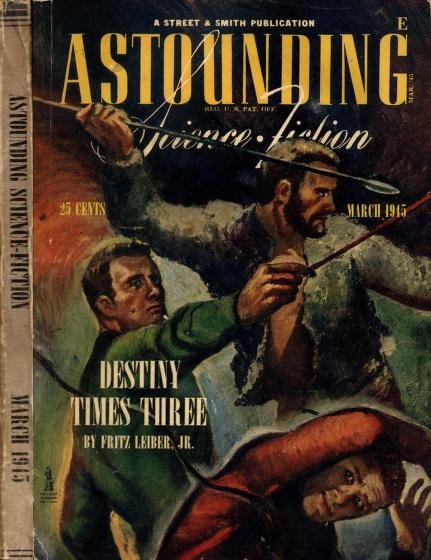
Destiny Times Three, first published in the March to April 1945 issues of Astounding Science Fiction. Retro Hugo nominee for Best Novel. Not one of Leiber’s more famous works, if the number of times it’s been reprinted says anything, but then it is quite a short novel—probably too short to sell on its own but also too long to be anthologized easily. One of Leiber’s earliest attempts at depicting alternate timelines, a premise that he would return to fruitfully much later.
Rime Isle, first published in the May to July 1977 issues of Cosmos Science Fiction and Fantasy. Never heard of Cosmos? Don’t worry, it only lasted four issues. Rime Isle is part of the Fafhrd and Gray Mouser series, being a later entry, as well as one of Leiber’s final appearances in the magazines; thereafter he stuck to original anthologies. Whereas some other Fafhrd and Gray Mouser stories are often cited, this is not one of them. I know basically nothing about it.
The novellas:
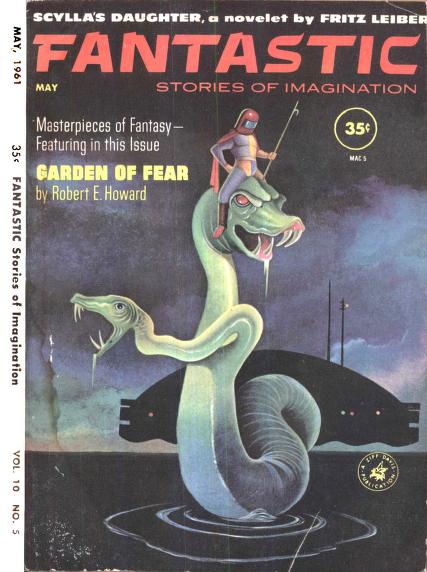
“Scylla’s Daughter,” from the May 1961 issue of Fantastic. The late ’50s saw a major revival for the Fafhrd and Gray Mouser series, which was not coincidental considering Fantastic‘s new editor, Cele Goldsmith, clearly sympathized with Leiber and wanted to buy what he was selling, with Fafhrd and the Gray Mouser getting at least one story a year in that magazine until Goldsmith left. “Scylla’s Daughter” would later be expanded into The Swords of Lankhmar.
“Ship of Shadows,” from the July 1969 issue of The Magazine of Fantasy and Science Fiction. This is a special issue of F&SF, being one of its author tribute issues, with “Ship of Shadows” as the lead novella. Technically a reread, but it’s been long enough that I could use a refresher, and hell, I remember liking it quite a bit. Leiber stories tend to fall into SF, fantasy, or horror, but “Ship of Shadows” ticks all three boxes, and it won a Hugo while it was at it!
The short stories:
“The Hound,” from the November 1942 issue of Weird Tales. The first several years of Leiber’s career saw him dwell primarily in Weird Tales and Unknown, the top fantasy-horror magazines of the early ’40s. Not being the most comfortable with SF, Leiber distinguished himself at first as a young master of terror and the supernatural. “The Hound” is one such early horror effort from Leiber, and hey, it’s apparently a werewolf story, and I love me some werewolves.
“The Moon Is Green,” from the April 1952 issue of Galaxy Science Fiction. After being relatively inative in the late ’40s, Leiber came back strong early the next decade, and his return to the field coincided with those explosive first years of Galaxy, the new SF magazine on the market. Leiber became one of Galaxy‘s leading writers in the early ’50s, and “The Moon Is Green” is one of those Galaxy-Leiber tales to get adapted for the legendary X Minus One.
Now, finally, the complete novel:
You’re All Alone, from the July 1950 issue of Fantastic Adventures. Apparently the magazine version is an earlier draft that Leiber had tried but failed to get published, since the fantasy market in the latter half of the ’40s was in the dumps, but luckily Fantastic Adventures, previously a second-rate pulp outlet, was under new management. Leiber would then “expand” the novel for book publication under the title The Sinful Ones, but from what I’ve heard the magazine version is better.
About how these complete novel reviews will work. My review schedule is on a rotation basis, switching between short stories, novellas, and serials; depending on how many days there are in a month I would cram in a third novella or short story. The way I have it figured is, if a month has 31 days, and if I’m set to review a novella on the 31st day, I’ll switch that would-be novella out for a complete novel. After all, I wanna save the biggest single review project for last, and I wanna give myself enough time to really digest the extra long material. The resulting review will itself of course be longer than average. Now, how do I separate a complete novel from a novella? How does one tell the difference, especially since magazines, while usually two-columned, have different type sizes and therefore some can pack more wordage into each page? Sometimes magazines give rough word counts, but much of this, admittedly, will come down to my own discretion.
Not making promises, but complete novel reviews will probably be the last department I add to my blog. This is a one-man show, ya know, and I do have a day job to contend with. Still, I wouldn’t be doing this if it wasn’t out of passive, and you also know that I’m a compulsive reader. The more the merrier! Just hope I can do someone as great as Leiber justice with this.
Jack Vance is a contender for the most influential mid-20th century SFF writer that relatively few people have read. He debuted in 1945, and unusually for a writer of that period his science fiction tended to read like fantasy—his fantasy, because nobody at that point wrote fantasy quite like Vance did. His 1950 collection (it’s a collection, I don’t CARE if some people call it a novel) The Dying Earth presents an Earth so far in the future that magic has not only emerged but overtaken technology; it influenced, among other things, Dungeons & Dragons. He would win two Hugos and a Nebula for the novellas “The Dragon Masters” and “The Last Castle,” which, despite sounding like they’d be fantasy, are in fact science fiction. He won a third Hugo in 2010 (this man lived a long time), this time for Best Related Work, with his autobiography This Is Me, Jack Vance! Even in his works that are not fantasy at all, there always seems to be a sense of magic with Vance.
Something to keep in mind is that Vance wrote a lot over a long span of time, and he has quirks that people will either accept or reject. If you really need your SFF to be colloquial or down to earth then you will probably not like Vance; his penchant for the flamboyant and the baroque has blocked off many would-be Vance fans. I have to admit that I wasn’t into Vance for a while, and even not I can’t say I love his work, but I do respect it and often enjoy it. Surely there’s something to like about a guy who will write a short story, set it on a planet that he’ll never write about again, and not only grant that setting a novel’s worth of detail, but even include footnotes. Vance is clearly a fan of planet-building, and it’s a niche talent he’s quite adept at, as we’ll see with today’s novella.
Placing Coordinates
“The Kragen” was first published in the July 1964 issue of Fantastic, which is on the Archive. A bit of a long story with this one. It’s not unusual for novellas to be expanded into novels, or to be made into sections of novels like they’re pieces in a jigsaw puzzle; in my experience the novella usually doesn’t benefit by being inflated to novel-length. “The Kragen” was expanded into the novel The Blue World in 1966, with the novel version getting nominated for a Nebula and being up for the Prometheus Hall of Fame a few times (makes sense). I just assumed that since the novel version is more well-known that “The Kragen” would be one of those novellas to get reprinted maybe once. Not quite! It was reprinted in Robert Silverberg Presents the Great SF Stories: 1964, edited by… you guessed it, Robert Silverberg (and also Martin H. Greenberg). It got a chapbook release from Subterranean Press, which is weird, like who asked for this? We have at least one in-print edition with the Vance collection Wild Thyme and Violets and Other Unpublished Works, in both paperback and as an ebook.
Enhancing Image
Much of this review will be spent on the world-building of “The Kragen,” rather than the plot, since the actual plot is pretty simple when viewed with a wide lens; I suppose it has to be. Vance has about sixty pages to not only introduce a whole world to us but to make it comprehensible, so while there are a few twists and turns, this is not one of his more complex narratives. Take it as an adventure story that theoretically could be just as easily fantasy as SF, if not for background details.
The unnamed world of the novella is entirely covered with water, which when you think about it is not so different from our world, which is only mostly water. Several generations ago (the dates aren’t clear) a ship crash-landed on the planet—apparently a ship full of criminals (though given their ability to procreate it must’ve been co-ed), and surprisingly the survivors did not all kill each other within a month; instead they found ways to survive and even prosper on the blue planet. This is impressive, not only because civilization managed to rebuild itself out of a bunch of scraps, but because it did so with some things that we take fore granted, such as electricity and even metal. There is a bit of metal that lies in some people’s possession, but it’s not enough to be used for much of anything, and anyway, nobody knows what to do with it.
Not the first or last time Vance did a lost colony narrative; he arguably did it better in his 1958 novella “The Miracle Workers,” in which survivors of a crashed ship eventually devolve into warring pseudo-medieval factions. In both stories the content could be construed as fantasy while the reasoning behind that content is undeniably science-fictional.
Society works on a caste system, although even at the beginning of the story the system is loosening up, with inter-caste marriage and what have you. In a bit of humor from Vance the castes are named after species of criminal, so you have the Incendiaries, the Swindlers, the Hoodwinks, and so on, with Advertisermen at the bottom. I know, very funny. Hoodwinks actually don’t do what you would expect, as their job is basically to act as signal-men, communicating with people on other floats in a sort of morse code, quite literally winking hoods at the tops of towers. I’m not sure what Swindlers do here, since their occupation probably wouldn’t align with what their name implies. Anyway, the protagonist, Sklar Hast, is one such signal-man, although he spends much more time in-story being a thorn in some authorities’ sides than doing his job.
About those “floats.” Without metal, without even glass, society has to rely on other resources, and in this case they were very lucky, because while the ocean does indeed stretch from pole to pole, there are these vast swaths of sea-plant that are big enough to not only serve as pseudo-land but to be handy for lots of other purposes too. Whatever the plants don’t cover, human bones will sometimes do the trick; apparently the people of this seafaring society are not one to waste the bodies of their dead, though from what I can tell they don’t indulge in cannibalism. I wonder Donald Kingsbury read this (or more likely The Blue World), got to the part where a human rib is used as a hook, and thought, “Hmm, I could write a novel like this.”
Despite the lack of resources, life has been mostly good for Sklar Hast and his people. “On this water-world, which had no name, there were no seasons, no tides, no storms, no change, very little anxiety regarding time.” It’s one thing to have a single-biome planet, but it’s an extra strain on one’s suspension of disbelief that there be practically no harsh weather. Of course, had there been gales and hurricanes then the crash survivors surely would’ve died off, and thus we wouldn’t have a story. You gotta do what you gotta do. There are a few other things, which I’ll get to in the spoilers section, that don’t strike me as the most credible, but Vance (as usual) goes the distance with the mechanics of his newfangled world. A lot of time is spent on what the people of the floats eat and how they eat it, and stuff like that, and much of it is at least intriguing.
But wait, there’s trouble in paradise! The people do have one natural threat to their way of life: the kragen (plural), a race of sea monsters that act more as really large pests than as direct threats to human life. Still, an angry kragen has the bulk and weaponry (tentacles and mandibles) to fuck up a person, and unfortunately the people don’t have weaponry good enough to take on the kragen; instead they have to rely on the supposed goodwill of the largest kragen of them all, King Kragen, which the elders “””allegedly””” are able to communicate with. If King Kragen is appeased with gifts (i.e., food) then he’ll kill or drive off smaller kragen. This feels like solving a big problem with an even bigger problem, but who am I to judge.
A little aside…
We get illustrations of the kragen on both the issue’s cover and with the opening interior illustrations, both done by Ed Emshwiller. Now, Emshwiller is a legend, and I respect him, but while I would say his depictions of the kragen are accurate enough, they seem a little… goofy.
It’s not his best work is what I’m saying.
One day a kragen fucks up Sklar Hast’s abode and instead of waiting on King Kragen to maybe show up, Sklar Hast takes matters into his own hands and rounds up some likeminded fellows to kill the kragen themselves, which they actually come close to doing. The fallout is catastrophic, though, resulting in a schism headed by Sklar Hast with a particularly zealous elder named Barquan Blasdel on the other side. The question comes down to this: Do the elders have any control over King Kragen, or are King Kragen’s appearances merely serendipitous, with the monster’s “help” purely fueled by the prospect of food? This is a Jack Vance story so you know damn well it’s closer to the latter, and come to think of it, questioning and overcoming unjust hierarchies is also a Vance staple. Sklar Hast and his people vow to not only head out on their own, detatching their float from the rest of society, but to kill King Kragen, come hell or high water.
Forgive me, I’ve been spending a considerable amount of time trying not to misspell these weird character names. Not really a Vance story if there aren’t weird character names.
Sklar Hast has manpower on his side, but what he doesn’t heave is the weaponry. Not yet. How do you take down a giant sea monster without guns? Crossbows? Even decent harpoons? They have to figure out how to modernize—to rediscover metal on a planet that’s practically devoid of it, and in the process prove to the elders that they no longer need such an arbitrary quasi-religious order of living. From here on the narrative becomes two-pronged, jumping between Sklar Hast and Barquan Blasdel, the new and the old, as they seek to destroy and protect King Kragen respectively.
There Be Spoilers Here
Mostly I wanna talk about how Sklar Hast and company are able to overpower the Kragen, because it’s… complicated. And also maybe a leap in logic. I’m not a scientist, but I’m not sure if blood works this way. The climactic scene of the men from the renegade float, now with crossbows made of metal and powered with electrical tubes, taking down King Kragen almost made me think more about the logistics of getting all that goddamn metal from burned blood (blood being smoldered down to iron, yes really) than the coolness of the action. And the action can be pretty cool when it’s there! So that says something about how much the solution to the lack of metal makes me scratch my head. The ubiquitous nature of the plant life already threatened to make things too convenient, but this is a bit much. That’s about it. That’s all I felt like saying about that.
A Step Farther Out
I have conflicting feelings as to the length of this thing. The plot is simple enough that I don’t think an extra fifty to a hundred pages would benefit it (mind you that The Blue World itself is quite short), but also I can see that extra wordage benefitting depth, especially character depth but also the workings of Vance’s world. Sklar Hast is a bit of a flat character; he wants one thing for most of the story, which is to kill King Kragen, and we can’t say he matures since he’s shown to be right pretty much from the outset and thus he has no lesson to take from all this. I at least appreciate that the elders, while shown generally to be wrong, are pragmatic enough that they’re not cartoonishly evil, with the exception of Barquan Blasdel. Indeed the pragmatism of the elders becomes part of the novella’s sly humor, which is perhaps chuckle-worthy but never laught-out-loud funny. Even so, I do think Vance’s sense of humor is underrated, and his jokes lend flaor to what would risk becoming a droll and humorless adventure.
I wouldn’t consider “The Kragen” to be Vance’s finest hour, if only because I don’t think it reaches the same level of epicness as his best stories of similar length. Consider that “The Miracle Workers” and “The Last Castle” each fit not only a novel’s worth of world-building into sixty pages, but a novel’s sense of grandeur; these are wondrous tales of action that feel like they’re deserving of big-budget Peter Jackson adaptations. Meanwhile “The Kragen” feels weirdly insular, with even the kragen themselves never being fully allowed to act the part of giant movie monsters. Also, I’m not sure where else to say this, so I’ll say it here: Don’t read “The Kragen” (or most Vance, for that matter) if you absolutely must have women in your fiction. In other words, this is not Vance at his worst, but it’s certainly not his best.
(Adventures in Time and Space, edited by Raymond J. Healy and J. Francis McComas. First edition cover by George Salter. Published 1946.)
The mission statement of my blog is to explore SFF in the magazines, of which there are many. Ideally original publications, but at some point I’ll cover stories that were first published elsewhere and then reprinted in the magazines. This is not to say I dislike the other major avenue for finding short fiction, the anthology; after all, I would not have discovered so much short fiction in the first place if not for anthologies, and I have to admit I have a lot of those on my shelves. For every unnecessary reprint of Harlan Ellison’s “‘Repent, Harlequin!’ Said the Ticktockman” there are over a dozen short stories and novellas I now love that I probably would not have found otherwise. The thing, though, is that by focusing on magazines I feel I’ve created both a filter and unlocked a door to a unfathomably huge world of mostly uncovered fiction, non-fiction, letter columns…
There’s only so much you can do with anthologies.
Not a criticism of anthology editors! Some of the best editors in the field have mostly or solely devoted their time to book publishing; when the Hugo for Best Professional Magazine was replaced by the Hugo for Best Professional Editor, it was to accommodate what was then an uptick in original anthologies, as well as to credit specific people whose achievements were not restricted to magazines. People like Damon Knight, Judy-Lynn del Rey, and Terry Carr would have been shut out from Hugo recognition with the previous category, but now they had a chance; that it took more than a decade for someone in book publishing to win Best Professional Editor is beside the point. My point is that this is not a problem of talent, but simply of the nature of anthologies, of their physical limitations and especially of the grim realities of the publishing world.
Let’s retrace our steps a bit. What is the purpose of an anthology? Obviously the answer will be different depending on whether it’s a reprint or original anthology, and even reprint anthologies (which are so often grouped together as fodder, unjustifiably) have different goals in mind. A reprint anthology might seek to cover a certain span of time or a certain demographic of authors; there are several reprints dedicated to female SFF authors at this point and we still have much work to do. The problem is that it’s never enough. I read a short story recently, “The Piece Thing” by Carol Emshwiller; it’s not a masterpiece, but it’s a fine read, and it strikes me as being worthy of being reprinted in at least a couple SF-horror anthologies. Not so. Despite being first published in 1956, it has since been anthologized a grand total of once, in Rediscovery 2: Science Fiction by Women (1953-1957), which came out… this year. How many more are like it?
Editors of reprint anthologies are allowed to be much pickier than magazine editors while also having a bigger pool to work with (keep in mind that magazines have to deal with a lot already), and as such their standards are inherently different. If a story which originally appeared in some obscure magazine in the ’50s was anthologized even once then presumably the editor of said anthology thought it worthy enough to not be stranded in a volume quite literally made of pulp paper which was not built to last and which has been out of circulation for many years. Sure, the issue that “The Piece Thing” first appeared in (the May 1956 issue of Science Fiction Quarterly, for those wondering) can now be read online, but prior to digital archiving there was literally only one way to find this story for decades. Again, how many stories are in this situation? How many “worthy” stories have been trapped in purgatory because anthology editors have overlooked them or simply not been able to know about them in the first place?
(Cover by Ed Emshwiller. Science Fiction Quarterly, May 1956.)
Again, this is not really the fault of editors. Well, maybe some of it is. There were quite a few female authors active in the ’40s and especially the ’50s, but you wouldn’t know that from contemporary reprint anthologies; even Judith Merril’s annual best-of anthologies tended to only have one or two stories by women per volume. Maybe that’s unfair, though. Maybe it really has to do more with the editor’s tastes than with their prejudices, not that the two don’t overlap at all. You can’t make an editor include a more diverse set of authors, and anyway I don’t think setting quotas is very healthy. Still, it’s telling that there have been several anthologies over the decades which have sought to “rediscover” magazine SFF by women, as if to compensate for the failings of earlier anthologies. It’s as if editors are only human and that they’re liable to overlook fiction which is very much deversing of preservation.
Because that’s what reprints are always ultimately about: preservation. Why anthologize in the first place? Why were fancy hardcover anthologies like Adventures in Time and Space and Groff Conklin’s A Treasury of Science Fiction big deals when they surfaced in the ’40s? Because for basically all of the stories included in those anthologies, it would’ve been the first time they met a reader’s eyes outside of the flimsy and brittle pages of a magazine; with book reprints there was hope that these stories could be discovered by future generations. Consider that Lovecraft’s legacy has been allowed to not only persist but thrive for two reasons: he was a compulsive letter writer who formed connections with a lot of people, a few of whom went on to form publishing houses (namely August Derleth and Donald Wandrei, who founded Arhham House), and also because said publishers made his work available in book form.
Lovecraft died poor and in obscurity, but if his work stayed in the magazines like virtually all of it was at the time of his death, he might now be yet another shrouded figure waiting to be rediscovered.
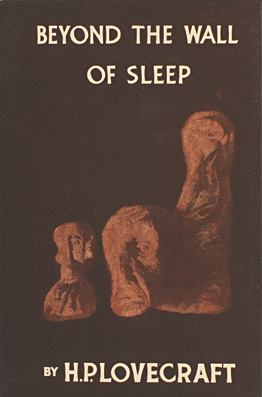
(Beyond the Wall of Sleep, editor uncredited. Cover by Clark Ashton Smith and E. Burt Trimpey. Published 1943.)
Obviously there’s a lot of crap in the magazines that’s not worth actively preserving; Sturgeon’s Law will not be defied. But I feel like even with the good stuff, there’s so much of it that anthologies are simply unable to cover everything. Take one of the greatest SFF anthologies of all time for instance, Adventures in Time and Space: this is a thick fucking book (about a thousand pages), and it has an extra advantage by covering only a relatively narrow range of material, with pieces published between 1932 and 1945. It also does something unusual for a fiction anthology, in that on top of the fiction it also reprints two speculative articles, which other reprint anthologies simply don’t do for some reason. Even with all these parameters, the 33 stories collected only emcompass a tiny fraction of the good stuff from that period, and it doesn’t help that editors Raymond J. Healy and J. Francis McComas give some authors multiple entries, which dilutes the diversity of voices. If you’re looking for a survey of where SFF was at in the ’30s and first half of the ’40s then a volume like Adventures in Time and Space will be a good starting point, but then you must dig deeper after that.
Keep in mind that most anthologies aren’t as long as Adventures in Time and Space; most are half that length, or even shorter. How many times have you started a anthology and the editor’s introduction goes something like this: “If I could edit a hypothetical hyper-dimensional book that never ran of space so that I could fit all the stories I wanted, I would, but unfortunately we don’t live in that reality so I can’t.” The horrors of picking favorites indeed. Imagine being a Gardner Dozois or a Terry Carr where you’re such a voracious reader, and you have hundreds of magazine issues and hundreds upon hundreds (vast oceans!) of stories at your disposal, and you can only pick so many. Dozois’s The Year’s Best Science Fiction series was huge, both in its number of installments and the thickness of each book, and yet he still felt it necessary to list stories that he would recommend that unfortunately he could not include properly. These recommendation lists were always quite long, and while these stories weren’t always taken from magazines, that tended to br the case more often than not.
Best-of anthologies try valiantly to sum up “the good stuff” from a given year, and we seem to be living in a golden age of best-of anthologies as we have several of them, all by capable editors. However, even if you were to combine the annual best-ofs by Neil Clarke, Jonathan Strahan, and Rich Horton (we’re looking at a good 1,500 pages or more, by the way) for a given year, you still could not even hope to cover everything. SFF is vast and it’s only gotten vaster as we’ve entered a new golden age for magazine SFF, what with magazines like Lightspeed and Uncanny Magazine voyaging beyond mere page count and entering that fourth dimension: digitalization. I can’t even say for sure how many pages it would take to print all the good SFF in 2022 because most of the magazines currently running publish exclusively online and in ebooks. The sheer amount can drive one mad; it feels like a variation on Borges’s library of Babel.
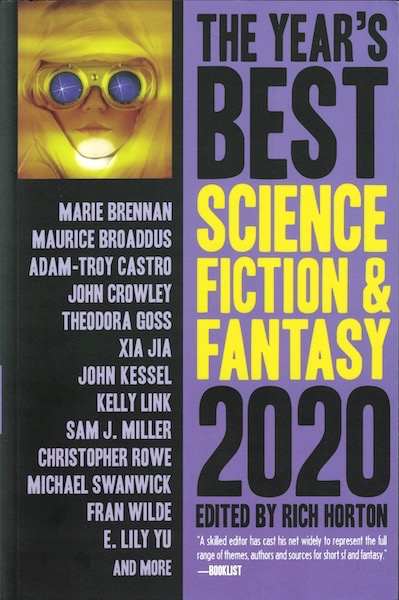
(The Year’s Best Science Fiction & Fantasy 2020, edited by Rich Horton. Cover by Argus.)
What I’m trying to say is that I find magazines ultimately more liberating. Sure, an issue of a magazine will be smaller and contain fewer stories than the average anthology, but there’s that flavor unique to magazines, and there’s always that feeling of digging for buried treasure. If a story shows up in a reprint anthology then it’s not up to you to rediscover it, as someone already did that job for you. Ah, but if you were to find some obscure story from six decades ago that has maybe been reprinted once in all that time while in the middle of digging through an equally obscure magazine issue, then it really feels like discovery! And the best part is that it doesn’t stop there. You’re not just leafing through an anthology—a selection of stories hand-picked by someone who had narrowed a pile down to what they feel are the best of the best—you’re a voyager, on a five-mission mission to explore strange new worlds. With the magazines you’re bound to hear voices you’ve never heard before and see places you’ve never seen before.
When I started this blog I wasn’t sure if I was ready to plumb the depths of magazine SFF, and ironically, as I’ve since only come to find just how deep those depths are, I’ve only become more excited about reaching for those depths. I turn over a rock and I find gold in the mud. Anthologies are a great supplement to magazines, but they’re not a substitute, for there’s always more to be uncovered, and the magazine, when taken collectively, is named Möbius.
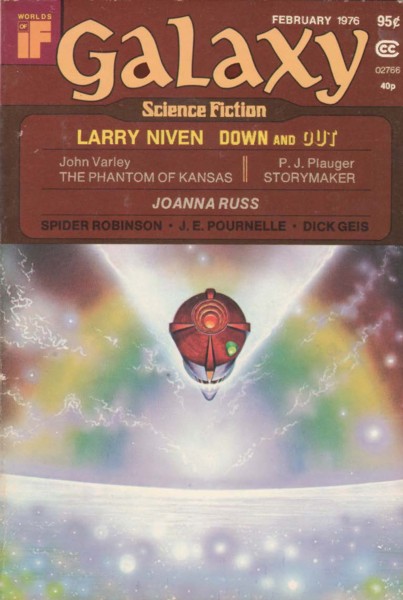
(Cover by Andrew M. Stephenson. Galaxy, February 1976.)
Who Goes There?
Joanna Russ was one of the defining feminist voices in ’60s and ’70s SF, as both a fiction writer and a critic. Her combative nature combined with her keen insight led to her accumulating a fair amount of enemies, but also some surprising allies; James Blish and Jim Baen were apparently defenders of Russ, despite being about as different from her politically as one can imagine. Her 1975 novel The Female Man remains her single most famous work, but she probably resonates with modern readers most strongly with her book-length essay How to Suppress Women’s Writing. In case these title choices don’t make it obvious, Russ is deeply concerned with women’s autonomy as people and as creatives. Lesbianism also figures into Russ’s writing, which is not unusual for second-wave feminism, though you’d be surprised how much it doesn’t show up (at least explicitly), including in today’s serial.
We Who Are About To… is Russ’s penultimate novel; she hadn’t even turned forty yet, but her fiction output would slow almost to a dead halt by the time the ’70s ended. This is my second Russ novel, as I had read Picnic on Paradise, her debut, and honestly I didn’t have much fun with that. The subject of today’s review isn’t fun either, but then again it would probably be insulted if you had a good time with it in the conventional sense. It’s a contender for the darkest SF novel of the ’70s, which I suppose is a point of praise. If you have a history of suicide ideation like I do then you’ll have a very bad time with Russ’s novel.
Placing Coordinates
Part 2 was published in the February 1976 issue of Galaxy Science Fiction. I’ve said before where you can find We Who Are About To… in book form, just check out my review for Part 1. I will say, the Feburary 1976 issue might be the most essential Baen-era issue of Galaxy that we have; it ticks all the boxes. We have a science article by Jerry Pournelle, a story by Larry Niven, a book review column by Spider Robinson, as well as pieces by daring young authors like John Varley and P. J. Plauger. And then we have Russ, who might stick out like a sore thumb, but I like said, Baen liked Russ, and he also liked paying lip service to explicitly leftist authors.
Enhancing Image
At the end of Part 1, the nameless narrator killed most of the party, excepting Mrs. Graham and her adopted daughter Lori. I didn’t bring up the fact that Lori is adopted in my review of Part 1 because I didn’t really think it mattered—and it doesn’t! Except on a symbolic narrator, which the narrator makes clear to us. The Grahams married for money, then “bought” a child with their wealth, painting them as delusional petit bourgeois, though they don’t do anything that I would say is too bad. Mr. Graham is a decent fellow and his death (via natural causes) in Part 1 is the closest the narrator comes to actually relating to another person who isn’t Cassie; sure, she treats Lori well (before she kills her), but that’s just being nice. At first I thought the narrator being so unlikable was an oversight on Russ’s part, but Part 2 showed me that this assessment was mistaken.
Returning to the campsite, the narrator kills a now justifiably furious Mrs. Graham with her own gun (Mrs. Graham probably never having handled a gun before), and proceeds to use the gas pellet gun on Lori, killing her instantly and relatively bloodlessly. “You must not shoot Lori with a large-caliber revolver. It’s not right.” This is all in the first few pages of Part 2, and the narrator, having done in everyone, is now left completely on her own. You may notice that we still have a little over thirty magazine pages to go at this point and the novel has become a one-woman show: it’s not as bad as it sounds, but it’s also not… great? The novel stumbles to its predetermined conclusion, but being stuck with just the narrator proves to not be the kiss of death I feared it would.
In Part 1, the narrator isn’t reflecting as much as she’s interacting with other characters, and much like Hamlet she seems to mess with other people intentionally: she claims to have been a “neo-Christian” but also a communist at one point, and everything she says is cloaked in hateful snark. An indicator of when the novel was written is that the narrator comes off like a burnt-out former hippie, with her idealism crushed under what would’ve in the real world been the gas shortage, Watergate, etc. Much like John Lude, the bureaucrat who thinks himself an intellectual, the narrator’s actual humanity is closed off from other eyes, her snarky antagonism being a foil to John’s calm smugness, or rather John is a foil to the narrator. Now that John is dead, along with everyone else, the narrator has nobody left to take her antagonism out on, though that doesn’t stop her from trying!
The realization that she is now by definition the loneliest person in the universe does not hit her immediately. It also doesn’t occur to her until some days in that starving yourself to death might be the slowest way to die possible. Oh sure, she could use her gas pellet gun on her self, or one of a myriad of poisons, or drown herself, but starving will do just fine. “I shall be bored to death long before I starve.” Indeed. As both the narrator and the reader try to fight off the onset of boredom, we get one of those old chestnuts of stranded astronaut stories: hallucinations! The most sustained hallucination is a mock trial in which the dead members of the party dunk on the narrator for killing them, seemingly with no better a justification thant she didn’t like them. These dialogues are all in the narrator’s head, though, something she acknowledges repeatedly.
There’ll be hallucinations about being rescued, I know: croaking thinly, “no, let me die!” (with immense dignity, of course) and I’m carried out to a shuttlecraft by great, coarse, strong, disgustingly healthy people in uniforms with thick necks. Actually it would be a little awkward trying to explain what happened to the others.
You killed them. Why?
They were trying to kill me.
Why?
To prevent me.
From doing what?
Dying.
It’s hard to not frame the narrator killing off most of the party as unforgivably heinous, even if she did it to retain some level of personal freedom in what she saw as a hopeless situation anyway. The thing is, I would’ve actually been more on the narrator’s side if her antagaonism resulted from the men in the party wanting to turn the women into breeding stock, but while there is a conversation in Part 1 about “repopulating,” the moral black hole of procreating without consent never takes center stage in the novel. The narrator is also maybe a lesbian, and at most this would be subliminal since we don’t get much at all from her regarding her orientation, despite the circumstances in Part 1 calling for transparency with that sort of thing. Of course it’s tempting to project Russ’s lesbianism onto the narrator, but I really do think the novel’s deconstruction of survival for its own sake would’ve been more effective if the narrator’s views on sex and relationships were made clearer.
Part 2 is arguably stronger than the first installment because we actually get some insight into the narrator’s motives and how she sees herself. It took long enough, but the novel does eventually become something like a character study, since the plot has basically ended only a fraction into Part 2 and we (and the narrator) are stuck with the protracted aftermath. If you’re a reader who favors plot then the latter half of We Who Are About To… will probably make you pull your hair out, but if you’re much more into character and/or thematic depth like myself then you’ll have more to chew on in the latter half. The other characters were little more than caricatures anyway, so dedicating so much wordage to the one character who might have some real human depth was a good move, even if it was made on what I would argue was a fundamentally flawed premise.
In other words, it sort of pans out, but I don’t think this novel should’ve been—well, a novel. Certainly it could be a novella, but even as a short novel I don’t think it justifies itself.
There Be Spoilers Here
The narrator dies. The end.
This time there really isn’t much more to be said. I’ll take this as a moment to clarify something, because I think there’s a timeline very similar to ours where We Who Are About To… came out as a 30,000-word novella and not a 50,000-word novel, and it would’ve been much stronger while being just as light on plot. The story continues past the point where the narrator has killed everyone, but the plot basically ends halfway through the novel—the plot, or any plot, being a sequence of events. There is action in a plot. That’s not to say something light on events is lacking in depth or even entertainment value; one of my least favorite criticisms of anything is when someone disses it for basically not having a theatrical (or cinematic) three-act structure. A work of art doesn’t have to hit a set quota of plot beats in order to be of enduring value. One of the most experimental and boundary-pushing novels of all time, James Joyce’s Ulysses, has very little in the way of plot, but the nuances of Joyce’s prose, his references, and the psychology of his characters, have been studied for quite literally a century now.
Here’s another example, and this one is directly SF-related: Samuel R. Delany’s Dhalgren. Delany’s novel is mostly, on its surface, 800 pages of druggy sex and totally-not-hippie artists discussing the nature of art and reality, but when taken past its mere plot it becomes a dense and wide-ranging fable about what might happen when a society tries to rebuild itself while being physically and culturally cut off from the rest of the world. You could hit all the plot beats in a quarter of the word count, but you would lose the juiciness of its meditations and allusions in the process. There’s a peculiar charm to a long rambling novel, but Russ’s novel is short, and it can afford to be even shorter. Russ doesn’t allow her characters, not even the narrator, to take on the human dimensions of Delany’s or Joyce’s, nor does she enchant the text with aesthetic flourishes except in short bursts.
The result is a novel that’s paradoxically short and yet long-winded. The narrator spends so much time starving that she eventually gives up and opts to put both herself and the reader out of her misery with poison. Having turned in her membership card to the human race with first her thorny attitude and then the murders (a mistake she realizes too late to remedy), she bids a final farewell (to herself, if nobody else) in the very last sentence fragment. There’s a line not long before that when she brings up a brief and incisive neo-Christian saying, which encapsulates the narrator’s relationship with the rest of the party as well as her failure to appreciate what little of humanity she had left.
I’ll tell you the neo-christian theory of love. The neo-Christian theory of love is this:
There is little of it. Use it where it’s effective.
It was a life poorly lived.
A Step Farther Out
Do I like this novel? Hmmmmm. Is it a novel that’s meant to be liked? Obviously there are people who are fond of it; it actually has a higher rating on Goodreads than The Female Man. But I don’t see We Who Are About To… as a novel to be enjoyed so much as a novel to be argued with. If you’re totally behind Russ’s apparent feelings on stranded astronaut and Adam & Eve plots (she loathes them) then you’ll at least like the novel on paper, but you’ll still have to contend with how it reads.
I have to admire making a protagonist so unlikable, and to have us be stuck inside the head of said protagonist, but we only begin to understand what her deal is once the excess weight of the rest of the cast has been expelled. This is not a novel that tries to win you over from the beginning; rather, this is the kind of novel that wants you to work for it a little. Again, I can respect that, but that doesn’t mean I have to enjoy reading it. I hate few things more than when a work of art dares me to experience it, like the experience is a game and I can only “win” if I refuse to play. I’ve been hesitant to check out Norman Spinrad’s The Iron Dream for the same reason, despite the praise. If a novel, by the nature of its premise, is not meant to be read but to be thought about then why read it? The act of reading should be pleasurable, not just a challenge.
I’m getting ahead of myself.
I respect Russ’s novel, but I don’t “like” it. If you’re one to search for transgressive ’60s and ’70s SFF novels, though, then I would go so far as to say We Who Are About To… is a hidden gem, even by the standards of that niche.
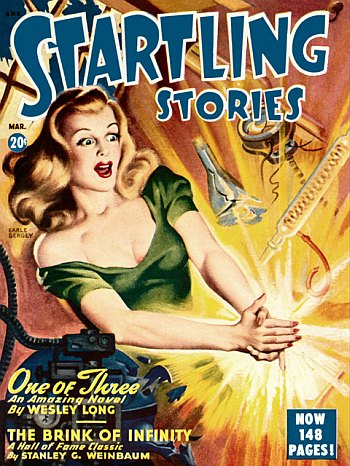
(Cover by Earle Bergey. Startling Stories, March 1948.)
Who Goes There?
Henry Kuttner began writing pretty young, being first published in either 1931 or 1936 (ISFDB claims the former, but something tells me they’re wrong), the latter at the very least introducing Kuttner under his own name to the world of SFF with “The Graveyard Rats.” Said story, a pretty solid one-man show about rats and claustrophobia, has been very recently adapted into an episode of Guillermo del Toro’s Cabinet of Curiosities. Kuttner would come to define himself, though, not as a practitioner of horror, but of humor, though the two are not always mutually exclusive. In the late ’30s he wrote prolifically, but not with a whole lot of success; he became known as one of many hack writers for the pulps, but unlike most of them he really did have talent lurking underneath. 1940 was a watershed year for Kuttner, as he married fellow writer C. L. Moore (they both got their start in Weird Tales, and Kuttner started as a big fan of hers), and together they wrote an impressive streak of SFF that remains essential.
While he more or less worked in collaboration with his wife (and vice versa) for the rest of his career, Kuttner would continue to write on his own (essentially if not quite literally) after 1940. Mostly outside of Astounding Science Fiction, Kuttner had stories submitted under his name alone, presumably because magazines like Startling Stories and Thrilling Wonder Stories were less reputable, and also because these stories were deemed more Kuttner-y than his more outright collaborations with Moore. After 1950, Kuttner’s productivity dropped to about one story a year (the same happened with Moore, as they both focused on their education), and unfortunately it never recovered; Kuttner died of a failed heart in 1958, only 42 years old. To quote Brian Aldiss (or maybe it’s David Wingrove) from Trillion Year Spree, “Our own minds were extinguished a little in response.”
Placing Coordinates
First published in the March 1948 issue of Startling Stories, which is on the Archive. “Don’t Look Now” has been reprinted a good number of times, at least one of which, My Best Science Fiction Story, is also on the Archive; actually there are two versions of this anthology, and thankfully the version that’s archived, the abridged version, still has Kuttner’s story. More importantly, we have an introduction by Kuttner himself explaining why it’s his “best” story—and look, I normally don’t look for authors’ comments on their own work, but this is glorious. I won’t quote the whole thing, but it’s so deliciously sarcastic—it alone would be worth the price of admission.
Why I selected Don’t Look Now as my favorite science fiction story is because it has the technical accuracy of Jules Verne; the realism of H. G. Wells, the social implications of Tolstoi (Leo—the Count, I mean), the freedom of Laurence Sterne, and the terseness of the Bible (the King James translation, of course).
These comparisons are BULLSHIT and Kuttner knows it. He takes apart the idea of an artist choosing their own favorite work and by extension the idea of making an anthology out of such a premise. He then finishes with the cherry on top: “Anyway, my wife wrote it.” Almost certainly untrue, by the way; after having read it I can say “Don’t Look Now” feels like a Kuttner story through and through. Kuttner’s really playing with the reader here, a forecasting of what will be an almost (if not equally) just as subversive a story.
Right, other reprints. The Great SF Stories: 1948, edited by Isaac Asimov and Martin H. Greenberg; by extension we also have The Golden Years of Science Fiction: Fifth Series, being an amalgamation of The Great SF Stories: 1947 and 1948. More curiously perhaps we have The History of the Science Fiction Magazine Part 3: 1946-1955, edited by Mike Ashley, which despite sounding like a non-fiction series is actually an anthology series. The most essential reprint is, of course, Two-Handed Engine: The Selected Stories of Henry Kuttner and C. L. Moore, which I brought up in my review of Moore’s story “Daemon” and which I recently managed to get my hands on. All seem to be out of print, but given that you have at least two free online resources I don’t think it’s a bad deal at all.
Enhancing Image
This is a barroom story, which is how you know it’s good. A lot of shit goes down in bars, whether it be between strangers or friends. We meet Lyman, our protagonist, who’s a bit of a weirdo an eccentric, making conversation with a man in a brown suit (let’s just call him the brown man, he doesn’t have a name), and things get a little weird right off the bat. Lyman starts talking about Martians, and how Martians live among us, and how everyone has a Martian whose job is to look after them and make sure they stay in line. Lyman’s Martian happens to be on break, how convenient. He also had been tailing the brown man all day, which is totally not creepy. The fact that the brown man doesn’t hightail it out of there simply because of Lyman’s weirdness perhaps says more about the brown man than it does about Lyman.
Not that the brown man is just some guy Lyman found off the street, he’s a journalist, which you’ll notice is a running thing in old-timey SF especially; if something “out there” is afoot then there’s a good chance a journalist will get involved. Lyman himself is supposedly an inventor. An accident involving “supersonic detergents” went awry and resulted in Lyman’s brain getting rewired, altering his senses such that he could now see and hear Martians—to an extent. He still doesn’t know what they really look like; they apparently walk around in human skin suits. That’s right, this story has actual skinwalkers. Reptilians who secretly rule the world. All that good stuff. Now Lyman is the Man Who Knows Better™, and he’s out to spread the word!
Did the movie They Live take after this? Is this plagiarism?
Anyway, given the alien invasion craze of the ’50s (think Invasion of the Body Snatchers), it’s surprising to me that “Don’t Look Now” was published in 1948, since it feels partly like a commentary on all those alien invasion stories. While there is a fine layer of paranoia coating things, there’s also a good deal of humor, as is typical of Kuttner. We get a reference to the famous Orson Welles radio broadcast of The War of the Worlds—you know, the radio drama that allegedly convinced thousands of people that there was an actual alien invasion going on. According to Lyman it was obviously fiction, but the novel the radio drama was adapting? Maybe not so much. “With Orson It was just a gag. H. G. knew—or suspected.” Again I’m surprised this was published in 1948 and not 1958, because it feels like the kind of self-aware takedown that would come about after a fad’s run its course.
Lyman also has the notion that cats were actually the ones who ran the world before the Martians, and they can even detect Martians as well. As someone who has (not owns) two cats, I find this credible enough.
Truth be told, it’s hard to talk too much about “Don’t Look Now,” for a few reasons. It’s probably the shortest short story I’ve reviewed so far, and I actually worried its length would be a problem; it’s only half a dozen magazine pages long, which translates to about a dozen book pages. Okay, that’s too bad. The thing is that it’s also chatty. This shit is like My Dinner with Andre if it was written by Thomas Pynchon, it’s a little gonzo and it almost feels mashed together. And because the vast majority of it is dialogue, with just two characters in one location, you might get the impression that nothing happens, which in a way is true. The stakes aren’t too high. We don’t suddenly break out into an action sequence. The Martians don’t barge in and wreak havoc. I know that’s entering spoiler territory, but I just wanna set the right expectations, because “Don’t Look Now” works almost like a Socratic dialogue—with a twist at the end, of course.
As such, this is my shortest review thus far; I’d be a little embarrassed if it wasn’t. Which is not to say the story is dull, or that it’s bad. Quite the contrary! Kuttner’s economy of style is empeccable; he does not waste any time and he doesn’t try to “elevate” it with flowery descriptions. Kuttner’s strength lies in punchy storytelling, so even though virtually nothing happens in “Don’t Look Now,” you don’t get the sense that Kuttner is just spinning his wheels, though you may be wondering what he’s up to. There’s definitely a point, but it’s saved for the very end, which naturally is where we’d get to spoilers. I’ll just say here that the story’s sense of paranoia lives up to the paranoia implied in its title, even if it is a bit jokey about it.
There Be Spoilers Here
The ending changes everything. Up to this point we’ve been led to believe that there’s a Martian in the bar, and that anyone could be it. Is it the brown man? The barkeep? Someone we were not aware of until now? No, it turns out that the Martian is… Lyman himself.
Lyman sat there. Between two wrinklesi n his forehead there was a stir and a flicker of lashes unfurling. The third eye opened slowly and looked after the brown man.
He was telling the truth about at least one thing: Martians have a third eye that they keep hidden. Most of everything else is probably a lie. The explanation about Martians appearing in infrared pictured has to be a lie. We’re still not sure what the Martians really look like. Lyman, since he is the protagonist and viewpoint character, has been taken for granted with regards to his trustworthiness, but we find out at the very end that the person who supposedly knows about aliens living among us is actually an alien himself. There’s even a subtle misdirect right before the final line where it looks like the barkeep might reveal himself as a Martian, but this is a red herring. Rarely do yoo come across a story where a good 90% of it is a red herring, come to think of it; the final reveal makes us doubt ourselves.
This raises a peculiar question, though: Why in God’s name did Lyman tell the brown man about Martians in the first place? What did he have to gain from it? Why would he rat out his own race like that? Unless, of course, you assume most of what he said was wrong on purpose; that he was giving the brown man just enough cookie crumbs to become paranoid about alien overlords, but then steered him off the patch by giving false information. Now why would someone in power deliberately give out misinformation? Hmmm. Not to mentions it explains Lyman’s erratic behavior before, which is revealed to have been very much calcualted. It would’ve been too easy for Lyman to get caught by a Martian, given he’s not being exactly secretive about his findings, so Kuttner does the smart thing and makes the Martian the last person we would suspect.
In “Don’t Look Now” we don’t see the solving of a mystery but the planting of one. You know how in Inception their normal job is extraction, which is to steal information from people’s dreams, but plnating false info is much harder? Lyman and Kuttner do that, and they do it pretty well.
A Step Farther Out
If “Don’t Look Now” feels somehow minor it’s because it’s set on so small a stage. There are only two principal characters and most of the word count is dedicated to their dialogue. Hell, only one of the characters is given a name. It’s all rather theatrical, like a one-act play. For a while I wondered where it was going, or rather what the point of it was, but I have to say the ending makes up for the lack of immediate point; it’s the kind of twist that makes you look back on the rest of the story and try to rearrange the pieces of the puzzle you’ve been given. Kuttner, more than anything, is clever, and he waits for the perfect moment to pull the rug out from under you. I would consider it his best, but I think it encapsulates what separates a Kuttner story from a Moore story.
In the years following World War II, there was an uptick in paranoid SF, projecting fears about nuclear weapons, the newfangled Cold War, or both. “Don’t Look Now” belongs to a certain subset of SF story from that period, leaning into the anxieties of the era and presenting something like an allegory. I don’t know where Kuttner stands on the issue of the Cold War, about the possibility of Soviety infiltrators in the US, the ending not really clarifying anything on that front, but I think that lack of clear intention only adds to the intrigue. While published in 1948, this is very much indicative of social anxieties prevalent in ’50s American SF. I would check it out, especially if you’re a sucker for that breed of fiction like I am.
The ’60s saw an influx of explicitly feminist SFF writers, in correspondence with the sexual revolution of the period, with authors like Ursula K. Le Guin and Kate Wilhelm (although the latter had debuted in the late ’50s) coming to prominence. Perhaps the most abrasive of these new voices in the field was Joanna Russ, whose professional debut was in 1959 and who really hit the scene with her classic vampire story “My Dear Emily” in 1962. Her series of stories about Alyx the barbarian are of interest for a few reasons: first was the novelty of having a female protagonist in what amounted to heroic fantasy, and the second was that said heroic fantasy hopscotched its way between that genre and science fiction. What made Russ most famous (or infamous), though, was her 1975 novel The Female Man, which had apparently been written half a decade earlier but remained shelved until then. Russ, in both her fiction and her criticism (she, along with Judith Merril, was considered one of old-timey SFF’s great critics), was a real warrior with the pen—her combativeness earned her some enemies, but also much respect.
Due to health problems, Russ’s output petered out after the ’70s, and her career as a novelist was short-lived, with her first and last novels (Picnic on Paradise and The Two of Them, respectively) being published only a decade apart. She did, however, get some awards recognition, winning the Hugo for Best Novella with her 1982 novella “Souls,” which, though people must not have figured it at the time, had come out during Russ’s twilight years as a fiction writer. Still, as arguably the most outwardly spoken vanguard of second-wave feminism in relation to SFF, it’s possible that by 1985 Russ had said pretty much everything she wanted to say. While she lived until 2011, Russ’s legacy is very much conjoined to prevailing feminist modes of thought in the ’60s and ’70s.
Placing Coordinates
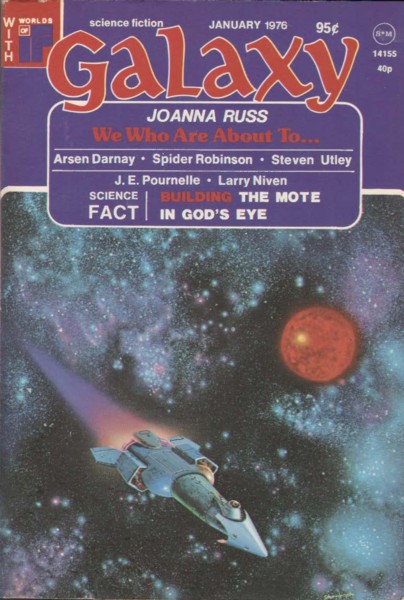
Part 1 of We Who Are About To… was published in the January 1976 issue of Galaxy Science Fiction, which is on the Archive. I assumed that this novel would be out of print, but this is not so! There’s a paperback from Wesleyan University Press that looks like it’s still in print, and the same goes for a more recent paperback from Penguin Books; yes, apparently Penguin thought We Who Are About To… was significant enough to give it a fresh printing. Of course, the Wesleyan edition is superior by virtue of not being British. Keep in mind also that this is a very short novel—170 pages in its first edition and just under 120 in the Wesleyan, almost making it a novella really.
It could’ve been even shorter, I’m just saying.
Just as interestingly, this was published in Galaxy during that period when Jim Baen was editor. Baen was a truly remarkably editor, one of the all-time greats, but it’s funny to see a serial by leftist firebrand Joanna Russ in the same issue as pieces by such grumpy right-wing stalwarts as Larry Niven and Jerry Pournelle; mind you, Baen’s fondness for out-of-left-field (pun intended) authors like Russ and Le Guin paled in comparison to his devotion to the conversative/libertarian crowd.
Enhancing Image
Before we get into the actual plot, let’s talk about a niche but weirdly prolific and popular subgenre, if you can even call it a subgenre: the stranded astronaut story. You know the drill, it’s when an astronaut (or at least someone who is spacefaring) gets stranded in some hostile environment and has to find a way either call for rescue and live in that new environment. Even by 1976, when Russ’s novel was serialized, this was a real old chestnut of the genre, and evidently it continues to be hugely popular in the present day if The Martian is anything to go by. Name an SF author and they probably wrote a stranded astronaut story at some point, and more often than not such a story is fundamentally optimistic about the prospect of humanity surviving amongst the stars. Such a premise is very much Campbellian, and while it didn’t start in John W. Campbell’s Astounding, it appeals to that sensibility.
We Who Are About To… does not hold such an optimistic view of humanity being able to overcome such obstacles; this is a novel that basically tells us right at the beginning that everyone will be dead by the end, so I’m not counting that as a spoiler, since it’s all but predestined. You may be wondering what I’m gonna do about the spoilers section, since I always have that for these reviews: don’t worry, you’ll see. You may also be wondering what the point is of Russ introducing us to these characters that she’s pointing at and saying, “Hehe, I’m gonna fucking KILL them by the end of this!” Well, you know what they say about the journey and the destination; more importantly, this novel would not be able to justify its own existence if it didn’t result in a kill-’em-all type of ending. Let’s pretend, though, for a second that we might get invested in these people.
Now, as for the characters…
There are eight of them at the outset, but only maybe half of them really matter. Five women and three men, and one of those women is very much underage (there’s a ’70s-ism here that I don’t feel like getting into, except to say that putting barely-in-their-teens characters in sexually compromising situations seemed like something you just did as an SFF writer in that era), not to mention a daughter of one of the other women. We have Mr. and Mrs. Graham and their daughter Lori, Cassie, Nathalie, Alan, John, and the unnamed female narrator. John is possibly the most interesting of the bunch since he acts as kind of a foil to the narrator, thinking himself an intellectual when in reality he’s a know-nothing bureaucrat. Alan is the youngest of the men and the closest the novel has to a conventional antagonist; he’s the only one who, prior to Part 1’s climax, resorts to physixal violence. Nathalie is a bit of a nonentity while Cassie is the closest (aside from Lori) the narrator has to an ally in all this. Not that that means much.
Our Heroes™, as part of an interplanetary expedition gone awry, crash land on what is probably a “tagged” planet, which is to say a planet whose makeup is not immediately fatal to humans. So it’s more habitable than Mars, which is something. Left with only the remains of their vessel, a land rover (or something like it), and some supplies, it’s time for the group to get their act together and see if they can make the best of a bad situation. They may as well get used to it since they have no way of calling for help and the planet itself is so distant from human civilization that help is simply not coming. But it can’t be all bad, can it? Well, the narrator thinks it’s all bad.
John Ude said, “Come on now, come on, dears. It’s a tagged planet. It has to be. Too much coincidence otherwise, eh? The air, the gravity. Now if it’s tagged, that means it’s like Earth. And we know Earth. Most of us were bom on it. So what’s there to be afraid of, hey? We’re just colonizing a little early, that’s all. You wouldn’t be afraid of Earth, would you?’’
Oh, sure. Think of Earth. Kind old home. Think of the Arctic. Of Labrador. Of Southern India in June. Think of smallpox and plague and earthquakes and ringworm and pit vipers. Think of a nice case of poison ivy all over, including your eyes. Status Asthmaticus. Amoebic dysentery. The Minnesota pioneers who tied a rope from the house to the barn in winter because you could lose your way in a blizzard and die three feet from the house. Think (while you’re at it) of tsunamis, liver fluke, the Asian brown bear. Kind old home. The sweetheart. The darling place.
The narrator has a snarky sense of humor—humor which, if absent, would render the novel borderline unreadable. The snark helps both the character and the reader cope with how hopeless things are. The narrator proceeds to list all the problems with a “tagged” planet and how basically nobody in the group is equipped to live long-term on such a planet, let alone set up a colony. Think of how many parts of our world are uninhabitable and compare that to a planet Our Heroes™ know nothing about, and whose very water could be lethal to humans. Something that constantly gets ignored or handwaved in these stranded astronaut stories is how fucking difficult (i.e., impossible) it would actually be to live in an environment that’s not suited for human habitation. While I have my issues with Russ’s novel, its mission statement as a strong dose of anti-Campbellian SF is admirable, even if I find it far too pessimistic for its own good. I do often prefer my SF to be at least a bit more hopepilled, just saying.
While the narrator is incessantly bitchy, her fatalistic viewpoint (we may as well play Uno until we die of starvation) is not unfounded. As far as she’s concerned, everyone died in the crash (not physically, but more metaphysically) and all this talk of setting up a colony is just delaying the inevitable. She might be more invested in survival if, say, they were literally the last human beings in the universe and if they didn’t procreate then the race would die out, but something tells me even if that was the case her response would still be “meh.” Naturally this attitude does not vibe well with the rest of the group, and she’s soon treated as a buzzkill at best and some kind of antisocial deviant at worst.
Take this little exchange between the narrator and John (again), which is easily one of my favorite bits of dialogue in Part 1:
“Civilization must be preserved,’’ says he.
“Civilization’s doing fine,’’ I said. “We just don’t happen to be where it is.’’
To say the narrator is thorny would be putting it mildly. Assuming the doom-and-gloom premise doesn’t alienate you, the total unlikability of the protagonist (even calling her an anti-heroine doesn’t feel right) just might, and I suspect is also the big reason why contemporary reviewers were not kind to the novel. It would be one thing if the narrator was set in her ways and she just wanted to be left to her own devices, but those dumb fellow humans keep trying to rope her back in, but she’s so nasty to everyone (except the Grahams, and even with them she’s standoffish) that we’re not sure why the others would want to keep her. The most plausible explanation is that they need everyone they can get, even the person who refuses to cooperate, if they hope to rebuild on this strange new planet, but I feel like it’s possible to do without just one person, especially if that person is a huge pain to be around.
Indeed, while the narrator is not without redeeming qualities, the conflict is only allowed to happen because she, for some reason, refuses to just take a hike and kill herself in peace, at least sparing everyone else the trouble. The whole idea is that she wants to die, since she sees no point in living under such dire circumstances, yet she keeps going. Oh, there are attempts from the others to keep the narrator from hurting herself, but she still has plenty of opportunities, not to mention means, of ending her own life, yet she can’t do it. She has a gas pellet gun which she can load with poison and enough drugs on her person to take down an elephant or two, so it shouldn’t be that hard. Of course, the narrator’s lack of drive to do what she herself thinks ought to be done is probably the point, which finally brings us to…
There Be Spoilers Here
Most of them die. End of Part 1.
…..
…………..
……………………
Okay, there’s more to it than that.
I can’t remember now when it happened exactly, but I realized that the narrator reminded me of a certain other character, and while I wasn’t expecting the comparison, it makes total sense to me now. I’m talking about Hamlet. The doomed prince of Denmark was a revolutionary character in theatrical storyteller, and, being innovative, he’s easy to poke fun at. The tragedy of Hamlet is that he is a man who is all thought and no action; every action he takes in the place is either misguided or comes about too late. To have the protagonist of your tragedy spend so much of the story saying so much and doing so little is probably frustrating for a lot of modern readers/viewers, but consider how unique Hamlet is as possibly the first true introvert in the history of theatre. The tragic hero, no matter how doomed, is typically a person who acts, while Hamlet is a person who thinks.
Similarly, the narrator of We Who Are About To… spends so much of her time thinking and so little time doing, so much so that the violent confrontation at the end of Part 1 struck me as more action-packed than it really was. The narrator is forced to take action against the rest of the group once she had literally nowhere left to run, resulting in her killing John, Alan, and Nathalie, and with Cassie, opting to do the reasonable thing and no longer put up with the narrator’s bullshit, killing herself. Had the narrator done so herself earlier, none of this would have happened, but like Hamlet she either acts in the wrong way or too late. Also like Hamlet, she thinks about suicide a good amount, and while I have to think of the novel’s pro-suicide (or at the very least pro-euthanasia) stance as almost more a shock tactic than an actual argument Russ is making, I also think it makes sense that she would (like Hamlet) struggle to go through with shuffling off this mortal coil.
The narrator being a Hamlet-esque figure does something to explain (if not to justify totally) her constant antagonism toward the rest of the group, not to mention her obsession with death. It’s all engaging on a thematic level, and it’s nice to think about—I just wish I could say the same for it as a reading experience.
A Step Farther Out
Part 1 ending where it does immediately brings up a structural problem, since by this point most of the cast is dead and there’s frankly not much than can happen from this point onward. At the end of Part 1 it feels more like we’re approaching the last third, or even the last quarter of the novel, and not the second half. It’s also a problem of length, since even taking into account how short it already is, I can’t help but feel like We Who Are About… can stand to be even shorter; it would be feasible, possibly even desirable, to whittle this 50,000-word novel (I would say Part 1 is about 25,000 words) down to a 30,000-word novella without sacrificing the important things. After all, we don’t need this many characters who inevitably will be snuffed out, nor do we need to know too much about them aside from how they figure into (i.e., oppose) the narrator’s viewpoint. Also, while I do find some of the narrator’s snark mildly funny, there’s only so much of her ultra-pessimistic unlikability that I can stomach.
Despite my reservations, I am curious as to how Russ plans to justify what looks to be mostly a one-woman show in the novel’s back half, and how that might impact my enjoyment of the whole thing as opposed to just admiring its thematic audacity. I’ve been burned before.
John Kessel is one of the defining SFF authors of the ’80s, although like many of his contemporaries he had debuted in the ’70s, in the likes of Galileo and Galaxy Science Fiction. Adjacent to the newfangled cyberpunk movement of the period but decidedly not a cyberpunk writer himself, Kessel, like close contemporary Bruce Sterling, is startlingly diverse in his output. His 1986 story “The Pure Product” is one of the more haunting explorations of time travel in modern SFF, and his slightly autobiographhical story “Buffalo” could lay claim to being one of the best short stories (inside or outside of SFF) of the ’90s. On top of his fiction, Kessel is an active genre critic and anthologist, the latter often in collaboration with James Patrick Kelly. While he has a few novels to his credit, Kessel has reserved most of his writing energy to short fiction and genre commentary.
“Another Orphan” is a relatively early outing from Kessel, but as we’ll see, it reads like the work of a stone-cold master. I should say it now so that I won’t have to ease you into it in some coy fashion: this is Moby Dick fanfiction. You may be thinking, “Now Brian, this is obviously not fanfiction!” I guess you’re right; it was, after all, published professionally, and so technically it doesn’t count. But “Another Orphan” is about an original character being plopped into a story that was first written by a different author, a premise which has since become an old and tired chestnut for fanfic writers. It’s what Kessel does with such a premise, though, that makes the result special.
Placing Coordinates
First published in the September 1982 issue of The Magazine of Fantasy and Science Fiction, which is on the Archive. Despite winning a Nebula, and being regarded as one of Kessel’s most major works, “Another Orphan” has not been reprinted often. Still, we have two options that I would consider major. The first is The Best Fantasy Stories from the Magazine of Fantasy & Science Fiction, edited by Edward L. Ferman, which is a bulky hardcover that you can find used pretty cheaply, and it also has a lot of stories that I consider of strong interest. More recently (so recent it came out THIS YEAR!) we have The Dark Ride: The Best Short Fiction of John Kessel, a fancy hardcover from Subterranean Press, which I would recommend if you’re already a fan of Kessel and/or you wanna play this game on Hard Mode. Limited edition with copies signed by Kessel himself, so you’re looking at at least $30, and that price will only go up with time.
Enhancing Image
A bit of context, because while it’s not necessary to have read Moby Dick in order to enjoy “Another Orphan,” the latter is very much in conversation with the former. Herman Melville is one of the great eccentrics in American literature, and especiallty 19th century American literally; his magnum opus, Moby Dick, is a bizarre, freewheeling, often meandering novel that alienates a lot of readers because at face value it seems to fail as an adventure narrative, when the reality is that Moby Dick, if anything, is a grand subversion of the seafaring adventure narrative. If you go in expecting what you imagine a canonical work to read like, or if you’re expecting an action-packed romp on the high seas, you’ll be disappointed, but if you’re expecting one of the weirdest and most enigmatic novels in American literature then you might come out of it with a new perspective on what is possible with the written word.
I say all this because our protagonist, Patrick Fallon, is someone who, once he realizes where he is and what he’s in, does not initially give the world of Moby Dick the respect it deserves. Patrick is a commodities analyst for some firm (let’s just call him a yuppie and be done with it) who, after a fight and an apology fuck with his girlfriend (I don’t think they’re married) one night, inexplicably finds himself awaking in the crew’s quarters on a whaling vessel—and not just any whaling vessel! He doesn’t immediately figure it out (he at first thinks it’s a dream, or that he got shanghaied), but he soon realizes that he’s on the Pequod, the doomed ship in Moby Dick that hunts the white whale for three days before being smashed to smitheroons, with only one survivor. Which is a bit of a problem.
Oh right, spoilers for Moby Dick, which is now over 170 years old and whose plot beats a lot of (at least American) readers are familiar with. I know some people are very sensitive about spoilers, but you have to draw a line somewhere. It’s like telling a grad student that Santa Claus isn’t real.
They had been compelled to read Moby Dick in the junior-year American Renaissance class he’d taken to fulfill the last of his Humanities requirements. Fallon remembered being bored to tears by most of Melville’s book, struggling with his interminable sentences, his wooly speculations that had no bearing on the story; he remembered being caught up by parts of that story. He had seen the movie with Gregory Peck. Richard Basehart, king of the sci-fi flicks, had played Ishmael. Fallon had not seen anyone who looked like Richard Basehart on this ship. The mate, Flask—he remembered that name now. He remembered that all the harpooners were savages. Queequeg.
He remembered that in the end, everyone but Ishmael died.
I appreciate the shoutout to the John Huston movie, which, by the way, was written by Ray Bradbury. The more you know…
The first thing I thought of when reading “Another Orphan” was actually L. Ron Hubbard’s Typewriter in the Sky, in which a musician somehow gets sucked into the world of his hack writer friend’s latest novel, in which he’s given the role of the villain. The thing is, of course, that said hack writer always kills off his villains at the end, which means our guy has to find some way to get (or at least alter events so as to avoid his doom) before it’s too late, and there’s a similar ticking-clock element in “Another Orphan.” Just know, though, that while there’s a bit of snarky humor at work, Kessel’s story is a good deal more serious than Hubbard’s, and a lot more thematically ambitious despite having half the word count.
Patrick, interestingly, is not put in the place of Ishmael, but he’s not in the place of some other preexisting character either; he’s known to the whalemen as Patrick Fallon, as if he had always been on the ship, although he’s treated like a bit of an outsider. He’s also not very strong, physically, which presents a problem when trying to fit in as a sailor on a ship full of sweaty hardened whalers. (I wanna go on a slight tangent about the homosexuality or rather the lasck of it. Moby Dick is infamously a pretty homoerotic novel, unintentionally or by design, but Patrick is straight as an arrow and he doesn’t speculate even slightly about homoerotic activity that might sprout between men who go out on a sailing vessel for months on end. Kessel’s story comments on or challenges a lot of things about Moby Dick, but that’s not one of them.) The situation only gets worse when he inevitably encounters the captain of the ship: Ahab.
And boy, Ahab’s flamboyance (really his campiness) does not disappoint. Patrick assumes, though (incorrectly, as it turns out), that Ahab is a caricature because of his maniacal rants. More generally he writes off the heightened atmosphere of the Pequod as unrealistic and silly, partly based on his murky remembrance of the novel and partly because he underestimates Melville’s intentions. A mistake Patrick makes repeatedly is that he fails to respect the artistry and intricacy of the fictional world he’s been thrown into; he thinks that because Ahab is subject to manic episodes and that the sea seemingly conforms to the energy of these episodes (a thunderstorm rages during one of Ahab’s monologues, which Patrick considers on-the-nose) it means these experiences can’t possibly be real. Or can they? Does Ahab’s mania, which to some extent reflects Melville’s own, count as a real experience, and not just scenes of heightened emotion concocted by a writer?
Ahab as represented in Kessel’s story is a pretty interesting character, but I’ll save him for spoilers since his “big scene” is saved for the climax. For now there is the question of Ishmael, and who he is, where he is, and who the hell Patrick is in all this. If you’ve read Moby Dick then you may recall that while Ishmael is the narrator, it would be misleading to call him the protagonist. While the first hundred pages or so have Ishmael as an active presence, once he boards the Pequod he becomes less and less a flesh-and-blood character until, for a good portion of the novel, he basically disappears into vapor. I don’t think there’s a single time while on the Pequod that another character calls Ishmael by his name; he’s a bit of a spook. It takes a minute for the realization that Ishmael is effectively a nonentity, and that he could be anyone on the ship, to hit Patrick.
Then an unsettling realization smothered the hope before it could come fully to bloom: there was not necessarily an Ishmael in the book. “Call me Ishmael,’: it started. Ishmael was a pseudonym for some other man, and there would be no one by that name on the Pequod. Fallon congratulated himself on a clever bit of literary detective work.
Yet the hope refused to remain dead. Yes, there was no Ishmael on the Pequod; or anyone on the ship not specifically named in the book might be Ishmael, any one of the anonymous sailors, within certain broad parameters of age and character—and Fallon wracked his brain trying to remember what the narrator said of himself—might be Ishmael. He grabbed at that; he breathed in the possibility and tried on the suit for size. Why not? If absurdity were to rule to the extent that he had to be there in the first place, then why couldn’t he be the one who lived? More than that, why couldn’t he make himself that man? No one else knew what Fallon knew. He had the advantage over them. Do the things that Ishmael did, and you may be him. If you have to be a character in a book, why not be the hero?
Ishmael is definitely not “the hero,” but that’s beside the point.
Patrick basically has two choices: he can take on the role of Ishmael and hope for the best, or he can find some way to prevent Ahab from going on the three-day hunt for Moby Dick that will doom the ship. Sparking a mutiny would be a high-rick high-reward option, not helped by the fact that with one or two exceptions nobody can stand to be around Patrick, let alone persuaded by him. However, if anyone can be persuaded to go “off script,” then it would be Starbuck, the first mate and the bottom to Ahab’s top. Readers of Moby Dick will remember Starbuck as the well-meaning but ineffectual right-hand man who considers overthrowing Ahab at one point, being well aware of the captain’s mania, but chooses not to through with it. Unfortunately Patrick’s efforts to stoke the fires of rebellion in Starbuck prove unsuccessful, but it seems like these “characters” are ultimately capable of making their own decisions.
At first I was wondering if Kessel genuinely disliked Moby Dick or if it was just Patrick’s snarky narration, but eventually I had to conclude it was the latter. I mean sure, it would make little sense to spill so much ink just to rag on a 170-year-old book, but occasionally it was hard to tell. There’s a scene where Patrick observes the harpooneers (Queequeg, Dagoo, etc.) and how they’re all POC, chocking their roles up to racism—although he’s not clear if it would be due to the ship owners’ racism or Melville’s, though it’s probably the former; Melville, it must be said, was considerably less racist than the average 19th century writer. Unfortunately, in what feels like a bit of a missed opportunity on Kessel’s part, we get practically zero dialogue from the harpooneers, and despite being a modern man with presumably modern-ish sensibilities, Patrick makes no attempt to befriend the harpooneers.
These are criticisms, sure, but they’re really just quibbles, especially in light of the back end of the novella, which is so masterfully done that it made me look back on the rest of the story in awe. The lengths Kessel goes to subvert one’s expectations do not reveal themselves until a good ways in.
There Be Spoilers Here
Normally in this kind of narrative, there’s an explanation for why the protagonist was suddenly taken out of their normal enviornment and plopped into something else; it doesn’t have to be a good explanation, but we would at least get an answer. No such relief for Patrick Fallon. Not only has he so far been unable to avert the ship’s course, but the source of his predicament remains completely mysterious. Is this a Schrodinger’s butterfly scenario? Is the world of the book a horribly elaborate dream, or was his prior life in the “real world” the dream? Which one is real? Could they possibly coexist? Why Moby Dick, a book Patrick had read years ago and wasn’t fond of, of all things? Kessel knowingly piles question upon question and refuses to answer, because to give answers would be to undermine the story’s aura as an existential nightmare.
Why should he not have a choice? Why should that God give him the feeling of freedom if in fact He was directing Fallon’s every breath? Did the Fates weave this trance-like calm blue day to lead Fallon to these particular conclusions, so that not even his thoughts in the end were his own, but only the promptings of some force beyond him? And what force could that be if not the force that created this world, and who created this world but Herman Melville, a man who had been dead for a very long time, a man who had no possible connection with Fallon? And what could be the reason for the motion? If this was the real world, then why had Fallon been given the life he had lived before, tangled himself in, felt trapped within, only to be snatched away and clumsily inserted into a different fantasy? What purpose did it serve? Whose satisfaction was being sought?
What had started out as a whacky misadventure has gradually turned into something more ominous and mysterious, but because of that sense of mystery it also becomes more enthralling. There’s a brief scene where Patrick, inexplicably, wakes up back in his old life, with his girlfriend and his yuppie job and all that, but even at the beginning of that scene something feels off. Before long the world of Moby Dick bleeds into the “real world” and Patrick awakens back on the Pequod, as if the reality of Patrick prior life were waning, giving into the growing reality of Melville’s fiction. The growing disparity between worlds, the diminishing hope of finding a way home, is almost of cosmic proportions. At first Patrick found the operatics of the novel to be unconvincing, but now he thinks them perfectly logical. The fading star of his prior life has become his own white whale.
People don’t realize that Moby Dick is a cosmic horror narrative—possibly the first (and to this day the most experimental) of its kind.
The final scene involves a one-on-one confrontation with Ahab, who while very much a character has not been much of a direct presence thus far. They get into something like an existential debate before a fight breaks out, with Ahab victorious—not just physically the winner, but also spiritually. After all he’s been through, Patrick has come no closer to returning home, indeed now with the Pequod appearing to be where he’s truly supposed to be. The final lines of the story echo those of the novel prior to the epilogue, and some of you might recall that Ishmael reveals himself to have been the ship’s sole survivor in that closing chapter. But no such epilogue exists here. I would say this is an anticlimax, and you could say it is, but it’s too deliberately written to feel like that; the lack of proper closure is necessary to nail home the feeling of existential dread. To cop the final words from the SF Encyclopedia’s entry on Melville (which is surprisingly detailed, given that Melville basically didn’t write any SF), Patrick ultimately finds himself “with no surcease in view, no escape from prison.”
A Step Farther Out
Is it fair to compare a 20,000-word novella to a 200,000-word novel? No, of course not, and I’m not gonna do that. “Another Orphan” is effectively a standalone deal; you’ll miss out on some of the juicy details if you’ve not read Moby Dick, but Patrick provides enough context for things that you probably won’t be confused. But as someone who loves Moby Dick I have to admit I was predisposed to either loving or hating “Another Orphan,” and I’m not sure how one would go about hating it. Kessel, incidentally, was about the same age as Melville (early 30s, which is insane when you consider the intricacies of Moby Dick) when he wrote “Another Orphan,” and part of me wonders if he saw the long-dead author as a kindred spirit. Patrick, on the other hand, while not a villainous character by any means, is what we would call a sellout; he repeatedly says he’s not a hypocrite (which is kind of a weird thing to say about yourself), but clearly he’s lacking in integrity. Maybe it makes sense, then, that a work of pure artistry like Moby Dick would serve as the playground for Patrick’s new purgatorial existence.
Very simple evaluation here. If you want your high seas adventures to be a little more thematically substantive, you’ll like this. If you want an ingeniously constructed fantasy narrative, you’ll like this. If you like Moby Dick, you’ll get a lot out of this. And if you’re a Kessel fan then you’ve probably already read “Another Orphan,” because this is essential reading.
Now we’re back to our regularly scheduled programming! Only not quite, but I’ll save that for the end. We’ve come back to our novella and serial reviews, which I’m thankful for; as fitting as it is to focus only on short stories and novelettes for a month of horror, I found it weirdly draining to review all those short stories back to back. With serials and novellas we’ll have more variety, never mind the lack of a horror theme.
I must’ve gone back and forth on this schedule too many times to count, frankly. The thing is that I like having a schedule for my reviews, as I think it allows me to plan some silly stuff in advance, like the fact that I’ll be tackling Joanna Russ and Poul Anderson stories back-to-back (for those of you who don’t know, I recommend looking up a certain exchange those two reportedly had), not to mention stuff like last month’s review slate. But I’m not here to waste your time, let’s get to the meat of the matter!
For the serials:
We Who Are About To… by Joanna Russ. Published in Galaxy Science Fiction, January to February 1976. Russ was a divisive figure in the field and We Who Are About To… in particular was not received well. Even so, it has its defenders, perhaps the biggest of them being Samuel R. Delany (who I always trust), and it also received a glowing review from Joachim Boaz over on his site. I have to admit my experiences with Russ have not been great up to this point, having found her Hugo-winning novella “Souls” underwhelming, but this could be a change of pace!
We Have Fed Our Sea by Poul Anderson. Published in Astounding Science Fiction, August to September 1958. It was nominated for the Hugo for Best Novel, and was published in book form as The Enemy Stars. Anderson was apparently a beloved figure when he was alive, but since his death his star power has faded somewhat, perhaps due to the scattered vairety of his fiction. He was a reliable and insanely prolific writer, and I often like (but rarely love) his work. We Have Fed Our Sea was one of THREE Anderson serials running in Astounding in 1958.
For the novellas:
“Another Orphan” by John Kessel. Published in the September 1982 issue of The Magazine of Fantasy and Science Fiction. Kessel can be thought of as adjacent to the cyberpunk movement of the ’80s, though it would be a mistake to consider Kessel himself one of the cyberpunks. Renowned for both his fiction and genre criticism, he’s also edited several anthologies, often in collaboration with James Patrick Kelly. “Another Orphan,” which won the Nebula for Best Novella, is apparently a riff on a classic work of American fiction…
“The Kragen” by Jack Vance. Published in the July 1964 issue of Fantastic. Like with Poul Anderson, Vance is a writer I often like but rarely find myself strongly attached to. Also like with Anderson, Vance represents to some extent SF writing typical of the pre-New Wave ’60s (i.e., relatively conservative), focusing less on literary experimentation and more on The Big Picture™. “The Kragen” may strike some readers as familiar because they had read it in a different form: it would be expanded into the novel The Blue World two years later.
For the short stories:
“Don’t Look Now” by Henry Kuttner. Published in the March 1948 issue of Startling Stories. You didn’t think I’d forget about Kuttner, right? Making his professional debut in 1936, Kuttner was not the instant success like hie future wife, C. L. Moore, was; actually he had a reputation as a hack writer for a while, and to this day his immense talent tends to be undervalued. Alongside Moore Kuttner would write some of the most beloved SFF of the ’40s, but he also remaimed prolific more or less on his own, “Don’t Look Now” being an example.
“Mountain Ways” by Ursula K. Le Guin. Published in the August 1996 issue of Asimov’s Science Fiction. Le Guin is one of those grandmasters of the field who really needs no introduction. She only appeared sporadically in the magazines from the ’60s to the ’80s, but the ’90s saw a major resurgance for Le Guin as a magazine presence, with her Hainish cycle especially getting more attention. “Mountain Ways” is a standalone Hainish story, and it won the James Triptree Jr. (now regrettably called the Otherwise) Award for gender-bending SF.
If you’re reading this post and it’s the first day of November then you’ll notice there are two new departments for my blog: one of them is simply a quality-of-life improvement while the other is more of a “I’m doing this for funzies” thing. Firstly we have an author index now! Reviews are organized by authors’ last names, and while this page may be small now, there will come a point when it will be massive, and since I don’t rate my reviews, this is probably the best way to help readers find what they’re looking for. The second is The Observatory, which like Things Beyond is an editorial department, but whereas Things Beyond is meant for forecasting reviews, The Observatory will be more like a conventional magazine editorial where I’ll spend a thousand words on whatever subject I feel like writing about—although, of course, it will be SFF-related.
Since Things Beyond happens at the beginning of every month, it seems only natural to have an Observatory editorial posted on the 15th of every month, so that it’ll never be skipped and it’ll fall exactly between two of my regular review posts. With these changes I feel like I’m one step closer to making my blog a “professional” (by that I really mean well-rounded) review site for magazine SFF.
The story of Jane Rice is one of the more quietly tragic in the history of fantasy and horror fiction—but not because of her personal life. Actually, Rice seemed a pretty well-adjusted woman, and it’s not like her career took a nosedive on the part of some grave career error; she did not, for instance, get wrapped up in Dianetics or something like that. Rather, Rice’s career as a writer was forever hampered by the fact that historically speaking, the magazines have been a poor market for fantasy; there just has never been that much demand for fantasy in the magazines. When John W. Campbell launched Unknown, Astounding‘s fantasy-leaning sister magazine, in 1939, he went out of his way to publish fantasy that was a lot more than just occult horror and heroic fantasy, like in Weird Tales; its scope was far more ambitious. Rice made her debut in Unknown in 1940, and a good third or so of her total output would be published in this magazine, in the span of just three years, despite her career spanning more than half a century.
And no, she’s not to be confused with Anne Rice, nor are they related in any way, although you may be tempted to confuse one with the other!
Rice’s fiction (from what I’ve read of it anyway) is unique, even among the Unknown stable of writers, for its often rural locales, being inspired by Rice’s Kentucky upbringing, and for a mean streak that would almost make Flannery O’Connor blush (almost!). Her werewolf story, “The Refugee,” appeared in that magazine’s final issue, and has been (rightly) reprinted quite a few times over the years. Unfortunately, Unknown‘s sales were never high, despite being issue-for-issue stronger than Astounding, and when Street & Smith, the publisher for both, pulled the plug on the former because of wartime paper rationing (Astounding itself barely survived World War II), several stories which had been purchased were left stranded. At least one, Anthony Boucher’s “We Print the Truth,” would see print in Astounding, but what would’ve been Rice’s debut novel, Lucy, not only did not get published, but it got lost in Street & Smith’s files; it’s been lost media for nearly eighty years. The loss must’ve been devastating, and except for a spat of short stories in the ’80s, Rice would never be nearly this productive again.
Placing Coordinates
“The Idol of the Flies” was first published in the June 1942 issue of Unknown, which is on the Archive. The weird thing about this one is that there aren’t any reprints that are in print, and only some are reasonably cheap; you’d actually be better off finding the older sources. Perhaps the anthology of most interest here is Witches’ Brew: Horror and Supernatural Stories by Women, edited by Marcia Muller and Bill Pronzini. Another curious anthology reprint is Children of Wonder: 21 Remarkable and Fantastic Tales, edited by William Tenn of all people, with Rice’s story appropriately falling under the section called “Terror in the Nursery.” There’s also the single comprehensive collection of Rice’s short fiction, The Idol of the Flies and Other Stories, but unfortunately it’s a collector’s item; the copies I see on eBay go for over a hundred bucks, which even for me is ridiculous.
Enhancing Image
Pruitt is seemingly a normal boy, except for the fact that he’s an orphan, now living with his spinster aunt and having a private tutor. Pruitt’s parents died… somehow, and now the boy mostly goes off and does his own thing: in his case this “case” tends to involve torture of some kind. A sadistic kid might bully his little sister, or pull the legs off a bug one but one, but Pruitt’s brand of sadism is amplified by him seemingly having the power to order flies to do his bidding. Dozens of them. Hundreds of them. And his tutor, Ms. Bittner, is deathly afraid of flies. Personally I find flies to be way more annoying than scary, but to each their own.
Most of the fantasy published in Unknown is not horror, but “The Idol of the Flies” most certainly is; if the stuff with the flies doesn’t creep you out enough, then Pruitt doing things any normal child can do almost certainly will. Not only does he pull epic pranks on the adults in the house, but he also bullies a local man with severe scoliosis (or something like that), physically tormenting him to the point where I actually wondered if Pruitt might kill him. Oh, and if that’s not enough for ya, read about what Pruitt does with a toad and twig—or maybe don’t, it’s not for the faint of heart. What makes these things so disturbing is that you don’t need anything supernatural in order to make them possible, and indeed much of the story reads like non-supernatural horror. How does the whole controlling-flies thing figure into it, though? Because of course something fantastical has to be going on, and there has to be an explanation for how Pruitt is able to use all these flies for his schemes.
The interior artwork for the story (which I’ll get into more in the spoilers section) shows Pruitt with an idol he’s made out of coal tar and which resembles a fly. Where did Pruitt get the idea to do this? I don’t remember us being given a clear answer on that, but that doesn’t matter too much. You might think he’s an incarnation of the devil like it’s The Omen or something, but I’ll just say right now it’s not that. It would be one thing if Pruitt was a demon in a human’s skin, but he’s just a normal-ass child; he does what he does because he loves nothing more than to hurt others, as if he were a child’s innate desire to destroy taken to its logical extreme. I suppose he’s like the kid from Jerome Bixby’s “It’s a Good Life,” though God help us if he had reality-warping powers.
We don’t get much of a line into Pruitt’s mindset, but when we do, it’s pretty ugly. He comes off like a Flannery O’Connor character in that rural grotesque way, though this was published several years prior to O’Connor’s first story. I’m sure O’Connor never read a Rice story in her life, but I can’t help but feel like there’s a connection…
Pruitt scuffed his shoe on the stone steps and wished he had an air rifle. He would ask for one on his birthday. He would ask for a lot of impossible things first and then—pitifully—say, “Well, then, could I just have a little old air rifle?” Aunt would fall for that. She was as dumb as his mother had been. Dumber. His mother had been “simple” dumb, which was pretty bad—going in, as she had, for treacly bedtime stories and lap sitting. Aunt was “sick” dumb, which was very dumb indeed. “Sick” dumb people always looked at the “bright side.” They were the dumbest of all. They were push-overs, “sick” dumb people were. Easy, little old push-overs.
Come to think of it, one of the few things that gives me the creeps is one of tried-and-true staples of horror: creepy children. Maybe it’s because someone young like me probably has anxiety about the prospect of parenthood, or maybe it’s because it feels so unnatural for a child, who after all has experienced so little of the world, to do things that are so heinous, or maybe it’s just because human children are the least adorable children in the world (consider that a baby crocodile is cuter than a human child) and they just suck, but creepy children will almost always get me to some extent. Pruitt is exceptional, even in the pantheon of bastard fictional children (let’s not forget Village of the Damned while we’re at it), in he seems to do everything of his own volition; it’s not like he’s brainwashed or being controlled by a demonic overlord, although that is a possibility. Thankfully, for how dastardly her pint-sized villain protagonist is, Rice has something just as dastardly in mind for her creation.
There Be Spoilers Here
So we’ve had animal abuse and Pruitt ruthlessly bullying a disabled man, but just how evil is he? He hasn’t actually killed another person, has he? He’s like six or seven years old, he can’t be that bad! Well…
We’ve heard before that Pruitt is an orphan, now living with his late dad’s sister, his parents appearently killed in an accident—which, as it turns out, was no accident. Pruitt’s been a little shit to his aunt and tutor, and also basically everyone else, up to this point, but we’ve not quite plumbed the depths of his sadism until now, in this tangential but horribly revealing passage wherein he reminisces (pretty happily, mind you) on the death of his parents—or more accurately, how he killed them:
This was the way he felt when he knew his father and mother were going to die. He had known it with a sort of clear, glittering lucidity—standing there in the white Bermuda sunlight, waving good-by to them. He had seen the plumy feather on his mother’s hat, the sprigged organdy dress, his father’s pointed mustache and his slender, artist’s hands grasping the driving reins. He had seen the gleaming harness, the high-spirited shake of the horse’s head, its stamping foot. His father wouldn’t have a horse that wasn’t high-spirited. Ginger had been its name. He had seen the bobbing fringe on the carriage top and the pin in the right rear wheel—the pin that he had diligently and with patient perseverance, worked loose with the screwdriver out of his toy tool chest. He had seen them roll away, down the drive, out through the wrought-iron gates. He had wondered if they would turn over when they rounded the bend and what sort of a crash they would make. They had turned over but he hadn’t heard the crash. He had been in the house eating the icing off the cake.
I was expecting, at some point, for there to be a reveal that Pruitt is the way he is because he’s possessed by some demon or supernatural power, but no, it seems he’s been this way for as long as he was able to conceive of such horrid acts. I think what’s scary about all this is that while they are extremely rare, children (especially as young as Pruitt) who are so malicious do exist in the real world—only they don’t worship an idol made of coal tar. It’s also disquieting how (like a real child) Pruitt uses his youth and presumed innocence as a weapon, playing puppydog with other people so as to deflect blame; sure, they think, he might be a bit of a rascal, but ultimately he’s just a child! Except that children are perfectly capable of doing horrible things—they’re just too ignorant to know better.
If I do have a problem with this story, it’s that the climax is rather abrupt, though I suppose it’s easy enough to anticipate if you know your demonology. The twist is also pretty strongly alluded to in the story’s interior artwork, courtesy of Kolliker.
What happens when you deal with the devil for your fly-manipulating powers? Eventually the devil comes to collect. He’s called Beelzebub here, which, ya know, lord of the flies and all that, though the story’s title seems to refer to both Beelzebub and the coal tar idol Pruitt uses. Anyway, despite his single-digit age, Puitt gets sent to HELL, which is pretty epic. Normally I’d be disturbed by such an outcome, but Puitt is shown to be such an irredeemably evil creature that in the context of a story’s world where the devil (and presumably God) exists, maybe it’s best to kick this kid off the top of the highest mountain.
While I take issue with how the climax is paced, I find the ending immensely satisfying. How often does a child in a story (particularly of this vintage) get killed off, and on top of that said child is also the protagonist! Truth be told, it would’ve been too dark if Pruitt had gotten away with everything, so as weird as it is to this, it’s fitting that Rice give him the fire-and-brimstone treatment. I also think it may be too on-the-nose for Bittner, in the final scene, to be reading a textbook entry on Beelzebub (perhaps in worry that readers might not get who “Asmodeus” is), but the dramatic irony of her being unaware of Pruitt’s fate is also satisfying. If what we’ve been reading prior to the climax was discomforting, watching this little shit doing all these things and not get punished for it, then the ending is worthy compensation.
A Step Farther Out
Did not think one of the oldest stories covered this month would also be the scariest, but I’m gonna say “The Idol of the Flies” is thoroughly disquieting. Ironically the demonic climax might be the least scary part of the whole ordeal, if only because the protagonist is devilish enough on his own. Pruitt has to be one of the most evil children in literature, and he’s arguably the most evil main character we’ve come across—yes, even more than Kornbluth’s Mindworm, which is more amoral than sadistic. Just letting you know that if you haven’t read it already, expect some animal torture and abuse of the disabled; this thing doesn’t mess around, all the more remarkable given its vintage. I can’t say I’m totally surprised, though, as the quality of the average Unknown story is much higher than average; really I would say the average Unknown story beats out the average Astounding story nine times out of ten. Rice showed herself to be a master of horror in the making, and it’s a shame that because of Unknown‘s premature death and the loss of her debut novel made her career as a fantasist screetch to a halt.
If you’re looking for a horror story about how children are vicious little monsters just in time for Halloween, boy do I have a recommendation!
(Cover by Jim Warren. Twilight Zone Magazine, April 1981.)
Who Goes There?
Where to start with Harlan Ellison? He resented being called a science fiction writer, but in his defense, he wrote a lot more than just SF; he was one of the most important and most productive writers of genre fiction from the second half of the 20th century. SF, fantasy, horror, things not so easily categorized? Ellison did it. He got his start in the ’50s as a middling young author along the lines of Robert Silverberg at the start of his career, but the ’60s saw a profiund step up for him as he began refining his craft, not only putting out award-winners like “I Have No Mouth and I Must Scream” but also writing for shows like Star Trek and The Outer Limits. Of course, things are not nearly as simple as that. Ellison’s involvement with Star Trek proved a fiasco, and when he was not being unprofessional (his degree of procrastination was legendary) as a writer, he was being a thorn in a lot of people’s sides as a fandom personality.
Perhaps the most memorable controversy with Ellison, for me, is his inability to finish (or seemingly even to start) what was to be the concluding entry in a trilogy of anthologies, The Last Dangerous Visions. Dangerous Visions was a landmark original anthology, as was its sequel (said to be superior at least in some ways), Again, Dangerous Visions, both edited by Ellison, but Ellison’s lack of initiative with working on TLDV (which was announced in 1972 but never published) has spawned many justifiably vitriolic reactions. While some stories that were sold to Ellison have since been published elswhere, the majority of the stories submitted for TLDV have yet, after all these decades, to be released to the public in any capacity. With Ellison’s death in 2018, followed by his late wife Susan’s in 2020, not only will we never get TLDV as Ellison envisioned it, but it looks like the Ellison estate has been thrown in disarray recently.
With all this said, and taking all of Ellison’s shortcomings as a writer (not to mention as a person) into account, he’s still one of the Big Names™ of short fiction in modern times, not just in SFF but outside of it. “Grail,” as I’ll elaborate on shortly, is a good example of Ellison’s vigorousness as a storyteller, as well as someone who (I say this in a good way) wears his emotions on his sleeve.
Placing Coordinates
First published in the April 1981 issue of Twilight Zone Magazine, which is on the Archive and which also happens to be that magazine’s inaugural issue. Twilight Zone Magazine is exactly the kind of publication that would get some TLC on my blog, as it’s a bit quirky, a bit out of left field, and most importantly, it didn’t last that long. Oh, TZM did fairly well, and for the first half of its existence it was edited by T. E. D. Klein (this is like if you gave Thomas Ligotti a horror magazine), who while not the most prolific of authors proved quite the reliable editor. Unfortunately, despite some high-quality fiction and fancy packaging, and despite its numbers never tanking, TZM did not quite survive the ’80s. Another story I recgonized from this issue is George R. R. Martin’s “Remembering Melody,” which I will absolutely get around to reading/reviewing… at some point.
Where else to find “Grail”? There are Ellison stories which have been reprinted many times (frankly too many times), but “Grail” is not one of them—not helped by the fact that, for some reason, it has become considerably harder to find Ellison books in the wild in recent years. I don’t know what happened. It looks like even the most essential Ellison collection have gone out of print; you can find them on the second-hand market, but you won’t find new editions, and even used copies are inexplicably harder to acquire. Still, there are a few options. “Grail” was reprinted in the Ellison collection Stalking the Nightmare, which is very much out of print but thankfully is not hard to find used. If you like Ellison like I do then you may be interested in The Essential Ellison, which is a massive volume that collects short fiction and essays and which comes in two distinct editions. The older edition is easier to find, but it’s still something of a collector’s item.
Enhancing Image
Christopher Caperton (which sounds like a name someone made up) is a shy kid who grows up desperate to seek adventure, and seek it he does. From the time he’s a child and for the rest of his life, Chris is deeply concerned with one question: What is love? Baby don’t hurt me Not just familial love or even romantic love, but True Love, that most elusive of abstractions. What does it look like? Does it have a face? Is it possible for Chris to find The One? Despite his life experiences, and despite reading the works of every author under the sun on subject of love, he’s no closer to finding True Love. As an aside, I find it funny that apparently John Cheever knows even less about love than our protagonist, as I’m not sure if Cheever’s turbulent personal life and bisexuality were public knowledge in 1981 (probably was for the former but not the latter). Speaking of which, queerness doesn’t really come up in-story; it’s alluded to, but the narrator makes it very clear to us that Chris is, to paraphrase the protagonist of Silverberg’s Dying Inside, drearily heterosexual. Oh well.
As a young man Chris finds himself in Vietnam in the late ’60s running drugs with a woman named Siri, who is not as normal as she seems. The two become lovers as well as partners in crime, and when all is said and done this is probably the happiest relationship Chris ever has; unfortunately it doesn’t last long. A random artillery strike kills Siri, but before she dies, she spends an impressively long amount of time explaining to Chris this artifact that’s supposed to represent True Love, an artifact which Siri had been looking for for years but had sort of given up on recently. She didn’t find True Love, but she found the next best thing. Siri is an interesting character because she’s one of those story figures who doesn’t get much screentime (or pagetime?) but whose plot relevance is immense; in this case she’s the one who basically kicks the plot into gear and sends Chris on his quest. Of course her dying words do not just encompass “This thing exists, now go get it,” as she also gives Chris some very specific and very unusual instructions.
More on that in a minute.
Something I wanna say right now is that when I picked “Grail” as part of my spooky short story lineup for review, I was under the impression that it would be straight horror. Not so! There’s a bit of horror, primarily having to do with a certain character, but overall it much more reads as an adventure narrative with a philosophical bent. Still, it’s spooky enough to serve as the first cover story for Twilight Zone Magazine, and more importantly, it’s good enough a story to earn that position. I can’t properly explain it, but the vigor that’s apparent in Ellison’s writing makes even his lists (and there are a few times where he basically just lists things in “Grail”) engaging to read. You could theoretically write a 300-page novel with “Grail” as a blueprint and the novel would not feel stretched thin, but Ellison zeros in on only the most relevant of info, resulting in what almost feels more like a compressed novel than a short story.
In my review of C. M. Kornbluth’s “The Mindworm” I noted Kornbluth’s use of compression and how he was able to cram a lot of history and worldbuilding into a tight space, and Ellison does basically the same thing here—only maybe even more impressively. Get this, the bulk of the artifact’s history as Siri understood it:
Between 1914 and 1932 the object—while never described—turned up three times: once in the possession of a White Russian nobleman in Sevastopol, twice in the possession of a Dutch aircraft designer, and finally in the possession of a Chicago mobster reputed to have been the man who gunned down Dion O’Banion in his flower shop at 738 North State Street.
In 1932 a man visiting New York for the opening of the Radio City Music Hall just after Christmas reported to the police who found him lying in an alley on West 51st Street just below Fifth Avenue that he had been mugged and robbed of “the most important and beautiful thing in the world.” He was taken to Bellevue Hospital, but no matter how diligently he was interrogated, he would not describe the stolen article.
In 1934 it was reputed to be in the private art collection of the German architect Walter Gropius; after Gropius’s self-imposed exile from Nazi Germany it was reputed to have passed into the personal collection of Hermann Goering, 1937; in 1941 it was said to be housed with Schweitzer in French Equatorial Africa; in 1946 it was found to be one of the few items not left by Henry Ford at his death to the Ford Foundation.
Its whereabouts were unknown between 1946 and February of 1968. But Siri told Chris, her final love, that there was one sure, dangerous way of finding it. The way she had used originally to learn the hand-to-hand passage of the artifact that was True Love from the Palace of Minos to its present unknown resting place.
So now we get to the spooky character in “Grail,” which is the minor demon Surgat. Siri left instructions so that Chris could not only summon Surgat (supposedly a demon who can pick any lock) but also stay protected from the demon’s treachery. Because a demon doesn’t want to help you, it’s more like a form of indentured servitude. There’s a bit of a deal-with-the-devil narrative here, although it’s more a case of two people who clearly hate each other’s guts but are forced to work together. The first time Chris summons Surgat he’s naturally unnerved about the whole thing (How often does one get to draw pentagrams and summon demons?), but given the very recent death of Siri and everything that’s happened this marks the start of his evolution into a badass. Surgat opens the trove that contains Siri’s most secret things, having to do with her search for the artifact, but before he fucks off he takes Siri’s body as a… treat.
The implications are a wee bit concerning.
From here on out, Chris is on his own. The man who started out as a bit of a wimp is now on a quest to find True Love, and if there’s one thing he’ll do anything for, it’s love. It’s at this point that we get a few time skips (remember what I said about the compressed novel thing), jumping from the late ’60s through the ’70s as Chris wanders the globe, “a nameless, stateless person, someone out of a Graham Grene suspense novel.” Again I’m taken back by how Ellison is able to squeeze so much in here, making years pass by in mere words without making us feel like we’re missing out on too much. It helps, too, that while Chris is not the most complex of characters, his mission, his want, is deeply relatable, and we’re given enough context about his life to see why this would be so important to him.
There Be Spoilers Here
Even more than a decade of searching, Chris has tracked the artifact to what seems to be its most recent resting place, in the hands of some super-rich mogul (I don’t think we even get his name), who also happens to be on his deathbed. The mogul has the artifact locked behind a ridiculously convoluted security system (it would make Mission: Impossible look like a documentary), but this doesn’t stop Chris from summoning Surgat again and revealing the artifact anyway. The artifact, which is indeed a grail, reveals in its liquid the face of True Love, but it’s not what Chris has been expecting all these years. The final twist of the story is subtle, yet deeply tragic, and shows Ellison twisting the knife that he’s just thrust into us; he’s very good at that.
This is not the very end, technically, but it’s enough:
He looked down into the loving cup that was True Love and in the silver liquid swirling there he saw the face of True Love. For an instant it was his mother, then it was Miss O’Hara, then it was poor Jean Kettner, then it was Briony Catling, then it was Helen Gahagan, then it was Marta Toren, then it was the girl to whom he had lost his virginity, then it was one woman after another he had known, then it was Siri—but was Siri no longer than any of the others—then it was his wife, then it was the face of the achingly beautiful bride on the cover of Esquire, and then it resolved finally into the most unforgettable face he had ever seen. And it stayed.
It was no face he recognized.
Years later, when he was near death, Christopher Caperton wrote the answer to the search for True Love in his journal. He wrote it simply, as a quotation from the Japanese poet Tanaka Katsumi.
What he wrote was this:
“I know that my true friend will appear after my death, and my sweetheart died before I was born.”
I’m gonna keep it real with you: I thought this was devastating. Ellison has done sadistic endings many times before, his protagonists sometimes being defeated outright or achieving a sort of Pyrrhic victory, but “Grail” mixes that sadism with a genuine tragedy. When I say “tragedy” I mean it in the proper sense of the word, which is to say Chris, due to a combination of circumstances and his own flaws, fails nobly. When people call something tragic they simply mean to say something bad has happened (don’t worry, I do this a lot too), as opposed to what it really means, but Ellison understands real tragedy. These are words coming from a man who, due in part to his own personality flaws, had loved and lost over and over. His famous novella, “A Boy and His Dog,” perfectly captures Ellison’s brand of wounded-dog misogyny (that’s right, it is a misogynistic story, but it’s a psychologically arresting story specifically because of its apparent distrust of women), but “Grail” achieves a similar effect without the blatant woman-hating.
I can believe that “Grail” is a middle-career piece from Ellison, because I don’t think the Ellison who wrote “I Have No Mouth and I Must Scream,” the Ellison who was younger and not as adjusted to his fame, could have written it. This story, and especially this ending, reads to me as by someone who still has a lot of fire in his belly but who also has been in the game long enough to pair that fire with real craftsmanship and insight. Even “The Deathbird,” which might still be my favorite Ellison story, and which still reads as totally experimental, does not distill its disquieting effect as succinctly as “Grail” does. This story made me feel something.
A Step Farther Out
I was shocked to find that “Grail” is only ten pages long; mind you, this is in TZM, which is not only two-columned but has frustratingly small type. What impresses me is that Ellison is able to tell what is basically a man’s whole life story in that span, and it doesn’t feel rushed or like we’re missing important information. Like sure, it’s compressed, the whole thing is an exercise in compression, but it’s a fully developed tale of one man’s search for the impossible. Chris starts out as a socially awkward nobody before tragedy sends him on a path to becoming a globe-trotting badass, but at the cost of something he can’t put his finger on. The question of finding true love is an ages-old but still deeply relevant one for most people, including myself, and personifying it as something akin to the Holy Grail is probably not new either, but it’s how Ellison gives it its own history, its own sense of weight, that makes the ending tragic. Indeed the ending would be an existential nightmare, were it not so sad and relatable.
I was expecting something more horror-centric, but I can’t say I was disappointed with what I got. Ellison is, if nothing else, an emotionally potent writer (sometimes to the point of edgy tedium), and “Grail” is an example of the mature Ellison flexing his muscles. On the one hand I’m a little surprised it didn’t get more awards attention (though it was up for the coveted Balrog Award), and also that it hasn’t been reprinted more often. Oh sure, “‘Repent, Harlequin!’ Said the Ticktockman” can be reprinted literally a hundred times, but an objectively better and more layered story like “Grail” is apparently deemed a minor work by virtue of its lack of exposure. Well I’m gonna change that! Maybe not “change,” but I do wanna tell more people about this one; I think it’s a bit of a hidden gem.