Happy New Year, ya screwheads. I said last month I would be taking a year off from covering serials, which means the field has very much opened up for tackling short fiction. The schedule I keep has changed in a sense, except not really; the only difference is that the spots that would normally be held for serial installments are now for short stories. So we’re looking at six or seven short stories a month, which if you ask me is for the best. There are so many short stories across the long history of the biz that I couldn’t stay content with only three or four a month. Think about how much ground there is to cover. Thus we have two novellas and seven short stories for this month, with as many authors being pulled.
There is one other thing I wanna mention, since it will be affecting what I cover for this year. As you know, The Magazine of Fantasy and Science Fiction is celebrating its 75th anniversary; it had premiered way back in 1949, and was initially called The Magazine of Fantasy. F&SF is such a prestigious outlet, with such a long history and with so much good material gathered in its pages over the decades, that a year-long tribute is in order. The question I then had tumbling around in my head was: How do I go about this? The solution I came to was twofold: first, as with last year, I’ll be covering all short stories in March, July, and October, only this time it will be all fiction from F&SF‘s pages; and the second is that outside of those months I’ll be covering two pieces (a short story and novella, or two of either) from F&SF each month. For example, you may notice we have two novellas from F&SF for January, which I think is a fine idea.
How March, July, and October will work is that I’ll be covering the first thirty years of F&SF across these months, so one decade for each. I’ll be grabbing stories from the ’50s, ’60s, and ’70s respectively, with the ’70s—falling on October—leaning more towards spooky stuff. F&SF‘s history is so rich that I won’t be able to give an adequate impression of its contents across 75 years, even with the methods I’ve created.
Lastly, in more solemn news, I’ll be reviewing works this month by some notable authors who sadly passed away recently. Michael F. Flynn died in September last year; Michael Bishop died in November; and David Drake died only last month. I’ve tackled Drake before, but while I wasn’t exactly a fan of “Time Safari” I did say I was curious to read more of his work. These are writers who are well-respected in the community and whom sadly I had read very little of when they were alive. If we’re to do right by the dead then we can’t afford to forget them.
For the novellas:
“Project Nursemaid” by Judith Merril. From the October 1955 issue of The Magazine of Fantasy and Science Fiction. She became known as an important critic and editor, but she started out as a member of the Futurians. Her story “That Only a Mother” is probably one of the most frequently reprinted classic SF stories, to the point that it’s now a little overexposed. I have to admit that aside from being force-fed “That Only a Mother” across multiple anthologies I’ve not read any of Merril’s other fiction, but I’m about to correct that!
“The Samurai and the Willows” by Michael Bishop. From the February 1976 issue of The Magazine of Fantasy and Science Fiction. Placed first in that year’s Locus poll for Best Novella. Speaking of writers I’ve been meaning to read more of, Bishop’s been on my radar for a minute now, but prior to his death I had only read a couple of his short stories. As with some other works of his, Bishop would revise “The Samurai and the Willows” extensively many years after the fact, but we’re reading it as it had originally appeared in F&SF.
For the short stories:
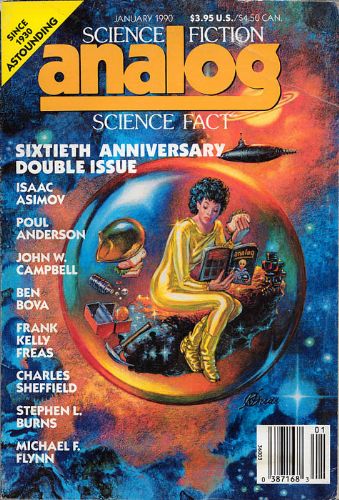
“Inertia” by Nancy Kress. From the January 1990 issue of Analog Science Fiction. I’ve covered Kress before, and while it’s always tempting to go for one of her novellas (given her fondness for that mode), I opted for something different—both in length and where the story was published. Kress has been a regular at Asimov’s for years, but “Inertia” is a rare appearance from her in Analog.
“Wall of Crystal, Eye of Night” by Algis Budrys. From the December 1961 issue of Galaxy Science Fiction. In some ways diametrically opposed to Judith Merril as a critic, and with as vicious an intellect, Budrys started as one of ’50s SF’s most promising writers. After a decade of heated activity he would turn away from fiction for the most part to focus on criticism and editing.
“Apartness” by Vernor Vinge. From the June 1965 issue of New Worlds. Vinge is one of the most important living SF writers, although sadly he retired from writing fiction about a decade ago. Despite being in some ways a prototypical Analog-type writer, Vinge made his debut in the Moorcock-run New Worlds with this story here. He would’ve been all of 19 years old when he wrote “Apartness.”
“House of Dreams” by Michael F. Flynn. From the October-November 1997 issue of Asimov’s Science Fiction. Theodore Sturgeon Memorial Award winner. I actually live one town over from Flynn, but sadly we never got to meet. “House of Dreams” is a rare case of Flynn appearing outside of Analog, and despite the Sturgeon win it has apparently never been reprinted in English, which is weird.
“The Valley Was Still” by Manly Wade Wellman. From the August 1939 issue of Weird Tales. Wellman started out during the Gernsback years, and was one of the few SFF authors of that era to maintain his street cred after Campbell took over Astounding—if only because he was more of a fantasy writer. I picked this one for the nerdy reason that it became the basis for a Twilight Zone episode.
“The Automatic Rifleman” by David Drake. From the Fall 1980 issue of Destinies. (Yes I’m still counting Destinies and its ilk as magazines.) David Drake was one of the codifying writers of military SF, but his range was a lot wider than that, having also written sword-and-sorcery fantasy and horror, on top of work that’s not so easy to classify. The following story seems to be an exercise in terror.
“The Agony of the Leaves” by Evelyn E. Smith. From the July 1954 issue of Beyond Fantasy Fiction. I only discovered this one as part of a very recent SF anthology edited by a certain colleague, and I’m pretty sure it’s not SF. As with too many female SFF writers in the ’50s, Smith moved away from the short fiction market once new avenues opened up; after 1960 she mostly stuck to novels.
L. Sprague de Camp made his debut in 1937, and would remain more or less active until his death in 2000, although he would lean much more towards fantasy than SF after 1960. De Camp technically debuted before John W. Campbell’s takeover of Astounding, but he quickly became one of Campbell’s court jesters, his humor being just innuendo-laden enough but more often relying on deadpan and slapstick delivery. But it was with Unknown, Astounding‘s fantasy sister magazine, that we saw much of de Camp’s best early work, both solo and in collaboration with Fletchet Pratt. It’s not surprising that in The Best of L. Sprague de Camp a solid portion of the stories included are from Unknown, despite that magazine only lasting a few years. De Camp would go on hiatus during America’s involvement in World War II, and he would not return to writing in earnest until around 1950. He’s probably most known today for his helping in raising awareness of Robert E. Howard’s work, if also his meddling in said work. The two would’ve been close contemporaries, had Howard lived.
Lest Darkness Fall was de Camp’s first solo novel (he had already written None But Lucifer with H. L. Gold), and it’s often considered his best. It was published in Unknown as a solid 50,000-word novel, which is why I’m confused by Wikipedia calling it the “short story version.” De Camp must’ve expanded it for book publication in 1941, but not by much, and he revised it for a 1949 reprint. This is often considered an SF novel, which makes its inclusion in Unknown a bit strange, but I do have a couple theories as to why it’s here: the first is the setting, which is pre-medieval and thus almost reads like low fantasy; the second is that Unknown had a policy of sometimes printing whole novels while Astounding did not, and Campbell maybe couldn’t fit Lest Darkness Fall in as a serial in the latter, for indeed it would’ve been too long to run in one piece.
Placing Coordinates
First published in the December 1939 issue of Unknown, which is on the Archive. You can also read the 1949 revision here. Lest Darkness Fall ran as a five-part serial in Galaxy’s Edge, presumably based on the 1949 version. It’s also been bundled in a Gollancz SF Gateway Omnibus with Rogue Queen and The Tritonian Ring. It’s also been bundled with a couple sequels by other hands as Lest Darkness Fall and Related Stories. In other words, this is not exactly a hard novel to find, and because it’s short by modern standards it’s often been packaged with other things.
Enhancing Image
I have some notes:
De Camp does not waste time here, at least with getting us to 6th century Rome. Martin Padway is an archeologist and a bit of a workaholic who’s currently staying in 1930s Rome. (We get a mention of the country being run by Mussolini’s fascists, but Padway doesn’t seem to feel anything strongly about fascism, and anyway it’s not dwelt on.) Padway is also a divorcee; his wife left him because after “one taste of living in a tent and watching her husband mutter over the inscriptions on potsherds” she realized being an archeologist’s wife was not in the cards for her. This is about all we learn about Padway before a bolt of lightning sends him back to 535 CE. We’re not given even the ghost of an explanation for how a lightning strike could do this and it’s obvious that de Camp is not interested in the how of getting his hapless anti-hero to where he wants him to be.
The line of plausibility is a fine one to walk, and I would say de Camp succeeds so long as one does not go deliberately looking for holes. Of course some convenience is at play. It’s convenient that Padway is an archeologist and, by extension, a kind of historian, not to mention he seems to have read Gibbon’s The Decline and Fall of the Roman Empire. De Camp himself admits in the introduction he took some inspiration from Robert Graves’s historical novels (incidentally I just finished I, Claudius), although Padway himself doesn’t mention Graves. This is a curious comparison, because the idea of making history entertaining was still a new concept then—not history as told in Hollywood productions but well-researched, fact-based history. With that said, while you do get some context within the novel, de Camp makes assumptions about the reader’s knowledge that probably aren’t valid anymore.
There is one thing that strains one’s suspension of disbelief, which is the language barrier. Italians in 535 CE spoke Latin, and Padway just so happens to know elementary-level Latin despite being a Congregationalist and not a Catholic; to de Camp’s credit he does acknowledge that language, even one as antiquated as Latin, changes over time, and so Padway talks with a heavy accent which other characters are quick to point out. Cleverly Padway adopts the more Latin-sounding name “Martinus Paduei” to fit in with the locals. Not sure why Padway wasn’t written as a Catholic (one who is estranged from his wife), since in the pre-Vatican II days it would’ve been perfectly sensible for a Catholic to know his Latin. Then again, Padway is mostly apolitical and unconcerned with religious matters, which is true of a lot of Protestants. De Camp is playfully ribbing some people here, but he’s not trying to make any kind of serious statement; this is, ultimately, an unserious novel.
So, the context: Rome in 535 CE is long past the days of Augustus, to put it lightly. The Italians have accepted Christianity for a couple centuries now, no longer looking to feed infidels to the lions, but the Roman Empire is now fractured. The western Italian-Gothic coalition is about to enter war with the Eastern Roman Empire, and the ensuing war will help bring about the Middle Ages, shrouding Europe “in darkness, from a scientific and technological aspect, for nearly a thousand years.” Padway knows that life in Rome is on the downslide and about to get much worse, but the people around him are blissfully ignorant of this. Surprisingly the idea of somehow returning to his own time doesn’t much occur to him; rather he quickly becomes concerned with surviving in a Rome that is about to get totally butt-fucked by war, and he also wonders if history can be changed enough to create an alternate future.
If you read anything about Lest Darkness Fall in advance then you know it’s alternate history novel, and indeed it doesn’t take long for Padway to introduce some changes that will have long-term consequences—some of which will not be to his advantage. Inventing the printing press and starting one’s own newspaper (freedom of the press and all that) in what amounts to a police state can land one in jail, as it turns out. Padway starts out “small,” teaching a local banker double-entry accounting, inventing the printing press, eventually starting the world’s firs telegraph line—you know how it is. Like I said, convenience plays a not-inconsiderable part here, although Padway is not a demigod; he can’t do everything himself. He gets arrested enough times that it becomes a sort of running gag. I would still argue Padway is too much of what Heinlein would call “the competent man,” and I have to wonder what would’ve happened if someone less skilled had been thrown back to Rome right before the Middle Ages; admittedly they would probably last all of three days.
As with Graves’s historical novels, de Camp throws some real-life figures into the mix, although due to the relative obscurity of the time period there’s nobody the reader is likely to recognize right away. I hope you know who Justinian is. And let’s not forget Thiudahad, king of the Italians and Goths who eventually succumbs to what is probably dementia or some other neurological disease; he’s pretty funny. The funniest might be Mathasuentha, princess and wife to whomever would succeed Thiudahad once he becomes unfit for the throne—and, much to Padway’s horror, a bloodthirsty opportunist. Padway considers romancing Mathasuentha until she reveals herself to be a bit of what we would call a yandere. “You wouldn’t exactly describe her as a ‘sweet’ girl,” the narrator tells us. Better to marry her off to Urias, who after all is a war hero and who can probably deal with her shenanigans. Padway himself remains a bachelor to the end, at least in the magazine version.
How good you think Lest Darkness Fall is will depend on how funny you think it is, because it is very much a novel filled with what we humans would call “jokes.” De Camp isn’t always funny, and I think his cynical brand of conservatism (almost like a distant precursor to South Park-type humor) holds him back from being a more serious writer, but when he’s on the ball he can elicit some chuckles. The novel becomes less funny as it pivots more towards alternate history warfare (this is when Padway gains enough clout to basically do Thiudahad’s job for him), but we’re assured that despite what the title suggests, nothing too dark will happen. This is largely because even as Padway’s situation becomes more serious, both Padway and the third-person narrator remain as deadpan as ever. At one point Padway ponders the evils of slavery and how he should probably do something about it, but it reads like someone writing down stuff they ought to buy as the grocery store. Like I said, not a very serious novel.
I can see why de Camp would add a few thousand words onto the novel for book publication, but if anything he should’ve expanded it even further. Lest Darkness Fall, for how much ground it’s covering, is too short; the magazine version is about 50,000 words long and it could easily be twice that length. I know this is weird coming from me, as someone who tends to like short novels, but consider that I, Claudius is 450 pages long and still omly makes up the first half of a larger narrative. There are characters who brim with personality but barely get any screentime because this novel is a train and the train will not stop. SFF novels prior to the ‘60s often didn’t go past 300 pages, and this is sometimes a bad thing because some narratives need more space to reach their full potential. Lest Darkness Fall feels like the abridged version of a complete novel which sadly does not exist.
There Be Spoilers Here
Darkness does not fall.
A Step Farther Out
The “modern man sent to the distant past” plot type has been done many times since Lest Darkness Fall, and needless to say some authors have built on the foundation de Camp laid down. There’s a lot of room for navel-gazing with this premise and de Camp keeps that to a minimum, for better or worse. If this novel succeeds (and it is a succeess for what it is), it’s because de Camp’s fascination with the foibles of ancient history is infectious, helped by the fact that this is a perfectly balanced, well-oiled machine of a novel. We’re given just enough context in what was then the modern day before being hit with the time-travel lightning. Padway is a bit of a scoundrel, but he’s not unlikable enough to make us always following him a chore; to make him a total asshole would’ve been fatal for the novel. There’s some commentary on the gap in values between Italy circa 535 CE and 20th century America, but not enough to give one the impression that de Camp is trying to make one of those pesky political statements. If this sounds like a cynical assessment of the novel, that’s because it’s a cynical novel.
What made Lest Darkness Fall inspirational for a couple generations of SFF writers is that it’s history made entertaining; one might even call it an early example of “edutainment” in genre literature. Admittely you may wanna do some extra reading on the twilight years of the Roman Empire, since de Camp assumes you’re a well-educated person who already know enough going in; this might’ve been true in 1939, but needless to say our priorities with history have changed drastically since then. It’s a genuinely funny novel, if also slight in terms of emotional and thematic content. Had I read this, say, five to ten years earlier, I probably would’ve loved it; but I also think it has since been outshined by its own progeny.
H. Beam Piper is one of the most intriguing and certainly one of the most tragic figures in old-timey SF. He made his debut with “Time and Time Again,” a pretty solid first story, in 1947, and kept writing off and on for the next decade. In the last five years of his life Piper went through a kind of metamorphosis, such that while he did write a couple novels before 1960, the years 1961 to 1965 saw at least one novel per year, with Little Fuzzy nabbing him a Hugo nomination. Unfortunately Piper did not have much time to enjoy this artistic success, as he committed suicide in 1964, and because he got his start very late in life his career was short-lived despite not exactly dying young. The SF Encyclopedia is mostly written in a matter-of-fact way, as befits an encyclopedia, but John Clute’s final words on Piper’s entry are bone-chilling: “He died in his prime.”
Piper’s work has this tendency to stand out in ways other SF of the period did not, even when he was playing with premises that were by no means novel. I’ve read quite a bit of ’50s SF at this point and Piper is the only writer I’ve met from that period who consistently posited that not only would a hypothetical space-faring humanity be multiracial, but that mixed-race people would be rather common in such a future; as a ressult of this his characters are often at least implied to be non-white. Women also do pretty well in Piper’s stories, despite his habit of calling them “girls,” as they’re shown to be as intelligent and capable as their male counterparts. “Genesis” is a take on something that even in 1951 must’ve been familiar to readers: the Adam-and-Eve plot. It’s the little things peppered throughout this story, though, that make it worth reading.
Placing Coordinates
First published in the September 1951 issue of Future Science Fiction, which is on the Archive. The only time “Genesis” was reprinted in Piper’s lifetime was in the anthology Shadow of Tomorrow (ed. Frederik Pohl). It was later collected in The Worlds of H. Beam Piper, which was part of a concerted effort from Ace in the early ’80s to put Piper’s work back into print. I recommend not looking up all the places this has been reprinted, since a couple of them have titles that give away plot twists. The good news, if you’re looking to read this for free and without guilt, is that most of Piper’s work has fallen into public domain, including this story. You can read it on Project Gutenberg, naturally.
Enhancing Image
A generation ship has headed out from the dying planet Doorsha, for a habitable planet called Tareesh for some 1,500 people may live. It’s the only ship of its kind, “fifty years’ effort” and without the resources neeed to make a second such ship. It would be a terrible shame, then, if a security failure were to result in the ship’s destruction. As if on cue, a meteor hits the ship and things fall apart fast enough that (as far as we know) only one escape pod makesss it out, with a one-way ticket to Tareesh. The pod contains two men and six women; Kalvar Dard and Seldar Glav, the men, are trained professionals, and unusually for a ’50s SF story so are the women for the most part. Olva is an “electromagnetician,” Varnis is a “machinist’s helper,” Kyna is a “surgeon’s-aide,” Dorita is an accountant, and Eldra is an “armament technician.” We’re not told what Analea’s—the last woman’s—job is, but I’m just listing these off to give you the idea that despite these grown women being called girls, they are still quite capable.
The first stretch of “Genesis,” which thankfully is not long, is also easily the weakest part. With pretty much any SF story there’s the question of plausibility, and I don’t think the way by which Piper puts his characters on Tareesh is all that plausible. For one I struggle to believe there would be only one generation ship without any backup, given a) the race’s survival depends on it not getting blown to bits, and b) the likelihood of an accident such as the one aforementioned occurring in space. I also would’ve thought there would be more survivors from the accident, maybe a few more lifeboats that made it to Tareesh; but I don’t think I’m spoiling things by saying that, at least far as our characters know, they’re the only survivors. Also, with what we have learned about space travel since 1951, it goes without saying that not only would a perfectly habitable planet like Tareesh be exceedingly unlikely, especially since it’s said to not be too far away from Doorsha, but that Our Heroes™ would at the very least be hindered by the change in gravity and air content; but then this is the sort of thing you have to accept with all but the hardest SF from that era.
I’m getting this negative criticism out of the way first, for one because this story’s problems are frontloaded, but also because otherwise I found the story to be a pretty good time once we land on Tareesh. The idea is simple enough: we have eight people, presumably the last of their rest (the rest stranded on a dying planet), who must not only survive in this harsh new environment but work to rebuild civilization. They have a few guns with ammo and some explosives, but these are very finite resources and at some point they will have to forge their own primitive weapons. The good news is that Tareesh is teeming with life that can be hunted for food and clothing; the bad news is that Our Heroes™ have some competition. A race of humanoids who may or may not be native to this planet, called the Hairy People, are aggressive and tribal, yet are intelligent enough to use tools and have their own language, “too bestial to bury as befitted human dead, but too manlike to skin and eat as game.” What ensues is a series of skirmishes over the years between Our Heroes™ and the Hairy People, and what makes this conflict unusual is that while Piper frames the latter as villainous, he also gives them enough humanity that their existence falls into the uncanny valley, never mind that the violence is tragic.
Life on Tareesh soon proves to be cutthroat, and while normally in old-timey SF women are spared from such ruthlessness, Kyna dies in childbirth while Eldra gets killed rather brutally by the Hairy People. Five years in and the original party has whittled down from eight to five; but all is not lost, as a few children have entered the fray. Something clever Piper does is he doesn’t always tell us who fathered what child, and ultimately raising the children is a group effort; it’s also not always clear who is paired with whom, romantically or sexually. It is clear from the very outset that the survivors all like each other, and that jealousy doesn’t seem to be an issue. This is like the polar opposite of Joanna Russ’s We Who Are About To…, which you may recall is a nasty subversion of the science-fictional Adam-and-Eve plot; in that novel nobody likes each other, and the unnamed heroine would rather spend the rest of her days playing card games than be forced to act as an Eve on a desolate planet. I would argue Piper’s version is just as much a subversion, coming from the other direction, in that it posits that the nuclear family model is unnecessary for human survival, and indeed might not be preferable for the persons involved. The word would not be coined for several more decades, but what we have here is arguably a polycule. Piper ditches romance drama in favor of cooperation.
Piper was not a poet, nor was he the hardest of science-fictionists (he had a few funny ideas, which we’ll get to), but he did have a knack for adventure writing. His prose is often lean and muscular; every gunshot and knife blow has weight to it, both from the punchiness of the style and the human cost involved. We don’t get to know Eldra much as a person, but we know just enough, and are given enough detail as to how she died, that her death still strikes a chord. These characters are broadly drawn in that we don’t get to know much about them as individuals, but we do understand what they mean to each other and what their survival means for their species; as such each death means something. Tareesh is vividly depicted as habitable but not hospitable; anyone can die here, man, woman, or child. A common criticism with old SF stories (and some recent ones actually) is that alien planets tend to just be Earth 2.0, but there is a reason for why Tareesh’s landscape and lifeforms will strike the reader as familiar; but for now I’ll hold off on giving that twist away. Said twist also seems to have caused some confusion as to whether “Genesis” is a one-off story or part of one of Piper’s series, but I’ll give my own theory on that in a minute.
There Be Spoilers Here
Twenty years after the crash landing and now only three of the original eight remain: Analea broke her back in an accident and opted to kill herself; Glav broke through the ice on a frozen river and survived, only to die later of hypothermia; and Olva got killed by the Hairy People. Varnis has gone insane from years of trauma, but the group still takes care of her. In a society where every human life matters, even those with mental illness are looked after. By the end of the story only two of the original eight are left, and one of them is delusional. Dard sacrifices himself with one of the last explosives on hand, to protect his tribe from the Hairy People. He won’t live to witness it, but Dard’s people will wage war against the Hairy People and drive them into extinction, for the Hairy People are Neanderthals—our close relatives in the last ice age. Doorsha is Mars, and Tareesh is Earth. You probably anticipated this twist, but as a dumb sack of shit I did not call it right away.
There’s a good deal to unpack here. Piper does not shy away from the fact that genocide would’ve played a part in Neanderthals going extinct, although we now know another reason was crossbreeding between the races (a good fraction of people alive today have a sliver of Neanderthal DNA in them), effectively homo sapiens absorbing the less adaptable Neanderthals. Homo sapiens being Martians also sort of falls in line with the first modern humans being non-white; this is another case of Piper sneaking non-white characters into his narratives. There’s some discomfort in the non-judgmental way in which said genocide is depicted, but I don’t think Piper is condoning it either; rather he’s chronicling something that (as far as we knew at the time) really happened, and if anything there’s a melancholy tone that intensifies as the story reaches its conclusion. The ensuing warfare between the humanoids is framed less as heroism and more as a consequence of the Martians’ need for survival. “You do what you must” seems to be the sentiment.
Since we’ve reached the story’s end I think it’s fair to bring up something that struck me as peculiar when I was looking into it pre-read. On ISFDB “Genesis” is labeled as a Paratime story, which confused me because a) it does not involve time travel, and b) Piper himself did not count it as part of that series. The people at ISFDB do invaluable work, but they also sometimes fuck up. The mix-up has at least two causes, as far as I can tell: the first is that it was reprinted in the series collection Paratime! from Wildside Press—although, tellingly, not in Ace’s The Complete Paratime. The other thing is that the lore of “Genesis” and the Paratime stories do not seem to contradict each other. In the Paratime series it’s all but said that homo sapiens descended from Martians, and indeed “Genesis” could serve as the germ for our Earth’s timeline in the Paratime continuity. But the two are not explicitly connected, and rather from what I can tell Piper might’ve genuinely believed that not only was there life on Mars but that these Martians are our ancestors. It’s unscientific, but you have to admit it’s fun to think about.
A Step Farther Out
Piper was not the most refined writer, and I have to admit “Genesis” could’ve been bumped up from a pretty good story to a very good one with one more rewrite, especially focused on the beginning. It’s quite possible, of course, that Piper wrote this story in a single blistering session, checked it once over for obvious mistakes, before sending it to his agent; this would’ve been far from unusual for SF writers at the time. It also might’ve been published in the low-budget Future because it got rejected (actually it almost certainly was a reject from the higher-paying magazines) elsewhere, but while it’s easy to think the cracks in the story’s armor did not endear it to more discerning editors, it might’ve also gotten rejected for being subtly subversive. Piper’s work is never perfect, but it’s often interesting in ways other SF of the time was usually not, and “Genesis” is no exception.
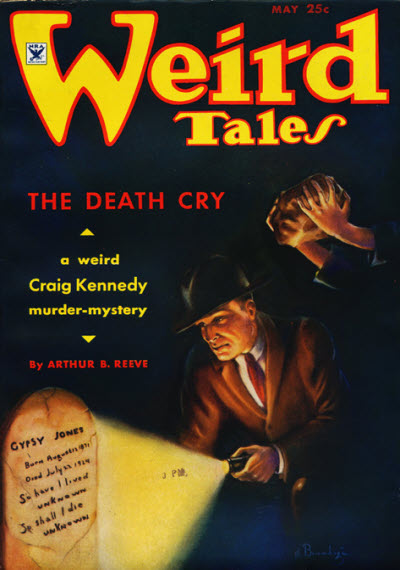
(Cover by Margaret Brundage. Weird Tales, May 1935.)
Who Goes There?
It’s telling of Robert E. Howard’s skill as well as his productivity that despite committing suicide at the age of thirty (most authors barely get their careers started by thirty these days), he stands out as one of the most influential American fantasists. He got his start when he was a teenager and from then on he never stopped writing, with a truly staggering amount of short fiction and poetry under his belt. (He only wrote two novels, however, one of which doesn’t seem to have been finished at the time of his death.) Howard started several series over his career, the most famous of these being Conan the Cimmerian, or Conan the Barbarian as he’s more popularly known. This one character (who admittedly is rarely ever depicted accurately in media by other hands) would lay the groundwork for sword-and-sorcery fantasy as we tend to recognize it, despite Conan not being Howard’s first attempt at such a character but rather a culmination. God only knows what the field would look like had Howard not died so young.
This will be my last serial review until 2025, and we’re capping things off with a reread. “Beyond the Black River” was one of the first Conan stories I had ever read, and it definitely helped ignite my interest in classic heroic fantasy, not to mention Howard’s writing. Conan himself is a bit of a handyman, taking on different odd jobs between stories, and this is reflected in the stories themselves taking on different subgenres, from straight action fantasy to weird horror. In the case of “Beyond the Black River” we see weird horror being wedded to—of all things—the frontier Western (think less A Fistful of Dollars and more The Last of the Mohicans). Howard really loved Westerns and he actually wrote a fair amount of straight examples of that genre, without fantastical elements.
Placing Coordinates
Serialized in the May and June 1935 issues of Weird Tales, which are on the Archive. It’s in more Conan collections than I can count, honestly, but good news is you don’t have to worry about tracking down a hard copy unlesss you really want to, because it’s on Project Gutenberg.
Enhancing Image
We start, not with Conan but a young Aquilonian settler named Balthus, who is on his way to his fort near Black River. He witnesses a fight between a Pict (a barbarian native to the land on which Balthus’s fort borders) and Conan, who really needs no introduction. Well, maybe a little. Conan is one of the most frequently (and inaccurately) depicted fantasy characters in visual media, and this is no doubt helped by Howard giving us some very juicy descriptions of his physique and demeanor in every story. He’s tanned, has raven-black hair, is built like a brick shithouse, moves “with the dangerous ease of a panther,” and is “too fiercely supple to be a product of civilization.” Conan is a Cimmerian, from a long line of Celtic barbarians, and in this sense he’s not dissimilar from the Pict whom he makes short work of. Balthus and Conan are working for the same side, although unlike the former, who believes in westward expansion, Conan is merely doing it for money, acting as muscle for the Aquilonians.
There’s a frontier war going on between the Picts and the Aquilonians, or more accurately a series of skirmishes. The only thing separating Pict land and Fort Tuscelan is Black River (not the black river as the title would suggest), not to mention woodland. The Aquilonians are a “civilized” people who, in the name of settler colonalism, may have bitten off more than they could chew. Balthus and Conan quickly find that there are far more dangerous things in the forest than Picts, for some animal had nearly ripped off the head of some dead merchant named Tiberias. We’re told of a Pictish sorcerer, Zogar Sag, who had been imprisoned in Fort Tuscelan for theft, but escaped and has since sought his revenge. The men who had originally detained the sorcerer were all killed, with their heads torn off. Zogar Sag lurks in Gwawela, a Pictish village on the other side of Black River. Clearly one side or the other must yield, but so far it’s been a stalemate between the Picts and Aquilonians, which is where Conan comes into play.
Beyond the Black River is a very different kind of story from the last Conan outing I reviewed, The People of the Black Circle, and indeed is quite different from other Conan stories I’ve read. Typically, though the narration is third-person, the perspective tends to be from Conan’s, at least when he’s onscreen. It’s pretty clear from the outset here, though, that Balthus is basically the protagonist of this story, not Conan. Of course, Conan is guaranteed to survive any story he’s in, but the same can’t be said of literally anyone else—including the person the story is really about. Another weird thing is that, to my knowledge, this is the only time Howard injects Western elements into the Conan series, although it’s certainly not the only time he mixed weird fiction with the Western. More specifically Beyond the Black River harks to a subgenre of Western that’s even older than the John Wayne variety—in this case James Fenimore Cooper’s Leatherstocking tales. Even the title would not be out of place in a Western pulp magazine.
Morality in the Conan series tends to lean towards a dark shade of grey, and Conan himself often only does heroic things by virtue of helping people who are not as bad as the opposition. In this case Our Anti-Hero™ gets caught between the settlers, who are rather misguided to put it one way, and Zogar Sag, who is actively malicious. There’s some debate, from a modern left-leaning perspective, if the settlers are sympathetic at all, given that they also indulge in racism against the Picts, and it’s not entirely clear how Howard himself sees them. Something very curious Howard does is he makes both sides of the conflict white, although the Picts (like Conan) are described as “swarthy” and dark-skinned, “but the border men never spoke of them as such.” It’s easy to make parallels, such as between WASPs and white Jews and in the US, or—more likely what Howard intended—between WASPs and the Irish. It’s unclear at what point the Irish started to not count as “off-white” in the US, but clearly anti-Irish discrimination was something experienced within living memory in Howard’s time.
(Conan himself continues to be one of the most entertaining characters in fantasy, in no small part because he’s a bit of a scoundrel. While he is a great warrior and there’s definitely a noble quality about him, he has no qualms with playing sides against each other, or even working for a faction he used to be enemies with if the pay is right. He admits pretty casually to Balthus that he had fought against the Aquilonians some years prior, despite now being on that government’s payroll as a mercenery.)
Beyond the Black River might be the most overt example of Howard’s thesis on the relationship between man and civilization, and it’s a shame he died when he did because had he lived he probably would’ve been able to refine it. Howard was pretty open-minded for a man of his time and place, but he still had his own prejudices, and there’s definitely something questionable going on in the dynamic between the settlers and Picts. I mentioned Cooper’s frontier Westerns before, and now I’m gonna specify the comparison a bit more, perhaps to an uncomfortable degree. Making the Picts white was a clever move, because it softens the blow—that being that this is clearly running parallel to American westward expansion in the 18th and 19th centuries. It’s true that the settlers are not shown in the fondest light (indeed Conan thinks their enterprise foolish), but the Picts—the stand-ins for Native Americans nations—are mindless fiends who probably don’t deserve to keep their land. That Zogar Sag is a ruthless killer who collects human heads and does blood sacrifices arguably plays into certain real-world stereotypes, and not incidentally the settlers call the Picts “savages.”
There Be Spoilers Here
Conan thinks correctly that it’d be better to assassinate Zogar Sag with a small group of warriors than a whole battalion, but it still goes about as well as you’d expect. Also, is it just me or did Howard really have a thing against snakes? Giant snakes show up pretty regularly in his fiction and the halfway point of Beyond the Black River is no exception.
A Step Farther Out
This is not what I would recommend as one’s first Conan story, but for my money it might be the most intriguing of the ones I’ve read; it’s certainly the one that tries hardest to worm its way out of what must’ve already become predictable sword-and-sorcery cliches. In some ways it feels complementary to another Conan story Howard wrote around the same time, “Queen of the Black Coast,” in which Conan takes up piracy and even falls for a pirate queen who’s no less a fearless adventurer than him. There aren’t any notable female characters in Beyond the Black River to my recollection, and actually this is a rare case of Conan not saving a scantily clad damsel—although Balthus fulfills the “damsel” part at the end of this installment. This is more downbeat and not as overtly pulpy as other Conan stories, and its lateness plus its mixing of genres imply that maybe Howard considered branching out with his writing; he was maturing, but unfortunately he would not give himself much more time to do that.
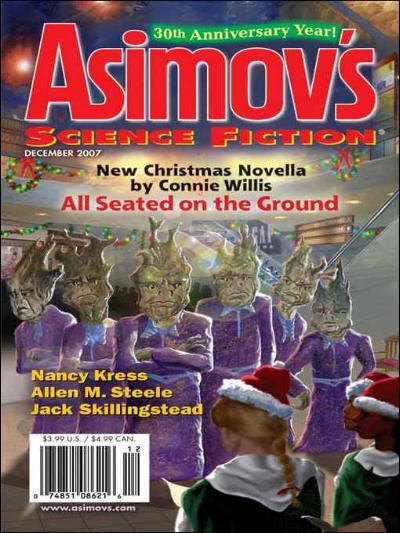
(Cover by Michael Carroll. Asimov’s, December 2007.)
Who Goes There?
It’s the holidays, Santa Claus is coming to town, Christmas cheer, all that. But before I pay that jolly son of a bitch a visit I’ve got some work to do, which in this case is to write about a seasonally appropriate story from perhaps the jolliest author currently working in the biz. Connie Willis made her debut back in the ’70s (which is wild, because I suspect people think of her as one of the fresh new talents of the ’80s), and has since collected Hugo awards like they’re Infinity stones. She currently holds the record for most Hugo wins for Best Novella (with “All Seated on the Ground” being the fourth and most recent), and I do love me ssome novellas. Willis has basically two modes: serious and comical. With serious Willis you get Doomsday Book and “The Last of the Winnebagos”; with comical Willis you get “Even the Queen” and today’s story, which is a Christmas comedy.
Placing Coordinates
First published in the December (appropriate) 2007 issue of Asimov’s Science Fiction, which is on the Archive. It was published pretty much simultaneously with a chapbook release from Subterranean Press, although given the nature of magazine publication the version in Asimov’s would’ve been available first. Despite the Hugo win it has never been anthologized. It was collected in The Best of Connie Willis and later A Lot Like Christmas, which as you can guess collects Willis’s Christmas stories.
Enhancing Image
In first contact stories the aliens might land in Washington, DC, or in some crop field in the Midwest; in this case they landed in Denver. The good news is that the Altairi are not hostile, but the bad news is they’re not talkative either, opting, in fact, to not say anything at all. A few meeting-the-aliens commissions are formed but fall through, which is where Meg, our narrator and protagonist, comes in. Meg is a small-time journalist who caught the government’s attention by having writing about aliens before, which doesn’t mean as much as they think it does, as she admits, “I’d also written columns on tourists, driving-with-cellphones, the traffic on I-70, the difficulty of finding any nice men to date, and my Aunt Judith.” That last part will figure majorly into the plot. Also on the commission are Dr. Morthman, “who as far as I could see, wasn’t an expert in anything,” and Reverend Thresher, your stereotypical Evangelical priest who (I don’t think I’m spoiling here) will be the story’s closest thing to a villain.
The Altairi aren’t communicative, but at least they don’t resist being driven around Colorado, to see some of humanity’s cultural touchstones—including the shopping mall. It’s the holidays, and it’s been long enough since the aliens came down that people in the mall don’t instantly swarm them. We’re talking about a group of six Altairi, none of whom say anything, the only method of communication they’re keen on being a constant and dismaying glare that, incidentally, is a look that reminds Meg of her aunt. The Altairi can be pushed around and herded, but they can’t be told to do anything, which is what makes what happens next pretty unusual. For reasons not known at first, since nobody had been observing them closely, the Altairi sit down in the middle of the mall; they had never been seen to sit down before, in the weeks they’ve been watched. There are shoppers, there’s Muzak on the intercom, and a group of carolers led by one Calvin Ledbetter. This is where we’re introduced to the central conflict of the story, or rather than central question: What made the Altairi sit down?
The question of what made the Altairi sit down all in unison is not as easy to answer as it may seem at firt, although (not to toot my own horn) I basically guessed the answer well in advance. “All Seated on the Ground” is a “problem” story in the classic Analog sense, which makes me think that, if not for the fact that I don’t think Willis ever sold to Analog (I could be wrong), this story could’ve fit better there than in Asimov’s. Not really a criticism, but I wanted to get out of the way just how dated this story is—not in its message or politics, but in how you could guess, without looking at the issue date, when it was published just from the cultural references. We get references to Paris Hilton, Men in Black II (not even the first movie), and this unbearably pungent stench of Bush-era humor. Comedy during the Bush years was like gazing into the abyss. Thresher himself is a caricature of a conservative clergyman, not that those people aren’t already deeply unserious. It’s all very tongue-in-cheek. I know Willis herself is a practicing Christian who really gets into the spirit of the holidays, so of course the commentary on religious intolerance is more playful ribbing than anything. Don’t expect any serious points from this if what I’m saying.
This is a story about Christmas, and more specifically about Christmas music; it’s about caroling and the classics. Again, not really a criticism, but it’s telling by what’s cited that there haven’t been any songs added to the Christmas music “canon” since this story was published—so 16 years now. I think the most recent song cited here is Mariah Carey’s “All I Want for Christmas Is You,” which itself is older than me. But this is a story that has a lot of fun picking apart the lyrics of old Christmas songs, seeing what makes them tick, and seeing what makes the Altairi sit down in universion; hell, if that’s even the only command they’re susceptible to via lyrics. Of course it can’t just be the lyrics, as Meg says; it could be “the voices singing them,” “the particular configuration of notes,” “the rhythm,” and/or “the frequencies of the notes.” It’s a problem or puzzle, depending on your viewpoint. Running parallel to the question of what the Altairi respond to is the budding romance between Meg and Calvin, which I’m not getting into other than a) to acknowledge it exists, and b) to point out that people in the cartoon world of the story seem very nosy about other people’s relationship status, because Our Heroes™ get asked repeatedly.
How much you enjoy “All Seated on the Ground” will depend on two things: on how much you care for Christmastime festivities (I don’t much), and on whether or not you find Willis’s humor to be more hit than miss. After having read some of Willis’s comedic fiction (To Say Nothing of the Dog, “Time Out,” “Blued Moon,” “Even the Queen,” and now this) I’ve come to find, via scientific analysis, that I don’t find her that funny. This is not a slight against Willis as a person, obviously; humor is maybe the only thing that rivals sexual attraction in terms of sheer subjectivity. I can hardly rationalize a joke I like or dislike any more than I can rationalize my immense attraction to Legoshi from Beastars. What’s more damning in the case of “All Seated on the Ground” is that while Willis does explore (as a good SF writer should) the implications of the question she poses, said question is not fit to sustain a work of novella length, for my money. I don’t expect there to be three subplots tag-teaming for wordage here, as a novella is short enough that you can have one plotline through the whole thing, but the plot here—really a driving question—could be more succinct about finding its answer. It could also be that this story is a bit constipated because Willis thought it necessary to add some third-act tension on top of the driving question, which is how we get such an overlong and misshapen thing.
There Be Spoilers Here
Thresher, who through misunderstanding and his own idiocy thinks the Altairi have become born-again Christians, goes on a broadcasted crusade that gets a whole lot of unwanted attention. It’s this idiocy that seems to prompt the Altairi to leave Earth (it’s later said that they were unsure if humans were sentient, in what must’ve been a lame joke even in 2007), only narrowly stopped because Meg and Calvin are able to solve the puzzle in time. This is done because, of all things, Meg is able to remember why her grumpy aunt always gave her the same look the Altairi had been giving for months on end. (I wanna point out that about nine months pass over the course of the story, but despite telling us this Willis does not show it in the writing itself, such that the time frame feels a lot more compressed than it is. Meg and Calvin’s relationship forms over the course of months, but you would think they fell for each other almost overnight without compressed the chain of events feels.) To give Willis some credit she does do a good job of making us wanna put a muzzle on Thresher, although it’s more that we’re supposed to think him a fool than to actually hate him; making him too despicable would not be very Christmas-y I suppose. I hate this man, but then I also think homophobes can eat shit.
Predicably we get a happy ending.
I wanna talk about something being “dated” some more. I’ve been thinking that the criterion for what makes a work of SF “modern” has become increasingly fuzzy, as if we’re approaching a singularity. Consider that a random genre SF story published in 1965 probably could not have gotten published in 1945 without substantial tinkering, namely changing the prose style and subject matter. Even a deliberately retrograde piece like Roger Zelazny’s “The Door of His Face, the Lamps of His Mouth” probably could not have seen print in 1945 without basically removing all the Zelazny-isms—in other words the thing which makes that story special. Conversely, it’s comparatively hard to find a genre SF story published in 2007 that, with few to no changes, could not have been printed in 1987. Change the pop culture references and a few technology points, like mentions of cell phones that can record video, and you could’ve printed “All Seated on the Ground” in 1987; incidentially this was another hyper-conservative era in American history. 2007 was not that long ago, and yet when reading Willis’s story I felt like I had traveled back considerably farther in time. I’ve actually read all the fiction Hugo winners from that year and while I was not keen on Chabon’s novel, the Willis piece impresses me less.
A Step Farther Out
Despite being a 23,000-word story I couldn’t find too much to say about this one. I think one sign of a great novella is that you get a great deal to chew on in a small amount of wordage, and by that metric “All Seated on the Ground” is definitely not one of the greats. Mind you, its slightness is by design, but I also think it was totally possible for Willis to cut it down to a long novelette. I’m also not exactly a fan of her sense of humor. It’s entertaining in fits and starts, but a joke was just as likely to make me cringe as make me chuckle; there’s a real doozy of a joke towards the end that made me wanna throw my virtual copy of the magazine at a wall. This is one of those cases where the stereotype that Hugo voters are frivolous applies, because I’m not surprised it was popular with readers, but also not surprised it didn’t get a Nebula nod, nor surprised that it’s never been anthologized.
WARNING: This is not, strictly speaking, a review, but it does discuss major spoilers for Godzilla Minus One, including the ending.
When Godzilla Minus One came to American theaters in late November, Toho had initially given it a one-week wide theatrical run, which basically meant that it was playing in a theater near you, but time was VERY limited. Strong box office numbers (for a non-English movie) and even stronger word of mouth have caused Toho to change their mind, and as of December 15 (more than a week after it was supposed to leave) the movie is being put in even more theaters. I know quite a few people who’ve seen it and reception has been very positive across the board. I personally think it’s the best entry in the series since the 1954 film, which means it’s the best Godzilla movie in nearly seventy years. Aside from it being just a great film, it implicitly makes the argument that Godzilla, despite his vintage and the fact that he’s been in a good deal of schlock, is still relevant.
There’s probably not a character in film history who has persisted to the same degree as Godzilla, nor one who has worn as many hats. Sure, you could say King Kong was famous back then (incidentally Kong’s 90th anniversary is this year) and remains famous now, but Kong as a film presence has only been around in little blips, getting a movie every once in a blue moon. And why not? How much can you do with an abnormally large ape? Then again, how much can you do with a giant radioactive dinosaur? This is what makes Godzilla so perplexing: his versatility. Let’s compare kaiju. Kong (at least the movies I’ve seen him in) is always a violent but ultimately tragic creature who has a touch of the human about him. Mothra is always a stand-in for Nature (capitalized), a perpetual force for good, and one of Earth’s guardians. King Ghidorah is (with one notable exception) always a tyrannical monster who came down from the stars in a ball of lightning and doom. These are monsters with multiple movies under their belts, spread across decades and realized by a variety of creative voices.
Godzilla started out as a villain, essentially, but at the same time a victim of the thing which gave him his atomic breath. The first Godzilla film was an allegory of post-war trauma, released just under a decade after the atomic bombs had been dropped on Hiroshima and Nagasaki, not to mention the firebombing of Tokyo. Godzilla decimates a city, but he is also scarred by nuclear test bombings in the Pacific ocean and ultimately killed by a weapon of mass destruction at least as terrible as the A-bomb. Thing is, that’s not the only role he was fit for. There are quite a few entries in the series where Godzilla is a villain, but there are also cases where he plays a heroic or neutral role. In Invasion of Astro-Monster he and Rodan are brought in to stop King Ghidorah, who is clearly the bigger threat. In Son of Godzilla he’s a loving (if stern) father (never mind who the mother could be). In Godzilla vs. Hedorah he’s a Captain Planet-like figure who fights what amounts to a giant walking piece of shit. In All Monsters Attack he’s the figment of a child’s imagination; the child does not fear Godzilla but, evidently having seen Son of Godzilla, looks up to him as a role model.
Even when Godzilla plays the villain it’s often not for the same purpose. In Mothra vs. Godzilla he’s the villain because he just wants to be an asshole. In Godzilla, Mothra and King Ghidorah: Giant Monsters All-Out Attack (rolls off the tongue, doesn’t it) he’s the specter of imperial Japanese militarism. In The Return of Godzilla he inadvertently unites the US and Soviet Union during one of the Cold War’s hot spots. In the 1954 film, Godzilla vs. King Ghidorah, and most recently Minus One he’s a victim as much as he is a perpetrator; though he’s ultimately still a monster that must be stopped, there’s something deeply tragic about him in these movies. In Minus One he’s basically a deranged animal. At the beginning of the film, set in the final months of World War II, he’s a dinosaur—unusually large and not based on any real species, but also not radioactive. A nuclear bomb being dropped in the Pacific, however, transforms Godzilla into something else. Not only does he grow to the size of a building but he now has his atomic breath, which in this movie launches what may as well be mini-nukes. Thing is, Godzilla is hurt by his own power; if not for his newfound fast-regeneration ability his atomic breath would surely kill him.
(You may be wondering why I haven’t mentioned Shin Godzilla, which after all was the last live-action Japanese entry in the series before Minus One. Well, I haven’t seen it yet; in fact it’s the only live-action Godzilla movie I’ve yet to see. I’ll get to it eventually, but don’t underestimate my capacity to spite Hideaki Anno fans. Anyway…)
Much has been made of the fact that the human narrative in Minus One is largely what it owes its success to. This is not strictly an unusual occurrence in the series; people who act like this is the first time a Godzilla movie has had a compelling human narrative since the 1954 film are in for a rude awakening. True, some of these movies have dull human scenes, but some also have a good deal of human interest and emotional depth. Godzilla vs. Biollante and Giant Monsters All-Out Attack come to mind immediately. It’s not that the human narrative in Minus One is compelling (although it is) so much as that Godzilla’s function as a character and symbol works in tandem with the plot he’s an accessory to. Yes, the film looks great (especially given it was apparently made on an EVEN LOWER budget than the alleged $15 million people have claimed), but it succeeds as a movie because it abides Theodore Sturgeon’s criteria for a good science fiction story: it’s a story with human problems and a human solution but with a science-fictional element that’s necessary for the story to work.
Consider: The story revolves around Koichi, who at the outset is a kamikaze pilot, meaning he is expected to crash his plane into the enemy. The Zero, the Japanese fighter plane during the war, did not have an eject button. While stationed on Odo Island (harking to the island of the same name in the 1954 film), Koichi and the engineers stationed there are terrorized one night by a hulking dinosaur. Koichi has the chance to at least hurt Godzilla with his plane’s guns, but his nerves buckle and he watches as the monster turns the camp to ruins, leaving only one of the engineers alive. Koichi survives the war, but as a kamikaze pilot who didn’t kill himself he is a walking disgrace, never mind he evidentally suffers from PTSD. His parents died during the war. Tokyo has become in parts a bombed-out slum. Japan is now under American occupation. Aside from the first scene this could still be a grounded drama about found family, what with Koichi helping raise a child with a young woman named Noriko (the child is not hers, but rather is implied to be a war orphan), but Our Hero™ needs something extra to make him realize his life still has value.
We would still have a movie here without Godzilla in it, but it would be a fundamentally different movie then, and probably not as exceptional. Godzilla is the destroyer here, but he’s also (not by his intention, of course) a redeemer, giving a bunch of war veterans a second chance—an opportunity for them to do right by humanity after having fought for a government that did not put much stock in human life. It’s a rather overt anti-government and anti-militarism message, and make no mistake, Minus One is a melodrama whose emotions are all in primary colors. What makes it work, though, is that Godzilla’s presence not only supports the film’s thesis but feeds into Koichi’s character arc; without Godzilla there to put Koichi’s faith in himself to the test the climax would not be as profound. And yes it helps that the scenes of kaiju action are handled with a sure touch. The sequence where Godzilla rampages through the Ginza district of Tokyo, leading to what we think is Noriko’s death, is one of the standout moments in blockbuster filmmaking from recent years. It’s moving, though, partly because of the spectacle but also the fact that Godzilla, in his current state, is the product of militarism—a walking weapon of mass destruction.
Director/writer Takashi Yamazaki has been pretty upfront about a) having wanted to make a Godzilla movie for a minute now, and b) what inspired him when making Minus One. Sure, it’s a sort of Fruedian return-to-the-womb moment for the series. Godzilla munching on a train during the Ginza rampage very much harks back to the 1954 movie. But this is not even the first time the series has gone back to its roots. The Return of Godzilla, Godzilla 2000, and Shin Godzilla are, at least on paper, back-to-basics movies, as is Minus One. When the 1954 film hit theaters Japan was only two years out of the American occupation; the memories of abject horror from the war were still fresh in the minds of those who saw that film. Minus One returns to the same well but nearly seventy years removed and tweaking things to great effect, proving that somehow, after all the hats he’s put on over the years, the film world still needs Godzilla. Some will take issue with this movie’s ending, which is a sequel hook, but not only would I like a sequel but I think that in terms of this film’s placement in the series it makes sense. While Godzilla seems to have been defeated, his regenerating and still-beating heart in the final shot tells us the end (thankfully) is not yet.
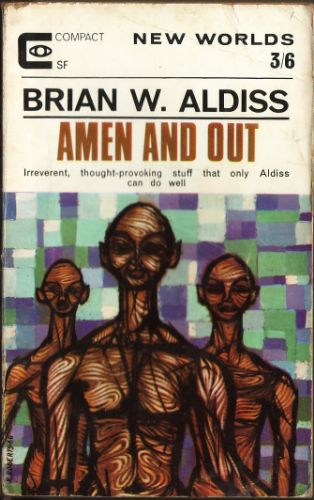
(Cover by Keith Roberts. New Worlds, August 1966.)
Who Goes There?
It’s possible that a TV adaptation of his Amber series will bring about a renaissance, but for many years now Roger Zelazny has been a somewhat known but sadly not famous science-fantasy writer. He had one of the fastest rises to prominence of any genre SF writer, making his professional debut in 1962 and just a few years later he would win big at the inaugural Nebulas. (He probably would’ve also won two Hugos that same year had the Best Novelette category been in effect then, as “The Doors of His Face, the Lamps of His Mouth” would’ve surely won that, on top of the Nebula.) In the ’60s Zelazny was a critical darling, and the ’70s saw commercial success with his Amber novels. Despite some more award wins, though, critical opinion grew shaky on him after his ’60s explosion, not helped by the fact that his output slowed down in the last years of his life.
Zelazny died relatively young, in 1995 from cancer. That he didn’t live to see what is probably the biggest indicator of his legacy, George R. R. Martin’s A Song of Ice and Fire (Martin very consciously takes after Zelazny, more on that later), no doubt played a part in dooming him to semi-obscurity. Despite being repped by some big names currently in the field like Martin and Neil Gaiman, recovering Zelazny is still a work in progress, completion date unknown. “The Keys to December” is one of those short stories Zelazny wrote in a white heat that made his reputation, and with good reason, as the SFWA, in agreeing with my assessment, nominated it for a Nebula. Just one of many for Zelazny during that time!
Placing Coordinates
First published in the August 1966 issue of New Worlds, which for some reason is not on the Archive but which thankfully is on Luminist. Its quality was immediately noted because the very next year it appeared in Best S.F. Stories from New Worlds (ed. Michael Moorcock) and World’s Best Science Fiction: 1967 (ed. Terry Carr and Donald Wollheim). It then appeared in The Doors of His Face, the Lamps of His Mouth and in the more comprehensive The Collected Stories of Roger Zelazny Volume 2.
Enhancing Image
Jarry Dark is your typical hard-working blue-collar man, except for the fact that a) he has a keen business sense, and b) he’s not, strictly speaking, human. Jarry was born to normal human parents, but his parents had signed away his future job prospects and even his genes to General Mining. The idea is that Jarry is to be genetically modified in utero as a Catform, or a humanoid with catlike qualities like those ears and a coat of thick hair—plus what will turn out to be a tendency to purr. The bad news of course is that Jarry and his kind will not be able to interact so much with normal human society, being different but also built for much colder climates than normal humans could withstand; but the good news is that by signing this contract his parents have guaranteed him a job with General Mining. Jarry will be trained to work on Alyonal, a recently purchased would-be mining colony.
The problem then becomes this: What if suddenly there is no more Alyonal? That planet’s sun has gone nova and now Jarry and his fellows (those of “the December Club”) are left without a workplace. There’s an initial hurdle to jump over with regards to this story, which is the absurd notion that a company with surely massive resources can genetically modify a race of furries into existence but can’t anticipate a sun going nova. A common flaw in Zelazny’s writing is that he’s not keen on scientific plausibility, and actually there’s a good chance he’ll deliberately go for an outdated depiction of a planet or ecosystem. The Mars of “A Rose for Ecclesiastes” was not a realistic depiction of that planet, even in 1963. The Venus of “The Doors of His Face, the Lamps of His Mouth” has more in common with how Leigh Brackett wrote it in the ’40s than with any speculations on that planet in 1965. “The Keys to December” has the advantage of depicting fictional planets, including what will be the setting for the action, dubbed Alyonal II, but we’ll come back to implausibility in a second.
So the Catforms are out of a job. Except not really. For one, true to the contract, the Catforms are guaranteed employment “until [they] achieved [their] majority” from General Mining, and Jarry himself soon enough becomes independently wealthy through the stock market. Now, finding a planet that can support life, Catform life specifically, and which is in rich in minerals, is a tall order. And then there’s the cost of terraforming, which will be necessary. “Worldchange” units cost a lot of money and a lot of manpower will be needed. Ultimately you have the December Club, some 28,000 Catforms, moving to Alyonal II with twenty Worldchange units, in a terraforming effort that Jarry calculates will take 3,000 years. This, of course, is 3,000 years in objective time; the workers will take shifts between working and cold sleep, and it’s said in passing at one point that due to advancements in medicine (read: space wizard handwaving), people can live unnaturally long lives in this future. Jarry and his “betrothed” Sanza will age only several years themselves while they pass over centuries.
Another problem: Alyonal II can not only support life but is in fact already teeming with it. Life itself is not unusual on this planet: you have the usual plant life, plus birds and assorted mammals. Not that Zelazny is normally creative with inventing alien life, but here he may be trying to make a point about Alyonal II being a counterpart to Earth. This idea gets reinforced when the settlers meet a vaguely humanoid race they take to calling Redforms, who at the outset are a little less evolved than our distant ancestors. “It was covered with a reddish down, had dark eyes and a long, wide nose, lacked a true forehead. It had four brief digits, clawed, upon each hand and foot.” An apt comparison might be that the Catforms are like homo sapiens while the Redforms are like Neanderthals, except it’s a sort of ironic reversal since the Catforms are the ones built for cold weather while Neanderthals died out (partly) because they could not adapt to warmer climate. You probably already guessed what the central conflict will be: the fact that as the Catforms terraform the planet, whole species will inevitably die out, including the Redforms who are at least borderline sentient.
“The Keys to December” explores the inherent tragedy of colonialism, but also overspecialization. We would blame the Catforms more for their lack of consideration for the native life, but the Catforms can’t live anywhere else except maybe in the vacuum of space; these are beings who were created for a rather niche existence. It’s a question of adaptation. Most of the life on the planet simply will not be able to adapt to the changing climate in 3,000 years—probably not even 10,000 years. This is the cold reality of man-made climate change. Homo sapiens can adapt to basically anything, as history has shown time and again, but the same can’t be said for most anything else. I’m not sure if Zelazny was making a comment on man-made climate change, since when he wrote this story (circa 1965), this was a topic that would not make its way into popular discussion for several more years. Then again, while they do tend to be comically wrong about predicting the future, SF writers are, or at least should be, less vulnerable to future shock. Regardless, intended or not, it still rings true.
Speaking of intentions, it’s hard to say who or what inspired Zelazny. All artists are inspired by something; I’ve yet to see any exceptions to this. The thing is that aside from maybe Ray Bradbury I can’t think of a clear predecessor to Zelazny in American genre SF. With “The Keys to December,” though, I was less reminded of Bradbury and more of Poul Anderson and Cordwainer Smith, who are not authors I would immediately associate with Zelazny. Admittedly with Smith the comparison is more surface level—ya know, genetically modified furries to be used for blue-collar work. But this story almost reads like an homage to Anderson’s more humane works and I have to wonder if this is a coincidence. For one there’s the preoccupation with planet-building, which I have to admit is a premise that never fails to draw my interest. (Why else would I read Kim Stanley Robinson’s Red Mars, and then stall on that series when Green Mars turned to be such a slog?) But there’s also a thematic similarity, in that Anderson often posits that interfering with other people’s cultures is a bad idea; this is a notion Zelazny, at least in this story, agrees with.
Of course, Zelazny is a more graceful writer than any of the aforementioned people, yes even including Bradbury. Enough happens in “The Keys to December” that it could serve as the germ for a whole novel, but Zelazny not only keeps it as novelette length but uses its relative brevity to achieve a poetic effect. The alternating sleep-wake cycle attains its own rhythm and we start to see the planet change in fits and starts alongside the characters, like camera footage being played at double speed in random intervals. Zelazny oscillates between long borderline Faulknerian passages and these short, punchy, at times vulgar bits that imply someone who probably smoked weed in college but also first tried his hand at writing poetry before he realized he was more suited to prose. Sometimes this is done for comedic effect; in the case of “The Keys to December” it’s done to convey a crushing sense of loss. Even as the Catforms slowly mold the planet to be more to their liking, a price must be paid. Take this, for example:
It was twelve and a half hundred years.
Now they could breathe without respirators, for a short time.
Now they could bear the temperature, for a short time.
Now all the green birds were dead.
While it’s hard to figure out who came before Zelazny (he really was one of those bright new talents in the ’60s, alongside Samuel R. Delany, and even Delany had obvious ties to the Modernists), it’s much easier to see who took after him. I’ve read a fair bit of early George R. R. Martin, his ’70s material, when he was trying to make his name more as a science fiction writer, and early Martin often reads much like early Zelazny, although Martin never had the knack for poetry that Zelazny did. Much as I love Martin’s “With Morning Comes Mistfall” (review here), it has some of the hallmarks of early Zelazny: a mood piece with a poetic rhythm set on an alien planet of dubious scientific plausibility. This is not really a slight against Martin; there are far worse writers to copy than Zelazny, especially early Zelazny when he seemed to be at his most passionate. True enough there’s a bit of romance here, although Sanza is not exactly a three-dimensional character; not that she needs to be, since ultimately the tragedy of the situation is far grander in scope than something between two people.
There Be Spoilers Here
Centuries have passed, and things have been going smoothly for Jarry and Sanza at their installation—until tragedy strikes. They encounter a bear-like creature while going out for a ride on their “sled,” and in the ensuing fight Sanza and the “bear” kill each other, and in front of a group of Redforms no less. Sanza is the first Catform to die during the terraforming. Centuries pass again. Something very strange starts happening with the Redforms: for one they’ve begun to evolve physically, even growing a pair of thumbs (I doubt this can be achived in a thousand years or so), but they’ve also taken to seeing the Catforms as demigods. Jarry is understandably disquieted by how the Redforms have taken on a more human appearance and demeanor. “They now had foreheads.” They’ve been adapting to the changing environment, but it might not be enough; they will almost certainly die out once the planet becomes cold enough for the Catforms’ liking.
Is this genocide? Is it genocide to kill off a race of sentient beings by way of inaction? Is it fair that one race must die so another can live? The best Jarry can hope for is that he can convince the rest of the December Club to slow down the terraforming enough that the Redforms might stand a fighting chance. Maybe it’s from a combination of grief and guilt, the former from losing Sanza and the latter from seeing life vanish on the planrt, that pushes Jarry to drastic measures—to terrorism. He sabostages multiple installations before they catch him. It’s amazing they don’t opt to shoot him on sight, but remember that Jarry partly bankrolled the project in the first place and is a highly respected member of the Club, plus the fact that grief does strange things to a person’s brain. And his conscience. A lethal cocktail of grief and guilt can send someone into a downward spiral mentally. Zelazny’s early stuff can be emotionally intense at times, but “The Keys to December” might be the most emotionally effective short story of his I’ve read, partly because it has a rock-solid foundation (iffy science aside) and partly because this is Zelazny at his most sincere.
Jarry forces a vote from the Club, even those who were supposed to be in cold sleep, as to what to do with the Redforms, and it’s unclear if the Club votes to slow down terraforming or not. Even so, the ending is deeply bittersweet. Jarry opts to forego cold sleep and spends the rest of his days with the Redforms, the race he had helped doom to extinction. But he did what he could, and that has to be worth something. The hero suffering a case of conscience like this is a bit unusual for Zelazny, whose characters tend to be more unrepentantly hard-boiled, and even Anderson (again the closest point of comparison for this story specifically) usually doesn’t bless (or curse) his characters with conscience like this. “The Keys to December” is in some ways atypical Zelazny; if not for its stylistic tics I would almost not think he had written it. This is not a bad thing. Zelazny wrote a lot in the ’60s and he did sometimes repeat himself, but not here.
A Step Farther Out
When recommending old-timey genre SF writers to people there’s sometimes the temptation to add the asterisk of a given writer’s prose style being function-only. This is not a problem with Zelazny, because line for line he was such a wordsmith, something I remembered when reading this story. Zelazny has other problems, such as an indifference to scientific plausibility, which does rear its head a bit here, but it’s easy to forgive. Some of Zelazny’s stuff can read as workmanlike (by his standards) and a little too abstract (the number of mood pieces he wrote, lacking both plot and character), but “The Keys to December” is a great SF story in the classic sense, in that it’s a human story whose conflict and resolution would not be possible without its science-fictional aspect. It’s a mix of scientific intrigue and human tragedy that Poul Anderson could muster on a very good day but which Zelazny, at least in the ’60s, evoked like it was second nature.
Lester del Rey was one of several young writers who came about in the late ’30s, just in time for John W. Campbell to take over Astounding Science Fiction and reshape it to his liking. Along with Theodore Sturgeon, del Rey was a sentimentalist who right away made a reputation for “human” stories, some of which, like “The Faithful,” “Helen O’Loy,” and “The Day Is Done,” were very popular at the time. Del Rey started out as sort of a humanist, but, maybe because he got more accustomed to the cutthroat and low-paying nature of the industry, both the man himself and his fiction became a lot more bitter with time. Eventually he would marry Judy-Lynn del Rey, who proved to be one of the most talented editors of her time, sadly gone too soon. The del Reys’ most lasting impact might be in their founding of Del Rey Books, which persists to this day.
In the early ’50s, apparently to capitalize on a boom in the market, del Rey got to edit several new SFF magazines—all of them unfortunately short-lived. One of these is Space Science Fiction, and to inaugurate this new magazine del Rey decided to employ his favorite writer: himself. “Pursuit” is considerably more hard-boiled than early del Rey, and it’s a curious choice for introducing the magazine even if it’s far from the best.
Placing Coordinates
First published in the May 1952 issue of Space Science Fiction, which is on the Archive. It was then collected in Gods and Golems alongside other novellas and long novelettes. If you’re curious you can read it for free on Project Gutenberg, and actually running the Gutenberg text through a word processor convinced me it’s of novella length—about 18,000 words. ISFDB incorrectly lists it as a novelette.
Enhancing Image
Wilbur Hawkes is an assistant math professor and recent divorcee, which normally would make him the protagonist of a Saul Bellow novel if not for the fact that he can’t remember anything from the past seven months. He wakes up one day and finds he’s taken up smoking, a habit he did not have before, and that through circumstantial evidence he finds there’s a seven-month gap in his memory. He remembers granting his ex-wife a divorce and getting a letter from a certain Dr. Meinzer, but after that it’s a blank. Quickly things go amiss when he finds he’s being watched by somebody, who probably knows more than he does, probably G-men who look to take him in for some purpose. Or it could be one big misunderstanding. Much of the ensuing plot is Hawkes a) recovering what had happened during those seven months, and b) trying to evade men who perhaps wanna do him harm. Weird things start happening. A subway entrance collapses. A cat, miraculously and horrifying, gets turned inside out. Something either supernatural or super-scientific is going on, Hawkes is gonna find out.
I don’t have a lot to say with this one, for a couple reasons. It’s a short novella, true, and fast-paced, but it’s also a victim of its own sense of economy. Del Rey runs into a major storytelling problem here, which is the “and then” school of plotting. Much of “Pursuit” can be summed up as “And then Hawkes went to this place, and then this happened, and then this happened” a few times over until we slow down a bit. There is no B-plot so it’s a straight line from Hawkes’s apartment to when he meets Ellen, at which point the chase slows down and we’re allowed some backstory, if not enough to stop the chase from continuing. Ellen is a childhood friend of Hawkes’s, although the two have not met in many years—at least from Hawkes’s perspective. Ellen, for her part, knows a lot more than she lets on at first. The two clearly have chemistry and they hit it off in what would normally be hasty circumstances, but these would not be so hasty for Ellen. I have issues with the characters, or rather the lack of characters, but to give del Rey some credit his inserting of a romance plot could be less convincing.
“Pursuit” is not very good, but it does have a few points of interest. For one there’s a barely offscreen sex scene between people who are not married that I was surprised to read; must’ve been rather titillating for what would’ve been a puritanical SF readership. Indeed there’s a level of violence and sexuality prevalent here that would’ve kept this story out of the pages of Astounding, not to mention a persistent (if also rudimentary at best) harking to Freudian psychology. The unconscious keeps being called “unconsciousness,” and it’s a good thing del Rey’s been dead for thirty years or else I would kill him over that. The central conflict of “Pursuit” is between Hawkes’s conscious and unconscious mind, but the way it’s phrased makes it sounds like he’s fighting between being awake and being asleep. Anyway, it’s too racy for Astounding but also too unrefined for Galaxy, which I suppose means it’s a good thing the magazine market was oversaturated in the early ’50s. Del Rey seemed to be playing with the boundary between SF and detective fiction here, something he would apparently try again in Police Your Planet.
There Be Spoilers Here
The big twist of “Pursuit” is one I saw coming a mile away, which is that Hawkes had, prior to the story’s beginning, agreed to an experiment with psi powers and in the process became a kind of superman; all of the crazy shit that happens in the story is his own doing, or rather the doing of his unconscious mind. Hawkes is so powerful in fact that the men pursuing him are no serious threat to him, and even when he tries to kill himself (for what he thinks is the good of everyone) he physically can’t. It’s at the point where Hawkes realizes he’s stuck with his psi powers and that the cat’s out of the bag, so to speak, that del Rey makes it clear he’s not really talking about psi powers—he’s talking about nuclear weapons. I wonder if readers were already sick of nuclear allegories by 1952. Also, del Rey runs into the problem of how one would inject a story with conflict if it’s about a superman; there are several ways one can tackle this issue. A. E. van Vogt basically made a career out of justifying plots around characters who are nigh invincible, most famously in Slan where the solution was to make the superman a child in a world where there are adults, both normal and super, who wanna eat him for lunch. In the case of “Pursuit” del Rey “solves” the issue by giving his superman a case of amnesia. Success…?
A Step Farther Out
I was unsure at first if I would have a review out on time today, partly because of outside circumstances but also I have to admit I was dragging my feet on this one. Sure, it’s short and it goes by quickly, but I found so little to chew on. Those who read “Pursuit” might be reminded of early van Vogt, or even Philip K. Dick’s “Paycheck,” but this story is not up to the standard of either good van Vogt or good Dick for a multitude of reasons, not the least of these being its lack of human character. It’s almost a pure action narrative wherein the stakes turn out to be miniscule, even if del Rey tries to make a point at the end. That “Pursuit” probably wouldn’t have gotten published in a magazine del Rey wasn’t editing goes to show that as a writer your worst choice for an editor is yourself.
(Cover by Michael Carroll. Asimov’s, December 2007.)
Christmas is coming up, and my birthday before that. Not incidentally we have a birthday among the authors covered, namely Connie Willis, whose birthday is the 31st. Willis is also very fond of Christmas stories so there’s that. Last December we did a month-long tribute to Fritz Leiber, who sadly will not be featured this time. (Don’t feel too bad, he’s already one of our most frequent “visitors.”) Since we’re closing out the first full year of this site, I figure it’s time to introduce one more major change (not permanent, don’t worry), not for this month but for January. December will be the last month probably until 2025 that I’ll be doing serial reviews; for 2024 I’ll be taking a break from serials and focusing on short stories and novellas, although I’ll still squeeze a few complete novels into the schedule.
The way it’ll work is, the days I would be reviewing sserial installments will instead be relegated to short stories, but otherwise the alternating slot method will not change, only starting in January you can expect to see two short stories for every novella. The space given to complete novels will remain the same: if a novella slot were to fall on the 31st of the month then I’ll at least try to tackle a complete novel. Why no serials for a year? For a few reasons. For one, I’m tired, and also I’ve come to find that my serial reviews are the least popular of my reviews, or rather they get the least feedback. Also, I’m a devotee of the short story at heart, and the reality is that there are way more short stories in the magazine market than serials, by at least a factor of ten; so for one year I think short stories deserve more of the glory. We do, of course, get two short serials to tackle before the hiatus, both of which are actually rereads for me.
There is one other thing I have in mind, a rather special thing, but you’ll have to wait until January to hear about it. It’s a secret. :3
For the serial:
Three Hearts and Three Lions by Poul Anderson. Serialized in The Magazine of Fantasy and Science Fiction, September to October 1953. Retro Hugo nominee for Best Novella. This is the first serial I’ll be covering where I’ve not only read the book version but also the serial version, so this is sort of my third go-around with it. It’s worth it, though; this is one of the more influential works in the history of American fantasy, having partly inspired Dungeons & Dragons. It also makes me wish Anderson wrote more fantasy.
Beyond the Black River by Robert E. Howard. Serialized in Weird Tales, May to June 1935. Despite committing suicide at the age of thirty, Howard wrote a truly staggering amount of fiction and created several series in the process, with his most famous creation being Conan the Cimmerian. Howard did not invent sword-and-sorcery fantasy but he had unquestionably the most influence on proceeding American fantasists. This right here was one of the first Conan stories I had read, and it still reads as one of the more unusual.
For the novellas:
“Pursuit” by Lester del Rey. From the May 1952 issue of Space Science Fiction. Del Rey started out as a sentimentalist at a time when genre SF was markedly unsentimental, filling a niche that had gone untapped such that early stories like “Helen O’Loy” and “The Day Is Done” were very popular. He would move away from that style, and in the ’50s he even edited several (very short-lived) SFF magazines, Space Science Fiction being one. Thus the first story in the first issue of this magazine is by del Rey’s favorite writer: himself.
“All Seated on the Ground” by Connie Willis. From the December 2007 issue of Asimov’s Science Fiction. Hugo winner for Best Novella. In the ’90s and 2000s Connie Willis could lay claim to being the most popular writer to appear regularly in Asimov’s, and that’s on top of her novels, a few of which are certified classics. Her novel Doomsday Book especially is excellent, although it does not indicate her penchant for humor. She holds the record for most Hugo wins for Best Novella, with “All Seated on the Ground” being her fourth.
For the short stories:
“The Keys to December” by Roger Zelazny. From the August 1966 issue of New Worlds. Zelazny looks like he might see a much deserved renaissance soon, with a TV adaptation of his Amber serie being in the works. This is good news, because for a couple decades Zelazny has been threatened with the dark cloud of obscurity, despite being one of the most acclaimed SFF writers to come out of the ’60s. I picked “The Keys to December” because, well, look at the title.
“Genesis” by H. Beam Piper. From the September 1951 issue of Future Science Fiction. Piper is surely one of the most tragic figures in old-timey SF, having started his writing career very late (he was in his forties) and committing suicide at the age of sixty, believing himself to be a failure, such that despite not dying young his career was short-lived. It’s a shame, because Piper was in some ways an unusual writer for the time; he was a bit of a character, one could say.
For the complete novel:
Lest Darkness Fall by L. Sprague de Camp. From the December 1939 issue of Unknown. From 1937 to 1942 (he took a break to support the war effort), de Camp was one of the designated court jesters in John W. Campbell’s Astounding, and perhaps more importantly in Unknown. It was here that de Camp got to show off his range as a fantasist (most famously in his collaborations with Fletcher Pratt), although ironically his two longest solo efforts in Unknown in its first year, Divide and Rule and Lest Darkness Fall, are science fiction, not fantasy. Lest Darkness Fall was de Camp’s solo debut novel, an early example of a modern person being sent back to an ancient time period, and according to a lot of people it’s also his best. It was expanded (although I can’t imagine by much, since the magazine version looks to be a solid 50,000 words) for book publication in 1941.
You may think it a weak move for me to have my last two serial reviews before the hiatus be of ones I’ve already read, but as I’ve said before and always hope to make clear, rereading is arguably more important than reading in the first place. So it goes.
(Cover by Vincent Di Fate. Analog, February 1988.)
The Story So Far
The Cay Habitat was constructed a few decades ago to house a race of special humans—ones that were made to work in zero gravity indefinitely, since such conditions are awkward for normal humans. With a second set of arms for legs, the quaddies are considered the property of GalacTech, who’re also the employers of Leo Graf, Our Hero™. Leo has a problem: How do you teach a group of people about exploitation when said people exist as slave labor? It’s a question that for better or worse will have to go unanswered, because word gets through that an anti-gravity device has not only been invented but deemed ready for market sale, thus rendering the quaddies obsolete. Of course this raises another problem: What do you do with outdated tech when the tech is people? At best GalacTech will have the quaddies sterilized and shipped off to a barracks—at worst have them terminated with extreme prejudice. If the quaddies can’t be allowed to live out their lives peacefully under GalacTech jurisdiction then the only solution is to get out of said jurisdiction—and then comes an idea.
The Habitat is small, when taken in its essentials; it was made to house a thousand quaddies and little more than that. If broken down, the Habitat could be made to piggyback on an interstellar ship as flies through the wormhole near Rodeo. What at first sounds like a moral problem then becomes an engineering problem. The quaddies are very young (the oldest are barely out of their teens), but the best of them, along with some help from sympathetic humans, could make the scheme a success. Sure, the other end of the wormhole falls under a different planet’s jurisdication, but they’ll cross that bridge when they get there.
Enhancing Image
Sorry this is a day late. Forces beyond my control kept me in a bind yesterday such that I couldn’t write this post in time. Oh well.
I’m not sure if I would get this same feeling if I read it all at once, but I’ve become less interested in Falling Free with each successive installment, and the big reason for this is that Bujold gives us a memorable premise and a memorable setting to go with it, but there also has to be a plot here. For the record, there’s a difference between conflict and plot; you could have a character-driven narrative that’s rife with conflict, but very little actually happens. We start with both external and internal conflict here. We have the conflict between Leo and Van Atta, Leo and Dr. Yei, Dr. Yei and the quaddies, Leo and the quaddies, and of course Leo conflicting with his own interests. A great deal is implied about what had led to the quaddies being created. We only learn about Dr. Cay through second-hand sources, since Cay died a year before the story’s beginning, but what we do learn about him is not flattering. Yei, Cay’s successor, is implied to be in conflict with herself, since she was hired basically to make the quaddies docile whilst being well aware of their slave status, but for most of the novel she has a “just doing my job” mentality that eventually gives way to guilt.
Bujold introduces us to some engrossing character conflicts, but they start taking a backseat as the plot starts being funneled into what amounts to a race against the clock. Van Atta was never a layered character (he is, I have to say, disappointingly one-dimensional), but his role gets eroded to the point where he becomes a walking plot device—a threat that Our Heroes™ have to evade, since he can’t be reasoned with. Since we’re never allowed into Dr. Yei’s head our ability to perceive her inner conflict is limited, and her redemption at the end in incapacitating Van Atta long enough to let the Habitat enter the wormhole is boiled down to a single action. The recurring problem with this novel as it progresses is that it starts out as rather chatty, with a lot of room for character depth, but rather than elaborate on that we’re instead forced down a corridor wherein characters, who once were well-defined and intelligent, are boiled down to their actions. Tony, who is the first quaddie we see, all but stops being a character after the first installment; now admittedly part of this is because he gets put on a bus, figuratively speaking, but when we do meet up with him again he is reduced to something Our Heroes™ have to rescue.
What’s frustrating is that, at least going by Theodore Sturgeon’s definition of what makes a good science fiction story, Falling Free is good SF. Paraphrasing Sturgeon here, a good SF story is a human story with a human problem that must be solved in a human way, but which hinges on a scientific aspect. In Falling Free we’re given a premise which (at least with existing technology) can only be made possible in a science-fictional universe; but at the same time sounds logical enough that it could happen. We’re given a problem centered around human rights and this problem is resolved in a human way, albeit with a dose of that old-school hard SF hardheadedness. There comes a point, however, when Bujold’s economy of style turns against her and the novel, which starts out as seemingly open-ended, turns into a series of Things Happening™. I can see what people mean when they say this is minor Bujold, despite the Nebula win. I would be less disappointed if the novel’s opening stretch wasn’t so promising.
Oh, and the romance between Leo and Silver is both unnecessary and unconvincing, never mind that Silver is half Leo’s age.
A Step Farther Out
I’m unsure how to feel about this novel, although having finished it I can say its winning the Nebula is totally baffling. Was there really no better choice that year? C. J. Cherryh’s Cyteen won the Hugo that year, and while I haven’t read it I have this hunch it would’ve at least been the more fitting winner; but to make things more baffling Cyteen wasn’t even nominated for the Nebula! What were people on back in the day? It’s shit like this that my borderline zoomer brain struggles to comprehend. I’m also not sure if Bujold wrote Falling Free with serialization in mind or if maybe her agent recommended it, but I don’t think the serial model works great for her. Admittedly there’s a reason serialization has basically become extinct, because a) not many people read magazine anymore, and b) it incentivizes a certain type of writing that puts higher priority on plot than character. Looking at this novel as a whole, I’m mixed. Getting kinda tired of serials.