Norman Spinrad has had a long and winding career over the past sixty-odd years; in fact he’s the only author we’re covering this month who’s still alive, at least last time I checked. Spinrad was born in 1940, in NYC, and he made his debut in 1963, just before the New Wave kicked into high gear. He’s one of the few prominent New Wavers who did not already have a career by the end of the ’50s. He stirred up controversy a few times, most notably with the novel Bug Jack Baron, which was serialized in New Worlds and which the UK parliament took an issue with on grounds of obscenity. They say all publicity is good publicity, but in the case of Bug Jack Baron the controversy actually contributed to New Worlds (already a small operation under Michael Moorcock) downsizing and ultimately evaporating by the early ’70s. There’s also his novel The Iron Dream, a kind of fictional novel as written by Adolf Hitler in an alternate timeline where Hitler became a hack genre writer instead of, ya know. Spinrad’s later outings are less incendiary. Star Trek fans might recognize his name because he wrote one of the better episodes of the original series, “The Doomsday Machine.” 1964 was Spinrad’s first big year as it saw multiple short stories of his in print, with “The Rules of the Road” sadly being minor Spinrad, being competent but otherwise unindicative of the career he would have.
Placing Coordinates
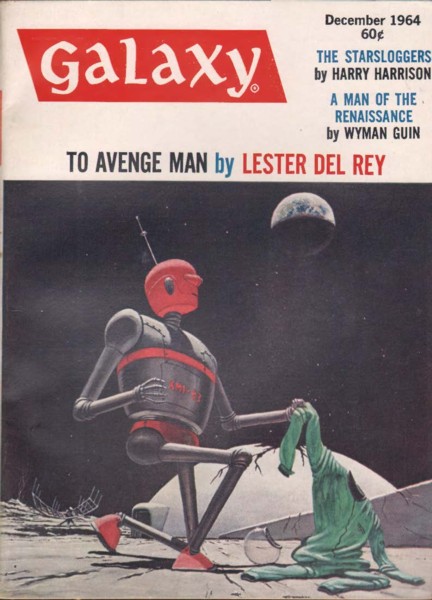
First published in the December 1964 issue of Galaxy Science Fiction. It’s been reprinted in First Step Outward (ed. Robert Hoskins) and the Spinrad collection The Last Hurrah of the Golden Horde.
Enhancing Image
Sorry that this will be a shorter review than usual. The story itself is quite short and I didn’t have much to say about it. Sometimes a short story can be densely packed with nuance and flavor so that I’d have more to write about, but this is not the case here.
A giant silver dome has appeared in Yucca Flats, which you may recall has a long history of US military involvement of the nuclear variety. (Its name is also associated with a certain infamously bad ’60s sci-fi movie, but putting that aside…) The dome appeared seemingly overnight and is obviously alien in origin, or else how could it be here. The top brass suspect the dome is some kind of ship, or maybe a “giant mousetrap” for human visitors, being perhaps a deadly labyrinth on the inside. Ten men have already been sent into the dome, and none have come out. The military begrudgingly concludes that it’ll take more than just a soldier or a normal civilian for the job, hence we’re introduced to Bert Lindstrom, a mercenary who’s gotten by on being very lucky—or rather Lindstrom has a borderline supernatural capacity to calculate risk. Risk, for Lindstrom, is indeed the name of the game. He’s a daredevil, but he’s an unusually rational kind of daredevil. Measuring risk is what gives Lindstrom’s life a sense of purpose, and pretty quickly we get that he’s a kind of anti-hero; other than that we find out nothing else about him.
“The Rules of the Road” feels both really short and somehow also protracted, because the premise is so simple and because most of it is effectively a one-man show, albeit with a voice from offscreen talking to Lindstrom, like the stage director hollering at the actors from just outside of the audience’s peripheral vision. It’s an adventure narrative, sure, but there’s actually not that much action, with Spinrad spending more time on Lindstrom’s state of mind as he enters the dome and tries to figure out what traps could be hidden inside it. There’s a bit of scenery porn, and also we do get the sense that something is at stake, although exactly what is not made clear at first. Now, if you’ve read your fair share of pre-New Wave ’60s SF then you may be thinking that this sounds a bit like Algis Budrys’s Rogue Moon, albeit without the melodramatic human drama that propels that novel’s plot, which Spinrad absolutely would have read by this point. I’ve seen people complain about Rogue Moon being far more about the people outside of the deadly labyrinth on the moon than about the labyrinth itself, but “The Rules of the Road” is what that same basic plot might look like if you removed the human element. This is to say that Spinrad’s story has the bones of what should be a compelling little adventure story, but lacks the warmth and intellectual stamina of Budrys’s novel. Mind you that Budrys was not the only author whose footsteps Spinrad seemed to follow, but in order to get to that we’ll be talking about the climax…
There Be Spoilers Here
That the dome is an alien construction is obvious, but what’s less obvious is the nature of the aliens who had constructed it. Are they here to put humanity through some kind of rite of passage, or are they here merely to toy with humanity as a kind of plaything? It turns out to be the former. As the alien host, who we hear but do not see, explains, the universe as we see it is actually an illusion, with our three-dimensional perception being a smokescreen for a universe whose “true” nature would turn the average person’s brain to mush. The true universe is “the road” the humanity will have to learn to navigate if it wants to be on par with the aliens, who clearly are supposed to be far more advanced than us. This is a reveal that would not have been out of place in the pages of Astounding a couple decades earlier, to the point where I feel like A. E. van Vogt had written just the same kind of story as this, with more pyrotechnics and a real sense of hallucinogenic wonder at the vastness of the universe. The big problem with Spinrad’s story, aside from its uneven pacing, is that it’s maybe too sober and rational, too casual about the cosmic potential of its premise. It’s “far out” on paper, but Spinrad did not write it as such. When Lindstrom returns from the dome, having apparently been transformed into “something other than human,” we don’t feel much of anything about it.
A Step Farther Out
Reading very early Spinrad you probably wouldn’t get the impression that he would write something decidedly transgressive like Bug Jack Baron a handful of years later, or that he would be one of the more accomplished New Wavers generally. When read the early stuff of, say, R. A. Lafferty or Roger Zelazny, you could see how they would later rub shoulders with the New Wave, but this is not so with Spinrad. “The Rules of the Road” reads like A. E. van Vogt at a discount, albeit if van Vogt also had a firmer grasp of English. It’s clearly magazine filler, which is a shame.
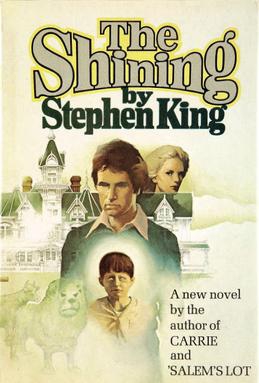
(The Shining. Cover by Dave Christensen. Doubleday, 1977.)
Aside from comedy, horror is the genre whose impact hinges most on its brevity, and indeed comedy and horror are rather closely linked, almost like twin siblings who have strikingly different personalities. Both traditionally rely on a setup followed by a punchline, preferably in quick succession. If you watch some third-rate horror movie you’ll likely be subjected to the “jump scare,” which itself plays out like a joke: there’s the setup (the growing sense of tension, either through a building musical score or the conspicuous lack of music, the person about to be jump-scared either knowing implicitly that something lurks around the corner or being totally ignorant of that lurking thing), followed by the punchline (the jump scare itself, typically accompanied by a scare chord from the music section). So, horror is tension plus time. The tension can only be sustained for so long, much like how the setup for a joke can only be sustained for so long before the audience gets impatient or bored, hence why historically horror has worked best and most often at short lengths. Surveying the history of horror literature in the Anglosphere as we recognize it, from the late 18th century to now, there’s no shortage of authors who wrote horror prolifically at short lengths. In the history of American literature especially the art of the modern short story can be traced back to Edgar Allan Poe and Washington Irving, who both often wrote either horror or fantasy of a weird if not outright horrific sort. Irving’s “The Legend of Sleepy Hollow” and “The Adventure of the German Student” by themselves may have inspired quite a few authors to try their hand at what we now call weird fiction, but then Irving wasn’t primarily a horror writer. Instead it was Poe who made his name as a master of horror in the short form, in the process also giving rise to the detective story, and even a fair amount of science fiction.
Poe’s most famous and arguably best story, “The Fall of the House of Usher,” came as a revelation when it was published in 1839—not so much for its innovation but in how it reshaped what had been for a couple decades seen as a literary school that had run its course: the capital-G Gothic narrative. I say “narrative,” but the Gothic story was, prior to Poe, typically of novella or novel length, the latter being more lucrative. The reality is that what was true in 1820 is more or less still true in 2025, which is that novels sell. With a few very notable exceptions (I’m looking at you, Ted Chiang), the rule is that if you wanna “make it” as a writer then you have to write novels. You can write short fiction on the side if you want, as like a hobby, but you must write at least a few novels. Preferably a series, if you can. And yet, despite the demands of capital, horror at novel length only existed sporadically in the time before Poe, and indeed for more than a century after his death. The horror novelist, i.e., someone who specializes at least somewhat in writing horror novels, simply did not exist yet. Consider what H. P. Lovecraft, in his seminal essay “Supernatural Horror in Literature,” thought of as the first true supernatural horror novel, that being Matthew Lewis’s The Monk. Lewis, the learned son of a diplomat, was only 19 when he wrote The Monk, a messy and rambling but also striking and entertainingly grotesque novel, published in 1795 or 1796 depending on the source. The Monk sparked controversy in the UK at the time, but it also sold well, to the point where it garnered the very young Lewis a reputation which he was not terribly keen on, being called “Monk” Lewis. While Lewis would continue writing, mostly for the stage, he never wrote a proper follow-up to The Monk; maybe he would have, had he not died young, at only 42.
There goes our first would-be horror novelist.
There was, of course, a close contemporary of Lewis’s who bordered on being a horror novelist, and may have been one had what she written been more in line with the genre. Ann Radcliffe is a name fans of Jane Austen would find as ringing a bell, if only because Austen satirizes her work rather playfully in the novel Northanger Abbey. Radcliffe was famous at the tail end of the 18th century for her Gothic novels, although actually she only wrote six of them before retiring from novel-writing at a relatively young age, and only one of them, The Mysteries of Udolpho, holds serious water in pop culture. Radcliffe’s novels are not horror as we understand the term, but more true to the title of that aforementioned novel, they’re meant to be taken as mysterious. The Gothic elements, from the castles to the Spanish Inquisition, certainly make these works rub shoulders with proper horror, but scaring her readers was not Radcliffe’s aim; rather she wanted to convey a sense of wonder and mystery, although many, including Lovecraft, fault her for providing at times convoluted rational explanations for what appear to be supernatural doings. In part due to Austen’s skewering of her work (albeit that it seemed to be affectionate) and partly from a rare case of pop culture osmosis having a negative effect on an artist’s reputation, Radcliffe’s work has only gotten reevaluated in the past couple decades, some 200+ years after publication. A couple decades after Radcliffe’s retirement, indeed around the time of Austen’s death, there were at least two one-off efforts from very different authors that would do what Radcliffe did not: Mary Shelley with Frankenstein and Charles Maturin with Melmoth the Wanderer. Lovecraft considered both but especially the latter to be the last and ultimately best out of the original Gothic tradition.
Mary Shelley needs no introduction, although it must be said that the stars seemed to align such that she would become one of the most important authors in all English literature, despite said importance hinging more or less on a single work. Shelley was the daughter of William Godwin and Mary Wollstonecraft, who were both famous in their time as proto-feminist and anti-authoritarian figures. Shelley herself married the now-famous Romantic poet Percy Bysshe Shelley, who sadly died very young in a shipwreck, just a few years after the publication of Frankenstein. The story of how Mary Shelley came to write Frankenstein is almost as famous as the novel itself, to the point where it’s recreated as the framing narrative in Bride of Frankenstein (weird choice, I know). The story goes that in 1816 Mary, Percy, Lord Byron, and John Polidori made a bet to see who could write the best horror story, although only Mary and Polidori actually managed to finish their contributions, the latter having written the pioneering vampire story “The Vampyre.” Frankenstein was published in 1818, with Mary Shelley revising it considerably in 1831; a good way to start an argument with fans of the book is to ask which version one should read first. Brian Aldiss later claimed, in Billion Year Spree among other places, that Frankenstein was the Big Bang moment for science fiction, the first proper SF story that set the standard for all to follow—a claim that certainly has firm ground for itself. But while Shelley wrote another major SF novel, The Last Man, Frankenstein remained her most substantial horror story, never mind the work she remains by far the most known for.
Charles Maturin was a very different case from Mary Shelley. An Irish Protestant clergyman of French heritage, Maturin mostly wrote in obscurity, and indeed Melmoth the Wanderer, widely considered his magnum opus, is the only thing of his you’ll likely to find in bookstores. Published in 1820, and inspired somewhat by what Maturin called “the Radcliffe romance,” Melmoth the Wanderer goes far beyond what Radcliffe or even Shelley had done, being at once a harrowing and genuinely eerie Gothic narrative and also bordering on an encyclopedic novel, being dense with allusions and references. One needs an edition that comes with notes when tackling this one. But while it is perhaps overstuffed with frame tales and almost cartoonish in its anti-Catholic sentiments (there’s a looooong sequence involving the Inquisition), there is, as Lovecraft says, “an understanding of the profoundest sources of actual cosmic fear.” Perhaps for the first time since The Monk, which is a religiously serious novel despite its grotesquery, there’s a tangible sense of fire-and-brimstone wrath in horror writing, made possible with Maturin’s novel. Maturin may have written a follow-up to Melmoth the Wanderer, had he not died only four years after its publication; as such it remains yet another one-off effort in the genre’s history, which at this point seems plagued by inconsistency. In the whole first half of the 19th century there was not a single writer, at least in the Anglosphere, who took up the mantle of writing horror consistently at novel length, and indeed there wouldn’t be one for a long while yet. Maturin’s own grand-nephew, the much more famous Oscar Wilde, himself wrote a rightly beloved horror novel, The Picture of Dorian Gray; but alas it would be his only novel, and anyway Wilde was not exactly a horror writer.
Looking back on the genre’s history, one would think horror literature stayed more or less dormant through the Victorian era and into the early 20th century, but this is far from true, for at short length the genre stayed very much alive and well through the years. There was a half-century period, from about 1890 to 1940, where the horror short story was arguably at the height of both its average quality and how much was being written, between those who specialized in horror and those who did not. The list, even if we’re just counting “literary” authors who wrote a fair number of short horror stories, is daunting: Ambrose Bierce, Henry James, Edith Wharton, Mary E. Wilkins-Freeman, Rudyard Kipling, H. G. Wells, John Collier, O. Henry, and so on. But then you also had those who did specialize in horror, at which point the list becomes near-endless. Yet none of these people wrote horror novels with any regularity—except maybe one. The closest we have to the first proper horror novelist is the semi-obscure William Hope Hodgson, whose books did not sell much when he was alive and whose untimely death on the battlefields of World War I meant he did not live to interact with the authors he would influence. Hodgson wrote four novels, but I’m especially considering the first three, which were written and published in quick succession, and which Hodgson considered what “may be termed a trilogy; for, though very different in scope, each of the three books deals with certain conceptions that have an elemental kinship.” These are The Boats of the “Glen Carrig,”The House on the Borderland, and The Ghost Pirates. I’ve read all three, and indeed despite very different settings (The House on the Borderland especially feels like an outlier), they do seem in conversation with each other; they’re also early examples of weird horror crossed with a romanticism that has not aged nearly as well. The Ghost Pirates, being easily the least romantic of the three, I would say is also the best from start to finish. Hodgson was a true innovator, but he also wrote for a living and it shows, not to mention his early death robbed us of more work.
It could be because the genre’s finest contributors tended to either stick to short stories and novellas or die tragically young, or both, but even during the height of Weird Tales, in the latter half of the 1920s through the ’30s, horror novels were still hard to come by. The editor of Weird Tales during this period, Farnsworth Wright, wasn’t keen on long serials, and as such you would only get maybe one full novel serialized in that magazine per year, sometimes not even that. Even when a novel runs in Weird Tales it is unlikely to find publication in book form anytime soon; there just wasn’t a market for new horror books in the ’30s. It’s perhaps telling that Lovecraft’s own three longest stories, The Case of Charles Dexter Ward, At the Mountains of Madness, and The Dream Quest of Unknown Kadath, had long journeys to publication, with only At the Mountains of Madness seeing print in Lovecraft’s lifetime, and only some five years after he had written it. His contemporaries didn’t do any better for the most part. Seabury Quinn, who in the ’30s was one of Weird Tales‘s most popular contributors, had his novel The Devil’s Bride serialized in 1932, yet it would not appear in book form until 1976. Robert Bloch’s first novel, The Scarf, languished in obscurity for decades and only got brought back into print literally this year. Bloch of course gained mainstream recognition for Psycho, the Alfred Hitchcock movie more so than the book itself; but while it is horror, Psycho is totally bereft of supernatural elements, making it an outlier in Bloch’s oeuvre. Frank Belknap Long wrote almost no horror at novel length. Robert E. Howard only managed to complete one novel, The Hour of the Dragon, which is a Conan story and not horror. When Wright stepped down as editor, shortly before his death, Weird Tales gave even less room to serials, with its new editor, Dorothy McIlwraith, focusing more strictly on short stories.
By the time the US entered World War II, the magazine market for both horror and fantasy was at a bit of a crossroads, and there was still no substantial book market for either; this trend continued into the post-war years, albeit there were a few spots of hope. In the ’50s Richard Matheson blessed us with semi-regular excursions into horror at novel length, including I Am Legend, A Stir of Echoes, and The Shrinking Man (primarily SF but definitely containing prominent horror elements), never mind his almost obligatory haunted-house novel Hell House in 1971. As with Bloch, however, Matheson wrote more prolifically elsewhere, be it short stories or writing film and TV scripts. Shirley Jackson, one of the most famous and controversial short story writers of her time, also found reasonable success with novels, and probably would have enjoyed the deluge of horror in the ’70s if not for her death in 1965. Indeed it wasn’t until the ’70s that the horror novel, having by this point become divorced from the magazine market while at the same time taking advantage of loosening censorship in multiple mediums, had begun truly to blossom in the sense that multiple authors were making a killing on the profession at the same time. Alongside Hell House in 1971 we also got William Peter Blatty’s The Exorcist, which you may have heard of. The Exorcist was not only a bestseller but spawned an even more popular movie that took home two Oscars, including one for Blatty’s screenplay. Horror, especially in the film world, was becoming nigh-ubiquitous, but for literature it would take one more push to make a powerhouse industry out of it.
In 1974, a sort of miracle happened. A young and often drunk writer from Maine in his twenties, named Stephen King, finally got his novel Carrie published, at Doubleday and under the shrewd editorship of one Bill Thompson. King had been writing horror stories since the tail end of the ’60s, and even got some published in respectable mainstream outlets prior to Carrie; but it was that first novel, which mind you is really a mix of horror and science fiction, which made him a star. However, it would’ve been one thing if King had written just Carrie before going back to short fiction; instead he did what previously mentioned authors did or could not do and came back soon with yet another bestseller in the form of ‘Salem’s Lot. Being one of the all-time classic vampire novels and arguably King’s first truly great novel, ‘Salem’s Lot was far more ambitious than Carrie, yet also showed a growing maturity in King’s writing and a fine-tuning when it came to building tension. By the time The Shining was published, not quite two years after ‘Salem’s Lot, it became apparent that King was a force to be reckoned with, for both his productivity and his commitment to writing horror that was accessible to the mainstream reader. I’ve given King a lot of shit, as I continue to do (I recently tried reading his overview of 20th century horror, Danse Macabre, and couldn’t get through it because I thought it was quite bad), but it would also be foolish to not give credit where credit’s due. It could be that King was on a creative streak in the ’70s, when he was young and hungry, or it could be that Thompson had edited his first four novels and provided a restraint latter-day King lacked, or it could be some combination; but regardless, King had emerged as almost an industry unto himself, a fact which shook the reading world.
By the end of the ’70s the horror novelist, as distinct from a novelist who sometimes writes horror, had come into existence, seemingly arbitrarily. Anne Rice made her novel debut with Interview with the Vampire in 1976, a very gay horror novel that also became a bestseller and which spawned a film adaptation, a TV adaptation, and a long-running book series. Peter Straub, who had made his debut in 1973 with the non-horror novel Marriages, languished in obscurity for a bit before making it big with Ghost Story in 1979, an atmospheric if also bloated horror novel about shape-shifting monsters. You may have heard of Straub if you’re a King fan because of their acclaimed collaborative novel The Talisman. (They also much later wrote a sequel, Black House, although we don’t talk about that one as much.) The ’80s saw such a growth in horror novels being published every year that the Horror Writers Association (HWA) was founded in 1985, and in 1987 would start giving out the Bram Stoker Award for several categories, it being the horror equivalent of the Hugo. The first year’s shortlist for Best Novel was so packed the the winner ended up being a tie between King’s Misery and Robert McCammon’s Swan Song. Indeed at this point you had Stephen King, Anne Rice, Peter Straub, Robert McCammon, Dean Koontz, Dan Simmons, Clive Barker, Ramsey Campbell, Tim Powers, and others who made a living off of writing novels which at least had prominent horror elements. The dam had burst open. These were not coming from small publishers either, like Arham House, but big names like Doubleday, Viking Press, and Pocket Books. When it comes to horror the big and small publishers have come to work parallel with each other, each covering ground the other will not, with the latter especially being good for short fiction and “the classics.” Regardless, it seems that nobody has dared look back.
It took close to two centuries, and indeed a few decades longer than it took with science fiction and fantasy, but long-form horror literature became its own industry, beholden to both critics and capital, for better or for worse. When David G. Hartwell assembled the landmark reprint anthology The Dark Descent in 1987, he envisioned it as a look back on the history of horror at it pertained to short fiction, since it had become apparent by the mid-’80s that the horror novel had overtaken the horror short story in the popular consciousness. The problem is that while the horror novel was and continues to be popular, there was no continuity of long-form horror up to that point, since as we can see, looking over this pretty lengthy piece of mine, the horror novel in English, for nearly 200 years, only existed sporadically. As Hartwell says in his introduction:
It is evident both from the recent novels themselves and from the public statements of many of the writers that Stephen King, Peter Straub and Ramsey Campbell, and a number of other leading novelists, have been discussing among themselves—and trying to solve in their works—the perceived problems of developing the horror novel into a sophisticated and effective form.
With the exceptions of a few novels which are unspeakably old at this point (Shelley’s Frankenstein, Stoker’s Dracula, and a couple others), the novels making up the horror “canon” have come about no earlier than 1950; and indeed recency bias has come into effect with horror far more profoundly than with science fiction, if only because there are so few horror novels published between 1900 and 1970 that one could even name, let alone think of as “canonical.” The horror novelist is a relatively new animal, being a mutation, somewhere between the Gothic novelist and the SF novelist. When King dies (hopefully later rather than sooner), we’ll have to reckon with his legacy with regards to his own body of work, but also the industry he helped create. It’s possible that in one year or in ten there will be a conspicuous King-shaped hole in horror writing, after Anne Rice and Peter Straub’s recent deaths. And Ramsey Campbell is looking quite old now, as is Dan Simmons, although Simmons is an asshole anyway. Hartwell himself died in 2016, and I’m not sure if he ever found a solution to the problem that is the still-young and uncertain world of horror novels as “serious” literature, which we are to study alongside examples of “canonical” SF and fantasy. It’s not a problem for me to think about much longer, since I tend to prefer short stories and novellas, but it’s food for thought.
(James Tiptree, Jr., real name Alice Bradley Sheldon [right] with her second husband, Huntington Sheldon [left]. Dated 1946.)
(Note: I shouldn’t have to say this, given the title of today’s post, but I’ll be discussing depression, mental illness generally, and suicide, including some real-life cases that have haunted our field.)
I was set to review Clare Winger Harris’s story “A Runaway World” today, but as you can see, this is not a review. I was also set to write my Observatory post for the 15th, but that didn’t happen either. Well, I’m doing it now. The truth is that when I read “A Runaway World” a couple days ago, two things occurred to me: that it wasn’t a very good story (in my opinion), and that I wasn’t sure what I would even write about it. This was a problem, because normally, even with stories that are sort of dull or not good, I’m able to articulate something such that I’m about to get at least a thousand-word review in; but this time I found myself pretty much totally divorced from the material I was supposed to be thinking and writing about. It then occurred to me that I was mentally unable to engage with the material. This is not to say that Harris was actually too “smart” a writer for me or that I had somehow missed the point of the thing, but that I was too much plagued with what a few centuries ago was called “the humors” to focus on what I was reading. I was too depressed. For the past four or five days, or almost a week at this point, I’ve slipped into a manic or depressive episode at least once during the day which left me basically unable to do anything except wish to crawl into a dark hole and cry in solitude, or to take my own life. I’m a manic-depressive. My therapist, whom I’ve been seeing for just under a year now, suspects I have bipolar disorder, specifically type II, which basically means that my mood shifts, for better or worse, tend to last a short time, a few hours instead of a few days like bipolar type I.
I was a fan of science fiction long before I was aware that there might be something “wrong” with me. One of the first books I ever read outside of the classroom was Kurt Vonnegut’s Slaughterhouse-Five, which in hindsight should have been a red flag. I read quite a bit of Vonnegut in high school: Slaughterhouse-Five, The Sirens of Titan, Mother Night, Cat’s Cradle, and even Breakfast of Champions, that really weird one that barely counts as a novel (not to be confused with Timequake, which isn’t really a novel at all). Breakfast of Champions especially stuck out to me when I read it at the time, for its weirdness but also Vonnegut’s candidness about his own long-term battle with depression, his family’s history of depression (the fact that his mother had killed herself), his PTSD, his disgust with the glorification of war in American culture, and so on. Vonnegut would live to a ripe old age, despite his “best” efforts (he somewhat jokingly claimed to smoke unfiltered cigarettes over many years as a way of killing himself), although it wasn’t cancer or a heart attack that got him but a trip down the stairs. It’s almost comedic, in a way I’m sure he would’ve approved of. Vonnegut ultimately won against his war with depression, in the sense that he allowed circumstance to take him rather than his own hand—for the difference between victory and defeat for every depressive is the question of whether to kill yourself or to leave your fragile little existence in the hands of the gods. Indeed, according to Albert Camus, the question of whether to kill yourself may be the only important question. Camus himself was not suicidal, on the contrary having a real lust for life; and yet as William Styron points out in his short but telling memoir, Darkness Visible, Camus became a passenger with someone he knew to be a reckless driver, in the car accident that would kill him, “so there was an element of recklessness in the accident that bore overtones of the near-suicidal, at least of a death flirtation.” Styron wrote Darkness Visible as a way to cope with his clinical depression, but like Vonnegut he chose to reject suicide.
Some other writers, including several prominent ones in the history of science fiction and fantasy, did not reject suicide. Robert E. Howard, James Tiptree, Jr., Walter M. Miller, Jr., Thomas M. Disch, H. Beam Piper, and some others I could mention, gave into some kind of psychological malady that had been pushing them to the brink. Howard is probably the most famous example out of all of them, and he was only thirty when he died. Supposedly Howard hated the idea of aging such that he wished not to live to an old age, which for someone so young is not in itself an unusual line of thinking. One has to admit that there’s also also an increasing sense of melancholy and foreboding in terms of tone, with Howard’s writing as he got closer to the day he chose to put a gun to his head; but this, by itself, is also not enough of a sign to have caused worry in those who knew Howard at the time. Sure, “Beyond the Black River” is a much more melancholy entry in the Conan series than “The People of the Black Circle,” which was published a year prior, but conveying melancholy through fiction is by no means a sign that the author is suicidal. As you may know, especially if you’re a fan of pre-Tolkien fantasy, Howard had a history of being sort of a moody fellow, but what pushed him into a more extreme mindset was his mother’s long-term illness and her impending death. There have been attempts to analyze Howard’s relationship with his mother, some of them in poor taste, but I’ll just say that what we know for certain is that Howard struggled to imagine a life for himself without his mother in it. As his mother’s illness reached its bitter end, Howard, like a lot of suicides who go through with the act, gave little clues to those closest to him as to what he was planning. But nobody took the hint until it was too late.
Howard’s suicide would haunt the pages of Weird Tales, his most frequent outlet, for years, not least because reprints and unpublished work from Howard would appear in that magazine after his death; and indeed hitherto unpublished work by Howard would appear sporadically over the next few decades, as if unearthed or discovered in some dusty tomb, giving one the sense that despite having been dead for almost ninety years now, we still feel the ripples of this man’s decision to cut his life and career short. Of course, while Howard suffered from insecurities, having to do with masculinity and other things, he was not (at least as far as I can tell) a long-term depressive; rather his suicide came about from a mix of material circumstances and something gone amiss in his own mind. Mind you that when I discuss depression here I am not exactly referring to depression in a clinical sense, like how a therapist or psychiatrist would use the term; rather I am using the word as laymen would have understood it for centuries for now, or for as long as the idea of depression has been understood in recorded history. By this I mean that depression at its core is the sense that the outside world, the material world, seems to shrink and become insignificant as one’s own sense of self-worth declines—a kind of self-loathing narcissism, or a snake eating its own tail. People who are unsympathetic to depressives (i.e., people who to some degree lack empathy for others) will say something along the lines of: “People with depression are so self-centered.” In a way this statement is true, although probably not in the way the empathy-deficient person imagines. The problem with depression is that due to the nature of the illness, there is be a barrier between the depressive and the people around them, who presumably are not also depressives. The result is that the depressive feels that they have no choice but to gaze inward, and to see an abyss; it’s self-obsession, but also self-hatred.
(Robert E. Howard in 1934, two years before his death.)
The other problem with depression, particularly those like myself who are depressives and also fans of SF, is that depictions of depression in SF seem to be nonexistent prior to maybe the 1950s. You can find a few examples, very scant and spread apart, but the exceptions if anything prove the rule. This is especially true of genre SF, in the American tradition, which does bring me back to the story I was supposed to review today. To make a long story short, “A Runaway World” is about Earth and Mars mysteriously being jettisoned from the solar system, in a scheme that has to do with radio waves and making alien contact. Or something like that. It’s an early example of a natural (or in this case, rather unnatural) catastrophe narrative that also runs adjacent to the Big Dumb Object™ narrative. It’s confusingly written and Harris’s prose is pulpy, to say the least, such that other than the fact that it’s apparently the first story by a female writer published under her own name in a genre magazine, there’s really nothing special about it. “A Runaway World” does serve, however, as a perfectly fine example of the kind of SF that normally saw print in the ’20s and ’30s, when genre SF saw print in Weird Tales and Amazing Stories; and, if we’re being perfectly honest, this technology-driven (i.e., material-driven) breed of SF would continue during the “golden age” of Astounding Science Fiction under John W. Campbell’s editorship. These stories are not really concerned with spirituality or even psychology, but are instead about people doing things, so in this way they are strictly materialist. There’s a material problem that requires a material solution. Now is not the time to ponder one’s own neurosis, or even the feelings of others. Something is to be done, physically. Characters in these old pulp stories can now strike us as weirdly inhuman, and while flat characterization is the surface criticism one should make, the lack of psychological depth is intrinsically tied with that characterization. These characters feel like cardboard because there’s nothing inside. As Gertrude Stein said, “There is no there there.”
Surely at least some of the authors who contributed to the early years of genre SF felt depression, anxiety, PTSD, and so on; but if they did in their personal lives then they dared not express such troubles in their fiction. Characters in the early stories of E. E. Smith, Murray Leinster, Raymond Z. Gallun, Isaac Asimov, and Robert Heinlein are (at least as far as the authors seem to think) perfectly reasonable and mentally fine-tuned fellows. Hal Clement, who made his debut during the height of Campbell’s powers, might be most “guilty” of this, as his characters, while being ostensibly human, do not have any human (in the psychological, Shakespearean sense) concerns to speak of. Mental illness and even just moments of mental disorder (say a nervous breakdown or an anxiety attack) were simply not things one was to write about if one wrote for the magazines in those days. Between the years of 1926 (when Amazing Stories launched and, incidentally, when “A Runaway World” was published) and circa 1945, one simply did not write or talk about mental illness anywhere near science fiction; and if you felt tempted then it was something between you and your therapist. Or God. Whichever you preferred. Yet in 1926 there were people, in the “literary” world, who wrote about their own mental illness, if only when projected onto their characters. The first examples to come to my mind are Virginia Woolf (suicide by drowning) and Ernest Hemingway (suicide by gunshot), who were both haunted by an inner sickness, among other things. But there was no one even close to a Woolf or Hemingway in the early days of genre SF—not just in writing skill but also giving a language to the array of mental pains that afflict far too many of us in the real world. I did, however, mention before that this streak of psychological emptiness in SF lasted from about 1926 to 1945, and there’s a reason for that.
World War II happened, and with it came a number of profound changes in the field. The once-hypothetical scenario of nuclear weapons became very much a reality overnight. Entire cities on fire. The enemy of the week went from being fascism to Soviet communism. There was the vast moral quandry of the Holocaust. There were also quite a few men who served in the war who came home, and decided to start writing science fiction. Kurt Vonnegut was one such veteran, whose experiences as a POW and subsequent PTSD inspired Slaughterhouse-Five. There was Walter M. Miller, who served as a bombardier, and who also suffered from PTSD and depression. There was C. M. Kornbluth, who saw action near the end of the war and whose already-weak heart was further weakened by the strain. Those who saw the horrors of World War II firsthand, and indeed those who grew up in the war’s aftermath (Philip K. Dick, Robert Sheckley, Robert Silverberg, etc.), seemed to take a much dimmer view of the human condition than the first generation of genre SF writers. Hal Clement served in the way and didn’t seem particularly bothered by his wartime experiences, but I see that as the exception that proves the rule. I have a bit of a hypothesis, although obviously you’re free to disagree with it: that one of the ways World War II impacted SF is how it made those us in the field aware that some of us, individually, are damaged inside. Before and during World War II the sentiment of the average SF story was, “There’s something wrong with the world,” but after the war it got amended to say, “There’s something wrong with the world, and me as well.” It’s hard to imagine a novel like A Canticle for Leibowitz, or Do Androids Dream of Electric Sheep?, or the stories of James Tiptree (possibly the most disturbed of all SF writers), could have been published in a landscape where depression were treated as if it did not exist.


 Science Fiction & Fantasy Remembrance