I wish I could say the past month has been better for me, but it has not. A big thing is happening in my life, in that today is actually the move-in date for my first apartment. Wow, imagine, at 28, my first apartment. Been taking care of the practical side of things, with assistance: furniture, stuff for the kitchen and bathroom, and of course signing up with utilities. This has been a long time coming, and truth be told I’ve become immensely tired of living with my parents. And yet I’m not happy. Moving into my own place might prove only marginally better than my previous living situation. I don’t make enough to pay for rent so I’ll be bleeding my savings for the following months. The only reason my application even got accepted is my credit score is good. I’ll be living by myself in this one-bedroom apartment. It’ll be very lonely here, as none of my partners live close enough to move in with me, and anyway, with one exception we don’t know each other that well yet. Surely the lack of my parents breathing down my neck will do me some good, but this will be a solitary existence.
Honestly I’ve been tired all the time as of late. My work schedule as of right now is erratic and I find myself going to sleep at six in the morning and waking up after noon. As you may know I have anxiety and depression, and while the former has not been as bad lately, the latter has been worse, or rather more persistent. I’m tired of everything. I’m tired of my job. I’m tired of my imperfect body, and the fact that I can barely sleep. I’m tired of being tired. The US election is in less than a week and honestly I’m sick of this fucking immoral country, and its authorities who have been spending the past couple centuries murdering socialists, queer people, ethnic minority groups, etc. We’re only a quarter into the 21st century but already I feel like almost everything that could go wrong has already gone wrong. And will get worse. I’m normally a pessimist, so take all this with a grain of salt, but I don’t see conditions improving much.
So, go backward or forward, but don’t stay here. I hate it here. I do this blog for fun, and according to stats have written 186,000 words (or about equivalent to Great Expectations in word count) this year alone; but I also do it as a coping mechanism. I don’t do it for readers, or money, because not enough people read this blog or even know about it, despite my spreading word on a few social media platforms. Maybe when I hit 200 subscribers I’ll start a Patreon. Just know I’ve been going at this for two years now because it gives me some degree of emotional security. If not for all these words I would surely have given up a minute ago.
Now, what do we have for reviewing? We have two stories from the ’40s, three from the ’60s, one from the ’80s, one from the ’90s, and one from the 2010s.
For the novellas:
“Attitude” by Hal Clement. From the September 1943 issue of Astounding Science Fiction. Retro Hugo nominee for Best Novella. Feels like it’s been a while since we last talked about Clement, who was one of the first hard SF authors as we now think of the term. Not only was Clement a pioneer, he had a pretty long life and career, remaining active into the beginning of the 21st century. His prose is workmanlike and his human characters tend to be little more than abstractions, but his lectures-as-stories can be enthralling.
“Last Summer at Mars Hill” by Elizabeth Hand. From the August 1994 issue of The Magazine of Fantasy and Science Fiction. Nebula and World Fantasy Award winner for Best Novella. Over the past four decades Hand has taken a kind of jack-of-all-trades approach to writing, tackling SF, fantasy, and horror seemingly with equal relish, with even the occasional movie novelization to her credit. (She wrote the novelization of the infamous 2003 Catwoman movie.) “Last Summer at Mars Hill” is one of her most decorated stories.
For the short stories:
“Beyond the Threshold” by August Derleth. From the September 1941 issue of Weird Tales. Derleth was correspondents with H. P. Lovecraft and could be argued as the person most responsible for preserving Lovecraft’s legacy, as he co-founded Arkham House with Donald Wandrei in 1939 firstly to reprint his mentor’s fiction. He also wrote quite a bit of fiction in his own right.
“The Scar” by Ramsey Campbell. From the Summer 1969 issue of Startling Suspense Stories. One of August Derleth’s biggest discoveries as editor was Ramsey Campbell, whose work Derleth had discovered when he was but a teenager. Campbell’s first collection was published when he was only 18, so that he got his start in weird fiction very early. He would later become a prolific horror novelist.
“Nomansland” by Brian W. Aldiss. From the April 1961 issue of The Magazine of Fantasy and Science Fiction. Aldiss debuted in the 1950s and would remain active pretty much until his death, which was not too long ago. He would win a Short Fiction Hugo for Hothouse, which is sort of a novel but also a collection of linked stories. We already covered the first story, and now we’re on the second.
“Flowers of Edo” by Bruce Sterling. From the May 1987 issue of Asimov’s Science Fiction. Sterling debuted in 1977 when he was barely out of his teens, but he would become one of the defining SF writers of the ’80s. While typically labeled as cyberpunk, Sterling has a surprising versatility, with even early novels like Schismatrix and Islands in the Net being very different from each other.
“Soft Clocks” by Yoshio Aramaki. From the January-February 1989 issue of Interzone. First published in 1968. Translated by Kazuko Behrens and Lewis Shiner. Seeing as how the Sterling story takes from Japanese culture, I thought it only right (and perhaps a neat gimmick) to follow up with a story from a Japanese writer. Yoshio Aramaki has been active since the ’60s as an author and critic.
“Checkerboard Planet” by Eleanor Arnason. From the December 2016 issue of Clarkesworld. Judging from her rate of output you might think Arnason a more recent author, but in fact she was born in 1942 and made her debut back in 1973. She’s been an activist for left-liberal causes since the ’60s but did not start writing full-time until 2009, hence her recent uptick in productivity.
When you think of cyberpunk the first author to come to mind is almost certainly William Gibson, who didn’t invent the subgenre but very much codified it with Neuromancer; after that it becomes a bit of a free-for-all. Cyberpunk goes back to the ’70s, before Gibson started writing in earnest, and you can even see inklings of it in the late ’60s, perhaps most profoundly in Samuel R. Delany’s Nova and Philip K. Dick’s Do Androids Dream of Electric Sheep?, which both have cyberpunk-y elements. But as far as the heyday of cyberpunk goes the author maybe most cited who is not Gibson would be Bruce Sterling—despite the fact that much of what Sterling has written has not been cyberpunk. It could be that Sterling is not as popular as he should be because he’s such a versatile writer, covering seemingly every subgenre under the sun and even ssometimess venturing into fantasy, all while retaining a certain attitude you’d expect from someone who grew up in Austin. He’s a bit of a punk like that.
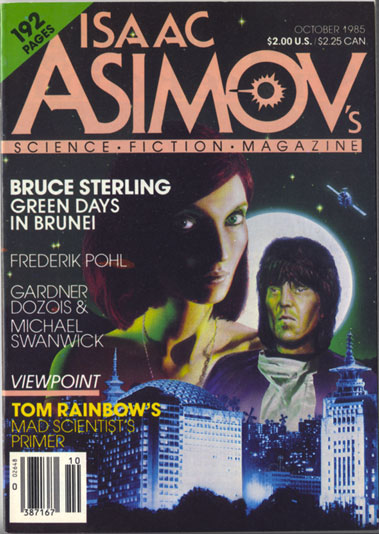
1985 was a pretty good year for Sterling that also showed off his range, with the vicious short story “Dinner in Audoghast” (alternate history), probably his most popular novel with Schismatrix (space opera), and today’s story, which is………. arguably cyberpunk. “Green Days in Brunei” has a few hallmarks of the subgenre but would nowadays be more likely classified as solarpunk than straight cyberpunk. The “green” of the title refers to money but also green energy. I’ve been on a streak with the past few novellas I’ve covered (not counting serials) and the streak continues here, as this story is pretty cool. It has naught but the skeleton of a plot but it’s a story that much more hinges on characters and speculations about the future.
Placing Coordinates
First published in the October 1985 issue of Asimov’s Science Fiction, which is on the Archive. I actually have a physical copy of this issue, but it’s easier to copy lines of text off a PDF. I ended up with six pages of “notes” for the damn thing, because Sterling packs a lot into this novella. It was then reprinted in Gardner Dozois’s The Year’s Best Science Fiction: Third Annual Collection, which unlike a few of the other early volumes you can find for reasonable pricess online. (Don’t try to collect the first volume unless you have money to burn.) It was later reprinted in the Sterling collections Crystal Express and Ascendancies: The Best of Bruce Sterling.
Enhancing Image
Turner Choi is a Chinese-Canadian twenty-something working officially as an engineer in what is set to be a robot shipyard in Brunei, a very small country on the island of Borneo; unofficially he’s also a computer hacker, although given the limited means he’s not able to do anything fancy. The shipyard in question is supposed to become fully automated, bringing industry back to Brunei with minimal human labor. Brunei is smaller than a lot of American cities, with Brunei Town itself housing only a hundred thousand people, with basically nothing to indicate it as standing in the 21st century. “No cars. No airport. No television.” It’s circa 2020 and a second oil crisis in the ’90s sucked out what little industry the country had before. Now it’s kept afloat with a very small pocket of money—an aristocracy that can almost fit on the head of a pin.
Said aristocracy, however, made a deal with Kyocera, a Japanese corporation (it’s not the ’80s if the Japanese aren’t depicted as economic juggernauts), and that’s where Turner comes in. It’s Turner’s first big job and it might be the toughest he’ll ever deal with, as he and his crew are basically expected to turn shit into sugar. The robot factory for the shipyard is condemned and has been untouched for two decades. This would not be such a problem if not for Brunei’s lacking in metals, never mind that Turner has to do some hacking on the sly to access what we might now call the internet—although here it’s basically just email and chat rooms. His Bruneian contact is also someone not easy to get along with—that being Jimmy Brooke, a former British rockstar, a “deaf, white-haired eccentric,” who came to Brunei years ago and never left. Brooke is curious, as for one he’s the only white character of importance in the narrative, but we’ll elaborate on him later.
There are only a few main characters, the last of these being Seria, a young woman who piggybacks off Brooke’s antics and who is, as it turns out, the sultan’s (rebellious) daughter. Turner hits on Seria one night and it does not occur to him fast enough that getting in with a literal princess might not be the best idea. In terms of personality Seria might be the best character, despite only existing in relation to the men in her life, including Turner, Brooke, her brother (who is mostly offscreen), and her rich dad (who is kept entirely offscreen). Turner and Seria hit it off despite the former looking a little ridiculous with his lumberjack jacket and knee-high boots that his mom bought for him. If not for his Chinese heritage, Turner would look like the typical white Canadian, perpetually gloomy from having lived in Vancouver—which hey, at least it’s not Toronto. In fairness to Turner, his personal life before coming to Brunei was a bit of a mess.
Where to start?
The shadow hanging over Turner throughout the story, aside from the stress of satisfying his employer, is the fact that he and his brother Georgie are kin to a real bastard: Grandpa Choi, now elderly but who back in the ’70s gained infamy as a corrupt cop in Hong Kong. The combined financial success and public scandal of Grandpa Choi seemed to have disastrous results for Turner’s dad, who sank into alcoholism and met an untimely death prior to the story’s beginning. We also find out that Turner’s old college girlfriend (having been separated for a few years now) is a barely functioning drug addict, and the one time we get an interaction between them is pretty uncomfortable. Turner is a classic rebellious hero, especially in the context of cyberpunk, being a romantic who is also trying to escape his past. The little computer shenanigans we see are framed romantically, both in how Turner’s l33t haxing powers are romanticized and how the romance between Turner and Seria is intensified through online messaging.
Something that caught my eye was how Sterling seemed to understand, even in this early period, how online messaging affects relationships differently from in-person talking, be they romantic or otherwise. When communicating via text you open a door to your inner consciousness that would normally be closed when talking with your mouth. Get a load of this passage describing the escalation of Turner’s relationship with Seria and how their texting only heightens their sense of intimacy:
Turner realized now that no woman had ever known and understood him as Seria did, for the simple reason that he had never had to talk to one so much. If things had gone as they were meant to in the West, he thought, they would have chased their attraction into bed and killed it there. Their two worlds would have collided bruisingly, and they would have smiled over the orange juice next morning and mumbled tactful goodbyes.
I need to read up more on what would’ve been computer culture when it was in its infancy. Sterling is known for his fiction, but he has also written extensively on the history of computing and the hacker subculture that spawned from it. 1985 sounds almost impossibly old for discussing such a topic, but remember that Steven Levy’s Hackers: Heroess of the Computer Revolution was published in 1984 and Sterling certainly would have known about it. One of the few quibbles I have with “Green Days in Brunei” is that it falls for what was then the common trap of framing hackers as heroic, noble figures—a pill that would be harder to swallow nowadays. While Turner is written as flawed, with his pride certainly getting in the way, Sterling doesn’t question the nobility of his illicit hacking in contrast with the shadowy bureaucracy of the Bruneian government. That Turner’s antics ultimately do much good might stretch the modern reader’s suspension of disbelief, but then its optimism is overall well-founded.
Turner has fallen in love, which dramatic purposes usually is something that results in disaster—or at the very least conflict. Which it does, as it should. It started as a job he would do before returning to Canada, but now he has a reason to stay in Brunei; mind you, it won’t be the only reason. Sterling makes the most of tropes that nowadays might read as predictable, even going to some lengths to justify the contrivances in the plot. Turner and Seria meeting is highly unlikely, sure, but given the small population it’s not as unlikely as if they were to meet in New York. Even the laughably outdated technology is justified by the fact that Brunei is a backwater, both from lack of industry and deliberate political choices. The Green Party (no, not that one), while kneecapped by the aristocracy, has worked to turn the country into almost one big greenhouse.
Turner, Seria, Brooke, and later Dr. Moratuwa (more on him in a minute) fit into archetypes that will be familiar to cyberpunk fans, but who are elevated above their archetypes through some pretty sharp dialogue. Would “Green Days in Brunei” have benefited from being written by a Chinese or Malaysian author? Maybe. The problem is that Sterling manages to be (somehow) both idiosyncratic and a bit of a chameleon. You can discern a Sterling story by how it’s written, but his willingness to tackle different zones of interest with ease makes it so that while you can try to emulate Sterling’s style, you would be hard-pressed to actually pull it off. I would would say the novella shows its age, given how easy it is to indulge in exoticism with former colonies (this is, after all, a post-colonial narrative), Sterling manages to be sensitive and forward-looking enough that it doesn’t read as exploitative; rather it reads as coming from someone early enough in their career that they’ve honed their skills and have not yet turned reactionary.
There Be Spoilers Here
Despite his appearance and rock-and-roll lifestyle, Brooke knows more about the workings of Brunei than he lets on—even saving Turning when the latter stumbles upon a political prison. It’s here that we meet Dr. Moratuwa, a decrepit former activist who still has some fighting spirit in him; being a devout Buddhist probably helps. It’s also here that we find out the true purpose of the robot shipyard, which is to construct primitive but robust rowboats that can cross the seas without need for electricity. In a way, although Turner’s employer isn’t aware of it, the purpose of the robot shipyard is to bring back the age of sailing—using modern technology to produce ships that are made of simple materials and which anyone with at least one arm can work. And the plan will work, so long as Turner does his job.
But then a wrench gets thrown into the whole thing: Grandpa Choi is on his deathbed. Not that Turner and Georgie have any love for the old man, and indeed in the one scene where Grandpa Choi talks she shows himself to be a real asshole, but it’s during this argument between Turner and his elder that Grandpa Choi, in a moment of devilish joy, reveals that Turner is set to inherit the old man’s considerable (and blood-drenched) fortune. Our romantic leads have now both come to a crossroads, wherein Turner wants to abandon his inheritance and Seria wants to give up her title. The rich suffering a case of conscience and giving up their wealth for the good of the world is a major point here, even given metaphysical significance when Moratuwa says, “Buddha was a prince also, but he left his palace when the world called out.” If only the rich in the real world were capable of feeling remorse or empathy. It thematically ties things together, but our leads’ decision to abandon their wealth in favor of the Green movement is probably not a conclusion a more jaded writer would read—which doesn’t stop the ending from feeling genuinely triumphant.
Sterling makes a few points by way of characters clearly speaking for him, and if I were to go over then one by one we would be here all day. This is a tightly packed narrative that feasibly could’ve been expanded into a novel (add a couple subplots and you’re set), but I much prefer single-minded works like this that are easier to reread. No doubt I’ll only enjoy it more when I eventually get around to it a second time.
A Step Farther Out
I’m not sure if the ending rings as true now as it did back then; at the same time, with the growing prominence of hopeful SF (specifically narratives which speculate on alternatives to capitalism in the future), said optimism may be prescient. I don’t know if the Sterling of today would’ve written this story, because it strikes me as being written by someone who wasn’t much older than the main characters, and who hadn’t yet been broken down by the harsh reality of genre publishing—never mind that it was written before the horrific consequences of the Reagan years fully sank in. “Green Days in Brunei” reads more like a reaction to the oil crisis of the ’70s than the austerity politics of the ’80s, but its attempt to reconcile modern technology with green energy is admirable. It helps that this is about as sincere as Sterling gets, rivaling only that great “romantic gesture” of his, “Dori Bangs,” which might still be my favorite.
It’s now September, or as I like to think of it, the month before October. Yeah, I don’t have anything special in mind for this. Summer is about to end, the kids have gone back to school, and I’m about to head back to work as I’m finishing up this post. As has become typical I’ve toyed around with what I’m gonna review repeatedly, right up to the last minute, because I cannot make up my damn mind sometimes. There’s so much fiction, especially short stories, to cover that I’m constantly going, “Hmm, I wanna check this out. But ohhh, what about THIS?” Much as I want to at times I can’t do everything I want in a day. I’m a slow reader and I don’t give myself the heavy loads of someone who gets paid for review columns.
Speaking of making a good use of your time, I recommend subscribing to a few SFF ‘zines; doesn’t matter too much which ones, although I’m biased and I think Uncanny Magazine and Lightspeed are very much worth supporting. Even buying the latest issues of The Big Three™ (Analog, Asimov’s, and F&SF) would be a much better use of your time and money than a no-good piece-of-shit (HBO) Max subscription.
Apparently Analog and Asimov’s now have their own digital subscription services, to compensate for the Amazon bullshit, so that’s great honestly. Not sure what F&SF is gonna do since, with all due respect, of The Big Three™ they’re the ones most “behind” with regards to adjusting to changing market forces. We’ll see what happens there.
So what reading materials do we have?
For the serials:
The Reign of Wizardry by Jack Williamson. Serialized in Unknown, March to May 1940. From a historical perspective, Williamson has to be one of the most intriguing figures in American SFF, debuting in 1928 and more or less remaining active until his death in 2006. At his best he also proves to be one of the most gripping and thoughtful “Golden Age” authors. The Reign of Wizardry was Williamson’s first attempt at writing fantasy that was not in the Weird Tales mode.
The Chronicler by A. E. van Vogt. Serialized in Astounding Science Fiction, October to November 1946. In the ’40s and early ’50s van Vogt was a star among genre readers, about on par with Robert Heinlein and Isaac Asimov—only since then his popularity has waned massively, for several reasons. A direct precursor to Philip K. Dick (by Dick’s own admission), van Vogt’s influence on the field is still discernable but now understated. He remains a divisive figure.
For the novellas:
“The Earth Quarter” by Damon Knight. From the January 1955 issue of If. As author, editor, and critic, Knight did much to bridge the gap between ’50s SF and the New Wave, with his Orbit series proving the viability of original anthologies. But in the ’50s he was one of the finer short story writers, with such classics as “Four in One” and “To Serve Man.” “The Earth Quarter” was later revised for book publication, but we’ll be reading the magazine version.
“Green Days in Brunei” by Bruce Sterling. From the October 1985 issue of Asimov’s Science Fiction. Probably the most important writer of cyberpunk whose name is not William Gibson, much of Sterling’s work is actually not cyberpunk—at least in content. If Gibson codified the tropes that would define the movement, Sterling codified the attitude of cyberpunk, emphasizing the “punk” half of that word. Will be one of two Sterling stories I review this month.
For the short stories:
“Forever to a Hudson Bay Blanket” by James Tiptree, Jr. From the August 1972 issue of Fantastic. Real name Alice Sheldon, Tiptree was one of the thorniest authors to come out of the New Wave, being much discussed for the outward feminism (and pessimism) of her work, the mystery of her true identity, and the tragic circumstances of her death. Tiptree made waves in the early ’70s, but I’m going for a relatively obscure story from that period.
“Wong’s Lost and Found Emporium” by William F. Wu. From the May 1983 issue of Amazing Stories. Surprisingly, given how obscure a name he is, this is not my first time reading or even reviewing Wu. He must’ve been one of the first Asian-American authors to partake in magazine SFF, and yet he remains to be rediscovered. This story, for one, was up for the Hugo, Nebula, and World Fantasy Award, and it even got turned into a Twilight Zone episode.
Next month is when we’ll be doing all short stories and all spooky shit, so be on the lookout for that. In the meantime my review schedule is pretty normal and I assume nothing will be replaced last-minute.


 Science Fiction & Fantasy Remembrance