Who Goes There?
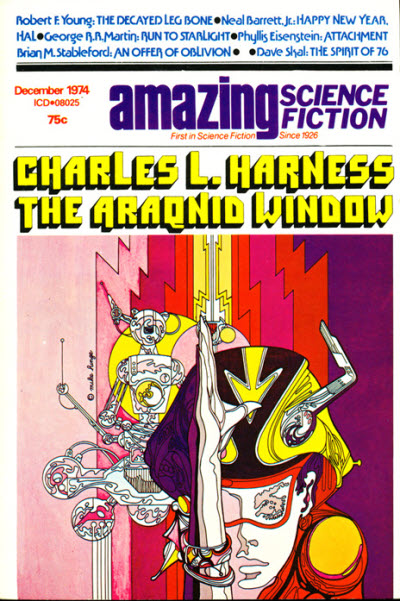
Charles L. Harness was born in 1915, in Texas, and came to writing science fiction relatively late, already being in his early thirties when his debut story, “Time Trap,” was published. He appeared sporadically in the late ’40s and early ’50s before going silent for more than a decade. It’s here that I should issue something like an apology, since the last time I reviewed a Harness story, his very weird and very enjoyable novella “The Rose,” I said that the reason Harness took a break from writing after 1953 stemmed from his difficulty in getting “The Rose” published. (It’s true enough that “The Rose” would not see print in the US for several years, first appearing in the second-rate UK magazine Authentic Science Fiction and being stranged there for over a decade.) Apparently, in one of the volumes of Orbit, Harness explained that the reason for his lapses of silence had to do with raising his family, as well as focusing on his day job, which itself proved more than lucative enough that writing for money was unnecessary. Harness had studied law and worked as a pattent attorney for over thirty years, eventually retiring in 1981. It’s no coincidence that Harness’s most productive period as a writer aside from that initial burst came in the ’80s.
Between his infrequent appearances and the fact that his style is maybe too willfully odd and unscientific (he comes off as a somewhat more literate A. E. van Vogt, or conversely like a more off-putting close contemporary with Katherine MacLean) to get mainstream traction, Harness seemed destined for the status of a cult favorite—sometimes admired but rarely read. He did live long enough to be named an Author of Distinction by the SFWA in 2004, and the same year “The Rose” garnered a Retro Hugo nomination for Best Novella. He got collect a few of the flowers due him, before dying just short of his 90th birthday in 2005. “The Araqnid Window” was published at almost the halfway point of Harness’s career, and was one of only two stories by him published in the ’70s, the other being the short novel Wolfhead. This is not what I would call major Harness, in part because of its length, but also it shows a sensitibility that would’ve been old-school even in 1974. In his introductory blurb, editor Ted White calls this story “daringly ‘old-fashioned’ science fiction,” but if anything it’s Harness’s own quirks that redeem it, as opposed to its retrograde attitude.
Placing Coordinates
First published in the December 1974 issue of Amazing Stories. It’s only been reprinted once, in the Harness collection An Ornament to His Profession.
Enhancing Image
Professor Speidel, a 70-year-old archeology teacher who’s on the eve of bein forced into retirement, is not the protagonist of this novella, but he is very important to the coming events. Speidel has two dreams as an aging digger on the brink of retirement: of finally discovering Araqnia, and of becoming famous by doing so. He’s traveled to the planet Algol, which had been discovered only a few decades prior, and if the lost city of Araqnia is to be found anywhere then it’s here. The problem is that despite historical allusions to the city, there is not even one brick of physical evidence of Araqnia having existed. Obviously it is no more, and must’ve been quite literally devoured by the sands of time for many moons; but then even with lost-and-found cities there are remnants. As Speidel explains in one of several lectures (he’s a bit of a yapper, when it comes to archeology, even despite being quite old and with a case of the common cold) during the expedition some pages later:
“Civilizations have come to an end before, of course. The Babylonians destroyed Nineveh in 612 B.C., and it never rose again. But at least the ruins are still there. Rome destroyed Carthage, but at least we know the site, and how it happened. Knossos fell beneath a combined earthquake and tidal wave. Ankor Wat has been deserted for a thousand years, but we know where the city is. The Mayan cities of the Yucatan are long deserted, but at least we know they are there, and we can see and touch the buildings and temples. Not only do we not know where Araqnia is, we don’t know why it disappeared. Was it flood? War? […] Disease? Some nasty virus such as I have?—God protect them!—It might well have been a genocidal epidemic.”
Mind you that he does not mention Pompeii, maybe the most famous case of a “dead” city that’s been fossilized, in which the unlucky denizens were smothered by volcanic ash and pyroclastic flow. Pompeii had been totally covered and seemingly forgotten about for over a thousand years, until it was rediscovered and found to be in impeccable shape, once the excavations began. This absence of mention is a bit conspicuous on Seidel’s part, but it almost certainly works as a kind of odd foreshadowing on Harness’s end, in that we’re prompted to think of Pompeii based on it not being mentioned in-story. A less subtle use of foreshadowing is how Seidel brings up his cold as a means by which intrusive settlers in North America and elsewhere unwittingly killed indigenous peoples by the dozens, as the latter group had no immunity to such innocuous illnesses. The Araqnids are presumably long dead, if they ever existed, and yet Harness nudges the reader and posits that somehow Seidel’s sickness will be made relevant. After all, why else would he bring it up multiple times?
Meanwhile we have the real protagonist in John Thorin, who majored in instrumentation and who doesn’t have much of an interest in archeology. “Even though he was majoring in instrumentation, he needed this 3-hour credit in ark. He had to finish this field trip.” Said “field trip,” of course, will end up being a life-or-death adventure for Thorin. The one upside is that he’s here with Coret, his wife, although she too will get way more than she could’ve possibly bargained for with this trip. There’s also the immediate problem of antagonism between Thorin and Speidel, since Speidel is a grouch who clearly doesn’t respect Thorin as a hanger-on while Thorin dislikes the professor’s borderline egomania and penchant for going on exhaustive tangents. Then there’s Coret, who unfortunately doesn’t have much of anything going on. I wouldn’t go so far as to say “The Araqnid Window” has a misogyny problem, since even the male characters are not that developed to begin with, but Coret very much functions as The Woman™ in the story, never mind that she ends up spending a lot of it as naked as God had made her. But then, of course, the characters are obviously not the point of all this; if anything, in keeping with the story’s “old-fashioned” leanings, the characters exist in service to the ideas Harness presents us with. This is a fun, if also rather slight, slice of adventure SF about a lost alien civilization.
There’s some more not-very-subtle foreshadowing. Speidel disparages Thorin for having brought a handgun (it even comes with a stun setting, like in Star Trek) to the expedition, but we understand on a sort of intrinsic lizard-brain level that at some point this handgun must come back around. Indeed Thorin’s gear, which it seems like he had packed too much of, will prove useful for a turn of events he could not have possibly foreseen. One day, while taking her morning bath, something happens to Coret. Thorin finds her naked and running away in a frenzy, like a decapitated chicken, with “something horrid and bristly on her back.” This, naturally, is an alien, and a chase commences. Through what was initially a mistake on his part, Thorin discovers an underground network that may lead to the lost city of Araqnia—if only he can find Coret and hopefully save her life first. Up to this point, about a third into “The Araqnid Window,” nothing that surprising had happened; if anything Harness is keen on prepping the reader for a big revelation coming. It’s not unusual to see a race of aliens, even for 1974, that lives by attaching itself to the back of a larger species, as you may be thinking of Robert Heinlein’s The Puppet Masters or (if you wanna go for a schlockier example) the creepy crawlies in The Tingler. It’s also not very inventive to have an ancient alien civilization buried under the figurative sand, as the “lost world” kind of story goes back to even before when Harness was born. It also takes a good deal of wordage to get to this point, and at about 19,000 words but with a premise more fit for 12,000 words this story could’ve benefited from a fair bit of trimming.
I can’t be too harsh, though, especially with the benefit of hindsight. Harness may not be the best when it comes to writing characters (you sort of get a hunch that he hails from a more hard-headed and less literarily inclined generation of SF writers), but what he (along with his immediate predecessor, A. E. van Vogt) has a knack for is sparking a sense of mystery and wonder. The solution to the mystery is not always sensical, but in the case of “The Araqnid Window” I think the payoff is quite good. Funnily enough, the story this reminds me of most is not anything by van Vogt, but instead P. Schuyler Miller’s “As Never Was,” one of the shiniest gems to have come out of Campbellian SF. There is the obvious connection of both being about archeology and alien artifacts, but there’s also the alarming similarity of time travel and the possibility of a stable time loop. How this relates to “The Araqnid Window” might be obvious to some, and no doubt some can see the revelation from a mile away, but I’m saving the specifics for the spoilers section. The point I wanna make here is that this story does escalate to a satisfying climax, even if it takes longer than would’ve been ideal to get there. It’s a decent, if rough, novella, coming from someone who specializes in flawed but intriguing SF.
There Be Spoilers Here
The network of tunnels Thorin pursues his wife through are such that there would be no hope of escape, if not for the equipment Thorin has on him that will orient him out of the tunnels; but these are electrically powered, and if they run out, then, well shit. Eventually he discovers a great chamber, home to a balcony and a peculiar window—you could call it the titular Araqnid window, a time viewer that looks out on the city as it was some 3,000 years ago, before the calamity. The dying alien on Coret’s back alludes to “the Death-One” and something about the window, but this is all kept vague at first. Thinking about it now, I really should’ve seen the twist with “the Death-One” coming, the being supposedly responsible for the extinction of the Araqnids. In a cruel (but arguably bittersweet) twist of irony, the one destined to bring down Araqnia and thus make the present possible is Professor Seidel—the man who, if anything, has an obsession with preserving every scrap of Araqnia he can find. In what is admittedly a convoluted turn of events, Seidel irreversibly (it’s one-way and so there’s no means of rescuing him) steps 3,000 years into the past, via the balcony area, where he will kill incalculable numbers of Araqnids with his easily treatable cold. One has to wonder what Seidel must’ve felt, once he inevitably realized he was responsible for the destruction of a race he so admired, and that it was too late, that there was nothing to be done about it. Indeed, this is how things must play out, for the good of the future. It’s a creepy realization, but there’s also a heavy dose of tragedy.
As Speidel says, and which Thorin appropriates at the end: “Archeology is a process of destruction.” Historically, archeology has been the practice of uncovering relics of the distant past, but it’s also involved destroying those same relics. Instead of using dynamite to unearth a tomb in Egypt, the destruction here takes the form of time-travel shenanigans and a wise but somewhat unraveled professor who’s at the end of his rope and who has nowhere to go, professionally speaking. It’s possible, given what he says in the first half of the novella, that Speidel is passively suicidal and thus doesn’t mind stepping 3,000 years into the past (thus becoming 3,000 years dead in Thorin’s present), but we don’t know for sure. If there’s a bright side at all, it’s that, aside from the few items the team are able to take with them, Coret had her brained filled with valuable information by the Arachnid (probably the last living Arachnid) who had taken to her parasitically. This is a bit of gosh-wow pseudo-science that would’ve probably fit more in the pages of Analog than Amazing, but whatever.
A Step Farther Out
As I’ve found is often the case when it comes to reading Amazing Stories, I have a hunch “The Araqnid Window” appeared here and not in a better-paying magazine because those editors had passed over it, maybe for it being too rough around the edges. No doubt another revision, with an emphasis on tightening the word count, would’ve helped it. Harness was not a very refined writer, but then he also cut his teeth on a writing environment (the late ’40s) where it was commonplace to turn in second- or even first-draft work and expect it to find publication somewhere. Like Seidel, who Harness may have related to in some way (both being aging men in fields that no longer see them as essential), he’s showing his age a bit. I say this as a criticism of “The Araqnid Window,” but it’s not entirely negative criticism, since the mind-bending climax succeeded in its intended effect. Even this deep into his career, Harness still had the ability to amaze, even if he wasn’t quite the same man who wrote “The Rose.”
See you next time.


 Science Fiction & Fantasy Remembrance