
Who Goes There?
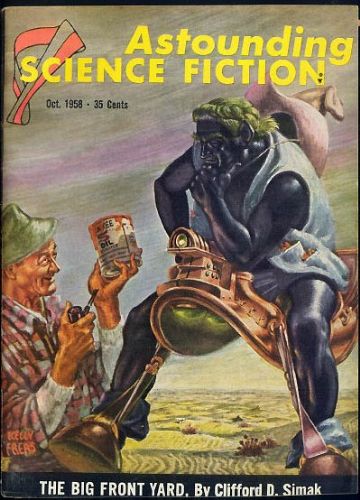
Clifford Simak had already been around for two decades when Galaxy premiered with the October 1950 issue, and this brave new magazine seemed to give the veteran writer’s career a second wind—or at the very least coincided with it. The ’50s would be a golden age for Simak (like with a lot of fellow genre writers), with the early ’50s alone seeing four novels from him (as opposed to just one in the previous twenty years combined), including his masterpiece City. Simak wrote a truly enormous amount of short fiction this decade, on top of the novels, and his outlet of choice was Galaxy. The reasons as to why Simak preferred Galaxy over the competition aren’t totally clear; it could be (I think I recall this) that he came to find John W. Campbell’s meddling to be too exhausting, although he still occasionally contributed to Astounding/Analog in the ’50s and ’60s. Simak has been sort of pigeonholed as a vaguely conservative writer, mostly due to his focusing on rural settings and peoples (that he’s a pastoralist can’t be denied), but a deeper reading of his fiction and reading the tragically few interviews we have with him show him to be a more complicated person. (We’re talking about someone who claimed to reread The Grapes of Wrath every year.) “Dusty Zebra” sounds at first like it might be a straightforward bartering-saves-the-day narrative, similar to Simak’s own “The Big Front Yard” (reviewed here), but it’s more of a humorous cautionary tale.
Also, I’m sorry that this is being posted later in the day than what would be ideal. My daily life has not been great.
Placing Coordinates
First published in the September 1954 issue of Galaxy Science Fiction, which is on the Archive. It has been reprinted in Alpha 9 (ed. Robert Silverberg) and the Simak collections The Worlds of Clifford Simak and Dusty Zebra and Other Stories.
Enhancing Image
Joe is a business-minded family man, whose son Bill happens to be even more business-minded (ripping off other schoolkids by trading junk for things with actual value), and one day while looking for stamps in his work desk he finds out something very odd: there’s a tiny dot on the desk, and if an object passes through it it goes—somewhere. Seemingly vanishes into thin air. And yet something takes its place. Joe puts random crap on the dot and gets back neat little gadgets, like a pen that also transforms into a fishing rod, and especially there’s the dust-collector, a kind of vacuum that sucks up dust and makes it disappear. Where does the dust go? Not sure. Joe encourages Bill’s schoolyard trading, so it makes sense that he would be interested in what turns out to be an trans-dimensional portal, the only problem then being that while Joe has business sense he doesn’t have technical sense; so in comes Lewis, the next door neighbor, who can explain the gadgetry and mechanics of the strange little dot. (Something you may notice about Simak is that a lot of the time his protagonists are not scientists at all, but they happen to be friends with someone who is scientifically minded and who can explain the SFnal elements of the story.) Before long Joe and Lewis form a business partnership around the trading, complete with a deliberately convoluted contract, and of course Joe tries to lessen Lewis’s share at every opportunity. Simak protagonists are often well-meaning, but they can also at times fall on the anti-hero end of the spectrum, which Joe very much is; not that he’s evil or anything, but he’s a capitalist at heart, maybe a little less human than the average Simak protagonist.
The recurring trade-off throughout the stories is that for some reason the person (called “the Trader”) on the other side of the portal really likes these cheap zebra bracelets that Joe happened to have, and in return for this seemingly useless trinket the humans get a dust-collector in return. The humans find that they can trade in the useless garbage for some pretty useful items, which can then be turned for a profit. We never do learn where the dot came from, who’s responsible for it, or even what the Trader looks like. This is all rather inexplicable, although there’s just enough scientific mumbo jumbo thrown in to keep this away from being fantasy. A lot of Simak’s stories can be thought of less as hard-nosed SF and more like machine fables, in which technology figures into the setting and moral of the story, but the actual plausibility of the tech is a distant second. The dot-as-portal is ridiculous, and also this seems like a very easy way to send over a deadly weapon, or an object that could carry diseases. If we’re to take the Trader as an alien, though, it makes sense that such a figure would be more or less benign in Simak’s book. I often think of Simak as an anti-Lovecraft figure, in that when Simak characters encounter the unknown it’s very rare for the unknown to pose a serious threat. Simak’s aliens, including the Trader, are often curious creatures who can be reasoned with on some level, such as, for instance, bartering being the common ground between humanity and the aliens in “The Big Front Yard.” I assumed “Dusty Zebra” would be a similarly straightforward first-contact story in which bartering is shown as a force for good; and while the bartering itself turns out to be fine, the get-rich-quick scheme Joe and Lewis concoct will have consequences neither of them would’ve wanted or expected.
So about the zebra bracelets. How do the humans and the Trader, well, trade? How do they understand each other? Short answer is, they don’t—at least not beyond a picture book language that even a toddler can understand; but this rudimentary language turns out to be just enough. Joe and company get the bright idea to use one of Bill’s picture books (one showing items as standing in for letters of the alphabet, so A is for apple, etc.) to show the Trader what they have for inventory, and the Trader sends the book back with the desired item marked. One problem: they forgot (or didn’t notice) that the item on the Z page is a zebra—and the Trader wants one of those. Now you may be thinking, that’s a whole-ass animal. Where you would even get one for sale? But as Joe says, after taking some “advice” from Bill, “[The Trader] doesn’t know a zebra is an animal, or, if he does, how big it is!” This is of course an example of ripping someone in a deal off, but as Joe rationalizes, if the Trader can’t tell the difference then what harm is being done? “If the Trader had any qualms about what was happening, he gave no sign of it. He seemed perfectly happy to send us dust collectors so long as we sent him zebras.” This is a partnership that seems to be working, for now. A certain question does linger, though: Where does all the dust that the dust-collectors pick up go? Conceivably it has to go somewhere, and the Trader doesn’t seem to be getting the dust back…
There Be Spoilers Here
Our Anti-Heroes™ have been making a killing on the gadgets, only the problem is that they can’t figure out how to reverse engineer them so as to manufacture them themselves. To really make a killing on the dust-collectors you would need at least a few thousand, but how would you get them? The Trader apparently wants more zebra bracelet charms in exchange for the dust-collectors, and those charms have since been discontinued. In what is admittedly a far-fetched turn of events Joe (this is after making a great deal of money) is able to make a deal with the charm manufacturer, and soon enough the house gets filled with literally thousands of the damn things. The good news is that they get more dust-collectors! In fact too many of them. So, there seems to be a third party in this, or so Joe suspects: clearly the dust must be going somewhere, and in the last stretch of the story it all comes back—pounds of the stuff across multiple households. Joe’s house alone gets filled with dust that seems to have come from another dimension, but maybe not the Trader’s. Then the dot vanishes. We never do find out why the Trader cuts off communication or what he could be doing with all those zebra charms. Maybe he (or they) realized he had gotten ripped off and decided some payback was needed. Or maybe there’s another dimension all the dust goes to and they didn’t like that very much. Point being that a combination of lawsuits and being unable to replicate the gadgets brings Joe and company pretty much back to square one by the end. I like how there’s some mystery retained with the Trader by the end, so that not only did the humans pay for their profit-seeking but that they’re also left wondering what could be going on in those other dimensions.
A Step Farther Out
In a way this is minor Simak, in that it doesn’t take itself very seriously. It’s also not very SFnal, indeed bordering on fantasy—possibly even cosmic horror. Or rather cosmic humor. It’s a story about some entertaining if also unlikable people who think they can get something with minimal effort and reap the benefits. Had this been a Henry Kuttner or C. M. Kornbluth story the ending would’ve been much more unforgiving towards the humans, but ultimately it was written to be in good fun. Simak is not dead-serious that often, but just because he tends to be on the lighthearted (or at least forgiving) side doesn’t mean he can’t make a solid point. I actually think we still don’t give him enough credit.
See you next time.


 Science Fiction & Fantasy Remembrance