(Cover by Frank Kelly Freas. Satellite, December 1956.)
Merry Christmas, happy birthday to me, and all that.
People who keep up with my posts may have noticed that I missed a couple things last month, including what was to be the start of the second serialized novel, Kuttner and Moore’s Fury. Let’s say I’ve been slow about it. Generally I’ve been slower about keeping up with this blog than I was a year ago, and there could be a few reasons for this, but the point is that I’ve come to understand I’m not as on top of my own blog as I once was. I’ve slowed down with the “required” reading, and I’ve been slower about writing, although (not to toot my own horn) I still write here more than some other fan writers I know. Maybe nowadays the load I give myself is just a bit too much, especially since I’ve also been wanting to get into writing professionally, for that bit of extra money, only I’ve not been able to find the time and/or motivation for it. So, I’ll lighten the load a bit. From now on I’ll only be covering one serial a month, regardless of length. Of course, if the serial is four parts or longer this won’t make a difference, but a lot of serials are three-parters, which should give me an extra day to myself. Other than that, it’s gonna be business as usual.
What do we have on our table? All science fiction, which isn’t very diverse, but when these stories were published is certainly more diverse. One story from the 1940s, one from the ’50s, one from the ’60s, one from the ’70s, one from the 2000s, and one from the 2020s.
For the serial:
Fury by Henry Kuttner and C. L. Moore. Serialized in Astounding Science Fiction, May to July 1947. Kuttner and Moore wrote so much, both together and each solo, that they resorted to a few pseudonyms, one of them being Lawrence O’Donnell. Fury takes place in the same universe as the earlier Kuttner-Moore story “Clash by Night.” Despite Fury historically being credited to Kuttner alone, Moore claimed years later to having been a minor collaborator.
For the novellas:
“Welcome to Olympus, Mr. Hearst” by Kage Baker. From the October-November 2003 issue of Asimov’s Science Fiction. Baker had spent much of her adult life working in insurance and with theatre as her primary hobby, before pivoting to writing SF in her forties. No doubt she would still be writing SF today, had she not died all too soon in 2010. Still, for about a dozen years she wrote furiously, with her big series following a team of time-traveling secret agents.
“The Dragon Masters” by Jack Vance. From the August 1962 issue of Galaxy Science Fiction. Winner of the Hugo for Best Short Fiction. This is a reread, although I only have a vague memory of having read it in the first place, and that was without Jack Gaughan’s accompanying artwork. Despite what the title might make you think, “The Dragon Masters” is pure planetary SF, albeit with fantasy-esque coloring that Vance had become known for at this point.
For the short stories:
“An Important Failure” by Rebecca Campbell. From the August 2020 issue of Clarkesworld. Winner of the Theodore Sturgeon Memorial Award. Born and raised in Canada but now living in the UK, Campbell has written only one novel so far, which in fact was her first SF writing of any sort. Good news is she’s been somewhat prolific in writing short stories and novellas over the past decade.
“The Earth Dwellers” by Nancy Kress. From the December 1976 issue of Galaxy Science Fiction. This is the third time now that I’ve come to Kress, and why not? Her career now spands nearly half a century, and her stories, if not always entertaining, often provide some food for thought. I know nothing about “The Earth Dwellers,” except it marked Kress’s very first appearance in the field.
For the complete novel:
A Glass of Darkness by Philip K. Dick. From the December 1956 issue of Satellite Science Fiction. This book sounds unfamiliar, even for seasoned Dick fans, although it may ring a bell under its book title: The Cosmic Puppets. Dick had burst onto the scene in the early ’50s as one of the most promising short-story writers at the time, in a generation that included such bright newcomers as Robert Sheckley, Algis Budrys, and Katherine MacLean. It only stood to reason, then, that while writing short stories nonstop was all well and good, writing a novel was the logical next step. A Glass of Darkness wasn’t the first novel Dick wrote, but it was the first to be published.
(Cover by H. R. Van Dongen. Astounding, November 1955.)
So I had read Anne McCaffrey’s “The Weather on Welladays,” and I didn’t like it. I’ve read Dragonflight and The Ship Who Sang, plus one other novel and a few short stories now, and I’m still not really sure what McCaffrey’s appeal is (I say this as someone who jumps to defend A. E. van Vogt’s early work). “The Weather on Welladay” isn’t bad, but it’s seriously hampered by being a novelette where the perspective shifts several times so that we have a few protagonists, when ideally we should have only one. I also just don’t think McCaffrey is that good a writer when compared with some of her peers, who were (and still are) not as popular. It’s nice that McCaffrey was the first woman to win both a Hugo and Nebula for fiction, but I wish those honors had gone to better writers. That’s the gist of how I felt about it, in case you’re wondering where my review post for it is.
The funny thing is that I had too good a time during the couple of days I normally would’ve spent on reading and writing for this site, which is ironic. I struggle to write here either when my personal life is at a peak or when it’s deep in a valley. I have to admit to you, the five of you who actually read these posts, that I sometimes resent writing—well, really anything, but especially for SFF Remembrance. Sometimes I just don’t feel like writing anything, but the problem is that if you stop writing then it can be a real challenge to start again. Writing (if you’re “a writer”) is like brushing your teeth, in that ideally it should be a daily activity. But I also don’t like writing that much; yet at the same time I can barely do anything else that would be considered “productive.” I work a service job. I pay my bills and my rent and my taxes like a “good American,” but I feel like I don’t create anything. I have this urge, or maybe this sense of obligation, to create something that is of any value, but I can’t do it. I hate myself and this country I am forced to live in. The environment is hostile, for creativity but also just for human decency. It’s like that Godspeed You! Black Emperor song: “We are trapped in the belly of this horrible machine, and the machine is bleeding to death.” I hate being here, and yet I’m not sure where I could be that’s better. I hate that this is a culture that worships money and productivity. We must have infinite growth, even if the destination is oblivion.
Putting aside that I’m forced to live in this body, and in this third-rate backwater country called America, things are going well for me! Maybe that’s the problem: on a personal I’m doing well, for the most part, but I get the sense that this contentedness will not last, because the world around me is dying. My surroundings are transient. There will surely come a point where the workers of the world will have their revenge and the last politician is strangled with the entrails of the last capitalist; but I’m convinced that I will not live to see any of this happen. Not even the beginning of it. I will have made my way for the exit before this play called The Downfall of Capitalism will have even gotten to its prelude. The curtains will not have risen and we will not see the stage, let alone the actors. There is a future on the way, but something tells me I won’t take part in it.
…
This is getting to be a bit much.
What’s the holdup? After all, it’s a packed month, as far as my review schedule goes, and I’ve really been meaning to get to some of these works for a hot minute. I’m also taking advantage of the loophole I had made for myself and so I have a serial from Galaxy, on top of a novella. We’ve got one story from the 1920s, one from the 1940s, one from the 1950s, one from the 1960s, one from the 1970s, one from the 1980s, and one from the 2010s. This might be my most diverse roster yet, in terms of when the works were published. Well, let’s get to it.
For the serials:
A Time of Changes by Robert Silverberg. Serialized in Galaxy Science Fiction, March to May-June 1971. Nebula winner for Best Novel. When Galaxy changed editors in 1969, readers at the time as well as historians are prone to say the change was a downgrade. One major plus, however, of Ejler Jakobsson taking over was that we got several Silverberg novels in the magazine as serials in rather quick succession. Despite the acclaim he was earning, A Time of Changes was the only Silverberg novel from this period to win a major award.
Under Pressure by Frank Herbert. Serialized in Astounding Science Fiction, November 1955 to January 1956. Also titled The Dragon in the Sea, this was Herbert’s first novel, after he had been in the field for a few years already with now-forgotten short fiction. Herbert’s legacy pretty much solely rests on his Dune series, to the point where it might surprise the reader to find any Herbert that isn’t Dune-related in the wild. I’ve heard from a friend or two that this is actually supposed to be one of Herbert’s best, but we’ll see about that.
For the novellas:
“The Lady Who Plucked Red Flowers Beneath the Queen’s Window” by Rachel Swirsky. From the Summer 2010 issue of Subterranean Online. Nebula winner for Best Novella. More controversially Swirsky also won a Nebula for her story “If You Were a Dinosaur, My Love.” She was also the founding editor of PodCastle, which is crazy to me because she was like, 26? She’s written a good deal of short fiction and poetry over the years, plus one novel so far.
“A Tragedy of Errors” by Poul Anderson. From the February 1968 issue of Galaxy Science Fiction. It’s been a minute since we last covered Anderson, made more conspicuous because he wrote a truly staggering amount of fiction. Of Anderson’s several series the most ambitious might be his Technic History, a centuries-spanning saga tracing the rise and fall of a galactic empire. “A Tragedy of Errors” takes place toward the end of this future history’s timeline.
For the short stories:
“The Storm King” by Joan D. Vinge. From the April 1980 issue of Asimov’s Science Fiction. Not quite as well-known as her late ex-husband, Vernor, partly on account of the fact that she hasn’t written much over the past four decades, but Joan D. Vinge was one of the most promising new writers of the post-New Wave era. She’s more known for her SF, but “The Storm King” is fantasy.
“The Woman of the Wood” by A. Merritt. From the August 1926 issue of Weird Tales. In the ’20s and ’30s Merritt was one of the most popular pulp writers, even getting a magazine named after him. I was set to review one of Merritt’s novels a couple years ago, but I could not get far into it. Well, now it’s time to correct things a bit. Curiously Merritt didn’t write much short fiction.
For the complete novel:
The Sorcerer’s Ship by Hannes Bok. From the December 1942 issue of Unknown. Bok was known far more for his artwork than his fiction, which is understandable given that he was one of the most gifted and recognizable SFF artists of the ’40s and ’50s. You kinda know a certain magazine or book cover is a Bok work just from looking at it. That Bok died relatively young and in poverty, after having all but retired from illustrating, is tragic. Of course, we might not even know about Bok in the first place if not for Ray Bradbury acting as cheerleader for his early material. Bok was really one of the few mavericks of SFF from that era, being a semi-closeted gay man with some niche hobbies, who was also a perfectionist when it came to his art. The Sorcerer’s Ship was Bok’s debut novel and was published complete in Unknown, but would not see book publication until after his death.
At the beginning of the year I said that I would be covering one short story or novella from Galaxy each month—but I said nothing about serials. The truth is that Galaxy was, alongside Astounding/Analog, the most consistent market for serialized novels and novellas at the time, so it would feel wrong to never acknowledge that part of the magazine’s history. As such we’re getting a novella and a serial from Galaxy this month; that they’re both from authors I admire probably helps.
Last month I covered a horror story by the crime/mystery author Dorothy Salisbury Davis, which gave me the idea of finding more SFF by people who normally write crime/mystery, which while also a genre that has a history in pulp magazines, is “realistic” fiction rather than SFF. One curiosity that struck me ever since I saw it years ago was the fantasy story “The Bronze Door” by Raymond Chandler, which marked one of only two times he appeared in an SFF magazine. Someone who wrote a good deal more SFF than Chandler would be John D. MacDonald, who wrote prolifically for the genre magazines in the late ’40s and early ’50s before shifting to crime fiction and making a killing on that. So for this month’s complete novel we’ve got the early MacDonald novel Wine of the Dreamers. Rounding out the novel-length stuff is a relatively obscure standalone SF novel by Roger Zelazny, who nowadays is more known for his fantasy.
For the women we have two people who are a few generations apart and coming from different continents, but who still, each in her own way, have come to write science fiction. Kate Wilhelm is actually a bit hard to find in magazines after the late ’60s, once she found her voice as a writer, but the September 2001 issue of F&SF was a special issue dedicated to Wilhelm, complete with a new novella. As for the Greek writer Eugenia Triantafyllou, I picked just about the newest story I reasonably could’ve (an unofficial rule of mine is that a story must be at least a year old for me to consider it for review), with “Loneliness Universe” being a finalist in this year’s Hugos. I’m voting in the Hugos, by the way.
That makes one story from the 1930s, two from the 1950s, two from the 1970s, one from the 2000s, and one from the 2020s.
For the serial:
The Dream Millennium by James White. Serialized in Galaxy Science Fiction, October to December 1973. I’ve been meaning to read more James White, and thankfully several of his novels first appeared as serials. White first appeared in the UK, in New Worlds, before eventually finding some success in the US as well. Along with Bob Shaw he was one of the few Irish SF writers to appear regularly on both sides of the Atlantic back in those days.
Doorways in the Sand by Roger Zelazny. Serialized in Analog Science Fiction, June to August 1975. Zelazny is one of the most influential SFF writers of all time, his mark being apparent on the likes of George R. R. Martin and (God help us) Neil Gaiman; and yet despite a couple generations of writers (especially those of fantasy) owing a debt to Zelazny, much of his work remains obscure or simply out of print, including this standalone novel.
For the novellas:
“Yesterday’s Tomorrows” by Kate Wilhelm. From the September 2001 issue of The Magazine of Fantasy and Science Fiction. It’s easy to forget this, but Wilhelm started in the ’50s, only that she flew under the radar for about a decade. Like a caterpillar turning into a butterfly, though, Wilhelm seemed to metamorphize almost overnight into one of the most acclaimed SF authors from the late ’60s until her death in 2018. She was married to Damon Knight.
“The Other Man” by Theodore Sturgeon. From the September 1956 issue of Galaxy Science Fiction. Sturgeon is one of my favorite authors, especially of short fiction. Sturgeon had started to write professionally with “mainstream” fiction, although this went nowhere and he quickly pivoted to SFF, much to our benefit. His productivity was peaks and valleys so that he was writing either a lot or nothing at all. He was most consistently productive in the ’50s.
For the short stories:
“Loneliness Universe” by Eugenia Triantafyllou. From the May-June 2024 issue of Uncanny Magazine. Hugo and Nebula nominee for Best Novelette. Triantafyllou was born and raised in Greece, and continues to live abroad, but writes her fiction in English. She made her debut back in 2017, and has yet to write her first novel, although maybe she just much prefers writing short fiction.
“The Bronze Door” by Raymond Chandler. From the November 1939 issue of Unknown. Possibly the most acclaimed crime writer of the 20th century, seriously only rivaled by Agatha Christie, Chandler’s known for his series of novels starring Philip Marlowe. Chandler famously didn’t start writing crime fiction until he was in his forties, and didn’t write his first novel until he was pushing fifty.
For the complete novel:
Wine of the Dreamers by John D. MacDonald. From the May 1950 issue of Startling Stories. Fans of crime fiction would know MacDonald for his prolific (21 novels over a span of as many years) Travis McGee series, as well as the standalone novel Cape Fear (first titled The Executioners, but then retitled after the 1962 film adaptation), but he also wrote a good deal of science fiction in the late ’40s and early ’50s. It’s not unusual for authors to cut their teeth on working with one genre before moving to greener pastures, so that much like how Elmore Leonard started with Westerns before moving to crime fiction, the same happened with MacDonald. Wine of the Dreamers was either MacDonald’s first or second novel, it’s hard to say.
This is it, the last post of the year, and also the last entry in my year-long tribute to that classiest of genre magazines: F&SF. I felt it only fitting to tackle a work by someone who was a long-time contributor to F&SF, and also from what I can tell this might be the only “complete novel” ever published in the magazine, all the others being serials. Algis Budrys enjoyed a long and productive life, and even got his start in the field early, being barely out of his teens when his first story was published in 1952. He was born in 1931 to Lithuanian parents, in what was then East Prussia, which later became German and then Russian territory. The family moved to the US when Budrys was five years old, and he spent some of his childhood in New Jersey (my home state), which no doubt played a part in the setting of today’s story. English was presumably his second language, which didn’t stop him from picking up the pen at a very young age and proving himself, over the course of just a few years, to be one of the finest wordsmiths in ’50s SF (for however much that’s worth). By the time he turned thirty he had already written such acclaimed novels as Who? and Rogue Moon, which, while flawed, are some of the most philosophically demanding reads of the pre-New Wave era, gaining him a reputation as a writer’s writer.
By past the early ’60s, Budrys’s output went down considerably, to the point where after that decade he would write only two novels: Michaelmas in 1977 and Hard Landing in 1992. While he wrote little short fiction, he kept busy and stayed a presence in the field in other ways, namely as critic and editor. He at first did the review collumn for Galaxy, before moving to F&SF, where he would stay for about 15 years. Also, around the same time Hard Landing was published, he staerted editing the ambitious semi-pro magazine Tomorrow Speculative Fiction. More controversially he was also a judge for the Scientology-backed Writers of the Future contest, and a long-time editor of the annual anthologies that organization put togehter, although Brudrys was not himself a Scientologist. Hard Landing was not the last work of fiction of his published in his lifetime, but it feels like a farewell to something, on top of being Budrys’s most formally complex novel, even if at about 45,000 words it barely counts as a novel.
Placing Coordinates
While its publication date is sometimes given as 1993, Hard Landing was first published in the October-November 1992 issue of The Magazine of Fantasy and Science Fiction. Unless Kristine Kathryn Rusch was lying or mistaken, this version is “the entire text” of the novel. The only way you can get it in-print is from Gollancz, either as an ebook or as part of a paperback omnibus with The Iron Thorn and Michaelmas.
Enhancing Image
We open with a document delving into the accidental death of a mysterious man, one by the name of Nelville Sealman, who got electrocuted at a railway station. To make a long story short, Sealman is one step short of being a John Doe, as his documentation turns out to be forged: he seemed to have borrowed the name of another Nelville Sealman, who had died in infancy in 1932, and he has no friends or next of kin. Nobody came to identify him. Authorities would only have the foggiest notion of who he was based on what he had on his person, which is not much. Doing some basic math tells us the story, at least at the time of Sealman’s death, is set in 1975. Of course, Sealman is not really Sealman, nor is he even a human being, but a humanoid alien named Selmon, who had crash-landed on Earth, in New Jersey, in the late 1940s, along with four others of his kind, although one of them had died from his injuries shortly after the landing. The deceased’s alien idenity is only made clear once an autopsy is performed and the National Registry of Pathological Anomalies (NRPA) enters the picture. Think The X-Files, which is funny because Hard Landing‘s magazine publication preceded that show’s premiere by mere months. Speaking of funny things, there’s a local pathologist named Albert Camus, which must be awkward for him since I assume the famous French writer was still a thing in this novel’s universe. (How come you never meet anyone named Abe Lincoln?) There’s also a certain Dr. William Henshaw, who appears to be a minor character at first but who will figure majorly into the plot.
The plot, such as it is, is not really the novel’s focus, for there isn’t much of a linear beat-by-beat plot but rather a Cerberus or hydra of plot threads, which happen in tandem with each other and which all sprout from the same seed. The “hard landing” of the novel’s title would have far-reaching ramifications, not least for the four (then three) survivors, especially Arvan (human name Jack Mullica) and Ravashan, with the third, Eikmo, mostly staying off-screen to do whatever business he does. Budrys ignores Eikmo, or rather refrains from giving us his perspective, for pretty much the entire novel; but this turns out to be quite deliberate rather than an oversight. As for Mullica (I’m calling him that for the rest of the review) and Ravashan, they serve as dual protagonists, being the two perspectives we shift to the most frequently. I say “the two perspectives” because despite this novel’s brevity, there’s a surprising number of those, including a fictionalized version of Brudrys himself. The, I guess you could say “gimmick” with Hard Landing is that it’s framed as a mix of fiction and non-fiction, between first-person accounts, documents, and interview recordings. It’s also not always clear who the POV character is, such that much of one’s effort when reading this novel goes into putting the pieces together—and of course these narrators are not always reliable. On paper there’s little (aside from some salty language) that would not be able to see print in, say, the years when Budrys was in his prime as a fiction writer (the ’50s and pre-New Wave ’60s), but the way in which Budrys goes about telling his story is decidedly postmodern.
Mullica and Selmon meet in 1975, in which the latter really does die in a railway accident. The rest of the novel mostly recounts how we got to this point, with the two main perspectives because Mullica’s and Ravashan. We find out early on that Mullica, despite being an alien, had gotten married a while back—he and Eikmo both, “Eikmo and his fish-store lady,” although Selmon and Ravashan remain bachelors. Mullica and Ravashan are like the plot threads of this novel in that despite starting at the same place (the crashed ship), they go in very different directions. One thing that stands out obviously with Hard Landing, and which people (on the rare occasion that anyone talks about this novel, for despite getting a Locus poll spot and Nebula nomination it’s quite obscure) are a little too quick to point out, is that it’s a dramatization of the immigrant experience—specifically the white European immigrant experience in the first half of the 20th century. Mullica and company are of course not of white European ancestry, but they pass for white, and Margery (Mullica’s wife) even mistakes him for a Soviet defector when they first meet. That Mullica and the others have rather unusual “equipment” on the inside (which does become plot-relevant) is beside the point. If readers nowadays seem indifferent to Hard Landing, or those few who read it in the first place, it’s because of two things: that Budrys’s use of multiple narrators is a smokescreen for what is really a simple and ultimately old-fashioned narrative (even in 1992 the idea of aliens landing and mixing in with everyday humans was not new), and I would also say the more unfair sentiment that the narrative of the continental European immigrant in America is no longer relevant.
There’s much debate as to how autobiographical a work of fiction can be. The idea that the author or creator puts at least a bit of themself into their work is in itself a relatively new one, in terms of understanding art, so it stands to reason that, for instance, when we read Hamlet or Macbeth we’re peeking into the mind of an Englishman who’s now been dead for over 400 years. But then there are authors who unabashedly project themselves onto their work, sometimes brazenly, to such an extent that the work really does become semi-autobiographical. Philip Roth basically made a career out of blurring the line between his real life and the lives of his main characters; there’s even a fictionalized version of himself in a few of his novels, most famously The Plot Against America. Even in the realm of genre SF there was a precedent for fiction-as-autobiography when Budrys wrote his final novel, namely with the case of Philip K. Dick. I decided to find out for myself, and Budrys had indeed reviewed Dick’s famously (or infamously) loopy novel-tract hybrid VALIS, for F&SF, although I was disappoint to find that he had very little to say about the novel as a reflection of what was clearly Dick’s mental illness and his attempt to cope with his condition. Maybe it was something one could not say in a book review that presumably thousands of people would read, including possibly Dick himself. But, whether he was genuine about it or not, Budrys’s assumption that VALIS was an attempt on Dick’s part to form a new Gnostic Christian sect was a tragic misreading of that book. Similarly it would be a tragic mistake to overlook that with his final novel, Budrys, as the son of immigrants, was writing about what it was like to be assimilated into American culture.
Mullica strives and eventually succeeds at basically living a normal life, albeit with a brush or two with low-level crime thanks to Margery’s brother (there’s the implication he runs drugs or dirty money, but not much comes with it, maybe intentionally on Budrys’s part), while Ravashan’s path is a lot more… let’s say ambitious. He gets involved with the US military and even starts to work for an unnamed and amoral congressman he calls “Yankee,” and he even founds NRPA. Yes, the department that investigates alien sightings and other anomalous activities was started by an alien. It’s called irony. Ravashan also believes he won’t be able to consult a physician for his problem, on account of keeping his alien nature a secret, so he gets the bright idea to see a veterinarian instead—who happens to be Henshaw. One of my quibbles with this novel is that its brevity and economy of words work as much against it as for it, particularly with character relationships. There’s quite a bit you could do with Ravashan and Henshaw’s interactions, but Budrys doesn’t do as much as he could’ve. Think about it: Ravashan, who by the back end of the novel has become unspeakably powerful, albeit preferring to work behind the scenes, is able to hide the fact that he is not technically a white man—that is to say he’s able to pass as a white man. But Henshaw is black. I bring this up now because Budrys brings it up. Henshaw is a well-educated black man, and is indeed the only POC in a cast of lily-white folks. On paper he’s potentially the most interesting character in the novel, but, perhaps because he feared he would screw things up, Budrys makes only step above minimal use of him. This is especially a shame because it turns out that Henshaw is one of the narrators, although this is not revealed until late. Hard Landing suffers, if anything, by being too short.
There Be Spoilers Here
It’s implied that Ravashan has contracted AIDS, at a time when the Reagan administration had not yet made it publicly known, which is how he goes out. In the strangest and maybe most provocative scene in the novel Ravashan pulls an As I Lay Dying and tells us the scene of his own death, and Henshaw subsequently burning his body so as not to leave evidence of an alien having lived on Earth. How this could be relayed to us is mysterious at first, but later we find that Henshaw has tried to write a novel based on his experiences with Ravashan and NRPA, although he’s not able to finish it. Murrica, depending on how you look at it, is not as lucky. Remember Eikmo? He’s back. He apparently got news of Selmon’s death and assumed the worst, because he tracks down Mullica to his home and thinks he had killed their mutual friend. After an altercation, both are dead, Mullica killed by Eikmo and Eikmo in turn killed by an enraged Margery. And then there were none. The scene plays like a fucking tragic play, although the exact facts of the exchange are called into question. The reality is that there is no objective viewpoint, and at the very end of the novel Budrys perhaps overplays his hand by his fictionalized self saying: “In fact, I could have made up the whole thing, couldn’t I?” Either he has a moment of doubt about whether his readers got the message or he’s mocking the obviousness of the narrator (or narrators) being unreliable. The latter is more likely, but either way I’m not a fan of the very end of this novel.
A Step Farther Out
That’s it, my last review of the year. I’ve come to realize that my ability to deliver reviews on time has been slipping as of late; partly this is because when I write, I write a lot, which takes time. I’m also quite lazy. I had finished reading Hard Landing almost a week ago but did not start working on my review until yesterday. I do, however, have a fun announcement to make in my forecast post tomorrow. Stay tuned.
Not much to update on for this month, although I did decide to shake things up for slightly for what I’ll be covering. See, for a while I was gonna do a whole tribute month for Clifford Simak, like I did for Fritz Leiber almost two years ago; but truth be told I’m not sure if I’ll do a whole month of reviews for one author like that again. It can be fatiguing to read a ton from one author, even one as diverse in his output as Leiber; and I can tell you Simak is not as diverse. I do have a compromise, though, since it’s gonna be the man’s 120th birthday in two days and I wanted to do something special. So instead of one Simak story we’re getting two. Not only that, but I’m making an exception for my “one story per magazine a month” rule (excepting F&SF this year, as you know) so as to pick two Simak stories from the pages of Galaxy Science Fiction. Simak was such a prolific contributor to Galaxy that I feel it’s only right to double dip here.
Another quirky choice I decided to pull was this month’s complete novel, which is not only a certified classic of “literary” fiction but a fantasy novel that people tend to not think of as such. Whether The Man Who Was Thursday “really” counts as fantasy was a point of contention even when it was printed in Famous Fantastic Mysteries, with people in the letters column loving the novel but questioning its fantasy credentials. But fuck you, I’m counting it. Aside from Simak we have a fairly diverse roster of writers, none of whom I’ve previously covered on here. We also have a few stories I would consider appropriate for summer reading, in that they take place in warm climates and/or involve aquatic life.
Let’s see here…
For the novellas:
“No Life of Their Own” by Clifford D. Simak. From the August 1959 issue of Galaxy Science Fiction. For the story I picked to cover on Simak’s birthday I figured I may as well pick a story that also had an August release date. When Simak restarted his writing career in the late ’30s he would be a regular at Astounding Science Fiction for the next decade, but in the ’50s it quickly became apparent Galaxy would be his new go-to outlet. Incidentally the ’50s also saw Simak’s most prolific period as a short fiction writer.
“Surfacing” by Walter Jon Williams. From the April 1988 issue of Asimov’s Science Fiction. Williams had started out as a “mainstream” writer in the early ’80s, but by the latter half of that decade he had moved to writing SF. His rise to prominence happened to coincide with the cyberpunk movement. Bit of a funny story: this is a semi-reread for me, since I got about halfway through “Surfacing” a year or so ago, but due to circumstances outside of my control I wasn’t able to finish it at the time. I’m correcting that now.
For the short stories:
“Retrograde Summer” by John Varley. From the February 1975 issue of The Magazine of Fantasy and Science Fiction. Varley debuted in 1974 and within just a couple years rose as arguably the most imaginative and exhilarating new writer in the field. His Eight Worlds stories especially (of which “Retrograde Summer” is one) pointed towards a writer who was a breath of fresh air at the time.
“The Voices of Time” by J. G. Ballard. From the October 1960 issue of New Worlds. Ballard would later see mainstream recognition, of a sort, with his highly controversial novel Crash and the semi-autobiographical Empire of the Sun. In the ’60s, however, Ballard was known as one of the quintessential figures in the New Wave. This story is an example of early Ballard, from before the New Wave.
“The Evening and the Morning and the Night” by Octavia E. Butler. From the May 1987 issue of Omni. Butler was a respected author in her lifetime, winning multiple awards, but her reputation seems to have gotten a second wind in the years following her death. She was a somewhat prolific novelist, but she wrote very few short stories—which didn’t mean there was a dip in quality.
“Dusty Zebra” by Clifford D. Simak. From the September 1954 issue of Galaxy Science Fiction. Simak had been with Galaxy from literally that magazine’s first issue, with the serialization of his novel Time Quarry (or Time and Again), and from there he was a constant presence. Given the subject matter, “Dusty Zebra” may or may not be a precursor to Simak’s more famous “The Big Front Yard.”
“The Year Without Sunshine” by Naomi Kritzer. From the November-December 2023 issue of Uncanny Magazine. Kritzer has been around for a while—actually way longer than you’d think, considering she only started getting real awards attention in the 2010s. This story here just won the Nebula, and is currently a finalist for the Hugo, making it the most recent story I’ll have covered.
“There Used to Be Olive Trees” by Rich Larson. From the January-February 2017 issue of The Magazine of Fantasy and Science Fiction. I remember reading a few Larson stories in the past and assuming he was older than he really was, which says something about his skill. Larson made his debut in the early 2010s while still a teenager, and has been writing at a mile a minute ever since.
For the complete novel:
The Man Who Was Thursday by G. K. Chesterton. From the March 1944 issue of Famous Fantastic Mysteries. First published in 1908. This is kind of a treat for myself, since not only is this a reread but The Man Who Was Thursday is also one of my favorite novels. Chesterton is known for his Father Brown detective series, and for being a celebrated Catholic apologist; but before his conversion he wrote one of the pioneering (and still one of the weirdest) espionage novels with this month’s pick. Interestingly this seems to be one of the rare cases of a “complete” novel in FFM actually being unabridged, the only omission being a poem at the beginning dedicated to a friend of Chesterson’s which is not part of the novel itself.
Not much to say with regards to updates here, other than I’m looking into a tutoring gig and I seem to be starting a polycule, the latter of which I’ve heard is kinda like starting a rock band. If anyone wants to join, please let me know. There are no gimmicks for this month’s review forecast, except that we have a complete novel on our hands for the first time in what feels like forever, and we’ve got a few familiar faces returning to the site. I may have also intentionally picked Lucius Shepard and Aliette de Bodard stories with similar titles. One thing I’ve been thinking about that I’ve decided to act on is reviewing more reprints of classic stories; one every couple months seems like a good deal. The reason for this is at least twofold: I have a soft spot for the classics, but I also wanna cover authors from the pre-pulp years who contributed to genre fiction. This month I’ll be reviewing an SF story by Jack London, who is not known primarily for his SF but who indeed wrote a lot of it. Once again Jack Vance will be providing the novel, which is unsurprising since quite a few of his novels first appeared in magazines, either as serials or all in one piece like this month’s novel.
Don’t wanna keep you long; just letting you know we have another month packed with fiction that looks to be at least interesting, although it’s mostly SF with a couple fantasy stories thrown in.
For the novellas:
“Birthright” by April Smith. From the August 1955 issue of If. Smith sadly is one of many women who wrote SF in the pre-New Wave days whom we know basically nothing about. We don’t know when she was born or when she died. She’s a ghost. She has one solo story, “Birthright,” to her credit, plus one collaboration. ISFDB classifies this story as a novelette, but running the Project Gutenberg text through a word processor shows it’s just over 17,500 words.
“Polyphemus” by Michael Shea. From the August 1981 issue of The Magazine of Fantasy and Science Fiction. Shea had a varied career, lasting from the ’70s until his death in 2014. His work ran the gamut from SF to high fantasy to the Cthulhu Mythos. He won the World Fantasy Award multiple times for his fantasy and horror. His most famous story, “The Autopsy,” is an SF-horror hybrid, and “Polyphemus” looks to be a similar blend of the two genres.
For the short stories:
“The Shadow and the Flash” by Jack London. From the June 1948 issue of Famous Fantastic Mysteries. First published in 1903. London was one of the most popular and prolific authors of the early 20th century, despite dying young. He’s best known for his adventure stories set in the Klondike, such as The Call of the Wild and White Fang, but he also wrote a surprising amount of science fiction.
“The Witch of Orion Waste and the Boy Knight” by E. Lily Yu. From the September-October 2016 issue of Uncanny Magazine. Yu burst onto the scene with her story “The Cartographer Wasps and the Anarchist Bees,” which nabbed her several award nominations. She won the Astounding Award for Best New Writer the same year she graduated from Princeton, which is no small feat.
“The Jaguar Hunter” by Lucius Shepard. From the May 1985 issue of The Magazine of Fantasy and Science Fiction. Speaking of late bloomers, Shepard didn’t start writing fiction as an adult until he was deep in his thirties, but he quickly emerged as one of the defining SFF writers of the ’80s. If you’ve read enough Shepard then you know he has a “type,” and this story looks to be typical Shepard.
“Descending” by Thomas M. Disch. From the July 1964 issue of Fantastic. Feels like it’s been a long time since I covered Disch, with his novel Camp Concentration. Disch was one of the daring young writers to kick off the New Wave in the ’60s, although despite being a regular at Michael Moorcock’s New Worlds he actually first appeared in Fantastic, under Cele Goldsmith-Lalli’s editorship.
“The Defenders” by Philip K. Dick. From the January 1953 issue of Galaxy Science Fiction. It’s been ten months since I last talked about Dick on here, which in my book is too long a wait. The thing about Dick is that he’s become frankly over-discussed in “serious” SF discussions, or at least his most famous novels. Thankfully this is not the case with many of his short stories, such as this one.
“The Jaguar House, in Shadow” by Aliette de Bodard. From the July 2010 issue of Asimov’s Science Fiction. Of Vietnamese heritage, living in France, and writing predominantly in English, de Bodard has a curious cultural background, so it makes sense she would concoct one of the most curious future histories in modern SF. Spacefaring humanity here is decidedly non-white and non-American.
For the complete novel:
Planet of the Damned by Jack Vance. From the December 1952 issue of Space Stories. The early ’50s were a formative period for Vance, who was showing himself to be one of the most imaginative talents at the time—albeit one whose efforts were mostly relegated to second-rate magazines. I’ve previously coveredBig Planet, which was a breakthrough title for Vance, and now we’re on Vance’s follow-up novel, published just a few months later. Planet of the Damned has a rather convoluted publication history: as with Big Planet, the magazine version and not the first book version served as the basis for future “definitive” reprints. It’s also been printed as Slaves of the Klau and Gold and Iron.
L. Sprague de Camp made his debut in 1937, and would remain more or less active until his death in 2000, although he would lean much more towards fantasy than SF after 1960. De Camp technically debuted before John W. Campbell’s takeover of Astounding, but he quickly became one of Campbell’s court jesters, his humor being just innuendo-laden enough but more often relying on deadpan and slapstick delivery. But it was with Unknown, Astounding‘s fantasy sister magazine, that we saw much of de Camp’s best early work, both solo and in collaboration with Fletchet Pratt. It’s not surprising that in The Best of L. Sprague de Camp a solid portion of the stories included are from Unknown, despite that magazine only lasting a few years. De Camp would go on hiatus during America’s involvement in World War II, and he would not return to writing in earnest until around 1950. He’s probably most known today for his helping in raising awareness of Robert E. Howard’s work, if also his meddling in said work. The two would’ve been close contemporaries, had Howard lived.
Lest Darkness Fall was de Camp’s first solo novel (he had already written None But Lucifer with H. L. Gold), and it’s often considered his best. It was published in Unknown as a solid 50,000-word novel, which is why I’m confused by Wikipedia calling it the “short story version.” De Camp must’ve expanded it for book publication in 1941, but not by much, and he revised it for a 1949 reprint. This is often considered an SF novel, which makes its inclusion in Unknown a bit strange, but I do have a couple theories as to why it’s here: the first is the setting, which is pre-medieval and thus almost reads like low fantasy; the second is that Unknown had a policy of sometimes printing whole novels while Astounding did not, and Campbell maybe couldn’t fit Lest Darkness Fall in as a serial in the latter, for indeed it would’ve been too long to run in one piece.
Placing Coordinates
First published in the December 1939 issue of Unknown, which is on the Archive. You can also read the 1949 revision here. Lest Darkness Fall ran as a five-part serial in Galaxy’s Edge, presumably based on the 1949 version. It’s also been bundled in a Gollancz SF Gateway Omnibus with Rogue Queen and The Tritonian Ring. It’s also been bundled with a couple sequels by other hands as Lest Darkness Fall and Related Stories. In other words, this is not exactly a hard novel to find, and because it’s short by modern standards it’s often been packaged with other things.
Enhancing Image
I have some notes:
De Camp does not waste time here, at least with getting us to 6th century Rome. Martin Padway is an archeologist and a bit of a workaholic who’s currently staying in 1930s Rome. (We get a mention of the country being run by Mussolini’s fascists, but Padway doesn’t seem to feel anything strongly about fascism, and anyway it’s not dwelt on.) Padway is also a divorcee; his wife left him because after “one taste of living in a tent and watching her husband mutter over the inscriptions on potsherds” she realized being an archeologist’s wife was not in the cards for her. This is about all we learn about Padway before a bolt of lightning sends him back to 535 CE. We’re not given even the ghost of an explanation for how a lightning strike could do this and it’s obvious that de Camp is not interested in the how of getting his hapless anti-hero to where he wants him to be.
The line of plausibility is a fine one to walk, and I would say de Camp succeeds so long as one does not go deliberately looking for holes. Of course some convenience is at play. It’s convenient that Padway is an archeologist and, by extension, a kind of historian, not to mention he seems to have read Gibbon’s The Decline and Fall of the Roman Empire. De Camp himself admits in the introduction he took some inspiration from Robert Graves’s historical novels (incidentally I just finished I, Claudius), although Padway himself doesn’t mention Graves. This is a curious comparison, because the idea of making history entertaining was still a new concept then—not history as told in Hollywood productions but well-researched, fact-based history. With that said, while you do get some context within the novel, de Camp makes assumptions about the reader’s knowledge that probably aren’t valid anymore.
There is one thing that strains one’s suspension of disbelief, which is the language barrier. Italians in 535 CE spoke Latin, and Padway just so happens to know elementary-level Latin despite being a Congregationalist and not a Catholic; to de Camp’s credit he does acknowledge that language, even one as antiquated as Latin, changes over time, and so Padway talks with a heavy accent which other characters are quick to point out. Cleverly Padway adopts the more Latin-sounding name “Martinus Paduei” to fit in with the locals. Not sure why Padway wasn’t written as a Catholic (one who is estranged from his wife), since in the pre-Vatican II days it would’ve been perfectly sensible for a Catholic to know his Latin. Then again, Padway is mostly apolitical and unconcerned with religious matters, which is true of a lot of Protestants. De Camp is playfully ribbing some people here, but he’s not trying to make any kind of serious statement; this is, ultimately, an unserious novel.
So, the context: Rome in 535 CE is long past the days of Augustus, to put it lightly. The Italians have accepted Christianity for a couple centuries now, no longer looking to feed infidels to the lions, but the Roman Empire is now fractured. The western Italian-Gothic coalition is about to enter war with the Eastern Roman Empire, and the ensuing war will help bring about the Middle Ages, shrouding Europe “in darkness, from a scientific and technological aspect, for nearly a thousand years.” Padway knows that life in Rome is on the downslide and about to get much worse, but the people around him are blissfully ignorant of this. Surprisingly the idea of somehow returning to his own time doesn’t much occur to him; rather he quickly becomes concerned with surviving in a Rome that is about to get totally butt-fucked by war, and he also wonders if history can be changed enough to create an alternate future.
If you read anything about Lest Darkness Fall in advance then you know it’s alternate history novel, and indeed it doesn’t take long for Padway to introduce some changes that will have long-term consequences—some of which will not be to his advantage. Inventing the printing press and starting one’s own newspaper (freedom of the press and all that) in what amounts to a police state can land one in jail, as it turns out. Padway starts out “small,” teaching a local banker double-entry accounting, inventing the printing press, eventually starting the world’s firs telegraph line—you know how it is. Like I said, convenience plays a not-inconsiderable part here, although Padway is not a demigod; he can’t do everything himself. He gets arrested enough times that it becomes a sort of running gag. I would still argue Padway is too much of what Heinlein would call “the competent man,” and I have to wonder what would’ve happened if someone less skilled had been thrown back to Rome right before the Middle Ages; admittedly they would probably last all of three days.
As with Graves’s historical novels, de Camp throws some real-life figures into the mix, although due to the relative obscurity of the time period there’s nobody the reader is likely to recognize right away. I hope you know who Justinian is. And let’s not forget Thiudahad, king of the Italians and Goths who eventually succumbs to what is probably dementia or some other neurological disease; he’s pretty funny. The funniest might be Mathasuentha, princess and wife to whomever would succeed Thiudahad once he becomes unfit for the throne—and, much to Padway’s horror, a bloodthirsty opportunist. Padway considers romancing Mathasuentha until she reveals herself to be a bit of what we would call a yandere. “You wouldn’t exactly describe her as a ‘sweet’ girl,” the narrator tells us. Better to marry her off to Urias, who after all is a war hero and who can probably deal with her shenanigans. Padway himself remains a bachelor to the end, at least in the magazine version.
How good you think Lest Darkness Fall is will depend on how funny you think it is, because it is very much a novel filled with what we humans would call “jokes.” De Camp isn’t always funny, and I think his cynical brand of conservatism (almost like a distant precursor to South Park-type humor) holds him back from being a more serious writer, but when he’s on the ball he can elicit some chuckles. The novel becomes less funny as it pivots more towards alternate history warfare (this is when Padway gains enough clout to basically do Thiudahad’s job for him), but we’re assured that despite what the title suggests, nothing too dark will happen. This is largely because even as Padway’s situation becomes more serious, both Padway and the third-person narrator remain as deadpan as ever. At one point Padway ponders the evils of slavery and how he should probably do something about it, but it reads like someone writing down stuff they ought to buy as the grocery store. Like I said, not a very serious novel.
I can see why de Camp would add a few thousand words onto the novel for book publication, but if anything he should’ve expanded it even further. Lest Darkness Fall, for how much ground it’s covering, is too short; the magazine version is about 50,000 words long and it could easily be twice that length. I know this is weird coming from me, as someone who tends to like short novels, but consider that I, Claudius is 450 pages long and still omly makes up the first half of a larger narrative. There are characters who brim with personality but barely get any screentime because this novel is a train and the train will not stop. SFF novels prior to the ‘60s often didn’t go past 300 pages, and this is sometimes a bad thing because some narratives need more space to reach their full potential. Lest Darkness Fall feels like the abridged version of a complete novel which sadly does not exist.
There Be Spoilers Here
Darkness does not fall.
A Step Farther Out
The “modern man sent to the distant past” plot type has been done many times since Lest Darkness Fall, and needless to say some authors have built on the foundation de Camp laid down. There’s a lot of room for navel-gazing with this premise and de Camp keeps that to a minimum, for better or worse. If this novel succeeds (and it is a succeess for what it is), it’s because de Camp’s fascination with the foibles of ancient history is infectious, helped by the fact that this is a perfectly balanced, well-oiled machine of a novel. We’re given just enough context in what was then the modern day before being hit with the time-travel lightning. Padway is a bit of a scoundrel, but he’s not unlikable enough to make us always following him a chore; to make him a total asshole would’ve been fatal for the novel. There’s some commentary on the gap in values between Italy circa 535 CE and 20th century America, but not enough to give one the impression that de Camp is trying to make one of those pesky political statements. If this sounds like a cynical assessment of the novel, that’s because it’s a cynical novel.
What made Lest Darkness Fall inspirational for a couple generations of SFF writers is that it’s history made entertaining; one might even call it an early example of “edutainment” in genre literature. Admittely you may wanna do some extra reading on the twilight years of the Roman Empire, since de Camp assumes you’re a well-educated person who already know enough going in; this might’ve been true in 1939, but needless to say our priorities with history have changed drastically since then. It’s a genuinely funny novel, if also slight in terms of emotional and thematic content. Had I read this, say, five to ten years earlier, I probably would’ve loved it; but I also think it has since been outshined by its own progeny.
(Cover by Walter Popp. Startling Stories, September 1952.)
Who Goes There?
It’s been a while since I’ve reviewed a “complete” novel here, and unlike last time this one is actually complete. Today’s novel, Big Planet, is a rare case where the magazine version of the novel serves as the basis for the definitive text, as opposed to the first book publication. I’m not even sure what Jack Vance’s first novel would be. Wikipedia says Vance’s juvenile novel Vandals of the Void was his first, but this was published after the magazine versions of Big Planet, Slaves of the Klau (magazine version titled Planet of the Damned) and The Five Gold Bands; and then there’s The Dying Earth, which may or may not count as a novel (I personally don’t count it). Thing is, Vance wrote a lot, especially from the ’50s through the ’70s. If you read enough Vance you pick up on certain pet themes of his and certain quirks (we might say limitations) which can grate on one’s sensibilities. I like Vance because he’s convenient to mine for review material.
But Vance is arguably the most important American SFF writer of the 20th century that the fewest people have read; his most famous work, The Dying Earth, has fewer than 10,000 ratings on Goodreads as of this writing. To put this in perspective, The Shadow of the Torturer, the first part of Gene Wolfe’s The Book of the New Sun (ya know, that science-fantasy series nerds will tell you is criminally overlooked) has more than double the ratings. Wolfe fans ought to read Vance at some point, since the former clearly owes a debt to the latter; but this also applies to fans of tabletop RPGs, whose mechanics (particularly those of Dungeons & Dragons) take after Vance’s depiction of magic in the Dying Earth series. Especially for his fantasy, Vance has left a distinct mark on genre fiction in the latter half of the 20th century, although not many people are aware it’s his mark.
Big Planet is science fiction from start to end, though, and unlike The Dying Earth it did not inspire a future trend; rather, what makes Big Planet unique for its time is its dedication to mixing planetary adventure with scientific plausibility, with a strong dash of anthropology. This is a novel where the setting is the main character—that while we find out little to nothing about the human characters propelling the action, we do get many passages in which Vance fleshes out the many locales and societies on Big Planet (for that’s the planet’s name). Because this is a fairly episodic novel, without any real subplots, I won’t be doing a point-by-point rundown but instead will focus on the novel’s ambitions and flaws as an experiment—for it’s certainly an interesting novel, though not a perfect one.
Placing Coordinates
First published in the September 1952 issue of Startling Stories, which is on the Archive. Whereas Startling Stories tended to publish borderline novellas and abridged or easly versions of full novels, Big Planet appears complete here at about 60,000 words, and for a quarter-century (according to Wikipedia) this would be the best version of the novel you could find. The first several paperback editions, including the Avon edition in 1957, were abridged in some way, so keep that in mind if you’re into collecting vintage editions. Nowaodays, though, you can find a complete and in-print version of Big Planet easily, with the Spatterlight Press paperback being your best bet. The Spatterlight Presss edition also comes with an enlightening introduction by Michael Moorcock as he admires both Vance and Big Planet while recognizing the novel’s unusual place in Vance’s oeuvre.
Enhancing Image
We start with a ship that’s heading for Big Planet, a ship containing a commission team from Earth who are supposed to get info on a certain rascal named Charley Lysidder and bring him to justice. Why? Because Lysidder is becoming the biggest warlord on Big Planet, which is a high benchmark because Big Planet is filled with warlords and slave traders. The commission team is headed by Glystra, who will be our protagonist (he doesn’t seem like it in the first couple pages, but watch out), followed by Cloyville, Bishop, Pianza, and some redshirts. We spend about a minute on the ship before everything goes to hell; there’s a spy aboard. The skipper and first mate get their throats cut and the ship crash lands on Big Planet, 40,000 miles from Earth Enclave, basically an embassy and the only safe space for Earthmen. “To land anywhere on Big Planet except Earth Enclave meant tragedy, debacle, cataclysm.” Never mind literally halfway around the world. It turns out that Big Planet bears its name for a good reason.
We get casualties before we’ve even landed on the planet and there are more once we do, including the ship’s stewards and a nun who did not have any lines up to this point and whose body is not even recovered. (Be sure to put a pin in that last part.) It’s bad enough that Glystra and the survivors landed on the other side of the planet, but also they have no means of getting to Earth Enclave in a timely fashion; a trip, assuming they make it, will take weeks. The reason for this is that not only is there no electricity for Big Planet tech, there’s very little metal—to such an extent that metal is measured by the ounce. Big Planet has a wide diameter (yeah, duh), but it manages to have about the same gravity as Earth by virtue of being very poor in metals. Indeed the locals who discover the crashed ship waste no time in tearing it apart for scraps as the materials alone would make them rich.
There are no spaceships or cars on Big Planet—also no birds, for some reason. You’ll have to hoof it, or find a wagon or some alternate means of transport that doesn’t require metal or electricity. This is all pretty near, by the way. Vance goes out of his way to explain why Big Planet is an Earth-like setting, complete with gravity that doesn’t crush the human characters, by explaining that in some ways it is like Earth—only it lacks metals. The energy weapons Glystra and others carry are valuable because they’re powerful and accurate (there’s something called an ion-shine, which I don’t even know what the fuck that’s supposed to look like so I just think of it as a raygun), but they can also be traded for precious resources and information if need be simply becausse of the rarity of the materials. Importing metal to Big Planet is illegal (or rather the Earth federation has enforced a metal embargo on Big Planet) probably so as to not upset the balance—hence one of the reasons why Glystra wants to take Lysidder to Earth authorities.
There’s one other thing: the people on Big Planet don’t fuck around. Glystra and his team will come across bandits, cannibals, despots, and if they’re really unlucky, Republicans. For both better and worse, Big Planet is a sandbox wherein damn near anything is possible so long as you don’t need 20th century technology (or shit, even 19th century technology) to achieve your goals. Any pre-industrial system of government would be possible here. We don’t read about socialist collective farms, but it’s not hard to imagine those existing—successfully—on Big Planet. The whole thing has a whiff of pastoralism about it, not so much in the Clifford D. Simak tradition but in how Vance seems to think that people, if left to their own devices, will gravitate towards feudalism or agrarianism. If you read enough Vance you’ll get the impression that he a) hates cities, and b) is consistently wary about organized religion, which is curious for classic SF.
Oh, one more thing…
The team gets a recruit in the form of Nancy, a Big Planet native who apparently has nothing better to do with her time than accompany a bunch of soldiers and bureaucrats on what amounts to a suicide mission. Nancy is not this woman’s proper name but for the sake of my sanity, and because every other character calls her Nancy henceforth, I’m calling her that. She’s the token woman of the group, which sounds… a bit dubious. I guess it’s better than nothing, but don’t go to Nancy looking for a layered character with a rich interior life, because she will only disappoint you. Then again, Glystra is the most developed character here and that’s by virtue of being the guy who gets to call the shots; if he was in the position of say, Corbus (the ship’s chief engineer, now Glystra’s right-hand man) or Bishop then we would find out basically nothing about him.
Nancy joining the team is inexplicable, and even Glystra can’t help but notice this—though it doesn’t occur to him that Nancy knows something he doesn’t. It could also be that Nancy is attractive and Glystra is too busy getting bricked up in the middle of the mission to think about how this may not be a random encounter for long. Get this:
Something was out of place. Would a girl choose such a precarious life from pure wanderlust? Of course. Big Planet was not Earth; human psychology was unpredictable. And yet—he searched her face, was it a personal matter? Infatuation? She colored.
Is he projecting? Is he dense? Maybe.
Going back through my notes, it’s striking me how many characters show up and how many of them I’ve already forgotten about. There are episodes early in the novel that aren’t exactly Shakespearean; this could be explained by the team being a little overcrowded at first, although it does get whittled down as the novel progresses. Who the hell is Darrot? I don’t remember anything him except that he was on the ship, and then he gets killed off unceremoniously, “his dead face turned up.” There are run-ins with bandits and a very odd scheme involving river monsters that I couldn’t quite wrap my head around, only being able to surmise that it involves locals being tricked into thinking that these beasts are carnivorous. We meet so many people in the first half of the novel that it almost becomes like a joke. “If [Glystra] set about righting the wrongs of everyone they met, they would never arrive at Earth Enclave.” I guess this is a price one has to pay with an episodic structure, because it’s like we’re on a riverboat at a theme park and we’re watching all the sights on the river’s edges but we’re not allowed to wallow in them.
Something I noticed about Big Planet that makes it stick out from most Vance I’ve read is that it lacks the affected language of Vance’s Dying Earth stories—indeed, much of his work in the ’60s onward. This is not merely the result of Big Planet being an early work, because The Dying Earth precedes it and that “””novel””” has some of the most purple prose you’ll find in American fantasy fiction. No, it’s more, I suspect, that Big Planet was written with magazine publication in mind; and yes this was still early in Vance’s career, before he had garnered a reputation as one of genre fiction’s most baroque practitioners. Vance’s tendency to adorn his prose with fancy vocabulary and have his characters in a rather mannered fashion, lacking verisimilitude, can turn some readers off, so those same people might find the straightforward (to the point of curtness at times) language of Big Planet to be refreshing; personally I don’t like or dislike it.
It’s here that we reach the cutoff point, though, because about halfway through the novel we get to the best part and Vance’s purest bit of invention for the novel. We’ve come across a few villages and groups of scoundrels up to this point, but we have not encountered a city—which is where Kirstendale comes in, for the precious few chapters we spend there.
There Be Spoilers Here
The team comes across a trolley service that makes travel a bit less painful, though it’s still no match for cars back on Earth. It’s here that we enter the most memorable location in the novel: the decadent city of Kirstendale. The midpoint and indeed much of the back end of the novel is concerned with Kirstendale, either as a setting or as a carrot on a string for Our Heroes™ since it represents the height of culture and luxury on Big Planet—which naturally means it has a few caveats. Compared to what has been dealt with up to now, though, Kirstendale is a paradise. “It was the largest and most elaborate settlement the Earthmen had seen on Big Planet, but it was never a city which might have existed on Earth.” It’s no wonder that Cloyville decides to stay behind in Kirstendale once the team gets moving again.
The class system in Kirstendale is pretty weird; it’s hard to describe. Not only is metal a precious material here (as expected), but the city and its environs are barren as far as animals fit to be eaten goes. Meat is a luxury that has to be imported, and in a pre-industrial world, without planes or even steamships, you can guess how expensive bringing in meat would be. As such Kirsters (as they’re called) are generally vegetarian, although it’s implied that they will resort to eating bugs if they see it fit. Prestigue in the city is also pretty much entirely performative, in that it’s not your family line or even how much money you have that detemines your status as much as how you carry yourself, such that someone can act as both master and servant in the span of a single day depending on what clothes they’re wearing. As far as I can tell Vance was a conservative, but his playing with class barriers—poking fun at the tenuousness of class division—must’ve tickled Moorcock’s pickle. This is the most entertaining and inventive section of the novel.
If you read enough of this novel you may be wondering where that bastard Lysidder is. Like where he at? The fuck? The man does not even appear, let alone have a line of dialogue, until the final stretch the novel. Glystra meeting Lysidder face to face is one of those moments, like Charles Marlowe meeting Kurtz in Heart of Darkness, where the man has been shrowded in so much mystery as to become a mythological figure. This is made more stark by the fact that once we do get to Lysidder, Corbus and Nancy are the only fellow travelers in the party left—and Nancy turns out to have been working for Lysidder the whole time. Wow, the woman who’s been acting a little suspicious for dozens of pages is the spy! Indeed she was disguised as a nun at the beginning of the book, hence her secrecy and the fact that we never saw the body; she had faked her death, only to take on the role of a simple Big Planet girl once the team sets out.
Glystra takes it easy on Nancy because she’s a woman her partnership with Lysidder is framed as abusive… or so she says. Glystra and Corbus come up with a different plan for Lysidder and his henchmen, which on a reread surprised me more than it must’ve initially. Having hijacked Lysidder’s “air-car,” Glystra decides to drop the scoundrel off in the middle of nowhere, far out enough where going back to his hideout would probably be suicide—but technically it would be possible to survive in this new environment. “If you stay here, you’ll probably have to work for a living—the worst punishment I could devise,” Glystra tells Lysidder half-jokingly, and that’s the last we see of the novel’s villain. It’s not all a loss for Lysidder, though; if his final argument with Glystra is to make the case that forcing Big Planet under Earth rule would be a mistake then the villain wins, because Glystra and Corbus end up not going to Earth Enclave after all.
Precious commissions to Earth Enclave are said to have never returned, mostly probably because they meet a grisly end, but there’s the implication that those who survive don’t come back because they find Big Planet to be a sort of Eden—a garden untarnished by industrialism and imperialism. With the resources they already have, Glystra and Corbus would be rich enough to become landowners, maybe even return to Kirstendale and catch up with Cloyville, and ultimately they decide that’s better than to have Big Planet become yet another satellite for Earth. Sure, conditions are rough, and even at its most decadent it’s not a place for the weak, but Vance seems to be telling us that maybe it really is better to reign in Hell than serve in Heaven. A bit of an unconventional happy ending, but I like it.
A Step Farther Out
So there you have it. In some ways Big Planet is a simple novel; it reads almost like an escort mission in a video game, which if you play your fair share of games doesn’t sound like a good time. True enough it does threaten to get monotonous at times, partly because of the characters being little more rounded than cardboard and coming and going through the narrative as they please, but it also shows Vance refining his craft as a novelist. Its best parts, which could almost work as short stories in themselves, read like episodes in a larger narrative, though this is not a fix-up like The Eyes of the Overworld, the first real novel in the Dying Earth series. In hindsight the episodes blur together with the exception of the first stretch, the episode in Kirstendale, and the finale, which admittedly is a pretty good finale by Vance standards. This is an early work that shows Vance trying to write a conventional adventure SF novel of the period and failing to the degree, which makes it more memorable than some of its peers.
Given the intricacies of what we do see of Big Planet, this is the kind of setting that could serve as venue for a trilogy of novels, each one over 500 pages long; but because Vance came from a generation of SFF writers who believed in not wasting the reader’s time, we’re left with two slim novels. We did eventually get an indirect followup with Showboat World in 1975, but as far as I can tell it doesn’t share anything with its predecessor other than the planet itself—which is just as well. Vance loves exploring settings, but for better or worse he’s not much of a plotter, which would explain why I struggled to recall what happened in Big Planet prior to this reread. No doubt I’ll forget again, but I’ll remember Kirstendale.
(Cover by Robert Gibson Jones. Fantastic Adventures, July 1950.)
Who Goes There?
This is it. The last Fritz Leiber review I’ll be writing for a long while. I’m about tuckered out at this point, but thankfully we’re ending this month on somewhat of a high note. I like Leiber quite a bit, and his range is impressive, but even with that said, this is not the sort of thing I’d normally do with an author. I’m not even sure I’ll do it again, ever, but it’s been a neat experiment! Most importantly, going through so many of his works in such a span of time has made me appreciate Leiber’s versatility more, the things that make him tick, as well as become more aware of his few limitations. That Leiber continued to produce great work for so long, despite some obstacles, is a testament to his skill and especially his creative restlessness. Despite debuting in 1939, alongside Isaac Asimov and Robert Heinlein, Leiber did three decades later what those peers of his could not: remain contemporary. His longevity and his versatility across several genres are remarkable, and much of his material still reads as perfectly modern.
You’re All Alone was part of a big revival for Leiber, having reinvigorated himself around 1950 after half a decade of low productivity and struggling to publish what little he wrote. Despite being published around the same time as SF classics like “Coming Attraction” and “A Pail of Air,” though, You’re All Alone‘s origins go back much farther, with themes and a tone that fall much more in line with Leiber’s horror fiction from the early ’40s. ISFDB provides an unusually lengthy note on the short novel’s gestation, but beware that this is a secondary source and the couple of typos left in tell me it’s not as thoroughly edited an entry as it should be. Basically, Leiber started working on You’re All Alone in 1943, right after finishing Conjure Wife and Gather, Darkness!, with the intention of submitting it to Unknown. Unfortunately, Unknown kicked the bucket midway through the year and Leiber was left without a suitable market for his fantasy-horror tale. It wasn’t until Fantastic Adventures, under the new editorship of Howard Brown (who also took over Amazing Stories), became a more prominent fantasy outlet in 1950 that Leiber’s novel would see publication.
Now, there are two versions of this novel: there’s the shorter magazine version under the title of You’re All Alone, and then there’s the longer book version titled The Sinful Ones (what a trashy, inferior title). The latter was initially published in 1953 with changes were made without Leiber’s consent, and it was “spiced up” considering books had looser censorship standards than the magazines. This strikes me as funny because the magazine version is already lurid enough, for reasons I’ll get into, and that while I haven’t read The Sinful Ones yet I feel like teetering more on the eroticism would simply be too much. Clocking in at 40,000 words (according to the contents page, and I can believe that estimate), You’re All Alone is too long to be considered a typical SFF novella (normally we’d be talking 20,000 to 30,000 words), and thus I’m reviewing it as a “complete novel,” even though it’s technically an abridged text.
Placing Coordinates
First published in the July 1950 issue of Fantastic Adventures, which is on the Archive. Pretty striking cover, huh? It does a good job of letting you in on this being a little horrifying, a little paranoid, but also, judging from the woman’s torn clothing, a little sexually charged as well. Oh, there’s a dog in the novel, and it’s big and ruthless enough to rip out a man’s throat, but it’s not nearly that big. Unusually for a complete novel, You’re All Alone saw magazine publication more than once, appearing again in the November 1966 issue of Fantastic, which you can also find here. It’s been reprinted in both its magazine form and as The Sinful Ones, which can get confusing; there’s a paperback of The Sinful Ones from Wildside Press, and there’s a combo paperback with You’re All Alone and C. G. Gilford’s The Liquid Man, also a Fantastic Adventures complete novel. Your best bet is to just bite the bullet and read it online, since neither version has been published often, and unfortunately even the shorter version is too long to be anthologized.
Enhancing Image
Carr Mackay is just your average thirty-something in a lot of ways. He’s got a nice job at a Chicago employment office, he’s attractive enough but not model material, he has a sexy if also demanding girlfriend, and he doesn’t have any major hangups to speak of. Unfortunately for Carr, whose life prior to the story’s beginning seemed to be simple, he’s about to get a real kick in the pants in the form of a girl (said to be college age, don’t think about it too hard) who will both make and break his world. What follows is a trip into a nightmare world, a novel-length chase sequence, and perhaps most perplexing of all, a bit of a love story.
We meet Jane, who comes in presumably for job opportunities but who, judging from her nervous demeanor, is here for something else. She notices something off about Carr, but she won’t say what it is, at least not in public. Carr himself notices that a tall blonde woman is spying on both of them, or at least that’s what it looks like. Jane tells Carr to act like everything’s normal, but she’s not doing a good job at such an act and all of this is confusing for Carr, who is now finding out that there’s somsrthing “different” with him, something which separates him from everyone else. When Jane leaves, the tall blonde, apropos of nothing, slaps her, but Jane does not react; she doesn’t so much as flinch, just ignoring the slap and walking out. Do the two know each other? How come nobody in the office reacted to this? The opening scene is uncanny, and it’s also from this early point that Leiber injects a bit of social commentary into the equation.
No one said anything, no one did anything, no one even looked up, at least not obviously, though everyone in the office must have heard the slap if they hadn’t seen it. But with the universal middle-class reluctance, Carr thought, to recognize that nasty things happened in the worlds they pretended not to notice.
You’re All Alone is a Chicago narrative through and through, and it’s pretty far from a flattering depiction of the city. Of course, this could be just about any city. For such an urbanite, Leiber consistently made out cityscapes to be nightmarish, oppressive, artless, unappealing, specifically in his horror fiction. While it was published years afterward, You’re All Alone has more in common with his early stories “Smoke Ghost” and “The Hound” (see my review of the latter here) than with other works of his published during that time. There is no science-fictional basis for what happens to Carr; he, the average guy, is plopped by the hand of God from “our” world into something else entirely, as if someone had flipped a switch in the universe. One second his girlfriend Marcia and his coworker Tom act like their usual selves and the next they start acting strange, like they too had been suddenly put into a different universe, only they act unaware of it.
One moment everything’s normal, the next it’s all backwards. That’s what falling in love is like, you know, only here it’s a bit more foreboding. Who can he trust? He supposes it would have to be Jane, but she hesitates to explain herself, only to say that she and Carr ought to trust each other, that the people Carr knows are not entirely who they seem to be, and that the tall blonde is someone to be avoided at all costs. This would be sort of a demented meet cute if not for the fact that Carr is already taken, though he won’t be like that for long. First Tom introduces him to someone who does not exist (possiblly Jane is supposed to be in that place, but Tom is talking to thin air), and later when Carr meets up with Marcia she talks to him, but not quite. Again Marcia is talking to thin air, but it’s like she’s talking to a Carr who is not where she thinks he is, like Carr has gone invisible and there’s another alternate version of him that’s supposed to be in his place.
What the hell’s going on here? Carr has his theories, as to why people he knows are suddenly ignoring him or acting like he’s somewhere he’s not, as to why Jane has singled him out. And surprisingly, in the midst of his theorizing, he more or less figures out what the deal is, although it’s hard to explain, all the more so because there’s no why given. Basically, Tom and Marcia and the others are not the people who are acting weird, but in fact it’s Carr and Jane (along with the tall blonde) who are acting out of order. The tall blonde is named Hackman, and she’s part of a trio of people who, like Carr and Jane, have stepped out of the “normal” world and entered a level of existence where normal people can’t touch them.
The “normal” world of You’re All Alone is predetermined, with everything on a set path, with an unwritten script that everyone is supposed to follow. The people of this world may look alive, but they’re basically robots (not literally but metaphorically) who exist to serve what is predetermined. There are, however, exceptions… people who have broken from the script, who have become truly alive in the sense that they’re able to think and make decisions that go against the greater reality. The weird part is that the robots don’t react to when the “free” people break from the script; they just keep going like nothing has changed, reacting to the ghosts of the people they assume to be following along. The result is that the “free” people are free to do whatever they want, albeit they have to contend with other people who have gone off-script, some of which I’ll get into in the spoilers section.
(Interior illustration by Henry Sharp.)
The question is, how do you inject physical conflict into a story where the leads are unable to be hurt by 99.9% of people in the world? Well, suppose you had a secret, and a possibly dangerous one at that; then suppose there was a small group of people that knew this secret of yours, and conversely you would know their secret. You would become secret sharers, which means you could form a bond over your shared knowledge, or…
Carr and Janes are faced with danger from more than one direction. On the one end you have the trio of Hackman, Wilson, and Dris, plus their dog (yes, the dog on the cover and in the interior art, although it’s nowhere near that size) and on the other they face an even more mysterious threat: a gang of four men in black hats, who seem to scare the aforementioned trio just as much as our leads. Then there’s a wild card in the form of Jane’s ally, or at least the closest she has to one, a fellow “free” person whose name we never learn, only described as a small man with glasses. How trustworthy is he? How do we deal with these villains? Stay tuned.
There Be Spoilers Here
This is a novel full of thrills, not just of the horror variety but also incorporating some thrills of the romantic/sexual kind. Not a surprising development, but as Carr and Jane try to evade the fiends which haunt the city streets, they also grow closer together, and the result is kind of a love story. Romance is not something often practice in old-timey SFF, and even more rarely does it work; while I wouldn’t put the romance between Carr and Jane on a Shakespearean pedestal, it’s a more earnest effort than what most authors of the time would’ve given us. The problem with writing romance in the world of old-timey SFF is that presumably there would have to be some chemistry between a male lead and a female lead, and the latter specifically is an issue because most authors were not keen on writing a female lead as more than just a satellite love interest.
Jane is not as thoroughly characterized as some later Leiber leading ladies (try saying that three times fast), but she’s certainly not a trophy with legs existing only as a reward for Carr. Unlike the average leading lady in SFF from this time, Jane also has some real baggage; her home life sucks (she has basically none to speak of, on account of going off-script), she constantly lives in fear, and she has some major trust issues—with Carr as well as the small man with the glasses. Unlike most other examples from this period, Jane is not a perfect do-gooder or a total shrew but a believably flawed person, and ultimately Carr accepts her anyway, which I think is pretty sweet. Really ahead of his time, that Leiber.
Speaking of being out of the norm, there’s this common assumption that American life in the ’50s (You’re All Alone was written in the ’40s, but you’ll get what I mean) was puritanical, basically devoid of depictions and discussions of sex outside of the bedroom. You didn’t read about it, and you didn’t watch it, and you certainly didn’t talk about it. I’m thinking of Pleasantville, which is a good movie, but it’s also often misunderstood to be a parody of ’50s American suburban life when it’s actually parodying ’50s American suburban life as depicted in ’50s American television. The truth is that people seventy years ago were about as horny then as they are now—which is to say they were pretty fucking horny, it’s just that they didn’t have as many outlets for expression. A good deal of pulp fiction illustrations from this period shows scantily clad or tastefully nude women, either in a state of distress or of joy.
Why do you think the book version of this novel is called The Sinful Ones? To make it sound more lurid for the book market, sure, but it’s also not entirely inaccurate. Carr, Jane, the small man with the glasses, and others of their kind are indeed the sinful ones, the ones who have broken from societal norms on account of breaking of the big machine, and well, if you had the ability to get away with, say, being a peeping tom without consequence, you may very well do that. A “free” person in the world of the novel wouldn’t use that ability to rob a bank or get away with murder (although the latter, as we see, is certainly an option), but rather for something even pettier: to get their rocks off. Sexuality defines so many of the motivations and actions among the characters that the novel would cease to function without it; even the “wholesome” romance between Carr and Jane is tinged strongly with sexual tension.
In one of the most memorable scenes in the novel, Carr and Jane are out on one of their “dates” and they stop at a club, except they don’t take part in Chicago’s night life so much as have their fun apart from it. At one point Jane does a strip tease for Carr where everyone can see them, except nobody notices past maybe a split-second of disruption, like a glitch in the Matrix. It’s provocative, but it also captures intimacy between lovers in a public space that I’ve rarely seen in fiction. It’s like you’re both caught in a bubble and suddenly you turn into a couple of exhibitionists. Why should you care if people watch? There really is nobody else.
Jane looked at Carr and let her slip drop. Tears stung Carr’s eyes. Her breasts seemed far more beautiful than flesh should be.
And then there was, not a reaction on the part of the crowd, but the ghost of one. A momentary silence fell on Goldie’s Casablanca. Even the fat man’s glib phrases slackened and faded, like a phonograph record running down. His pudgy hands hung between chords. While the frozen gestures and expressions of the people at the tables all hinted at words halted on the brink of utterance. And it seemed to Carr, as he stared at Jane, that heads and eyes turned toward the platform, but only sluggishly and with difficulty, as if, dead, they felt a faint, fleeting ripple of life.
And although his mind was hazy with liquor, Carr knew that Jane was showing herself to him alone, that the robot audience were like cattle who turn to look toward a sound, experience some brief sluggish glow of consciousness, and go back to their mindless cud-chewing.
The eventual two-way confrontation with Hackman, Wilson, and Dris (and let’s not forget the dog!) and the gang of four (who are implied, going by their names, to be mafia members) is also inevitable; thus I don’t feel the need to dig deep into that. I was expecting thrills and chills with You’re All Alone, a robust and fast-moving plot with Leiber’s reliable level of prose, but what I was not expecting was sheer grime and sleaziness of the setting to not only be as present as it was but also to inform the plot to such an extent. Sex and violence are like border towns in neighboring countries, techically separated but only a stone’s throw apart. Leiber knew all about sex, violence, and alienation, and he respected the audience enough to let them in on this dark knowledge. For “pulp trash” in 1950 to do this? It’s likelier than you think. In hindsight the version of You’re All Alone that we now have would probably not have gotten printed in Unknown, a magazine which for all its virtues was a “classier” and more chaste establishment.
The ending is hopeful, if also too abrupt for my tastes, yet there’s still this sense of danger lurking around every corner, as if the dog that had been stalking Carr and Jane for much the novel was only a taste of future terrors. The total lack of an epilogue (the novel ends at exactly the same time the action ends) hints at a lack of real closure. Our leads can escape normal everyday life, but they can’t escape the shadows of the city, nor can they even hope to return to normality. It’s the story of star-crossed lovers who find, for both better and worse, that they are not alone.
A Step Farther Out
Leiber wasn’t much of a novelist, despite the two Hugo wins (plus a Retro Hugo) in that category, but unlike Destiny Times Three, which was short and felt like it could’ve been longer, You’re All Alone is short and yet feels like it wouldn’t really benefit from expansion. The cast is small, the plot is simple when you get down to it, yet this baby is dripping with atmosphere; the Chicago skyline is oppressive, the alleys and clubs no refuge from the lurking terror of suffocation. I’m not surprised Leiber had started working on it in the early ’40s, since it has more in common with his horror fiction and even the moodier Fafhrd and Gray Mouser stories from that period. Leiber started out as a fantasist, but he was especially a practitioner of horror—a student of Lovecraft who quickly outpaced his teacher. You’re All Alone, published during Leiber’s return as a masterful science-fictionist, feels like the climax of his horror phase, being his last major venture in the genre for at least a decade. It might be the strongest argument for Leiber as the most important innovator in urban fantasy (and horror) in the days before Neil Gaiman, which may sound like a niche compliment, but it really isn’t.
Well, that’s it! I might do something like this again late next year, but this has been exhausting, if somewhat enlightening. Leiber is one of the few old-timey SFF authors who can be read voraciously in a variety of modes, and if there’s anything I’ve learned it’s that such a marathon is unwise for even an author as varied as him. I’ll be posting this on the last day of 2022, and if you’re reading this in the future (which yeah, 99% likelihood you will be) you’ll have at least something of an idea as to how 2023 is going. Is it better? did things somehow get worse? Regardless, I’m looking forward to getting back on a regular schedule with a roundtable of authors, jumping across decades and discovering (and rediscovering) several quite different voices. Much as I like to pay tribute to an author I respect very much, the thrill of discovery is so much greater…


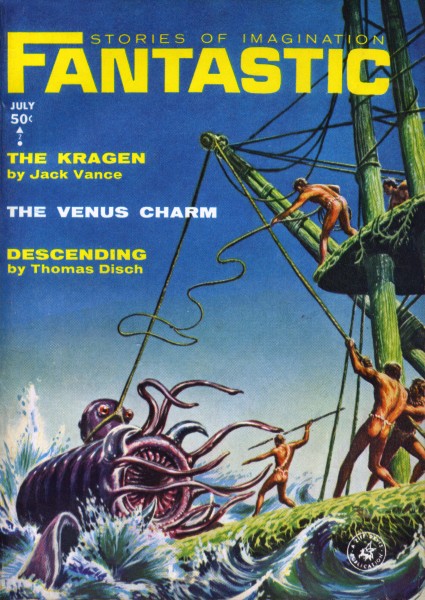

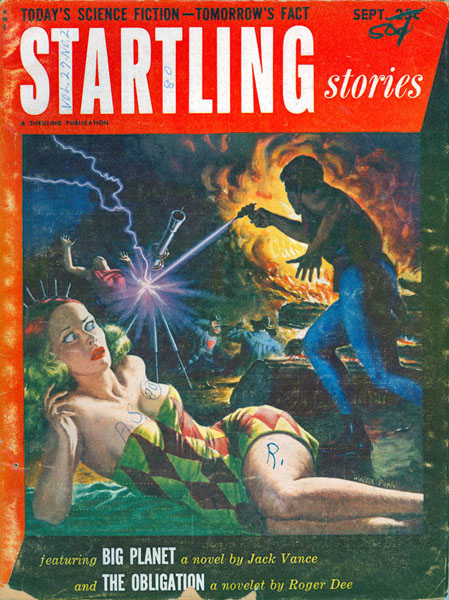


 Science Fiction & Fantasy Remembrance