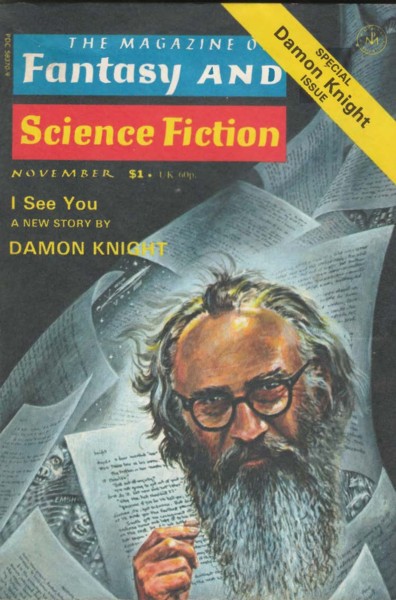
Sometimes the topics for these editorials can venture into “serious” territory, but this one is rather frivolous, being about a little footnote in genre history that nobody living today thinks about—probably not even the likes of John Clute. At the same time it’s such an odd footnote that I had to turn it into a thousand-word essay, so sit back and enjoy your coffee while I talk about one of the most important figures in old-timey American SF and how he, if not mostly for circumstance, could’ve been a very fine magazine editor on the level of Ed Ferman or even Anthony Boucher. There were brief spots in the ’50s, in fact, when Knight got the chance to flex his editing muscles—only he got the plug pulled far too early.
Knight, as you know, started out in the ’40s as a critic—arguably the first serious critic in American magazine SFF. He was a bratty 20-something who made no bones about his opinions, and it was also clear that he was a little more “literary” than the average bear, which would put him in the same boat as Brian Aldiss and fellow Futurian James Blish. Reviewers in the field at the time were sometimes accomplished writers who turned to reviewing, such as Boucher and P. Schuyler Miller, but Knight was a reviewer who then turned to writing fiction—almost as a way of proving that he could do himself what he wanted other writers to do. While his criticism is not what Knight is now most known for, he did win a special Hugo in 1956 for his book reviews, and no doubt his astute breaking-down of other people’s work led him to be just as demanding with his own fiction.
Knight’s success in fiction was not immediate, but 1950 would see two of his most famous short stories in print: “Not with a Bang” in the Winter-Spring 1950 issue of F&SF, and “To Serve Man” in the November 1950 issue of Galaxy. These are not works of great depth, but they are memorable and quite functional, being written very much in the O. Henry mode wherein we’re given a setup and a twist payoff in the span of ten pages or less. Knight would write more ambitious stories in subssequent years, but it can’t be denied that 1950 was a watershed year for him—and not just for his most remembered stories. Working as an assistant under Ejler Jakobsson, Knight got a first taste of what editing a magazine was like with the revived Super Science Stories, and this experience seemed to encourage him to strike out on his own and make a magazine in his own image.
Still only 27 when he would’ve begun work on Worlds Beyond, Knight got to start his new magazine with Hillman Periodicals, who, at a time when the SFF magazine market was about to explode, wanted a hit as soon as possible and had no patience when they didn’t get it. Worlds Beyond hit newsstands in November with the December 1950 issue, and for a first issue its contents certainly catch one’s attention. On top of original works by Fredric Brown, Mack Reynolds, C. M. Kornbluth, and future detective fiction heavyweight John D. MacDonald, we have reprints by a couple unusual names such as Franz Kafka and Graham Greene. Knight’s policy with reprints at first looks like he’s taking a cue from F&SF (which had quite a few reprints at the outset), and he probably was—but the choice in authors is telling. Whereas Boucher and McComas picked pre-pulp authors who generally were known for supernatural fiction, Knight picked authors who are not usually associated with genre fiction.
There was another reprint in the first issue of Worlds Beyond that should catch one’s eyes: Jack Vance’s “The Loom of Darkness,” published earlier that year in The Dying Earth as “Liane the Wayfarer.” Vance was still pretty early in his career, and The Dying Earth initially saw very little attention, being a small collection of connected fantasy stories that really did not read like anything else at the time; but clearly Knight was enamored with it. That issue of Worlds Beyond no doubt introduced some readers to the Dying Earth series. Vance would appear again in the February 1951 issue with “Brain of the Galaxy,” reprinted thereafter as “The New Prime.” Another author who clearly appealed to Knight was fellow Futurian C. M. Kornbluth, who also appeared in two of the three issues—although that latter appearance was reprints rather than original fiction.
Worlds Beyond obviously took after F&SF to a degree, but whereas F&SF started out as a “classy” genre outlet with more emphasis put on supernatural fantasy (it was indeed The Magazine of Fantasy initially), Knight was not afraid to print fairly pulpy science fiction if the actual writing—the substance of the work—met his standards. There was about a 50/50 split between original fiction and reprints, and for something that lasted only three issues there’s a disproportionate amount of notable work here, such as Vance’s “The New Prime,” Kornbluth’s “The Mindworm,” Judith Merril’s “Survival Ship,” William Tenn’s “Null-P,” and Harry Harrison’s debut story (he was already active as an illustrator) “Rock Diver.” Knight also ran the book review column for each issue, which makes sense considering he was already perfectly qualified for that job—and anyway Knight’s reviews are often informative, if caustic. This all seems like a recipe for success.
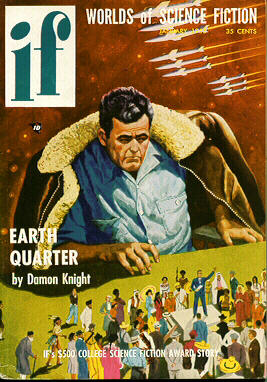
Worlds Beyond might’ve prospered, or at least survived until the market crunch of 1955, if not for Hillman Periodicals seeing the lackluster numbers for the first issue and immediately pulling the plug. The second and third issues were already being printed when the magazine got the ax, so we’re lucky enough to have three issues instead of just one. Still, it must’ve been a blow for Knight, as he would not return to magazine editing for nearly a decade—but thankfully he would return, if only for a short while again. It’s a bit of an odd coincidence that Knight edited two magazines in the ’50s and they both lasted only three issues under his watch; no more, no less. Of course, If was a reasonably ssuccessful magazine before Knight came along and it would persist long after he left, being something of a chameleon, changing colors depending on who’s running the show—for better or worse. Genre historians often make note of how If reinvented itself under Frederik Pohl’s editorship, but its transformation under Knight was almost as radical, as we’re about to see.

For most of the ’50s If was a second-tier magazine that sometimes published very good fiction but otherwise had little to distinguish itself. It began as a pet project for James L. Quinn, published by Quinn’s own company and with him as the editor for most of the decade. If‘s quality under Quinn fluctuated depending on who was working as Quinn’s assistant (i.e., doing much of the heavy lifting) at the time, but in 1958 Quinn let go of the reins (mostly) and gave them to Knight, so that while Quinn still kept an eye on things as the publisher, Knight suddenly had more control of the magazine than if he was “just” an assistant. As with Worlds Beyond, Knight also ran the book review column, which shouldn’t surprive anyone.
The October 1958 issue was the first to have Knight’s name on it, and if we’re being honest it’s a pretty weird issue on its face, just going by the theme. Yes, the October 1958 has a shared theme between the stories, although this was appearently done after the fact (the authors had no intention of their stories connecting somehow) and it was Quinn’s idea, not Knight’s. The idea was that we would get a chronology—let’s call it a future history—of mankind and space flight. It’s an obnoxious gimmick that didn’t actually amount to anything of substance, but there are still a few notable pieces here, including works by A. Bertram Chandler, one of the first stories by Richard McKenna (sadly gone too soon), and one of Cordwainer Smith’s more famous stories, “The Burning of the Brain.” Smith’s piece was part of a future history, but not the cobbled-together one that the issue proposes; instead it’s part of his Instrumentality series.
Something to keep in mind about Smith is that up to this point he had only appeared a few times in the magazines, with his work being a little too eccentric and ambitious for most editors at the time. Indeed his debut story as an adult, “Scanners Live in Vain,” took about five years to see publication, and only then in an obscure little semi-pro called Fantasy Book. Fred Pohl would later take an immense liking to Smith, even calling first dibs on all his work and printing most of it in the ’60s—but before Pohl there was Knight, who must’ve gobbled up whatever Smith had on hand, since every issue of Knight’s If had a Smith story. McKenna also appeared in all three issues, first under “R. M. McKenna” and then under his full name. Other big names include Fritz Leiber, Algis Budrys, Margaret St. Clair, Philip K. Dick, and even an early appearance from David R. Bunch, who would later become much associated with the New Wave.
A rule of thumb with magazines changing editors is that it takes several issues for the new boss to carry about their policy, since they would have a backlog of purchased stories to deal with and, after all, Rome was not built in a day. What’s impressive about Knight’s If is that in only three issues, the magazine was reshaped to fit Knight’s rather quirky parameters, becoming wholly his own by the second issue. The standard of the fiction had gone up, certainly, but combining that with Knight’s review column and his obvious bias with certain authors, I have no doubt that had If kept going like this for even another year or two it could’ve easily surpassed Galaxy, which at this particular point in time was not putting out its best work. H. L. Gold, at one point the finest editor in the field by a considerable margin, had become noticeably fatigued by the end of the ’50s, letting Pohl do a considerable amount of the heavy lifting for him before giving him the reins in light of a car accident that left Gold physically disabled.
Knight would have continued raising the bar for If, but Quinn saw a lack of profits for the magazine and decided to sell it to another publisher, and Knight did not come with the package. It was a loss even more arbitrary than the axing of Worlds Beyond—nothing more than cutthroat publishing industry nonsense. Knight went back to writing fiction, even trying his hand more earnestly at writing novels (not his strong suit), while If skipped what would’ve been the April 1959 issue before returning with the July issue, this time under a worn-out Gold as editor. For those keeping track it must’ve looked like If was on the verge of shutting down unceremoniously before returning in a somewhat regressed state; it would not come even close to the forefront again for several more years. But for a brief moment—all too brief—we got a glimpse of a magazine that started as one step above pulp that could’ve been a real contender.
The experience, of course, was not a total loss: Knight would return to editing again—only this time it was for books, not magazines. The first volume of Orbit appeared in 1966, with Knight expressing a noble mission statement of publishing science fiction that likely would not see print in any of the magazines—fiction that was too experimental, too mature, too literary for magazine editors (in the US, anyway) to touch. The plan worked. The Orbit series saw some very fine work by voices who probably would not have prospered in the magazine market at the time, including Kate Wilhelm, R. A. Lafferty, and most importantly of all, Gene Wolfe, who wrote such memorable stories as “The Fifth Head of Cerberus” and “Seven American Nights” with Knight as both editor and coach. The Orbit series proved the validity of both the New Wave and original anthologiess as an alternative market, and while it did occasionally print nigh unreadable garbage, Knight’s achievement here is hard to overstate.
With that said, I do occasionally think about what we lost…

 Science Fiction & Fantasy Remembrance