I’ve been in a bit of a rut recently, or rather I’m facing another bout of depression and lethargy when it comes to writing. I considered tackling something serious, but while we will no doubt get to a serious topic one of these days, such a thing requires more time and effort than what I’m currently able to afford. It’s also been a few months since I last did an Observatory piece. I have to admit I’ve slackened a bit when it came to this department. As such, you can think of this editorial as a warm-up exercise; if nothing else it should provide some food for thought. It’s actually a topic that’s been lingering in the back of my mind for a long time now, as like one of those fun little “what if” scenarios that you would not seriously contemplate, but rather would return to occasionally and twist and turn like a safety valve in your mind. It’s something to do as a distraction while there are some serious problems afoot.
I write about what I think of as the big three fantastic or unrealistic genres, those being science fiction, fantasy, and horror, as opposed to genres that historically rubbed shoulders with realism, namely Westerns and detective fiction. Nowadays I tend to read realistic or “literary” fiction (with some nonfiction thrown in there) in my free time a lot more often than genre fiction, in part because I wanna keep my efforts as a reviewer/blogger at least somewhat segregated from my efforts purely as a reader (I know people who review genre fiction for a living who, because of the time and effort required for the job, barely read anything except genre fiction, and that’s not the way I would like to live), but also I must confess I do often enjoy reading literary fiction more than genre fiction. Of course, the line between those two can be pretty blurry. A literary novel can have genre elements, and as you know I’ve reviewed works by authors on this very site who are typically found in literary and not genre spaces: Graham Greene, Robert Graves, G. K. Chesterton, to name a few. You have people like Jack London who are known primarily for their literary fiction, but who also wrote a good deal of genre fiction; and because for some the term “science fiction” hadn’t been coined yet, there was no effort to separate literary from genre. How do you put something in the SF ghetto if “SF” is not a label in your lexicon? But now that the label does exist, and has existed for almost a century at this point, some lines have been drawn in the sand.
Realistic or literary fiction is really an umbrella that could encompass practically every other genre, but only rarely does a work of genre fiction find its way into the literary canon; and in the case of SF, the number of SF works to worm their way into literary spaces is very small. You have 1984, Brave New World, Fahrenheit 451 and The Martian Chronicles, Frankenstein, the early novels and stories of H. G. Wells, The Handmaid’s Tale, and more recently the works of Octavia E. Butler. With the notable exception of Butler, whose reputation has been heightened to almost an extreme in the years following her death, you may notice that the SF works to have entered the so-called literary canon are the usual suspects. Also, with the exception of maybe Frankenstein, these are works that are far more revered for their historical and/or societal importance than for their literary merits. SF that enters literary spaces has historically been treated as more useful than beautiful, as more of a societal good than as an aesthetic achivement. There’s also the problem that SF, at its core, its unrealistic, which is to say it does not and cannot depict the highs and lows of society as they exist in the current year; it can extrapolate on society as it currently exists (and often does), but that’s not quite the same thing. Meanwhile a realistic novel typically tries to capture some facet (or maybe multiple facets) of current (or past, if it’s a historical novel) society. But as I said, a realistic novel can have traces of SF or even fantasy (we tend to call examples of the latter “magic realism,” which rather smacks of whimsy, but it’ll have to do) in its blood, but the genre element is not the focal point.
This brings us to the question of the Great Novel, by which I mean what is typically considered a country’s defining literary achievement. The Great Novel, for a given country or culture, is a work which ideally, through scope and attention to detail, captures a certain time and place with as much fullness as the author could manage. The Great Russian Novel is War and Peace, the Great French Novel is Les Misérables, the Great English novel is Middlemarch or Vanity Fair, and even Ireland has its clearly designated Great Novel with Ulysses. The Great American Novel is more up for debate, to the point where Wikipedia has a rather long list of candidates: to name some (but not all) we have Moby-Dick, The Great Gatsby, To Kill a Mockingbird, Gravity’s Rainbow, Blood Meridian, Beloved, and Underworld. While they vary greatly in length, subject matter, and perspective, it’s easy enough to understand why each of these novels would be a candidate, since they aim to be nothing less than a definitive look at a certain time and place with a certain point of view. Moby-Dick is “the definitive” novel on whaling and American port towns, The Great Gatsby is “the definitive” novel on the excesses and follies of the 1920s, Beloved is “the definitive” novel on black Americans’ traumatic relationship with chattel slavery, and so on. Of course I use quotation marks because these novels (except maybe Moby-Dick, which really did seem to close the door on whaling culture as far as representation in fiction goes) are by no means the only or ultimate statements on their respective subject matter. Also, a novel need not necessarily be of a certain length (The Great Gatsby is a mere 180 pages, after all) to tackle its subject properly, although length does help. The point is that these novels, in both scope and substance, give one an impression of a whole place or culture over a certain period of time.
In genre SF, there didn’t seem to be any concern about writing The Great SF Novel up until at least the 1950s, which makes sense considering the market restrictions of the time (the average SF novel at this time clocked in at about 200 pages or so) and the fact that SF criticism was in its infancy. The field, by the end of the ’50s, had barely crawled out of the primordial slime that was the height of the Campbell era, in which low-paying genre magazines dominated and getting published in hardcover or even in a mainstream magazine was considered the highwater mark for one’s career. In 1950, to be an SF writer and have your story printed in The Saturday Evening Post was basically the most you could hope for. But by the ’60s there was clearly a change in the air, perhaps incentivized by the magazine market shrinking; there were only a half-dozen or so genre magazines active in the US by 1960, such that it would no longer have been viable to make a living just writing short fiction at a mile a minute. Authors turned to writing novels, and it didn’t take long for there to not only be more novels as original paperback releases (and also hardcover), but some of these novels were quite big for the time. Even in its original cut-down form, Stranger in a Strange Land clocked in at just over 400 pages, which would’ve been nigh unthinkable just five years earlier. To think, 400 pages that’s mostly just people talking about sex, religion, cannibalism, and whatnot. The usual. The gambit paid off, though, with Robert Heinlein winning a Hugo for it and with Stranger in a Strange Land becoming one of the most popular SF novels of the ’60s, even gaining a mainstream readership. That Stranger is a huge and overwhelming book, tackling several topics with reckless abandon and often in exhaustive detail, did nothing to halt its sales figures.

Stranger was not Heinlein’s first mainstream success, for he already had several stories published in The Saturday Evening Post and a whole series of juveniles in a deal with Scribner’s, but Stranger (published by G. P. Putnam’s Sons) showed that an SF novel didn’t have to be just about one or two things, but could in fact have an almost encyclopedic thoroughness while still being a bestseller. In other words, the dam broke. The impact was not immediate, by throughout the ’60s there came a laxing attitude on publishers’ parts towards long and epic SF novels—some of which even threatened to have literary ambitions. I was doing a cursory search of essays and blog posts done on the idea of the Great Science Fiction Novel, and I basically found nothing, at least so far, which is weird to me because it’s so obvious that some authors in the ’60s going forward clearly wanted to write such a thing, whereas no such ambition seemed to exist beforehand. This is not to say there aren’t great SF novels to come out of the ’50s and early, quite the contrary, but typically the great SF novels from prior to the ’60s had scope or depth—not both. Meanwhile, by the end of the ’60s we had gotten Dune, Stand on Zanzibar, The Man in the High Castle, The Left Hand of Darkness, Heinlein’s Stranger in a Strange Land and The Moon Is a Harsh Mistress, and a few others I could name. Dune was so big that it originally appeared at two separate serials, totally eight installments, and it certainly feels like it. Frank Herbert famously had to go to Chilton to have Dune published in book form, with Chilton not being an SF or even normally a fiction publisher—not that this stopped Dune from selling enormously well. Dune, even being the first entry of a wide-spanning series, is a mind-numbing study of a fictional planet and its ecology, and how mankind might be able to live in such a hostile environment. Herbert’s novel was, at the time of its publication, the most ambitious and plausible hard SF (despite nowadays being marketed as akin to fantasy) novel on the market.
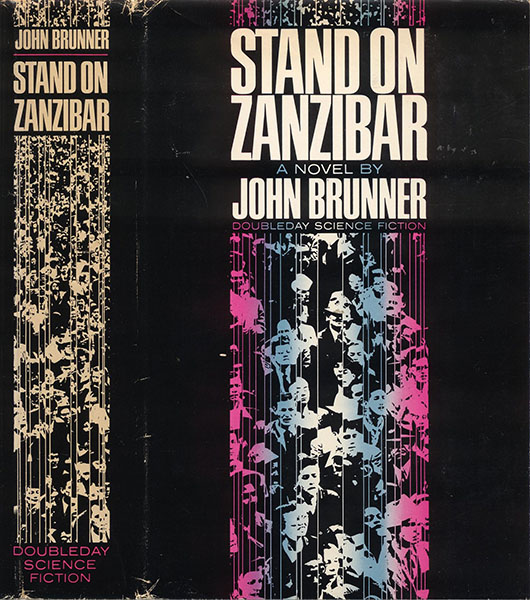
Did Heinlein and Herbert intend to write the Great Science Fiction Novel at the time? I’m not sure. I can think of at least one person who did, though. Clocking in at just under 600 pages, not too crazy by today’s standards but a real mammoth of a book for SF in 1968, John Brunner’s Stand on Zanzibar consciously takes cues from Modernist literature, to the point where it can be considered a late Modernist novel as much as an SF novel. Brunner was known for quantity rather than quality, even writing a few short low-effort novels during the time that he was working on Stand on Zanzibar, which probably made this novel’s scope and complexity come to most if not all readers as a shock. Here we’re presented with a 2010 that is both in some ways similar and dissimilar from the 2010 we actually lived through, in which the world is overpopulated, people are overstimulated, there seem to be mass shootings and terrorist threats every week, there are computers small enough to fit comfortably in one’s home, and it seems to also be the only SF novel of the era to not assume that the Soviet Union would survive into the 21st century. There’s a main storyline, but it’s interspersed with vignettes featuring unrelated characters, as well as advertisements and news stories that give us an idea of what is going on this strange new world. It’s an incredible read, if also exhausting and rather cold-hearted by design. Brunner really transcended himself with it, and the effort paid off—to an extent. Stand on Zanzibar won a Hugo, and remains in print to this day, but was not exactly a bestseller. Brunner wrote a handful of big novels about big topics, including The Jagged Orbit and The Shockwave Rider, but the effort he put into these novels did not result in sales figures to match. Ironically the person who at the time strove the hardest to write an all-encompassing all-consuming SF novel on par with a Moby-Dick or a Ulysses garnered inadequate reception for it, compared to what Heinlein and Herbert were able to accomplish.
The average SF novel remained compact, on average, for a while, but you still got outliers (or abberations, if you hate long novels) with varying degrees of commercial success, not to mention success as attempts at being the Great Science Fiction Novel. The ’70s saw what might be the closest we’ve gotten to a synthesis between the Great American Novel and the Great Science Fiction Novel, in at least two instances: Gravity’s Rainbow and Dhalgren. Thomas Pynchon and Samuel R. Delany, the authors of these respective novels, were borderline prodigies of the form (Delany was 19 when he wrote his first novel), are both of the silent generation, both owing a clear debt to the Modernists, and both being arguably the most fit for taking on the task of writing an enormous and challenging literary novel that could also be taken as science fiction.
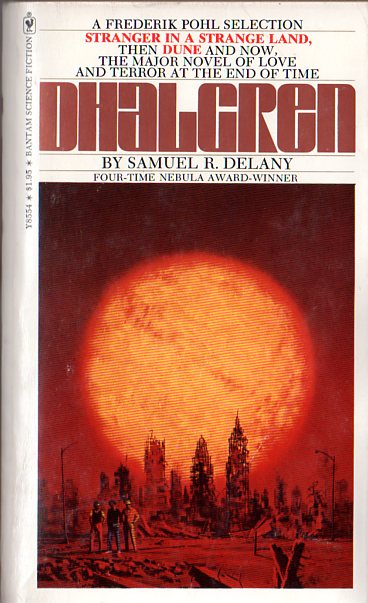
Gravity’s Rainbow is… a lot of things. There’s something about a big mind-controlled octopus. Something about a young American having been trained from infancy to anticipate the locations of rocket strikes with his penis. Something about the end and immediate aftermath of World War II in Europe. Something about the extinction of the dodo. There’s a young witch (she says she’s a witch) in training. Totally mind-boggling novel, in that it’s a war novel, a kind of perverted nightmare, a stage musical, and also science fiction. It’s also 760 pages, published by The Viking Press, and was set to win (but was denied) the Pulitzer Prize. It was even nominated for the Nebula for Best Novel, but lost to Rendezvous with Rama. Then there’s Dhalgren, which in hindsight could be argued as the last big attempt at marrying genre SF with “high-brow” literary fiction. Delany pays homage to James Joyce pretty blatantly from the outset, to make it clear to us that this is a Serious™ novel. Well, it’s not that serious. Dhalgren is sort of a hangout novel, in which not much happens, but rather in which the isolated city of Bellona comes alive with quite a few memorable characters. As with Gravity’s Rainbow there’s a pornographic element to it. It’s also a goddamn beast in terms of length, clocking in at 879 pages in the original Bantam paperback edition. When Dhalgren came out in 1975, there wasn’t anything else quite like it in the field, and there also wouldn’t be anything like it thereafter. These two novels sold well, but got extremely mixed reactions, with Dhalgren also being up for a Nebula but losing to the relatively short and conventional (but very good, let’s be clear here) The Forever War.
Folks have typically considered the Nebula to be the writer’s award, which makes sense since it’s members of the SFWA basically voting on each other’s work, and professional authors are presumably more literarily knowledgable than readers. The Nebula going to Rendezvous with Rama and The Forever War over Gravity’s Rainbow and Dhalgren respectively however implies an aversion to works that might be considered too literary. Indeed, in the world of SF, much of the ’70s would be spent on doing away with much of both the good and bad parts of the New Wave while also co-opting just enough of it to give the pages of Analog a PG-13 and occasionally even an R-rated level of spiciness. The New Wave gave us some really bad literature; actually I would say 90% of New Wave SF was bad, but then, to paraphrase Theodore Sturgeon, 90% of everything is bad. At the same time, the New Wave years saw a collective sentiment that great SF that should also be Great Literature™, which is how we even got something like Stand on Zanzibar, or Delany’s earlier novels. The backlash to the New Wave caused SF to swerve in a retrograde direction. As Jonathan Lethem puts it in his article, “The Squandered Promise of Science Fiction”:
Fearing the loss of a distinctive oppositional identity, and bitter over a lack of access to the ivory tower, SF took a step backward, away from its broadest literary aspirations. Not that SF of brilliance wasn’t written in the years following [the ’60s], but with a few key exceptions it was overwhelmed on the shelves (and award ballots) by a reactionary SF as artistically dire as it was comfortingly familiar.
This is not to say great SF novels weren’t published after Dhalgren, obviously, or indeed after The Forever War, which may be the field’s equivalent of The Red Badge of Courage. But at least for a while after, it’d be hard to think of an SF novel that tries even inadvertently to be the Great Science Fiction Novel, which is to say a novel which is both unquestionably SFnal and which also depicts a fullness of human existence as seen in the likes of Stand on Zanzibar and even The Moon Is a Harsh Mistress. There’s Gene Wolfe’s The Book of the New Sun, although it’s a setting that can be easily confused for fantasy—a mix of SF and fantasy that Wolfe deliberately invokes. There’s Neuromancer, which is a sprawling mix of SF and detective fiction, but which nowadays strikes me and some other folks as pretty close to unreadable. There’s Cyteen, which is quite large and even won a Hugo, but I have to admit I’ve not gotten around to it yet. If there’s something like a modern candidate for the Great Science Fiction Novel the problem is that either the novel leans too heavily into SFnal territory or it’s simply a literary novel that happens to have a pinch of SF about it. I could be missing something, of course, and I’d be curious to see if anyone can bring up candidates for the Great Science Fiction Novel post-1975. I don’t read that much recent SF, and even for the sake of my blog I only tackle something like that occasionally; you could say I’m biased in favor of the classics.
 Science Fiction & Fantasy Remembrance