Who Goes There?
I’ve only read a few stories by Dennis Etchison, but it’s clear to me that a) he was a genuine student of the horror game, and b) he was part of that generation of writers who could not have imagined much success pre-1970, but who in the ’70s found a reasonable niche. Etchison never found mainstream success like Stephen King or Anne Rice, or even brushed with it like Peter Straub, in no small part because he wasn’t much of a novelist. Totally random, but he did write some film novelizations in the ’80s, including, of all things, a novel adaptation of Videodrome. (His first original novel didn’t come out until 1986, with Darkside.) But Etchison was clearly much more about the short story (as any horror fan should be), evidenced by both his sizable short fiction output and the fact that he was a pretty respected anthologist of other people’s work, winning the World Fantasy Award more than once as an editor. Etchison’s fiction encapsulates a kind of desolate Americana, in some parts exploitation cinema and other parts a byproduct of beatnik culture, as today’s story tells us. “The Smell of Death” is a slice of eerie Americana, a creeping horror story with a touch of science fiction, written during a time when the space race had already reached its climax and public interest was waning.
Placing Coordinates
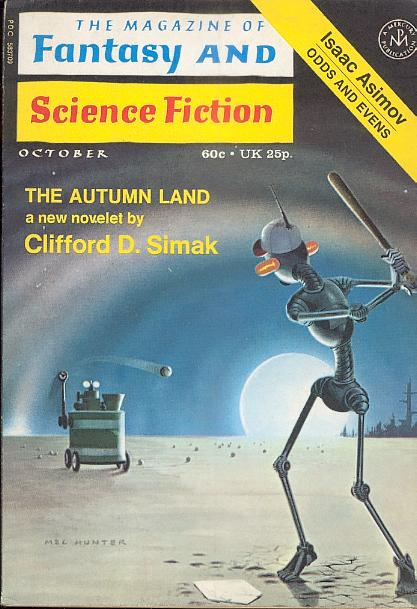
First published in the October 1971 issue of The Magazine of Fantasy and Science Fiction. It’s been reprinted in English only once, in the Etchison collection Red Dreams.
Enhancing Image
A family is at a gas station, in the middle of nowhere, with a daughter in the back seat. The young girl is dying, as it becomes clear to the man the parents consult, “the man from the diner,” although the man doesn’t say this out loud. Why the parents ask for this man’s help and why they trust him to take care of their daughter is unclear, but we’re also told there’s no hospital for dozens of miles. The man, whom we learn is called Raven (this is certainly not to be taken as his real name), looks over the girl, who seems unaware of what is happening, her eyes forced shut by the sickness. Then something strange happens, in the it’s not clear, from how it’s phrased, if Raven is smelling the girl’s infection or is exhaling an infection of his own when he’s close to her. It doesn’t matter. He deliberately displaces a nerve in the girl’s neck and she dies, seemingly peacefully, as the parents don’t notice what has happened; as far as they know the man has been a help. “He hoped it would be a long time before they checked the back seat.” Etchison intentionally omits some context for this opening scene, and it doesn’t help that it doesn’t tie in directly with the rest of the plot; but it does succeed at introducing a creepy idea, that there’s a killer lurking on the highway, maybe California or maybe Nevada, but somewhere in the desert. Of course, Raven turns out to be not quite who we think he is.
What this story lacks in complexity, or even human character, it makes up for with character of a different sort: a kind of desolate beauty that would later be realized in Bruce Springsteen’s Nebraska, the movie Paris, Texas, and the works of the late Denis Johnson. Also some of Stephen King’s work. In the years following World War II and the rapidly growing suburban sprawl of the ’50s there seemed to be a much increased interest in highways, and places between towns and cities. Liminal spaces. Diners and gas stations on the side of the road, every which way distant from civilization. Incidentally Raven works at a diner and gas station; how he does this, what hours he works, where he lives, I’m not sure. I’m not sure Etchison thought this situation through entirely, and it only raises more questions the more we find out about “Raven” and his strange ability. Etchison would’ve been only 26 or 27 when he wrote this, and while he had been published several times before (“The Smell of Death” wasn’t even his first appearance in F&SF), I sense a lack of care for internal logic, the how and why of things, that normally would indicate a young writer who’s still growing into their shoes. Oh well, this is more about the vibes anyway. Fun fact, I actually read this story in its entirety twice before writing my review—not because I thought it was that good (it’s fine), but because I was convinced I had not picked up on enough things the first time worth talking about. I thought maybe I had missed something, when really I was just soaking in the flavor of the thing more the second time around, when I wasn’t take notes.
After the incident with the girl, Raven meets up with an unnamed reporter, a young guy who claims his car broke down a pretty long walk from here, and he needs a lift. Raven, understandably, is suspicious about this. The reporter is supposed to be looking for a guy named McCabe, an astronaut who was involved in a very weird and tragic incident some fifteen years ago and who has since seemingly vanished off the map. There was a test run for a squad of astronauts, for what would be a manned-satellite program, and Houston intentionally cut off communications with the team for 36 hours—the problem being that when those 36 hours were up, three of the four members were dead. A nerve in the neck had been dislocated. “Nerves, pressure points, all that stuff was part of the hand-to-hand training for the men who served in Special Forces in the war in Asia then, which includes McCabe, of course,” the reporter says. So, McCabe was suspected of murder, but before Houston command could do anything he took on a disguise and skipped town. Now, it soon becomes apparent (and also obvious to the reader), that Raven and McCabe are the same person, and that the reporter meeting Raven/McCabe on the road was no coincidence. This raises a few questions, like how McCabe has been able to live on his own for the past fifteen years, and also how nobody has recognized him despite him presumably not changing much physically from how he would’ve looked in what was surely a widely publicized event. Or maybe the government kept it under wraps to an extent. There’s some what I would think is important information Etchison refrains from giving us, which I do think is to the story’s detriment. It’s ten pages and could’ve been fleshed out more.
There Be Spoilers Here
After saving him from a possibly venomous snake McCabe decides to not kill the reporter after revealing his identity—at least not directly. He does try sabotaging the reporter’s car, under the guise of helping him (“It was the first time that he had had to do this, to leave a man to die to insure his own safety.), but this backfires. Why McCabe feels the need to go through this whole process is another unanswered question, since he could’ve just done the nerve trick on the reporter while he had him to himself and without any witnesses. Anyway, while working on the car, McCabe thinks back on what had killed his fellow crewmembers, and what’s curious is that while he had indeed killed them, they were already dying, due to what McCabe suspects was an airborne virus that had found its way into the cabin and to which McCabe was miraculously immune. The very end, however, as McCabe lies dying with his arm trapped under the lopsided car, implies that he was in fact the one carrying the virus—that he had at some point become contaminated and is immune to it because he’s the one spreading it. Or the whole “smell of death” thing could just be metaphorical. It could be that McCabe merely put his team members out of their misery, as they were dying of something he was not responsible for, and that he’s not been exactly a murderer but someone who “eases” people through their final moments. His one conscious decision to kill, this being the case with the reporter, leaves him at best with a severed arm at the end.
A Step Farther Out
Like I said, it’s fine. I’ve read better Etchison, although I can see how it has the right mix of horror and SF to fit in F&SF‘s pages. There’s a bit of violence but not much; it’s a lot more a character study, about a man who survived war, then a freak accident as an astronaut, and who seems cut off from the rest of society. It’s about as tragic as it is creepy, but it has the rough edges of a talented author’s early work.
See you next time.

 Science Fiction & Fantasy Remembrance