March was a bit of a marathon here at SFF Remembrance, but truth be told I had more fun writing about that very old and dusty science fiction than in the past few months. I had been suffering from fatigue, along with some real-life stuff that was getting to me and making it hard to sleep at night. Now I feel somewhat rejuvinated. I feel good enough about reviewing stuff here again, in fact, that I’m bringing back the two-short-stories two-novellas deal, although I’m still keeping it to one serial for the month. The serial in question is a three-parter, being the first appearance of one of the most important SF novels ever written—and yet one that has been totally lost to the sands of time. You might find references to The Skylark of Space if you’re a Star Wars fan, as a point of trivia, since it was this novel that in part invented the space opera subgenre. Edmond Hamilton was writing space opera at shorter lengths around the same time Smith made his debut, but there was nothing on the scale of Smith’s novel before it. Smith “revised” it for its eventual book publication, removing co-author Le Hawkins Garby’s contributions, but we’ll be reading it as it appeared in Amazing Stories. This was a long time coming for me.
For the dates of stories, we’re looking at one from the 1920s, two from the 1950s, one from the 1960s, and one from the 1990s. Both of the stories from the ’50s are from the first half of that decade, which was an incredibly productive period for magazine SF.
For the serial:
The Skylark of Space by E. E. Smith and Lee Hawkins Garby. Serialized in Amazing Stories, August to October 1928. When Smith studied chemistry at the University of Iowa, he didn’t think he would later become one of the pioneering authors of space opera. He didn’t even think he would write fiction, until he talked science fiction with Lee Hawkins Garby and her husband, who were friends from college. This was in 1915, before “science fiction” had even been coined as a label. The Skylark of Space took some years to gestate, but when it appeared in 1928 it made Smith a sensation among the then-niche SF readership. Garby’s contributions were later removed when the novel appeared belatedly in book form.
For the novellas:
“Half-Past Eternity” by John D. MacDonald. From the July 1950 issue of Super Science Stories. Fans of classic crime fiction will be familiar with MacDonald, at least by reputation. His Travis McGee series is one of the most prolific and widely read detective series ever. In 1972 he was given the Grand Master Award by the Mystery Writers of America. He also wrote a good deal of SF from the late ’40s through the early ’50s, along with nearly every other genre.
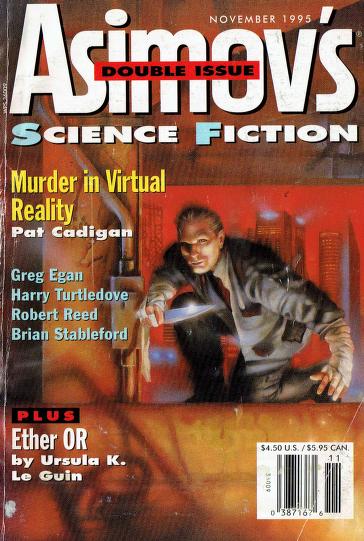
“Death in the Promised Land” by Pat Cadigan. From the November 1995 issue of Asimov’s Science Fiction. It was first published in the March 1995 issue of Omni, but that magazine had gone purely online by that point and the Asimov’s printing marked its first physical appearance. Cadigan is arguably the queen of cyberpunk, going back to the ’80s. She’s not as famous as William Gibson or Bruce Sterling, but she really should be more read than she is.
For the short stories:
“Dumb Martian” by John Wyndham. From the July 1952 issue of Galaxy Science Fiction. It’s surprising to think that Wyndham had made his SF debut in the early ’30s. His career peak came later than it does with most authors, since he was deep in his forties when The Day of the Triffids was published. The ’50s were a great time to be John Wyndham, between his novels and short stories.
“Timberline” by Brian W. Aldiss. From the September 1961 issue of The Magazine of Fantasy and Science Fiction. This is the fourth installment in Aldiss’s Hothouse series, which was then published as a novel. The series of stories, rather than the novel version, won Aldiss a Hugo, which was certainly a confusing move. It’s been almost a year since I reviewed the last Hothouse story, so here we go.
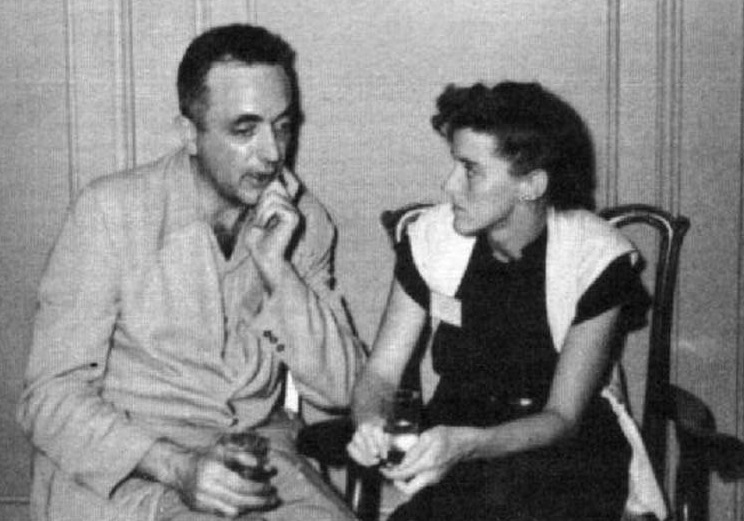
(Fritz Leiber and Katherine MacLean at the 1952 Worldcon.)
When you read and review old science fiction as a hobby, at some point you have to ask a certain question: “How come so many of these authors from fifty to a hundred years ago, who if fan letters are to be believed were seen as giants in their day, are obscure now?” This inevitably leads to some really boring follow-up questions, such as “What belongs in the science fiction literary canon?” and “Can there even exist such a canon in the first place?” These are boring questions in themselves, if only because they’re so old that the questions have crow’s feet and grey hairs, but they do at least imply something about SF literature that is arguably unique to it, which is that, far more than with fantasy or horror, the SF “canon” is fluid. There are exceptions, but even these exceptions (which I’ll get into) are far from immune to criticism, especially from younger fans, to the point where even the most rock-solid canonical author’s reputation could erode to the point where they’re, at best, considered something of a sore subject. We actually see this happening with Robert Heinlein and Isaac Asimov in real time, and I think it’s only a matter of time before Arthur C. Clarke’s reputation takes a serious hit—more for what seem to be a few skeletons in his closet than the importance of his writing. The reality is that the people (well, usually men) most influential in the development of SF as its own genre are only human, which is a diplomatic way of saying that these people have issues. That SF fandom has been, in all honesty, more proactive in recent years about how it should deal with canonical works and authors than some others is a testament to the fandom’s—and by extension the genre’s—ability to adapt to changing circumstances.
Of the genres that involve fantastic or supernatural events, SF is the youngest, the most rebellious, and the most likely to question its own masters. Unlike fantasy and especially horror, which are (in my opinion) implicitly conservative genres in that they’re prone to defending the status quo against all sorts of change (the oldest fear, as Lovecraft puts it, is fear of the unknown), SF at least ideally wants the status quo to be shaken and even shattered. There’s a reason why most notable works of dystopian and utopian fiction are SF and not fantasy: they look on the status quo that is our world and cast either a hopeful or pessimistic light, or in the case of something like Ursula K. Le Guin’s The Dispossessed, a cautiously optimistic light. The single most famous work of fantasy (at least of the 20th century), The Lord of the Rings, is ultimately a story wherein the good guys bring back the status quo as much as they’re able to; it’s a story about a “rightful” monarch returning to the throne that he very obviously “deserves.” Yet perhaps its closest SFnal equivalent, the Dune series, shows the other side of the coin, wherein a young ruler-to-be fulfills a prophecy and the results are catastrophic. Frank Herbert had his own issues, namely his homophobia, but his staunch ambivalence towards authority figures clashes with Tolkien’s belief that there’s a “correct” ruler and that the status quo is something worth fighting for. SF, at its core, is about rejecting authority, which makes the considerable swath of conservative SF fans a bit perplexing. It might be more accurate to say SF is all about changes, whether they be for good or ill. In horror especially, though I love that genre dearly, pretty much any change that comes the protagonist’s way is to be taken as a threat; but for SF this is not so. The question is, then, what do you do with a genre that’s always changing? Or rather, what do you do with its relics?
When E. E. “Doc” Smith made his debut in 1928 with The Skylark of Space, it changed what was possible, for nobody had ever seen a spacefaring adventure of this scale before. “Space opera” was not even in our lexicon yet. There’d been stories about traveling beyond Earth, for example going to Earth’s moon, but there wasn’t anything in SF up to that point that was on the same scale of what Smith was doing. Soon what seemed like a one-off thing at first became a series, and then came the Lensman series, and then the rest was history—up to a point. From the tail end of the ’20s to his death in 1965, Smith was immensely popular with SF fandom; and yet he remained totally unknown outside of that ultimately small pocket of readers. When Smith died, the wind did not change direction, nor did the sun shine any less bright, nor did the seas wax and wane any differently. There used to be people who loved reading E. E. Smith, but they’re all dead now. His work stands now as a bunch of museum pieces, I would say for the simple reason that he was not a good writer; he was innovative, but that’s not the same thing as being good, although we have a bad habit of thinking a work of art must be good to also be innovative. When Alexei and Cory Panshin wrote The World Beyond the Hill: Science Fiction and the Quest for Transcendence, a big Hugo-winning book that took over a decade for them to write, they felt the need to defend Smith, for fear that his reputation was going down the shitter, which it was. The World Beyond the Hill came out in 1989, and since then the SF world has very much moved beyond Smith. This is a case where someone was treated as canonical by the end of their life, only to gather dust and at times derision for decades afterward, for the straightforward reason that the author’s work does not hold up to modern scrutiny. Time has been unkind to E. E. Smith and some others of his ilk.
So someone loses their canonical status because they’re simply not that good a writer. It happens. But then what happens when you have someone who by all rights should retain that canonical status, yet who nowadays is somewhat and unjustifiably forgotten? There are too many examples of such a phenomenon to list. I said before that SF is prone to questioning its masters, as well as doing a good job of tossing aside work that no longer rings as good or true; yet SF is equally prone to forgetting its best. One of the most glaring examples of this has to be Fritz Leiber, whose fantasy work is still in print, albeit not that easy to find, but whose SF has been relegated to the museum. I’ve written about Leiber enough here already so that I don’t wanna repeat myself too much, but it’s hard to overstate, from the late ’30s until close to his death in 1992, how game-changing Leiber was. Not only was he an innovator in heroic fantasy, his Fafhrd and Gray Mouser series even getting parodied in Terry Pratchett’s Discworld series, but he was one of the finest wordsmiths of his generation when it came to SF, fantasy, and horror. Indeed he’s one of the few authors who handled all three genres with more or less equal craftsmanship. He won multiple Hugos, both during his life and also one or two Retro Hugos, and he’s also one of the few people to be a Guest of Honor at Worldcon more than once, in 1951 and again in 1979. Yet nowadays you’d be hard-pressed to find Leiber’s books, even at your local used bookstore, with many of his books straight-up being out of print. If Amazon and Goodreads numbers are anything to go by (and admittedly you should take a pinch of salt with those sources), barely anyone today reads Leiber. This is rather hard to justify. Mind you that the man was not perfect, between his alcoholism and at times messy relationships, and the fact that not everything he wrote was good (The Wanderer is enough proof of that); but surely he deserves better than this.
Sometimes an author falling into obscurity has nothing to do with the quality of their work or the moral fiber of their character; actually if anything we’ve learned that you can be a real piece of shit as a human being and millions of people will still read your books. (We really have to confront people more aggressively on why they feel justified supporting J. K. Rowling in any way.) It seems to me that losing canonical status has at least as much to do with bad timing, or circumstances beyond the author’s control, as it does with the author’s own actions. It could also have to do with the fact that SF fandom today is almost unimaginably larger and more varied in its makeup than even a few decades ago. Being hot shit among SF readers in 1980 does not carry the same weight as being hot shit among SF readers in 2025, because now there are so many more people from different backgrounds who read SF regularly. Fans tolerated or didn’t even know about Asimov’s harassing of female authors and fans when he was alive, but rest assured he would not be able to get away with such foolishness today. This is a good thing, mind you. We’re doing a much better job of holding each other accountable now than before. This then presents another problem, though. How do you rescue works and authors who once had canonical status from oblivion? Another problem is, what do we do with authors who nowadays are elder statesmen? Will someone who is considered a big deal today still be remembered in another twenty-to-thirty years? Will we forget about Ted Chiang, or John Scalzi, or Martha Wells? Will there be some invisible executioner with a line of riflemen, ready to take aim and fire? Who gets to be remembered? How much control do you have over your own legacy? One can certainly do a thing or two to demolish your own chances at being remembered (or at least remembered fondly), but securing said reputation might as well be left up to the directions of the wind.
When August Derleth and Donald Wandrei founded Arkham House in 1939, it was for the express purpose of preserving Lovecraft’s works, by way of giving them fancy hardcover editions. Lovecraft had died in 1937, in poverty and as an obscure figure in the grand scheme of American letters, and there was a pretty good chance he would’ve retained that obscurity (at least for a while) if not for Derleth and Wandrei’s efforts. Arkham House soon expanded its scope and brought other authors from the Lovecraft circle into book form, giving them similarly needed facelifts. Now Lovecraft is recognized as one of the most important writers of the 20th century, even getting a Library of America hardcover volume collecting his most essential work, and “Lovecraftian” horror is synonymous with cosmic horror. Yet there are other authors, like Henry S. Whitehead and Frank Belknap Long, whom Derleth and Wandrei had rescued temporarily, only to still languish in obscurity decades later. Someone with resources might come along to dig up your work after you’ve died and give it the “proper” treatment, but that doesn’t necessarily mean you’ll be canonized posthumously. There are too many factors going into one’s own assessment as a writer. I know this is a very “boomer” opinion to have, even though I’m only turning thirty this year, but it seems to me that people around my age who are earnest about SF are, in questioning the supposed masters of yore, too quick to throw the baby out with the bath water. As a fan myself there’s not much I can do about this, but at least I’m trying here.
(Cover by Leo Morey. Amazing Stories, January 1934.)
Who Goes There?
There were once people who loved reading E. E. Smith, but they’re all dead now. Even at the time of his own death in 1965, Edward E. Smith was something of a dinosaur, albeit one treated with reverence within SF fandom, even if he remained totally unknown outside of it. Smith, as you might know, was perhaps the chief innovator of space opera; when his debut novel, The Skylark of Space, was serialized in 1928, there was nothing else quite like it on the market. The closest for comparison would have been Edmond Hamilton’s Interstellar Patrol series, but there was nothing on the scale of what Smith was doing. Unfortunately, to cop a line from Alexei and Cory Panshin’s review of The Best of Stanley G. Weinbaum, time has long since swallowed up what were once Smith’s virtues—an assessment that I think befits Smith a lot more than Weinbaum, for the record. You can still read and enjoy Weinbaum just fine, assuming you’re not of the sort that requires your SF to be dead serious; but with Smith, even if one were to keep an open mind, it can be a real challenge. Smith just wasn’t a good writer, sad to say, really in any sense of the word, except he did have a sixth sense for scale and action, mostly in the depths of space. Even Hamilton, Smith’s closest contemporary, holds up better to modern scrutiny, especially since he did end up evolving with the times, whereas Smith did not. Thus we have someone whose work strikes even the most retro-friendly of modern SF readers as a museum piece.
Why did I pick Triplanetary as my first Smith to cover here, then? The novelty of it was tempting. You see, along with the Skylark series there was the even grander Lensman series, which occupied Smith for much of the ’30s and ’40s. Smith didn’t see any of his novels get published in book form, however, until after the end of World War II, by which point some of these novels had not seen the light of day since they ran as serials more than a decade earlier. When Smith took hold of Triplanetary for book publication he revised and expanded it so as to make it almost unrecognizable from its serial version, to the point that whereas the serial version of Triplanetary is a standalone novel, the book version was retrofitted to be a prequel entry in the Lensman series. The book version is also about 1.5x the length of the serial version. The two are so different that they have separate ISFDB pages. Like I said, it’s the novelty of the thing.
Placing Coordinates
Triplanetary was serialized in Amazing Stories, January to April 1934. Smith had apparently hoped to sell it to Astounding, but that magazine went through a change in both editor and publisher, not to mention it’d gone on hiatus for about six months. The serial version of Triplanetary would remain stranded there for more than seventy years, until it was transcribed for Project Gutenberg in 2007. A few small publishers have since made this version of the novel available in book form, making sure to differentiate it from its book counterpart.
Enhancing Image
The space liner Hyperion is going on its merry way—or maybe not so merry, as the crew is aware that two ships from the Triplanetary League have gone missing in this part of space recently. Not destroyed, but simply vanished without a trace. (The Triplanetary League is a coalition of Earth, Mars, and Venus, from that distant time when Venus was thought to be hostile to human life, sure, but theoretically livable.) Conway Costigan is First Officer of the Hyperion, but also a member of the Triplanetary Secret Service, so he’s like if Spock and Jason Bourne were the same guy. Unfortunately, a pirate must’ve snuck aboard ship and taken on a disguise, as there’s an outbreak of Vee-Two gas, which incapacitates the crew. Costigan only has enough time to save himself and a single passenger, Clio Marsden, getting them into a lifeboat and reviving her. Costigan explains to Clio that Vee-Two is strictly forbidden, something she apparently already knows. (There’s quite a bit of dialogue wherein characters explain things to each other that they already know.) “The penalty for using it or having it is death on sight. Gangsters and pirates use it, since they have nothing to lose, being on the death list already,” says Costigan. Looking into Smith’s works, the death penalty was something he was just really keen on, to the point where he seemed to support its use even for drug dealers—a view that I wanna say has not aged well, but it looks like modern American conservatives are about as enthusiastic about capital punishment. History doesn’t repeat, but it does rhyme. Costigan heads back into the bowels of the Hyperion to track down the pirate, with a gas mask, space armor, and a nifty weapon on a tripod that’s so powerful that it not only jibs the pirate but turns him into a cloud of mist. This scene, the strongest in the installment, understandably provides the image for Leo Morey’s cover for the issue.
You can accuse Triplanetary of a lot of things, but it is certainly not slow in its pacing, unless you’re talking about the book version. I’ve gathered that the biggest change Smith made was that he wrote six chapters of backstory to pad out the beginning of the book version, working mainly to wedge Triplanetary into the Lensman continuity. I don’t know how anyone is supposed to survive a single chapter of lore written by E. E. Smith, let alone six. The serial version, for all the bad writing on display, wastes the reader’s time as little as possible. In the course of three chapters we’re introduced to the hero, the (probable) love interest, the villain, and what’s at stake. Speaking of which, when it looks like the Hyperion’s troubles are over, the crew is taken hostage by a ship that appears to be invisible, with Costigan, Clio, and Captain Bradley meeting face to face with the owner of an artificial “planetoid” (listen, it’s not the Death Star, got it?), named Roger. Yes, Roger. That’s his name! We know this is about as old-school a space opera as you can get because tractor beams are mentioned. Roger is a mad scientist, although he considers himself not to be mad but perfectly calm and collected; indeed he doesn’t do a Bond villain laugh or anything like that, but rather is calculated in his malice. Even his threat to rape Clio (I suspect it’s implied rather than explicit because of censorship) is stated in so many words, rather than bluntly put. Much of Roger’s workforce is also robotic, rather than flesh-and-blood people, despite what the pirate in the first chapter would make us believe. Thankfully Costigan, being a badass secret agent, has a plan for getting at least himself and the others out of prison. They escape, thanks to some tech that somehow Roger’s goons were unable to detect, but their victory is short-lived as there turns out to be yet another villain, apparently alien, even bigger of a threat than the mad scientist.
Oh, it’s bad.
Putting his ridiculously bland name aside, Roger’s actually not a bad villain. Smith doesn’t bother much with describing his characters physically, but he does give Roger special treatment:
Not only was [Roger] dressed entirely in gray, but his heavy hair was gray, his eyes were gray, and even his tanned skin seemed to give the impression of grayness in disguise. His overwhelming personality radiated an aura of grayness—not the gentle gray of the dove, but the resistless, driving gray of the super-dreadnaught; the hard, inflexible, brittle gray of the fracture of high-carbon steel.
Mind you that this all happens, with Costigan and company getting attacked by pirates and then introduced to Roger, in the first chapter. If the book version of Triplanetary suffers from being too slow, as in frontloaded with exposition, then the serial version might have the opposite problem. And yet, despite having breakneck pacing, Smith still finds room to insert dialogue that is, let’s say redundant. For example Roger spends rather too much time saying, indirectly, that he plans to make a sex toy out of Clio, if only because she’s apparently too slow on the uptake to get his point. A common criticism I’ve seen when reading about Smith is that his characters don’t talk like real people, or even people you’d read about in SF published a decade later, but almost like old-school comic book characters. It’s writing in the old pulp tradition, although even within that context I’d still say Smith is more stilted than, say, Edgar Rice Burroughs, who for all his faults went out of his way to not irritate the reader unless one thought about his racism or dodgy science too deeply. Three chapters in and we have one character who feels like he has real presence, except Roger turns out to not even be the greater-scope villain, if the third chapter’s anything to go by.
There Be Spoilers Here
My eyes started glazing over towards the end, although I’m not sure how much of that was the quality of the novel and how much was the awful mood I’ve been in lately. I’ll let you know.
A Step Farther Out
On the one hand I believe that once I start writing about a serial then I really ought to finish it, as I probably will in this case. I’ll be honest with you, though, it’s been rough going already and we’re only a quarter into it. Maybe I just like Smith as a writer; something about him, aside from his obvious faults, bugs me. I tend to be generous with old-timey SF, even of the pre-Campbell sort, but this might be the threshold for me. But, it’s also possible that this is as bad as it gets.
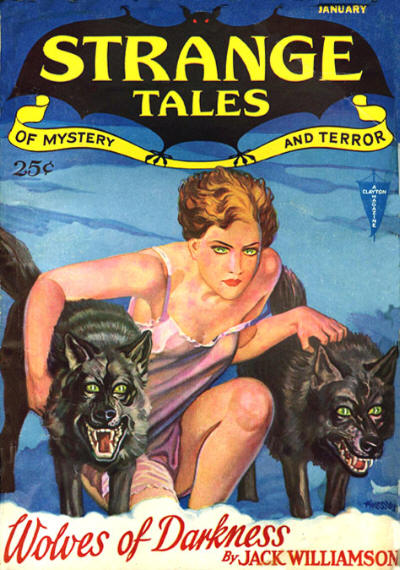
(Cover by H. W. Wesso. Strange Tales, January 1932.)
My schedule is not what it used to be, although I’m not sure if that’s my new living conditions, work slowly growing down on me, the real-world turmoil happening just outside of view, or some combination. I used to run this blog as a way of escaping temporarily from the drudgery of my everyday existence, between my job and living with my parents; but since I moved out four months ago, the scales have shifted in balance quite a bit. Writing for this blog no longer feels like an escape, but just more work that I have to do. I must write every couple days or else… what? What would happen if I took a break for, say, a month? Most likely my skill at writing would wither, if only a bit. Writing is like any other skill in that if you don’t do it for long enough then you sort of forget how to do it in the first place. It’s why I always find it amazing whenever an artist, be they a writer, filmmaker, musician, or whatever, takes a hiatus from the craft, then returns years later, seemingly out of hibernation, as if nothing had happened. Do you think Terrence Malick had to remember what it’s like to direct a movie when he was making The Thin Red Line, or if Robert Fripp, after not playing guitar for a couple years, had to refamiliarize himself with the damn thing when recording for David Bowie’s “Heroes”? Really this mindset can be applied to any skill, even one as worthless and solitary as writing.
I just remembered a depressing thought I had the other night, during one of my shifts, which is that I might be witnessing the death of human creativity in my lifetime. I’m not talking about creativity on an individual level, since I think it’s obvious that so long as humankind exists there will be artists, probably living on the margins, for the same reason there will always be Palestinians and Kurds and Chechens and what have you. I’m talking about a collective resentment towards creativity that has, at least in the US and UK, been building up since the Reagan and Thatcher years, if not earlier. Fascism, be it Christofascism or neo-liberalism of the Reagan-Clinton sort, is at its core a rejection of the human mind’s ability, indeed its incessant urging, to grow and progress. There is a Freudian return-to-the-womb desire inherent in fascism, except on a systemic level. The fascist wants to stop the future from happening—not a good or bad future, but the future as a concept. You can at least give the Chinese credit for envisioning a future, although if we’re being honest it’s a rather bleak one. In a more just world “AI” would be used only to make soul-crushing labor easier to stomach for human workers, but instead the right-wing technocrats who have increasingly gotten a stranglehold on government and commerce think such incredible technology should rather be used for kneecapping the human imagination. It’s possible that in just a decade or two the artist will be treated like how drug addicts and the homeless are treated today, which is to say the artist will be treated in the mainstream as at best a nuisance and more often as a threat to “the status quo.” We are undoubtedly on the path to that conclusion, and really it’s been a long time coming.
So what can I do? I talk a lot about art and artists, because I’m of the firm belief that without art human existence is really not worth it. Evelyn Waugh said that without God human existence is “unintelligible and unendurable.” I mostly agree with that sentiment. I write about art, even bad art, even the pulpy stuff, because I think there must be some value in it, and because God knows there isn’t much value elsewhere. Speaking of which, I decided it’s been too long since I last covered material from the pre-Campbell years that isn’t from the pages of Weird Tales. (I can’t help it that on average Weird Tales aged a lot better than its SF contemporaries.) So, I’m doing something a bit different this month. The serial, along with both novellas, will be from the pre-Campbell ’30s. I’m also finally checking the E. E. Smith box off my list, although not by reading a Skylark or Lensman novel but a standalone that caught my eye if only because of its convoluted publication history. The two short stories are from lady writers, one of whom you might’ve heard of if you’re really into crime fiction, while the other is totally obscure. See, the news is not all bad. Spring is finally here, and while my allergies may be kicking in I’m no longer freezing to death.
I’ve done enough yapping. What will I be reading? We have three stories from the 1930s and two from the 1950s.
For the serial:
Triplanetary by E. E. Smith. Serialized in Amazing Stories, January to April 1934. Smith was immensely popular in SF fandom during his lifetime, and yet despite a few attempts to resurrect his reputation he has since then been relegated to something of a sideshow attraction. Along with Edmond Hamilton he was one of the pioneers of space opera, with his novel The Skylark of Space especially laying the groundwork for future entries in that subgenre. The magazine version of Triplanetary was a standalone novel that Smith later retooled so as to make it a prequel in the Lensman series.
For the novellas:
“Proxima Centauri” by Murray Leinster. From the March 1935 issue of Astounding Science Fiction. I actually don’t remember if I’ve read this one before, so I’m counting it as a new read. Anyway, Leinster is curious if only because he’s one of the few writers from the Gernsback era to survive the coming of Campbell; not only that, but he actually hit his creative peak in the ’40s and ’50s.
“Wolves of Darkness” by Jack Williamson. From the January 1932 issue of Strange Tales. Williamson had one of the longest careers of any writer, inside or outside of SF, debuting in 1928 and remaining active until his death in 2006. “Wolve of Darkness” stands out as, if I remember right, getting Williamson his single biggest paycheck for a story up to that point, as he says in his autobiography.
For the short stories:
“The Pilot and the Bushman” by Sylvia Jacobs. From the August 1951 issue of Galaxy Science Fiction. This is now the third time I’ve nabbed a story from this issue of Galaxy. I unfortunately have next to nothing to say about Jacobs since we know basically nothing about her, not even when and where she was born. She wrote a handful of SF stories in the ’50s and ’60s and then vanished.
“The Muted Horn” by Dorothy Salisbury Davis. From the May 1957 issue of Fantastic Universe. This is a case where looking at an author’s ISFDB page can be deceiving, since going by it one would think Davis wrote very little; but actually she was a prolific crime novelist, and was even President of the Mystery Writers of America when she wrote this story, which is apparently horror.

 Science Fiction & Fantasy Remembrance