Who Goes There?
I have to admit, I fucked up. I was supposed to write about Leslie F. Stone’s “The Human Pets of Mars” for today, except I realized that it was too long to cover as a short story. It’s actually a short novella, and for some reason I had assumed it was shorter. A replacement would have to do. Fret not, I’ll be writing about Leslie F. Stone in the not-too-distant future. I figured that instead I should go for something “safe,” maybe something I’ve read before but haven’t in a while. I was then reminded of Edmond Hamilton’s “Devolution,” which I know for a fact I’ve read before, because it’s in the Orson Scott Card anthology Masterpieces: The Best Science Fiction of the Century. Incidentally this is a story with a similar premise to George Allan England’s “The Thing from—’Outside’,” but with a different tone and quite a different ending. Of course, it makes sense to cover Edmond Hamilton in a marathon of pre-Campbell magazine SF, since he was one of that era’s major architects, made even more sensible as he stayed clear of Astounding and found Campbell too picky an editor.
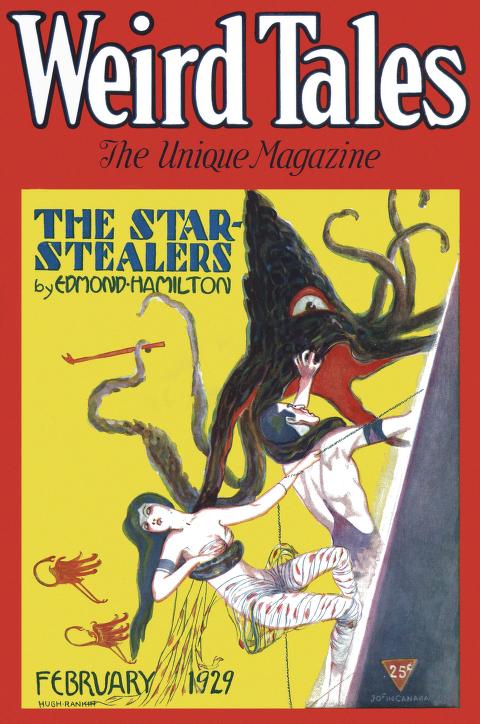
Hamilton was in 1904, in Ohio, although he later moved to Pennsylvania and then finally California. He made his debut young, in the August 1926 issue of Weird Tales, when he was just 21. He stayed committed to Weird Tales even into the post-war years, when that magazine’s popularity was waning, and he was probably its most consistent contributor of SF. Some of Hamilton’s SF was tinged with horror, whether it appeared in Weird Tales or not, in those pre-war years. Some of his early work also codified the space oprea subgenre, alongside the work of E. E. Smith. But while Smith took his space action to greater heights and longer lengths, Hamilton was easily the more capable writer. By 1950, Hamilton had matured into a thoughtful and pretty reliable writer, while Smith was respected as a relic of a bygone age. “Devolution” is pulpier than Hamilton’s later work, for sure, but it also shows a darkness and pessimism regarding the human condition that would appear much later in a more refined style.
Placing Coordinates
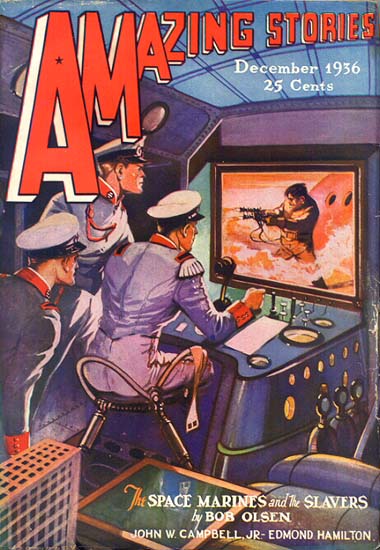
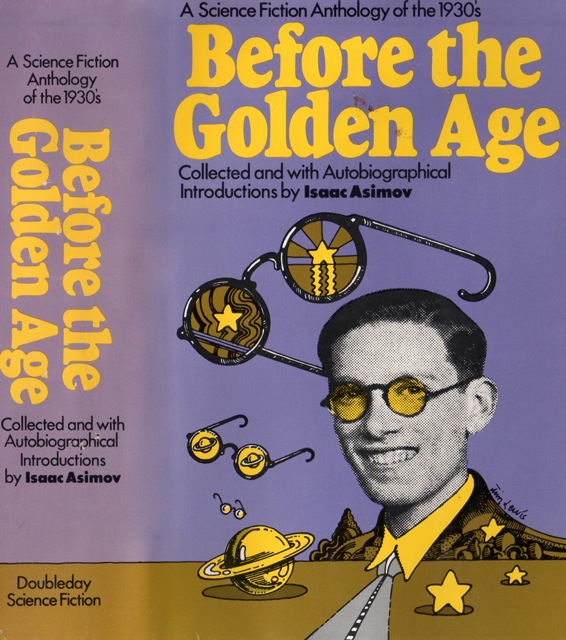
First published in the December 1936 issue of Amazing Stories. I actually have two reprints of this story in my library somewhere, Before the Golden Age (ed. Isaac Asimov) and Masterpieces: The Best Science Fiction of the Century (ed. Orson Scott Card). “Devolution” also has the honor of being reprinted in Amazing Stories as a “classic” more than once, in the April 1961 issue and then in the May 1979 issue.
Enhancimg Image
Ross, an aviator who claims to have seen some very strange creatures in the French-Canadian wilderness, had brought along Gray and Woodin, a couple biologists, with him for this expedition. But it’s been four days of camping and canoeing and so far nothing on these jellyfish-like creatures Ross says he saw from the air one day. Contrary to how the story starts and whose POV we get at first, Ross is not the protagonist here; indeed, him being framed as such is kind of a red herring. Instead the protagonist is Woodin, the older and more even-tempered of the biologists. Not that these three men are all that different from each other in their personalities, but the subversion of the pilot-adventurer not ultimately being the “hero” of the story is the first of a few ways in which Hamilton goes against what would’ve been pulp reader expectations. The setting, a forest in Quebec, also seems ripe for adventure, but ultimately this is not an adventure narrative, as there won’t be much in the way of action. The England story I mentioned involves a similar setting, along with an encounter with an all-powerful alien force, but Hamilton goes in a different direction. When the aliens here do show themselves one night, Woodin’s in for quite a surprise.
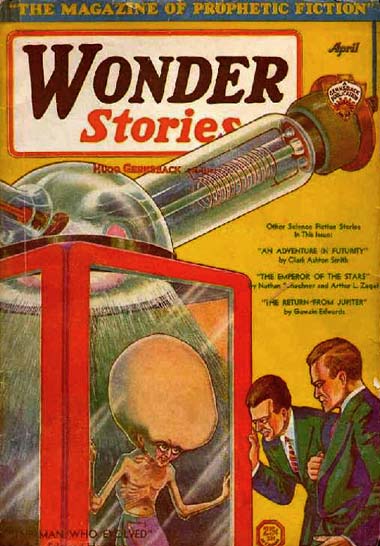
“Devolution” plays with a couple super-science ideas that were making the rounds in the ’30s, and which in fact Hamilton had played with before. The first is the notion that evolution of life on Earth got kickstarted because of radiation, which we know now is very much not true. Hamilton had used this evolution-via-radiation idea in an earlier story, “The Man Who Evolved.” This was all in the pre-war years, when atomic weapons were purely theoretical and SF writers took it upon themselves to devise some strange and implausible uses for radioactive elements. (You may recall that Jack Williamson’s take on radiation’s effect on the human body, in “The Metal Man,” was even more outlandish.) Another super-science idea that would end up having a longer shelf life is the notion of “ancestral memory,” in which the human brain can be plundered for locked-away memories, not just of past human lives but those of organisms predating mankind. The aliens in “Devolution” just so happen to have an easy way of diving into Woodin’s ancestral memories, but more on that in a minute. It’s easier for a modern reader to understand at least the narrative appeal of the latter concept, if not the “science” behind it. “Devolution” deliberately goes against the narrative of Darwinian evolution—yet the alternative it presents is a far cry from what we call Intelligent Design.
Woodin is awakened to find Ross and Gray dead—killed by a group of blobular aliens. These aliens, who call themselves Arctarians, are a salvage team who have come to Earth in search of the fate of some colonists who had come here billions of years ago. The Arktarians are flabby and physically unimposing, but they’re exceedingly intelligent, with enough brain power that they can kill a man (as they just did) with a mere thought. Ross and Gray tried using their guns against the aliens, in a moment of blind fear, but it was no use. The aliens had merely acted in self-defense, for they belief aggression is beneath them. In a way the Arktarians are like Vulcans, but blobular instead of humanoid, with reason and mindfulness having top priority in their culture; at the same time they’re like so many energy beings we find in Star Trek, who have the powers of demi-gods. They can even communicate with Woodin telepathically with ease, which is how we get a massive exposition dump on where the Arktarians came from and why they’re here. There’s also the so-far unanswered question of what had become of those Arktarian colonists, which can only be answered by unlocking Woodin’s ancestral memories. The Arktarians find that Woodin, despite being a scientist and a reasonable man, is stupid and small-brained enough that they can crack his mind open easily.
As you can tell, the outlook of this story is decidedly grim. In fact it wouldn’t be out of place for an H. P. Lovecraft story, and that’s before we even get to the big twist, which itself is rather Lovecraftian. While the Arktarians talk and act in such a way that they may well be super-smart humanoids (think again of Vulcans), they certainly don’t look human at all. They also take Woodin’s wellbeing into account only insofar as his ancestral memories would prove useful to them, for they think very little of having killed his colleagues. Indeed, they think of humans like how we think of mice and other animals in a testing lab. Such an intelligent and competent alien race would surely have a hard time appearing in the pages of Campbell’s Astounding some years later, at least without facing the wrath of an even more competent and ingenious human race. Yet it was not that unusual to find alien races in pre-Campbell magazine SF that were so much more advanced than mankind that we’d struggle to comprehend them. This is all well and good, but the twist Hamilton goes for, while maybe appearing obvious to the reader by now, pushes things over the edge, thus making “Devolution” a memorable story.
There Be Spoilers Here
Digging into Woodin’s mind, we discover that billions of years ago, when Earth was just another rock in the midst of black space, a group of Arktarian colonists had come to our planet, after their homeworld had become degraded. Unfortunately, radioactive materials in Earth’s makeup had a slow-burning degenerative effect on the colonists’ biology. The impact wasn’t immediately, but over the case of many generations and millennia, the super-intelligent and bodily weak aliens’ descendants became dumber and less mentally capable, while at the same time becoming physically adaptive to our planet’s unforgiving climate. Unicellular organisms became multicellular, then these invertebrates formed skeletons and even started crawling onto dry land. Amphibians, then reptiles, then mammals. Evolution, but not as we know it. By the time homo sapiens came around, the brain power the Arktarians possessed had been practically extinguished, giving way to a violent and savage race of primates. Yes, mankind is a distant descendant of these boneless and limbless aliens. The realization disgusts the team of alien explorers, compelling them to abandon both Woodin and Earth as a whole. Our planet, as far as they’re concerned, is uninhabitable. The knowledge that not only is he related to these aliens but is considered a genetic failure by them drives Woodin to suicide.
A shared assumption of both many religious people and those who idolize the hard sciences, albeit for different reasons, is that mankind is the logical end point of a long game regarding life on Earth. For better or worse, homo sapiens is capable of “special” things—things even our closest relatives and ancestors could scarcely begin to fathom. Hamilton, in “Devolution,” posits that mankind might represent an end point after all—just such in a way that means bad news for us. The twist rejects both the implied divinity given to mankind in Intelligent Design and the evolutionary exceptionalism put out by champions of Darwinian evolution. Rather, this is a misanthropic story whose darkness is only cushioned by the awkwardness and weigthy exposition of Hamilton’s style. If James Tiptree, Jr. taken the same premise, plot, whole thing, but recreated it in her image, it would surely be one of the bleakest stories in all of SF. The big reveal even echoes that of Lovecraft’s more famous “The Rats in the Walls.”
A Step Farther Out
In his afterword to Hamilton’s story in Before the Golden Age, Isaac Asimov writes about how teenage him had been impressed by “Devolution,” especially its ending. He writes:
On the whole, I am an optimistic writer, and my heroes generally win out in the end and the world is saved. Yet, for years I had noticed that stories with sad endings, or ironical ones, or paradoxical ones struck me harder than those with conventionally happy ones, and stayed with me longer.
And, every once in a while, it seemed to me that the downbeat was better and was even necessary in my own usually upbeat stories. It was remembering stories like “Devolution” that gave me the courage to try such endings.
Hamilton took a cosmic horror premise, gave it a super-science rationale, and then proceeded to put a little twist on it. Why it stayed out of print for 25 years before appearing in Amazing Stories once again, I’m not sure. It could be that while “Devolution” might’ve gone well with readers had it appeared in Weird Tales, where downer endings are not uncommon, more would’ve appreciated it initially; but in Amazing Stories, the more scientific and optimistic magazine, readers would espect solutions to problems. While Hamilton was no stranger to resorting to formula (he was, after all, the chief creative force behind Captain Future), he was more versatile and had a darker view of the world than most of his peers.
See you next time.


 Science Fiction & Fantasy Remembrance