
Who Goes There?
Carol Emshwiller was one of the most acclaimed short-story writers of her generation, made more impressive because she kept doing good work for about half a century, longer than most authors’ careers. She started in the ’50s, at the tail end of the magazine boom, and kept writing, albeit mostly in the realm of short fiction and never too prolifically, until her death in 2019. She likely would’ve still become a favorite of readers from across a few generations even had she not been married to Ed Emshwiller, but that certainly helped, with Ed even illustrating some of her stories. It was one of those rare marriages where you had two very talented artists, and whose works even sometimes fed into each other. Emshwiller (Carol, that is) was also not an SF doctrinaire, but someone who was open to experimenting with genre boundaries from pretty early in her career, so it makes sense that she was one of the few women to appear in Dangerous Visions. Today’s story is itself very much outside the boundaries of SF, although I hesitate to call it horror as well, even though that’s what it is marketed as. “I Live with You” is a short and simple story that doesn’t easily fall into any genre; if it’s horror then it’s by virtue of the uncanny nature of the relationship between the two women at its center. This is a story that’s meant to be taken allegorically, rather than literally.
Placing Coordinates
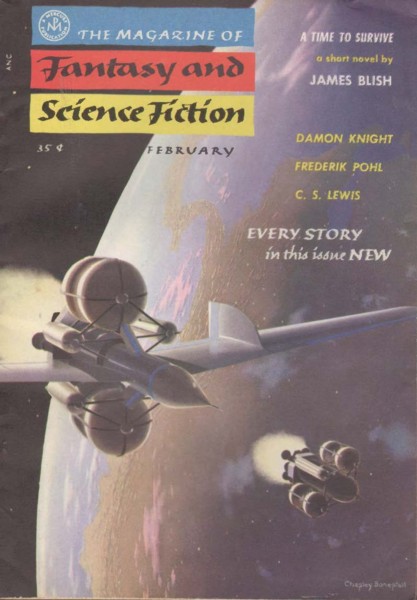
First published in the March 2005 issue of The Magazine of Fantasy and Science Fiction. It’s been reprinted in The Mammoth Book of Best New Horror 17 (ed. Stephen Jones) and the Emshwiller collections I Live with You and The Collected Stories of Carol Emshwiller Vol. 2.
Enhancing Image
The narrator is a ghost, maybe, or perhaps just unhoused lady who has somehow been living off of table scraps, in a book store for a while and in a department store before that. She’s been hiding for who knows how long, but nobody has caught her yet, and as she says, “I never steal.” At least this was the case before she started hiding in Nora’s house. The narrator looks enough like Nora to be her doppelganger, but the two don’t seem to be related. The only other company at this house is the cat, which Nora doesn’t get along with very well, although the little beast takes much more of a liking to the doppelganger. She spends her time in the attic, when Nora is home, but otherwise she has the whole house to herself. It takes weeks for Nora to figure that someone might be intruding, and even then she doesn’t call the cops, but instead has a deadbolt installed for her bedroom door. Nora is so out of it, so passive in her day-to-day life, that she doesn’t even notice when her doppelganger is just one room over from her. The narrator, partly out of pity for Nora and partly as a means of entertainment for herself, figures it’s time for Nora to get herself a man—or rather for the narrator to get one for her. The more pitiable the better. In stories in which a “normal” person meets their doppelganger, the latter is typically more adventurous or mischievous, if not outright evil, and the same holds true here. The disparity is such, in fact, that Nora comes off as the uncanny one in the pair, rather than the narrator, on account of how empty she is as a person. The narrator schemes to bring a man to Nora’s home because she’s frustrated with how dull Nora is. As the narrator says:
At the book store and grocery store at least things happened all day long. You keep watching the same TV programs. You go off to work. You make enough money (I see the bank statements), but what do you do with it? I want to change your life into something worth watching.
There’s the question, firstly, of why the narrator continues to live with Nora if she finds her so boring, and it’s a question she doesn’t answer in any straightforward fashion. There’s also the question (also never quite answered) of what the narrator is supposed to be and why she’s a dead ringer for Nora. There’s something supernatural going on, maybe, but Emshwiller doesn’t care to give us answers to these questions, if for no other reason than that an explanation might distract from the unusual dynamic between the women. As a rule of thumb, good horror (and “I Live with You” is ostensibly horror) should abstain from explaining or rationalizing the horrors of its world. Certainly from Nora’s perspective this ordeal would count as horror, as it uneases her enough to get deadbolts for her bedroom door—for the inside and then, rather irrationally, for the outside. The real question is, who is really the woman living in the attic? Literally it’s the narrator, but she’s so comfortable living in Nora’s house that it’s Nora who comes off as the one living here as an outsider. The narrator comes and goes as she pleases, taking bits and pieces of Nora’s stuff, although it’s always stuff Nora was unlikely to appreciate in the first place.
Things get more interesting once the two women finally meet face to face, and of course it’s by accident. This is in the midst of the narrator’s scheming to have a guy with a gimp leg, named Willard. It’s possibly the most memorable passage in the whole story, if only because of how neatly it illustrates the contrast between the women. As the narrator says, “I’m wearing your green sweater and your black slacks. We look at each other, my brown eyes to your brown eyes. Only difference is, your hair is pushed back and mine hangs down over my forehead.” Worth mentioning that while “I Live with You” is technically a first-person narrative, the doppelganger refers to “you” as if you were Nora, or rather as if she were talking directly to Nora. The reader is meant to be in the place in this plain, unassuming, seemingly empty-headed woman. In a way it makes sense, because who else could she be talking to? If it has to be told in the first person, then making it border on second-person like this makes sense enough. It also adds a touch of creepiness, since the doppelganger, this unnatural person, is talking directly to us, although she means no harm.
There Be Spoilers Here
The threeway(?) doesn’t exactly go well. Willard comes over under the impression that the woman who wrote him the letter was Nora and not the narrator, a confusion compounded because of the ladies’ identical looks. Nora seems to be taken in, though, after some initial fumbling (quite literally at one point, as the narrator trips her on purpose), and it seems like the two might at least be hitting off for a one-night stand. It’s implied that the narrator is here to watch, except that when things do get steamy she’s disappointed by the lack of spectacle. (Given that Emshwiller would’ve just turned eighty, I’m a bit surprised that sex plays as big a factor in this story as it does.) Nora fumbles for the last time, though, and Willard leaves. The narrator also decides to leave at this time, having left Nora traumatized but also a more mature woman than before. I’m actually not sure how old the two women are supposed to be, certainly old enough that Nora has a house and a job; but despite her assumed age, Nora’s implied to possess a certain innocence which by the end of the story has been taken and replaced with something. Maybe something better, who’s to say? Even for full-grown adults there are events in our lives in which we feel like we’ve been compelled, or maybe pushed or shoved violently, into being one step closer to enlightenment. As with the stories of Theodore Sturgeon and Robert Aickman, whom Emshwiller may have been thinking of, the crossing of the shadow-line is framed as traumatic.
A Step Farther Out
“I Live with You” won the Nebula for Best Short Story that year, which is curious, for one because it’s pretty unassuming, but also this was in the sixth decade of Emshwiller’s career. The fact that she had won her first Nebula just a few years earlier is in itself unusual; authors typically don’t write work this solid this deep into their careers. I unfortunately can’t say I agree with the Nebula win for “I Live with You,” but it is a tightly knit and moody story with a feminist bent. It’s hard to write about something that’s both this self-contained and which more or less already speaks for itself, so the only thing I can really do is recommend you read some Emshwiller, especially since her career coincides with much of genre SF’s history, from the pre-New Wave years into the 21st century.
See you next time.




 Science Fiction & Fantasy Remembrance