Who Goes There?
There seemed to be a point in the ’90s when Kathe Koja could lay claim to being the best horror writer in the business, and certainly her output at this time was hard to argue with. She debuted in the late ’80s, as part of a wave of extreme and body-focused horror writers (think Clive Barker), although she also has quite a snarky sense of humor that tends to stop her fiction from becoming a black hole. In the 21st century her output has generally slowed down and she’s turned more to YA, which might partly explain why she has not been given the amount of attention she deserves. In a better world Koja would be awaking millions of readers to her unique style and explorations of the human body’s relationship to the external world, but instead we’ll have to awaken ourselves to her. Unfortunately most of her novels are not exactly easy to find in the wild. “Angels in Love” is a short but finely tuned story, packed with tension and perversion, more of a character study than a conventional horror narrative. This was published the same year as Koja’s first novel, The Cipher, and if you were on the look-out in 1991 it would’ve been hard to deny the talent on display.
Placing Coordinates
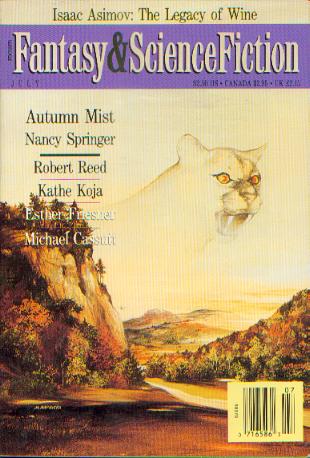
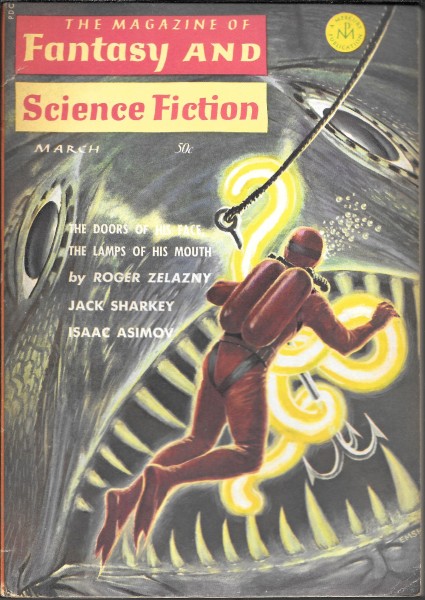
First published in the July 1991 issue of The Magazine of Fantasy and Science Fiction. It’s since been reprinted in The Year’s Best Science Fiction: Ninth Annual Collection (ed. Gardner Dozois), The Year’s Best Fantasy and Horror: Fifth Annual Collection (ed. Ellen Datlow and Terri Windling), The Weird: A Compendium of Strange and Dark Stories (ed. Ann and Jeff VanderMeer), and the Koja collection Extremities. That Dozois reprint is funny considering it’s arguably not SF.
Enhancing Image
The next-door neighbors are being loud, which is not normally something Lurleen would mind—except that the neighbors are fucking. Not the usual kind of fucking, but something more vigorous and yet mysterious. A rhythmic thumping that isn’t bed springs, and she’s not hearing the people’s moans exactly. “Lying there listening, her own bones tingled, skin rippled light with goose bumps, speculation: who made those strange, strange sounds?” It has to be sex. What else could it be? Of course Lurleen is interested, at least in part because she’s bored with her day-to-day life, working at a record store for a boss (Roger) she doesn’t like. Bored and lonely. This was also in the days before high-speed internet, so if you wanted to jerk it as a way of passing the time or to relieve pressure you had to resort to print, film, or your imagination. In this sense “Angels in Love” shows its age, in that it presumably had to take place in a pre-internet world, in the world of the erotic thriller—Fatal Attraction, Basic Instinct, Brian De Palma movies, and so on. The erotic thriller (and “Angels in Love” could be understood partly as an example of such a thing) is a subgenre that basically doesn’t exist anymore, due to a few factors: the availability of online porn, but also moviegoers seem to be more squeamish now than thirty years ago. This is a graphic and indeed borderline pornographic story, but the eroticism is very much there for a purpose, not to mention it helps build tension. There’s a reason the erotic thriller was popular for a while, which is the overlap between feeling horny and feeling scared—the heightened blood pressure and senses being needed for both.
I guess people spying on their neighbors the old-fashioned way, by eavesdropping or using a pair of binoculars, was more acceptable back then. Not to say what Lurleen’s doing is good, but she’s framed such that it’s easy to sympathize with her despite her perversion. After all, she’s clearly lonely and sexually deprived, her boss is a pain in the ass, the men she meets outside of work tend to be pigs. She wants to be desired but not objectified, which almost sounds like a paradox, because how do you present yourself in an interaction as desirable without also becoming a slab of meat to the other party? She knows Roger objectifies her, she knows the clerk at the store objectifies her, she knows the dumb muscle she picks up at bars sees her the same way. But here the tables have turned, as she objectifies her neighbors without even seeing them first—although she soon works to change that. “It came to her that she had never really seen that next-door neighbor of hers.” The girl next door is Anne, and Lurleen is surprised to find that the woman who’s been having such amazing sex (or so Lurleen thinks) is so… boring. Not obnoxious or messy, but bland. Beige. When they finally meet Lurleen is put off by how normal Anne is—so unassuming, actually, that she becomes an uncanny figure. The mystery then becomes with regards to the man Anne is seeing, assuming it’s the same man (and assuming it’s a man, which Lurleen does) every time Lurleen spies on them. So Anne is boring, but then what about the man she’s seeing?
The subtle horror of “Angels in Love” works in two ways: the mystery of the next-door neighbor, but also the lengths Lurleen goes to in finding out her neighbor’s private life. She starts acting in ways that are undeniably creepy, and were she not the perspective character it would be easy to understand Lurleen as a villain. This is not a case of unintended dissonance between the protagonist’s actions and what the reader expects of them, but part of the story’s design. Lurleen is an anti-heroine, and in just a handful of pages Koja makes sure we know this. There’s an especially creepy passage where she takes her eavesdropping to levels that would be considered unacceptable, even by most perverts:
She began to stalk Anne, never thinking of it in so many words, but as sure and surely cautious as any predator. Waiting, lingering in the hallway after work, for Anne to come home from whatever unfathomable job she did all day. Never stopping to talk, just a smile, pleasant make-believe. She made it her business to do her laundry when Anne did hers; at the first whoosh and stagger of the old machine, Lurleen was there, quarters in hand; her clothes had never been so clean; she had to see. Any jockey shorts, bikini underwear, jockstraps, what? She meant to take one if she could, steal it before, before it was clean. Smell it. You can tell a lot about a man.
This is a cosmic horror story ultimately, and we’ll get to that part, but Koja understands that often the scariest thing is human behavior—something that can be found in everyday life, no science fiction or fantasy needed. Lurleen’s growing obsession with Anne and her mystery boyfriend escalates at a rate that makes enough sense and at the same time doesn’t feel rushed, given how short this story is. It has to do with stalking, and getting too interested in other people’s lives, but it also has to do with misogyny, both how the male characters view the women and Lurleen’s own internalized misogyny against Anne, whose only crime is being a “sorry-looking bitch.” She wonders how such an “empty” person could have such a stud muffin in her bed on a regular basis, as opposed to Lurleen’s bed. Because she obviously deserves him more, right? And yet she also wonders, given Anne’s own blandness, “Could a man want a woman to be nothing? Just a space to fill? Lurleen had known plenty of guys who liked their women dumb—it made them feel better—but anyway, Anne didn’t seem dumb, just empty.” Is wanting a woman to be “just a space to fill” at the core of misogyny? Is that what it comes down to? Maybe it’s as simple as that. Maybe Anne is with this mystery man because she’s such easy pray. Lurleen’s about to find out.
There Be Spoilers Here
Cosmic horror is ultimately about the terror of discovering something you shouldn’t have—of fucking around and finding out. Lurleen fucks around and she finds out. In a way the conclusion is totally predictable; if anything it’s a release after the building tension and the escalating of Lurleen’s creepy behavior. We know that at some point this story has to enter SFF territory at some point, and so it does on the final page. During one of their bouts Anne and her boyfriend suddenly stop, seemingly mid-thrust, which concerns Lurleen enough that she rushes over next door to see what’s going on. What she encounters is hard to describe, and there’s a certain degree of ambiguity in the situation. “His body beautiful, and huge, not like a man’s, but so real it seemed to suck up all the space in the room, big elementary muscles, and he was using them all.” Anne’s back is bent at an unnatural angle and some liquid “like spoiled black jelly” is leaking from her mouth. Is she dead? Is fucking what the two had actually been doing this whole time? How long has this been going on? We never learn, and neither will Lurleen, maybe. The creature takes notice of her, and the story ends before we find out what becomes of either of them. We do know that Lurleen has just stepped over a line she shouldn’t crossed, and that she has gained the notice of something whose attention you don’t really want. I do have to wonder if maybe Koja had taken inspiration from Clive Barker’s The Hellbound Heart, or Hellraiser, in making the “angel” of the story a supreme sadist—a supernatural creature whose definition of pleasure includes immense pain. Maybe it was an angel, long ago, but it had gone bad.
A Step Farther Out
I’m not sure what else to say, go read this one.
See you next time.




 Science Fiction & Fantasy Remembrance